AIIMS CRE OPTOMETRY
PRIVIOUS YEAR PYQ’s
On the OPTOMETRY STUDY HUB
whatsapp group channel./Part :- 02/
Scan
here!
● 📚 Free Notes
● 📄 PDF Material
● 🎥 PPT Slides
● 📝 PYQ (Download free)
● 🎯 Daily Practice DPP
● 💡 Concept Explanation
Join our whatsapp channel to get more pyq/dpp/mcq/notes/ppt/ etc.
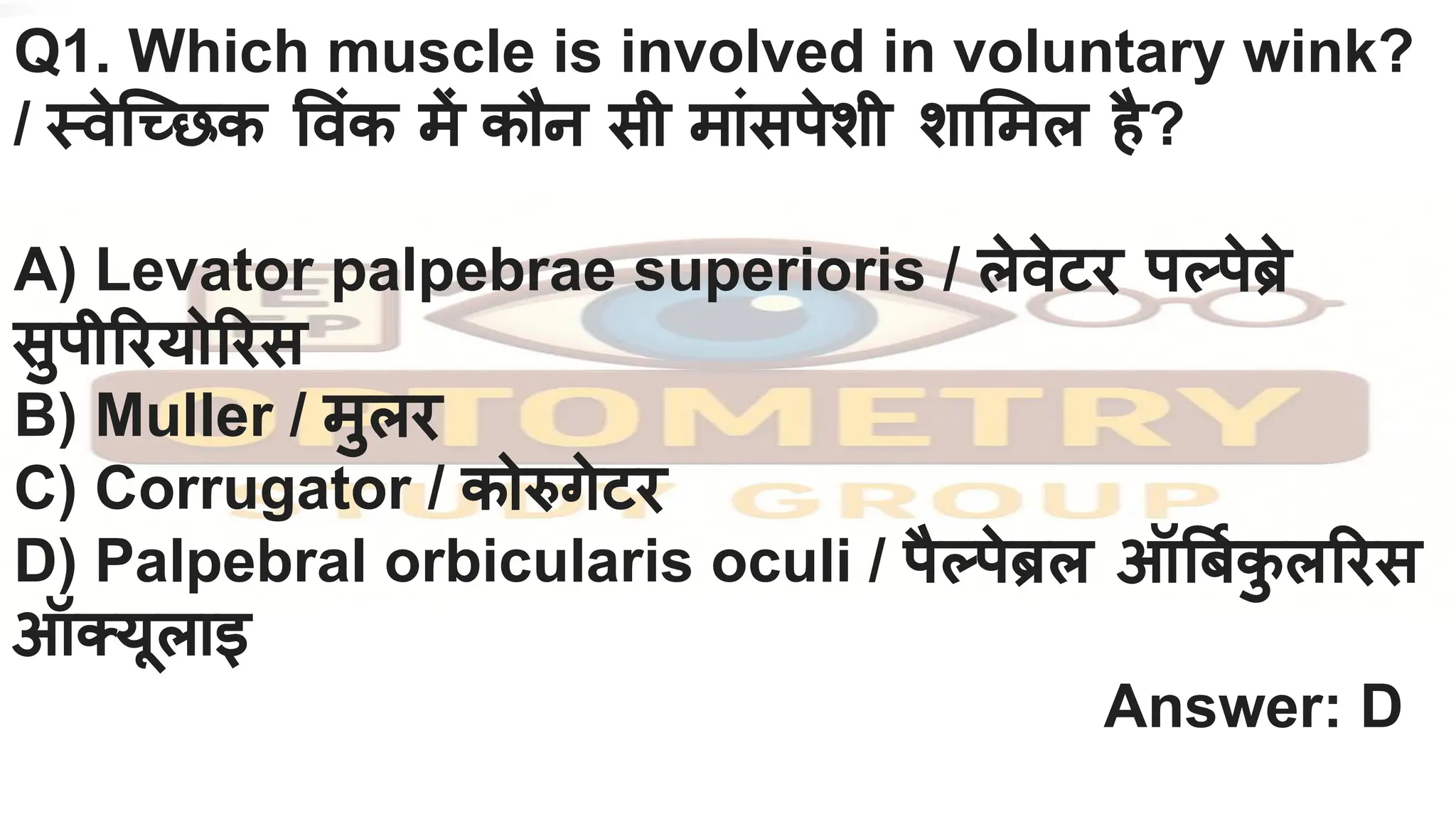
Q1. Which muscle is involved in voluntary wink?
/ स्वेि छक वंक में कौन सी मांसपेशी शा मल है?
A) Levator palpebrae superioris / लेवेटर प पेब्रिे
सुपी रयो रस
B) Muller / मुलर
C) Corrugator / कोरुगेटर
D) Palpebral orbicularis oculi / पै पेब्रिल ऑ बर्निक
ु ल रस
ऑक्यूलाइ
Answer: D
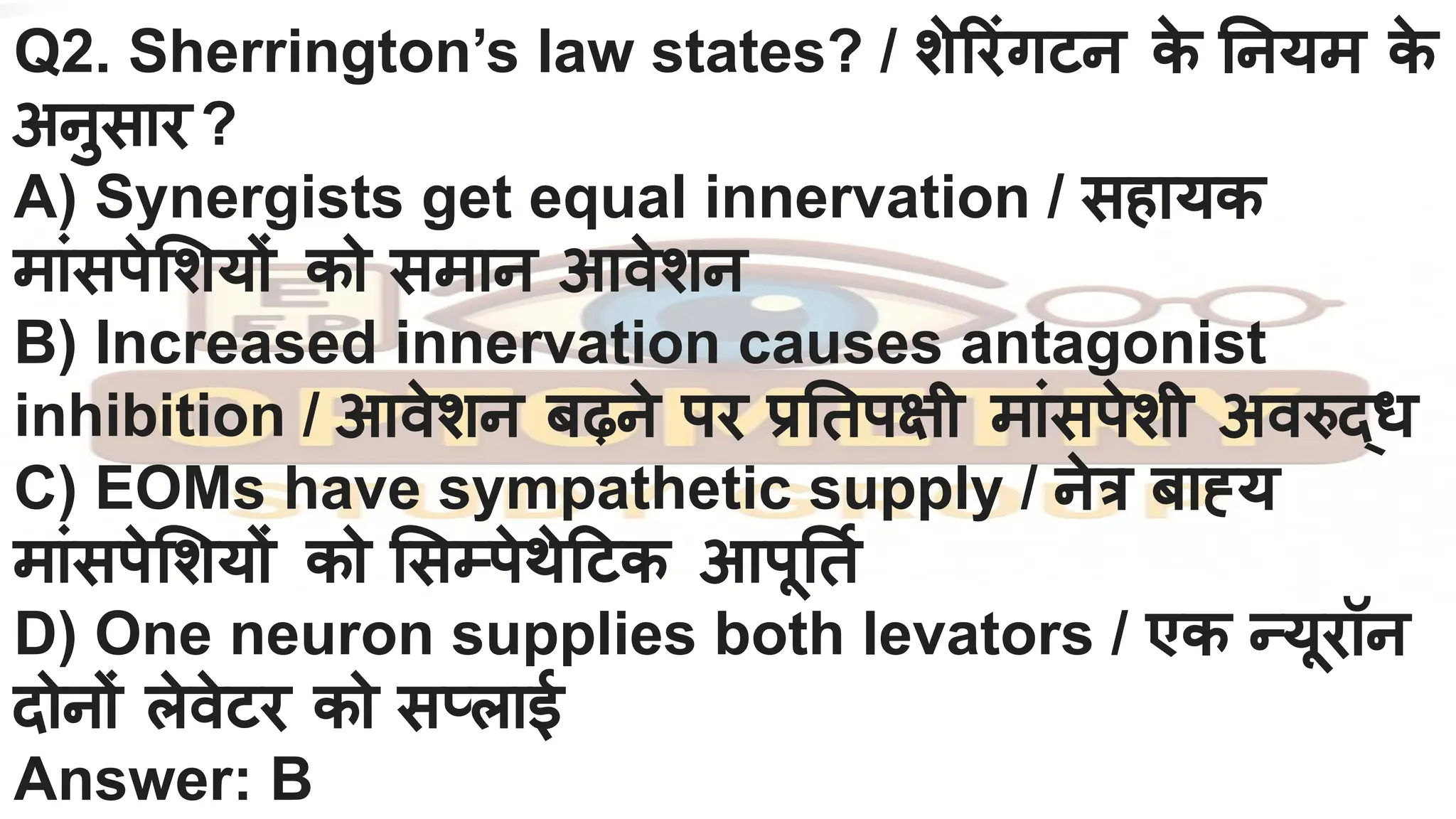
Q2. Sherrington’s law states? / शे रंगटन क
े नयम क
े
अनुसार ?
A) Synergists get equal innervation / सहायक
मांसपे शयों को समान आवेशन
B) Increased innervation causes antagonist
inhibition / आवेशन बढ़ने पर प्र तपक्षी मांसपेशी अवरुद्ध
C) EOMs have sympathetic supply / नेत्र बाह्य
मांसपे शयों को सम्पेथे टक आपू तर्नि
D) One neuron supplies both levators / एक न्यूरॉन
दोनों लेवेटर को सप्लाई
Answer: B
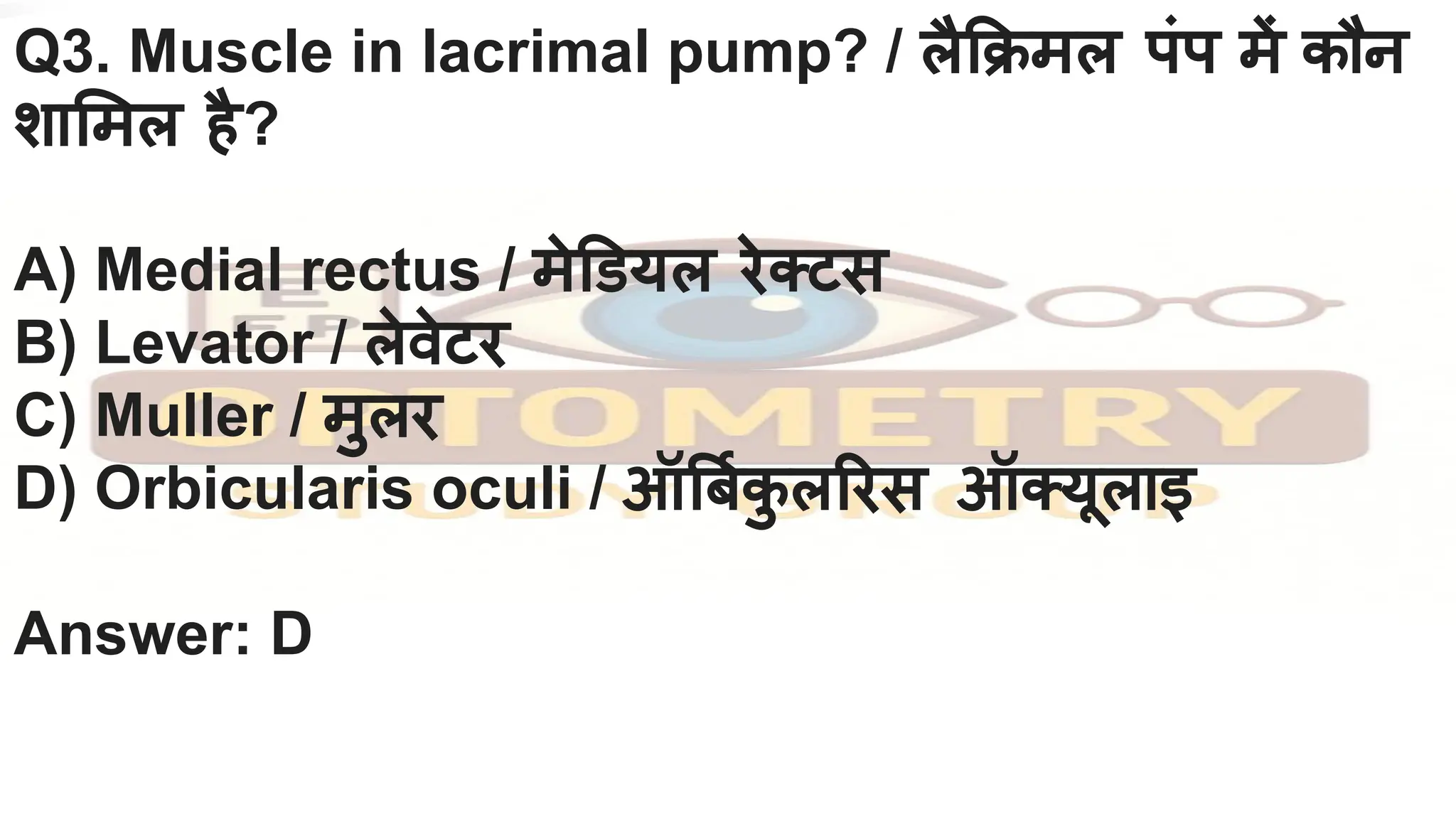
Q3. Muscle in lacrimal pump? / लै क्रमल पंप में कौन
शा मल है?
A) Medial rectus / मे डयल रेक्टस
B) Levator / लेवेटर
C) Muller / मुलर
D) Orbicularis oculi / ऑ बर्निक
ु ल रस ऑक्यूलाइ
Answer: D
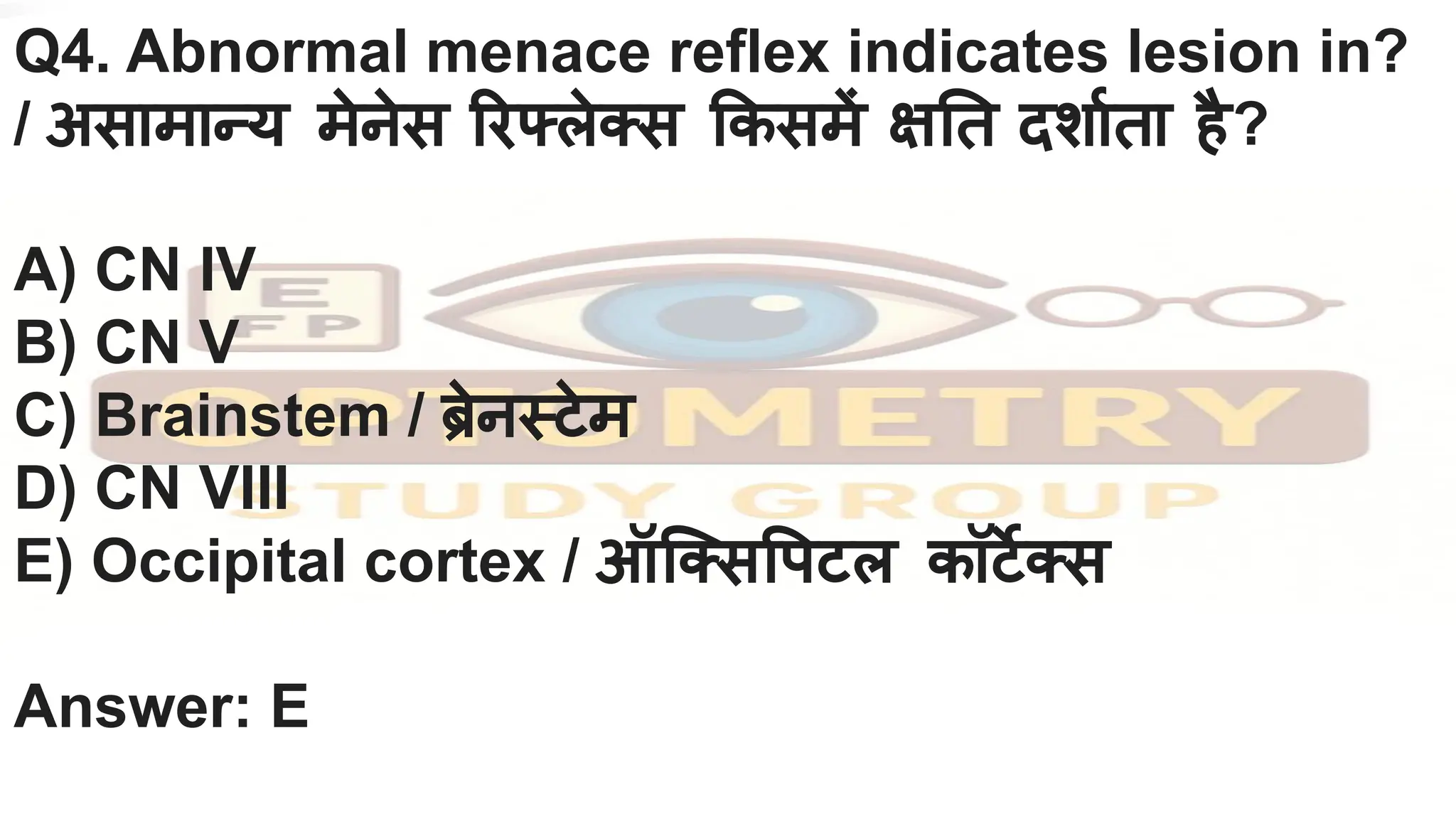
Q4. Abnormal menace reflex indicates lesion in?
/ असामान्य मेनेस रफ्लेक्स कसमें क्ष त दशार्निता है?
A) CN IV
B) CN V
C) Brainstem / ब्रिेनस्टेम
D) CN VIII
E) Occipital cortex / ऑिक्स पटल कॉटर्जेक्स
Answer: E
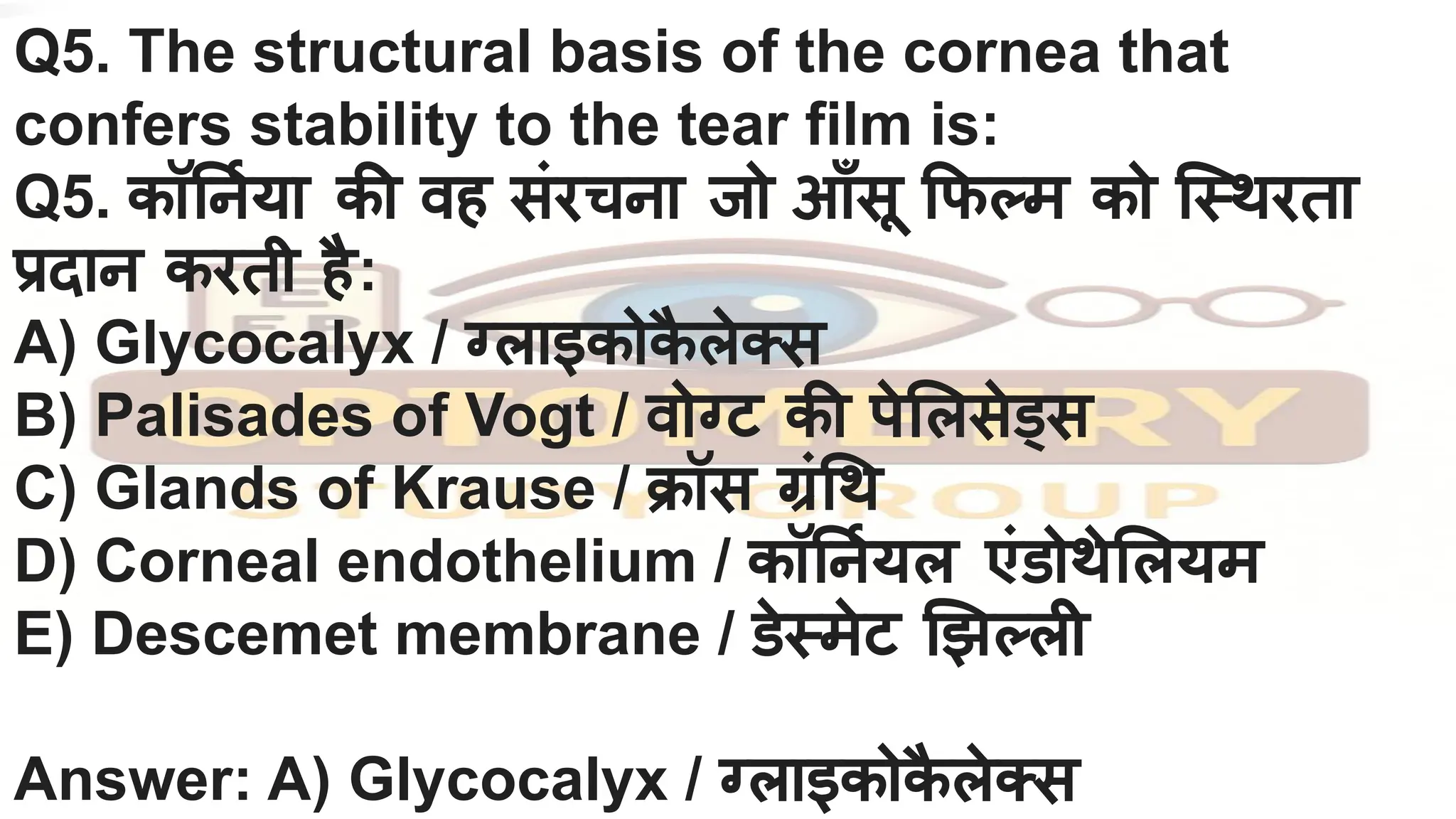
Q5. The structural basis of the cornea that
confers stability to the tear film is:
Q5. कॉ नर्निया की वह संरचना जो आँसू फ म को िस्थरता
प्रदान करती है:
A) Glycocalyx / ग्लाइकोक
ै लेक्स
B) Palisades of Vogt / वोग्ट की पे लसेड्स
C) Glands of Krause / क्रॉस ग्रं थ
D) Corneal endothelium / कॉ नर्नियल एंडोथे लयम
E) Descemet membrane / डेस्मेट झ ली
Answer: A) Glycocalyx / ग्लाइकोक
ै लेक्स
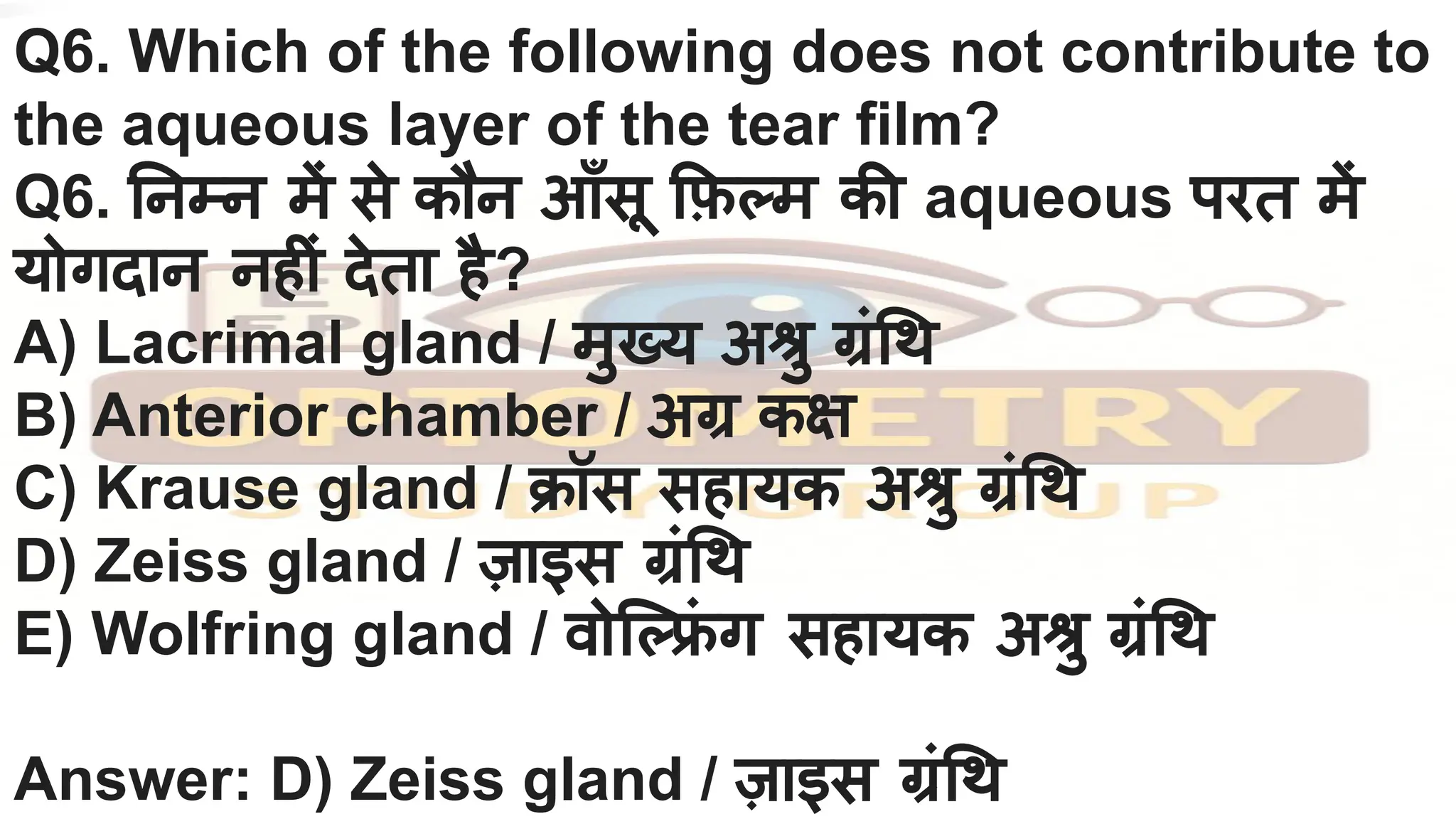
Q6. Which of the following does not contribute to
the aqueous layer of the tear film?
Q6. नम्न में से कौन आँसू फ़ म की aqueous परत में
योगदान नहीं देता है?
A) Lacrimal gland / मुख्य अश्रु ग्रं थ
B) Anterior chamber / अग्र कक्ष
C) Krause gland / क्रॉस सहायक अश्रु ग्रं थ
D) Zeiss gland / ज़ाइस ग्रं थ
E) Wolfring gland / वोि ल्फ्रि
ं ग सहायक अश्रु ग्रं थ
Answer: D) Zeiss gland / ज़ाइस ग्रं थ
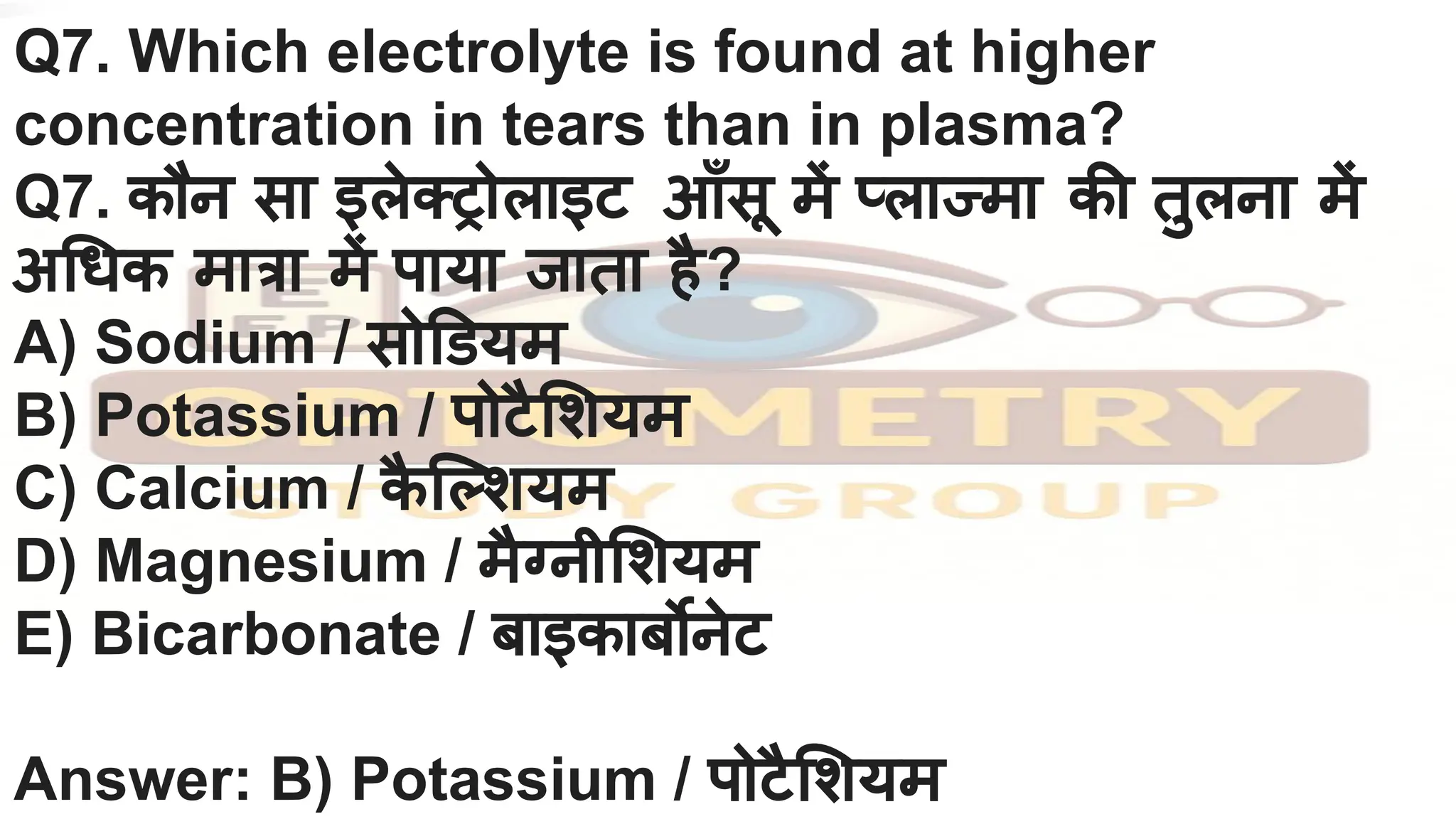
Q7. Which electrolyte is found at higher
concentration in tears than in plasma?
Q7. कौन सा इलेक्ट्रोलाइट आँसू में प्लाज्मा की तुलना में
अ धक मात्रा में पाया जाता है?
A) Sodium / सो डयम
B) Potassium / पोटै शयम
C) Calcium / क
ै ि शयम
D) Magnesium / मैग्नी शयम
E) Bicarbonate / बाइकाबर्बोनेट
Answer: B) Potassium / पोटै शयम
Q8. What is the main difference between Jones and Doane’s
lacrimal pump theory?
Q8. Jones और Doane क
े lacrimal pump सद्धांत में मुख्य अंतर
क्या है
A) Siphoning occurs during relaxation in Doane’s model /
Doane मॉडल में आराम क
े समय सफ़ो नंग होती है
B) Jones कहते हैं क lipid layer पानी की परत को खींचती है / Jones
क
े अनुसार lipid layer पानी को खींचती है
C) Doane कहता है क पलकों क
े बंद होने पर canaliculi में negative
pressure बनता है जो आँसू को sac में खींचता है
D) Jones but not Doane suggests Horner muscle pumps into
duct / Horner muscle की भू मका सफ
र्नि Jones बताता है
E) Jones कहता है क eye closure पर lacrimal sac compress
होता है / Jones eye closure पर sac compress मानते हैं
Q9. Aqueous secretion increases:
Q9. आँसू (aqueous) स्राव बढ़ता है:
A) As high as 50 times with stimulation / उत्तेजना
पर 50 गुना तक बढ़ सकता है
B) With age / उम्र क
े साथ
C) More in evening / शाम में अ धक
D) During sleep / नींद में
E) With sympathetic and parasympathetic
stimulation / sympathetic और parasympathetic
दोनों से
Answer: A) As high as 50 times with
Q10. When the eyes move in opposite directions
simultaneously, the movement is called:
Q10. जब आँखें एक ही समय में वपरीत दशाओं में चलती
हैं, तो इसे क्या कहते हैं?
A) Duction / डक्शन
B) Version / वजर्निन
C) Vergence / वजर्जेन्स
D) Torsion / टॉशर्निन
Answer: C) Vergence / वजर्जेन्स
Q11. Which of the following is correct regarding the
oculocephalic reflex?
Q11. Oculocephalic reflex क
े बारे में नम्न में से कौन सा कथन सही
है?
A) It is elicited by moving objects / यह चलती वस्तुओं से उत्पन्न
होता है
B) Trigeminal nerve mediates the reflex / यह Trigeminal nerve
द्वारा नयं त्रत होता है
C) It is for gaze shifting / यह दृिष्ट प रवतर्निन क
े लए कायर्नि करता है
D) Involves the trochlear cranial nerve / इसमें क
े वल Trochlear
nerve शा मल होती है
E) It is initiated via the vestibular nerve / यह Vestibular nerve
क
े माध्यम से आरंभ होता है
Answer: E) It is initiated via the vestibular nerve
Q12. What is the main action of detergents
required for optimal ocular drug penetration?
Q12. नेत्र औष ध क
े प्रभावी अवशोषण क
े लए detergents
का मुख्य कायर्नि क्या है?
A) Maintain transepithelial potential / ट्रांसए पथी लयल पोटें शयल
बनाए रखना
B) Increase calcium levels / क
ै ि शयम स्तर बढ़ाना
C) Decrease permeability / पारगम्यता कम करना
D) Break down tight junctions / टाइट जंक्शन को तोड़ना
E) Promote wound healing / घाव भरने को बढ़ावा देना
Answer: D) Break down tight junctions
Q13. Transparency of the cornea is based on:
Q13. कॉ नर्निया की पारद शर्निता नम्न में से कस पर
आधा रत है?
A) Variable size of fibrils / फाइ ब्रि स क
े आकार में
प रवतर्निन
B) Mainly on hydration level / मुख्य रूप से जलयोजन
स्तर पर
C) Distance between fibrils / फाइ ब्रि स क
े बीच की
दूरी
D) Crosslinking barrier / कोलाजेन का क्रॉस लंक बाधा
E) Interwoven arrangement / तंतु का जालदार
Q14. A trauma to the corneal epithelium initially leads to:
Q14. कॉ नर्नियल ए पथे लयम में चोट होने पर प्रारं भक अवस्था में क्या
होता है?
A) Faster healing near limbus / लम्बस क
े पास उपचार तेजी से होता
है
B) New wing cell formation by stem cell mitosis / स्टेम सेल
द्वारा नए वंग सेल बनते हैं
C) Loss of desmosomes but hemidesmosomes remain /
डेस्मोसोम नष्ट होते हैं ले कन हे मडेस्मोसोम बने रहते हैं
D) Reinnervation in 1 week / 1 सप्ताह में पुनः तं त्रका आपू तर्नि
E) Decreased endothelial pump density / एंडोथी लयल पंप घनत्व
कम होता है
Answer: C) Loss of desmosomes but hemidesmosomes
remain
Q15. Which structure mainly maintains corneal
deturgescence (dehydration state)?
Q15. कॉ नर्निया क
े deturgescence ( नजर्निलीकरण संतुलन) को मुख्य रूप
से कौन बनाए रखता है?
A) Basal epithelial cells / बेसल ए पथे लयल को शकाएँ
B) Stroma extracellular matrix / स्ट्रोमा बाह्य मै ट्रक्स
C) Na⁺/K⁺-ATPase pumps in endothelium / एंडोथी लयम में
Na⁺/K⁺-ATPase पंप
D) Aqueous reabsorption by ciliary body / स लयरी बॉडी द्वारा
पुनःअवशोषण
E) Aqueous layer of tear film / आँसू की aqueous परत
Answer: C) Na⁺/K⁺-ATPase pumps in corneal endothelium
Q16. What is the main source of glucose in the
corneal epithelium?
Q16. कॉ नर्नियल ए पथे लयम क
े लए ग्लूकोज़ का मुख्य
स्रोत क्या है?
A) Limbal vessels / लम्बल रक्तवा हकाएँ
B) Aqueous humor / एक्वस ह्यूमर
C) Conjunctival vessels / क
ं जंक्टाइवल रक्तवा हकाएँ
D) Tears / आँसू
E) Stem cells / स्टेम को शकाएँ
Answer: B) Aqueous humor
Q17. In which structure is ocular metabolism
essentially anaerobic?
Q17. आँख का कौन सा भाग मुख्यतः anaerobic ( बना
ऑक्सीजन ) मेटाबो लज़्म करता है?
A) Cornea / कॉ नर्निया
B) Sclera / स्क्लेरा
C) Lens / लेंस
D) Vitreous / व ट्रयस
E) Retina / रे टना
Answer: C) Lens
Q18. Which of the following does NOT indicate a
disease but is a normal aging change?
Q18. इनमें से कौन सा प रवतर्निन रोग नहीं है बि क बढ़ती
उम्र का सामान्य प रणाम है?
A) Descemetocele / डेस्मेटोसील
B) Keratoconus / क
े राटोकोनस
C) Corneal guttata / कॉ नर्नियल गुटाटा
D) Hassall–Henle bodies / हैसल–हेनले बॉडीज़
E) Fuchs’ dystrophy / फ
ु क्स डस्ट्रोफी
Answer: D) Hassall–Henle bodies
Q19. Which factor is NOT necessary to maintain
normal corneal thickness?
Q19. सामान्य कॉ नर्नियल मोटाई बनाए रखने क
े लए इनमें
से कौन आवश्यक नहीं है?
A) Ion pumps / आयन पंप
B) Oxygen / ऑक्सीजन
C) Glucose / ग्लूकोज़
D) Cell junctions / सेल जंक्शन
E) Lactic acid / लैिक्टक ए सड
Answer: E) Lactic acid
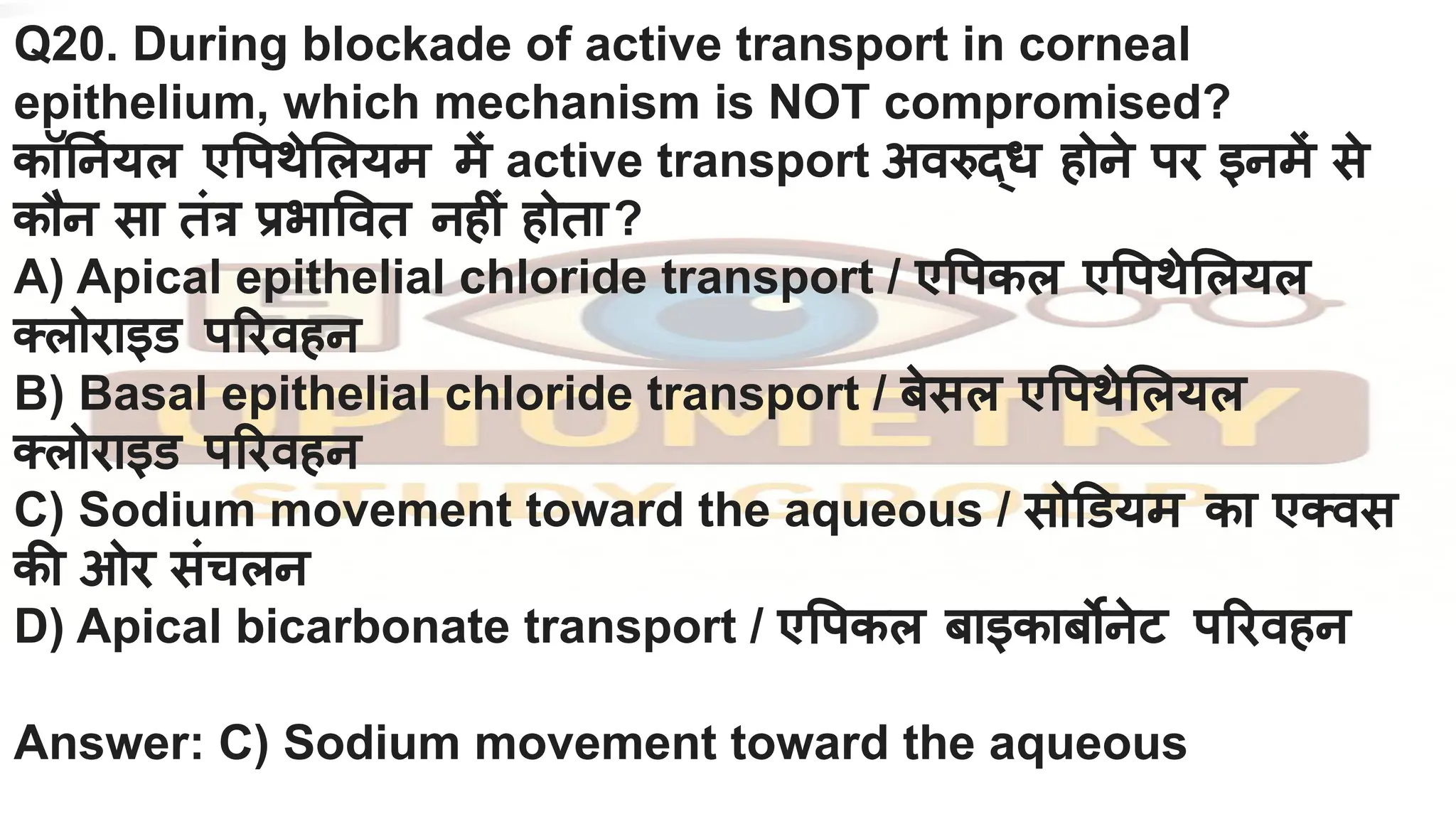
Q20. During blockade of active transport in corneal
epithelium, which mechanism is NOT compromised?
कॉ नर्नियल ए पथे लयम में active transport अवरुद्ध होने पर इनमें से
कौन सा तंत्र प्रभा वत नहीं होता?
A) Apical epithelial chloride transport / ए पकल ए पथे लयल
क्लोराइड प रवहन
B) Basal epithelial chloride transport / बेसल ए पथे लयल
क्लोराइड प रवहन
C) Sodium movement toward the aqueous / सो डयम का एक्वस
की ओर संचलन
D) Apical bicarbonate transport / ए पकल बाइकाबर्बोनेट प रवहन
Answer: C) Sodium movement toward the aqueous
More pdf download it get free
Part:-01
Thank you

Aiims cre Optometry PYQ part 2/ Imp/.pdf

  • 1.
    AIIMS CRE OPTOMETRY PRIVIOUSYEAR PYQ’s On the OPTOMETRY STUDY HUB whatsapp group channel./Part :- 02/ Scan here! ● 📚 Free Notes ● 📄 PDF Material ● 🎥 PPT Slides ● 📝 PYQ (Download free) ● 🎯 Daily Practice DPP ● 💡 Concept Explanation Join our whatsapp channel to get more pyq/dpp/mcq/notes/ppt/ etc.
  • 2.
    Q1. Which muscleis involved in voluntary wink? / स्वेि छक वंक में कौन सी मांसपेशी शा मल है? A) Levator palpebrae superioris / लेवेटर प पेब्रिे सुपी रयो रस B) Muller / मुलर C) Corrugator / कोरुगेटर D) Palpebral orbicularis oculi / पै पेब्रिल ऑ बर्निक ु ल रस ऑक्यूलाइ Answer: D
  • 3.
    Q2. Sherrington’s lawstates? / शे रंगटन क े नयम क े अनुसार ? A) Synergists get equal innervation / सहायक मांसपे शयों को समान आवेशन B) Increased innervation causes antagonist inhibition / आवेशन बढ़ने पर प्र तपक्षी मांसपेशी अवरुद्ध C) EOMs have sympathetic supply / नेत्र बाह्य मांसपे शयों को सम्पेथे टक आपू तर्नि D) One neuron supplies both levators / एक न्यूरॉन दोनों लेवेटर को सप्लाई Answer: B
  • 4.
    Q3. Muscle inlacrimal pump? / लै क्रमल पंप में कौन शा मल है? A) Medial rectus / मे डयल रेक्टस B) Levator / लेवेटर C) Muller / मुलर D) Orbicularis oculi / ऑ बर्निक ु ल रस ऑक्यूलाइ Answer: D
  • 5.
    Q4. Abnormal menacereflex indicates lesion in? / असामान्य मेनेस रफ्लेक्स कसमें क्ष त दशार्निता है? A) CN IV B) CN V C) Brainstem / ब्रिेनस्टेम D) CN VIII E) Occipital cortex / ऑिक्स पटल कॉटर्जेक्स Answer: E
  • 6.
    Q5. The structuralbasis of the cornea that confers stability to the tear film is: Q5. कॉ नर्निया की वह संरचना जो आँसू फ म को िस्थरता प्रदान करती है: A) Glycocalyx / ग्लाइकोक ै लेक्स B) Palisades of Vogt / वोग्ट की पे लसेड्स C) Glands of Krause / क्रॉस ग्रं थ D) Corneal endothelium / कॉ नर्नियल एंडोथे लयम E) Descemet membrane / डेस्मेट झ ली Answer: A) Glycocalyx / ग्लाइकोक ै लेक्स
  • 7.
    Q6. Which ofthe following does not contribute to the aqueous layer of the tear film? Q6. नम्न में से कौन आँसू फ़ म की aqueous परत में योगदान नहीं देता है? A) Lacrimal gland / मुख्य अश्रु ग्रं थ B) Anterior chamber / अग्र कक्ष C) Krause gland / क्रॉस सहायक अश्रु ग्रं थ D) Zeiss gland / ज़ाइस ग्रं थ E) Wolfring gland / वोि ल्फ्रि ं ग सहायक अश्रु ग्रं थ Answer: D) Zeiss gland / ज़ाइस ग्रं थ
  • 8.
    Q7. Which electrolyteis found at higher concentration in tears than in plasma? Q7. कौन सा इलेक्ट्रोलाइट आँसू में प्लाज्मा की तुलना में अ धक मात्रा में पाया जाता है? A) Sodium / सो डयम B) Potassium / पोटै शयम C) Calcium / क ै ि शयम D) Magnesium / मैग्नी शयम E) Bicarbonate / बाइकाबर्बोनेट Answer: B) Potassium / पोटै शयम
  • 9.
    Q8. What isthe main difference between Jones and Doane’s lacrimal pump theory? Q8. Jones और Doane क े lacrimal pump सद्धांत में मुख्य अंतर क्या है A) Siphoning occurs during relaxation in Doane’s model / Doane मॉडल में आराम क े समय सफ़ो नंग होती है B) Jones कहते हैं क lipid layer पानी की परत को खींचती है / Jones क े अनुसार lipid layer पानी को खींचती है C) Doane कहता है क पलकों क े बंद होने पर canaliculi में negative pressure बनता है जो आँसू को sac में खींचता है D) Jones but not Doane suggests Horner muscle pumps into duct / Horner muscle की भू मका सफ र्नि Jones बताता है E) Jones कहता है क eye closure पर lacrimal sac compress होता है / Jones eye closure पर sac compress मानते हैं
  • 10.
    Q9. Aqueous secretionincreases: Q9. आँसू (aqueous) स्राव बढ़ता है: A) As high as 50 times with stimulation / उत्तेजना पर 50 गुना तक बढ़ सकता है B) With age / उम्र क े साथ C) More in evening / शाम में अ धक D) During sleep / नींद में E) With sympathetic and parasympathetic stimulation / sympathetic और parasympathetic दोनों से Answer: A) As high as 50 times with
  • 12.
    Q10. When theeyes move in opposite directions simultaneously, the movement is called: Q10. जब आँखें एक ही समय में वपरीत दशाओं में चलती हैं, तो इसे क्या कहते हैं? A) Duction / डक्शन B) Version / वजर्निन C) Vergence / वजर्जेन्स D) Torsion / टॉशर्निन Answer: C) Vergence / वजर्जेन्स
  • 13.
    Q11. Which ofthe following is correct regarding the oculocephalic reflex? Q11. Oculocephalic reflex क े बारे में नम्न में से कौन सा कथन सही है? A) It is elicited by moving objects / यह चलती वस्तुओं से उत्पन्न होता है B) Trigeminal nerve mediates the reflex / यह Trigeminal nerve द्वारा नयं त्रत होता है C) It is for gaze shifting / यह दृिष्ट प रवतर्निन क े लए कायर्नि करता है D) Involves the trochlear cranial nerve / इसमें क े वल Trochlear nerve शा मल होती है E) It is initiated via the vestibular nerve / यह Vestibular nerve क े माध्यम से आरंभ होता है Answer: E) It is initiated via the vestibular nerve
  • 14.
    Q12. What isthe main action of detergents required for optimal ocular drug penetration? Q12. नेत्र औष ध क े प्रभावी अवशोषण क े लए detergents का मुख्य कायर्नि क्या है? A) Maintain transepithelial potential / ट्रांसए पथी लयल पोटें शयल बनाए रखना B) Increase calcium levels / क ै ि शयम स्तर बढ़ाना C) Decrease permeability / पारगम्यता कम करना D) Break down tight junctions / टाइट जंक्शन को तोड़ना E) Promote wound healing / घाव भरने को बढ़ावा देना Answer: D) Break down tight junctions
  • 15.
    Q13. Transparency ofthe cornea is based on: Q13. कॉ नर्निया की पारद शर्निता नम्न में से कस पर आधा रत है? A) Variable size of fibrils / फाइ ब्रि स क े आकार में प रवतर्निन B) Mainly on hydration level / मुख्य रूप से जलयोजन स्तर पर C) Distance between fibrils / फाइ ब्रि स क े बीच की दूरी D) Crosslinking barrier / कोलाजेन का क्रॉस लंक बाधा E) Interwoven arrangement / तंतु का जालदार
  • 16.
    Q14. A traumato the corneal epithelium initially leads to: Q14. कॉ नर्नियल ए पथे लयम में चोट होने पर प्रारं भक अवस्था में क्या होता है? A) Faster healing near limbus / लम्बस क े पास उपचार तेजी से होता है B) New wing cell formation by stem cell mitosis / स्टेम सेल द्वारा नए वंग सेल बनते हैं C) Loss of desmosomes but hemidesmosomes remain / डेस्मोसोम नष्ट होते हैं ले कन हे मडेस्मोसोम बने रहते हैं D) Reinnervation in 1 week / 1 सप्ताह में पुनः तं त्रका आपू तर्नि E) Decreased endothelial pump density / एंडोथी लयल पंप घनत्व कम होता है Answer: C) Loss of desmosomes but hemidesmosomes remain
  • 17.
    Q15. Which structuremainly maintains corneal deturgescence (dehydration state)? Q15. कॉ नर्निया क े deturgescence ( नजर्निलीकरण संतुलन) को मुख्य रूप से कौन बनाए रखता है? A) Basal epithelial cells / बेसल ए पथे लयल को शकाएँ B) Stroma extracellular matrix / स्ट्रोमा बाह्य मै ट्रक्स C) Na⁺/K⁺-ATPase pumps in endothelium / एंडोथी लयम में Na⁺/K⁺-ATPase पंप D) Aqueous reabsorption by ciliary body / स लयरी बॉडी द्वारा पुनःअवशोषण E) Aqueous layer of tear film / आँसू की aqueous परत Answer: C) Na⁺/K⁺-ATPase pumps in corneal endothelium
  • 18.
    Q16. What isthe main source of glucose in the corneal epithelium? Q16. कॉ नर्नियल ए पथे लयम क े लए ग्लूकोज़ का मुख्य स्रोत क्या है? A) Limbal vessels / लम्बल रक्तवा हकाएँ B) Aqueous humor / एक्वस ह्यूमर C) Conjunctival vessels / क ं जंक्टाइवल रक्तवा हकाएँ D) Tears / आँसू E) Stem cells / स्टेम को शकाएँ Answer: B) Aqueous humor
  • 19.
    Q17. In whichstructure is ocular metabolism essentially anaerobic? Q17. आँख का कौन सा भाग मुख्यतः anaerobic ( बना ऑक्सीजन ) मेटाबो लज़्म करता है? A) Cornea / कॉ नर्निया B) Sclera / स्क्लेरा C) Lens / लेंस D) Vitreous / व ट्रयस E) Retina / रे टना Answer: C) Lens
  • 21.
    Q18. Which ofthe following does NOT indicate a disease but is a normal aging change? Q18. इनमें से कौन सा प रवतर्निन रोग नहीं है बि क बढ़ती उम्र का सामान्य प रणाम है? A) Descemetocele / डेस्मेटोसील B) Keratoconus / क े राटोकोनस C) Corneal guttata / कॉ नर्नियल गुटाटा D) Hassall–Henle bodies / हैसल–हेनले बॉडीज़ E) Fuchs’ dystrophy / फ ु क्स डस्ट्रोफी Answer: D) Hassall–Henle bodies
  • 22.
    Q19. Which factoris NOT necessary to maintain normal corneal thickness? Q19. सामान्य कॉ नर्नियल मोटाई बनाए रखने क े लए इनमें से कौन आवश्यक नहीं है? A) Ion pumps / आयन पंप B) Oxygen / ऑक्सीजन C) Glucose / ग्लूकोज़ D) Cell junctions / सेल जंक्शन E) Lactic acid / लैिक्टक ए सड Answer: E) Lactic acid
  • 23.
    Q20. During blockadeof active transport in corneal epithelium, which mechanism is NOT compromised? कॉ नर्नियल ए पथे लयम में active transport अवरुद्ध होने पर इनमें से कौन सा तंत्र प्रभा वत नहीं होता? A) Apical epithelial chloride transport / ए पकल ए पथे लयल क्लोराइड प रवहन B) Basal epithelial chloride transport / बेसल ए पथे लयल क्लोराइड प रवहन C) Sodium movement toward the aqueous / सो डयम का एक्वस की ओर संचलन D) Apical bicarbonate transport / ए पकल बाइकाबर्बोनेट प रवहन Answer: C) Sodium movement toward the aqueous
  • 24.
    More pdf downloadit get free Part:-01
  • 25.