Your Rights to Access
Environmental
Information
Michael Ewing
Coordinator of the Environmental Pillar
Purpose & Objective
Information: Guides and informs effective action
“Thoughts are not facts”
Typical methods:
Leveraging the Oireachtas
FOI ( Freedom of Information )
Access to Information requests/AIE
Searching the Web
...
“Different horses for different courses”

Factors to consider:

Nature of information, Timing/lack of
time,
Sequence, …

Other tools:

Search thoroughly!

Seanad

Dáil

EU Structures
Introduction to AIE
• Foundation
• Legislation
• Basic Requirements “Dos and Don’ts”
• Lifecycle of a request, scenarios
• Template
Where does AIE come from?
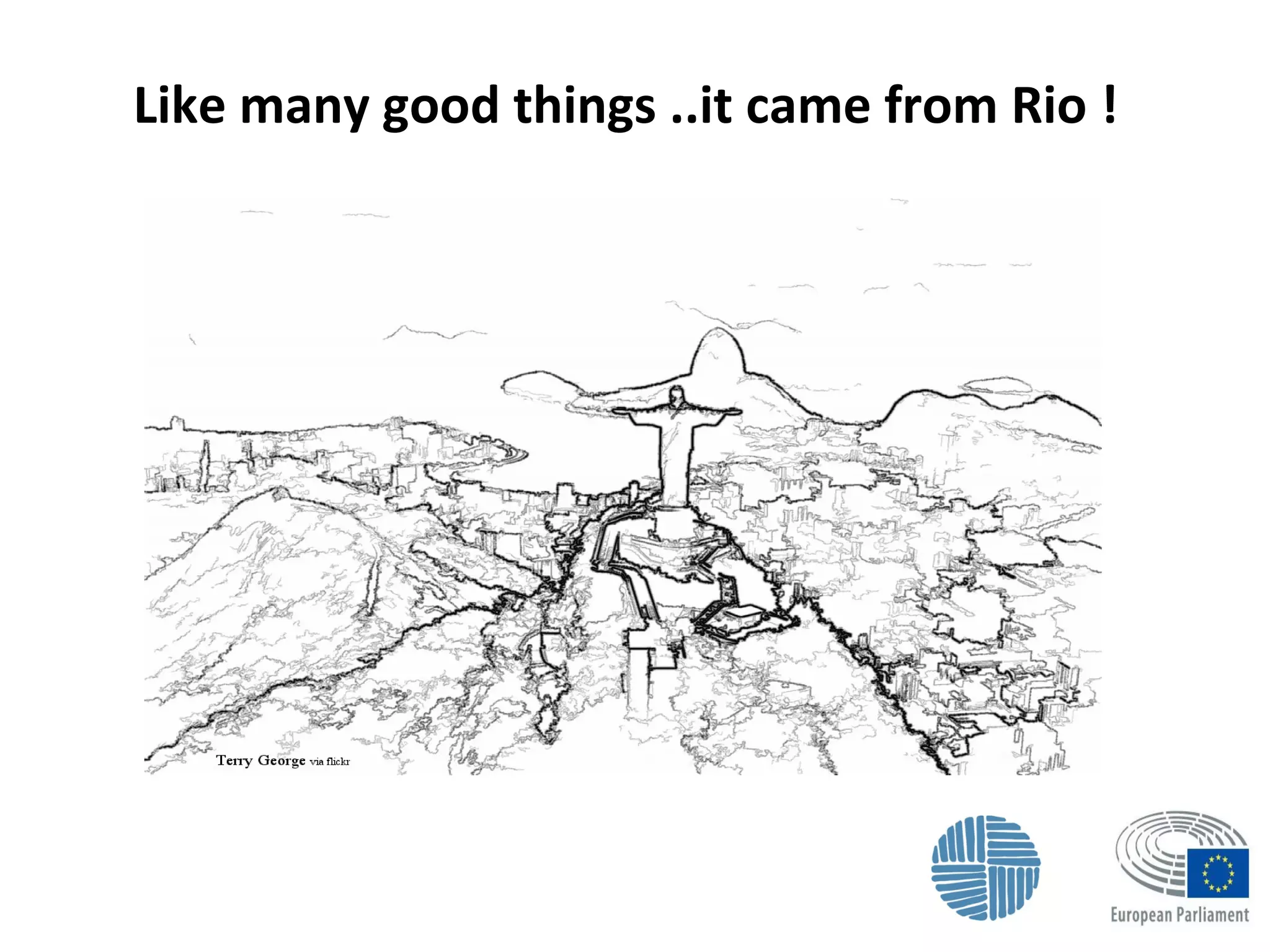
Like many good things ..it came from Rio !
Principle 10 (P.10), of the ‘Rio DeclarationPrinciple 10 (P.10), of the ‘Rio Declaration
on Environment and Development, 1992’,on Environment and Development, 1992’,
“Environmental issues are best handled with the
participation of all concerned citizens, at the relevant
level. At the national level, each individual shall have
appropriate access to information concerning the
environment that is held by public authorities,
including information on hazardous materials and
activities in their communities, and the opportunity to
participate in decision-making processes. States shall
facilitate and encourage public awareness and
participation by making information widely available.
Effective access to judicial and administrative
proceedings, including redress and remedy, shall be
provided”.
www.environmentalpillar.ie 8
1998
The UNECE draws up a
Convention to convert the
aspirations of Principle 10 into
International Law.
Ireland ratified the Convention
20th June 2012.
19/05/17
www.environmentalpillar.ie 9
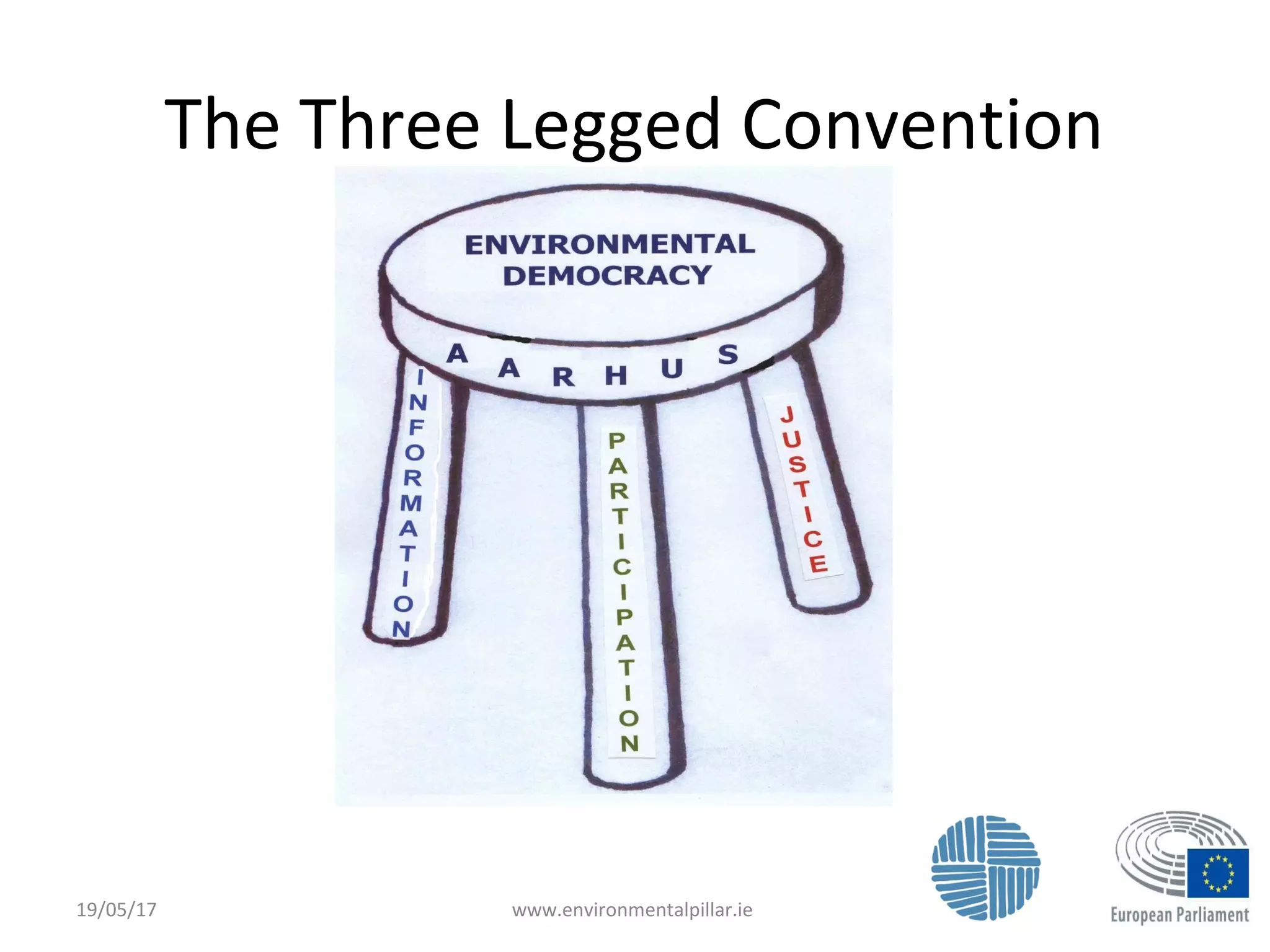
The Three Legged Convention
19/05/17
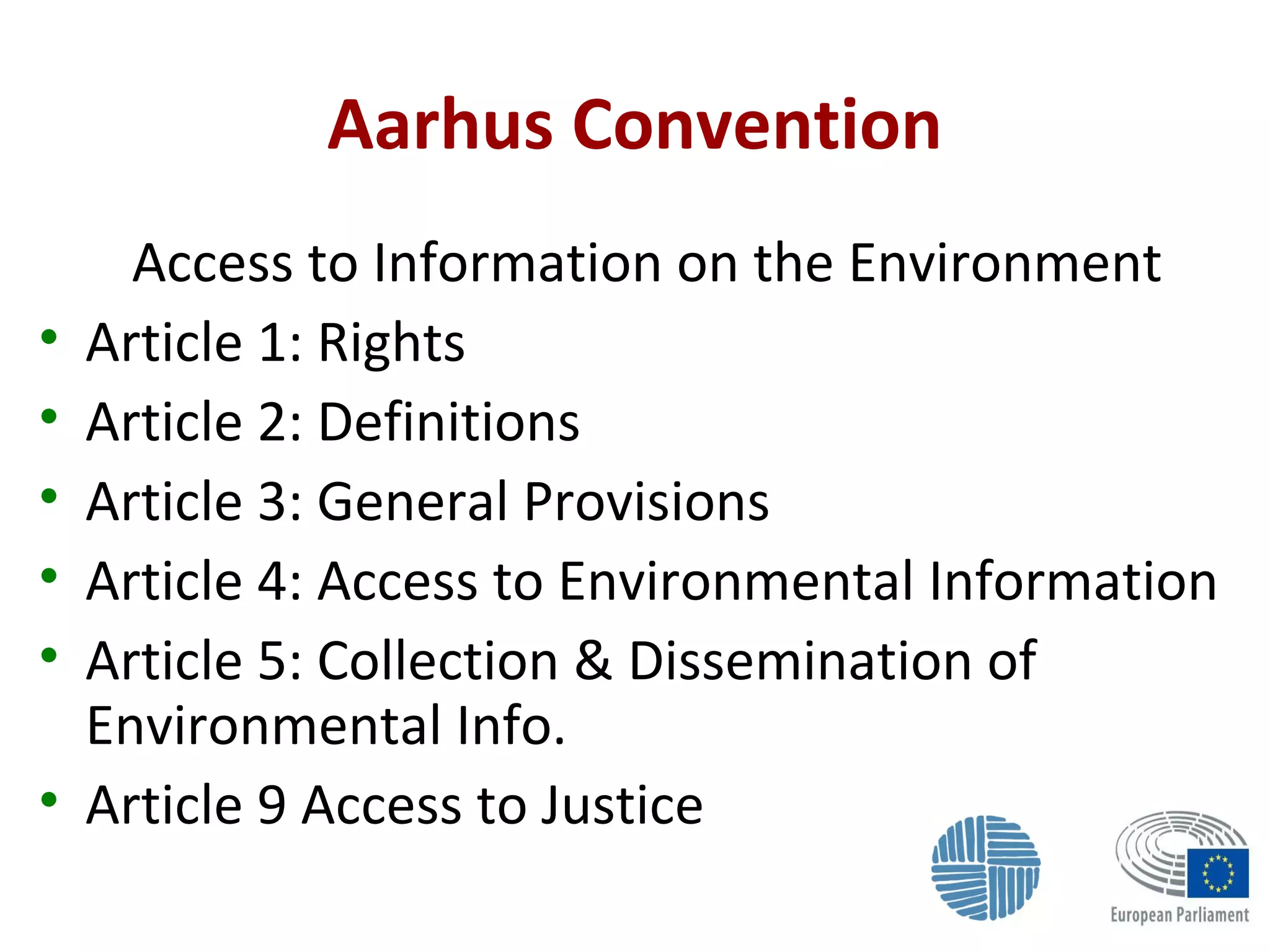
Aarhus Convention
Access to Information on the Environment
• Article 1: Rights
• Article 2: Definitions
• Article 3: General Provisions
• Article 4: Access to Environmental Information
• Article 5: Collection & Dissemination of
Environmental Info.
• Article 9 Access to Justice
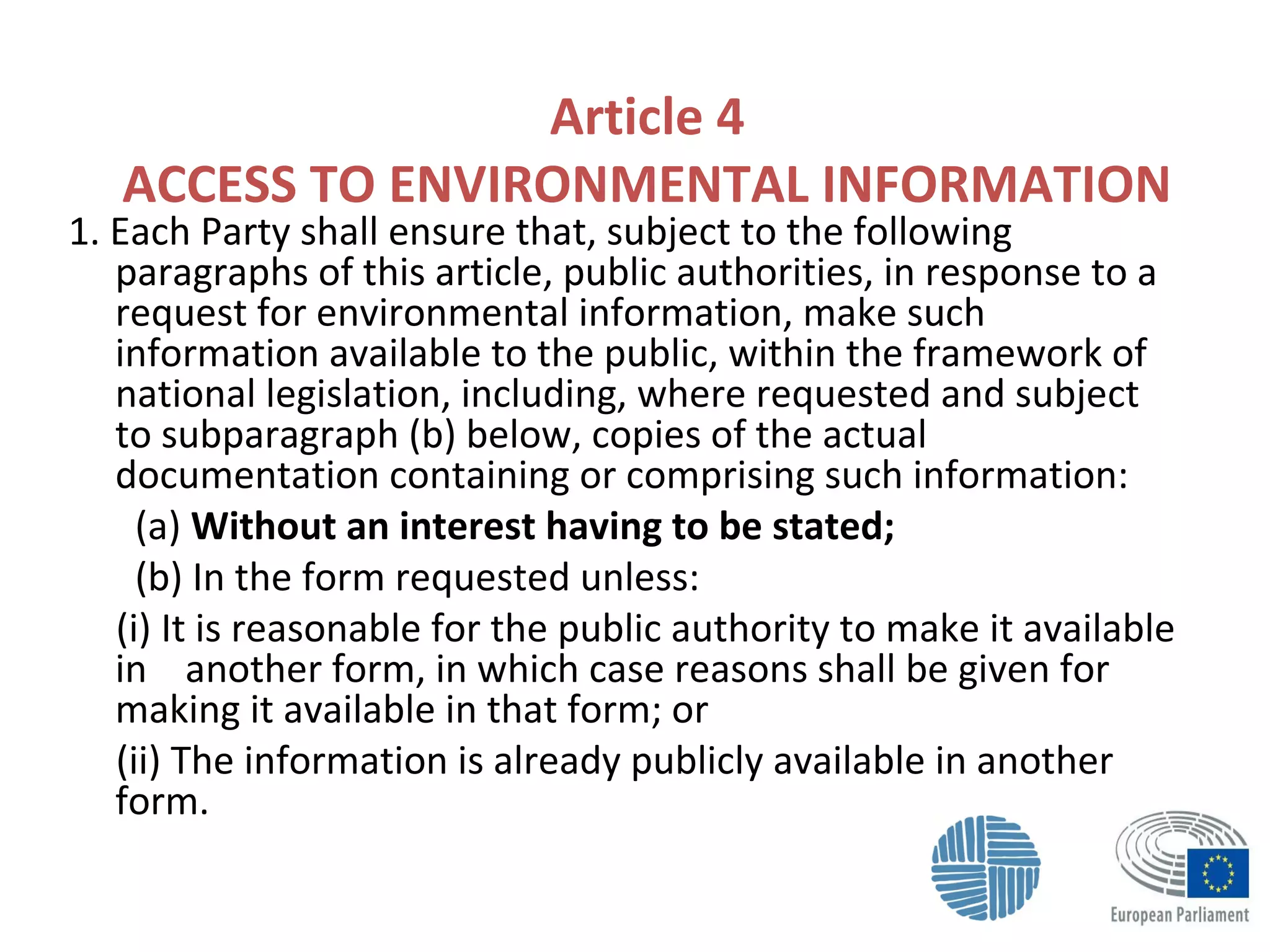
Article 4
ACCESS TO ENVIRONMENTAL INFORMATION
1. Each Party shall ensure that, subject to the following
paragraphs of this article, public authorities, in response to a
request for environmental information, make such
information available to the public, within the framework of
national legislation, including, where requested and subject
to subparagraph (b) below, copies of the actual
documentation containing or comprising such information:
(a) Without an interest having to be stated;
(b) In the form requested unless:
(i) It is reasonable for the public authority to make it available
in another form, in which case reasons shall be given for
making it available in that form; or
(ii) The information is already publicly available in another
form.
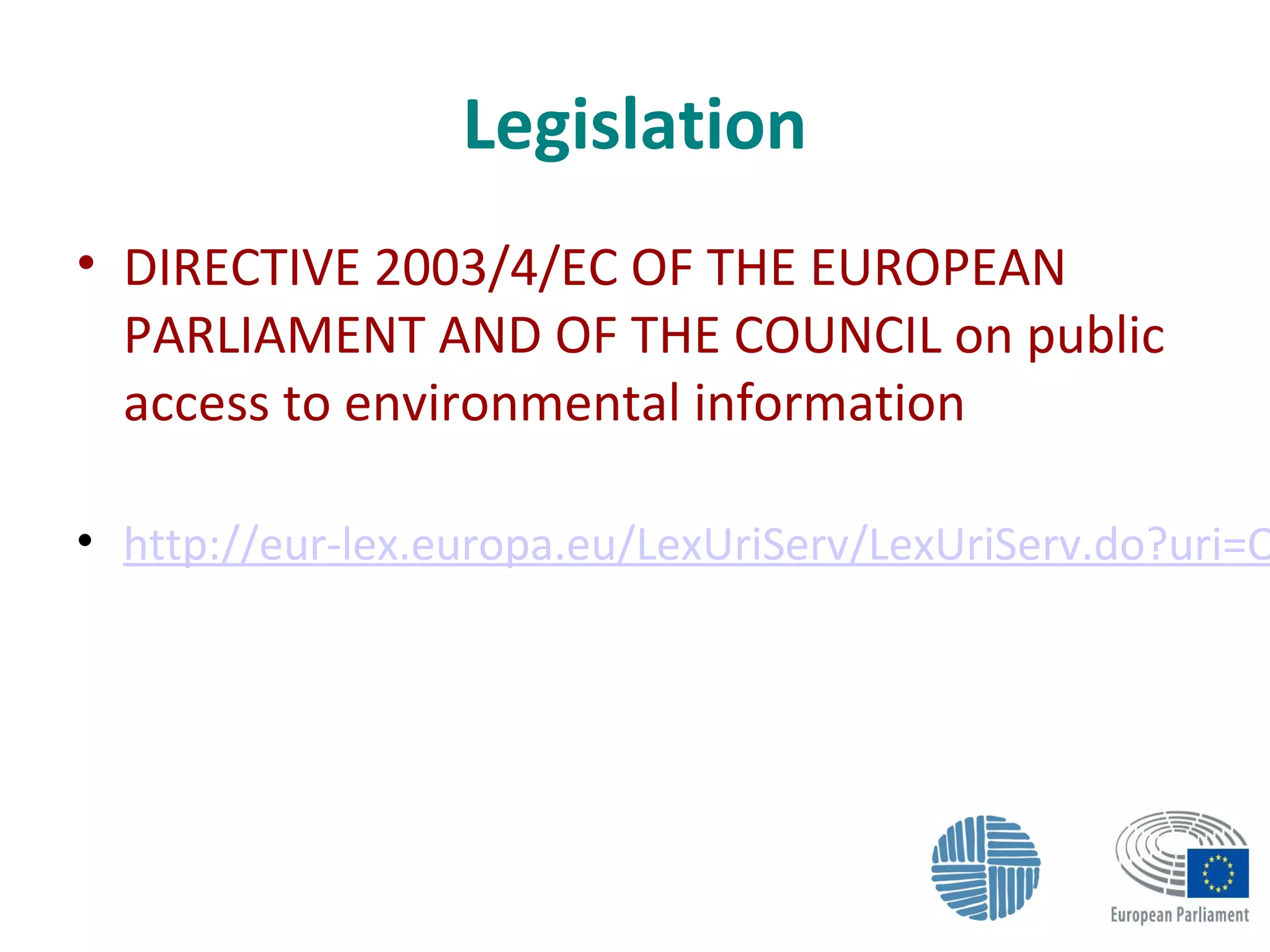
Legislation
• DIRECTIVE 2003/4/EC OF THE EUROPEAN
PARLIAMENT AND OF THE COUNCIL on public
access to environmental information
• http://eur-lex.europa.eu/LexUriServ/LexUriServ.do?uri=O
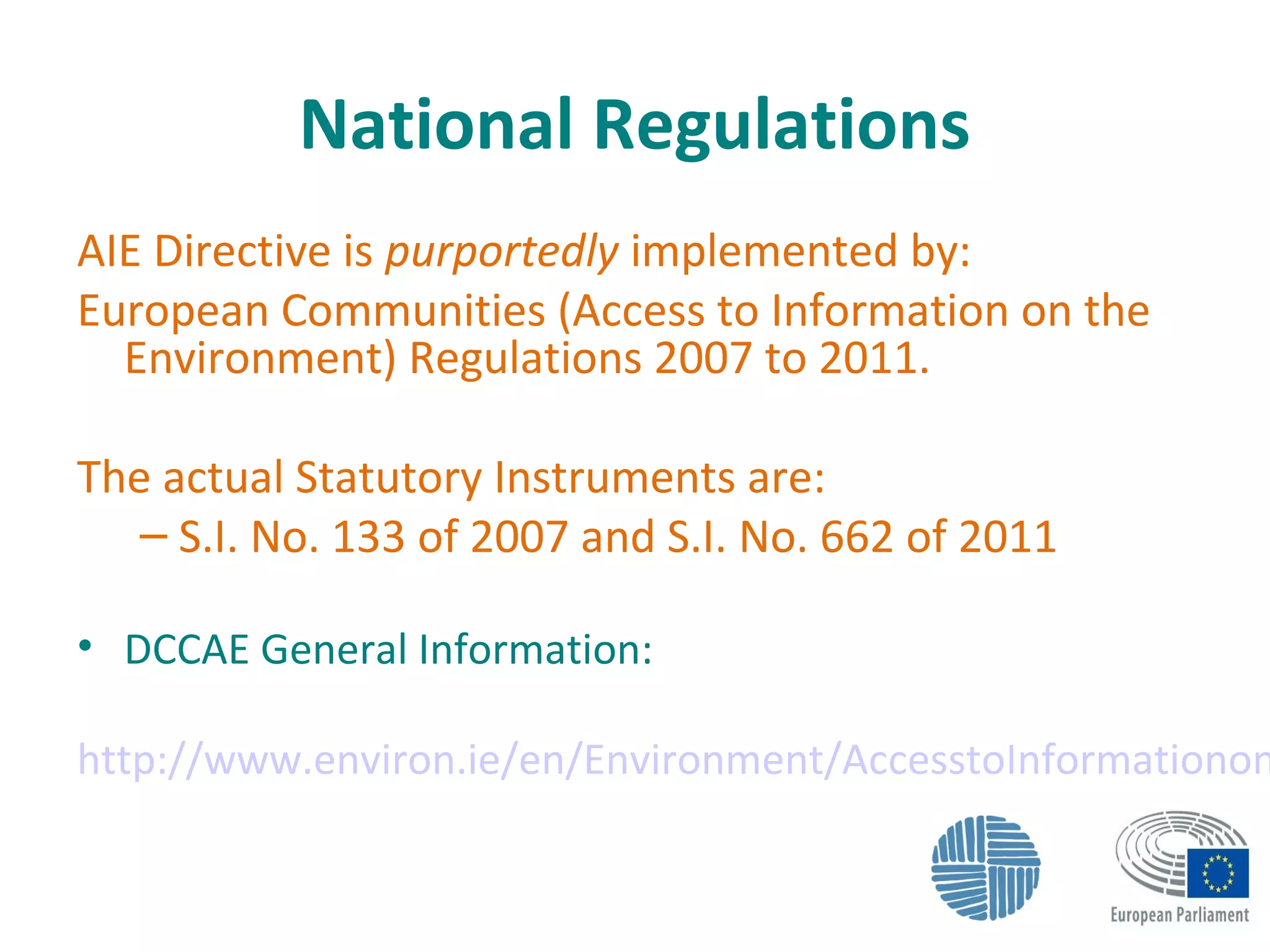
National Regulations
AIE Directive is purportedly implemented by:
European Communities (Access to Information on the
Environment) Regulations 2007 to 2011.
The actual Statutory Instruments are:
– S.I. No. 133 of 2007 and S.I. No. 662 of 2011
• DCCAE General Information:
http://www.environ.ie/en/Environment/AccesstoInformationon
Do’s
• Consider carefully what you want and why
you want it!
• Then…:
– Consider carefully what you actually want and
why you actually want it!
• And finally:
– Consider carefully what you really want and why
you really want it!
Look first!
• Look/Search first …thoroughly!
• Remember processing requests requires
public resources
Does it conform?
Ask yourself:
–Is it “environmental information” as defined by
the Directive?
But Definitions are key!
Article 2
1. Environmental information" shall mean any
information in written, visual, aural, electronic or
any other material form on:
– (a) the state of the elements of the environment,
such as air and atmosphere, water, soil, land,
landscape and natural sites including wetlands,
coastal and marine areas, biological diversity and
its components, including genetically modified
organisms, and the interaction among these
elements;
Definitions are cool!
Article 2
1. Environmental information" shall mean any
information in written, visual, aural, electronic or
any other material form on:
– (b) factors, such as substances, energy, noise,
radiation or waste, including radioactive waste,
emissions, discharges and other releases into the
environment, affecting or likely to affect the
elements of the environment referred to in (a);
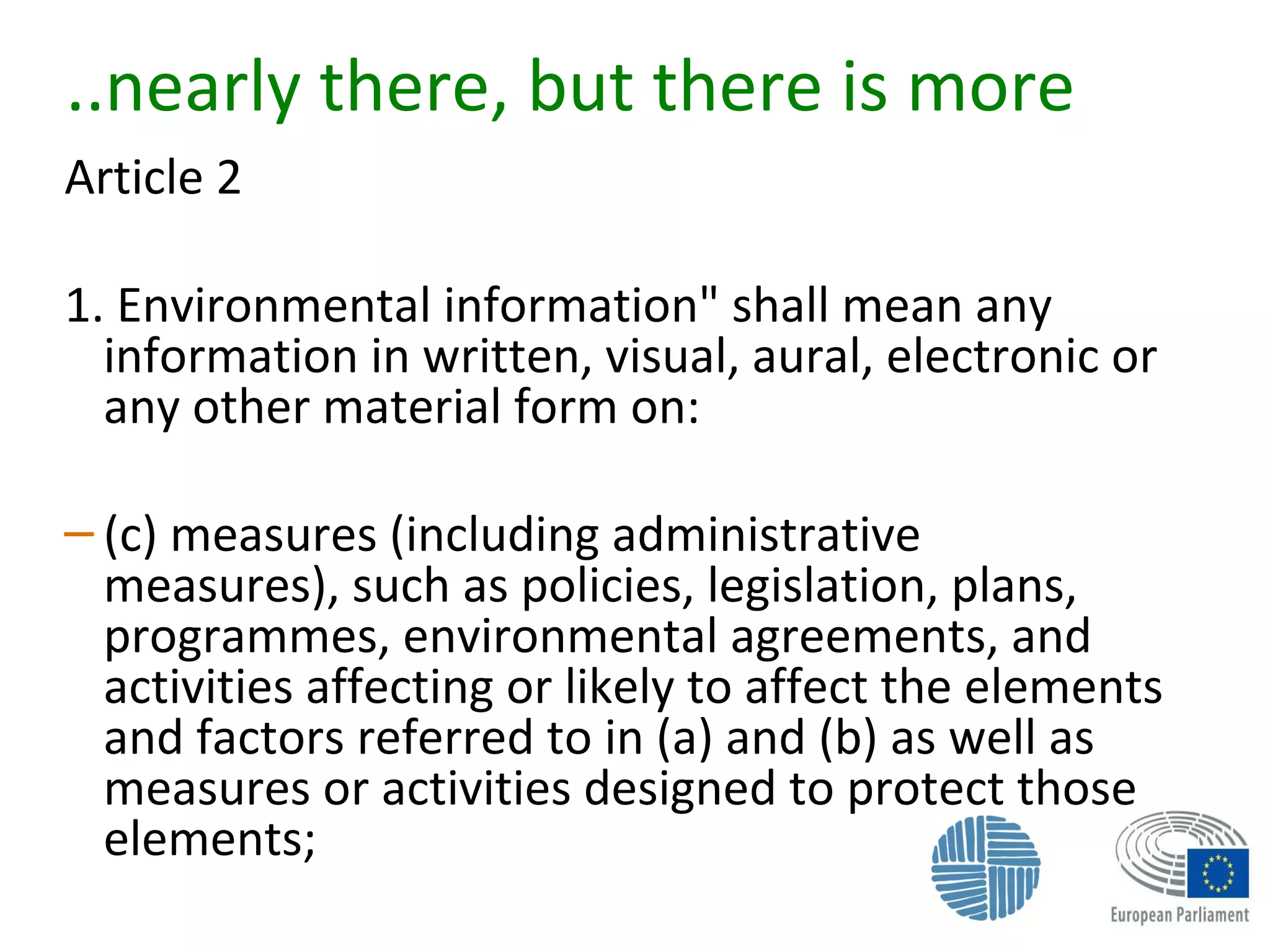
..nearly there, but there is more
Article 2
1. Environmental information" shall mean any
information in written, visual, aural, electronic or
any other material form on:
– (c) measures (including administrative
measures), such as policies, legislation, plans,
programmes, environmental agreements, and
activities affecting or likely to affect the elements
and factors referred to in (a) and (b) as well as
measures or activities designed to protect those
elements;
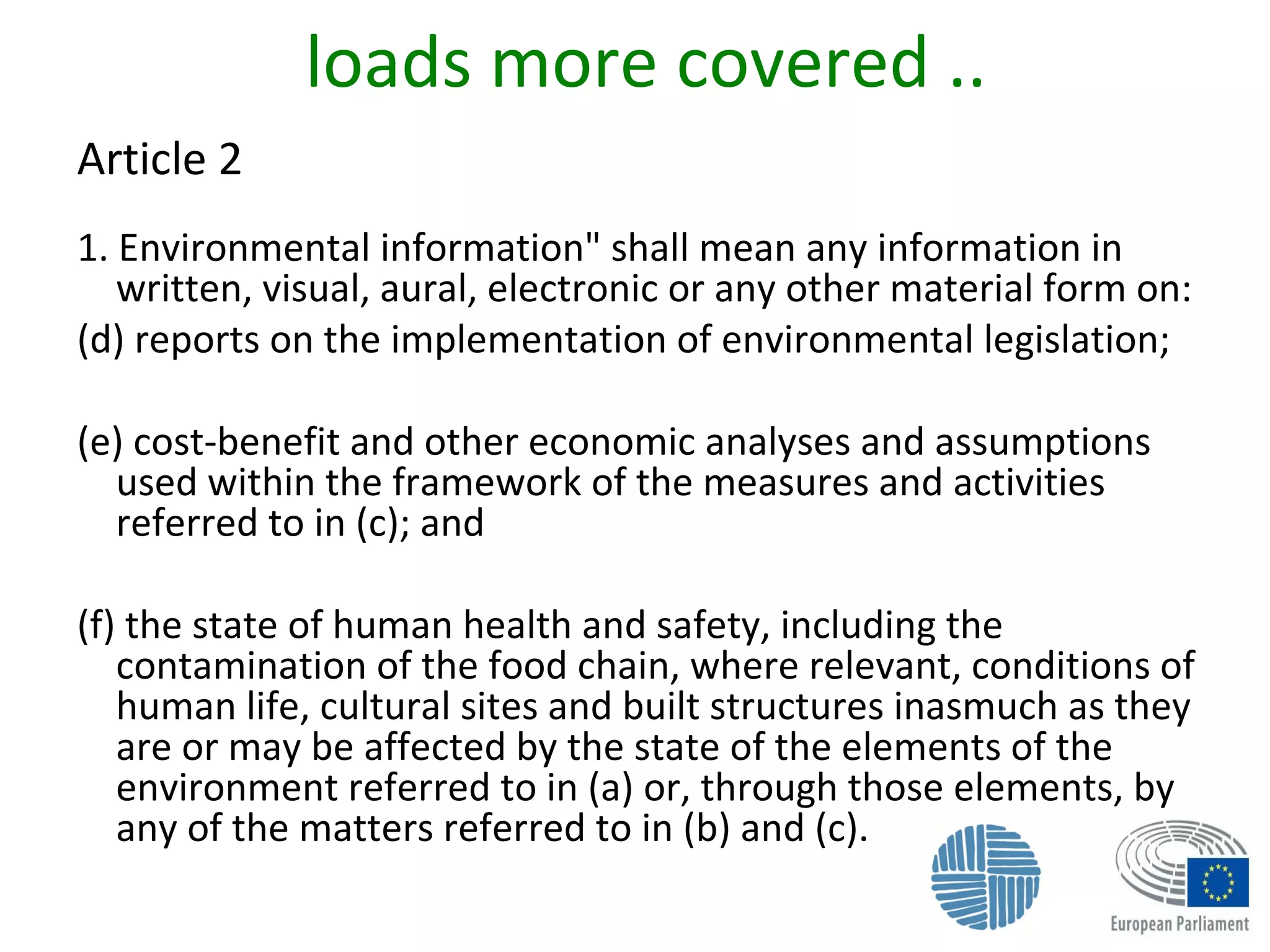
loads more covered ..
Article 2
1. Environmental information" shall mean any information in
written, visual, aural, electronic or any other material form on:
(d) reports on the implementation of environmental legislation;
(e) cost-benefit and other economic analyses and assumptions
used within the framework of the measures and activities
referred to in (c); and
(f) the state of human health and safety, including the
contamination of the food chain, where relevant, conditions of
human life, cultural sites and built structures inasmuch as they
are or may be affected by the state of the elements of the
environment referred to in (a) or, through those elements, by
any of the matters referred to in (b) and (c).
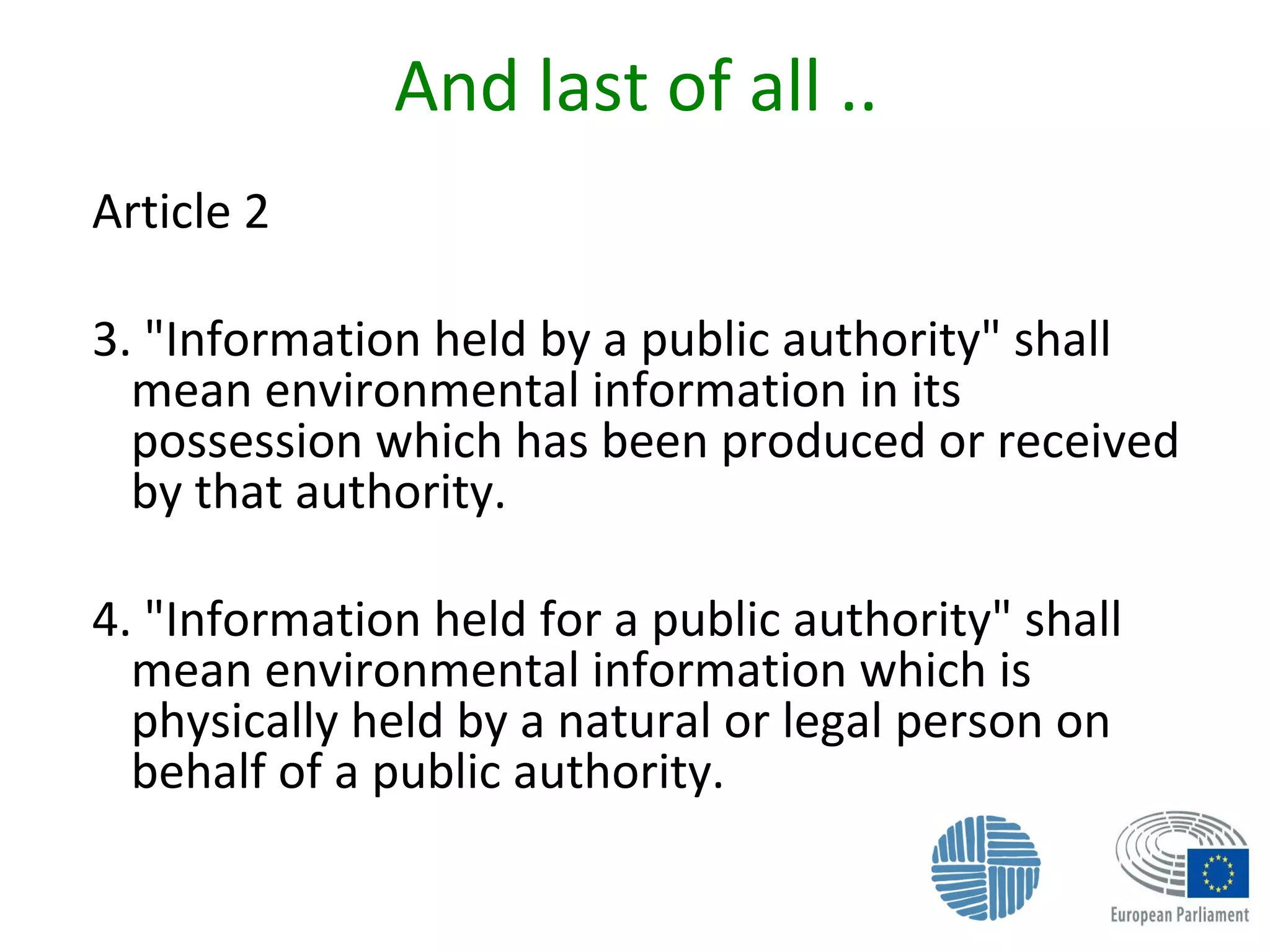
And last of all ..
Article 2
3. "Information held by a public authority" shall
mean environmental information in its
possession which has been produced or received
by that authority.
4. "Information held for a public authority" shall
mean environmental information which is
physically held by a natural or legal person on
behalf of a public authority.
Recap: What do you need to do first?

Consider carefully why and what you are asking for

Look first

Does it constitute “environmental information”?

Still wish to proceed ok ?
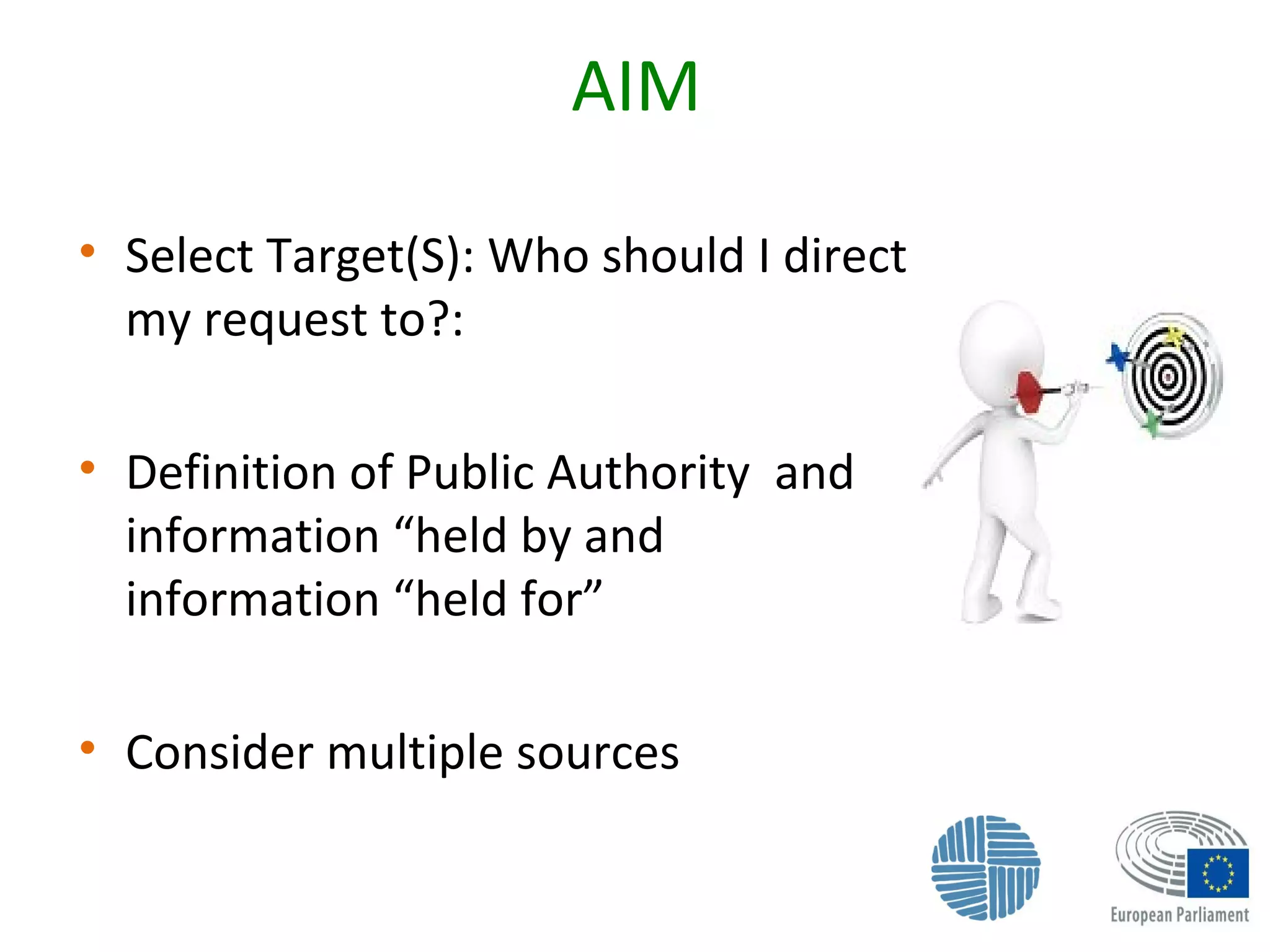
AIM
• Select Target(S): Who should I direct
my request to?:
• Definition of Public Authority and
information “held by and
information “held for”
• Consider multiple sources
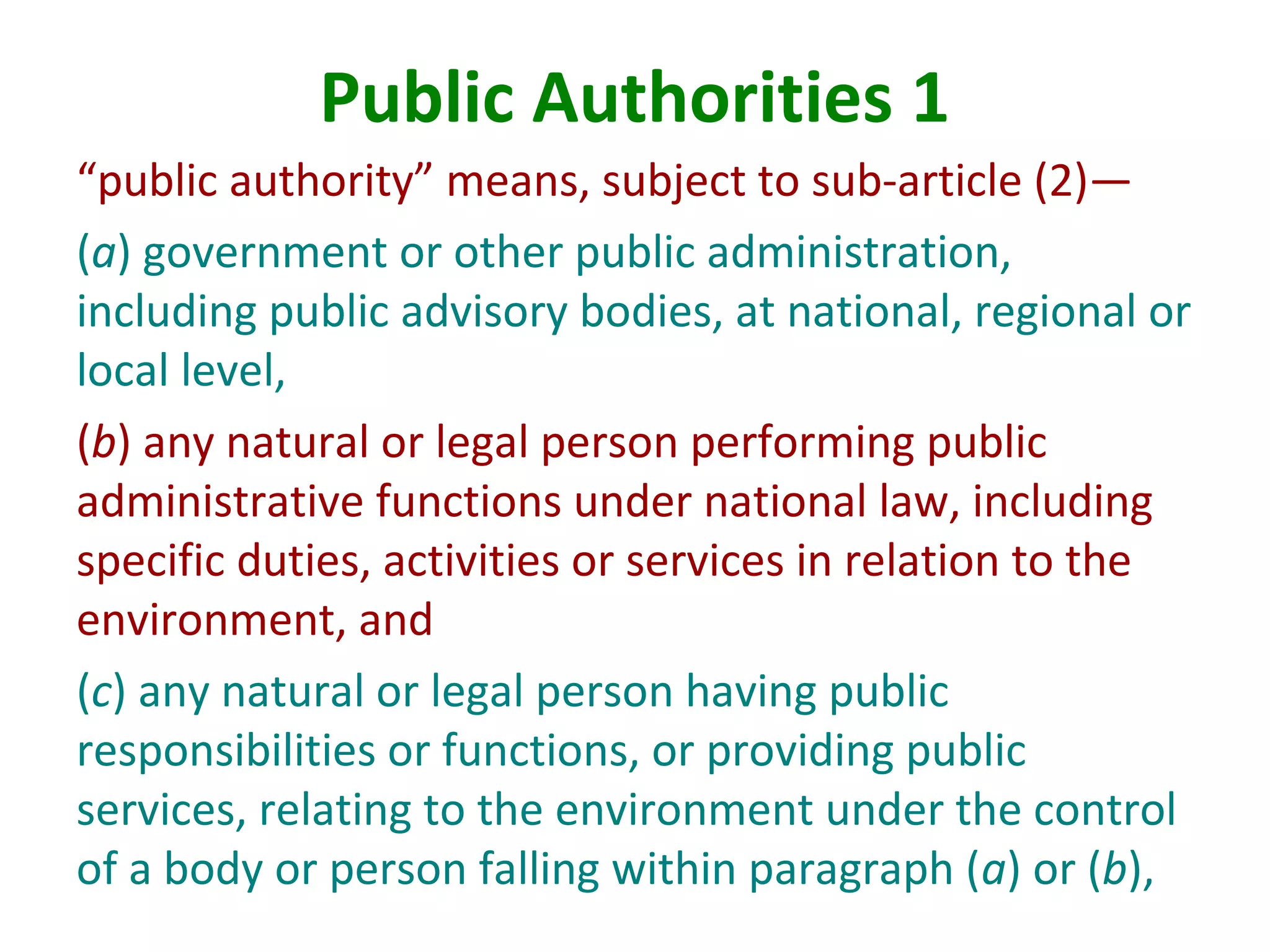
Public Authorities 1
“public authority” means, subject to sub-article (2)—
(a) government or other public administration,
including public advisory bodies, at national, regional or
local level,
(b) any natural or legal person performing public
administrative functions under national law, including
specific duties, activities or services in relation to the
environment, and
(c) any natural or legal person having public
responsibilities or functions, or providing public
services, relating to the environment under the control
of a body or person falling within paragraph (a) or (b),
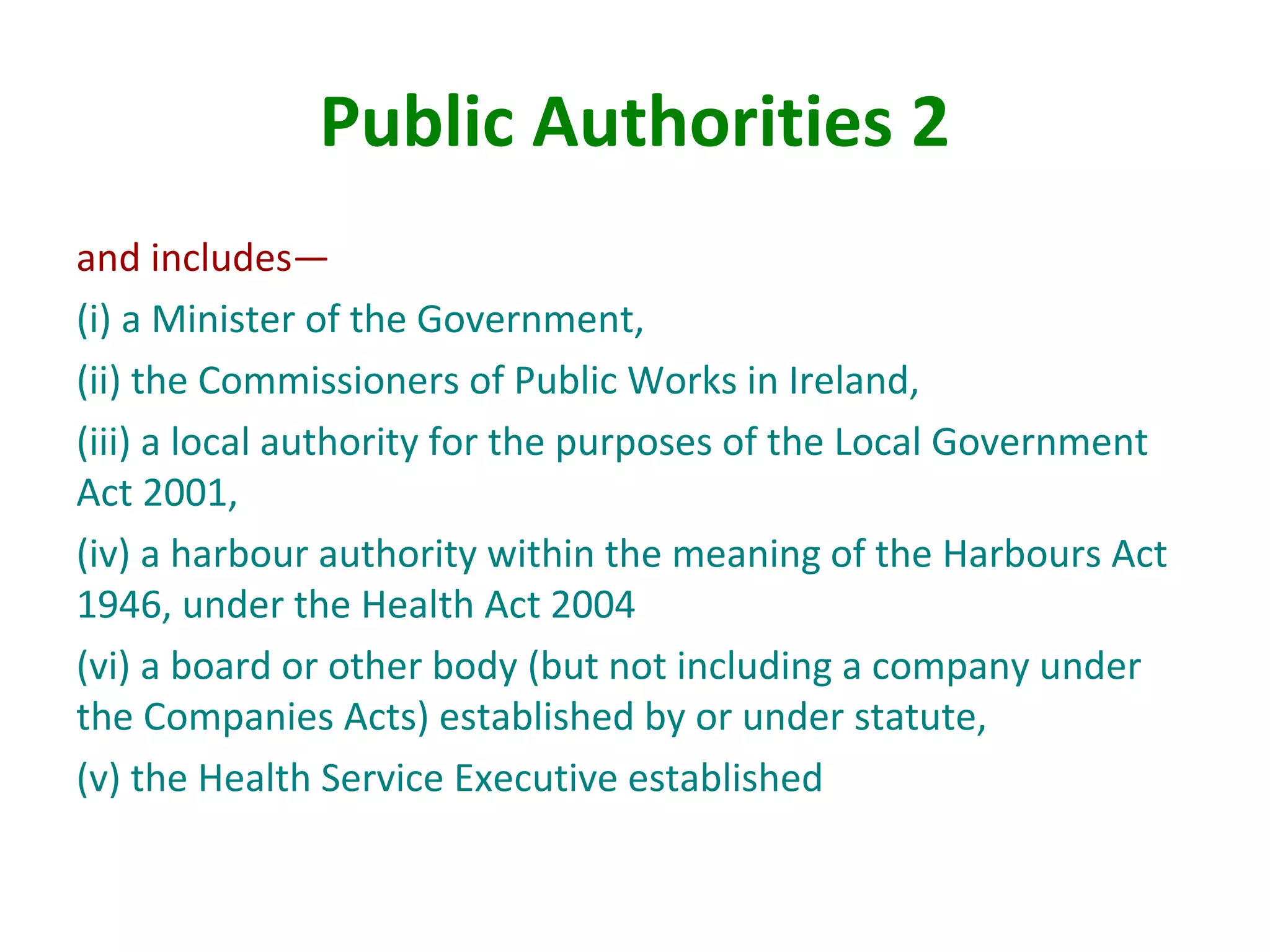
Public Authorities 2
and includes—
(i) a Minister of the Government,
(ii) the Commissioners of Public Works in Ireland,
(iii) a local authority for the purposes of the Local Government
Act 2001,
(iv) a harbour authority within the meaning of the Harbours Act
1946, under the Health Act 2004
(vi) a board or other body (but not including a company under
the Companies Acts) established by or under statute,
(v) the Health Service Executive established
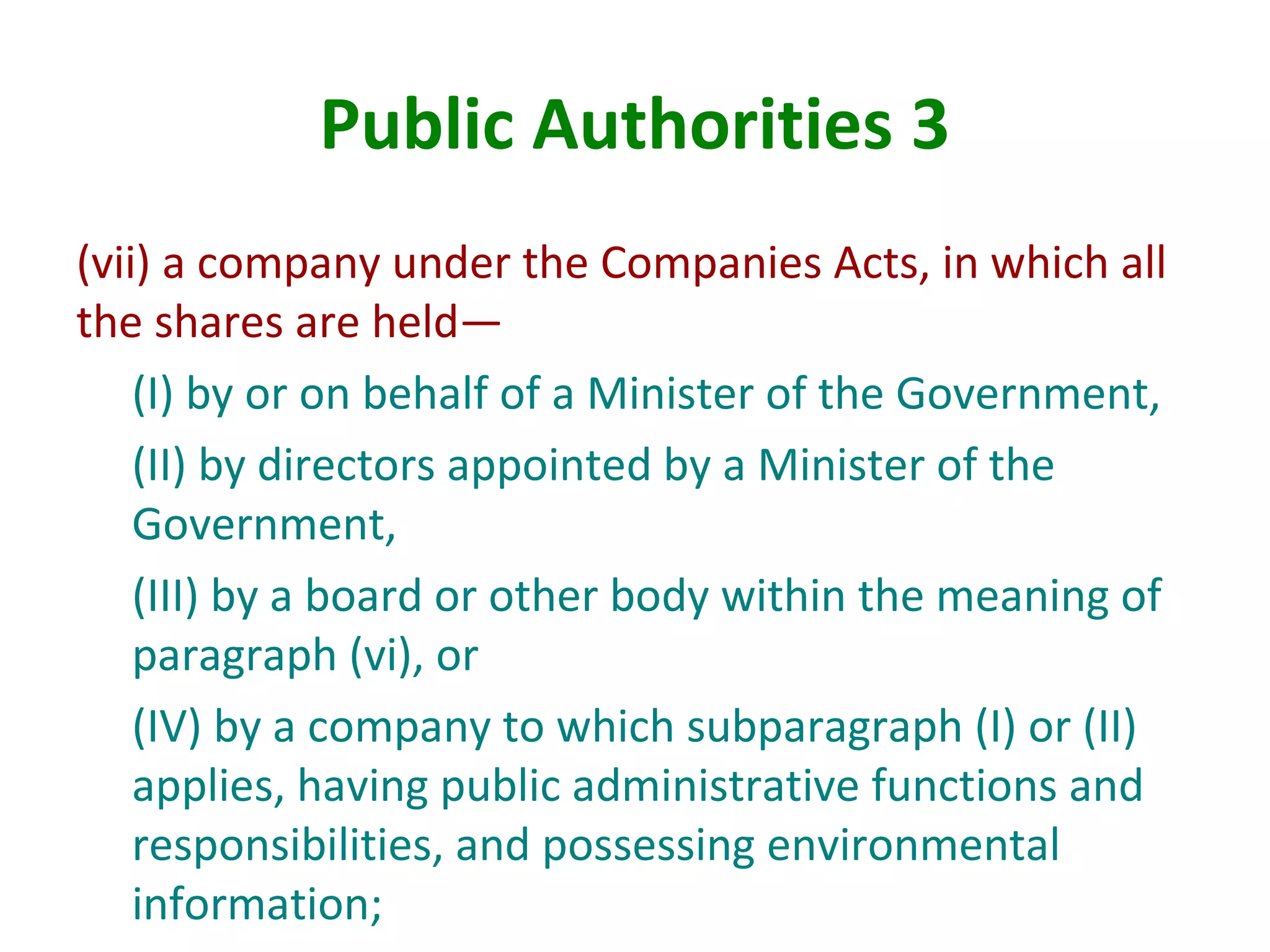
Public Authorities 3
(vii) a company under the Companies Acts, in which all
the shares are held—
(I) by or on behalf of a Minister of the Government,
(II) by directors appointed by a Minister of the
Government,
(III) by a board or other body within the meaning of
paragraph (vi), or
(IV) by a company to which subparagraph (I) or (II)
applies, having public administrative functions and
responsibilities, and possessing environmental
information;
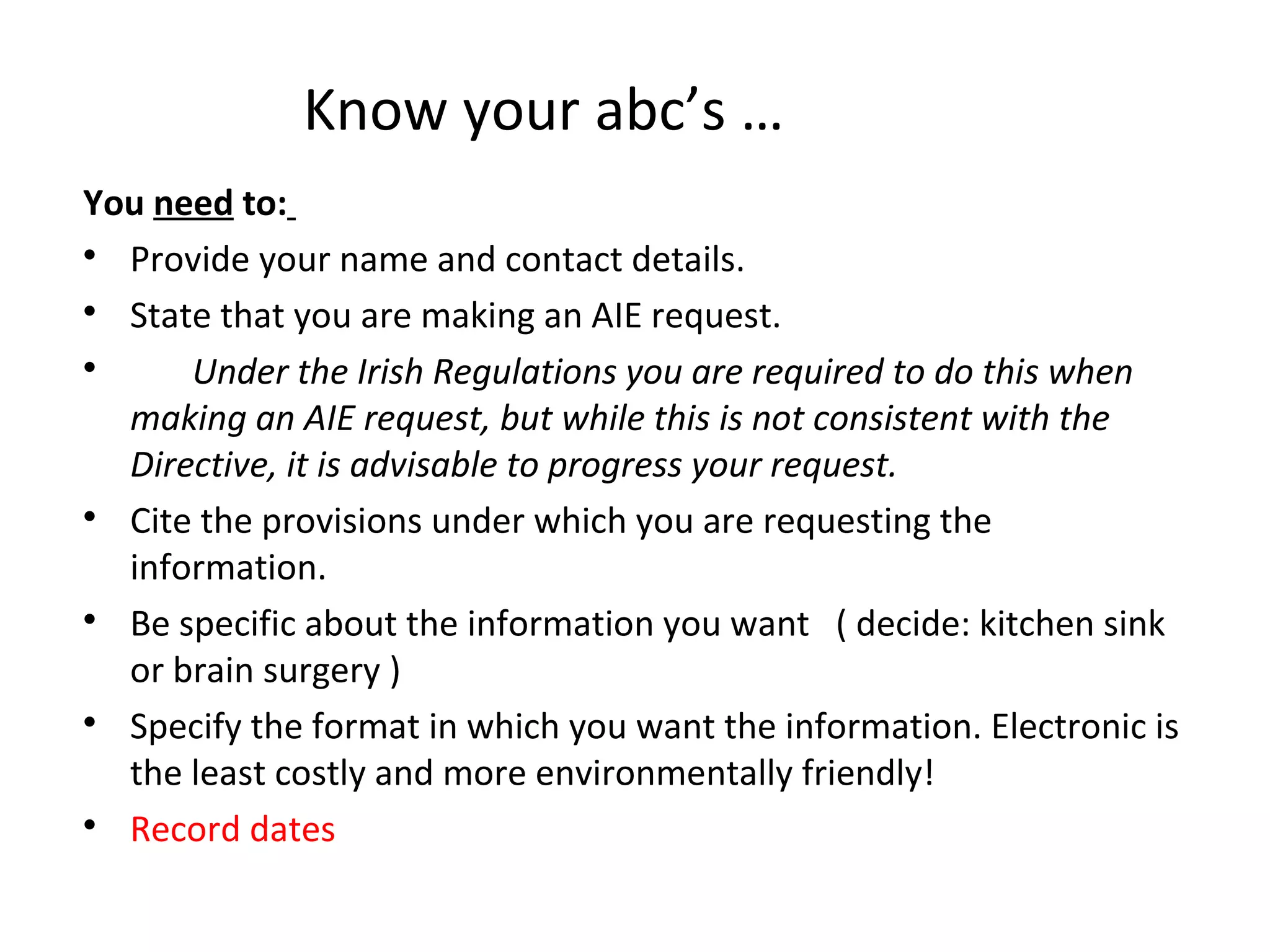
Know your abc’s …
You need to:

Provide your name and contact details.

State that you are making an AIE request.

Under the Irish Regulations you are required to do this when
making an AIE request, but while this is not consistent with the
Directive, it is advisable to progress your request.

Cite the provisions under which you are requesting the
information.

Be specific about the information you want ( decide: kitchen sink
or brain surgery )

Specify the format in which you want the information. Electronic is
the least costly and more environmentally friendly!

Record dates
Record dates
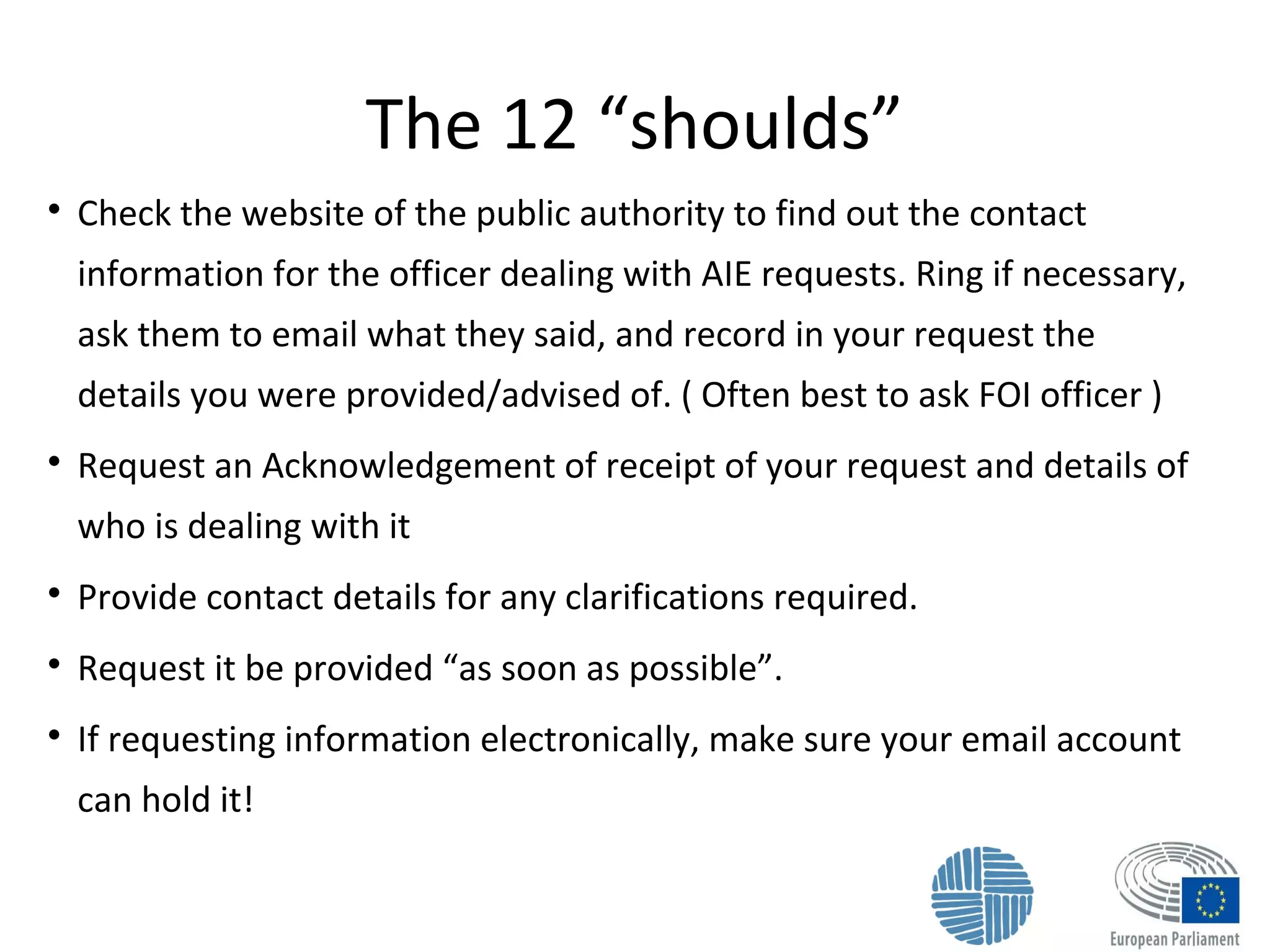
The 12 “shoulds”

Check the website of the public authority to find out the contact
information for the officer dealing with AIE requests. Ring if necessary,
ask them to email what they said, and record in your request the
details you were provided/advised of. ( Often best to ask FOI officer )

Request an Acknowledgement of receipt of your request and details of
who is dealing with it

Provide contact details for any clarifications required.

Request it be provided “as soon as possible”.

If requesting information electronically, make sure your email account
can hold it!
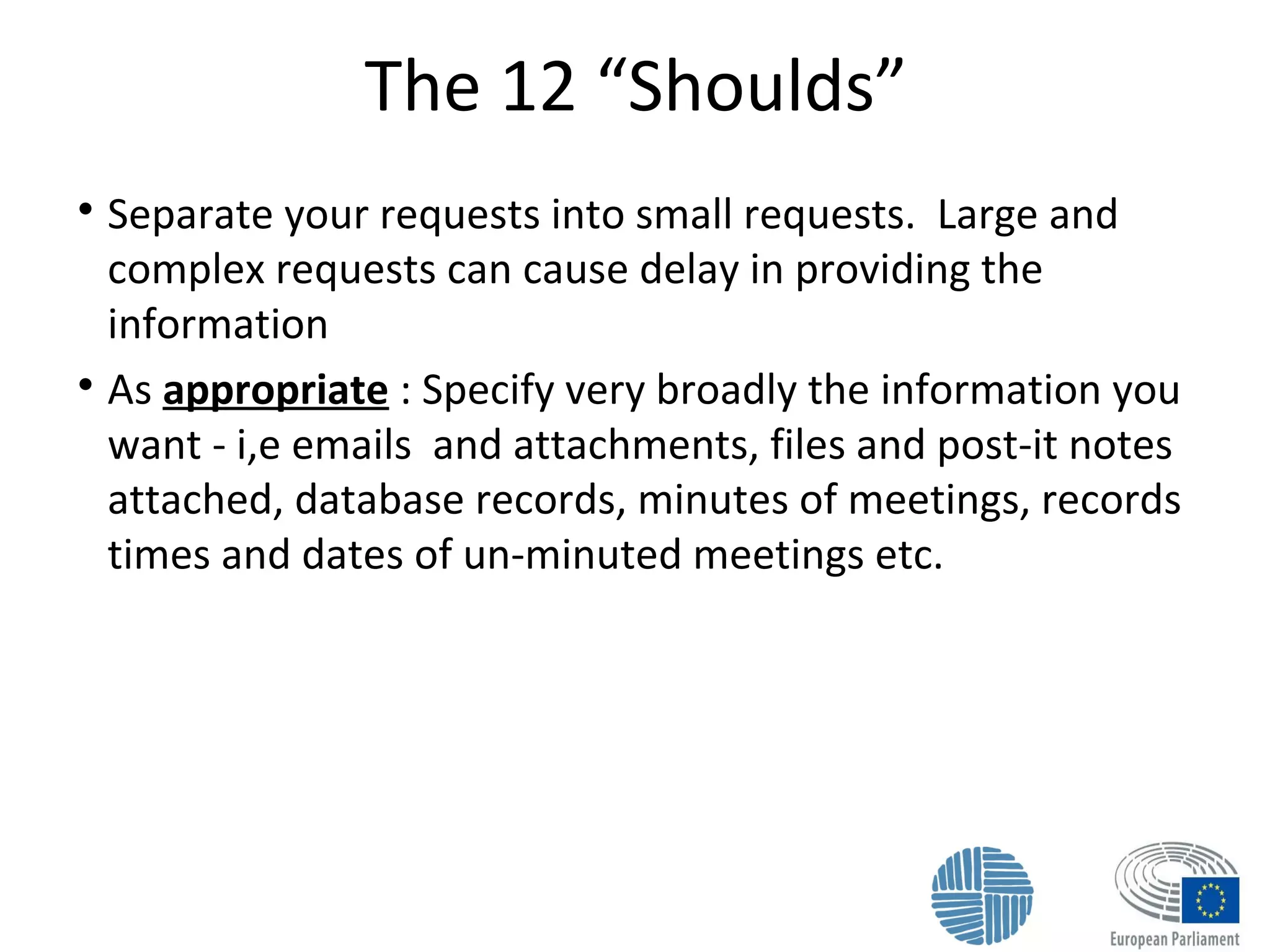
The 12 “Shoulds”

Separate your requests into small requests. Large and
complex requests can cause delay in providing the
information

As appropriate : Specify very broadly the information you
want - i,e emails and attachments, files and post-it notes
attached, database records, minutes of meetings, records
times and dates of un-minuted meetings etc.
The 12 “Shoulds” / Tips

Calculate key dates and create reminders.
Remember the timeframes for appeals are strict.
The 12“Shoulds” / Tips

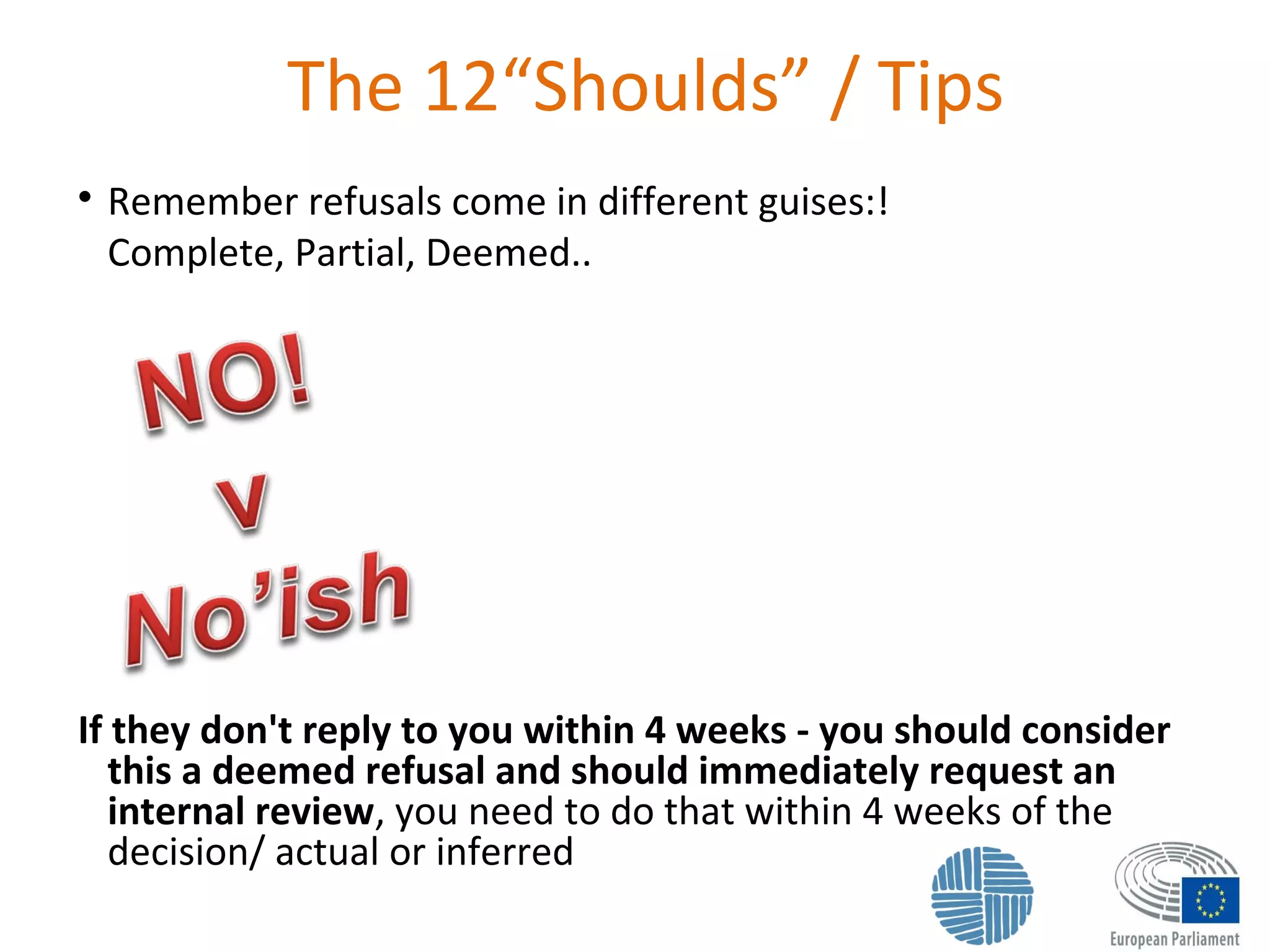
Remember refusals come in different guises:!
Complete, Partial, Deemed..
If they don't reply to you within 4 weeks - you should consider
this a deemed refusal and should immediately request an
internal review, you need to do that within 4 weeks of the
decision/ actual or inferred
The 12 “Shoulds” / Tips

Always check the text of the original directive and or
convention as there are issues with the Irish regulations.

Think about cross-requesting from different sources!

Remember it will take time to review the responses!
Summary Lifecycle
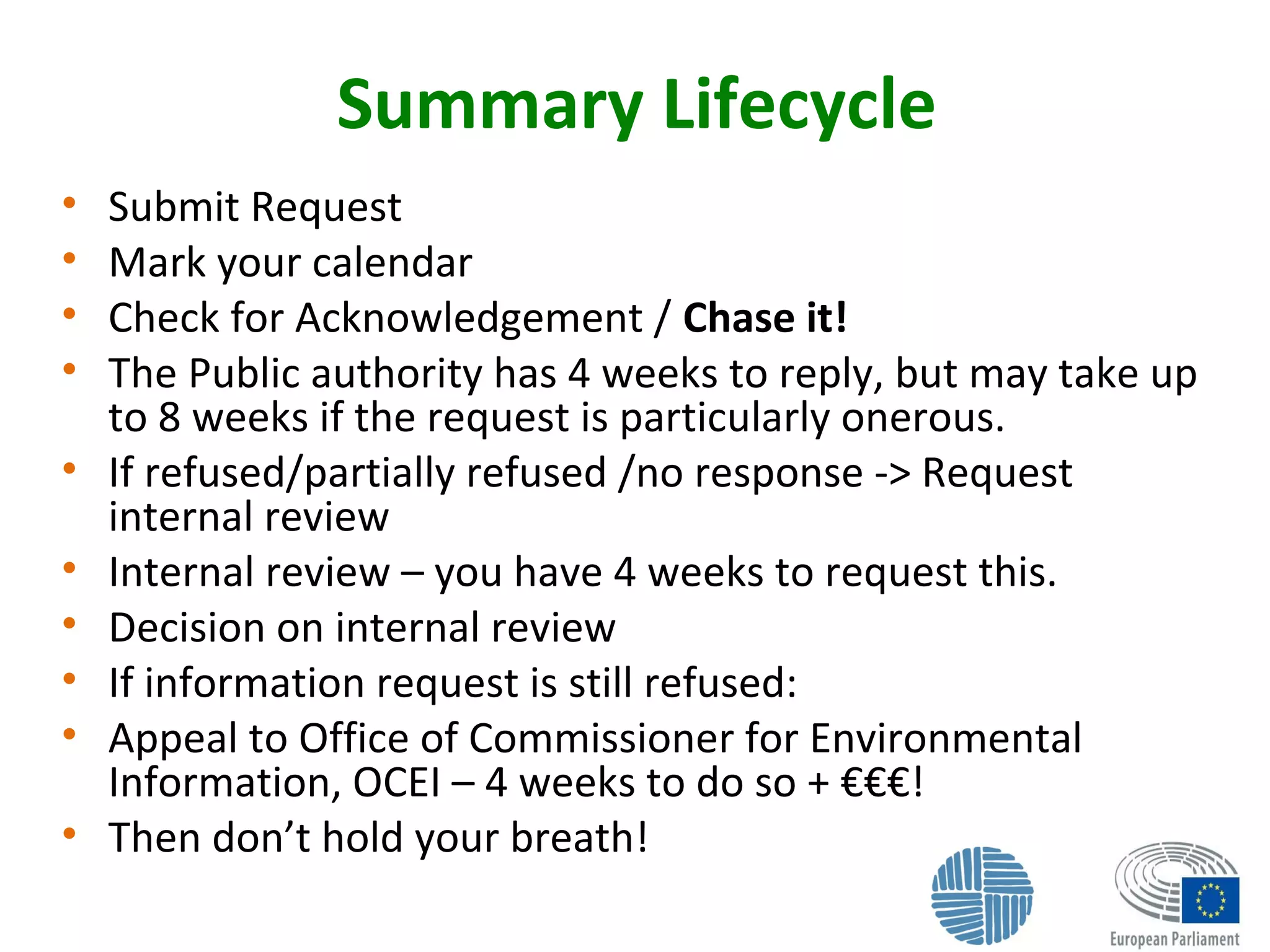
• Submit Request
• Mark your calendar
• Check for Acknowledgement / Chase it!
• The Public authority has 4 weeks to reply, but may take up
to 8 weeks if the request is particularly onerous.
• If refused/partially refused /no response -> Request
internal review
• Internal review – you have 4 weeks to request this.
• Decision on internal review
• If information request is still refused:
• Appeal to Office of Commissioner for Environmental
Information, OCEI – 4 weeks to do so + €€€!
• Then don’t hold your breath!
Thank You
Go raibh maith agaibh
www.environmentalpillar.ie
Michael Ewing - Coordinator 35

Aie presentation

  • 1.
    Your Rights toAccess Environmental Information Michael Ewing Coordinator of the Environmental Pillar
  • 2.
    Purpose & Objective Information:Guides and informs effective action “Thoughts are not facts” Typical methods: Leveraging the Oireachtas FOI ( Freedom of Information ) Access to Information requests/AIE Searching the Web ...
  • 3.
    “Different horses fordifferent courses”  Factors to consider:  Nature of information, Timing/lack of time, Sequence, …  Other tools:  Search thoroughly!  Seanad  Dáil  EU Structures
  • 4.
    Introduction to AIE •Foundation • Legislation • Basic Requirements “Dos and Don’ts” • Lifecycle of a request, scenarios • Template
  • 5.
    Where does AIEcome from?
  • 6.
    Like many goodthings ..it came from Rio !
  • 7.
    Principle 10 (P.10),of the ‘Rio DeclarationPrinciple 10 (P.10), of the ‘Rio Declaration on Environment and Development, 1992’,on Environment and Development, 1992’, “Environmental issues are best handled with the participation of all concerned citizens, at the relevant level. At the national level, each individual shall have appropriate access to information concerning the environment that is held by public authorities, including information on hazardous materials and activities in their communities, and the opportunity to participate in decision-making processes. States shall facilitate and encourage public awareness and participation by making information widely available. Effective access to judicial and administrative proceedings, including redress and remedy, shall be provided”.
  • 8.
    www.environmentalpillar.ie 8 1998 The UNECEdraws up a Convention to convert the aspirations of Principle 10 into International Law. Ireland ratified the Convention 20th June 2012. 19/05/17
  • 9.
    www.environmentalpillar.ie 9 The ThreeLegged Convention 19/05/17
  • 10.
    Aarhus Convention Access toInformation on the Environment • Article 1: Rights • Article 2: Definitions • Article 3: General Provisions • Article 4: Access to Environmental Information • Article 5: Collection & Dissemination of Environmental Info. • Article 9 Access to Justice
  • 11.
    Article 4 ACCESS TOENVIRONMENTAL INFORMATION 1. Each Party shall ensure that, subject to the following paragraphs of this article, public authorities, in response to a request for environmental information, make such information available to the public, within the framework of national legislation, including, where requested and subject to subparagraph (b) below, copies of the actual documentation containing or comprising such information: (a) Without an interest having to be stated; (b) In the form requested unless: (i) It is reasonable for the public authority to make it available in another form, in which case reasons shall be given for making it available in that form; or (ii) The information is already publicly available in another form.
  • 12.
    Legislation • DIRECTIVE 2003/4/ECOF THE EUROPEAN PARLIAMENT AND OF THE COUNCIL on public access to environmental information • http://eur-lex.europa.eu/LexUriServ/LexUriServ.do?uri=O
  • 13.
    National Regulations AIE Directiveis purportedly implemented by: European Communities (Access to Information on the Environment) Regulations 2007 to 2011. The actual Statutory Instruments are: – S.I. No. 133 of 2007 and S.I. No. 662 of 2011 • DCCAE General Information: http://www.environ.ie/en/Environment/AccesstoInformationon
  • 14.
    Do’s • Consider carefullywhat you want and why you want it! • Then…: – Consider carefully what you actually want and why you actually want it! • And finally: – Consider carefully what you really want and why you really want it!
  • 15.
    Look first! • Look/Searchfirst …thoroughly! • Remember processing requests requires public resources
  • 16.
    Does it conform? Askyourself: –Is it “environmental information” as defined by the Directive?
  • 17.
    But Definitions arekey! Article 2 1. Environmental information" shall mean any information in written, visual, aural, electronic or any other material form on: – (a) the state of the elements of the environment, such as air and atmosphere, water, soil, land, landscape and natural sites including wetlands, coastal and marine areas, biological diversity and its components, including genetically modified organisms, and the interaction among these elements;
  • 18.
    Definitions are cool! Article2 1. Environmental information" shall mean any information in written, visual, aural, electronic or any other material form on: – (b) factors, such as substances, energy, noise, radiation or waste, including radioactive waste, emissions, discharges and other releases into the environment, affecting or likely to affect the elements of the environment referred to in (a);
  • 19.
    ..nearly there, butthere is more Article 2 1. Environmental information" shall mean any information in written, visual, aural, electronic or any other material form on: – (c) measures (including administrative measures), such as policies, legislation, plans, programmes, environmental agreements, and activities affecting or likely to affect the elements and factors referred to in (a) and (b) as well as measures or activities designed to protect those elements;
  • 20.
    loads more covered.. Article 2 1. Environmental information" shall mean any information in written, visual, aural, electronic or any other material form on: (d) reports on the implementation of environmental legislation; (e) cost-benefit and other economic analyses and assumptions used within the framework of the measures and activities referred to in (c); and (f) the state of human health and safety, including the contamination of the food chain, where relevant, conditions of human life, cultural sites and built structures inasmuch as they are or may be affected by the state of the elements of the environment referred to in (a) or, through those elements, by any of the matters referred to in (b) and (c).
  • 21.
    And last ofall .. Article 2 3. "Information held by a public authority" shall mean environmental information in its possession which has been produced or received by that authority. 4. "Information held for a public authority" shall mean environmental information which is physically held by a natural or legal person on behalf of a public authority.
  • 22.
    Recap: What doyou need to do first?  Consider carefully why and what you are asking for  Look first  Does it constitute “environmental information”?  Still wish to proceed ok ?
  • 23.
    AIM • Select Target(S):Who should I direct my request to?: • Definition of Public Authority and information “held by and information “held for” • Consider multiple sources
  • 24.
    Public Authorities 1 “publicauthority” means, subject to sub-article (2)— (a) government or other public administration, including public advisory bodies, at national, regional or local level, (b) any natural or legal person performing public administrative functions under national law, including specific duties, activities or services in relation to the environment, and (c) any natural or legal person having public responsibilities or functions, or providing public services, relating to the environment under the control of a body or person falling within paragraph (a) or (b),
  • 25.
    Public Authorities 2 andincludes— (i) a Minister of the Government, (ii) the Commissioners of Public Works in Ireland, (iii) a local authority for the purposes of the Local Government Act 2001, (iv) a harbour authority within the meaning of the Harbours Act 1946, under the Health Act 2004 (vi) a board or other body (but not including a company under the Companies Acts) established by or under statute, (v) the Health Service Executive established
  • 26.
    Public Authorities 3 (vii)a company under the Companies Acts, in which all the shares are held— (I) by or on behalf of a Minister of the Government, (II) by directors appointed by a Minister of the Government, (III) by a board or other body within the meaning of paragraph (vi), or (IV) by a company to which subparagraph (I) or (II) applies, having public administrative functions and responsibilities, and possessing environmental information;
  • 27.
    Know your abc’s… You need to:  Provide your name and contact details.  State that you are making an AIE request.  Under the Irish Regulations you are required to do this when making an AIE request, but while this is not consistent with the Directive, it is advisable to progress your request.  Cite the provisions under which you are requesting the information.  Be specific about the information you want ( decide: kitchen sink or brain surgery )  Specify the format in which you want the information. Electronic is the least costly and more environmentally friendly!  Record dates
  • 28.
  • 29.
    The 12 “shoulds”  Checkthe website of the public authority to find out the contact information for the officer dealing with AIE requests. Ring if necessary, ask them to email what they said, and record in your request the details you were provided/advised of. ( Often best to ask FOI officer )  Request an Acknowledgement of receipt of your request and details of who is dealing with it  Provide contact details for any clarifications required.  Request it be provided “as soon as possible”.  If requesting information electronically, make sure your email account can hold it!
  • 30.
    The 12 “Shoulds”  Separateyour requests into small requests. Large and complex requests can cause delay in providing the information  As appropriate : Specify very broadly the information you want - i,e emails and attachments, files and post-it notes attached, database records, minutes of meetings, records times and dates of un-minuted meetings etc.
  • 31.
    The 12 “Shoulds”/ Tips  Calculate key dates and create reminders. Remember the timeframes for appeals are strict.
  • 32.
    The 12“Shoulds” /Tips  Remember refusals come in different guises:! Complete, Partial, Deemed.. If they don't reply to you within 4 weeks - you should consider this a deemed refusal and should immediately request an internal review, you need to do that within 4 weeks of the decision/ actual or inferred
  • 33.
    The 12 “Shoulds”/ Tips  Always check the text of the original directive and or convention as there are issues with the Irish regulations.  Think about cross-requesting from different sources!  Remember it will take time to review the responses!
  • 34.
    Summary Lifecycle • SubmitRequest • Mark your calendar • Check for Acknowledgement / Chase it! • The Public authority has 4 weeks to reply, but may take up to 8 weeks if the request is particularly onerous. • If refused/partially refused /no response -> Request internal review • Internal review – you have 4 weeks to request this. • Decision on internal review • If information request is still refused: • Appeal to Office of Commissioner for Environmental Information, OCEI – 4 weeks to do so + €€€! • Then don’t hold your breath!
  • 35.
    Thank You Go raibhmaith agaibh www.environmentalpillar.ie Michael Ewing - Coordinator 35