Introduction to Artificial
Intelligence
AI Demo Lecture – Air University
Islamabad
What is Artificial Intelligence (AI)?
• AI is the simulation of human intelligence in
machines.
• It enables machines to learn, reason, and
make decisions.
• Examples: Self-driving cars, chatbots, facial
recognition, etc.
Understanding AI Further
• AI combines computer science, mathematics, and
cognitive science.
• It can be categorized as:
- Narrow AI: Performs specific tasks (e.g., Siri,
Google Translate)
- General AI: Performs any intellectual task like a
human (still theoretical)
• AI applications range across healthcare, finance,
robotics, and education.
Techniques in AI
• Machine Learning (ML): Learning from data
• Deep Learning (DL): Neural networks with many
layers
• Natural Language Processing (NLP):
Understanding human language
• Computer Vision: Interpreting visual information
• Expert Systems: Rule-based decision-making
systems
Example ML Algorithm: Decision
Trees
• Decision Trees are used for classification and
regression tasks.
• They split data based on feature values into
tree-like structures.
• Easy to interpret and visualize.
• Example: Classifying emails as spam or not
spam based on keywords.
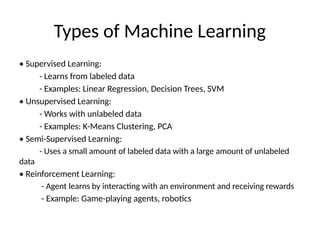
Types of Machine Learning
• Supervised Learning:
- Learns from labeled data
- Examples: Linear Regression, Decision Trees, SVM
• Unsupervised Learning:
- Works with unlabeled data
- Examples: K-Means Clustering, PCA
• Semi-Supervised Learning:
- Uses a small amount of labeled data with a large amount of unlabeled
data
• Reinforcement Learning:
- Agent learns by interacting with an environment and receiving rewards
- Example: Game-playing agents, robotics
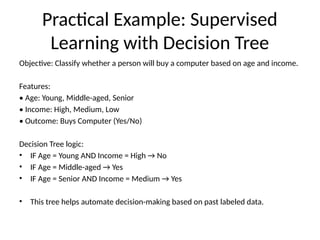
Practical Example: Supervised
Learning with Decision Tree
Objective: Classify whether a person will buy a computer based on age and income.
Features:
• Age: Young, Middle-aged, Senior
• Income: High, Medium, Low
• Outcome: Buys Computer (Yes/No)
Decision Tree logic:
• IF Age = Young AND Income = High → No
• IF Age = Middle-aged → Yes
• IF Age = Senior AND Income = Medium → Yes
• This tree helps automate decision-making based on past labeled data.

AI_Demo_Lecture_With_Practical_Example.pptx

  • 1.
    Introduction to Artificial Intelligence AIDemo Lecture – Air University Islamabad
  • 2.
    What is ArtificialIntelligence (AI)? • AI is the simulation of human intelligence in machines. • It enables machines to learn, reason, and make decisions. • Examples: Self-driving cars, chatbots, facial recognition, etc.
  • 3.
    Understanding AI Further •AI combines computer science, mathematics, and cognitive science. • It can be categorized as: - Narrow AI: Performs specific tasks (e.g., Siri, Google Translate) - General AI: Performs any intellectual task like a human (still theoretical) • AI applications range across healthcare, finance, robotics, and education.
  • 4.
    Techniques in AI •Machine Learning (ML): Learning from data • Deep Learning (DL): Neural networks with many layers • Natural Language Processing (NLP): Understanding human language • Computer Vision: Interpreting visual information • Expert Systems: Rule-based decision-making systems
  • 5.
    Example ML Algorithm:Decision Trees • Decision Trees are used for classification and regression tasks. • They split data based on feature values into tree-like structures. • Easy to interpret and visualize. • Example: Classifying emails as spam or not spam based on keywords.
  • 6.
    Types of MachineLearning • Supervised Learning: - Learns from labeled data - Examples: Linear Regression, Decision Trees, SVM • Unsupervised Learning: - Works with unlabeled data - Examples: K-Means Clustering, PCA • Semi-Supervised Learning: - Uses a small amount of labeled data with a large amount of unlabeled data • Reinforcement Learning: - Agent learns by interacting with an environment and receiving rewards - Example: Game-playing agents, robotics
  • 7.
    Practical Example: Supervised Learningwith Decision Tree Objective: Classify whether a person will buy a computer based on age and income. Features: • Age: Young, Middle-aged, Senior • Income: High, Medium, Low • Outcome: Buys Computer (Yes/No) Decision Tree logic: • IF Age = Young AND Income = High → No • IF Age = Middle-aged → Yes • IF Age = Senior AND Income = Medium → Yes • This tree helps automate decision-making based on past labeled data.