The Dropouts
COVID-19 Detection using X-ray
images
Vishal Rishi M.K – 6379592151
Harish Iniyarajan – 9600750441
Bharathi Mozhian M – 9444159358
Janaki Raman – 6379740399
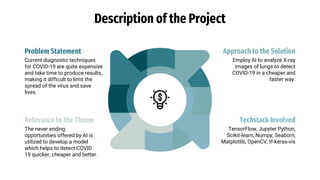
Description of the Project
Techstack Involved
TensorFlow, Jupyter Python,
Scikit-learn, Numpy, Seaborn,
Matplotlib, OpenCV, tf-keras-vis
Relevance to the Theme
The never ending
opportunities offered by AI is
utilized to develop a model
which helps to detect COVID
19 quicker, cheaper and better.
Problem Statement
Current diagnostic techniques
for COVID-19 are quite expensive
and take time to produce results,
making it difficult to limit the
spread of the virus and save
lives.
Approach to the Solution
Employ AI to analyze X-ray
images of lungs to detect
COVID-19 in a cheaper and
faster way.
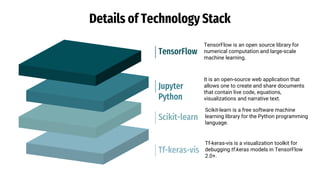
Tf-keras-vis
Tf-keras-vis is a visualization toolkit for
debugging tf.keras models in TensorFlow
2.0+.
Scikit-learn
Scikit-learn is a free software machine
learning library for the Python programming
language.
Jupyter
Python
It is an open-source web application that
allows one to create and share documents
that contain live code, equations,
visualizations and narrative text.
Details of Technology Stack
TensorFlow
TensorFlow is an open source library for
numerical computation and large-scale
machine learning.
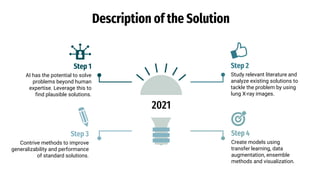
Description of the Solution
Step 2
Study relevant literature and
analyze existing solutions to
tackle the problem by using
lung X-ray images.
Step 4
Create models using
transfer learning, data
augmentation, ensemble
methods and visualization.
Step 1
AI has the potential to solve
problems beyond human
expertise. Leverage this to
find plausible solutions.
Step 3
Contrive methods to improve
generalizability and performance
of standard solutions.
2021
Novelty of the Solution
• Providing visualization techniques that improve interpretability thus enabling the medical community to
understand the reason behind AI’s decision.
• Train, test and compare excellent pre-trained networks and use ensemble methods for robust results.
• Explain feature entanglement using auto encoders and PCA. The model captures excellent features that
distinguish between the classes.
• Our model produced second best accuracy of 94.5% tested on 96 samples in a Kaggle competition. High
accuracy with a small dataset speaks volumes about the model’s generalization and performance.
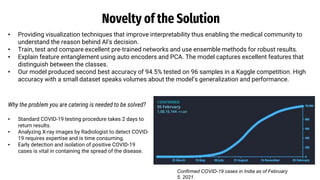
Why the problem you are catering is needed to be solved?
▪ Standard COVID-19 testing procedure takes 2 days to
return results.
▪ Analyzing X-ray images by Radiologist to detect COVID-
19 requires expertise and is time consuming.
▪ Early detection and isolation of positive COVID-19
cases is vital in containing the spread of the disease.
Confirmed COVID-19 cases in India as of February
5, 2021.
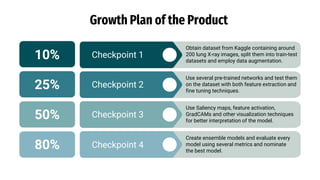
Growth Plan of the Product
Checkpoint 1
Obtain dataset from Kaggle containing around
200 lung X-ray images, split them into train-test
datasets and employ data augmentation.
10%
Checkpoint 2
Use several pre-trained networks and test them
on the dataset with both feature extraction and
fine tuning techniques.
25%
Checkpoint 3
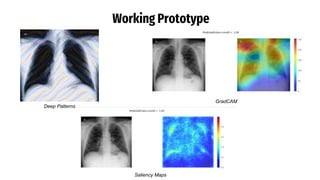
Use Saliency maps, feature activation,
GradCAMs and other visualization techniques
for better interpretation of the model.
50%
Checkpoint 4
Create ensemble models and evaluate every
model using several metrics and nominate
the best model.
80%
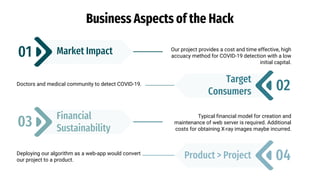
Business Aspects of the Hack
Market Impact
01 Our project provides a cost and time effective, high
accuacy method for COVID-19 detection with a low
initial capital.
Financial
Sustainability
03
Typical financial model for creation and
maintenance of web server is required. Additional
costs for obtaining X-ray images maybe incurred.
Target
Consumers 02
Doctors and medical community to detect COVID-19.
Product > Project 04
Deploying our algorithm as a web-app would convert
our project to a product.
Working Prototype
Deep Patterns
GradCAM
Saliency Maps
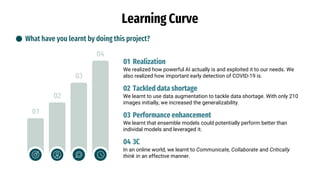
Learning Curve
What have you learnt by doing this project?
01
02
03
04
01
We realized how powerful AI actually is and exploited it to our needs. We
also realized how important early detection of COVID-19 is.
Realization
02
We learnt to use data augmentation to tackle data shortage. With only 210
images initially, we increased the generalizability.
Tackled data shortage
03
We learnt that ensemble models could potentially perform better than
individal models and leveraged it.
Performance enhancement
04
In an online world, we learnt to Communicate, Collaborate and Critically
think in an effective manner.
3C
External referenes:
1) https://github.com/keisen/tf-keras-
vis/blob/master/examples/attentions.ipynb
2) https://www.tensorflow.org/tutorials/gener
ative/deepdream
3) https://arxiv.org/pdf/2004.13175.pdf
About Team
03
Team Member
Bharathi Mozhian M
Team Member
Harish Iniyarajan
04
01
Team Lead
Vishal Rishi M.K
02
Team Member
Janaki Raman

BbbbbbbbbbbbbbbbbbbbbbElectrothonPPT.pptx

  • 1.
    The Dropouts COVID-19 Detectionusing X-ray images Vishal Rishi M.K – 6379592151 Harish Iniyarajan – 9600750441 Bharathi Mozhian M – 9444159358 Janaki Raman – 6379740399
  • 2.
    Description of theProject Techstack Involved TensorFlow, Jupyter Python, Scikit-learn, Numpy, Seaborn, Matplotlib, OpenCV, tf-keras-vis Relevance to the Theme The never ending opportunities offered by AI is utilized to develop a model which helps to detect COVID 19 quicker, cheaper and better. Problem Statement Current diagnostic techniques for COVID-19 are quite expensive and take time to produce results, making it difficult to limit the spread of the virus and save lives. Approach to the Solution Employ AI to analyze X-ray images of lungs to detect COVID-19 in a cheaper and faster way.
  • 3.
    Tf-keras-vis Tf-keras-vis is avisualization toolkit for debugging tf.keras models in TensorFlow 2.0+. Scikit-learn Scikit-learn is a free software machine learning library for the Python programming language. Jupyter Python It is an open-source web application that allows one to create and share documents that contain live code, equations, visualizations and narrative text. Details of Technology Stack TensorFlow TensorFlow is an open source library for numerical computation and large-scale machine learning.
  • 4.
    Description of theSolution Step 2 Study relevant literature and analyze existing solutions to tackle the problem by using lung X-ray images. Step 4 Create models using transfer learning, data augmentation, ensemble methods and visualization. Step 1 AI has the potential to solve problems beyond human expertise. Leverage this to find plausible solutions. Step 3 Contrive methods to improve generalizability and performance of standard solutions. 2021
  • 5.
    Novelty of theSolution • Providing visualization techniques that improve interpretability thus enabling the medical community to understand the reason behind AI’s decision. • Train, test and compare excellent pre-trained networks and use ensemble methods for robust results. • Explain feature entanglement using auto encoders and PCA. The model captures excellent features that distinguish between the classes. • Our model produced second best accuracy of 94.5% tested on 96 samples in a Kaggle competition. High accuracy with a small dataset speaks volumes about the model’s generalization and performance. Why the problem you are catering is needed to be solved? ▪ Standard COVID-19 testing procedure takes 2 days to return results. ▪ Analyzing X-ray images by Radiologist to detect COVID- 19 requires expertise and is time consuming. ▪ Early detection and isolation of positive COVID-19 cases is vital in containing the spread of the disease. Confirmed COVID-19 cases in India as of February 5, 2021.
  • 6.
    Growth Plan ofthe Product Checkpoint 1 Obtain dataset from Kaggle containing around 200 lung X-ray images, split them into train-test datasets and employ data augmentation. 10% Checkpoint 2 Use several pre-trained networks and test them on the dataset with both feature extraction and fine tuning techniques. 25% Checkpoint 3 Use Saliency maps, feature activation, GradCAMs and other visualization techniques for better interpretation of the model. 50% Checkpoint 4 Create ensemble models and evaluate every model using several metrics and nominate the best model. 80%
  • 7.
    Business Aspects ofthe Hack Market Impact 01 Our project provides a cost and time effective, high accuacy method for COVID-19 detection with a low initial capital. Financial Sustainability 03 Typical financial model for creation and maintenance of web server is required. Additional costs for obtaining X-ray images maybe incurred. Target Consumers 02 Doctors and medical community to detect COVID-19. Product > Project 04 Deploying our algorithm as a web-app would convert our project to a product.
  • 8.
  • 9.
    Learning Curve What haveyou learnt by doing this project? 01 02 03 04 01 We realized how powerful AI actually is and exploited it to our needs. We also realized how important early detection of COVID-19 is. Realization 02 We learnt to use data augmentation to tackle data shortage. With only 210 images initially, we increased the generalizability. Tackled data shortage 03 We learnt that ensemble models could potentially perform better than individal models and leveraged it. Performance enhancement 04 In an online world, we learnt to Communicate, Collaborate and Critically think in an effective manner. 3C
  • 10.
    External referenes: 1) https://github.com/keisen/tf-keras- vis/blob/master/examples/attentions.ipynb 2)https://www.tensorflow.org/tutorials/gener ative/deepdream 3) https://arxiv.org/pdf/2004.13175.pdf
  • 11.
    About Team 03 Team Member BharathiMozhian M Team Member Harish Iniyarajan 04 01 Team Lead Vishal Rishi M.K 02 Team Member Janaki Raman