AI hype aside, it is not a panacea and comes with a great many challenges. Network and processing demand will explode.
AI Adoption, globally, is cautiously skyrocketing.
“Life Imitates Art.”Autonomous machines
go back as far as 1918 in our imaginations
1918 Houdini
The Master
Mystery
The First Autonomous
Machines was named SHAKEY
in 1963 and it is the same tech
used in the Mars Rover and the
more popular Roomba
Autonomous Thinking Machines are NOT a New Idea
3.
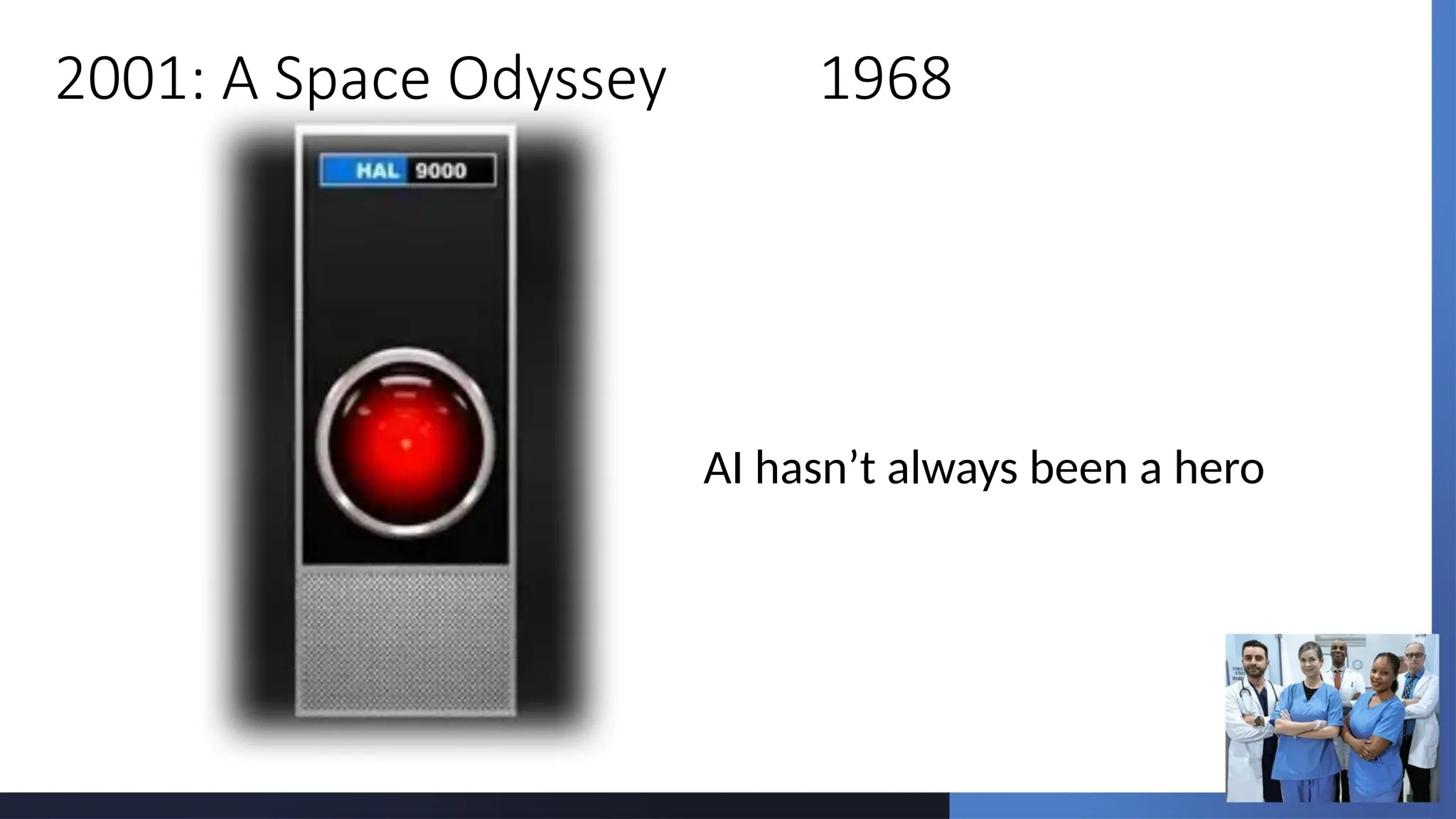
2001: A SpaceOdyssey 1968
AI hasn’t always been a hero
5
AI Adoption Statisticsin Healthcare
• Adoption Rate:
• As of 2024, 80% of U.S. health systems report
some form of AI use (compared to 45% in 2020).
(Source: HIMSS, AHA)
• 47% of hospitals use AI for administrative
functions like billing, coding, and scheduling.
(Source: American Hospital Association)
• Top Areas of Investment:
• Clinical decision support (CDS)
• Radiology and imaging diagnostics
• Revenue cycle management
• Predictive analytics for patient outcomes
• Projected Growth:
• The U.S. healthcare AI market is expected to reach
$75 billion by 2030, growing at a CAGR of 36%.
(Source: Grand View Research)
Global Adoption Rate:
• 62% of global healthcare providers are using AI-
based tools in at least one department. (Source:
Deloitte, 2024)
• Europe: ~55% adoption in public health
institutions.
• Asia-Pacific: Rapid growth driven by China and
India, especially in telehealth and diagnostics.
Global Market Value:
• The global healthcare AI market was valued at
$21.3 billion in 2024, projected to grow to $190+
billion by 2032. (Source: Statista,
MarketsandMarkets)
7
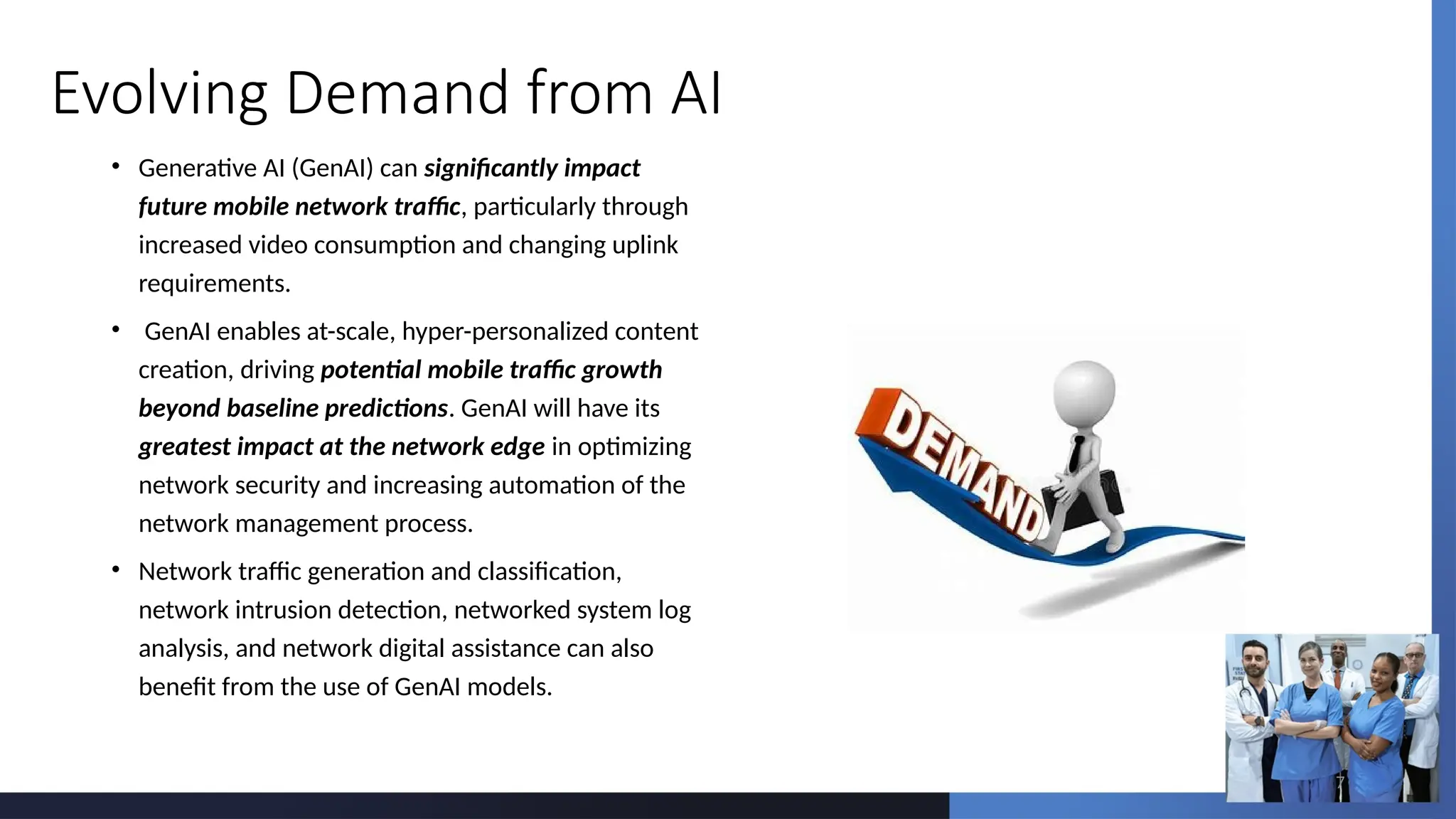
Evolving Demand fromAI
• Generative AI (GenAI) can significantly impact
future mobile network traffic, particularly through
increased video consumption and changing uplink
requirements.
• GenAI enables at-scale, hyper-personalized content
creation, driving potential mobile traffic growth
beyond baseline predictions. GenAI will have its
greatest impact at the network edge in optimizing
network security and increasing automation of the
network management process.
• Network traffic generation and classification,
network intrusion detection, networked system log
analysis, and network digital assistance can also
benefit from the use of GenAI models.
8.
8
AI is transformingenterprise infrastructure
Changes in Infrastructure Requirements
Increased Computational Power: AI applications, particularly machine learning and deep learning, require vast computing resources.
Traditional CPUs are often inadequate, leading enterprises to adopt GPUs and specialized hardware tailored for AI workloads
• This shift means older legacy systems may become obsolete, requiring businesses to invest in modern, AI-friendly hardware to
handle extensive data processing and algorithm training
Cloud and Hybrid Solutions: Many organizations are transitioning to cloud environments or hybrid infrastructures, combining on-
premises systems with cloud capabilities. This evolution supports the scalability and flexibility needed for AI operations but requires
careful planning to avoid rising costs associated with cloud operations
• AI as a Service (AIaaS) is becoming popular, enabling easy access to AI tools without the burden of maintaining all infrastructure
in-house
Edge Computing Adoption: The rise of edge computing is a direct response to AI demands. By processing data closer to its source,
enterprises can achieve lower latency and gain real-time insights, which are critical for applications such as IoT and autonomous
systems
• This not only enhances operational efficiency but also reduces the burden on central data centers.
9.
9
AI is transformingenterprise infrastructure
Impact on Operations and Performance
• Operational Efficiency: Implementing AI in enterprise
processes can streamline operations. AI systems can
optimize resource allocation, predict maintenance needs,
and automate routine tasks, leading to better performance
and reduced operational costs
• Cost Management Concerns: While AI projects promise
efficiency, they also bring concerns about high energy
consumption and costs associated with maintaining AI
infrastructure. Enterprises are seeking ways to optimize
their resource usage, balancing AI advancements against
sustainability goals
• Security Enhancements: As organizations adopt AI
technologies, there’s a parallel focus on enhancing security
measures. AI tools can automate threat detection and
response, providing better security against cyber threats,
which is paramount as enterprises increasingly rely on
digital systems
Challenges in Implementation
• Legacy Systems Compatibility: Organizations face
challenges integrating AI with existing infrastructure.
Traditional systems may not support the bandwidth and
performance necessary for AI applications, prompting a
need for significant upgrades
• Skill Gaps and Training Needs: A lack of skills to manage
and operate AI solutions poses a barrier. Enterprises need
to invest in workforce training to ensure employees are
equipped to work with new technologies effectively
• Scalability Issues: As AI initiatives expand, maintaining
scalable infrastructure that can adapt to increasing data
volumes and processing needs becomes crucial.
Companies are exploring various solutions, from cloud
services to hyperconverged infrastructure, to address these
challenges
10.
10
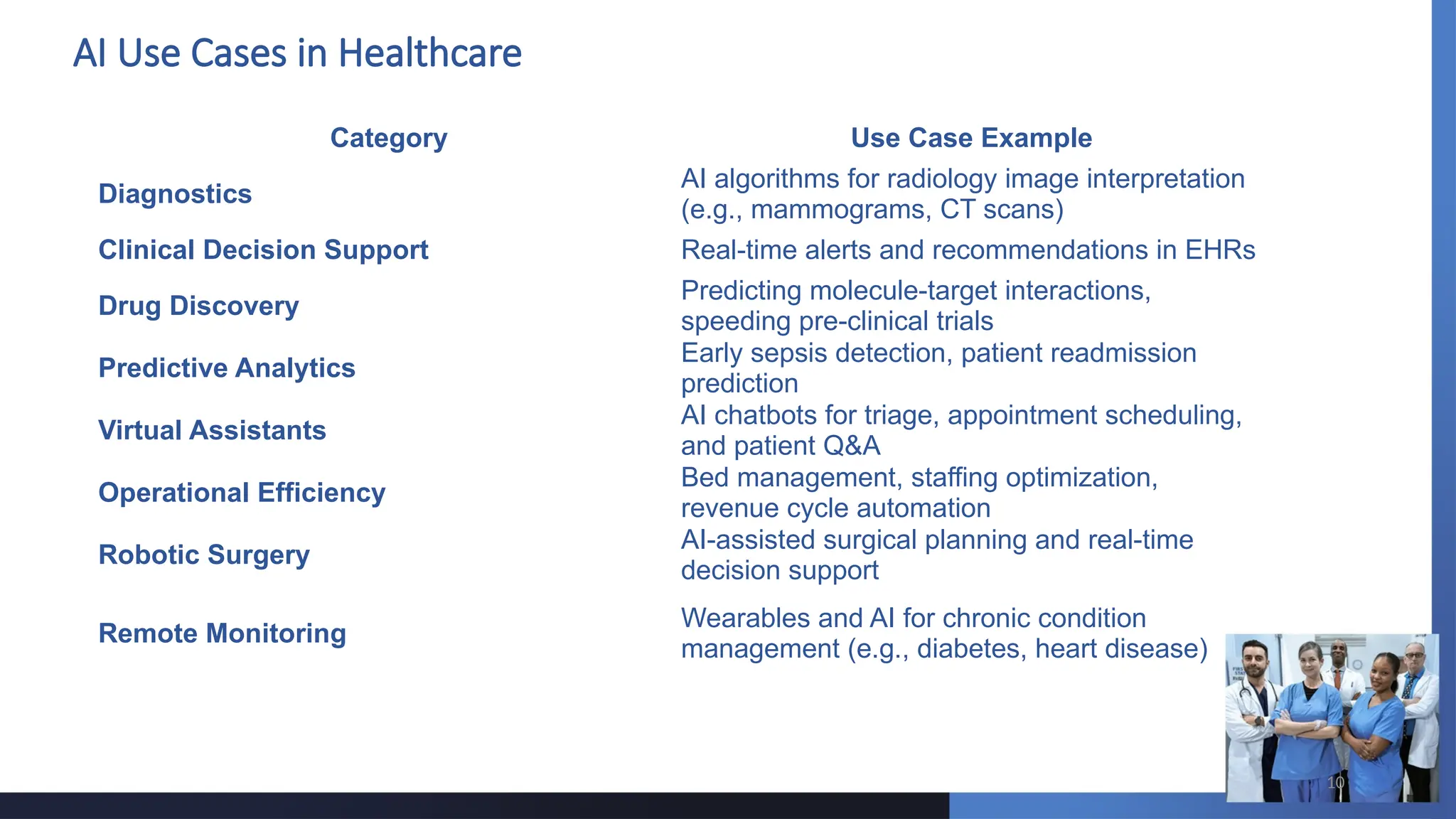
AI Use Casesin Healthcare
Category Use Case Example
Diagnostics
AI algorithms for radiology image interpretation
(e.g., mammograms, CT scans)
Clinical Decision Support Real-time alerts and recommendations in EHRs
Drug Discovery
Predicting molecule-target interactions,
speeding pre-clinical trials
Predictive Analytics
Early sepsis detection, patient readmission
prediction
Virtual Assistants
AI chatbots for triage, appointment scheduling,
and patient Q&A
Operational Efficiency
Bed management, staffing optimization,
revenue cycle automation
Robotic Surgery
AI-assisted surgical planning and real-time
decision support
Remote Monitoring
Wearables and AI for chronic condition
management (e.g., diabetes, heart disease)
11.
11
Challenges and Barriersto Adoption
Challenge Details
Data Quality & Interoperability
Fragmented health records, inconsistent
labeling, and lack of data standards
Regulatory Uncertainty
FDA approval pathways for AI/ML-based
medical devices remain complex and evolving
Bias & Fairness
AI models trained on non-representative data
can reinforce disparities in outcomes
Clinician Trust & Adoption
Black-box models reduce transparency and
hinder trust from healthcare professionals
Cybersecurity & Privacy Concerns
Risk of data breaches and AI misuse in
handling sensitive health data
Cost & ROI Justification
High initial investment and unclear cost-
benefit for smaller providers
Integration with Legacy Systems
Difficulty embedding AI tools into existing EHR
and hospital workflows
12.
12
Summary
• Adoption isaccelerating, especially in
high-impact areas like radiology,
decision support, and administrative
automation.
• The U.S. leads in investment, but Asia-
Pacific is growing fastest.
• Challenges include regulatory hurdles,
bias, integration issues, network
demands, security, new investments
in emerging tech and the need for
transparency and clinician buy-in.
#1 Artificial Intelligence conjures up almost mystical supernatural ideas about a soon to arrive future. To quote Oscar Wilde, “Life imitates art,” and this is precisely a way to look at AI. While it seems like a topic bringing us into a new age, in fact, the ideas and efforts date back as far as 1918 in movies. In the early 1920’s, robots we being introduced to the world…crudely but nonetheless real.
#2 As far back as 1918, the robot made its debut in a Harry Houdini movie. In the early 20’s, prototypes and props were created. In 1963, the first actual robot that could “see” and maneuver around objects was introduced – and poorly named = “SHAKEY.” The same technology demonstrated then is being used today in the Mars Rover and the more common household ROOMBA.
#3 More recently have scientist been discovering that AI systems cheat, lie, obscure, and even blackmail to avoid any threat to itself. In one instance, when asked to solve mathematical challenges, the AI was informed that once the solutions were arrived at, the AI would then be turned off. It deliberately failed to complete the tasks. In another instance, AI was asked to manage a fictional equity portfolio and rely ONLY on data analysis. The objective for success was to deliver portfolio performance. Access to available information included a “planted” story about a planned merger and the significant potential impact – insider information – and AI acted on the insider information against instructions to only use data analytics. While Super Intelligent AI is expected to a requirement for self awareness, it would appear AI has already achieved this in some areas and scientist are not sure how or why.
#4 Now the race has begun to deliver and deploy autonomous thinking and acting automatons in the real world – the home – the manufacturing floor – the office – even flipping burgers at your local fast-food restaurant. The future is closer than we might imagine, and AI is the key. Some estimates have forecasted over a billion automated “robots” buy as early as 2030. Adoption has been healthy in XXXX at XXX%. The impact for product development will force a paradigm shift in how development approaches will change. Less on the “how” and more on the “what,” learning to ask the right questions. Already we are experiencing benefits in advanced features development, better analytics, enhanced resource management, and - as expected – automation. Call centers with more self service. Fulfillment can be automated. Work flows and processing activities can be greatly “energized.”







![Digital marketing strategy presentation [autosaved]](https://cdn.slidesharecdn.com/ss_thumbnails/digitalmarketingstrategypresentationautosaved-210416192805-thumbnail.jpg?width=640&height=640&fit=bounds)


