The Carbon Cycle:
What is Carbon?
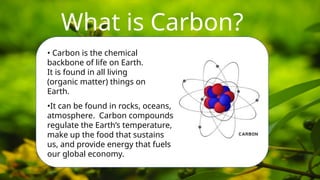
• Carbon is the chemical
backbone of life on Earth.
It is found in all living
(organic matter) things on
Earth.
•It can be found in rocks, oceans,
atmosphere. Carbon compounds
regulate the Earth’s temperature,
make up the food that sustains
us, and provide energy that fuels
our global economy.
The Carbon Cycle:
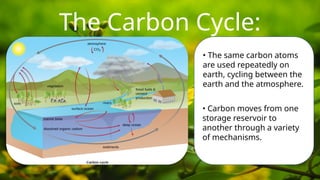
• The same carbon atoms
are used repeatedly on
earth, cycling between the
earth and the atmosphere.
• Carbon moves from one
storage reservoir to
another through a variety
of mechanisms.
Plants and Carbon Cycle:
• Carbon moves from one storage reservoir to another through a variety of mechanisms.
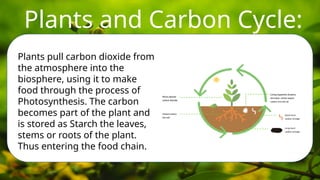
Plants pull carbon dioxide from
the atmosphere into the
biosphere, using it to make
food through the process of
Photosynthesis. The carbon
becomes part of the plant and
is stored as Starch the leaves,
stems or roots of the plant.
Thus entering the food chain.
Animals and Carbon Cycle:
• Carbon moves from one storage reservoir to another through a variety of mechanisms.
.
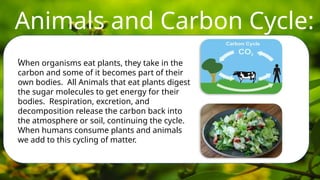
When organisms eat plants, they take in the
carbon and some of it becomes part of their
own bodies. All Animals that eat plants digest
the sugar molecules to get energy for their
bodies. Respiration, excretion, and
decomposition release the carbon back into
the atmosphere or soil, continuing the cycle.
When humans consume plants and animals
we add to this cycling of matter.
Hum
an
impa
ct
• Carbon moves from one storage reservoir to another through a variety of mechanisms.
Human Impact
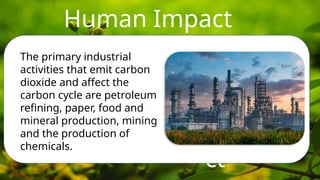
The primary industrial
activities that emit carbon
dioxide and affect the
carbon cycle are petroleum
refining, paper, food and
mineral production, mining
and the production of
chemicals.
THE
END

Ahmers presentation about carbon cycle.pptx

  • 1.
  • 2.
    What is Carbon? •Carbon is the chemical backbone of life on Earth. It is found in all living (organic matter) things on Earth. •It can be found in rocks, oceans, atmosphere. Carbon compounds regulate the Earth’s temperature, make up the food that sustains us, and provide energy that fuels our global economy.
  • 3.
    The Carbon Cycle: •The same carbon atoms are used repeatedly on earth, cycling between the earth and the atmosphere. • Carbon moves from one storage reservoir to another through a variety of mechanisms.
  • 4.
    Plants and CarbonCycle: • Carbon moves from one storage reservoir to another through a variety of mechanisms. Plants pull carbon dioxide from the atmosphere into the biosphere, using it to make food through the process of Photosynthesis. The carbon becomes part of the plant and is stored as Starch the leaves, stems or roots of the plant. Thus entering the food chain.
  • 5.
    Animals and CarbonCycle: • Carbon moves from one storage reservoir to another through a variety of mechanisms. . When organisms eat plants, they take in the carbon and some of it becomes part of their own bodies. All Animals that eat plants digest the sugar molecules to get energy for their bodies. Respiration, excretion, and decomposition release the carbon back into the atmosphere or soil, continuing the cycle. When humans consume plants and animals we add to this cycling of matter.
  • 6.
    Hum an impa ct • Carbon movesfrom one storage reservoir to another through a variety of mechanisms. Human Impact The primary industrial activities that emit carbon dioxide and affect the carbon cycle are petroleum refining, paper, food and mineral production, mining and the production of chemicals.
  • 7.