 One among kshudra roga.
 Mentioned by sushrutha in Kshudraroga
nidana,Nidanasthana 13th chapter.
 Adhisthana is Guda.
 Dosa is Kapha-Raktha.
 Age group: Infant
 Matrka dosa
 Prstaru
 Gudakuttakam
 Anaamika
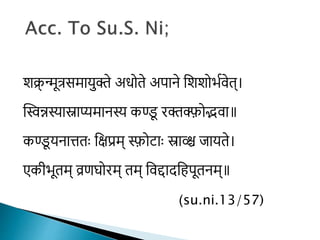
शक्र्न
् मूत्रसमायुक्ते अधोते अपाने शशशोर्भवेेत्
स्विन्नस्यास्नाप्यमानस्य कण्ड
ू रक्तक्फ़ोद्भेा॥
कण्ड
ू यनात्ततः शिप्रम् स्फ़ोटाः स्राव्श्च जायते
एकीर्भूतम् व्रणघोरम् तम् शेद्दादशिपूतनम्॥
(su.ni.13/57)
UNHYGIENIC CONDITIONS :
 Absence of proper cleaning after defecation
& urination.
 Negligence of bath after oversweating.
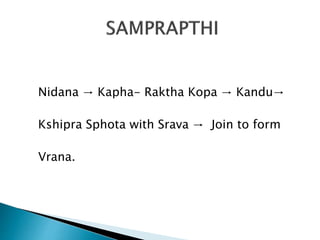
Nidana → Kapha- Raktha Kopa → Kandu→
Kshipra Sphota with Srava → Join to form
Vrana.
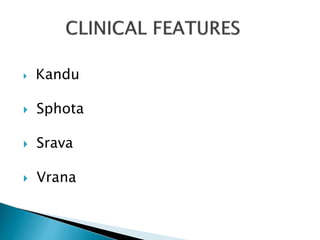
 Kandu
 Sphota
 Srava
 Vrana
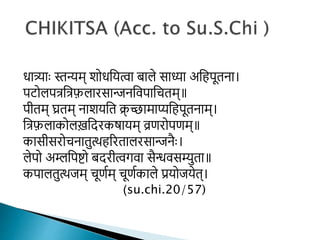
धात्र्ाः स्तन्यम् शोधशयत्वा बाले साध्या अशिपूतना
पटोलपत्रशत्रफ़लारसान्जनशेपाशितम्॥
पीतम् घ्रतम् नाशयशत क्र्न
् छामाप्यशिपूतनाम्
शत्रफ़लाकोलख़शदरकषायम् व्रणरोपणम्॥
कासीसरोिनातुत्थिररतालरसान्जनः
लेपो अम्लशपष्टो बदरीत्वगेा सन्धेसम्युता॥
कपालतुत्थजम् िूणवम् िूणवकाले प्रयोजयेत्
(su.chi.20/57)
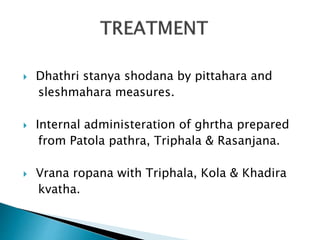
 Dhathri stanya shodana by pittahara and
sleshmahara measures.
 Internal administeration of ghrtha prepared
from Patola pathra, Triphala & Rasanjana.
 Vrana ropana with Triphala, Kola & Khadira
kvatha.
 Lepa with Kasisa, Gorochana, Thutha,
Haritala & Rasanjana. or
 Lepa with Badari tvak added with saindhava
& macerated with any sour juice.
 Avachurnana with Kapala churna & Thutha
churna.
Also be called as :
 Diaper Rash
 Nappy Rash
 Diaper Dermatitis
It is an inflammatory disorder
characterized by the development of
erythema, papules & sometimes
vesiculation with scaling affecting the
napkin or diaper area of usually
infants.
 Very common
 Some babies get sore bottom very easily,
others very rarely, but they all grow out of
it when they stop wearing nappies.
 Irritant Contact Dermatitis: Urine & faeces
will cause a rash on any skin left in contact
for long enough.
Ammonia is formed and burns the skin.
 Infection with bacteria & candida yeasts.
 Other skin disorders like Psoriasis and
Atopic Dermatitis can affect the Napkin area.
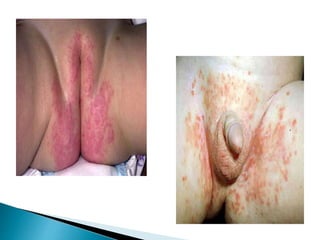
 Disease is characterised by development of
erythema in its early stages.
 Followed by formation of vesicles that
rupture to ooze out serous discharge.
 Lesions resolve with scaling.
Areas affected are: Convexities such as
Prominences of ;
 Pubis
 Thighs &
 Buttocks
 Frequent diaper changes & short periods
without diapers are important adjunctive
treatment.
 Area should be washed following a bowel
movement.
 Washing should be done with warm water
only.
 Air drying is useful.
 Long standing diaper rash should be treated
with topical antifungal therapy such as
nystatin cream, powder or ointment;
clotrimazole 1% cream; miconazole 2%
ointment etc.
INCLUDE:
o Use disposable nappies.
o If cloth nappies are used, make sure the
nappies are rinsed and dried well after
washing.
o Change the nappies frequently.
o Do not leave your baby in wet or dirty nappy.
o Wash the babys bottom at every change.
o Use warm water to remove all urine & bowel
motions.
o Pat dry frequently.
o Moisturize dry skin at every nappy change.
AHIPUTANA.pptx

AHIPUTANA.pptx

  • 2.
     One amongkshudra roga.  Mentioned by sushrutha in Kshudraroga nidana,Nidanasthana 13th chapter.  Adhisthana is Guda.  Dosa is Kapha-Raktha.  Age group: Infant
  • 3.
     Matrka dosa Prstaru  Gudakuttakam  Anaamika
  • 4.
    शक्र्न ् मूत्रसमायुक्ते अधोतेअपाने शशशोर्भवेेत् स्विन्नस्यास्नाप्यमानस्य कण्ड ू रक्तक्फ़ोद्भेा॥ कण्ड ू यनात्ततः शिप्रम् स्फ़ोटाः स्राव्श्च जायते एकीर्भूतम् व्रणघोरम् तम् शेद्दादशिपूतनम्॥ (su.ni.13/57)
  • 5.
    UNHYGIENIC CONDITIONS : Absence of proper cleaning after defecation & urination.  Negligence of bath after oversweating.
  • 6.
    Nidana → Kapha-Raktha Kopa → Kandu→ Kshipra Sphota with Srava → Join to form Vrana.
  • 7.
     Kandu  Sphota Srava  Vrana
  • 8.
    धात्र्ाः स्तन्यम् शोधशयत्वाबाले साध्या अशिपूतना पटोलपत्रशत्रफ़लारसान्जनशेपाशितम्॥ पीतम् घ्रतम् नाशयशत क्र्न ् छामाप्यशिपूतनाम् शत्रफ़लाकोलख़शदरकषायम् व्रणरोपणम्॥ कासीसरोिनातुत्थिररतालरसान्जनः लेपो अम्लशपष्टो बदरीत्वगेा सन्धेसम्युता॥ कपालतुत्थजम् िूणवम् िूणवकाले प्रयोजयेत् (su.chi.20/57)
  • 9.
     Dhathri stanyashodana by pittahara and sleshmahara measures.  Internal administeration of ghrtha prepared from Patola pathra, Triphala & Rasanjana.  Vrana ropana with Triphala, Kola & Khadira kvatha.
  • 10.
     Lepa withKasisa, Gorochana, Thutha, Haritala & Rasanjana. or  Lepa with Badari tvak added with saindhava & macerated with any sour juice.  Avachurnana with Kapala churna & Thutha churna.
  • 11.
    Also be calledas :  Diaper Rash  Nappy Rash  Diaper Dermatitis
  • 12.
    It is aninflammatory disorder characterized by the development of erythema, papules & sometimes vesiculation with scaling affecting the napkin or diaper area of usually infants.
  • 13.
     Very common Some babies get sore bottom very easily, others very rarely, but they all grow out of it when they stop wearing nappies.
  • 14.
     Irritant ContactDermatitis: Urine & faeces will cause a rash on any skin left in contact for long enough. Ammonia is formed and burns the skin.  Infection with bacteria & candida yeasts.
  • 15.
     Other skindisorders like Psoriasis and Atopic Dermatitis can affect the Napkin area.
  • 16.
     Disease ischaracterised by development of erythema in its early stages.  Followed by formation of vesicles that rupture to ooze out serous discharge.  Lesions resolve with scaling.
  • 17.
    Areas affected are:Convexities such as Prominences of ;  Pubis  Thighs &  Buttocks
  • 19.
     Frequent diaperchanges & short periods without diapers are important adjunctive treatment.  Area should be washed following a bowel movement.  Washing should be done with warm water only.
  • 20.
     Air dryingis useful.  Long standing diaper rash should be treated with topical antifungal therapy such as nystatin cream, powder or ointment; clotrimazole 1% cream; miconazole 2% ointment etc.
  • 21.
    INCLUDE: o Use disposablenappies. o If cloth nappies are used, make sure the nappies are rinsed and dried well after washing.
  • 22.
    o Change thenappies frequently. o Do not leave your baby in wet or dirty nappy. o Wash the babys bottom at every change.
  • 23.
    o Use warmwater to remove all urine & bowel motions. o Pat dry frequently. o Moisturize dry skin at every nappy change.