C M Y K
C M Y K
C M Y K
C M Y K
Tel. (UK) 0845 458 1944
Tel. (Int.) +44 1844 271 640
Email info@apm.org.uk
Web apm.org.uk
Association for Project Management
Ibis House, Regent Park
Summerleys Road
Princes Risborough
Buckinghamshire HP27 9LE
A Guide to
Project
Auditing
A Guide to
Project Auditing
Association for Project Management
34641_00_FM to End-landscape.indd 1 13/04/2018 14:42
ii
Association for Project Management
Ibis House, Regent Park
Summerleys Road, Princes Risborough
Buckinghamshire
HP27 9LE
© Association for Project Management 2018
All rights reserved. No part of this publication may be reproduced, stored in a retrieval system, or
transmitted, in any form or by any means, without the express permission in writing of the
Association for Project Management. Within the UK exceptions are allowed in respect of any fair
dealing for the purposes of research or private study, or criticism or review, as permitted under
the Copyright, Designs and Patents Act, 1988, or in the case of reprographic reproduction in
accordance with the terms of the licences issued by the Copyright Licensing Agency. Enquiries
concerning reproduction outside these terms and in other countries should be sent to the Rights
Department, Association for Project Management at the address above.
British Library Cataloguing in Publication Data is available.
Paperback ISBN: 978-1-903494-74-5
eISBN: 978-1-903494-75-2
Cover design by Fountainhead Creative Consultants
Typeset by RefineCatch Limited, Bungay, Suffolk
in 10/14pt Foundry Sans
34641_00_FM to End-landscape.indd 2 13/04/2018 14:42
iii
Contents
1 Introduction 1
1.1 Introduction 1
1.2 Purpose of the guide 2
1.3 Structure of the guide 2
1.4 What is project auditing? 3
1.5 Principles of project audit 3
1.6 Project life cycle 4
1.7 Why do we need project audits? 4
1.8 Who should use the guide? 5
1.8.1 The project sponsor 5
1.8.2 The project team 5
1.8.3 The project auditor 6
2 Project audit process 7
2.1 Planning the audit 8
2.1.1 Audit prioritisation 8
2.1.2 Choosing the audit team 8
2.1.3 Information gathering 8
2.1.4 Risk assessing a project 9
2.1.5 The project audit programme 9
2.2 Fieldwork 10
2.2.1 Elements for review 10
2.3 Evaluation and reporting 11
2.3.1 Evaluation 11
2.3.2 Reporting 12
2.4 Follow-up 13
2.5 Benefits evaluation 13
2.6 Legacy and lessons learned 13
Appendix 1 14
Matrix of element-based areas of review, risks and controls 14
Appendix 2 31
Comparison of project audit elements for review, with
assurance measures toolkit categories 31
34641_00_FM to End-landscape.indd 3 13/04/2018 14:42
iv
Acknowledgements
The guide was prepared by members of the APM’s Assurance SIG led by
Roy Millard as chair. The authors of the guide are Peter Deary, Mushtaq Ali and
Mark Reilly.
The authors acknowledge the contributions of Pascal Barras, Wendy Gregory,
Tony Hargraves, Julian Harris, Chris Little, Gary Poole, Nicola Read, Pauline Scott
and Naveed Sheikh in the preparation of the guide.
34641_00_FM to End-landscape.indd 4 13/04/2018 14:42
1
1
Introduction
1.1 Introduction
Project assurance is a fundamental part of effective project governance. The
project audit is the means to provide that assurance and enables the sponsor to
have confidence that the governance is working and that the project is being
managed as intended. There is currently a considerable amount of information
relating to the assurance of projects and programmes, and why it is important.
This guide seeks to demonstrate how to plan and undertake a comprehensive
audit of a project, thereby providing that assurance.
The guide seeks to explain the role of an audit, how it could be planned and
undertaken, the degrees of assurance that can be given, and how project audits
can be aligned to organisational governance. Although the guide acknowledges
the need for project audits to be integrated with the works of other assurance
providers (particularly technical and quality audits) a project audit is a stand-alone
process aimed at the three main roles involved in a project.
The three main roles involved in project audits are:
Role Description
Organisation board/audit committee/
sponsor/other stakeholders
Those who schedule the project audit and
receive the audit findings
Project team Those whose project is being audited, with
whom the auditors interact
Project auditor(s) Those who undertake the audit, and report its
findings and make recommendations
For any audit to be successful and provide value to all parties, these three
main roles must work together and understand each other’s function in the
process.
As is common in all projects it is vital that there is a recognition that people
undertaking different project roles may have differing interests and perceptions
aboutprojectoutputs,progressandthevariousstakeholders.Thisguidetherefore
34641_00_FM to End-landscape.indd 1 13/04/2018 14:42
A Guide to Project Auditing
2
refers to how audits relate to the various responsibilities within a project and how
to apply the processes associated with auditing in a project context taking project
responsibilities into consideration. These processes include: the development of
an annual audit plan; choosing the auditor/audit team to undertake the work;
developing an audit programme; performing, closing, and reporting the audit;
and undertaking follow-ups.
1.2 Purpose of the guide
This guide is principally intended for use by project auditors in developing an
audit approach to the review and assurance of projects. However, it is also
intended to be of value to anyone involved in the management and administration
of projects, as it records areas of project risk, and identifies audit evidence and
practices. The guide will also indicate those aspects of a project which the
auditors may choose to review, and how the audit will be performed.
This guide is not intended to provide step-by-step instructions on how to carry
out audits on any particular type of project; rather, it will provide guidance which
can be adapted by the user to the circumstances of their own projects. The audit
can then be planned, performed and reported on, and based on the auditor’s
preferred approach, adapted to suit the particular project discipline.
In section 2.2.1, and expanded in Appendix 1, the guide proposes some
elements and areas of interest for review by project auditors, together with the
risks and expected controls to manage those risks. These elements do not form
an exhaustive list so it is recommended that further assessment by the project
auditor is always necessary to decide upon areas of focus before a project audit is
undertaken.
1.3 Structure of the guide
Theguidefocusesonthevariousaspectsofprojectaudits,toanswerthefollowing
three questions:
n What is an audit?(Andhowanauditdiffersfromotherassurancemethods.)
n Why do we undertake project audits?
n How should a project audit be planned, performed, evaluated,
reported, and followed up?
34641_00_FM to End-landscape.indd 2 13/04/2018 14:42
3
Introduction
Thisguidecoverstheplanningofprojectaudits(Section2.1);suggestedelements
of a project which are to be reviewed (Section 2.2.1 and Appendix 1); evaluation
and reporting (Section 2.3); and follow-up processes (Section 2.4).
1.4 What is project auditing?
Auditing is defined by the Chartered Institute of Internal Auditors as ‘an
independent, objective assurance and consulting activity designed to add value
and improve an organisation’s operations. It helps an organisation accomplish its
objectivesbybringingasystematic,disciplinedapproachtoevaluateandimprove
the effectiveness of risk management, control, and governance processes’.
In any audit, the auditor(s) perceives and recognises the propositions before
them for examination, collects evidence, evaluates the same, and on this basis
formulatesanopinionontheadequacyofcontrolswithintheactivitybeingaudited.
Throughout this guide we use the term ‘project’ to mean ‘a unique, transient
endeavour undertaken to achieve planned objectives’ (see APM Body of
Knowledge, 6th edition); the audit of programmes and portfolios will require
different techniques. Auditing of a project should be seen in the context of the
definition of project, programme and portfolio (P3) assurance set out in the APM
Body of Knowledge: P3 Assurance is ‘the process of providing confidence to
stakeholders that projects, programmes and portfolios will achieve their scope,
time, cost and quality objectives, and realise their benefits’.
1.5 Principles of project audit
The APM publication A Guide to Integrated Assurance identifies the principles
governing project audit, which are those established for the provision of
assurance generally. Project audit should be:
n independent, and supported in this by the organisation board;
n accountable within a governance and reporting system;
n planned and coordinated as part of the organisation’s management system;
n proportionate to risk potential and the assurance needs of stakeholders;
n risk-based, against an independent risk evaluation;
n abletoallowtheimpactofidentifiedweaknessestobereportedandaddressed,
by follow-up and escalation.
34641_00_FM to End-landscape.indd 3 13/04/2018 14:42
A Guide to Project Auditing
4
1.6 Project life cycle
The APM Body of Knowledge identifies four, and where appropriate five, phases
of a project life cycle:
n Concept: an initial idea is developed through production of an outline
business case and schedule. At this stage a project sponsor is appointed to
lead development of the idea, and to provide the answer to two questions:
n Is the project likely to be viable?
n Is it definitely worth investing in the next, definition phase?
n Definition: the preferred solution is identified and ways of achieving this are
refined. The project management plan (PMP) is developed. Approval of this
and the business case must be given by the sponsor before progressing to the
development phase.
n Development: the PMP is put into action. The continuing viability of the
project may be assessed and reviewed at various stages throughout this phase.
n Handover and closure: the project outputs are handed over and accepted
by the sponsor on behalf of the users.
n Where appropriate, Benefits realisation: a project may include a benefits
realisation phase.
Throughout the phases of a project there should be provision for independent
audit to give assurance to key stakeholders including the project sponsor and
executive board, of the likelihood that the objectives of the project will be
achieved.
1.7 Why do we need project audits?
The giving of assurance to project stakeholders, including the organisation board,
through providing assessment of the likelihood of the project achieving its
objectives, is a fundamental aspect of project governance (see APM guides:
Directing Change – A Guide to Governance of Project Management, and A
Guide to Integrated Assurance). This assurance will cover the identification and
management of risk, evaluation of opportunities, and actions being taken to
realise those benefits on which approval of the business case was based.
Assurance also seeks evidence of effective controls and opportunities to increase
34641_00_FM to End-landscape.indd 4 13/04/2018 14:42
5
Introduction
the likelihood of success of the project. The audit will consider among other
things the following elements (see also 2.2.1 below):
n project definition and requirements management;
n project organisation and governance;
n risks management;
n commercial, procurement and commissioning;
n configuration management, project change controls and the PMO;
n project planning and scheduling;
n performance and benefits management;
n stakeholder management and communications;
n organisational capability and culture;
n social responsibility and sustainability.
1.8 Who should use the guide?
1.8.1 The project sponsor
The sponsor must ensure that their projects or programmes meet the
organisational requirements. The sponsor can use the audit function to assist
them in meeting these needs by understanding the scope of audits available to
them, and by selecting specific audits that address the projects’ risks and also
take into consideration the position in the project life cycle.
In relation to audits they are responsible for liaising with the audit team in
planning a programme of project audits; providing support to the audit team; and
ensuring that remedial actions are implemented.
1.8.2 The project team
Delivery of the project and of its ability to achieve the expected outputs and
outcomes is the responsibility of the project team. In doing this the project
is expected to provide assurance and comfort to the wider organisation that it
is being delivered in a structured and controlled manner and in accordance
with organisation protocols including controls, systems and procedures. Project
audits are a principal way for organisations to review and assess that their
projects, programmes and portfolios will deliver the expected outcomes and
benefits.
34641_00_FM to End-landscape.indd 5 13/04/2018 14:42
A Guide to Project Auditing
6
Inrelationtoaudits,theprojectteamisresponsibleforensuringdata,information
and staff are available to participate in the audit; responding to audit findings; and
resolving any issues arising.
1.8.3 The project auditor
The auditor is not only responsible for undertaking the audit and reporting the
findings. They also undertake a key role in working with the sponsor and project
community in the management, communication and scheduling of audits across
the organisation.
The responsibilities of the auditor in relation to the audits include identifying
the risks to be reviewed; planning and carrying out the audit; and reporting to the
project sponsor on findings made and overall rating of the audit as defined by the
organisation’s audit function.
34641_00_FM to End-landscape.indd 6 13/04/2018 14:42
7
2
Project audit process
In terms of auditing techniques, a project audit is no different from any other
form of risk-based or compliance audit. However, unlike other types of audit,
the range of topics, disciplines and risks to consider for audit can be wide-
ranging. Without careful planning, the scope of a project audit can become too
broad to manage or lack sufficient depth to find the real issues. As a result,
auditing a project may be broken down into several audits (each with a distinct
purpose) over the lifetime of a project. Auditors with a specialist background/
discipline may be engaged at different stages e.g. an engineer to audit the
design elements of the project; an environmentalist to cover environmental
compliance and sustainability; a health and safety expert to see that facility
design and construction is safe, etc. Such experts may come from different audit
and assurance providers within/outside the organisation. The challenge for the
organisation (and the project sponsor) may then be to manage and integrate (see
APM: A Guide to Integrated Assurance) all of these audit interventions to ensure
that the project is not overwhelmed, there is no duplication and each audit
adds value.
Based on APM’s five phases of the project life cycle (concept; definition;
development; handover and close; and if required, benefits realisation)
the current phase of the project should be determined prior to starting the
audit as this will allow the auditor to focus the audit programme/questions
to the priority areas of the project. During the project audit, various project
areas will be assessed to ensure adequate controls are in place. These project
areas change in priority throughout the project life cycle. For example, the
priority of assessing controls for developing the business case development
is higher at Concept stage than it would be at the Handover and Close
phase, and the priority of assessing the controls around project closure would
be lower in the Concept phase than it will be at the Handover and Close
phase.
34641_00_FM to End-landscape.indd 7 13/04/2018 14:42
A Guide to Project Auditing
8
2.1 Planning the audit
2.1.1 Audit prioritisation
Project audits should be prioritised within the context of the organisation’s annual
audit plan and the requirements of its audit committee. Project audits should be
planned on the basis of risks to the organisation and to the project.
2.1.2 Choosing the audit team
Conducting a project audit is a specialist skill, so at least one influential member
oftheauditteamshouldhaveknowledgeandexperienceofaprojectenvironment.
The size of the team should be appropriate to the scale and risks faced by the
project and the requirements of the audit programme. Most organisations which
aredevelopingprojectswillhaveaccesstothisskillset,whichneednotnecessarily
be held by an experienced auditor; such people could be managed by an
experienced audit supervisor. The audit team should have access to specialist
technical skills e.g. quality assurance, and should bear in mind the organisation’s
appetite for integrated assurance.
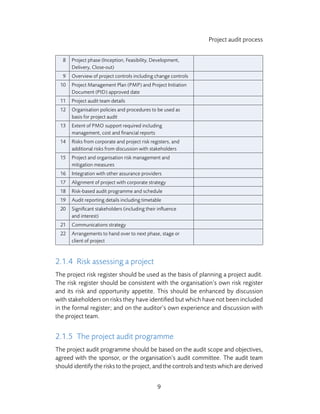
2.1.3 Information gathering
This table below is an example of a format that could be used to record relevant
informationfortheaudit.Thelistisnotexhaustiveandcanbeamendedoradapted:
Background information Results
1 Project name/reference
2 Brief description of the objectives of the project and any
relevant notes. Record any information here that will
help in assessing risk areas for audit
3 Project value (total)/(this year)
4 Appropriate (outline or full) business case approved/
date/value
5 Agreed project audit scope, objectives and name/
reference
6 Project governance arrangements including project
sponsor, project manager and project team
7 Project management arrangements
34641_00_FM to End-landscape.indd 8 13/04/2018 14:42
9
Project audit process
8 Project phase (Inception, Feasibility, Development,
Delivery, Close-out)
9 Overview of project controls including change controls
10 Project Management Plan (PMP) and Project Initiation
Document (PID) approved date
11 Project audit team details
12 Organisation policies and procedures to be used as
basis for project audit
13 Extent of PMO support required including
management, cost and financial reports
14 Risks from corporate and project risk registers, and
additional risks from discussion with stakeholders
15 Project and organisation risk management and
mitigation measures
16 Integration with other assurance providers
17 Alignment of project with corporate strategy
18 Risk-based audit programme and schedule
19 Audit reporting details including timetable
20 Significant stakeholders (including their influence
and interest)
21 Communications strategy
22 Arrangements to hand over to next phase, stage or
client of project
2.1.4 Risk assessing a project
The project risk register should be used as the basis of planning a project audit.
The risk register should be consistent with the organisation’s own risk register
and its risk and opportunity appetite. This should be enhanced by discussion
with stakeholders on risks they have identified but which have not been included
in the formal register; and on the auditor’s own experience and discussion with
the project team.
2.1.5 The project audit programme
The project audit programme should be based on the audit scope and objectives,
agreed with the sponsor, or the organisation’s audit committee. The audit team
should identify the risks to the project, and the controls and tests which are derived
34641_00_FM to End-landscape.indd 9 13/04/2018 14:42
A Guide to Project Auditing
10
from these. The different phases of the project life cycle should lead to audit
programmesandtestsappropriatetothosephases,andtothenatureoftheproject.
2.2 Fieldwork
The audit team should gather information and documentation, and talk to
key stakeholders including (as appropriate) members of the project team, the
procurement function and the supply chain. There should be an effective
working relationship with the project management office (PMO), to ensure that
information, documents and reports are readily available for purposes of the
audit, including the procedures and policies which form the basis of evaluation.
2.2.1 Elements for review
The APM publication, Measures for Assuring Projects: APM Toolkit, identifies
10 key categories of criteria for review, around which the project assurance
process should be based. We have drawn on those categories stated within the
toolkit, as offering guidance to the identification of elements for review in carrying
out an audit of a project. In Appendix 1 this guide suggests some aspects of those
elements, together with the associated risks and controls, which could be subject
to audit review where appropriate. In Appendix 2 we have mapped across from
those elements we have identified for project audit and review, to the toolkit’s
categories for which assurance should be sought. The selection of elements
is not intended to be exhaustive, nor to serve as a project audit checklist; and it
is expected that this should be adapted to reflect the circumstances of the project.
The elements which have been identified are:
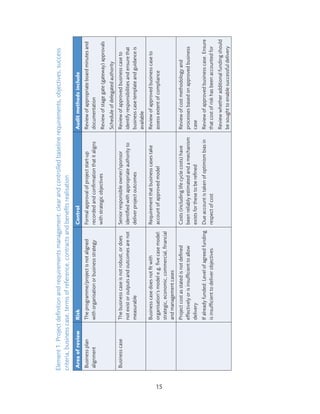
1. Project definition and requirements management – clear and controlled
baseline requirements, objectives, success criteria, business case, terms of
reference, contracts and benefits realisation.
2. Project organisation and governance – the processes to align the interests
and strategic direction of sponsors and stakeholders.
3. Risks management – management of risks and opportunities through the life
cycle of the project.
4. Commercial, procurement and commissioning – procurement and contract
management, financial controls and engagement with commissioning
processes.
34641_00_FM to End-landscape.indd 10 13/04/2018 14:42
11
Project audit process
5. Configuration management, project change controls and PMO – processes
and systems to administer and control the project and changes to it.
6. Project planning and scheduling – appropriately detailed execution
strategies, plans and schedules.
7. Performance and benefits management – to provide assurance that the
benefits stated in the business case can be delivered within the resources
made available.
8. Stakeholder management and communications – all stakeholders affected
by the project have been identified and are appropriately involved.
9. Organisational capability and culture – people, behaviours, teams and the
working environment including the organisation’s culture.
10. Social responsibility and sustainability – managing the impact of project
delivery on the social, physical, ecological and economic environment
including health and safety.
2.3 Evaluation and reporting
In concluding the audit, the project will need to be evaluated against a clear set of
criteria which the organisation expects. It will enable the sponsor to assess the
likelihood of a successful outcome from the project and to develop a clear set of
actions to address any matters going forward.
Provision of assurance covers not only the investigation and reporting of
findings, but also includes the identification and implementation of actions to
address those findings. The auditor will need to assess the findings made and
how critical these are to success of the project and risk to the organisation.
Reporting requirements will vary between and within organisations and
projects, but a sound and useful technique is to rate the findings in accordance
with the agreed criteria, and to provide an overall evaluation score for the project.
Such clear criteria offer benefits to the sponsor, and the audit and project
teams in that consistency and rigour of approach will support objectivity in the
audit process.
2.3.1 Evaluation
The overall evaluation of the project will often be directed towards the project
sponsor, and the requirement to address the individual issues will be held within
the project team.
34641_00_FM to End-landscape.indd 11 13/04/2018 14:42
A Guide to Project Auditing
12
The number of issues identified and their ratings will then determine the
overall rating given to the project. There are numerous methods to rate findings
and evaluate projects, but the basic idea is to use a grading score to rank each
audited element and indicate the extent to which the project has performed.
One method of grading used extensively to measure performance is the ‘traffic
light’ system of three ratings: red/amber/green (RAG). During project audits it
may be more appropriate to use four or five ratings, with additional definitions
and next steps. Definitions of RAG will depend on project and reporting
requirements; the traffic light technique is used by many assurance providers
and can be tied to reporting of the achievement of key performance indicators
(KPIs). One definition of the ratings is:
n Red: there are significant issues with the project (such as tolerances set by the
board for cost, time or quality have been exceeded). The matter should be
escalated to the sponsor and project board immediately.
n Amber: a problem has had a negative effect on project performance but
can be dealt with by the project team. One aspect of project viability is at
risk but is within agreed tolerances. The sponsor and project board should
be notified.
n Green: the project is performing to plan. All aspects of project performance
are within tolerance. No action is needed.
2.3.2 Reporting
Individual organisations have their own reporting requirements, including who
should receive the report, who has responsibility for responding to it and to
what timescale, and who will be tasked with implementing its findings and
recommendations. Provision should be made to issue the report in line with the
agreed timetable, or sooner if circumstances require this. As some of the content
of the report may be commercially or otherwise sensitive, this should be borne in
mind in circulation and distribution of draft and final reports.
Following a close-out meeting with auditees, the preliminary report should be
prepared and internally reviewed before issue to those auditees and other
stakeholders for comment on findings and recommendations.
Importantly, responses may indicate that the organisation is willing to accept a
degree of project risk greater than that on which the audit was based.
The final report, which should contain the evaluation rating based on
the responses received, should be distributed in accordance with the
34641_00_FM to End-landscape.indd 12 13/04/2018 14:42
13
Project audit process
requirements of the agreed audit plan. The final report should also be issued
to the organisation’s audit committee.
2.4 Follow-up
Follow-up is the final element of the audit process, in which the audit team
confirms that the sponsor and project team have implemented the agreed actions
toaddressidentifiedprojectrisksandissues.Thiscanbeconfirmedbymonitoring
the implementation process, or by accepting a formal statement from the sponsor
or project team that the recommended actions have been carried out.
2.5 Benefits evaluation
Where the scope of the project audit included evaluation or auditing of outcomes
on which approval of the business case was based (the benefits realisation phase
of the project life cycle), a separate audit process will be required. This will seek
to compare recorded benefit outcomes against those proposed in the business
case through the use of defined benefit measures, normally by quantitative
methods. The organisation should normally have a benefits evaluation process
by which it is able to carry out such evaluation itself without instructing the audit
team to do so.
2.6 Legacy and lessons learned
The organisation may operate a legacy programme, to capture the intellectual
capital within a project before the project team is disbanded. A notable example
is the Learning Legacy programme developed by the 2012 Olympic Delivery
Authority: this is open to everyone, to share knowledge of construction and
event organisation. The results of project audits can provide valuable reference
points for the organisation’s legacy and lessons learned process. The audit team
should be aware of the organisation’s requirements for confidentiality if involved
in the legacy and lessons learned process.
34641_00_FM to End-landscape.indd 13 13/04/2018 14:42
14
Appendix 1
Matrix of element-based
areas of review,
risks and controls
34641_00_FM to End-landscape.indd 14 13/04/2018 14:42
15
Element
1.
Project
definition
and
requirements
management:
clear
and
controlled
baseline
requirements,
objectives,
success
criteria,
business
case,
terms
of
reference,
contracts
and
benefits
realisation
Area
of
review
Risk
Control
Audit
methods
include
Business
plan
alignment
The
programme/project
is
not
aligned
with
organisation
or
business
strategy
Formal
approval
of
project
start-up
recorded
and
confirmation
that
it
aligns
with
strategic
objectives
Review
of
appropriate
board
minutes
and
documentation
Review
of
stage
gate
(gateway)
approvals
Schedule
of
delegated
authority
Business
case
The
business
case
is
not
robust,
or
does
not
exist
or
outputs
and
outcomes
are
not
measurable
Senior
responsible
owner/sponsor
identified
with
appropriate
authority
to
deliver
project
outcomes
Review
of
approved
business
case
to
identify
responsibilities
and
ensure
that
business
case
template
and
guidance
is
available
Business
case
does
not
fit
with
organisation’s
model
e.g.
five
case
model:
strategic,
economic,
commercial,
financial
and
management
cases
Requirement
that
business
cases
take
account
of
approved
model
Review
of
approved
business
case
to
assess
extent
of
compliance
Project
cost
as
stated
is
not
defined
effectively
or
is
insufficient
to
allow
delivery
If
already
funded:
Level
of
agreed
funding
is
insufficient
to
deliver
objectives
Costs
(including
life
cycle
costs)
have
been
reliably
estimated
and
a
mechanism
exists
for
these
to
be
refined
Due
account
is
taken
of
optimism
bias
in
respect
of
cost
Review
of
cost
methodology
and
processes
based
on
approved
business
case
Review
of
approved
business
case.
Ensure
that
cost
of
risk
has
been
accounted
for
Review
whether
additional
funding
should
be
sought
to
enable
successful
delivery
34641_00_FM to End-landscape.indd 15 13/04/2018 14:42
16
Area
of
review
Risk
Control
Audit
methods
include
Target
dates
are
unrealistic
or
overly
ambitious
Target
dates
have
been
subject
to
a
reality
check
and
a
mechanism
exists
for
these
dates
to
be
refined
Due
account
is
taken
of
optimism
bias
in
respect
of
target
dates
and
schedules
Review
of
schedule
and
programme
methodology
and
processes
Review
of
approved
business
case
Business
cases
are
not
used
as
a
control
against
achievement
of
the
project
deliverables
Approved
business
case
is
used
as
a
change
control
baseline
document,
and
is
subject
to
periodic
review
Assessment
of
change
control
mechanisms
applicable
to
project
and
that
business
case
is
routinely
updated
Scope
defined
including
change
control
processes
The
project
scope/requirements
is
not
clearly
defined
or
understood
Project
scope
defined
Change
control
processes
implemented
Project
manager’s
responsibilities
and
limits
of
authority
defined
Review
of
approved
business
case
–
scope
must
be
clear
and
unambiguous
Assessment
of
change
control
processes
Schedule
of
delegation
in
PID
or
approved
business
case
Requirements
definition
–
clear/
complete/
understood?
Required
outcomes
clear/agreed
The
project’s
scope/plan
is
not
baselined
at
time
of
project
start
Project
plan
developed
to
appropriate
level
Review
of
PID
and
approved
business
case
to
ensure
clarity
of
scope
and
planning
Authorisation
including
definition
of
baseline
The
project
has
commenced
prior
to
formal
authorisation
Project
governance
arrangements
reflect
organisation
requirements
Review
of
project
governance
arrangements
including
authorisation
to
start
projects
34641_00_FM to End-landscape.indd 16 13/04/2018 14:42
17
Area
of
review
Risk
Control
Audit
methods
include
Documenting
client
objectives
and
requirements
and
success
criteria
Project
deliverables
and
outcomes
and
what
will
represent
success
have
not
been
identified
or
cannot
be
measured
Clear
and
unambiguous
deliverables
and
objectives
set
out
in
PID
and
PMP
Agreed
outcomes
and
success
criteria
Review
of
PID
and
PMP
to
ensure
clarity
and
consistency
with
approved
business
case
Review
measurement
criteria
Defining
and
managing
expected
benefits
Projects
are
undertaken
without
expected
benefits
being
managed
Business
case
contains
stated
and
quantified
benefits
Realisation
of
benefits
is
controlled
by
established
processes
Review
of
approved
business
case
to
ensure
benefits
are
stated
Review
of
processes
to
ensure
benefits
can
be
baselined,
controlled
and
can
be
measured
Agreeing
and
documenting
acceptance
process
Unclear
acceptance
processes
Documented
acceptance
processes
for
project
and
its
elements
Contractual
controls
available
for
implementation
as
needed
Review
of
PID
and
project
governance
to
ensure
clear
acceptance
processes
exist
Readiness
for
acceptance
and
implementation
of
project
Commissioning
processes
and
resources
are
not
adequate
to
accept
and
deliver
project
benefits
Commissioning
plans
and
processes
are
agreed
in
advance
Sufficient
resources
are
available
for
commissioning
and
change
Review
of
commissioning
plans
to
ensure
consistency
with
approved
business
case
and
benefits
management
processes
Review
resourcing
and
equipment
planning
Review
measures
in
place
for
embedding
benefits
(if
relating
to
change
management)
34641_00_FM to End-landscape.indd 17 13/04/2018 14:42
18
Element
2.
Project
organisation
and
governance:
the
processes
to
align
the
interests
and
strategic
direction
of
sponsors
and
stakeholders
Area
of
review
Risk
Control
Audit
methods
include
Project
governance
structures
Inadequate
project
governance
structures
or
organisation
inexperienced
at
implementing
governance
Defined
project
governance
structures
based
on
organisation
and
project
requirements
Project
sponsor
appointed
with
appropriate
authority
to
allocate
resources
and
reinforce
governance
best
practice
Review
project
governance
arrangements
to
ensure
consistency
with
organisation
governance
Terms
of
reference
for
project/programme
boards
Review
organisation
schedule
of
delegation
Sponsorship
The
project
sponsor
is
not
an
effective
link
between
the
organisation
and
project
management
Ownership
of
business
case
and
accountability
for
delivery
are
approved
at
organisation
board
level
Ensure
role
of
sponsor
is
supported
by
organisation/board
governance
structures
and
are
recorded
in
PID
Evidence
that
there
is
buy-in
to
this
process
Roles
and
responsibilities
Inadequately
defined
roles
and
responsibilities
Defined
roles
and
responsibilities
within
a
formal
project
and
organisation
management
structure
Ensure
roles
and
responsibilities
are
defined
within
a
formal
project
and
organisation
governance
and
management
structure
and
are
recorded
in
the
PID
Authorisation
and
approvals
Decisions
and
authorisations
are
made
without
proper
authority
or
are
made
at
a
level
unsuited
to
the
requirements
of
effective
project
control
Approvals
and
authorisation
processes
are
defined
and
are
based
on
organisation
and
project
requirements
Ensure
approval
and
authorisation
processes
are
defined
within
a
formal
project
and
organisation
governance
and
management
structure
and
are
recorded
in
the
PID
Ensure
that
processes
are
being
adhered
to
and
that
appropriate
recording
of
decisions
is
in
place
34641_00_FM to End-landscape.indd 18 13/04/2018 14:42
19
Area
of
review
Risk
Control
Audit
methods
include
Organisational
structure
Project
staffing
and
resource
structures
are
unsuited
to
effective
project
management
Project
structure
reflects
requirements
of
both
project
and
the
organisation,
at
various
phases
of
the
project
life
cycle
Review
phased
staffing
and
resource
plans
and
implementation
processes
for
various
phases
of
the
project
life
cycle
Reporting
Timely,
relevant
and
reliable
information
is
not
available
to
support
the
organisation’s
and
project’s
direction
and
decision-
making
processes
Reporting
structures
and
methods
are
defined
from
the
outset
and
assurance
is
obtained
periodically
that
information
reported
is
timely,
relevant
and
reliable
Review
PID
and
approved
business
case
for
reporting
requirements
and
processes
Element
3.
Risks
management:
management
of
risks
and
opportunities
through
the
life
cycle
of
the
project
Area
of
review
Risk
Control
Audit
methods
include
Risk
and
opportunity
strategy
Project
risk
and
opportunity
strategy
is
not
consistent
with
the
organisation’s
risk
appetite
Risk
and
opportunity
identification
and
management
strategy
is
developed
which
aligns
with
that
of
organisation
Review
approved
business
case
for
risk
and
opportunity
management
and
processes,
including
fit
with
organisation’s
risk
appetite
and
evidence
of
proactive
risk
management
approach
Risk
and
opportunity
identification,
assessment
and
management
processes
Project
risks
and
opportunities
are
not
identified
and
managed
effectively
Formal
risk
and
opportunity
management
processes,
including
formal
risk
register
and
periodic
review,
are
implemented
Review
risk
and
issue
registers
and
processes
for
populating
these
Ensure
that
definitions
of
risks
and
issues
are
fully
understood
Plan
and
implement
responses
to
risk
Unplanned
or
unconsidered
response
to
crystallisation
of
risk
Responsibility
for
action
on
crystallisation
of
risk
is
established,
and
action
plan
is
developed
Review
risk
and
issue
processes
to
ensure
clarity
of
ownership
on
crystallisation
and
ability
to
develop
action
plans
34641_00_FM to End-landscape.indd 19 13/04/2018 14:42
20
Area
of
review
Risk
Control
Audit
methods
include
Contingency
No
contingency
plans,
processes
or
allowances
related
to
occurrence
of
adverse
events
Contingencies
of
time
and
cost
form
part
of
project
planning
process
and
approvals.
As
elements
of
plan
are
achieved,
contingency
allowances
are
released
if
unused
Assess
time
and
cost
contingency
planning
and
processes
Ensure
that
contingency
is
realistically
quantified
Review
processes
for
release
of
contingencies
Business
continuity
and
disaster
recovery
Response
to
major
adverse
occurrence
to
project
is
unplanned
or
otherwise
not
allowed
for
Business
continuity
plan
and
disaster
recovery
plan
are
established
for
implementation
in
stated
circumstances.
Organisation
processes
allow
allocation
of
resources
to
mitigate
and
achieve
delivery
of
continuity
and
recovery
plans.
Plans
reviewed
periodically
Identify
role
of
business
continuity
in
organisational
governance
and
how
this
relates
to
the
project
governance
and
planning
Assess
extent
to
which
plans
which
could
affect
project
outcomes
are
reviewed
periodically
Element
4.
Commercial,
procurement
and
commissioning:
procurement,
contract
management,
financial
controls
and
engagement
with
commissioning
processes
Area
of
review
Risk
Control
Audit
methods
include
Procurement
strategy
Procurement
strategy
is
not
consistent
with
project
and
business
case
requirements,
particularly
in
respect
of
timing
and
life
cycle
costs
Procurement
strategy
is
agreed
within
business
case
and
is
consistent
with
organisation
and
project
requirements
Review
procurement
planning
processes
and
fit
with
project
and
organisation
strategy
Ensure
engagement
in
place
with
organisation’s
procurement
teams
to
ensure
compliance
with
strategy
Procurement
processes
Procurement
processes
do
not
comply
with
legal
and
organisational
requirements
and
are
not
effectively
planned
and
managed
Procurement
processes
are
subject
to
rigorous
planning,
evaluation
and
review
by
both
project
and
organisation
Review
procurement
processes
including
tendering
and
evaluation,
to
assure
transparency
and
compliance
with
legal
and
organisational
requirements
34641_00_FM to End-landscape.indd 20 13/04/2018 14:42
21
Area
of
review
Risk
Control
Audit
methods
include
Contract
strategy
Contract
strategy
is
not
consistent
with
procurement
strategy,
or
legal
and
project
requirements,
and
may
not
offer
value
for
money
Contract
strategy
does
not
apportion
risk
to
the
party
best
able
to
bear
it
Contract
strategy
should
be
assessed
for
consistency
with
organisation
and
project
requirements
Assess
contract
strategy
and
planning
for
consistency
with
organisation
and
project
requirements
Assess
whether
contract
and
procurement
risk
is
borne
by
the
party
best
able
to
bear
it,
in
accordance
with
the
parties’
organisational
risk
appetite
Contract
administration
Administration
of
contracts
does
not
support
achievement
of
project
objectives
or
does
not
comply
with
requirements
of
conditions
of
contract
Sufficient
resource
is
available
to
manage
and
administer
contracts
effectively
Review
procurement
resource
strategy
at
all
stages
of
the
project
life
cycle.
Review
contract
administration
plans
Financial
control
Control
of
project
finance
and
accounting
matters
is
inadequate
Robust
and
effective
financial
control
and
management
processes
are
established,
including
cost
and
cashflow
reporting
Review
standing
financial
instructions
and
project
cost
reporting
procedures
and
processes
to
assess
extent
to
which
these
support
effective
project
governance
Commissioning
within
the
organisation
Commissioning
processes,
reflecting
the
changes
which
will
result
from
the
project,
and
are
to
be
carried
out
by
stakeholders
have
not
been
established
within
the
organisation
Resources,
plans
and
equipment
have
been
made
available
for
training
stakeholders
in
the
changed
methods
of
provision
of
services
and
goods
which
will
result
from
introduction
of
the
project
deliverables
Review
commissioning
resource
plans,
including
training
and
provision
of
suitable
equipment
to
support
changed
methods
of
service
delivery
Contract
completion
and
handover
Project
or
contract
is
handed
over
or
otherwise
accepted
and
payment
made
although
completion
has
not
been
achieved
Robust
approval
processes
for
the
acceptance
of
contracts
or
projects
have
been
established,
to
ensure
that
completion
has
been
achieved
in
accordance
with
the
conditions
of
contract
Review
contractual
approval
processes
to
assure
that
projects
will
not
be
accepted
nor
payment
made
if
completion
has
not
been
achieved
34641_00_FM to End-landscape.indd 21 13/04/2018 14:42
22
Element
5.
Configuration
management,
project
change
controls
and
the
PMO:
processes
and
systems
to
administer
and
control
the
project
and
changes
to
it
Area
of
review
Risk
Control
Audit
methods
include
Configuration
management
processes
Configuration
management
is
not
effectively
planned
or
is
not
consistent
with
the
project
deliverables
as
specified
Documented
configuration
management
processes
Responsibilities
for
actions
assigned
Review
configuration
management
procedures
and
processes,
including
schedule
of
delegation
Document
management
system
Document
management
system
is
not
structured
to
support
change
control
and
configuration
management
processes
Planned
document
management
system
which
is
consistent
with
configuration
processes
and
the
project
filing
system
Review
document
management
systems
(including
electronic
systems)
to
assure
effective
support
for
project
administration
and
governance
Scope
and
change
management
system
Changes
to
the
baseline
scope
of
a
project
may
not
be
made
in
a
controlled
manner
Project
and
contract
changes
are
not
effectively
controlled
Risk
of
uncontrolled
scope
creep
A
structured
and
rigorous
process,
covering
review
and
changes
to
baseline
scope
should
be
instituted
Review
processes
for
management
of
changes
to
scope
and
other
parameters
to
assure
these
offer
effective
control
Review
processes
for
managing
how
changes
impact
on
programme
and
costs
Project
filing
system
Project
filing
system
is
unclear
or
not
effectively
managed
and
does
not
support
the
project’s
administration
and
control
processes
A
structured
project
filing
system,
which
is
consistent
with
organisation,
project
and
configuration
management
needs
is
implemented
Assess
project
filing
system
(including
electronic
systems)
to
assure
support
for
effective
administration
and
management
of
the
project
Project
management
office
(PMO)
Administrative
processes,
as
supplied
through
the
PMO,
are
unsuitable,
insufficient
or
too
onerous
for
effective
administration
of
project
activities
A
formal
PMO
structure,
appropriate
to
the
size
and
nature
of
the
project
and
adequately
resourced,
should
be
established
Assess
PMO
structure
and
resourcing,
to
assure
effective
and
support,
scaled
to
the
size
and
needs
of
the
project
Project
deliverables
There
is
not
a
process
to
administer
achievement
of
deliverables
Formal
processes
for
recording
achievement
of
deliverables
of
the
project
and
its
elements
are
established
Review
processes
for
recording
and
approving
achievement
of
deliverables,
which
may
be
linked
to
contractual
payment
processes
34641_00_FM to End-landscape.indd 22 13/04/2018 14:42
23
Element
6.
Planning
and
scheduling:
appropriately
detailed
execution
strategies,
plans
and
schedules
Area
of
review
Risk
Control
Audit
methods
include
Integrated
approach
to
planning
Planning
processes
are
not
consistent
with
those
of
the
organisation
or
other
parts
of
programme
Planning
processes
and
activities
are
defined
at
high
level
within
the
organisation
and
with
stakeholders
Assess
planning
processes
for
consistency
with
project
and
organisation
requirements
and
with
stakeholders
High
level
planning
There
is
not
a
high
level
plan
in
place
for
the
whole
project
life
cycle
Organisation
board
approval
of
high
level
plan
and
schedule
through
business
case
process
High
level
plan
and
schedule
used
as
basis
of
progress
and
cost
control
and
management
Review
high
level
plan
and
reporting
against
it
to
organisation
board
Confirm
that
the
high
level
plan
is
regularly
updated
to
account
for
changes
to
scope
Detailed
planning
More
detailed
plans
are
not
aligned
to
high
level
plans
Formal
planning
process
for
detailed
planning
held
at
project
board
level
Reconciliation
process
between
high
level
and
detailed
plans
Assess
governance
arrangements
for
planning
processes
Review
detailed
plan
and
reporting
within
organisation
Defining
activities
Unclear
milestones,
work
breakdown
structure
(WBS)
and
dates
Ensure
clearly
defined
descriptions
of
deliverables
and
realistic
plan
for
achievement
Reconciliation
between
detailed
planning
process
and
activity
and
resource
schedules
Ensure
appropriate
skill
level
of
project
team
(including
training
if
required)
Assess
planning,
review
and
reporting
processes
to
assure
clarity
and
comprehensiveness
to
project
team
and
stakeholders
as
required
34641_00_FM to End-landscape.indd 23 13/04/2018 14:42
24
Area
of
review
Risk
Control
Audit
methods
include
Schedule
integrity
Unrealistic
assumptions
made
in
respect
of
time
and
cost
(this
could
be
by
the
project
team
or
sponsor)
Formal
review
of
basis
of
planning
assumptions
in
respect
of
time
and
cost
Ensure
that
realistic
timescales
have
been
agreed
at
board
level
Review
basis
of
planning
assumptions
including
taking
expert
advice
to
assure
that
those
assumptions
are
realistic
Progress
reporting
Progress
reports
are
not
provided
or
tailored
to
the
appropriate
level
within
the
organisation
Appropriately
detailed
planning
and
progress
reports
are
provided
as
per
the
project’s
governance
structure
and
project
assurance
requirements
Assess
arrangements
for
effective
governance
of
project,
including
reporting
and
assurance
requirements
Ensure
that
reporting
is
being
implemented
as
per
the
governance
and
assurance
recommendations
Change
Project
changes
are
made
without
early
warning,
formal
documentation
or
clear
decision-making
Change
processes
make
provision
for
early
warning
of
changes
and
their
impacts
Assess
all
logs
for
risks,
issues,
actions
and
decisions
and
ensure
that
cost
and
time
implications
are
being
captured
and
that
any
significant
or
sensitive
decisions
are
being
recorded.
Commissioning
Requirements
for
new
and
changed
service
provision
have
not
been
planned
for
Planning
for
commissioning
of
future
service
provision
forms
part
of
overall
life
cycle
project
planning
Review
commissioning
plans
including
training
and
resourcing,
to
assure
fit
with
changed
service
provision
Ensure
that
there
is
a
process
in
place
for
continual
embedding
of
change
Project
completion
and
closure
Processes
for
completion,
handover
and
project
closure
have
not
been
planned
for
or
are
unclear
Planning
for
completion,
handover
and
project
closure
is
part
of
project
planning
process
from
the
outset
Review
approved
business
case
and
subsequent
completion,
handover
and
project
closure
plans
and
processes
34641_00_FM to End-landscape.indd 24 13/04/2018 14:42
25
Element
7.
Performance
and
benefits
management:
to
provide
assurance
that
the
benefits
stated
in
the
business
case
can
be
delivered
within
the
resources
made
available
Area
of
review
Risk
Control
Audit
methods
include
Project
benefits
strategy
There
is
not
a
project
benefits
strategy
A
benefits
strategy
forms
part
of
the
approved
business
case,
and
is
controlled
and
measured
against
a
baseline
Review
approved
business
case
for
benefits
strategy,
and
review
subsequent
reports
against
it
and
check
that
metrics
are
in
place
Alignment
of
benefits
with
organisation
strategy
Project
benefits
do
not
align
with
organisation
strategy
or
objectives
Alignment
of
project
benefits
with
organisation’s
strategy
forms
part
of
approved
business
case
and
is
controlled
against
Continual
review
of
business
case
at
key
project
stages
Review
approved
business
case
for
strategic
fit
of
benefits
Check
that
business
case
is
reviewed
at
each
project
gateway
Accountability
for
achievement
of
benefits
Accountability
for
achievement
of
benefits
is
not
allocated
to
the
project
sponsor
Project
sponsor
is
recorded
in
approved
business
case
as
being
accountable
for
achievement
of
benefits,
and
is
an
appropriate
person
to
be
accountable
Accountability
survives
project
completion
and
handover
Review
approved
business
case
and
PID
for
governance
arrangements
and
assess
whether
these
are
extant
Assess
arrangements
for
survival
of
accountability
Benefits
realisation
planning
No
benefits
realisation
plan
A
formal
benefits
realisation
planning
process
is
established,
reporting
to
organisation
and
project
boards
Review
approved
business
case
and
assess
whether
a
benefits
realisation
plan
has
resulted
from
it
34641_00_FM to End-landscape.indd 25 13/04/2018 14:42
26
A Guide to Project Auditing
Area
of
review
Risk
Control
Audit
methods
include
Measurement
of
benefits
Project
benefits
are
not
expressed
in
measurable
form
Project
benefits
are
expressed
in
measurable
form
which
can
be
baselined
Performance
is
tracked
against
benefits
realisation
plan
Benefits
realisation
measurement
continues
throughout
the
project
life
cycle
and
appropriate
action
taken
to
preserve
and
continue
to
embed
benefits
as
required
Review
approved
business
case
and
benefits
realisation
plan
for
extent
of
measurable
benefits,
where
these
are
consistent
with
the
project
objectives
Review
if
the
project
is
able
to
demonstrate
that
it
is
delivering
both
outputs
and
outcomes
(achievement
of
benefits
realisation)
Benefits
realisation
review
and
post-project
evaluation
Provision
not
made
to
review
benefits
realisation
nor
to
evaluate
project
performance
Benefits
realisation
review
is
planned
for
from
the
outset,
based
on
approved
business
case
Post-project
evaluations
are
planned
from
the
outset
to
take
place
at
appropriate
times,
particularly
before
the
project
team
is
broken
up
Review
approved
business
case
for
provision
for
benefits
realisation
planning
and
management
Review
if
resource
is
in
place
to
ensure
that
benefits
realisation
plan
can
be
properly
implemented
Assess
arrangements
for
post-project
evaluations
and
legacy
learning
(where
appropriate).
Such
arrangements
should
be
consistent
with
commercial
confidentiality
requirements
of
the
organisation
Assess
that
project
has
a
plan
for
managing
transition
to
‘business-as-usual
to
ensure
that
benefits
are
not
lost’
34641_00_FM to End-landscape.indd 26 13/04/2018 14:42
27
Element
8.
Stakeholder
management
and
communications:
all
stakeholders
affected
by
the
project
have
been
identified
and
are
appropriately
involved
Area
of
review
Risk
Control
Audit
methods
include
Stakeholder
management
strategy
A
stakeholder
management
strategy
has
not
been
established
A
stakeholder
management
strategy
forms
part
of
the
approved
business
case,
ensuring
due
consideration
is
given
to
the
requirements
of
all
stakeholders
Ensure
sufficient
resource
in
place
to
delivery
stakeholder
management
strategy
Review
approved
business
case
for
stakeholder
management
strategy
requirements,
and
assess
resulting
processes
and
activities
Review
that
sufficient
resource
is
in
place
to
address
stakeholder
management
Communication
strategy
A
communication
strategy
has
not
been
established
A
communications
strategy
is
established,
to
take
account
of
the
need
for
all
stakeholders
to
be
informed
to
the
necessary
extent
Review
approved
business
case
for
communications
strategy
requirements
and
assess
resulting
processes
and
activities
Identification
of
stakeholders
Not
all
stakeholders
have
been
identified
Stakeholders
mapped
to
record
levels
of
influence,
interest
and
involvement,
and
capacity
to
disrupt
progress
Review
stakeholder
management
plan
for
mapping
processes
and
completeness
Review
process
for
managing
most
influential/interested
stakeholders
Stakeholder
management
plan
Stakeholder
interests
are
not
identified
Stakeholder
management
plan
established
Policies
to
engage
stakeholders
commensurate
with
their
needs
are
established
Regular
reporting
to
stakeholders
Review
stakeholder
management
plan
and
subsequent
reports
for
policies
and
activities
to
engage
stakeholders
Communication
plan
There
is
not
a
structured
communications
framework
and
plan
for
the
project
Communications
structure
and
plan
established
to
define
communication
requirements
for
the
project
and
organisation
and
how
these
will
be
distributed
Review
communications
plan
and
subsequent
reports
for
policies
and
actions
to
communicate
with
stakeholders
and
others
34641_00_FM to End-landscape.indd 27 13/04/2018 14:42
28
Area
of
review
Risk
Control
Audit
methods
include
Integration
with
contractors’
communications
strategies
and
plans
Undesirable
release
or
retention
of
project
information
Agreed
protocols
for
contractors’
communications
form
part
of
contractual
documentation
Joint
communications
plan
developed,
to
be
operated
under
control
of
project
manager
Review
contractual
documents
to
assess
extent
and
consistency
of
protocols
between
contracting
parties
on
communication
Review
joint
communications
plan
and
its
governance
arrangements
Element
9.
Organisational
capability
and
culture:people,
behaviours,
teams,
processes,
systems
and
the
working
environment
including
the
organisation’s
culture
Area
of
review
Risk
Control
Audit
methods
include
People
and
staffing
Project
staff
resource
requirements
are
unplanned
Project
staffing
plan
is
established
as
part
of
approved
business
case,
and
achievement
is
reported
to
organisation
and
project
boards
Review
approved
business
case
and
PID
to
assure
staffing
plan
has
been
established
and
is
reported
on
under
governance
arrangements
Teamwork
Teams
are
not
integrated
sufficiently
to
support
project
and
organisation
objectives
Emphasis
by
project
manager
on
ensuring
staff
resources
form
effective
teams
whose
performance
is
subject
to
review
Discuss
with
project
manager
the
structure
and
performance
of
the
project
team(s),
and
roles
and
responsibilities
Culture
Project
or
contractor
culture
does
not
align
with
that
of
organisation
Integrated
culture
requirements
statement
forms
part
of
business
case
or
cultural
expectations
included
in
contractual
documents
Review
approved
business
case
and
contractual
documents
for
details
of
cultural
arrangements
including
governance
arrangements
34641_00_FM to End-landscape.indd 28 13/04/2018 14:42
29
Area
of
review
Risk
Control
Audit
methods
include
Processes
and
systems
Processes
and
systems
in
operation
do
not
enhance
delivery
or
deliverability
of
project
and
its
benefits
Review
of
all
systems
to
ensure
flexible
flow
is
maintained
and
disruption
to
achievement
of
objectives
is
minimised
Discuss
with
project
management
and
review
to
assure
flexibility
is
maintained
and
disruption
caused
by
inappropriate
systems
is
minimised
Working
environment
Suitable
premises/locations
to
work
from
for
effective
delivery
are
not
supplied
or
otherwise
are
not
available
for
staff
and
other
resources
Requirement
for
suitable
working
environment/s
in
appropriate
locations
to
be
stated
in
business
case
and
in
contractual
documents
as
necessary
Compliance
with
statutory
and
other
requirements
assessed
End
of
project
release
of
accommodation
and
facilities
planned
from
the
outset
Review
approved
business
case
and
PID
for
provision
being
made
in
respect
of
suitable
working
environment
and
accommodation,
in
conjunction
with
review
of
staffing
and
other
project
resource
plans
Leadership
Unidentified
or
ineffective
project
leadership
does
not
allow
project
and
its
staff
to
flourish
Leadership
assessment
audits,
related
to
the
outcomes
of
project
assurance
activities,
should
be
instigated
to
improve
performance
of
project
management
and
staff
Ensure
sponsor
and
board
fully
understand
their
project
roles
Review
outcomes
of
leadership
assessment
audits
and
subsequent
actions,
to
assess
how
performance
of
project
management
is
improving
Administrative
and
IT
resources
Administrative
and
IT
services,
software
and
equipment
do
not
effectively
support
delivery
of
the
project
objectives
Provision
of
effective
administrative
and
IT
resources
forms
part
of
approved
business
case
Available
administrative
and
IT
resources
are
subject
to
review,
with
the
object
of
best
supporting
achievement
of
project
objectives
Review
approved
business
case
and
PID,
to
assess
extent
to
which
administrative
and
IT
resources
have
been
provided,
and
are
subject
to
review
34641_00_FM to End-landscape.indd 29 13/04/2018 14:42
30
Element
10.
Social
responsibility
and
sustainability:
managing
the
impact
of
project
delivery
on
the
social,
physical,
ecological
and
economic
environment
including
health
and
safety
Area
of
review
Risk
Control
Audit
methods
include
Social
responsibility
and
risks
Project
scope,
delivery
and
benefits
are
not
aligned
with
the
organisation’s
reputational
risk
or
social
responsibility
appetite
Organisation
board
should
assess
reputational
risks
to
the
organisation
during
the
process
of
approving
the
business
case
Project-related
reputational
risk
should
be
placed
on
the
organisations
risk
register
and
be
subject
to
review
as
required
Assess
consideration
by
organisation
board
during
approval
of
business
case
process
Review
organisation
risk
register
for
project-related
potential
causes
of
reputational
risk
Health,
safety
and
security
Health,
safety
and
security
management
systems
have
not
been
developed
or
implemented
Health,
safety
and
security
requirements
are
subject
of
a
comprehensive
management
plan,
progress
against
which
is
reported
to
organisation
and
project
boards
Review
health
safety
and
security
planning
processes,
and
subsequent
reports
to
organisation
and
project
boards
34641_00_FM to End-landscape.indd 30 13/04/2018 14:42
31
Appendix 2
Comparison of project
audit elements for review,
with assurance measures
toolkit categories
(see para 2.2.1)
Project audit elements
Element Description Comparable toolkit
criteria – ref:
1 Project definition and requirements management – clear
and controlled baseline requirements, objectives, success
criteria, business case, terms of reference, contracts and
benefits realisation.
1 Client and scope
2 Project organisation and governance – the processes to
align the interests and strategic direction of sponsors and
stakeholders.
10 Governance
3 Risks management – management of risks and
opportunities through the life cycle of the project.
2 Risks and
opportunities
4 Commercial, procurement and commissioning
management – procurement and contract management,
financial controls and engagement with commissioning
processes.
5 Supply chain
5 Configuration management, project and change controls
and PMO – processes and systems to administer and
control the project and changes to it.
6 Solution
6 Project planning and scheduling – appropriately detailed
execution strategies, plans and schedules.
3 Planning and
scheduling
7 Performance and benefits management – to provide
assurance that the benefits stated in the business case can
be delivered within the resources made available.
9 Performance
34641_00_FM to End-landscape.indd 31 13/04/2018 14:42
32
A Guide to Project Auditing
Element Description Comparable toolkit
criteria – ref:
8 Stakeholder management and communications – all
stakeholders affected by the project have been identified
and are appropriately involved.
1 Client and scope;
10 Governance
9 Organisational capability and culture – people,
behaviours, teams and the working environment
including the organisation’s culture.
4 Organisational
capability and culture
10 Social responsibility and sustainability – managing the
impact of project delivery on the social, physical, ecological
and economic environment including health and safety.
8 Social responsibility
and sustainability
Toolkit criteria
Criteria Description
1 Client and scope – clear and controlled baseline requirements, objectives, success
criteria, business case, terms of reference, contracts and benefits realisation.
2 Risks and opportunities – management of risk and opportunity through the life
cycle of the project.
3 Planning and scheduling – appropriately detailed execution strategies, plans and
schedules.
4 Organisational capability and culture – people, behaviours, teams, processes,
systems and the working environment.
5 Supply chain – procurement processes, engagement with, and capability of, both
the internal and external supply chain.
6 Solution – the deliverables and outcomes that meet the client requirements. This
includes product and/or service quality and the impact of the finished product or
service on the social, physical and economic environment.
7 Finance – commercial management and administration.
8 Social responsibility and sustainability – managing the impact of project delivery on
the social, physical, ecological and economic environment; this includes health and
safety.
9 Performance – measuring all facets of performance against the baseline
requirements, variance analysis and management action.
10 Governance – the processes to align the interests and strategic direction of
sponsors and stakeholders.
Criteria are taken from the APM publication, Measures for Assuring Projects: APM Toolkit (2016)
34641_00_FM to End-landscape.indd 32 13/04/2018 14:42

a-guide-to-project-auditing.pdf