Agriculture
Geography
Chapter 5
Grade 6
Importance of Agriculture
 Grows food crops that is necessary for living.
 Important role in agro based industries.
 Major occupation, provides money for farmers.
 Crops grown through agriculture can be traded with other countries through
land and water.
 Crops grown through agriculture bind the soil together by their roots and
prevent soil erosion.
Agriculture
• Derived from 2 Latin words- ager means field and cultra means to cultivate.
• Agriculture refers to the cultivation of a field.
Subsistence farming
 Practised by farmers with small pieces of land.
 Farmers grow just enough to meet their needs and those of their families.
 Generally grow rice or vegetables and use organic or natural fertilizers like
cow dung, animal droppings and dead and dried plants.
 They depend on rainfall for water for the crops.
Intensive farming
 Practised on small plots of land
 Farmer tries to get maximum yield on his land by using cross bred hybrid
seeds, pleanty of fertilizers and pesticides
 Expensive <cost of HYV SEEDS + labour help>
 Major crops are rice wheat cotton sugar cane
 Yield per acre is high as night soil animal manure household waste are used
 Methods used are double cropping multiple cropping and crop rotation
 Mainly practised in the Indian subcontinent china japan and Korea
 In India, valleys of Himalayan region and narrower plains of Brahmaputra
valley in Assam.
Extensive farming
 Practised in areas of low population where plenty of land is available
 Less human labour is available hence large machines<combine harvester> are
used.
 Maize wheat barley are major crops
 Size of farm is 1000 to 2000 acres
 Practised in Temperate grasslands
 Usa, Canada and Australia
 India, Punjab and Haryana
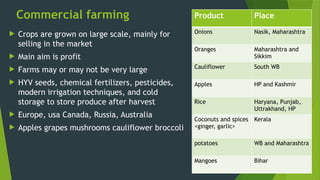
Commercial farming
 Crops are grown on large scale, mainly for
selling in the market
 Main aim is profit
 Farms may or may not be very large
 HYV seeds, chemical fertilizers, pesticides,
modern irrigation techniques, and cold
storage to store produce after harvest
 Europe, usa Canada, Russia, Australia
 Apples grapes mushrooms cauliflower broccoli
Product Place
Onions Nasik, Maharashtra
Oranges Maharashtra and
Sikkim
Cauliflower South WB
Apples HP and Kashmir
Rice Haryana, Punjab,
Uttrakhand, HP
Coconuts and spices
<ginger, garlic>
Kerala
potatoes WB and Maharashtra
Mangoes Bihar
Plantation farming
 Type of commercial farming
 Planted over a large area called plantation
 Cash crops only, quality control is important as products trade home and abroad
 Work is highly organized
 Large amount of money is required as capital and modern scientific techniques
are incorporated.
 Farms anre very big
Mixed farming
Shifting cultivation

Agriculture power point presentation geography

  • 1.
  • 2.
    Importance of Agriculture Grows food crops that is necessary for living.  Important role in agro based industries.  Major occupation, provides money for farmers.  Crops grown through agriculture can be traded with other countries through land and water.  Crops grown through agriculture bind the soil together by their roots and prevent soil erosion.
  • 3.
    Agriculture • Derived from2 Latin words- ager means field and cultra means to cultivate. • Agriculture refers to the cultivation of a field.
  • 4.
    Subsistence farming  Practisedby farmers with small pieces of land.  Farmers grow just enough to meet their needs and those of their families.  Generally grow rice or vegetables and use organic or natural fertilizers like cow dung, animal droppings and dead and dried plants.  They depend on rainfall for water for the crops.
  • 5.
    Intensive farming  Practisedon small plots of land  Farmer tries to get maximum yield on his land by using cross bred hybrid seeds, pleanty of fertilizers and pesticides  Expensive <cost of HYV SEEDS + labour help>  Major crops are rice wheat cotton sugar cane  Yield per acre is high as night soil animal manure household waste are used  Methods used are double cropping multiple cropping and crop rotation  Mainly practised in the Indian subcontinent china japan and Korea  In India, valleys of Himalayan region and narrower plains of Brahmaputra valley in Assam.
  • 6.
    Extensive farming  Practisedin areas of low population where plenty of land is available  Less human labour is available hence large machines<combine harvester> are used.  Maize wheat barley are major crops  Size of farm is 1000 to 2000 acres  Practised in Temperate grasslands  Usa, Canada and Australia  India, Punjab and Haryana
  • 7.
    Commercial farming  Cropsare grown on large scale, mainly for selling in the market  Main aim is profit  Farms may or may not be very large  HYV seeds, chemical fertilizers, pesticides, modern irrigation techniques, and cold storage to store produce after harvest  Europe, usa Canada, Russia, Australia  Apples grapes mushrooms cauliflower broccoli Product Place Onions Nasik, Maharashtra Oranges Maharashtra and Sikkim Cauliflower South WB Apples HP and Kashmir Rice Haryana, Punjab, Uttrakhand, HP Coconuts and spices <ginger, garlic> Kerala potatoes WB and Maharashtra Mangoes Bihar
  • 8.
    Plantation farming  Typeof commercial farming  Planted over a large area called plantation  Cash crops only, quality control is important as products trade home and abroad  Work is highly organized  Large amount of money is required as capital and modern scientific techniques are incorporated.  Farms anre very big
  • 9.
  • 10.