A member of CGIAR consortium www.iita.org
AGRIBUSINESS:KEY TO
PRODUCTIVE YOUTH
EMPLOYMENT
A member of CGIAR consortium www.iita.org
Outline of Presentation
Objectives of training
Introduction
What is agribusiness?
Types of agribusiness
Reasons for youth involvement in agriculture
Opportunities for youth in agribusiness
Conclusion
A member of CGIAR consortium www.iita.org
Training Objectives
Define agribusiness
Define value chain
Identify reasons for involving youth in
agribusiness
Itemize available opportunities for youth in
agribusiness
A member of CGIAR consortium www.iita.org
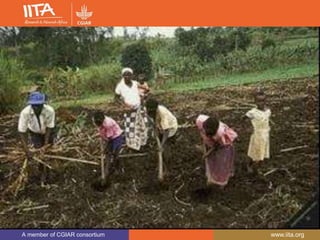
Introduction
Agriculture has become an especially unattractive
sector, due to a combination of youth attitudes and
perception, lack of investment from the government
and inability to incentivize the involvement of a
younger generation. Young, ambitious people have
never looked at agriculture as a source of income and
livelihoods because they think it is meant for the old
and does not make a good living.
A member of CGIAR consortium www.iita.org
Nigerian Youth’s Perception of
Agriculture
 Perception of agriculture as a job for poor people.
 Parental influence on the youth to move out of farming.
 Continuous poor harvests and soil degradation.
 Youth see agriculture as an occupation of last resort
Agriculture seen as job for idlers.
 General dislike of village life.
A member of CGIAR consortium www.iita.org
Introduction/2
According to the Nigerian Bureau of statistics(2016),
the national unemployment rate is 13.9% with the
Nigerian youth accounting for more than 25%.
Increased involvement of youth in agricultural
activities will help reduce the problems of the ageing
farm population and increasing youth unemployment.
This is where agribusiness comes in, it is a growing
industry that provides wide range of career options.
A member of CGIAR consortium www.iita.org
Introduction/3
Agribusiness has various activities involved that
provide gainful employment for youths.
It cuts across different chains and different interest,
which leaves youth with a range of options to choose
from, although it is not as rosy as it appears, it
requires lot of dedication and hard work.
A member of CGIAR consortium www.iita.org
What is agribusiness?
 Agribusiness is the business of agricultural production. It
involves agrochemicals, breeding, agro-service
provision, crop production (farming and contract
farming), distribution, farm machinery, processing, seed
supply, ICT, capacity building, and transportation, as
well as marketing and retail sales.
 Agribusiness encompasses all activities that are relevant
to the eventual production, transformation/value adding,
distribution and retailing of food, fiber and associated
products. It is a business that earns most of its revenue
from agriculture.
A member of CGIAR consortium www.iita.org
Prospects of Agribusiness
 For agriculture to be sustainable, needs to be viewed
as a business
 Agribusiness – A business introduced in all aspects of
agriculture – inputs (seeds and fertilizer), farming,
processing, marketing, distribution, and sales etc.
 The youth – greatest education, enthusiasm and strength
– get few opportunities to apply talents
 Agribusiness offers realistic opportunities for food
security, job and wealth creation for young people.
A member of CGIAR consortium www.iita.org
Major types of agribusiness/1
Agribusinesses fall into many different types, which are
largely derived from their products or what they do. The
common types of agribusinesses in Nigeria include the
following:
 Crop production
In this type of agribusiness, the businesses are engaged in
the production and selling of crops like wheat, maize,
cabbages, cowpea, millet, cassava, soybean, rice,
groundnut etc. This type of agribusiness may be carried
out on a large scale or on a small scale
A member of CGIAR consortium www.iita.org
Major types of Agribusiness/2
 Livestock production
In this type of agribusiness, the businesses are engaged in
the rearing and selling of different animals for their meat
and other products like milk, hides and skins, etc. In
Nigeria, the animals commonly reared by such businesses
include goats, sheep, pigs, rabbits, etc.
 Poultry keeping
In this type of agribusiness, the business concentrate on
rearing and selling different types of birds for their meat,
eggs, skins and feathers. In Nigeria, the birds commonly
kept include chicken, turkeys, ducks, guinea fowls etc.
A member of CGIAR consortium www.iita.org
Major types of Agribusiness/3
 Aquaculture/Fish farming
This is one of the fastest growing enterprise in agribusiness.
Youth can explore fish feed production, fish production and
fish processing.
 Agricultural support businesses
In this type of agribusiness, the businesses provide
support services to agribusinesses. Such businesses
provide extension services, inputs like fertilizers, drugs,
ICT, capacity building etc.
A member of CGIAR consortium www.iita.org
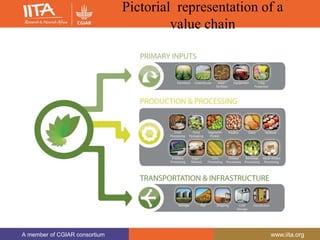
Value chain
One of the central ideas of the Agricultural Value-
Chain concept is the differentiation of the total agro
system and the specialization of each element so as to
optimize the entire system.
Agric-food Value Chains are designed to increase
competitive advantage through collaboration in a
venture that links producers, processors, marketers,
food service companies, retailers and supporting
groups such as shippers, research groups and
suppliers.
A member of CGIAR consortium www.iita.org
Pictorial representation of a
value chain
A member of CGIAR consortium www.iita.org
 Age
 Diversity of Agribusiness
 Reduction in unemployment
 Reduce importation of agricultural commodities
 Literacy and ICT Savvy (skills)
 Reduction in rural-urban migration
IITA YOUTH AGRIPRENEUR 2014
Reasons to Involve Youths in Agribusiness
A member of CGIAR consortium www.iita.org
Reasons to Involve Youths in
Agribusiness/1
Age
There is compelling evidence of ageing farmer
population in the country which must be addressed to
facilitate sustainability in agriculture production.
Majority of farmers who practice farming are in the
age range of 46-55 years and this has not encouraged
sustainable productivity. Hence, increase productivity
in agricultural sector depends on the youth whose
energy and numbers provide tremendous
opportunities for increasing agricultural productivity.
A member of CGIAR consortium www.iita.org
Reasons to Involve Youths in
Agribusiness/2
Diversity of Agribusiness
Agribusiness is a business introduced in all aspects
of agriculture. It involves transformation of
agricultural raw materials into industrial products
involving different value chains and agriculture value
chain provides plenty opportunities acting as grounds
for diversification. Hence, agribusiness will spread
the risk farmers face, increase returns for farmers, and
this will improve their standard of living.
A member of CGIAR consortium www.iita.org
Reasons to Involve Youths in
Agribusiness/3
Reduction in unemployment
A value chain is a basis for a chain of activities that
will involve manpower. Agribusiness involves value
chain for various agricultural produce. It’s a one-stop
shop where a range of service offerings to be
exploited by youths as business awaits. Therefore,
agribusiness will keep youths productively employed
in agriculture
A member of CGIAR consortium www.iita.org
Reasons to Involve Youths in
Agribusiness/4
Reduce importation of agricultural
commodities
Nigeria as a country has little participation in global
agribusiness except as an importer, with aging
farmers, and no usage of new technologies or large
scale mechanization will make Nigeria a nation
without food security. So, youths need to be
passionately involved in agriculture to ensure boost
in food production to meet the need of Nigerian
population.
A member of CGIAR consortium www.iita.org
Reasons to Involve Youths in
Agribusiness/5
Literacy and ICT Savvy
There are constraints experienced by farmers in
accessing available agricultural information from
their sources. This may be due to illiteracy and cost
incurred to access information, poor relations with
extension workers. Hence, the literacy level and ICT
know-how among youths will lead to effective
communication(www.agriculturenigeria.com),reducti
on in cost expended and increased accessibility of
necessary agricultural information .
A member of CGIAR consortium www.iita.org
Reasons to Involve Youths in
Agribusiness/6
Reduction in rural-urban migration
Youths migrate from rural areas due to search for
education and skills acquisition, and the absence of
desirable job opportunities. Increased awareness
about agribusiness to change the negative perception
of youths about agriculture as a venture that can keep
youths productively involved will reduce rural-urban
migration.
A member of CGIAR consortium www.iita.org
Opportunities for Youth in Agribusiness
Few examples of how youth in Agriculture can be involved
in the value chain are as follows:
 Input suppliers (agro-chemicals, planting materials etc.)
 Farm managers/producers/Entrepreneurs
 Processing (value-addition/processing of products)
 Wholesalers/Retailers/Exporters
A member of CGIAR consortium www.iita.org
Opportunities for Youth in Agribusiness
 Researchers (research institutions – public and private
sector)
 Agricultural consultants (communication, extension,
social media specialist , Agricultural tools/machinery,
GIS, GPS, transport, packaging, distribution etc.)
A member of CGIAR consortium www.iita.org
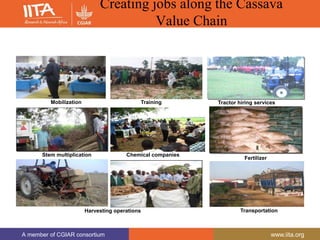
Creating jobs along the Cassava
Value Chain
Mobilization Training Tractor hiring services
Stem multiplication
Fertilizer
distribution
Transportation
Chemical companies
Harvesting operations
A member of CGIAR consortium www.iita.org
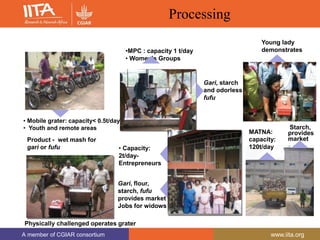
• Mobile grater: capacity< 0.5t/day
• Youth and remote areas
Product - wet mash for
gari or fufu
Gari, starch
and odorless
fufu
Physically challenged operates grater
•MPC : capacity 1 t/day
• Women’s Groups
• Capacity:
2t/day-
Entrepreneurs
Gari, flour,
starch, fufu
provides market
Jobs for widows
Processing
Young lady
demonstrates
MATNA:
capacity:
120t/day
Starch,
provides
market
A member of CGIAR consortium www.iita.org
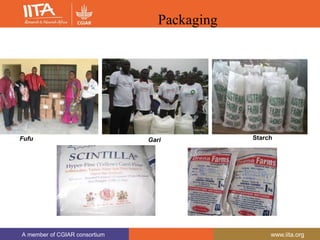
Packaging
Fufu Gari Starch
A member of CGIAR consortium www.iita.org
Conclusion
Of course all of these come with their own hurdles,
but as one article states “Africa has the highest
number of youth in the world, and some of the most
fertile soils – the two combined could be a force to
promote agricultural development!“ Engaging youth
in agriculture will aid in the positive transformation
of agricultural sector.
A member of CGIAR consortium www.iita.org
Quote
• Farming is cool, Agriculture
is the business.
- Chianu Paschal
A member of CGIAR consortium www.iita.org
Thank
you

Agribusiness_presentation1111111111111111.ppt

  • 1.
    A member ofCGIAR consortium www.iita.org A member of CGIAR consortium www.iita.org AGRIBUSINESS:KEY TO PRODUCTIVE YOUTH EMPLOYMENT
  • 2.
    A member ofCGIAR consortium www.iita.org A member of CGIAR consortium www.iita.org Outline of Presentation Objectives of training Introduction What is agribusiness? Types of agribusiness Reasons for youth involvement in agriculture Opportunities for youth in agribusiness Conclusion
  • 3.
    A member ofCGIAR consortium www.iita.org A member of CGIAR consortium www.iita.org Training Objectives Define agribusiness Define value chain Identify reasons for involving youth in agribusiness Itemize available opportunities for youth in agribusiness
  • 4.
    A member ofCGIAR consortium www.iita.org A member of CGIAR consortium www.iita.org Introduction Agriculture has become an especially unattractive sector, due to a combination of youth attitudes and perception, lack of investment from the government and inability to incentivize the involvement of a younger generation. Young, ambitious people have never looked at agriculture as a source of income and livelihoods because they think it is meant for the old and does not make a good living.
  • 5.
    A member ofCGIAR consortium www.iita.org A member of CGIAR consortium www.iita.org Nigerian Youth’s Perception of Agriculture  Perception of agriculture as a job for poor people.  Parental influence on the youth to move out of farming.  Continuous poor harvests and soil degradation.  Youth see agriculture as an occupation of last resort Agriculture seen as job for idlers.  General dislike of village life.
  • 6.
    A member ofCGIAR consortium www.iita.org A member of CGIAR consortium www.iita.org
  • 7.
    A member ofCGIAR consortium www.iita.org A member of CGIAR consortium www.iita.org Introduction/2 According to the Nigerian Bureau of statistics(2016), the national unemployment rate is 13.9% with the Nigerian youth accounting for more than 25%. Increased involvement of youth in agricultural activities will help reduce the problems of the ageing farm population and increasing youth unemployment. This is where agribusiness comes in, it is a growing industry that provides wide range of career options.
  • 8.
    A member ofCGIAR consortium www.iita.org A member of CGIAR consortium www.iita.org Introduction/3 Agribusiness has various activities involved that provide gainful employment for youths. It cuts across different chains and different interest, which leaves youth with a range of options to choose from, although it is not as rosy as it appears, it requires lot of dedication and hard work.
  • 9.
    A member ofCGIAR consortium www.iita.org A member of CGIAR consortium www.iita.org What is agribusiness?  Agribusiness is the business of agricultural production. It involves agrochemicals, breeding, agro-service provision, crop production (farming and contract farming), distribution, farm machinery, processing, seed supply, ICT, capacity building, and transportation, as well as marketing and retail sales.  Agribusiness encompasses all activities that are relevant to the eventual production, transformation/value adding, distribution and retailing of food, fiber and associated products. It is a business that earns most of its revenue from agriculture.
  • 10.
    A member ofCGIAR consortium www.iita.org A member of CGIAR consortium www.iita.org Prospects of Agribusiness  For agriculture to be sustainable, needs to be viewed as a business  Agribusiness – A business introduced in all aspects of agriculture – inputs (seeds and fertilizer), farming, processing, marketing, distribution, and sales etc.  The youth – greatest education, enthusiasm and strength – get few opportunities to apply talents  Agribusiness offers realistic opportunities for food security, job and wealth creation for young people.
  • 11.
    A member ofCGIAR consortium www.iita.org A member of CGIAR consortium www.iita.org Major types of agribusiness/1 Agribusinesses fall into many different types, which are largely derived from their products or what they do. The common types of agribusinesses in Nigeria include the following:  Crop production In this type of agribusiness, the businesses are engaged in the production and selling of crops like wheat, maize, cabbages, cowpea, millet, cassava, soybean, rice, groundnut etc. This type of agribusiness may be carried out on a large scale or on a small scale
  • 12.
    A member ofCGIAR consortium www.iita.org A member of CGIAR consortium www.iita.org Major types of Agribusiness/2  Livestock production In this type of agribusiness, the businesses are engaged in the rearing and selling of different animals for their meat and other products like milk, hides and skins, etc. In Nigeria, the animals commonly reared by such businesses include goats, sheep, pigs, rabbits, etc.  Poultry keeping In this type of agribusiness, the business concentrate on rearing and selling different types of birds for their meat, eggs, skins and feathers. In Nigeria, the birds commonly kept include chicken, turkeys, ducks, guinea fowls etc.
  • 13.
    A member ofCGIAR consortium www.iita.org A member of CGIAR consortium www.iita.org Major types of Agribusiness/3  Aquaculture/Fish farming This is one of the fastest growing enterprise in agribusiness. Youth can explore fish feed production, fish production and fish processing.  Agricultural support businesses In this type of agribusiness, the businesses provide support services to agribusinesses. Such businesses provide extension services, inputs like fertilizers, drugs, ICT, capacity building etc.
  • 14.
    A member ofCGIAR consortium www.iita.org A member of CGIAR consortium www.iita.org Value chain One of the central ideas of the Agricultural Value- Chain concept is the differentiation of the total agro system and the specialization of each element so as to optimize the entire system. Agric-food Value Chains are designed to increase competitive advantage through collaboration in a venture that links producers, processors, marketers, food service companies, retailers and supporting groups such as shippers, research groups and suppliers.
  • 15.
    A member ofCGIAR consortium www.iita.org A member of CGIAR consortium www.iita.org Pictorial representation of a value chain
  • 16.
    A member ofCGIAR consortium www.iita.org A member of CGIAR consortium www.iita.org  Age  Diversity of Agribusiness  Reduction in unemployment  Reduce importation of agricultural commodities  Literacy and ICT Savvy (skills)  Reduction in rural-urban migration IITA YOUTH AGRIPRENEUR 2014 Reasons to Involve Youths in Agribusiness
  • 17.
    A member ofCGIAR consortium www.iita.org A member of CGIAR consortium www.iita.org Reasons to Involve Youths in Agribusiness/1 Age There is compelling evidence of ageing farmer population in the country which must be addressed to facilitate sustainability in agriculture production. Majority of farmers who practice farming are in the age range of 46-55 years and this has not encouraged sustainable productivity. Hence, increase productivity in agricultural sector depends on the youth whose energy and numbers provide tremendous opportunities for increasing agricultural productivity.
  • 18.
    A member ofCGIAR consortium www.iita.org A member of CGIAR consortium www.iita.org Reasons to Involve Youths in Agribusiness/2 Diversity of Agribusiness Agribusiness is a business introduced in all aspects of agriculture. It involves transformation of agricultural raw materials into industrial products involving different value chains and agriculture value chain provides plenty opportunities acting as grounds for diversification. Hence, agribusiness will spread the risk farmers face, increase returns for farmers, and this will improve their standard of living.
  • 19.
    A member ofCGIAR consortium www.iita.org A member of CGIAR consortium www.iita.org Reasons to Involve Youths in Agribusiness/3 Reduction in unemployment A value chain is a basis for a chain of activities that will involve manpower. Agribusiness involves value chain for various agricultural produce. It’s a one-stop shop where a range of service offerings to be exploited by youths as business awaits. Therefore, agribusiness will keep youths productively employed in agriculture
  • 20.
    A member ofCGIAR consortium www.iita.org A member of CGIAR consortium www.iita.org Reasons to Involve Youths in Agribusiness/4 Reduce importation of agricultural commodities Nigeria as a country has little participation in global agribusiness except as an importer, with aging farmers, and no usage of new technologies or large scale mechanization will make Nigeria a nation without food security. So, youths need to be passionately involved in agriculture to ensure boost in food production to meet the need of Nigerian population.
  • 21.
    A member ofCGIAR consortium www.iita.org A member of CGIAR consortium www.iita.org Reasons to Involve Youths in Agribusiness/5 Literacy and ICT Savvy There are constraints experienced by farmers in accessing available agricultural information from their sources. This may be due to illiteracy and cost incurred to access information, poor relations with extension workers. Hence, the literacy level and ICT know-how among youths will lead to effective communication(www.agriculturenigeria.com),reducti on in cost expended and increased accessibility of necessary agricultural information .
  • 22.
    A member ofCGIAR consortium www.iita.org A member of CGIAR consortium www.iita.org Reasons to Involve Youths in Agribusiness/6 Reduction in rural-urban migration Youths migrate from rural areas due to search for education and skills acquisition, and the absence of desirable job opportunities. Increased awareness about agribusiness to change the negative perception of youths about agriculture as a venture that can keep youths productively involved will reduce rural-urban migration.
  • 23.
    A member ofCGIAR consortium www.iita.org A member of CGIAR consortium www.iita.org Opportunities for Youth in Agribusiness Few examples of how youth in Agriculture can be involved in the value chain are as follows:  Input suppliers (agro-chemicals, planting materials etc.)  Farm managers/producers/Entrepreneurs  Processing (value-addition/processing of products)  Wholesalers/Retailers/Exporters
  • 24.
    A member ofCGIAR consortium www.iita.org A member of CGIAR consortium www.iita.org Opportunities for Youth in Agribusiness  Researchers (research institutions – public and private sector)  Agricultural consultants (communication, extension, social media specialist , Agricultural tools/machinery, GIS, GPS, transport, packaging, distribution etc.)
  • 25.
    A member ofCGIAR consortium www.iita.org A member of CGIAR consortium www.iita.org Creating jobs along the Cassava Value Chain Mobilization Training Tractor hiring services Stem multiplication Fertilizer distribution Transportation Chemical companies Harvesting operations
  • 26.
    A member ofCGIAR consortium www.iita.org A member of CGIAR consortium www.iita.org • Mobile grater: capacity< 0.5t/day • Youth and remote areas Product - wet mash for gari or fufu Gari, starch and odorless fufu Physically challenged operates grater •MPC : capacity 1 t/day • Women’s Groups • Capacity: 2t/day- Entrepreneurs Gari, flour, starch, fufu provides market Jobs for widows Processing Young lady demonstrates MATNA: capacity: 120t/day Starch, provides market
  • 27.
    A member ofCGIAR consortium www.iita.org A member of CGIAR consortium www.iita.org Packaging Fufu Gari Starch
  • 28.
    A member ofCGIAR consortium www.iita.org A member of CGIAR consortium www.iita.org
  • 29.
    A member ofCGIAR consortium www.iita.org A member of CGIAR consortium www.iita.org Conclusion Of course all of these come with their own hurdles, but as one article states “Africa has the highest number of youth in the world, and some of the most fertile soils – the two combined could be a force to promote agricultural development!“ Engaging youth in agriculture will aid in the positive transformation of agricultural sector.
  • 30.
    A member ofCGIAR consortium www.iita.org A member of CGIAR consortium www.iita.org Quote • Farming is cool, Agriculture is the business. - Chianu Paschal
  • 31.
    A member ofCGIAR consortium www.iita.org A member of CGIAR consortium www.iita.org Thank you

Editor's Notes

  • #2 KEY
  • #10 Abdoulaye, T., S. A. Bamire and A. S Olanrewaju. 2012. An assessment of Maize Seed Sub-Sector in DTMA Countries in West Africa. (forthcoming) Abdoulaye, T., D. Sanogo, A. Langyinyuo, S. A. Bamire and A. Olanrewaju 2009. Assessing the Constraints affecting Production and Deployment of maize seed in DTMA countries of West Africa. IITA, Ibadan, p. 40.
  • #11 Abdoulaye, T., S. A. Bamire and A. S Olanrewaju. 2012. An assessment of Maize Seed Sub-Sector in DTMA Countries in West Africa. (forthcoming) Abdoulaye, T., D. Sanogo, A. Langyinyuo, S. A. Bamire and A. Olanrewaju 2009. Assessing the Constraints affecting Production and Deployment of maize seed in DTMA countries of West Africa. IITA, Ibadan, p. 40.
  • #12 Reference: Fulton J., M. Marshall, J. Dennis, L. Hoelscher, K. Keener, K. Quagrainie, S. Smith, S. J. Swain, A. Alderson, V. Hadley, J. Luzar, K. Parker, M. Zoglmann (Undated) Bigger Profits through Targeted Sales: A one-day, hands-on workshop for entrepreneurs and small business owners focusing on marketing and sales. Purdue University, 105pp.
  • #13 Reference: Fulton J., M. Marshall, J. Dennis, L. Hoelscher, K. Keener, K. Quagrainie, S. Smith, S. J. Swain, A. Alderson, V. Hadley, J. Luzar, K. Parker, M. Zoglmann (Undated) Bigger Profits through Targeted Sales: A one-day, hands-on workshop for entrepreneurs and small business owners focusing on marketing and sales. Purdue University, 105pp.
  • #14 Reference: Fulton J., M. Marshall, J. Dennis, L. Hoelscher, K. Keener, K. Quagrainie, S. Smith, S. J. Swain, A. Alderson, V. Hadley, J. Luzar, K. Parker, M. Zoglmann (Undated) Bigger Profits through Targeted Sales: A one-day, hands-on workshop for entrepreneurs and small business owners focusing on marketing and sales. Purdue University, 105pp.
  • #17 Reference: Fulton J., M. Marshall, J. Dennis, L. Hoelscher, K. Keener, K. Quagrainie, S. Smith, S. J. Swain, A. Alderson, V. Hadley, J. Luzar, K. Parker, M. Zoglmann (Undated) Bigger Profits through Targeted Sales: A one-day, hands-on workshop for entrepreneurs and small business owners focusing on marketing and sales. Purdue University, 105pp.
  • #24 Reference: Fulton J., M. Marshall, J. Dennis, L. Hoelscher, K. Keener, K. Quagrainie, S. Smith, S. J. Swain, A. Alderson, V. Hadley, J. Luzar, K. Parker, M. Zoglmann (Undated) Bigger Profits through Targeted Sales: A one-day, hands-on workshop for entrepreneurs and small business owners focusing on marketing and sales. Purdue University, 105pp.