AGRI-FOOD PROCESSING AND
MANAGEMENT
by
Mr.Jai Singh
Why Agri-Business Management?
• Understanding agribusiness is crucial for botany students as it provides
insights into the practical applications of plant science in agriculture.
Knowledge of agribusiness practices allows them to contribute to
sustainable and efficient crop production.
• Agribusiness directly influences food production, processing, and
distribution. Nutrition students can gain insights into how the supply
chain affects the quality and availability of food, enabling them to
address nutritional challenges and advocate for healthy food systems.
• Agribusiness models impact the entire food production process. Food
science students can benefit from understanding how agricultural
practices influence the quality, safety, and sustainability of food
products.
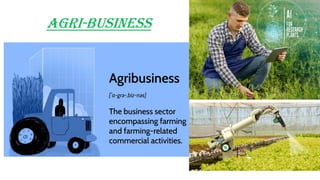
AGRI-BUSINESS
1.Can you think of specific examples of
agribusinesses in India that align with
the described categories?
2.How does each link in the agribusiness
value chain contribute to adding value for
the end consumer?
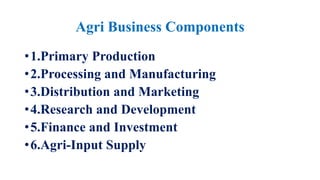
Agri Business Components
•1.Primary Production
•2.Processing and Manufacturing
•3.Distribution and Marketing
•4.Research and Development
•5.Finance and Investment
•6.Agri-Input Supply
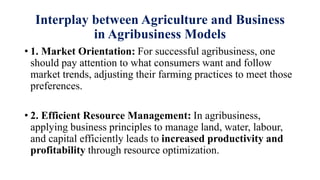
Interplay between Agriculture and Business
in Agribusiness Models
• 1. Market Orientation: For successful agribusiness, one
should pay attention to what consumers want and follow
market trends, adjusting their farming practices to meet those
preferences.
• 2. Efficient Resource Management: In agribusiness,
applying business principles to manage land, water, labour,
and capital efficiently leads to increased productivity and
profitability through resource optimization.
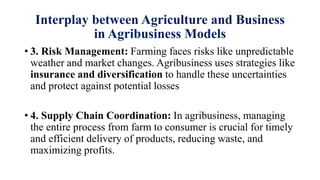
Interplay between Agriculture and Business
in Agribusiness Models
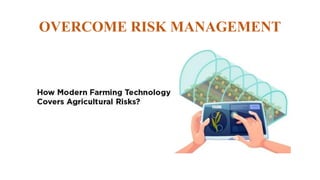
• 3. Risk Management: Farming faces risks like unpredictable
weather and market changes. Agribusiness uses strategies like
insurance and diversification to handle these uncertainties
and protect against potential losses
• 4. Supply Chain Coordination: In agribusiness, managing
the entire process from farm to consumer is crucial for timely
and efficient delivery of products, reducing waste, and
maximizing profits.
Interplay between Agriculture and Business
in Agribusiness Models
• 5. Technology Adoption: In agriculture, the adoption of
technology like precision farming, IoT applications, and data
analytics optimize production, boost efficiency, and lessen
environmental impact.
• 6. Value Addition: Agribusiness emphasizes adding value to
raw agricultural products through processing and
manufacturing, meeting consumer demands for convenience
and creating new markets and revenue streams for producers.
OVERCOME RISK MANAGEMENT
What does the term "Agribusiness"
encompass?
•a) Only crop cultivation
•b) Integration of various agricultural and business
activities
•c) Livestock breeding only
•d) Fishing activities only
2. What is the foundation of
agribusiness?
•a) Distribution and Marketing
•b) Processing and Manufacturing
•c) Primary Production
•d) Research and Development
3. Which component of agribusiness
involves the supply of inputs
like seeds, fertilizers, and machinery?
•a) Finance and Investment
•b) Market Orientation
•c) Agri-Input Supply
•d) Efficient Resource Management
4. Why is risk management
important in agribusiness?
•a) To increase market orientation
•b) To optimize resources efficiently
•c) To mitigate uncertainties like weather and
market fluctuations
•d) To enhance primary production
AGRI-BUSINESS
•Agri-business is a concept of economics which
includes total sum of all activities involved in
the manufacturing and
•distribution of farm supplies,
•production,
•operations on the farm and the
•storage processing and distribution of farm
commodities and items made from them
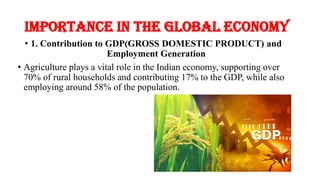
Importance in the Global Economy
• 1. Contribution to GDP(GROSS DOMESTIC PRODUCT) and
Employment Generation
• Agriculture plays a vital role in the Indian economy, supporting over
70% of rural households and contributing 17% to the GDP, while also
employing around 58% of the population.
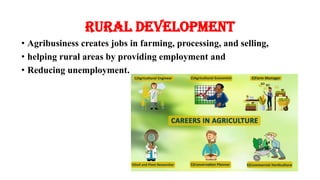
Rural Development
• Agribusiness creates jobs in farming, processing, and selling,
• helping rural areas by providing employment and
• Reducing unemployment.
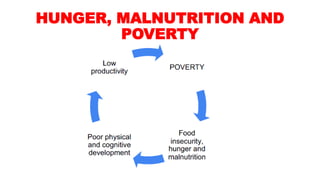
HUNGER, MALNUTRITION AND
POVERTY
1. What does the input sector in
agriculture primarily supply to
farmers?
•a) Finished Products
•b) Machinery and Fuel
•c) Processed Goods
•d) Marketing Services
2. What is the primary focus of the
product sector in agriculture?
•a) Crop Cultivation
•b) Storage and Processing
•c) Livestock Breeding
•d) Seed Supply
3. What percentage does agriculture
contribute to India's total GDP?
•a) 10%
•b) 17%
•c) 30%
•d) 50%
4. What does food security
encompass beyond the physical
availability of
food?
•a) Agricultural Production
•b) Economic and Physical Access
•c) Input Sector
•d) Political Stability
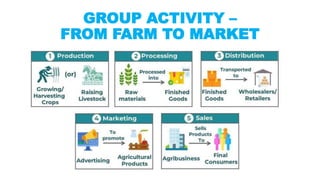
GROUP ACTIVITY –
FROM FARM TO MARKET
Different Types Of Farming
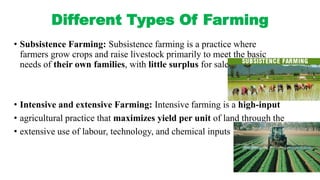
• Subsistence Farming: Subsistence farming is a practice where
farmers grow crops and raise livestock primarily to meet the basic
needs of their own families, with little surplus for sale or trade
• Intensive and extensive Farming: Intensive farming is a high-input
• agricultural practice that maximizes yield per unit of land through the
• extensive use of labour, technology, and chemical inputs
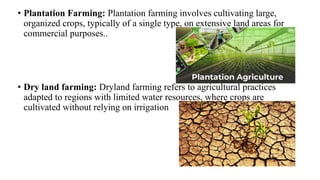
• Plantation Farming: Plantation farming involves cultivating large,
organized crops, typically of a single type, on extensive land areas for
commercial purposes..
• Dry land farming: Dryland farming refers to agricultural practices
adapted to regions with limited water resources, where crops are
cultivated without relying on irrigation
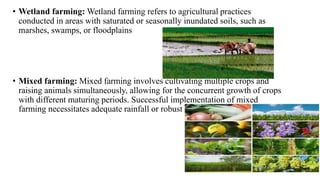
• Wetland farming: Wetland farming refers to agricultural practices
conducted in areas with saturated or seasonally inundated soils, such as
marshes, swamps, or floodplains
• Mixed farming: Mixed farming involves cultivating multiple crops and
raising animals simultaneously, allowing for the concurrent growth of crops
with different maturing periods. Successful implementation of mixed
farming necessitates adequate rainfall or robust irrigation facilities
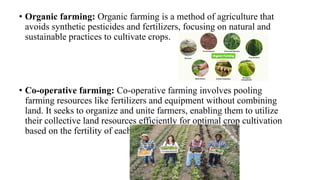
• Organic farming: Organic farming is a method of agriculture that
avoids synthetic pesticides and fertilizers, focusing on natural and
sustainable practices to cultivate crops.
• Co-operative farming: Co-operative farming involves pooling
farming resources like fertilizers and equipment without combining
land. It seeks to organize and unite farmers, enabling them to utilize
their collective land resources efficiently for optimal crop cultivation
based on the fertility of each plot.
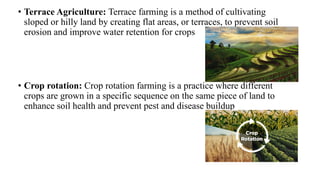
• Terrace Agriculture: Terrace farming is a method of cultivating
sloped or hilly land by creating flat areas, or terraces, to prevent soil
erosion and improve water retention for crops
• Crop rotation: Crop rotation farming is a practice where different
crops are grown in a specific sequence on the same piece of land to
enhance soil health and prevent pest and disease buildup
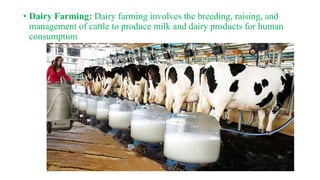
• Dairy Farming: Dairy farming involves the breeding, raising, and
management of cattle to produce milk and dairy products for human
consumption
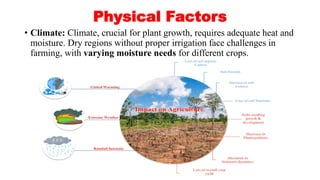
Physical Factors
• Climate: Climate, crucial for plant growth, requires adequate heat and
moisture. Dry regions without proper irrigation face challenges in
farming, with varying moisture needs for different crops.
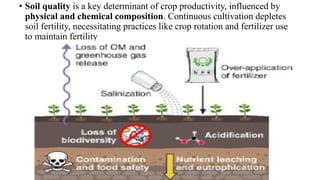
• Soil quality is a key determinant of crop productivity, influenced by
physical and chemical composition. Continuous cultivation depletes
soil fertility, necessitating practices like crop rotation and fertilizer use
to maintain fertility
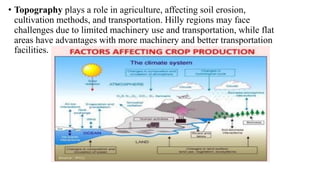
• Topography plays a role in agriculture, affecting soil erosion,
cultivation methods, and transportation. Hilly regions may face
challenges due to limited machinery use and transportation, while flat
areas have advantages with more machinery and better transportation
facilities.
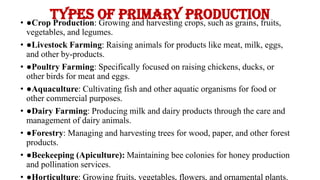
Types of Primary Production
• ●Crop Production: Growing and harvesting crops, such as grains, fruits,
vegetables, and legumes.
• ●Livestock Farming: Raising animals for products like meat, milk, eggs,
and other by-products.
• ●Poultry Farming: Specifically focused on raising chickens, ducks, or
other birds for meat and eggs.
• ●Aquaculture: Cultivating fish and other aquatic organisms for food or
other commercial purposes.
• ●Dairy Farming: Producing milk and dairy products through the care and
management of dairy animals.
• ●Forestry: Managing and harvesting trees for wood, paper, and other forest
products.
• ●Beekeeping (Apiculture): Maintaining bee colonies for honey production
and pollination services.
• ●Horticulture: Growing fruits, vegetables, flowers, and ornamental plants.
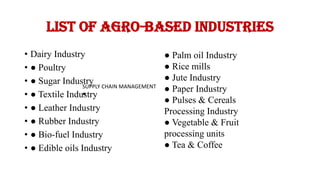
List of Agro-Based Industries
• Dairy Industry
• ● Poultry
• ● Sugar Industry
• ● Textile Industry
• ● Leather Industry
• ● Rubber Industry
• ● Bio-fuel Industry
• ● Edible oils Industry
● Palm oil Industry
● Rice mills
● Jute Industry
● Paper Industry
● Pulses & Cereals
Processing Industry
● Vegetable & Fruit
processing units
● Tea & Coffee
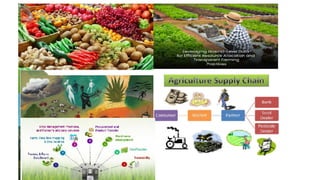
SUPPLY CHAIN MANAGEMENT
●
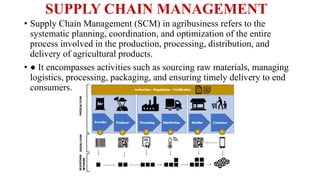
SUPPLY CHAIN MANAGEMENT
• Supply Chain Management (SCM) in agribusiness refers to the
systematic planning, coordination, and optimization of the entire
process involved in the production, processing, distribution, and
delivery of agricultural products.
• ● It encompasses activities such as sourcing raw materials, managing
logistics, processing, packaging, and ensuring timely delivery to end
consumers.
What characterizes subsistence farming in
India?
• A. Export-oriented crops
• B. Large-scale production
• C. Profit-driven motives
• D. Cultivation for self and family livelihood
Which farming type involves cultivating
extensive areas with the aim of
exporting products to other countries?
• A. Intensive farming
• B. Commercial farming
• C. Plantation farming
• D. Wetland farming
What is a potential benefit of e-commerce
platforms in agriculture?
• A. Increases dependence on middlemen
• B. Reduces farmers' earnings
• C. Connects farmers directly with consumers
• D. Promotes isolation of rural communities
What is a key objective of sustainable
agriculture?
• A. Maximizing reliance on non-renewable resources
• B. Minimizing biodiversity
• C. Promoting pollution
• D. Safeguarding soil fertility and improving ecological conditions
AGRICULTURE AND ITS INNOVATIVE TECHNIQUES

AGRICULTURE AND ITS INNOVATIVE TECHNIQUES

  • 1.
  • 2.
    Why Agri-Business Management? •Understanding agribusiness is crucial for botany students as it provides insights into the practical applications of plant science in agriculture. Knowledge of agribusiness practices allows them to contribute to sustainable and efficient crop production. • Agribusiness directly influences food production, processing, and distribution. Nutrition students can gain insights into how the supply chain affects the quality and availability of food, enabling them to address nutritional challenges and advocate for healthy food systems. • Agribusiness models impact the entire food production process. Food science students can benefit from understanding how agricultural practices influence the quality, safety, and sustainability of food products.
  • 3.
  • 5.
    1.Can you thinkof specific examples of agribusinesses in India that align with the described categories? 2.How does each link in the agribusiness value chain contribute to adding value for the end consumer?
  • 7.
    Agri Business Components •1.PrimaryProduction •2.Processing and Manufacturing •3.Distribution and Marketing •4.Research and Development •5.Finance and Investment •6.Agri-Input Supply
  • 8.
    Interplay between Agricultureand Business in Agribusiness Models • 1. Market Orientation: For successful agribusiness, one should pay attention to what consumers want and follow market trends, adjusting their farming practices to meet those preferences. • 2. Efficient Resource Management: In agribusiness, applying business principles to manage land, water, labour, and capital efficiently leads to increased productivity and profitability through resource optimization.
  • 9.
    Interplay between Agricultureand Business in Agribusiness Models • 3. Risk Management: Farming faces risks like unpredictable weather and market changes. Agribusiness uses strategies like insurance and diversification to handle these uncertainties and protect against potential losses • 4. Supply Chain Coordination: In agribusiness, managing the entire process from farm to consumer is crucial for timely and efficient delivery of products, reducing waste, and maximizing profits.
  • 10.
    Interplay between Agricultureand Business in Agribusiness Models • 5. Technology Adoption: In agriculture, the adoption of technology like precision farming, IoT applications, and data analytics optimize production, boost efficiency, and lessen environmental impact. • 6. Value Addition: Agribusiness emphasizes adding value to raw agricultural products through processing and manufacturing, meeting consumer demands for convenience and creating new markets and revenue streams for producers.
  • 12.
  • 13.
    What does theterm "Agribusiness" encompass? •a) Only crop cultivation •b) Integration of various agricultural and business activities •c) Livestock breeding only •d) Fishing activities only
  • 14.
    2. What isthe foundation of agribusiness? •a) Distribution and Marketing •b) Processing and Manufacturing •c) Primary Production •d) Research and Development
  • 15.
    3. Which componentof agribusiness involves the supply of inputs like seeds, fertilizers, and machinery? •a) Finance and Investment •b) Market Orientation •c) Agri-Input Supply •d) Efficient Resource Management
  • 16.
    4. Why isrisk management important in agribusiness? •a) To increase market orientation •b) To optimize resources efficiently •c) To mitigate uncertainties like weather and market fluctuations •d) To enhance primary production
  • 17.
    AGRI-BUSINESS •Agri-business is aconcept of economics which includes total sum of all activities involved in the manufacturing and •distribution of farm supplies, •production, •operations on the farm and the •storage processing and distribution of farm commodities and items made from them
  • 18.
    Importance in theGlobal Economy • 1. Contribution to GDP(GROSS DOMESTIC PRODUCT) and Employment Generation • Agriculture plays a vital role in the Indian economy, supporting over 70% of rural households and contributing 17% to the GDP, while also employing around 58% of the population.
  • 19.
    Rural Development • Agribusinesscreates jobs in farming, processing, and selling, • helping rural areas by providing employment and • Reducing unemployment.
  • 20.
  • 22.
    1. What doesthe input sector in agriculture primarily supply to farmers? •a) Finished Products •b) Machinery and Fuel •c) Processed Goods •d) Marketing Services
  • 23.
    2. What isthe primary focus of the product sector in agriculture? •a) Crop Cultivation •b) Storage and Processing •c) Livestock Breeding •d) Seed Supply
  • 24.
    3. What percentagedoes agriculture contribute to India's total GDP? •a) 10% •b) 17% •c) 30% •d) 50%
  • 25.
    4. What doesfood security encompass beyond the physical availability of food? •a) Agricultural Production •b) Economic and Physical Access •c) Input Sector •d) Political Stability
  • 26.
  • 27.
    Different Types OfFarming • Subsistence Farming: Subsistence farming is a practice where farmers grow crops and raise livestock primarily to meet the basic needs of their own families, with little surplus for sale or trade • Intensive and extensive Farming: Intensive farming is a high-input • agricultural practice that maximizes yield per unit of land through the • extensive use of labour, technology, and chemical inputs
  • 28.
    • Plantation Farming:Plantation farming involves cultivating large, organized crops, typically of a single type, on extensive land areas for commercial purposes.. • Dry land farming: Dryland farming refers to agricultural practices adapted to regions with limited water resources, where crops are cultivated without relying on irrigation
  • 29.
    • Wetland farming:Wetland farming refers to agricultural practices conducted in areas with saturated or seasonally inundated soils, such as marshes, swamps, or floodplains • Mixed farming: Mixed farming involves cultivating multiple crops and raising animals simultaneously, allowing for the concurrent growth of crops with different maturing periods. Successful implementation of mixed farming necessitates adequate rainfall or robust irrigation facilities
  • 30.
    • Organic farming:Organic farming is a method of agriculture that avoids synthetic pesticides and fertilizers, focusing on natural and sustainable practices to cultivate crops. • Co-operative farming: Co-operative farming involves pooling farming resources like fertilizers and equipment without combining land. It seeks to organize and unite farmers, enabling them to utilize their collective land resources efficiently for optimal crop cultivation based on the fertility of each plot.
  • 31.
    • Terrace Agriculture:Terrace farming is a method of cultivating sloped or hilly land by creating flat areas, or terraces, to prevent soil erosion and improve water retention for crops • Crop rotation: Crop rotation farming is a practice where different crops are grown in a specific sequence on the same piece of land to enhance soil health and prevent pest and disease buildup
  • 32.
    • Dairy Farming:Dairy farming involves the breeding, raising, and management of cattle to produce milk and dairy products for human consumption
  • 33.
    Physical Factors • Climate:Climate, crucial for plant growth, requires adequate heat and moisture. Dry regions without proper irrigation face challenges in farming, with varying moisture needs for different crops.
  • 34.
    • Soil qualityis a key determinant of crop productivity, influenced by physical and chemical composition. Continuous cultivation depletes soil fertility, necessitating practices like crop rotation and fertilizer use to maintain fertility
  • 35.
    • Topography playsa role in agriculture, affecting soil erosion, cultivation methods, and transportation. Hilly regions may face challenges due to limited machinery use and transportation, while flat areas have advantages with more machinery and better transportation facilities.
  • 36.
    Types of PrimaryProduction • ●Crop Production: Growing and harvesting crops, such as grains, fruits, vegetables, and legumes. • ●Livestock Farming: Raising animals for products like meat, milk, eggs, and other by-products. • ●Poultry Farming: Specifically focused on raising chickens, ducks, or other birds for meat and eggs. • ●Aquaculture: Cultivating fish and other aquatic organisms for food or other commercial purposes. • ●Dairy Farming: Producing milk and dairy products through the care and management of dairy animals. • ●Forestry: Managing and harvesting trees for wood, paper, and other forest products. • ●Beekeeping (Apiculture): Maintaining bee colonies for honey production and pollination services. • ●Horticulture: Growing fruits, vegetables, flowers, and ornamental plants.
  • 39.
    List of Agro-BasedIndustries • Dairy Industry • ● Poultry • ● Sugar Industry • ● Textile Industry • ● Leather Industry • ● Rubber Industry • ● Bio-fuel Industry • ● Edible oils Industry ● Palm oil Industry ● Rice mills ● Jute Industry ● Paper Industry ● Pulses & Cereals Processing Industry ● Vegetable & Fruit processing units ● Tea & Coffee SUPPLY CHAIN MANAGEMENT ●
  • 40.
    SUPPLY CHAIN MANAGEMENT •Supply Chain Management (SCM) in agribusiness refers to the systematic planning, coordination, and optimization of the entire process involved in the production, processing, distribution, and delivery of agricultural products. • ● It encompasses activities such as sourcing raw materials, managing logistics, processing, packaging, and ensuring timely delivery to end consumers.
  • 41.
    What characterizes subsistencefarming in India? • A. Export-oriented crops • B. Large-scale production • C. Profit-driven motives • D. Cultivation for self and family livelihood
  • 42.
    Which farming typeinvolves cultivating extensive areas with the aim of exporting products to other countries? • A. Intensive farming • B. Commercial farming • C. Plantation farming • D. Wetland farming
  • 43.
    What is apotential benefit of e-commerce platforms in agriculture? • A. Increases dependence on middlemen • B. Reduces farmers' earnings • C. Connects farmers directly with consumers • D. Promotes isolation of rural communities
  • 44.
    What is akey objective of sustainable agriculture? • A. Maximizing reliance on non-renewable resources • B. Minimizing biodiversity • C. Promoting pollution • D. Safeguarding soil fertility and improving ecological conditions