Agile Retrospective Activities
             Paulo Caroli
    agileretroactivities.blogspot.com


                         Paulo Caroli              Agile Coach


                        pcaroli@thoughtworks.com
                        Twitter: @paulocaroli
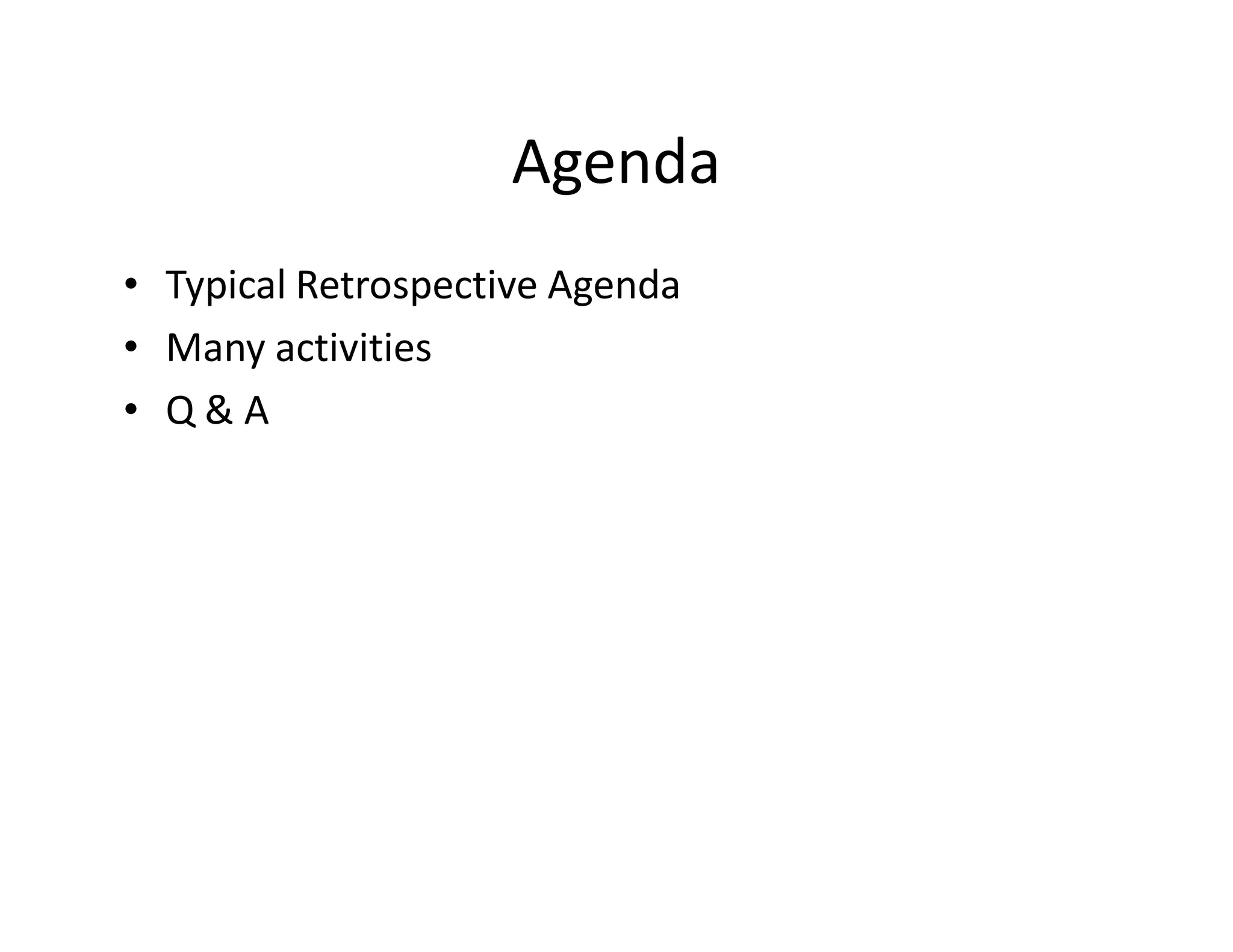
Agenda
• Typical Retrospective Agenda
• Many activities
• Q&A
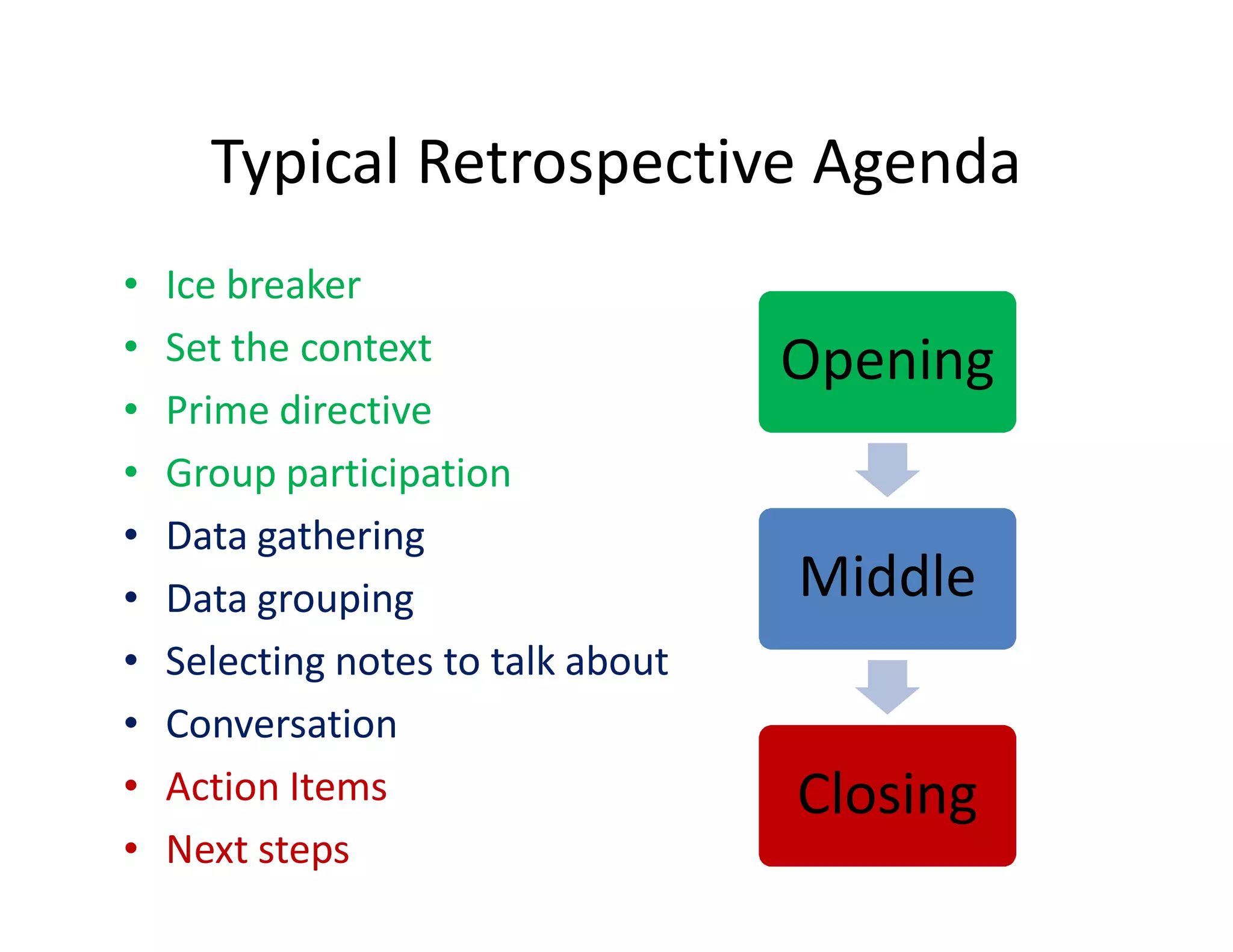
Typical Retrospective Agenda
•   Ice breaker
•   Set the context                 Opening
•   Prime directive
•   Group participation
•   Data gathering
•   Data grouping                   Middle
•   Selecting notes to talk about
•   Conversation
•   Action Items                    Closing
•   Next steps
Zip Zap Zoom
Ping Pong
Setting the context
Prime Directive


                  9/18/2012
The Prime Directive

Regardless of what we discover, we
 understand and truly believe that
 everyone did the best job they could,
 given what they knew at the time, their
 skills and abilities, the resources
 available, and the situation at hand.
Creating Safety
ESVP activity
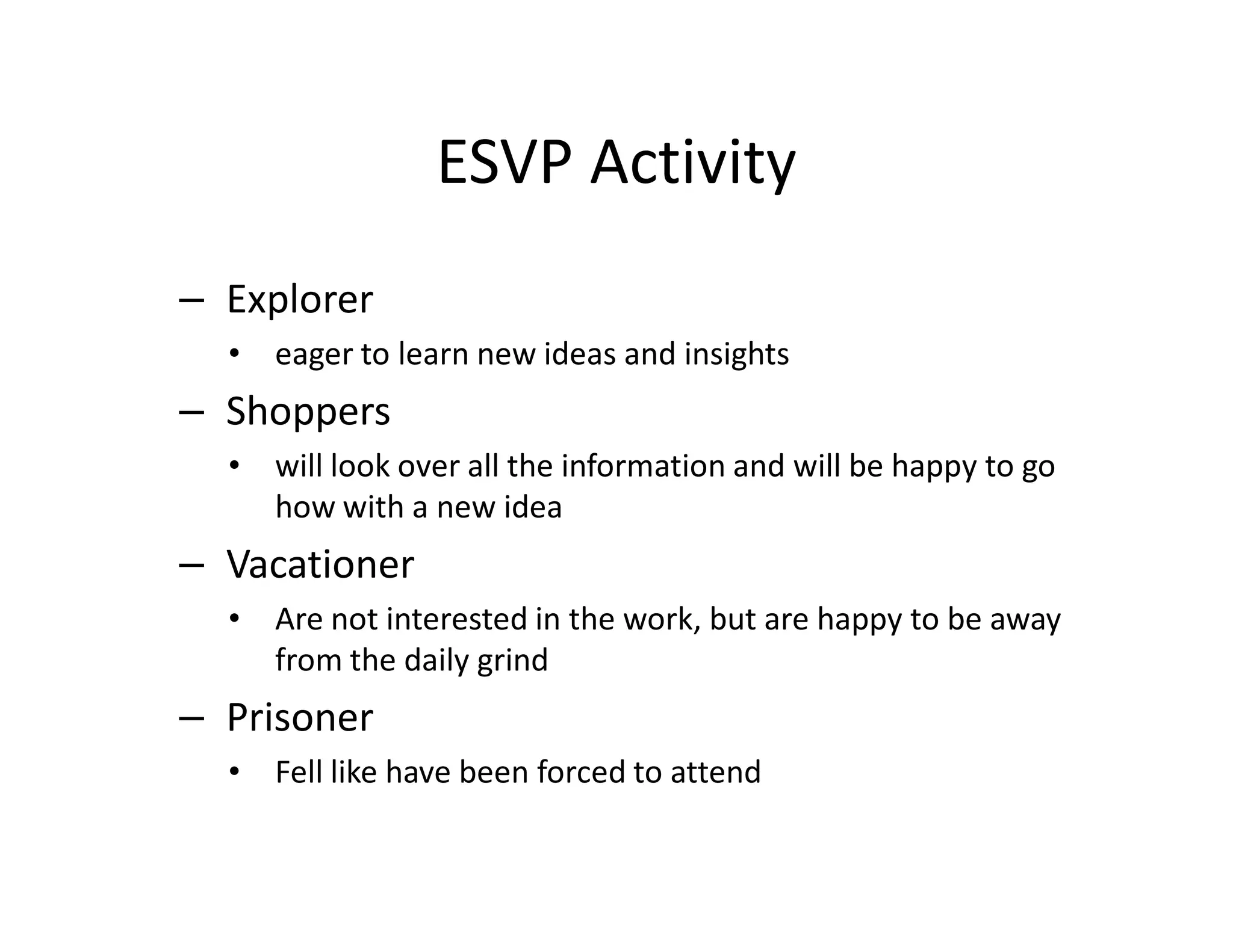
ESVP Activity
– Explorer
  •   eager to learn new ideas and insights
– Shoppers
  •   will look over all the information and will be happy to go
      how with a new idea
– Vacationer
  •   Are not interested in the work, but are happy to be away
      from the daily grind
– Prisoner
  •   Fell like have been forced to attend
Well, Not so well, Puzzle
Happiness Radar
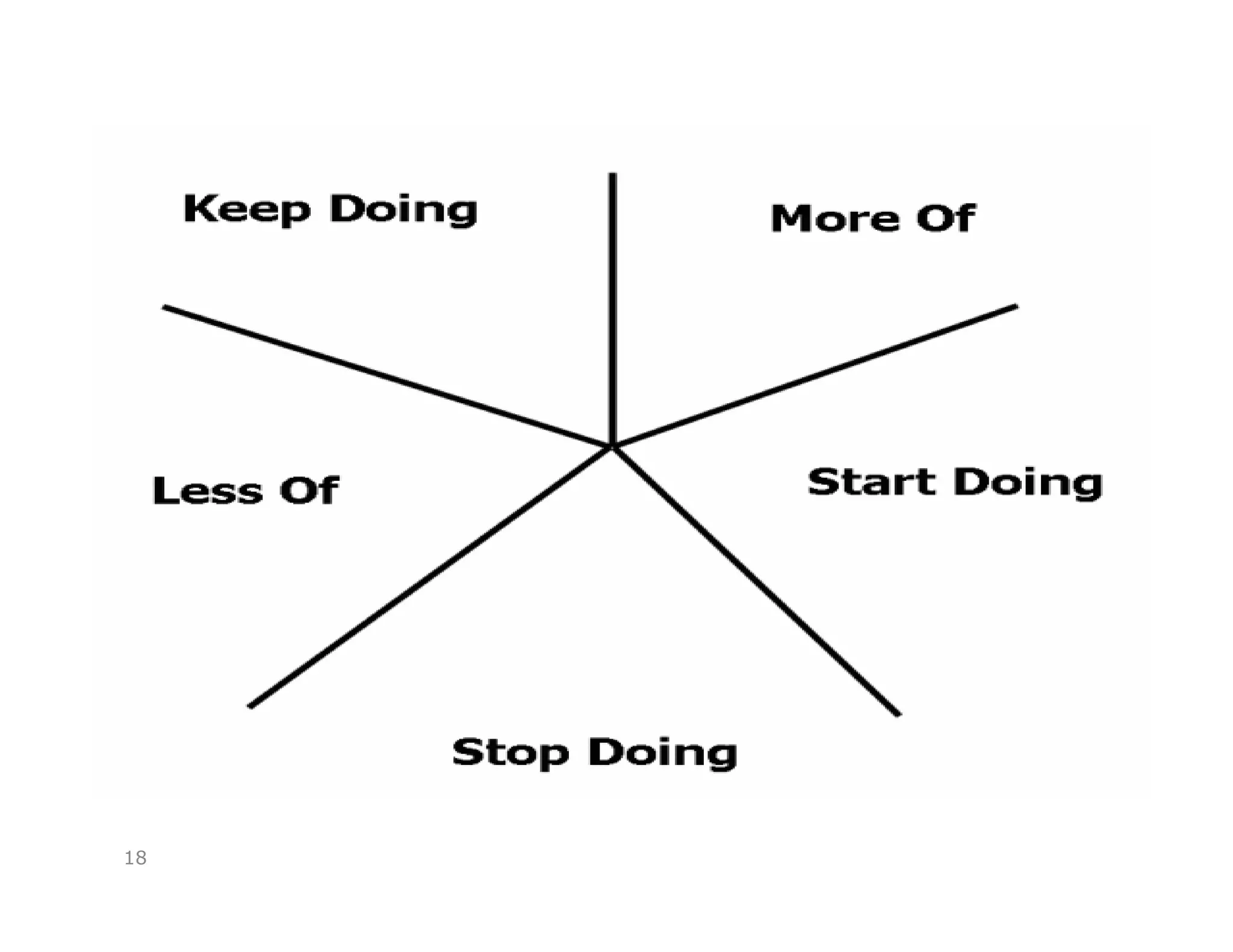
Starfish
 A data gathering activity to foster the
thinking around practices and the value
          the team get from it.
           Retrospective activities
                Paulo Caroli
Activities before
• Ice breaker
• Group participation
• Context setting
16
The Starfish
• The starfish divides the board into 5 areas
18
Keep Doing
• What are the good things you like?
• Think about things you would miss if they
  were removed; a particular practice,
  technique, technology, person, role, etc.
• An example: Running tests locally before
  committing (This prevented me from breaking
  the build and delaying the branch cut).
Less Of
• What are practices that might need a bit
  more refining--or reduction--in the current
  circumstance?
• Think about things that do add value, but
  would be better with a little less.
• An example: Stand ups have become status
  meetings and so there should be less of
  talking to one person (and more of talking to
  each other) during them.
More Of
• What are the things that you want to try
  more?
• Think about things you believe are not
  necessarily taking full advantage of.
• A good example is that maybe people are pair
  programming but knowledge transfer might
  be gained by doing more of swapping
  programming partners.
Stop Doing
• What is not adding much value?
• Think about things you believe are not useful
  anymore.
• An example: Perhaps writing status reporting
  email at the end of the day (because now the
  team is using an awesome tool which already
  conveys the current status information)
Start Doing
• What are the new things that you want to try?
• Think about new things you want to suggest.
• An example: Tracking lead time (I read an
  article about it and believe would provide us
  precious information regarding process
  improvement)
Taking notes
• Please use one post it per note
• Consider using different post it colors for
  notes:
  – Team inward (things within our team boundaries)
  – Team outward (things beyond our team
    boundaries)
Activities to follow
•   data grouping
•   selecting notes to talk about
•   targeted conversation based on data
•   creating action itens
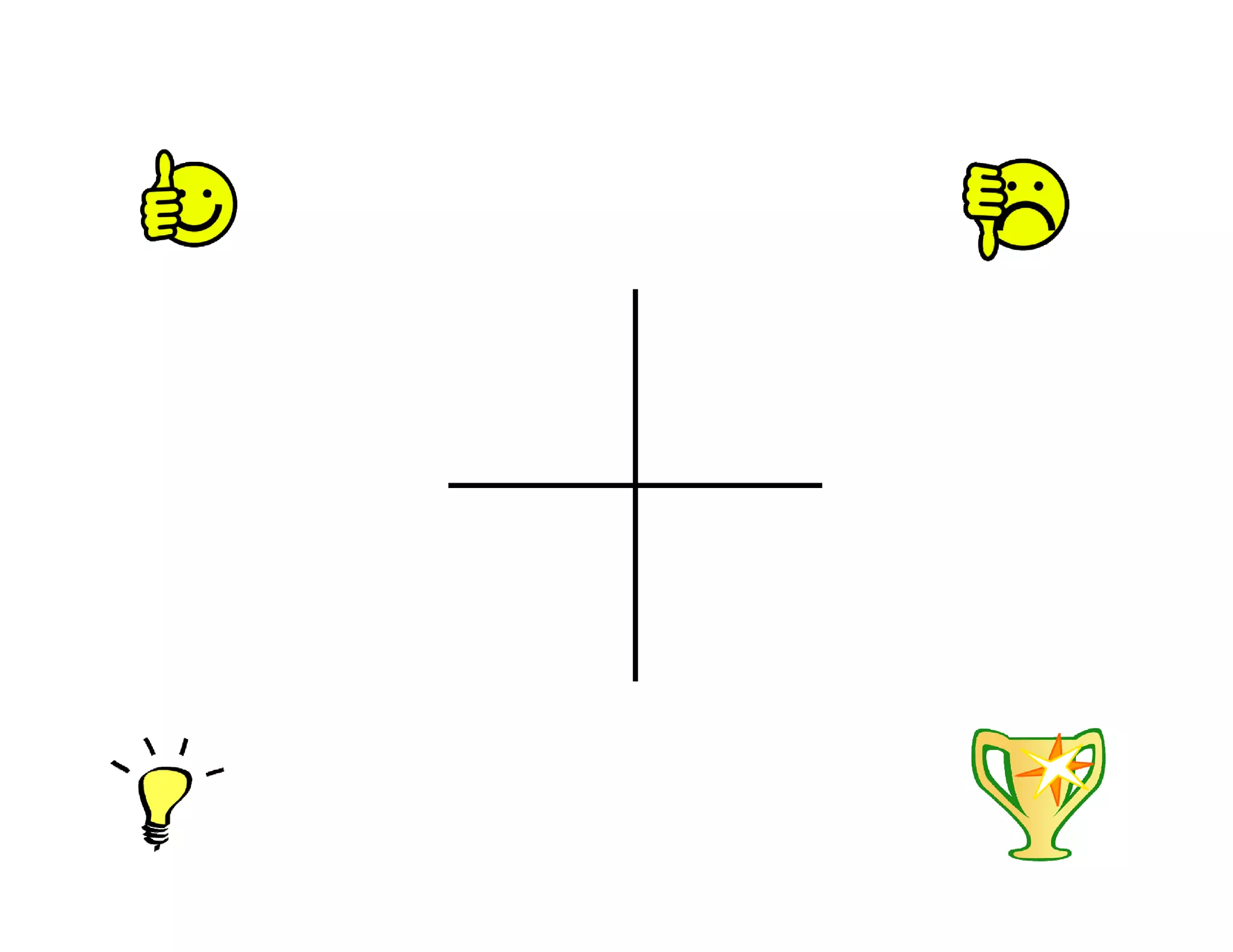
Up, Down, Ideas and Awards
The quadrants
•   Thumbs up – things you like
•   Thumbs down – things you dislike
•   Award– appreciations/thank-yous
•   Light bulbs – ideas/new things to try
Activities to follow
• selecting notes to talk about
• targeted conversation based on data
• creating action itens
Timeline activity

An activity for data gathering for
          given period.
Building the Timeline
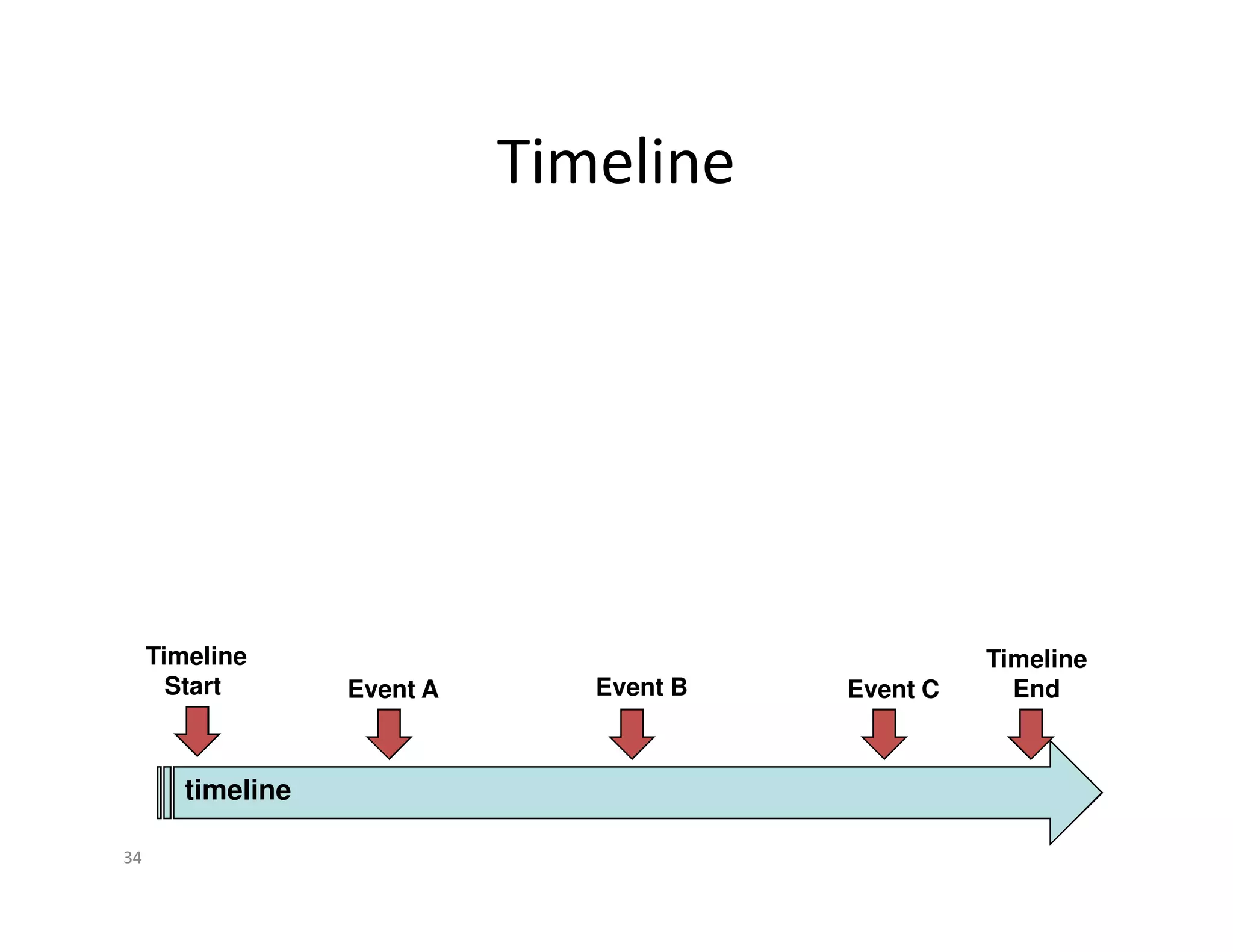
• Please draw a timeline on a large area (e.g.
  whiteboard)
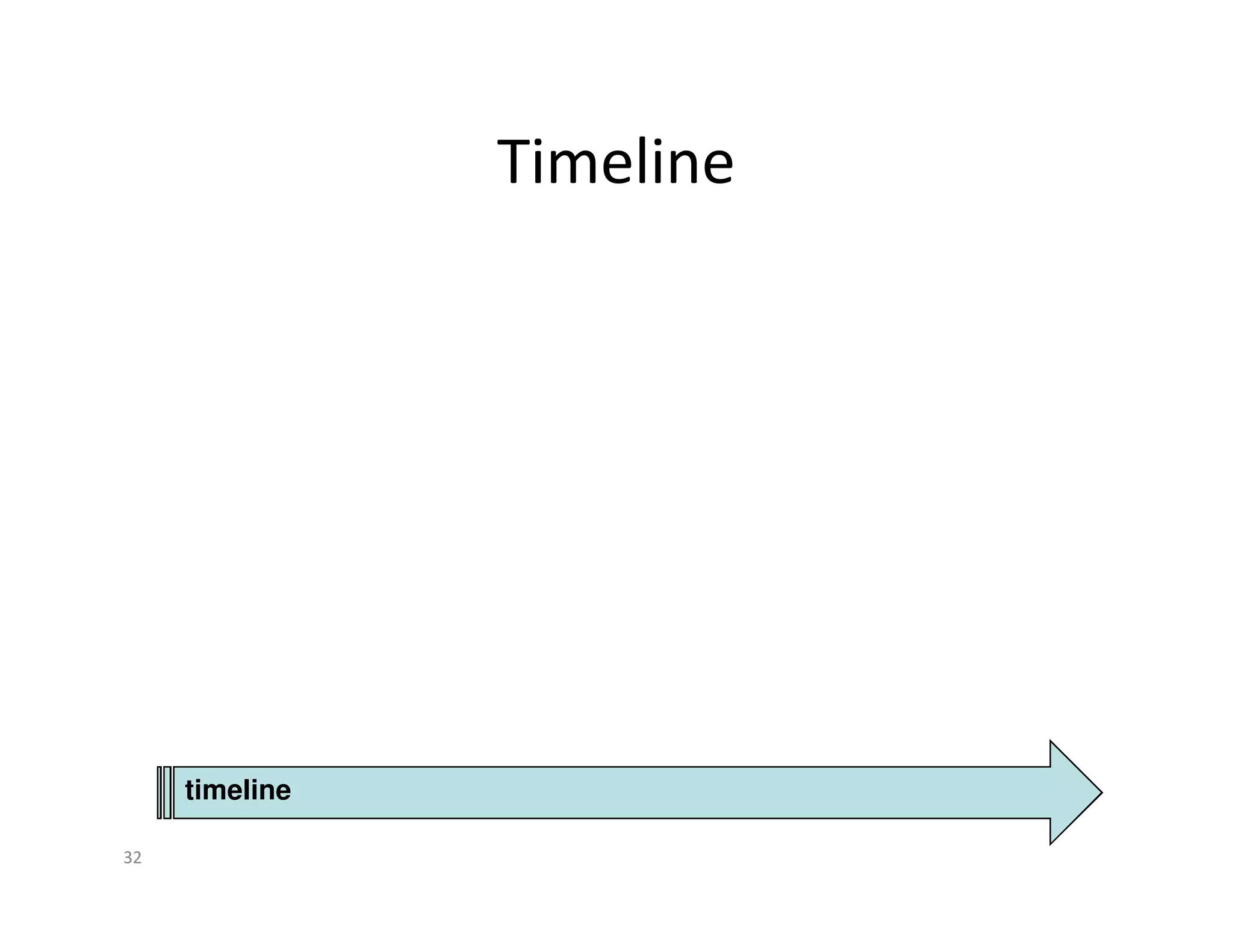
Timeline


     timeline

32
Building the Timeline
• Decide the timeline start and end (e.g. 05 Jan–
  Inception Start; 12 Dec – 10 days after Prod)
• Add a few noticeable events (e.g. New team
  members arrival, release 1, release 2)
Timeline


     Timeline                                       Timeline
       Start       Event A      Event B   Event C     End


        timeline

34
Building the Timeline
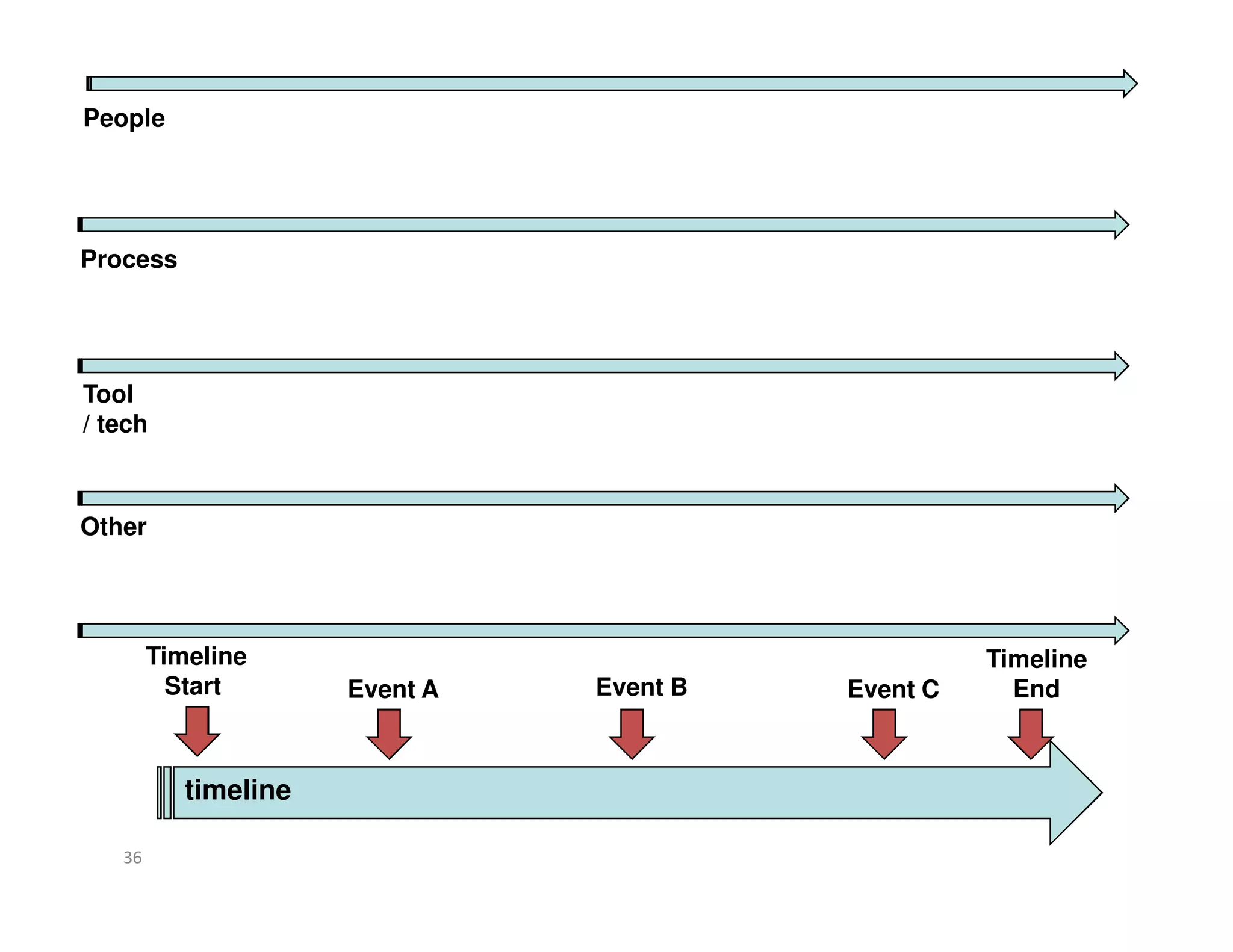
• Split the timeline into a areas (2 to 4
  recommended), and decide upon the areas
  (e.g. People, process, technology, other)
People


Process


Tool
/ tech


Other


        Timeline                                    Timeline
          Start       Event A   Event B   Event C     End


           timeline

   36
Building the Timeline
• Decide upon post it colors for the notes (e.g.
  Green for well, pink for not so well)
• Use another color for action items (e.g. Yellow
  for action items)
Timeline activity instrctions
• Use one post it for each note
• Follow the color code
• Place the note on the area according to the
  timelime (e.g. A green post it “New load
  balance server” is added on the Technology
  area around Release2 timeline)
• Timebox the activity (10 minutes
  recommended)
Activities to follow
• data grouping
• selecting notes to talk about
• targeted reasoning based on data
Open the box
 A data gathering activity which foster
innovation and challenges the current
   activities performed by the team.
           Retrospective activities
                Paulo Caroli
“The world as we have created it is a process of
  our thinking. It cannot be changed without
  changing our thinking.” ― Albert Einstein


“They always say time changes things, but you
  actually have to change them yourself.” ―
  Andy Warhol
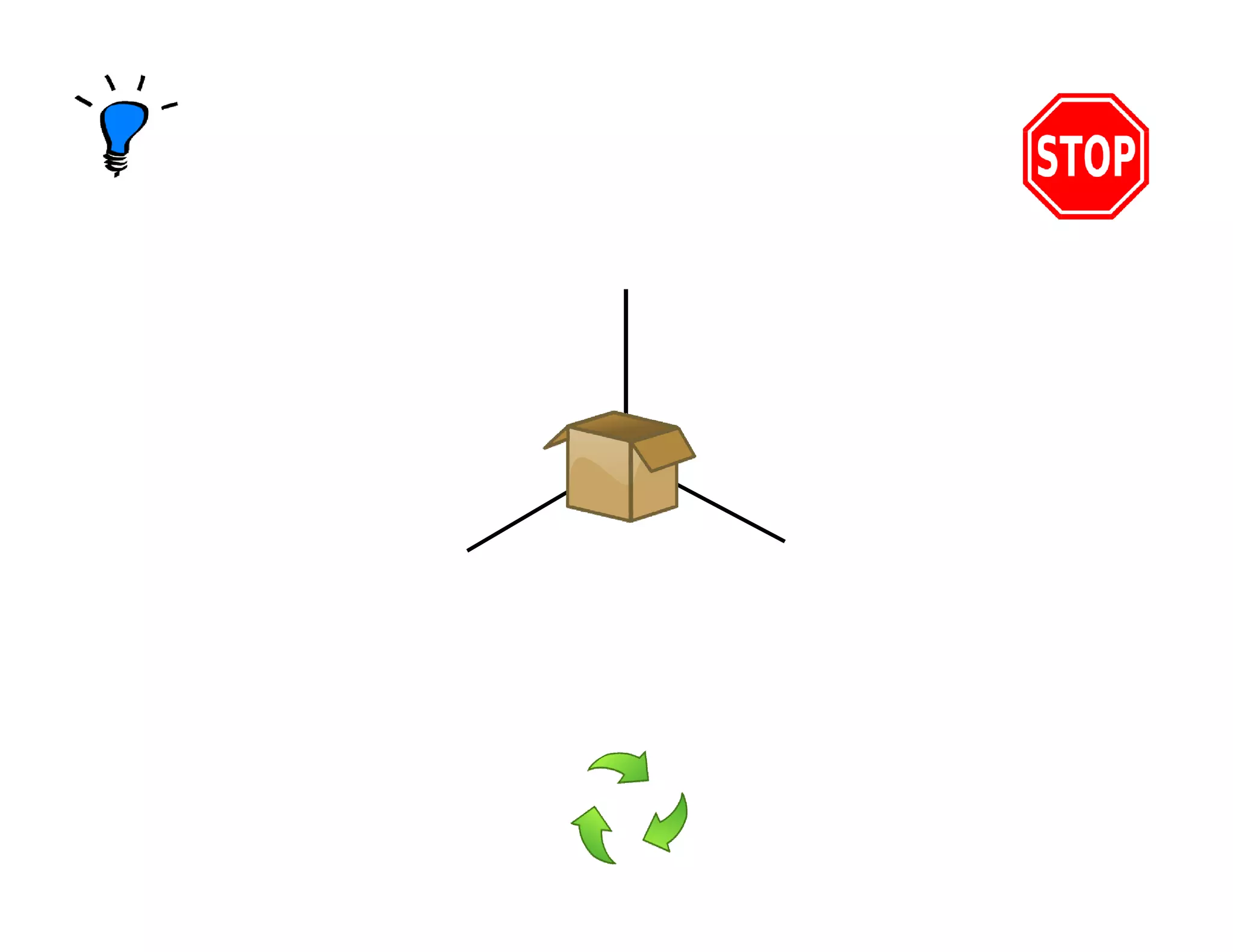
Inside this box are all activities
    performed by the team
Please open the box…
Which activities should
 be removed from it?
Which activities should be added?
What to recycle?
Taking notes
• Please use one post it per note
• Use the different post it colors for notes
  related to:
  – process
  – tools and technology
  – Other
• Timing: 10 minutes or less
Next step:
            validating changes
• Executing ideas is often tougher than
  generating them.
• How should we test ideas quickly and cheaply,
  so that we can afford to experiment?
• Please go back to your notes and add new
  post –its (please use a new color) describing
  how to test the idea execution.
Activities to follow
•   data grouping
•   voting
•   selecting notes to talk about
•   targeted conversation based on data
•   creating action itens
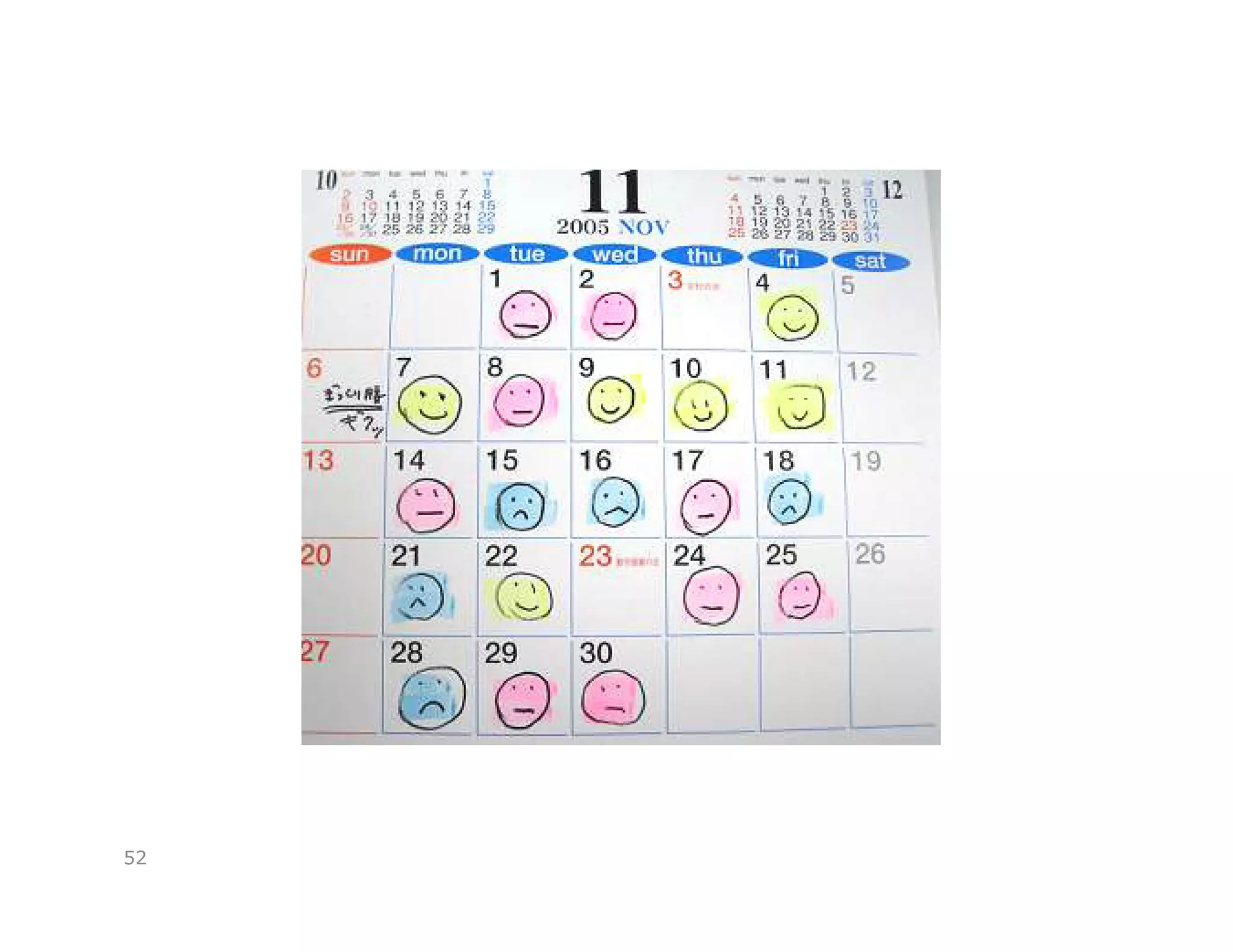
Smiley Calendar Average


                          9/18/2012
52
Smiley Calendar Average


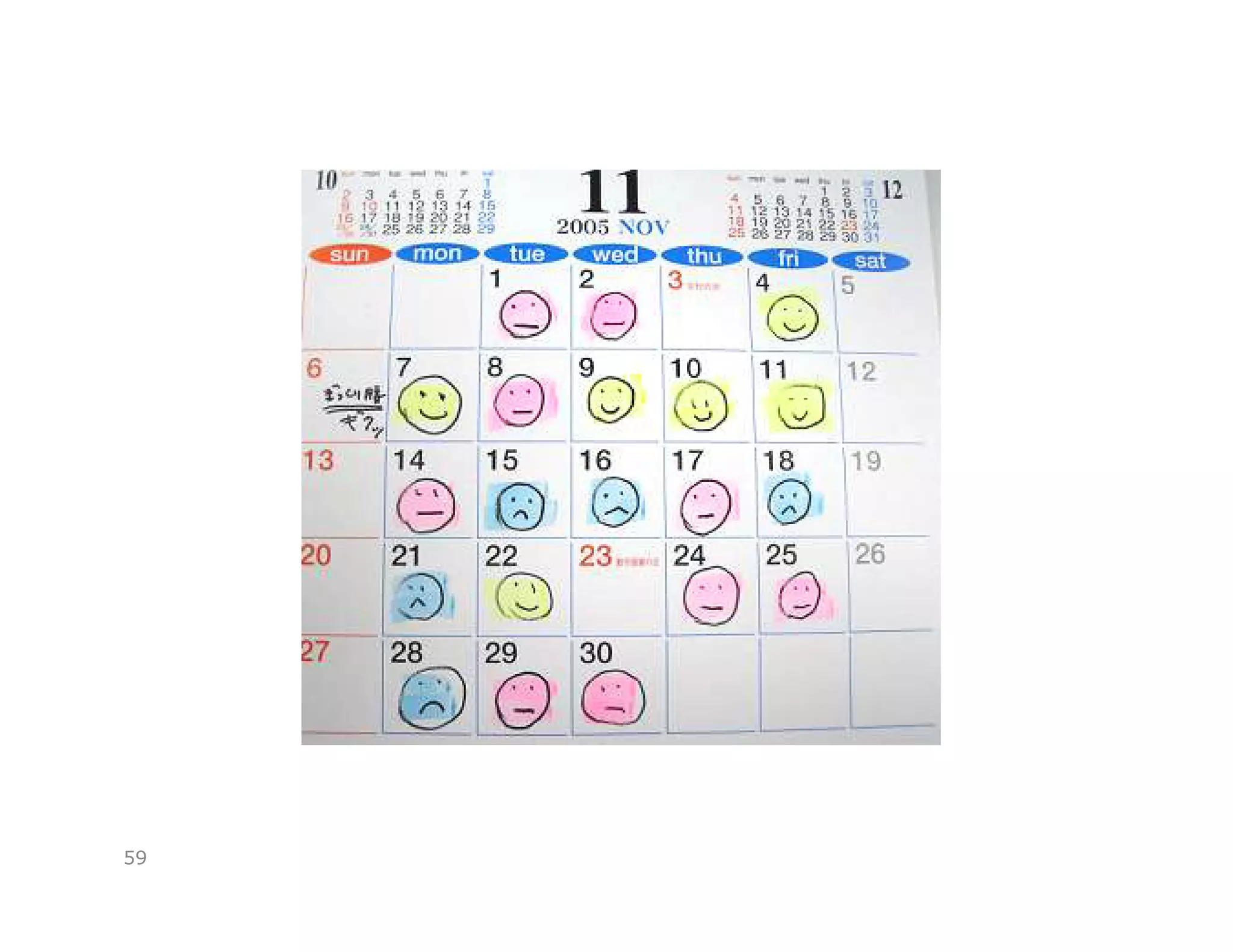
Please go back on time and imagine
  your Smiley Calendar for each day
  since last Retrospective...
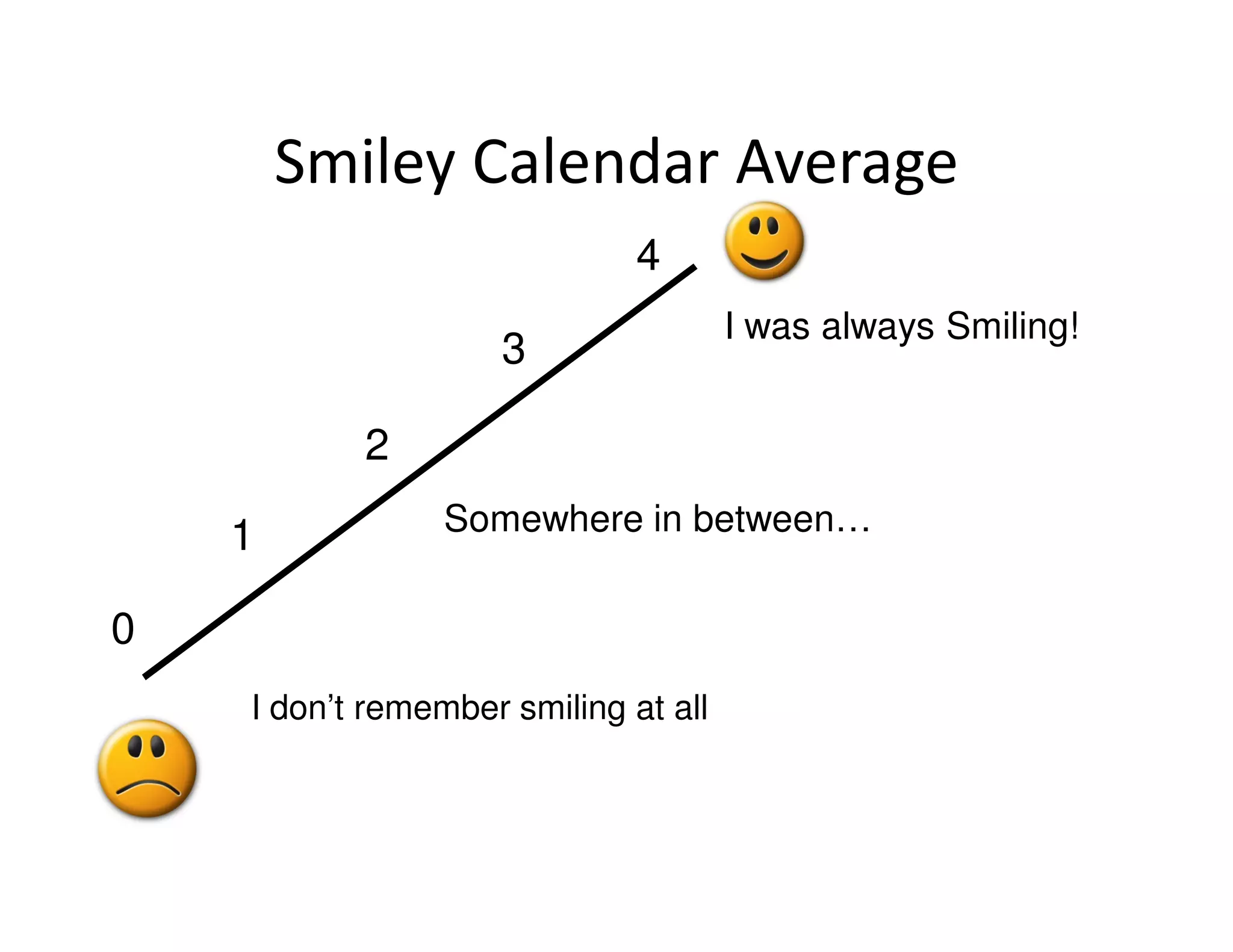
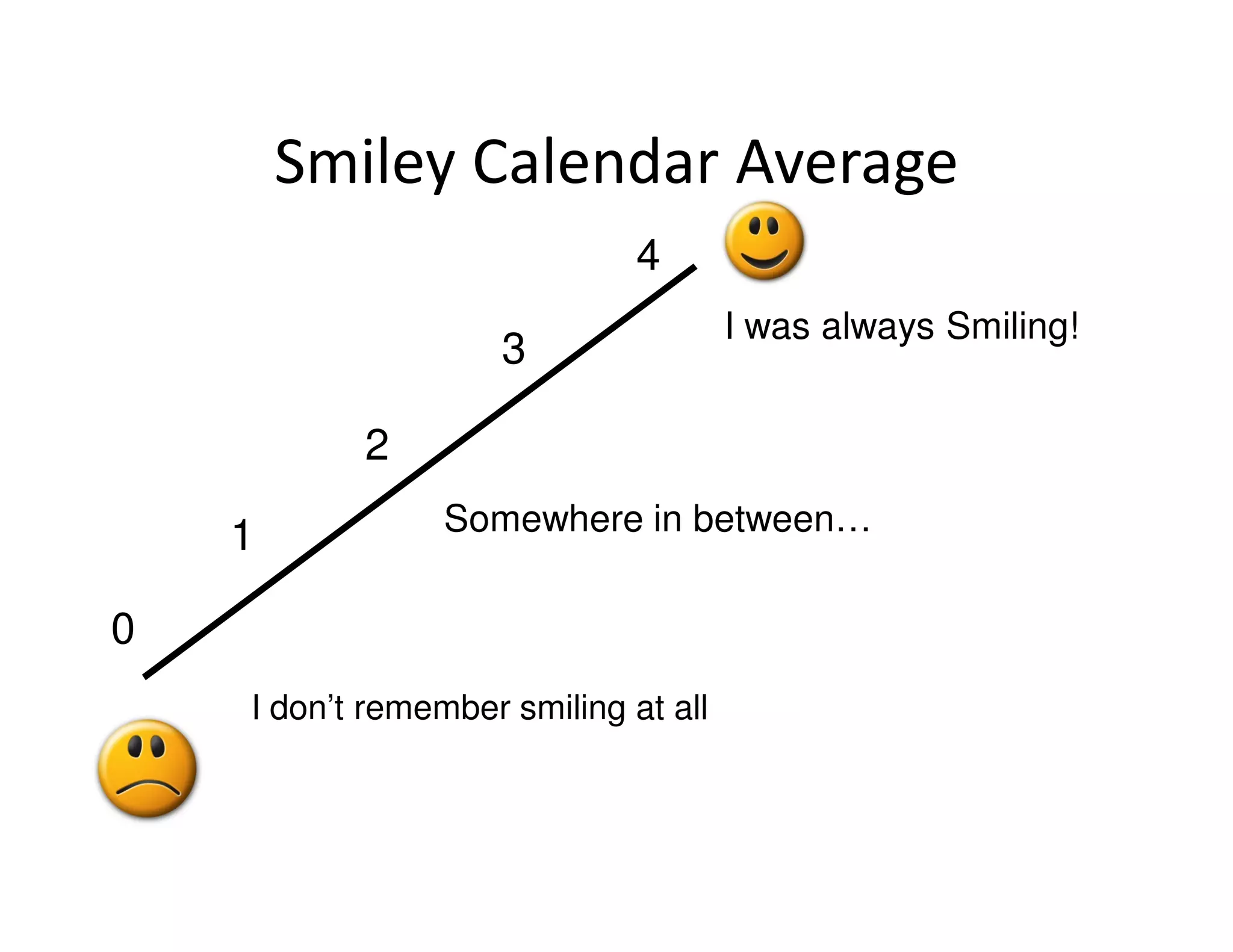
Smiley Calendar Average
                              4
                                      I was always Smiling!
                     3

           2

    1            Somewhere in between…


0
    I don’t remember smiling at all
Smiley Calendar Average


Please add a mark next to the smiley
  average line
Activities to follow
• Smiley faces data gathering
• Guided conversation on Smiley faces
Smiley Calendar data gathering


                             9/18/2012
Activities before
•   Ice breaker
•   Group participation
•   Context setting
•   Prime directive
•   Smiley Calendar Average (mandatory)
59
Smiley Calendar Average


Now, let’s dig into our mood
 variation and the reasons for it
Smiley Calendar data gathering


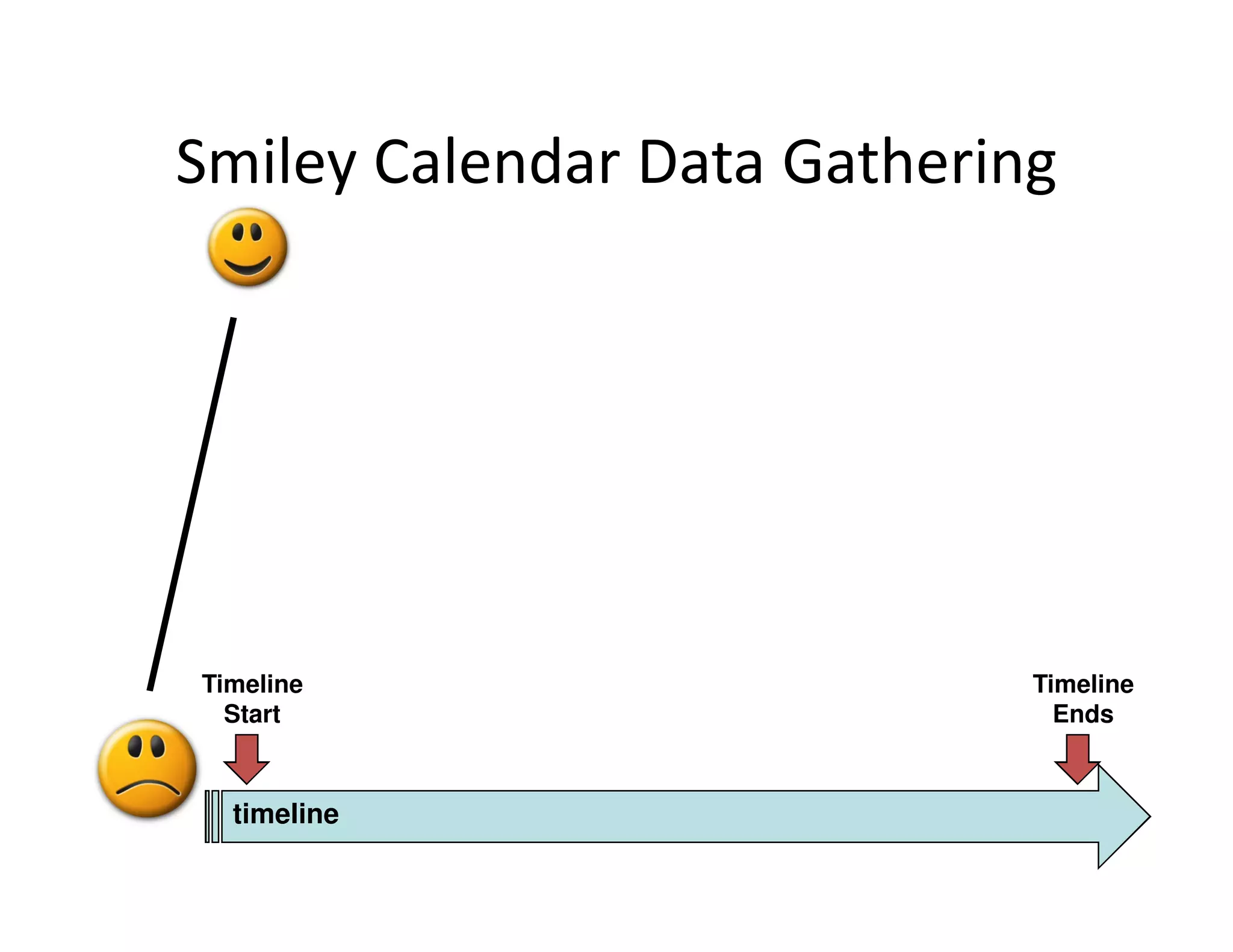
Even though you might not
  remember every single day, please
  tell us the happenings that got you
  either very ☺ or very
Smiley Calendar Data Gathering


Timeline                     Timeline
  Start                        Ends


  timeline
Activities to follow
•   data grouping
•   selecting notes to talk about
•   targeted reasoning based on data
•   looking for action items
Guided conversations
   on smiley faces


                       9/18/2012
Activities before
•   Ice breaker
•   Group participation
•   Context setting
•   Prime directive
•   Smiley Calendar Average (mandatory)
Smiley Calendar Average
                              4
                                      I was always Smiling!
                     3

           2

    1            Somewhere in between…


0
    I don’t remember smiling at all
Guided conversation


Now, let’s think about the future...
Guided conversation
What are the things that will keep you
☺?

What will you do different in order to
avoid a face?
Activity instructions
• Open conversation
• Timebox the activity (10 minutes
  recommended)
Activities to follow
• sharing the notes
• looking for action items
Hot air balloon
A data gathering activity which focus on
things impacting the team ability to go
                 faster
           Retrospective activities
                Paulo Caroli
Activities before
• Ice breaker
• Group participation
• Context setting
The Balloon
• The balloon represents the team cruising
  along the project.
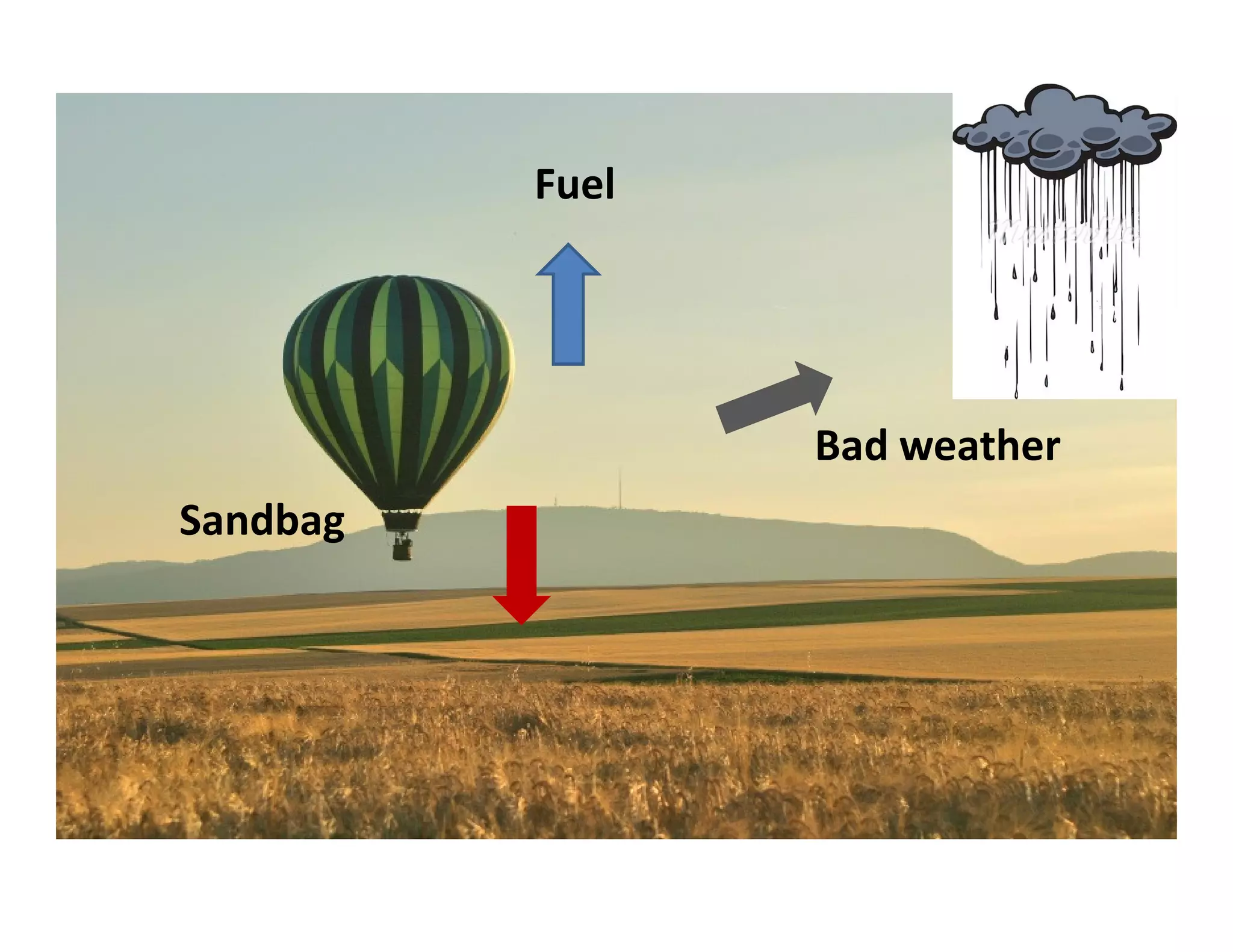
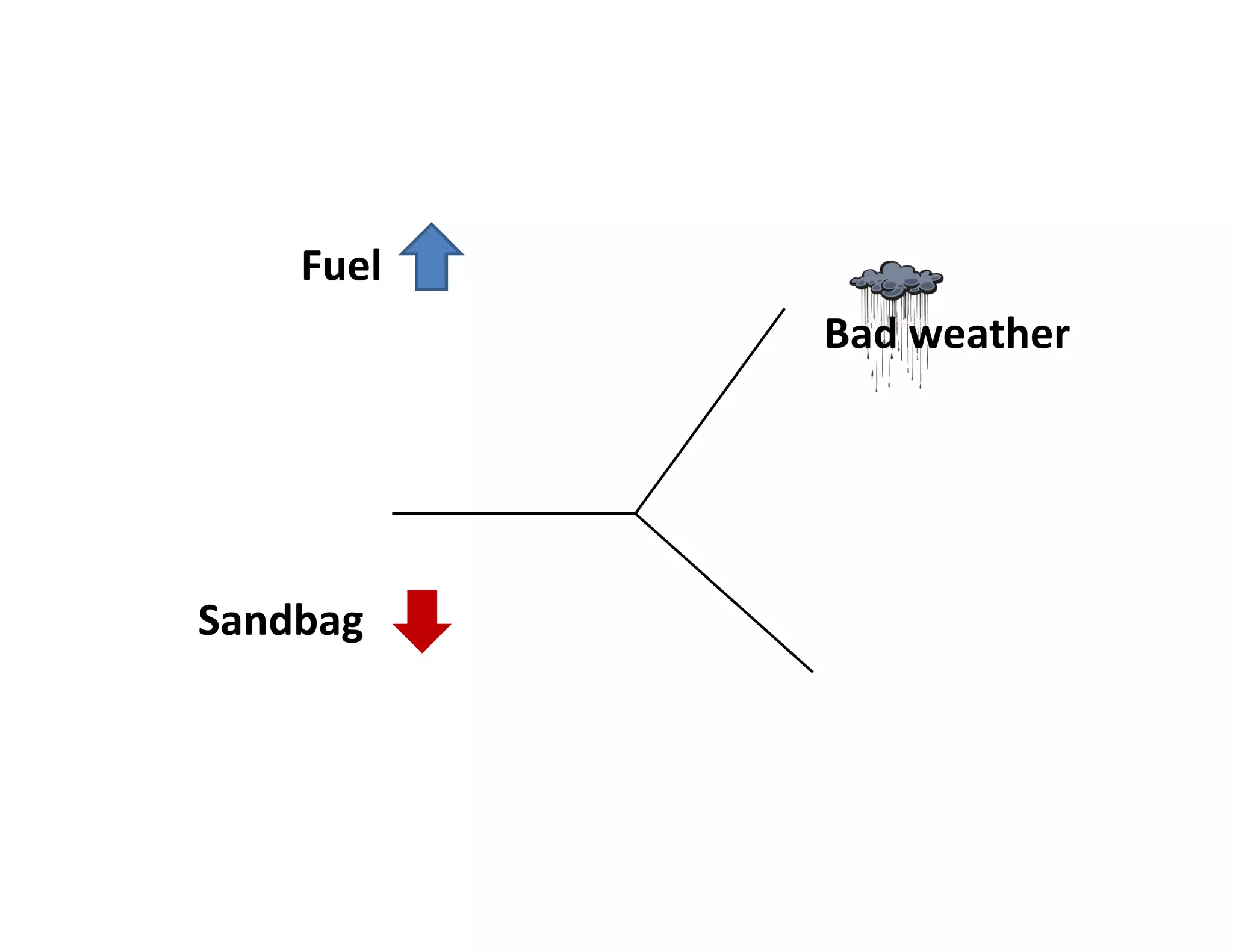
• Let’s split the board into 3 areas
Fuel


                 Bad weather
Sandbag
Fuel
• What is the fuel for our balloon?
• The things that will help our balloon goes
  higher and faster
Sandbag and ropes
• What is slowing down our balloon?
• The things that keep us from going faster
Bad weather
• What would be the bad weather ahead?
• The things that would put our journey at risk
Fuel
           Bad weather


Sandbag
Taking notes
• Please use one post it per note
• Use the different post it colors for notes
  related to:
  – people
  – process
  – tools and technology
  – other
Activities to follow
•   data grouping
•   selecting notes to talk about
•   targeted conversation based on data
•   creating action itens
Plan of Action


82
• Long-term goal: Have test automation on
  acceptance-test level
• Now-Action: Pete will automate one test
  using Fit


83
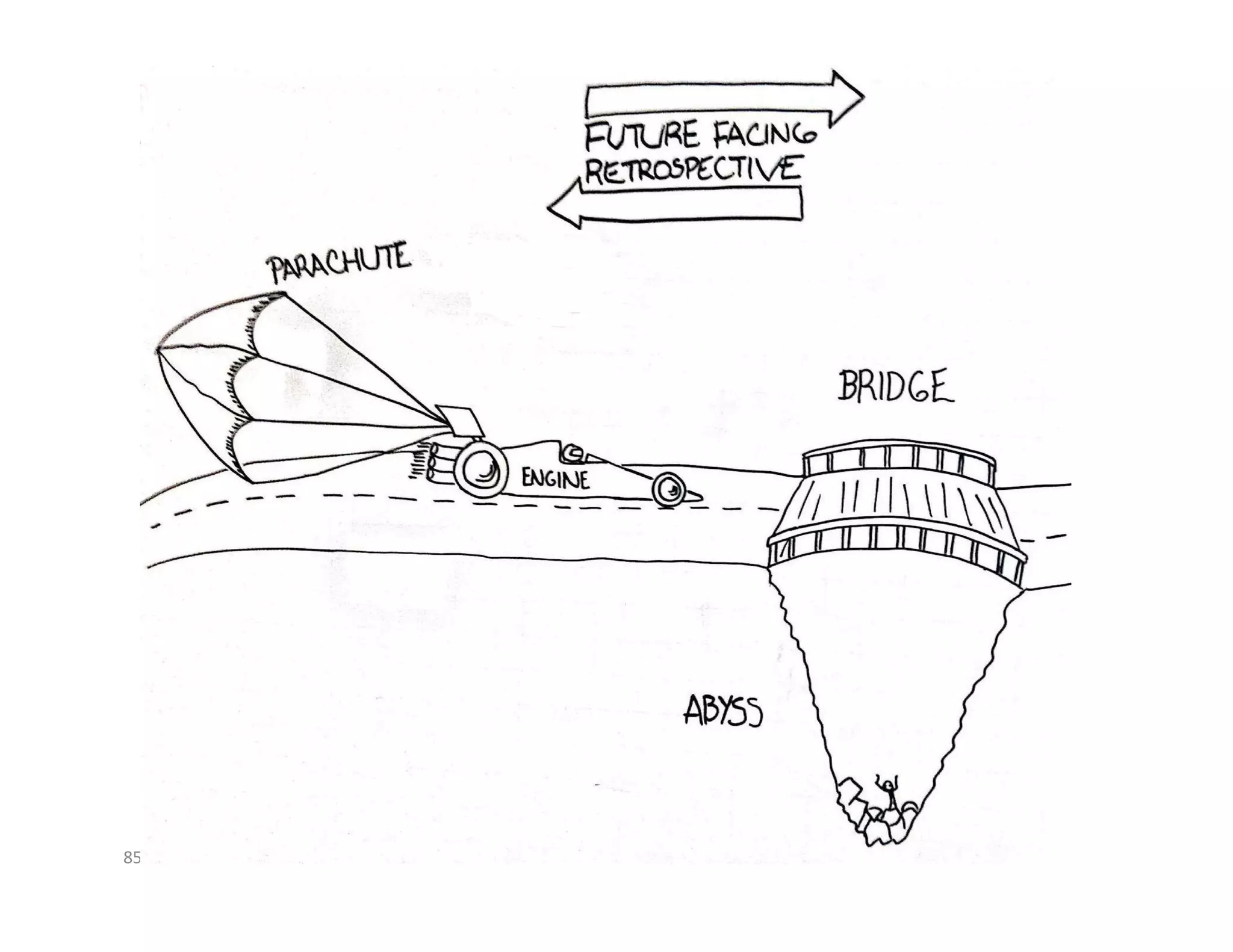
Speed Car - Abyss
retrospective exercise


                         9/18/2012
85
Six Thinking Hat

 Edward de Bono
Six Thinking Hats is a thinking tool
  for group discussion, it provides a
  means for groups to think
  together more effectively, and a
  means to plan thinking processes
  in a detailed and cohesive way.
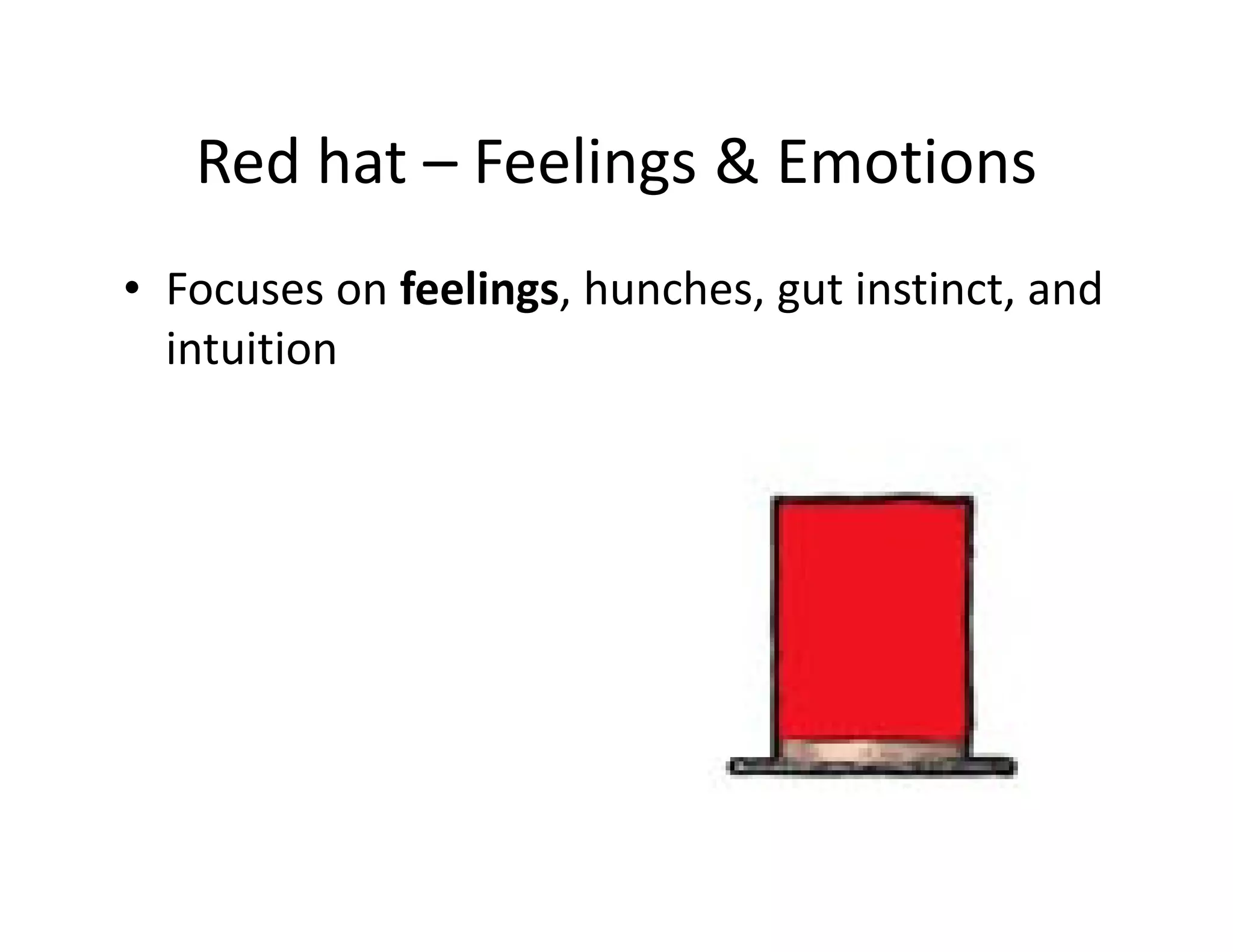
Red hat – Feelings & Emotions
• Focuses on feelings, hunches, gut instinct, and
  intuition
White hat – Facts & Information
• Focus on data, facts, information know of
  needed
Black hat – Critical Judgment
• Focuses on difficulties, potential problems.
  Why something may not work.
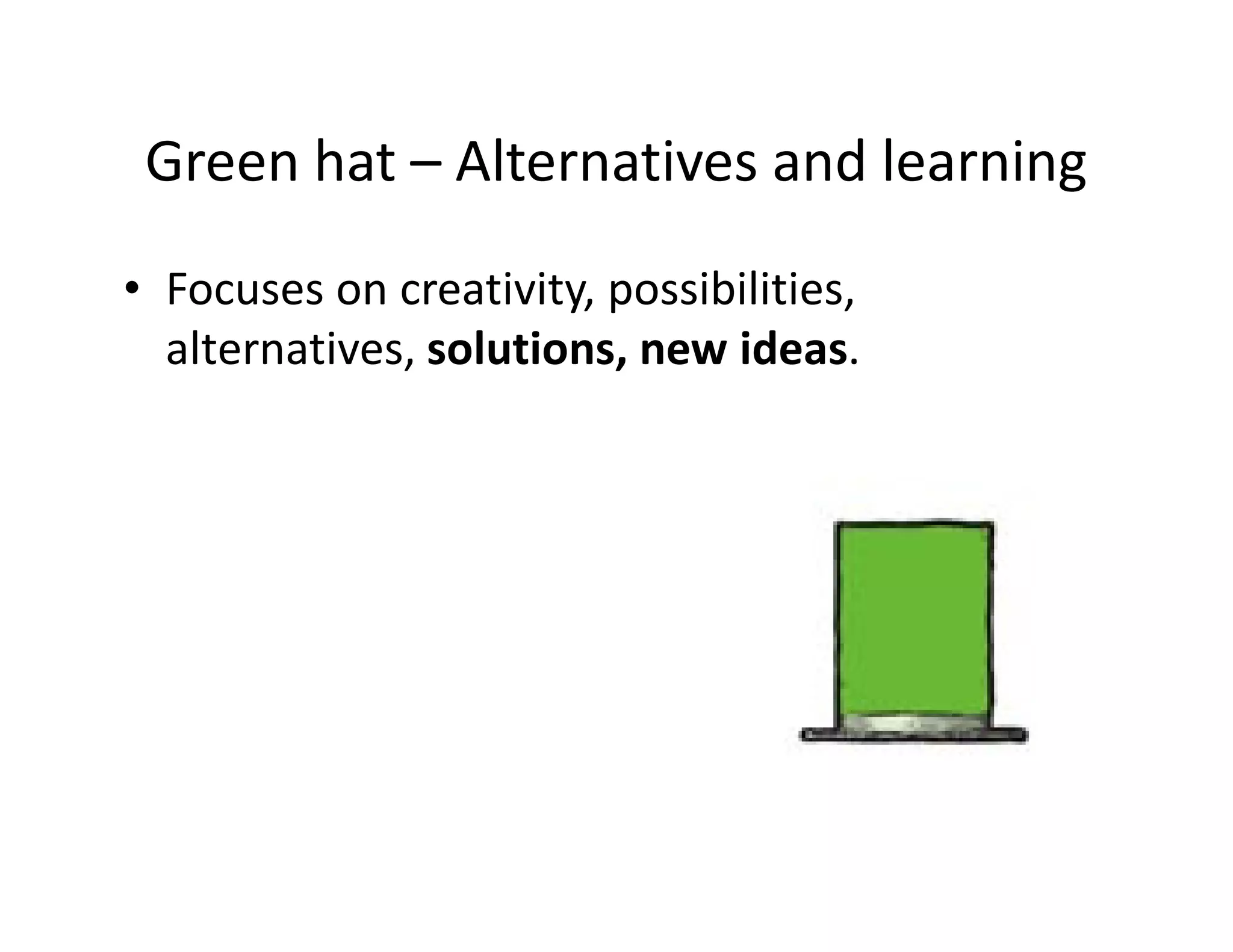
Green hat – Alternatives and learning
• Focuses on creativity, possibilities,
  alternatives, solutions, new ideas.
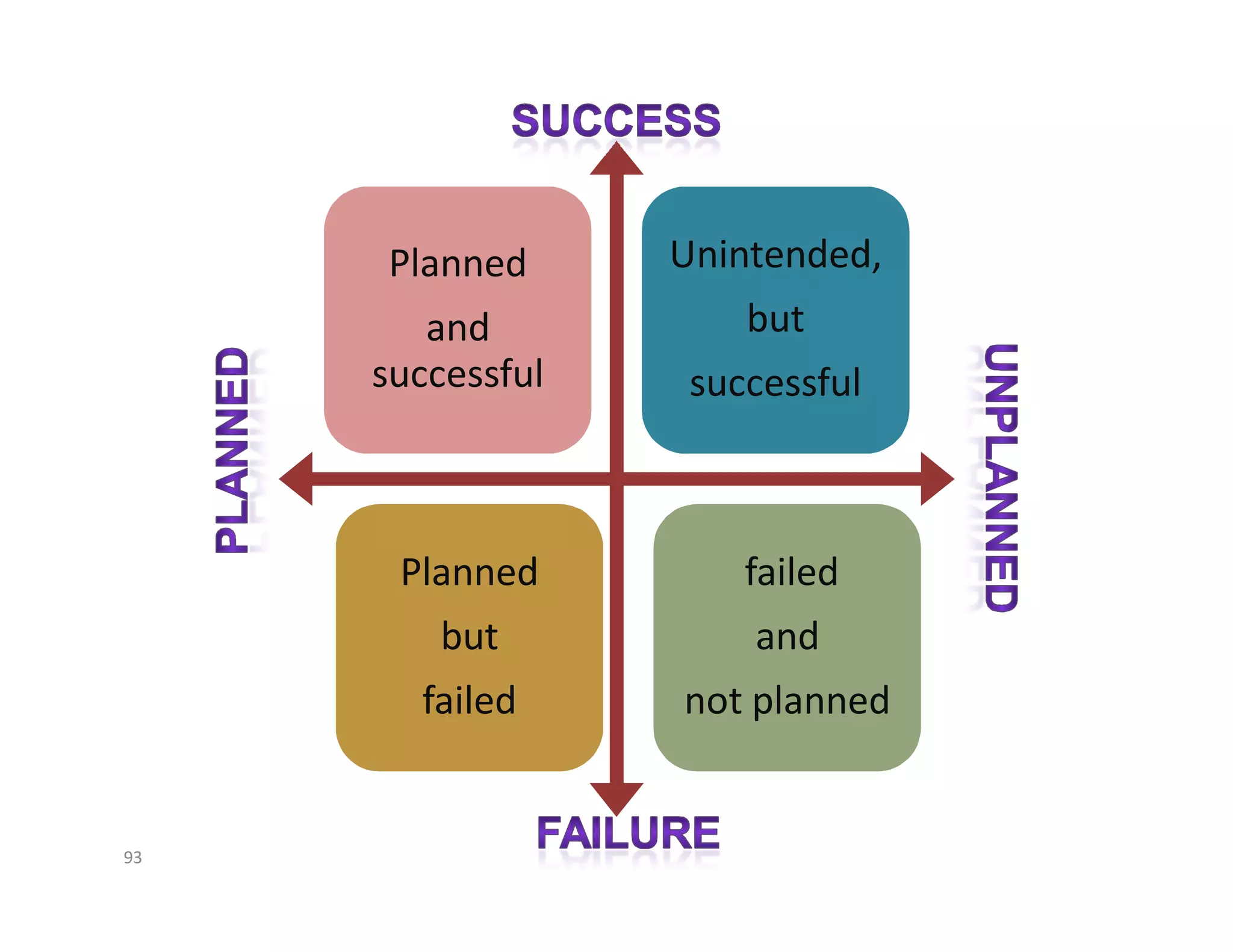
The 4 quadrants
     (planning vs success)
             activity
      for lessons learned


92
Planned      Unintended,
        and           but
     successful    successful


      Planned         failed
        but           and
       failed     not planned


93
ROI
Agile Retrospective Activities
           Questions?
           Thank you!
 Feedback please: @paulocaroli
agileretroactivities.blogspot.com

                   Paulo Caroli               Agile Coach


                   pcaroli@thoughtworks.com
                   Twitter: @paulocaroli

Agile retro activities agile brazil - sept 2012

  • 1.
    Agile Retrospective Activities Paulo Caroli agileretroactivities.blogspot.com Paulo Caroli Agile Coach pcaroli@thoughtworks.com Twitter: @paulocaroli
  • 2.
    Agenda • Typical RetrospectiveAgenda • Many activities • Q&A
  • 3.
    Typical Retrospective Agenda • Ice breaker • Set the context Opening • Prime directive • Group participation • Data gathering • Data grouping Middle • Selecting notes to talk about • Conversation • Action Items Closing • Next steps
  • 4.
  • 5.
  • 6.
  • 7.
  • 8.
    The Prime Directive Regardlessof what we discover, we understand and truly believe that everyone did the best job they could, given what they knew at the time, their skills and abilities, the resources available, and the situation at hand.
  • 9.
  • 10.
  • 11.
    ESVP Activity – Explorer • eager to learn new ideas and insights – Shoppers • will look over all the information and will be happy to go how with a new idea – Vacationer • Are not interested in the work, but are happy to be away from the daily grind – Prisoner • Fell like have been forced to attend
  • 12.
    Well, Not sowell, Puzzle
  • 13.
  • 14.
    Starfish A datagathering activity to foster the thinking around practices and the value the team get from it. Retrospective activities Paulo Caroli
  • 15.
    Activities before • Icebreaker • Group participation • Context setting
  • 16.
  • 17.
    The Starfish • Thestarfish divides the board into 5 areas
  • 18.
  • 19.
    Keep Doing • Whatare the good things you like? • Think about things you would miss if they were removed; a particular practice, technique, technology, person, role, etc. • An example: Running tests locally before committing (This prevented me from breaking the build and delaying the branch cut).
  • 20.
    Less Of • Whatare practices that might need a bit more refining--or reduction--in the current circumstance? • Think about things that do add value, but would be better with a little less. • An example: Stand ups have become status meetings and so there should be less of talking to one person (and more of talking to each other) during them.
  • 21.
    More Of • Whatare the things that you want to try more? • Think about things you believe are not necessarily taking full advantage of. • A good example is that maybe people are pair programming but knowledge transfer might be gained by doing more of swapping programming partners.
  • 22.
    Stop Doing • Whatis not adding much value? • Think about things you believe are not useful anymore. • An example: Perhaps writing status reporting email at the end of the day (because now the team is using an awesome tool which already conveys the current status information)
  • 23.
    Start Doing • Whatare the new things that you want to try? • Think about new things you want to suggest. • An example: Tracking lead time (I read an article about it and believe would provide us precious information regarding process improvement)
  • 24.
    Taking notes • Pleaseuse one post it per note • Consider using different post it colors for notes: – Team inward (things within our team boundaries) – Team outward (things beyond our team boundaries)
  • 25.
    Activities to follow • data grouping • selecting notes to talk about • targeted conversation based on data • creating action itens
  • 26.
    Up, Down, Ideasand Awards
  • 28.
    The quadrants • Thumbs up – things you like • Thumbs down – things you dislike • Award– appreciations/thank-yous • Light bulbs – ideas/new things to try
  • 29.
    Activities to follow •selecting notes to talk about • targeted conversation based on data • creating action itens
  • 30.
    Timeline activity An activityfor data gathering for given period.
  • 31.
    Building the Timeline •Please draw a timeline on a large area (e.g. whiteboard)
  • 32.
    Timeline timeline 32
  • 33.
    Building the Timeline •Decide the timeline start and end (e.g. 05 Jan– Inception Start; 12 Dec – 10 days after Prod) • Add a few noticeable events (e.g. New team members arrival, release 1, release 2)
  • 34.
    Timeline Timeline Timeline Start Event A Event B Event C End timeline 34
  • 35.
    Building the Timeline •Split the timeline into a areas (2 to 4 recommended), and decide upon the areas (e.g. People, process, technology, other)
  • 36.
    People Process Tool / tech Other Timeline Timeline Start Event A Event B Event C End timeline 36
  • 37.
    Building the Timeline •Decide upon post it colors for the notes (e.g. Green for well, pink for not so well) • Use another color for action items (e.g. Yellow for action items)
  • 38.
    Timeline activity instrctions •Use one post it for each note • Follow the color code • Place the note on the area according to the timelime (e.g. A green post it “New load balance server” is added on the Technology area around Release2 timeline) • Timebox the activity (10 minutes recommended)
  • 39.
    Activities to follow •data grouping • selecting notes to talk about • targeted reasoning based on data
  • 40.
    Open the box A data gathering activity which foster innovation and challenges the current activities performed by the team. Retrospective activities Paulo Caroli
  • 41.
    “The world aswe have created it is a process of our thinking. It cannot be changed without changing our thinking.” ― Albert Einstein “They always say time changes things, but you actually have to change them yourself.” ― Andy Warhol
  • 42.
    Inside this boxare all activities performed by the team
  • 43.
  • 44.
    Which activities should be removed from it?
  • 45.
  • 46.
  • 48.
    Taking notes • Pleaseuse one post it per note • Use the different post it colors for notes related to: – process – tools and technology – Other • Timing: 10 minutes or less
  • 49.
    Next step: validating changes • Executing ideas is often tougher than generating them. • How should we test ideas quickly and cheaply, so that we can afford to experiment? • Please go back to your notes and add new post –its (please use a new color) describing how to test the idea execution.
  • 50.
    Activities to follow • data grouping • voting • selecting notes to talk about • targeted conversation based on data • creating action itens
  • 51.
  • 52.
  • 53.
    Smiley Calendar Average Pleasego back on time and imagine your Smiley Calendar for each day since last Retrospective...
  • 54.
    Smiley Calendar Average 4 I was always Smiling! 3 2 1 Somewhere in between… 0 I don’t remember smiling at all
  • 55.
    Smiley Calendar Average Pleaseadd a mark next to the smiley average line
  • 56.
    Activities to follow •Smiley faces data gathering • Guided conversation on Smiley faces
  • 57.
    Smiley Calendar datagathering 9/18/2012
  • 58.
    Activities before • Ice breaker • Group participation • Context setting • Prime directive • Smiley Calendar Average (mandatory)
  • 59.
  • 60.
    Smiley Calendar Average Now,let’s dig into our mood variation and the reasons for it
  • 61.
    Smiley Calendar datagathering Even though you might not remember every single day, please tell us the happenings that got you either very ☺ or very
  • 62.
    Smiley Calendar DataGathering Timeline Timeline Start Ends timeline
  • 63.
    Activities to follow • data grouping • selecting notes to talk about • targeted reasoning based on data • looking for action items
  • 64.
    Guided conversations on smiley faces 9/18/2012
  • 65.
    Activities before • Ice breaker • Group participation • Context setting • Prime directive • Smiley Calendar Average (mandatory)
  • 66.
    Smiley Calendar Average 4 I was always Smiling! 3 2 1 Somewhere in between… 0 I don’t remember smiling at all
  • 67.
    Guided conversation Now, let’sthink about the future...
  • 68.
    Guided conversation What arethe things that will keep you ☺? What will you do different in order to avoid a face?
  • 69.
    Activity instructions • Openconversation • Timebox the activity (10 minutes recommended)
  • 70.
    Activities to follow •sharing the notes • looking for action items
  • 71.
    Hot air balloon Adata gathering activity which focus on things impacting the team ability to go faster Retrospective activities Paulo Caroli
  • 72.
    Activities before • Icebreaker • Group participation • Context setting
  • 74.
    The Balloon • Theballoon represents the team cruising along the project. • Let’s split the board into 3 areas
  • 75.
    Fuel Bad weather Sandbag
  • 76.
    Fuel • What isthe fuel for our balloon? • The things that will help our balloon goes higher and faster
  • 77.
    Sandbag and ropes •What is slowing down our balloon? • The things that keep us from going faster
  • 78.
    Bad weather • Whatwould be the bad weather ahead? • The things that would put our journey at risk
  • 79.
    Fuel Bad weather Sandbag
  • 80.
    Taking notes • Pleaseuse one post it per note • Use the different post it colors for notes related to: – people – process – tools and technology – other
  • 81.
    Activities to follow • data grouping • selecting notes to talk about • targeted conversation based on data • creating action itens
  • 82.
  • 83.
    • Long-term goal:Have test automation on acceptance-test level • Now-Action: Pete will automate one test using Fit 83
  • 84.
    Speed Car -Abyss retrospective exercise 9/18/2012
  • 85.
  • 86.
    Six Thinking Hat Edward de Bono
  • 87.
    Six Thinking Hatsis a thinking tool for group discussion, it provides a means for groups to think together more effectively, and a means to plan thinking processes in a detailed and cohesive way.
  • 88.
    Red hat –Feelings & Emotions • Focuses on feelings, hunches, gut instinct, and intuition
  • 89.
    White hat –Facts & Information • Focus on data, facts, information know of needed
  • 90.
    Black hat –Critical Judgment • Focuses on difficulties, potential problems. Why something may not work.
  • 91.
    Green hat –Alternatives and learning • Focuses on creativity, possibilities, alternatives, solutions, new ideas.
  • 92.
    The 4 quadrants (planning vs success) activity for lessons learned 92
  • 93.
    Planned Unintended, and but successful successful Planned failed but and failed not planned 93
  • 94.
  • 95.
    Agile Retrospective Activities Questions? Thank you! Feedback please: @paulocaroli agileretroactivities.blogspot.com Paulo Caroli Agile Coach pcaroli@thoughtworks.com Twitter: @paulocaroli