by Scrum.org – Improving the Profession of Software Development
Empirical Management Explored
Evidence-Based Managing of Software
Gunther Verheyen
Shepherding the Professional series
Scrum.org
Scrum Days Poland
Exec Track
May 29, 2015
Warsaw
2© 1993-2015 Scrum.org, All Rights Reserved
MIN
3
What kind of organization do you work at?
Raise your hand if:
• It’s a pure software company
• Software is crucial (critical) for your company
• Scrum is used for software development
• It’s an Agile organization
• An organization that is gradually becoming Agile
• An organization where Agile is seen as the new fad (like
Prince2, CMMi, Lean, etc.)
Short Survey About You
3© 1993-2015 Scrum.org, All Rights Reserved
Have you also heard?
“Managers are useless and not
needed in (an) Agile
(organization).”
An endangered species?
4© 1993-2015 Scrum.org, All Rights Reserved
An Agile Organization?
Looking for a definition
"If you haven't found it yet, keep looking. Don't
settle. As with all matters of the heart, you'll
know when you find it.”
-Steve Jobs
5© 1993-2015 Scrum.org, All Rights Reserved
“Agile”
The mindset expressed in the 4 value
statements and 12 principles of the
“Manifesto for Agile Software
Development”
6© 1993-2015 Scrum.org, All Rights Reserved
Fascinating opinions exist on the state
of Agile
7© 1993-2015 Scrum.org, All Rights Reserved
Agile Is Dead
“[Agile] has been greatly
abetted by the legions of Agile
consultants. By stressing the
practices, they have corrupted
what Agile was about.”
http://www.drdobbs.com/architecture-and-design/the-corruption-of-agile/240166698
8© 1993-2015 Scrum.org, All Rights Reserved
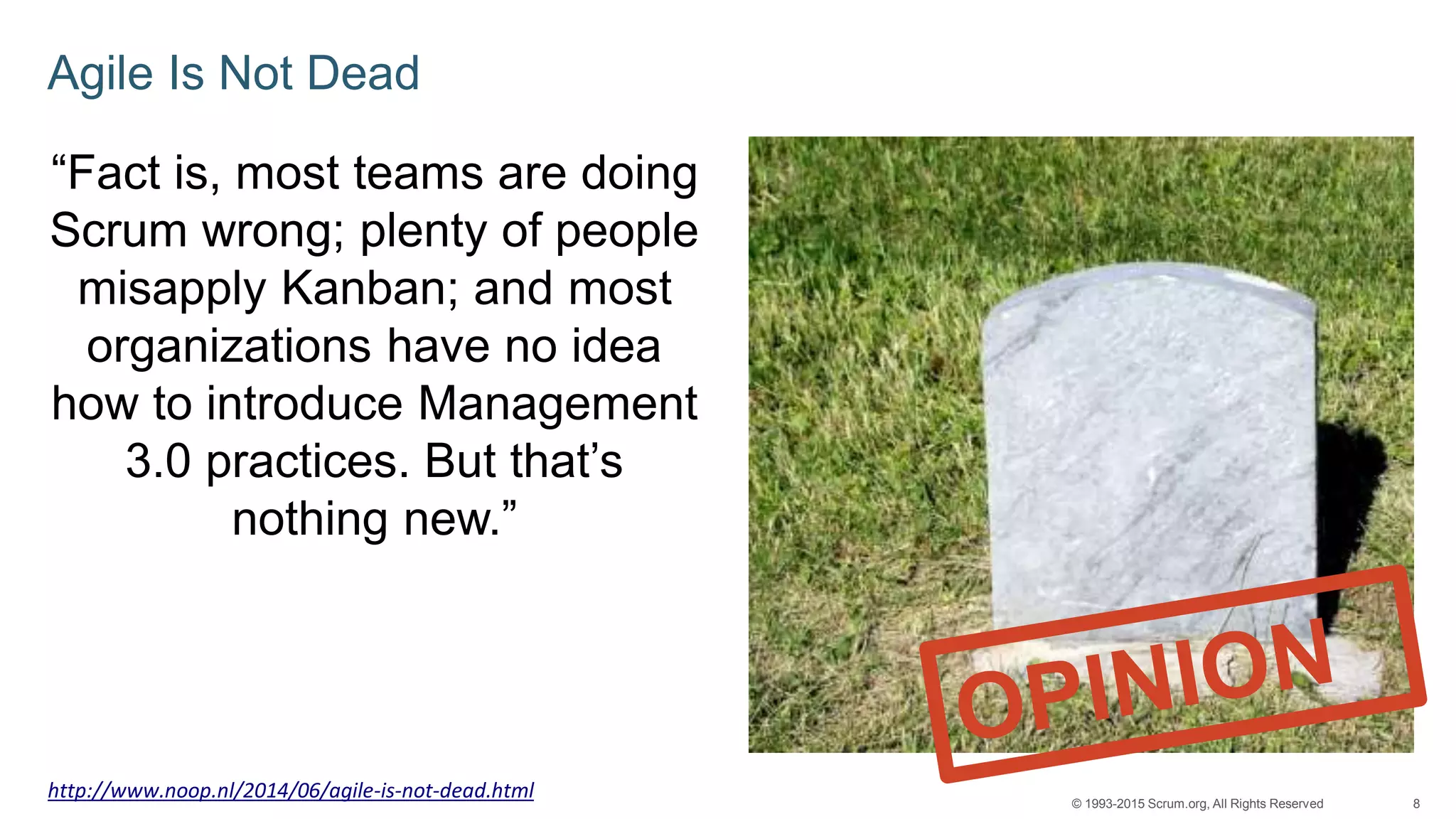
Agile Is Not Dead
“Fact is, most teams are doing
Scrum wrong; plenty of people
misapply Kanban; and most
organizations have no idea
how to introduce Management
3.0 practices. But that’s
nothing new.”
http://www.noop.nl/2014/06/agile-is-not-dead.html
9© 1993-2015 Scrum.org, All Rights Reserved
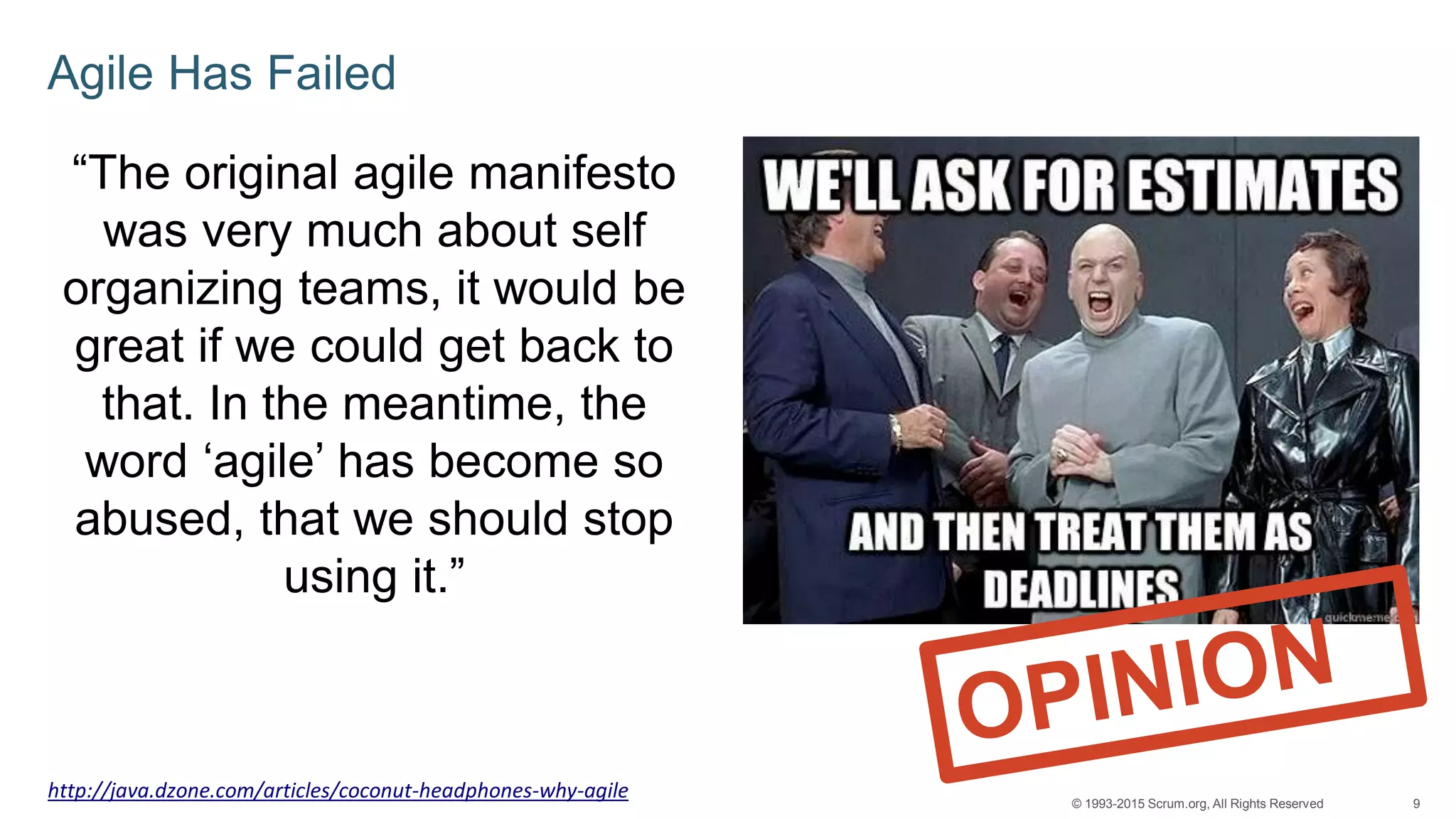
Agile Has Failed
“The original agile manifesto
was very much about self
organizing teams, it would be
great if we could get back to
that. In the meantime, the
word ‘agile’ has become so
abused, that we should stop
using it.”
http://java.dzone.com/articles/coconut-headphones-why-agile
10© 1993-2015 Scrum.org, All Rights Reserved
Agile Is The Future
“The Agile Manifesto was
written to express shared
values of people who saw a
new way of developing
software. […] many in our
industry will continue to build
better and better software
based on these values.”
http://kenschwaber.wordpress.com/2013/06/11/agile-fad/
11© 1993-2015 Scrum.org, All Rights Reserved
MIN
2
What is the state of Agile and Scrum in
your organization?
The State of Agile (2015)
12© 1993-2015 Scrum.org, All Rights Reserved
“Agility”
• Agility is a state envisioned by moving to Agile processes.
– The adoption of Agile processes for product development is an
important foundation.
• Agility is the state of constant re-invention, and high
responsiveness, speed and adaptiveness, while controlling
risks and maintaining the creation of value.
– It takes time for agility to settle in the hearts and minds of the
people.
13© 1993-2015 Scrum.org, All Rights Reserved
Remember?
“Our highest priority is to satisfy the
customer through early and continuous
delivery of valuable software.”
How is that for a purpose?
14© 1993-2015 Scrum.org, All Rights Reserved
“Our highest priority is to satisfy the
customer through early and
continuous delivery of valuable
products and services.”
A Suggested Purpose for an Agile Organization
15© 1993-2015 Scrum.org, All Rights Reserved
Scrum is a Stance (too)
Empirical Management Explored
"If you haven't found it yet, keep looking. Don't settle. As
with all matters of the heart, you'll know when you find
it.”
-Steve Jobs
16© 1993-2015 Scrum.org, All Rights Reserved
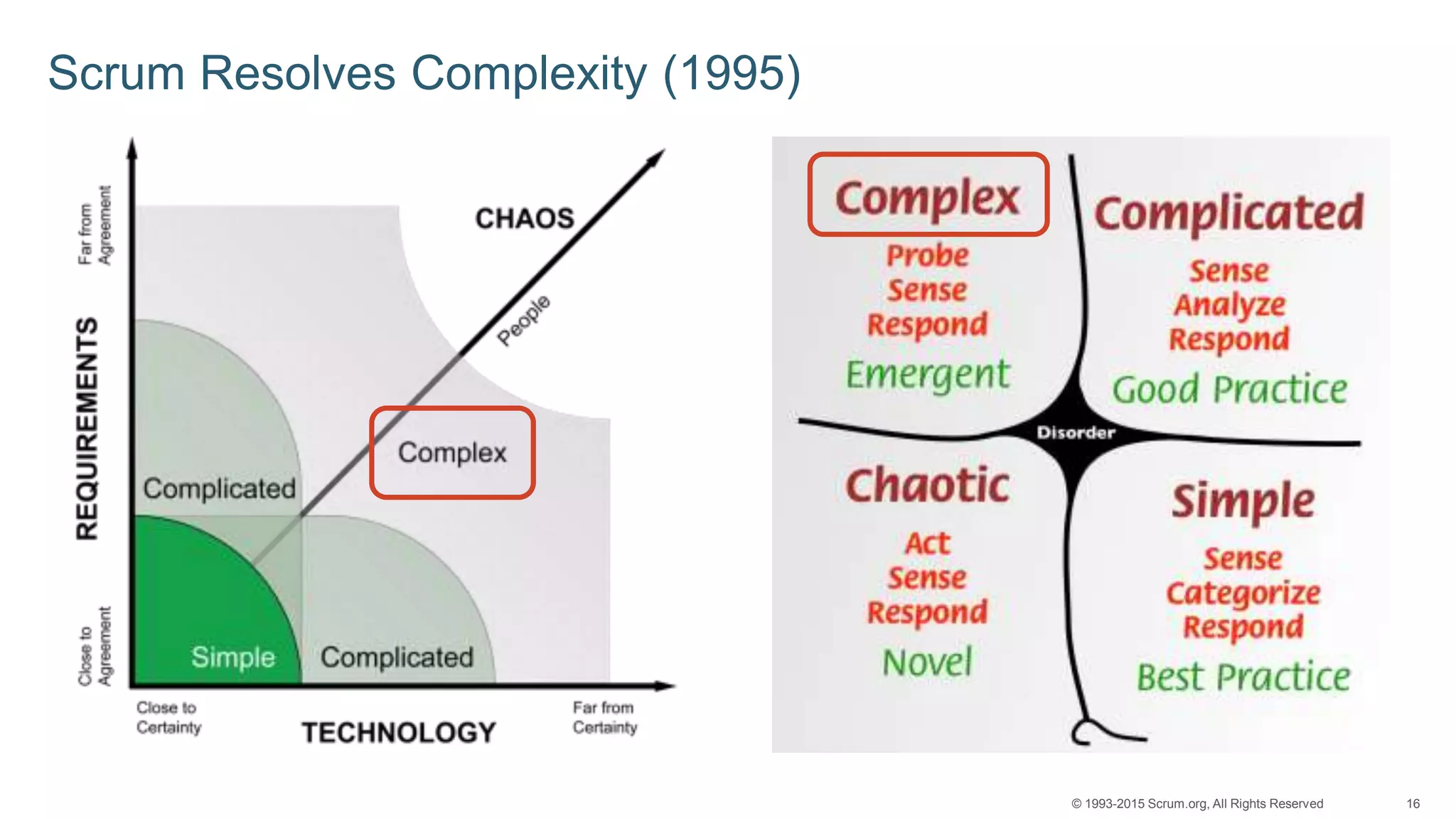
Scrum Resolves Complexity (1995)
17© 1993-2015 Scrum.org, All Rights Reserved
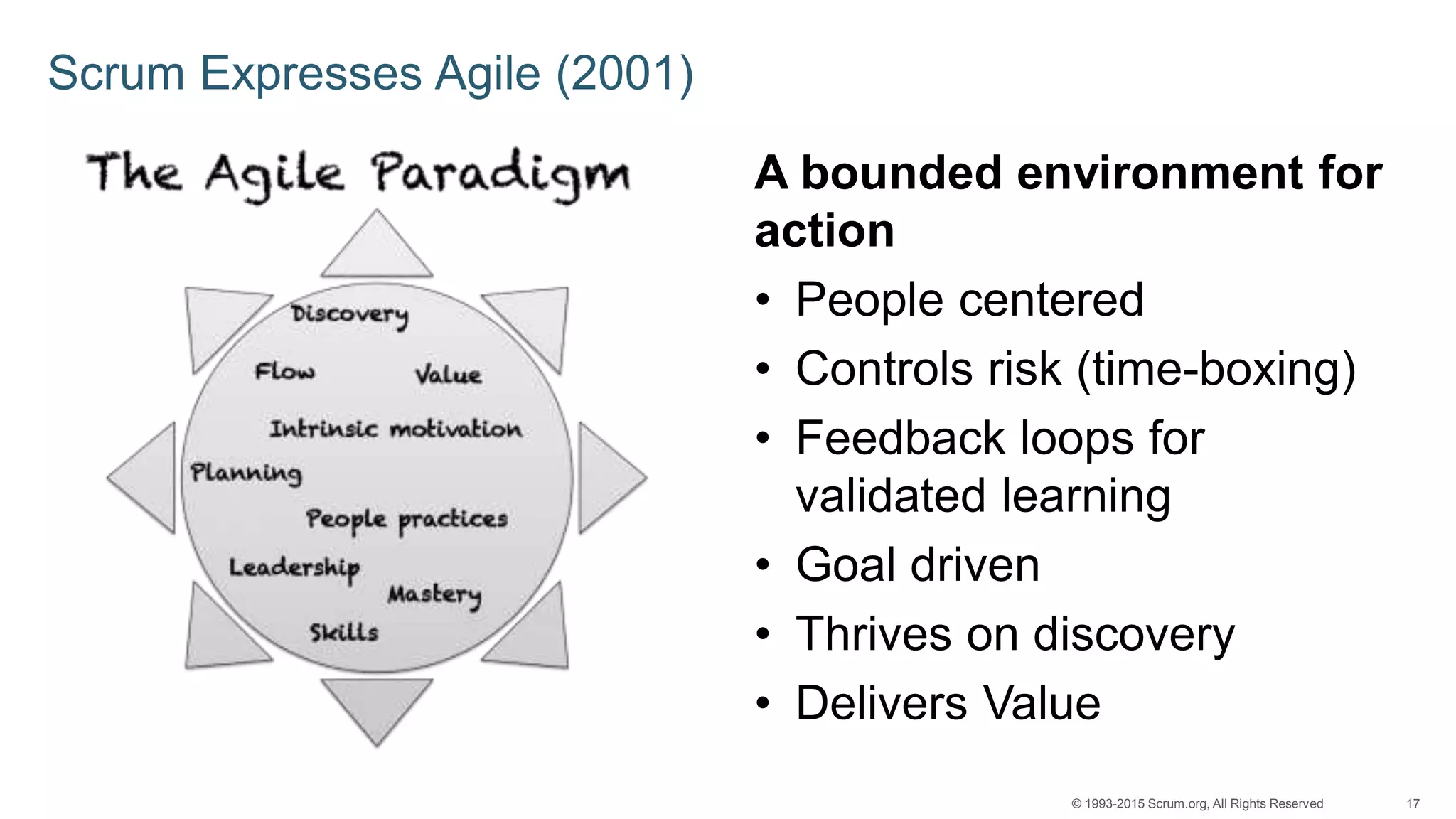
Scrum Expresses Agile (2001)
A bounded environment for
action
• People centered
• Controls risk (time-boxing)
• Feedback loops for
validated learning
• Goal driven
• Thrives on discovery
• Delivers Value
18© 1993-2015 Scrum.org, All Rights Reserved
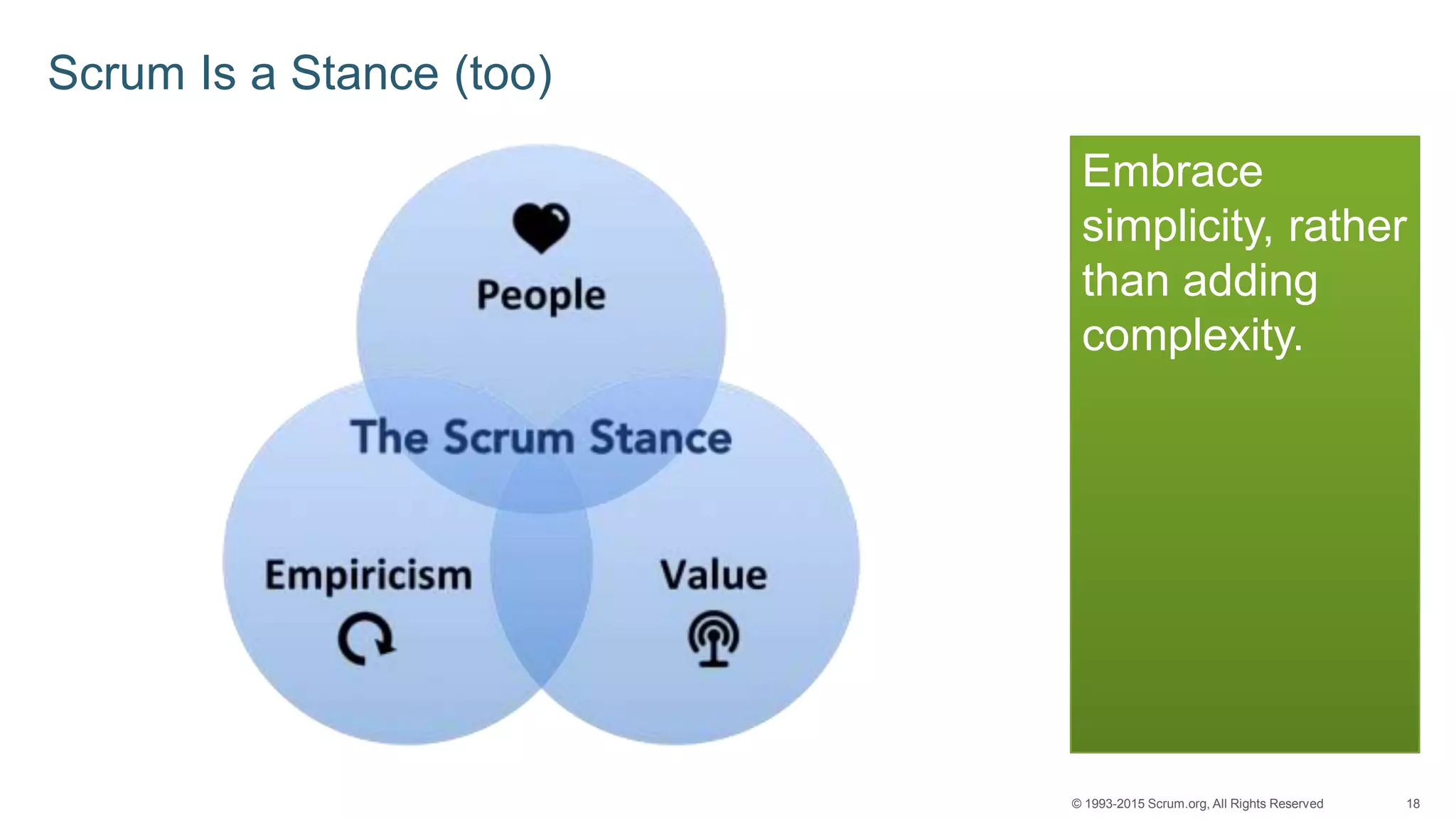
Scrum Is a Stance (too)
Embrace
simplicity, rather
than adding
complexity.
19© 1993-2015 Scrum.org, All Rights Reserved
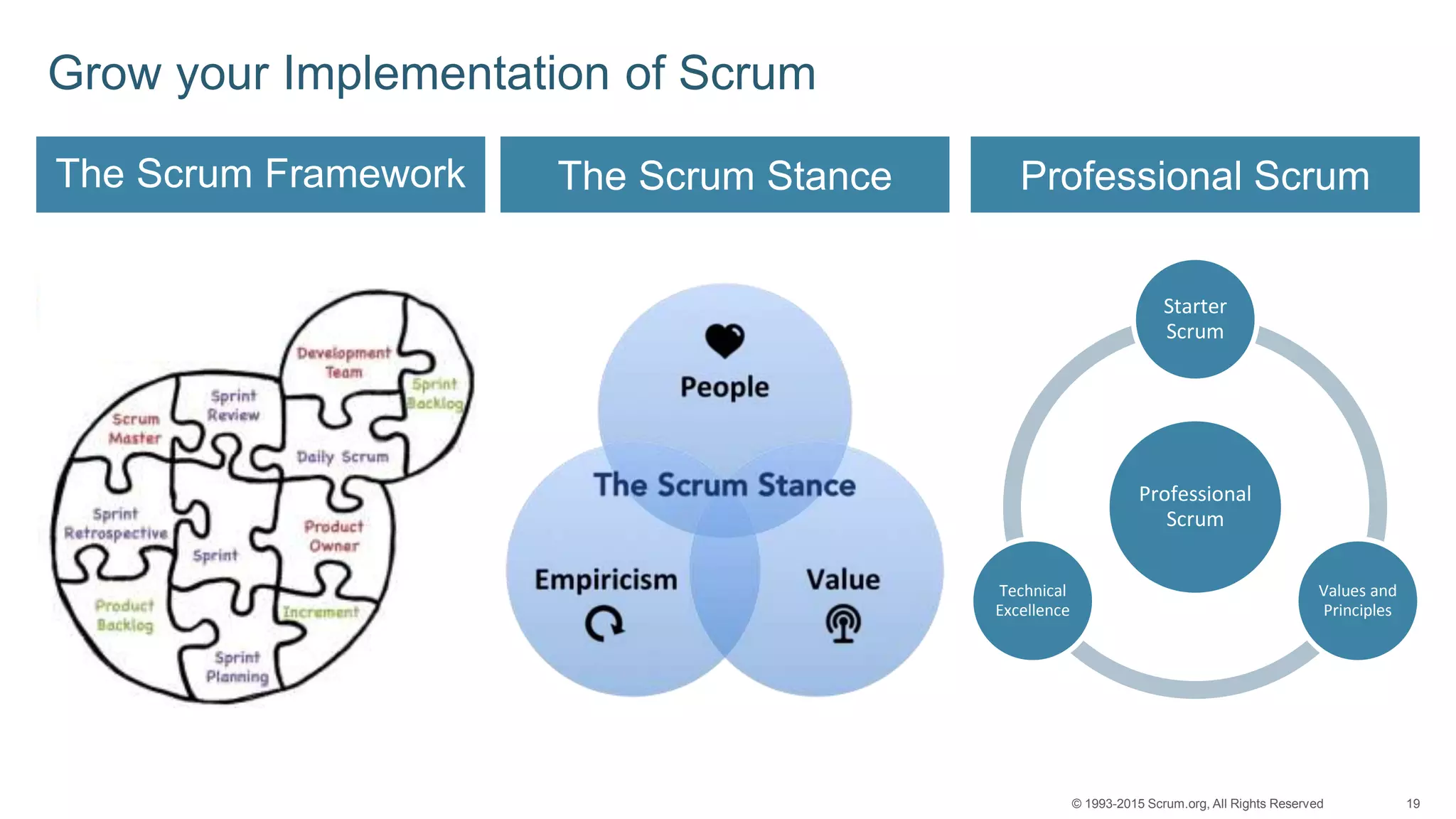
Grow your Implementation of Scrum
The Scrum Framework The Scrum Stance Professional Scrum
Professional
Scrum
Starter
Scrum
Values and
Principles
Technical
Excellence
20© 1993-2015 Scrum.org, All Rights Reserved
People employ empiricism to optimize
the value of their work.
The Scrum Stance
21© 1993-2015 Scrum.org, All Rights Reserved
Managing for Value
Empirical Management Explored
“Scrum Teams manage themselves. You don’t
manage them. You set goals.”
-Ken Schwaber
22© 1993-2015 Scrum.org, All Rights Reserved
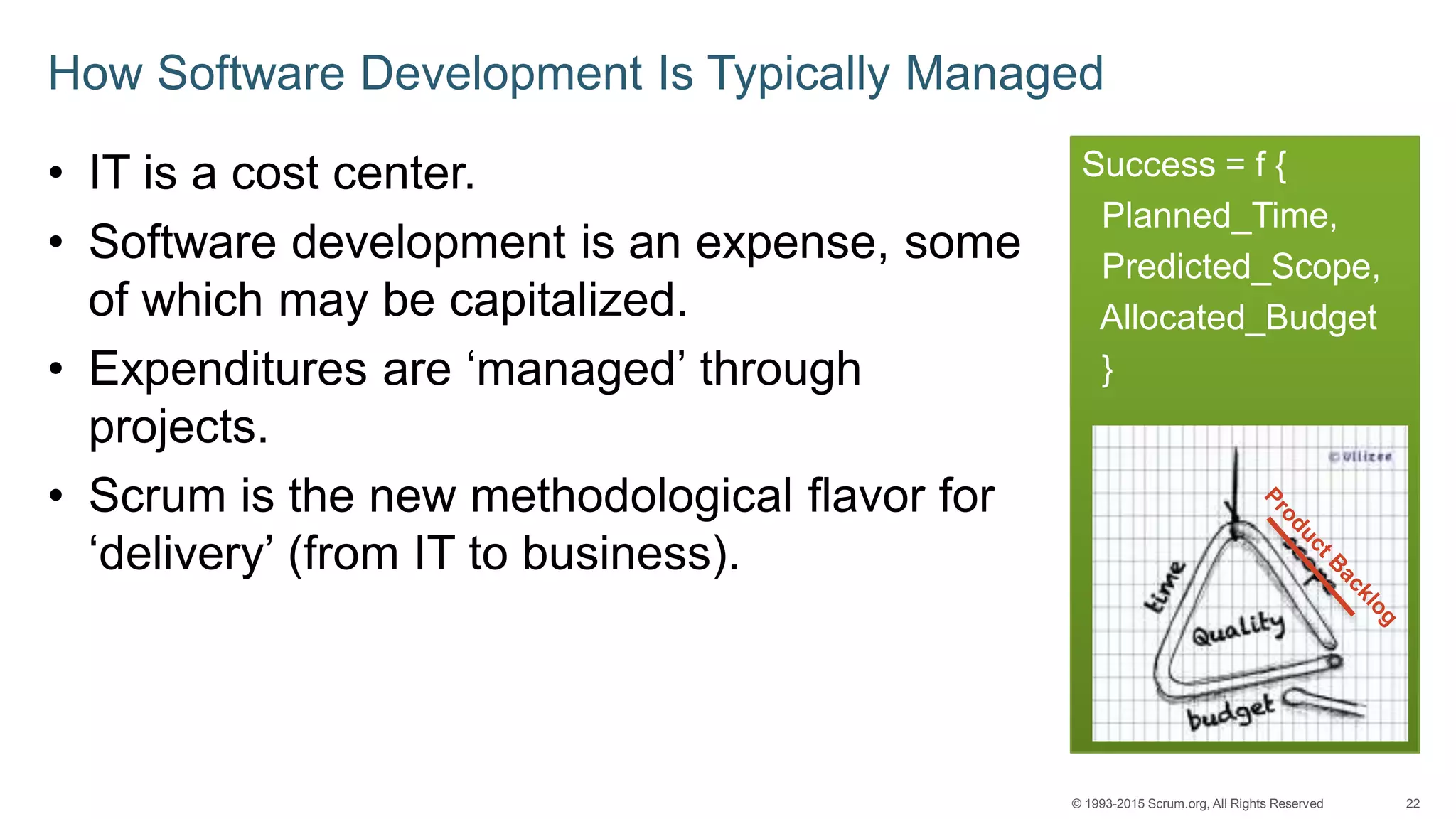
How Software Development Is Typically Managed
• IT is a cost center.
• Software development is an expense, some
of which may be capitalized.
• Expenditures are ‘managed’ through
projects.
• Scrum is the new methodological flavor for
‘delivery’ (from IT to business).
Success = f {
Planned_Time,
Predicted_Scope,
Allocated_Budget
}
23© 1993-2015 Scrum.org, All Rights Reserved
Are you looking to increase output, or
optimize the value of your output?
Delighting Customers?
24© 1993-2015 Scrum.org, All Rights Reserved
MIN
2
How would you define ‘value’ for your
organization?
Understanding Value
25© 1993-2015 Scrum.org, All Rights Reserved
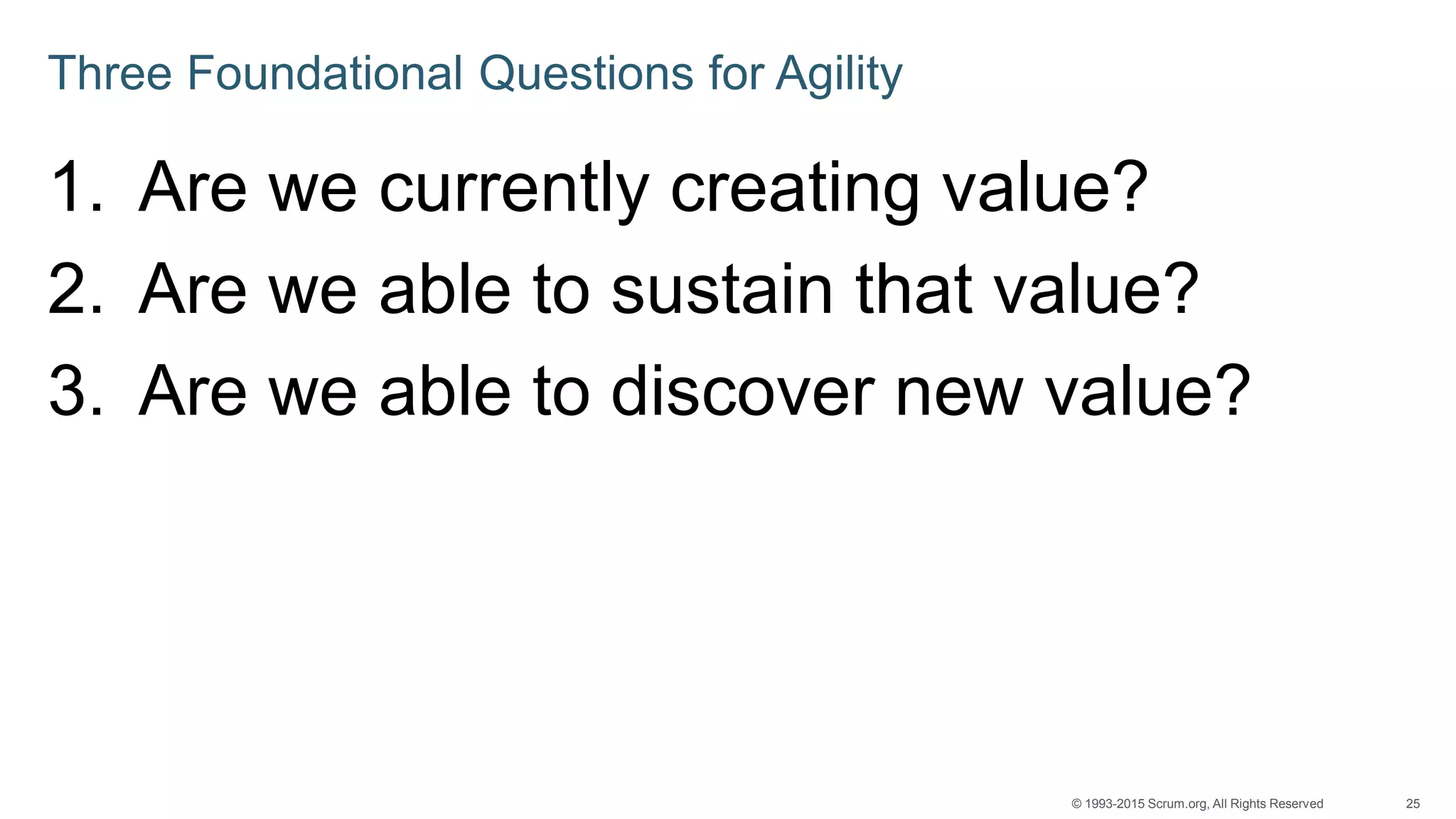
Three Foundational Questions for Agility
1. Are we currently creating value?
2. Are we able to sustain that value?
3. Are we able to discover new value?
26© 1993-2015 Scrum.org, All Rights Reserved
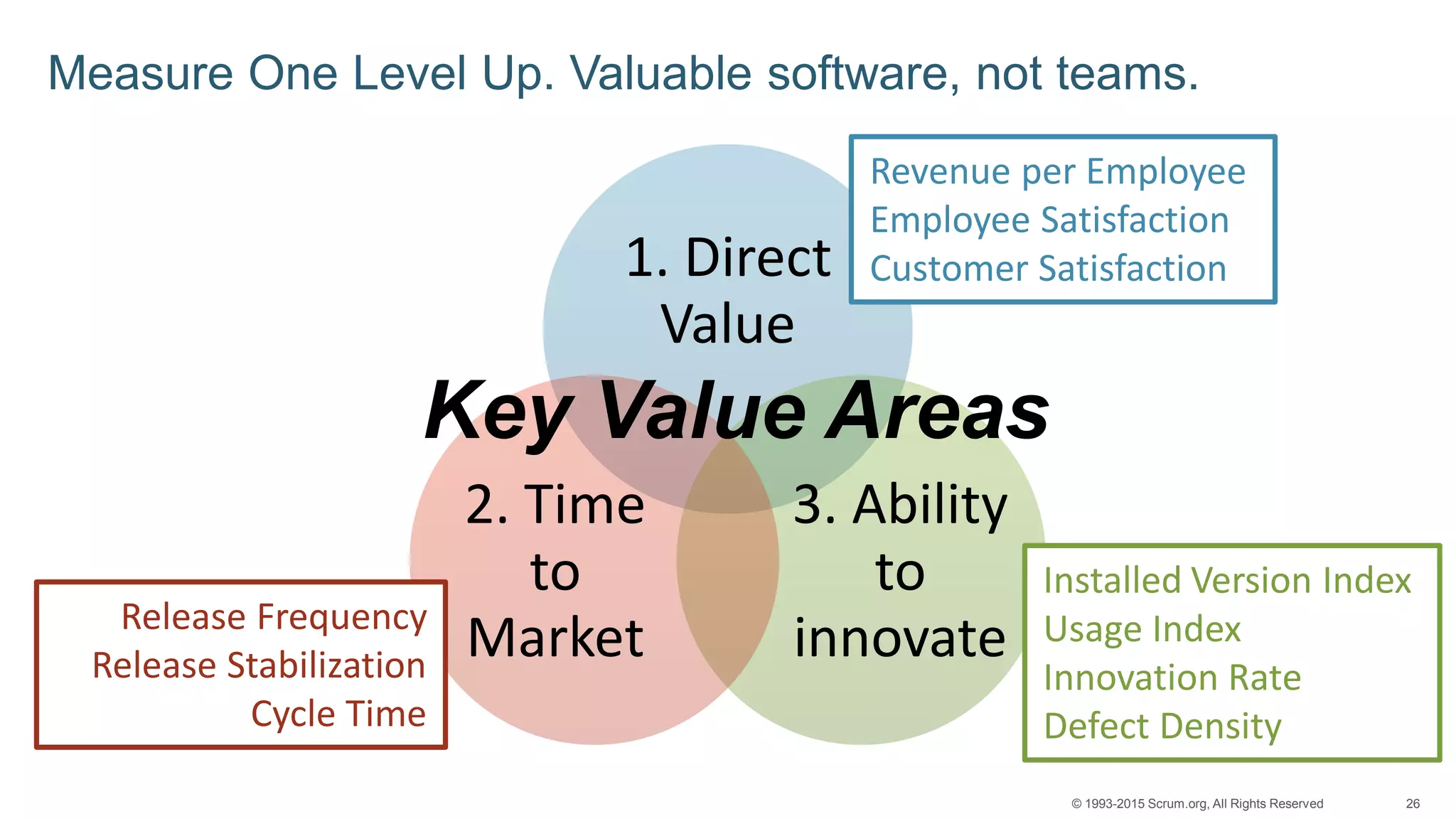
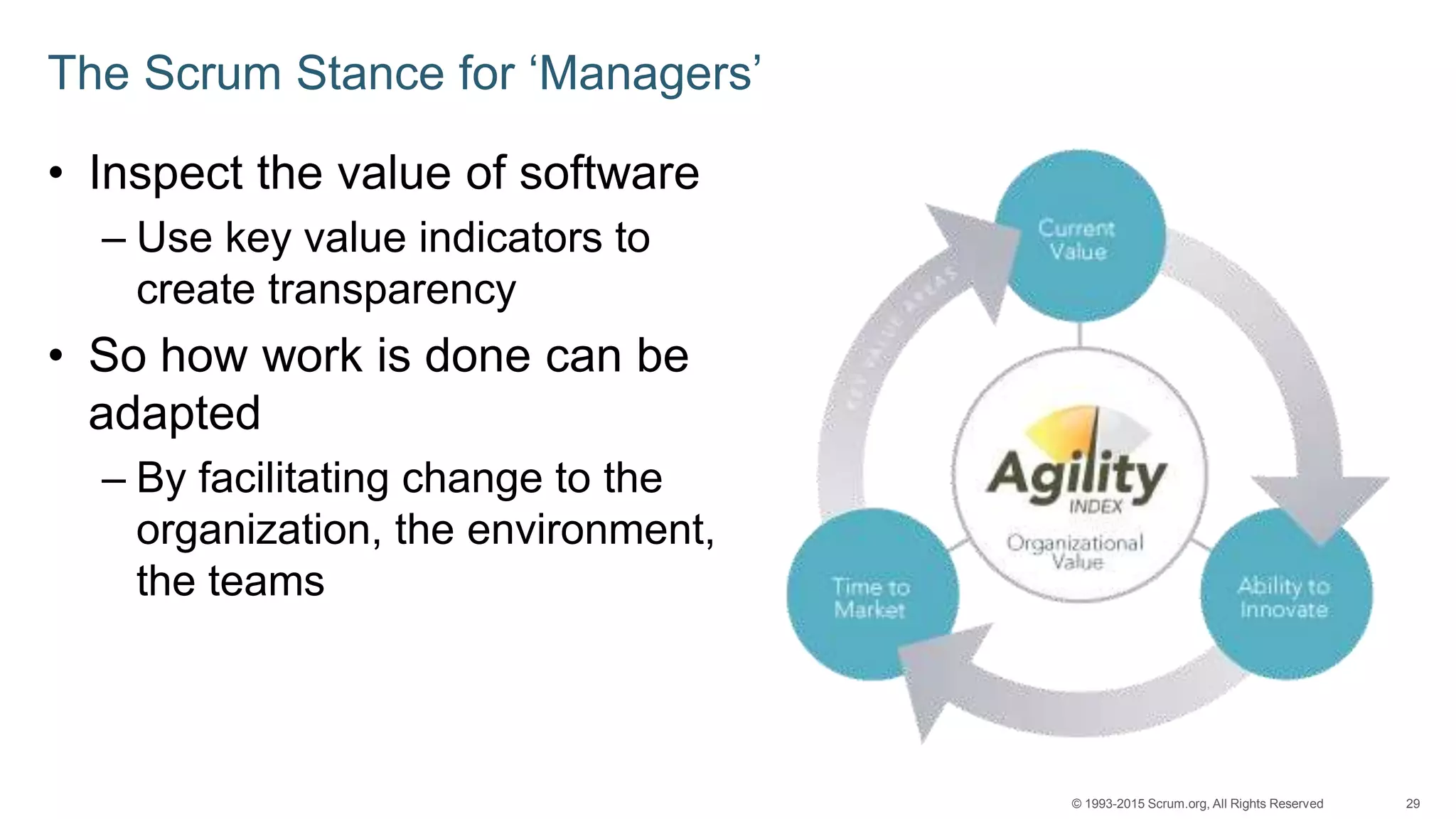
Measure One Level Up. Valuable software, not teams.
1. Direct
Value
3. Ability
to
innovate
2. Time
to
Market
Key Value Areas
Release Frequency
Release Stabilization
Cycle Time
Installed Version Index
Usage Index
Innovation Rate
Defect Density
Revenue per Employee
Employee Satisfaction
Customer Satisfaction
27© 1993-2015 Scrum.org, All Rights Reserved
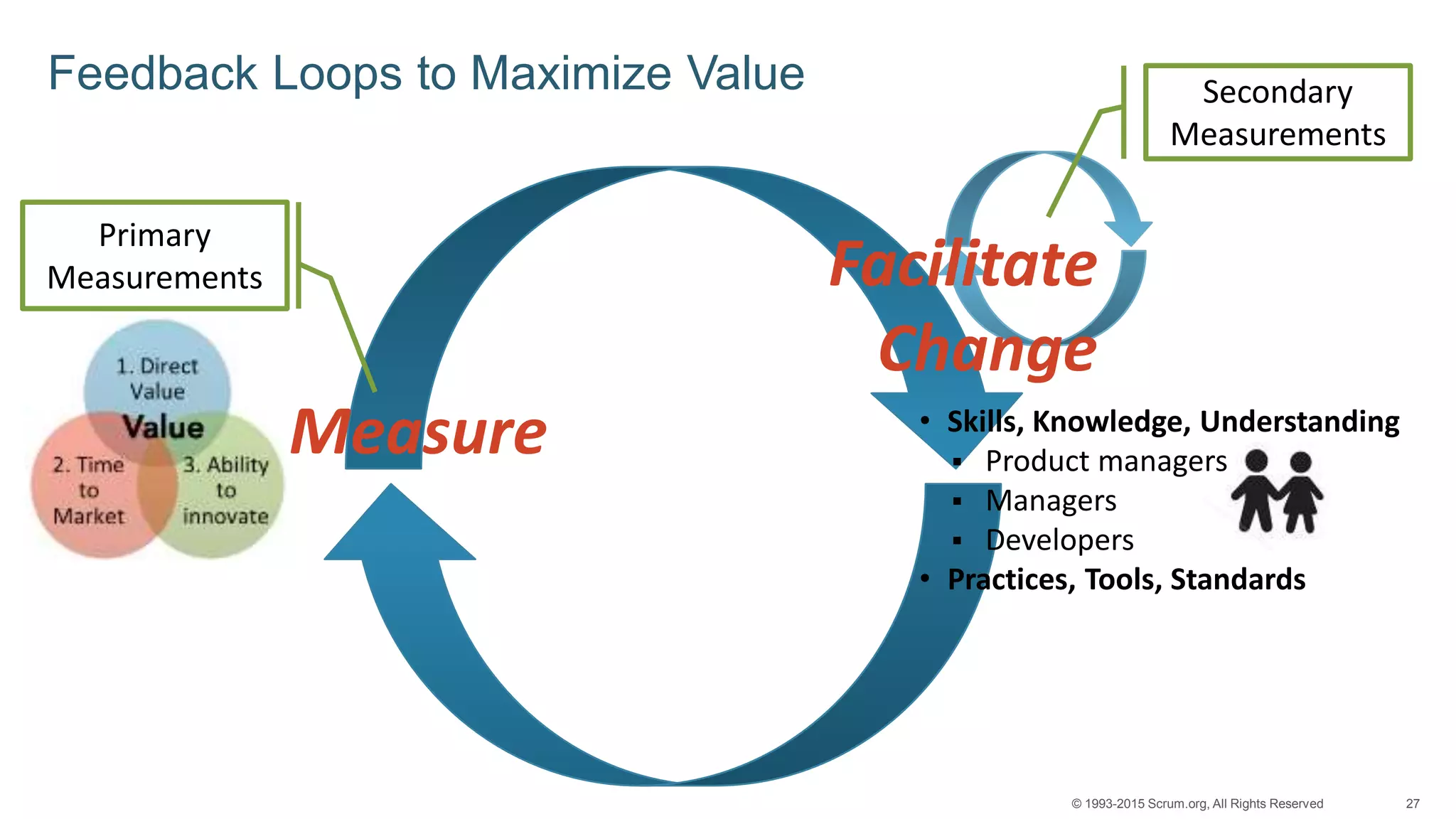
Feedback Loops to Maximize Value
Measure
Facilitate
Change
• Skills, Knowledge, Understanding
 Product managers
 Managers
 Developers
• Practices, Tools, Standards
Secondary
Measurements
Primary
Measurements
28© 1993-2015 Scrum.org, All Rights Reserved
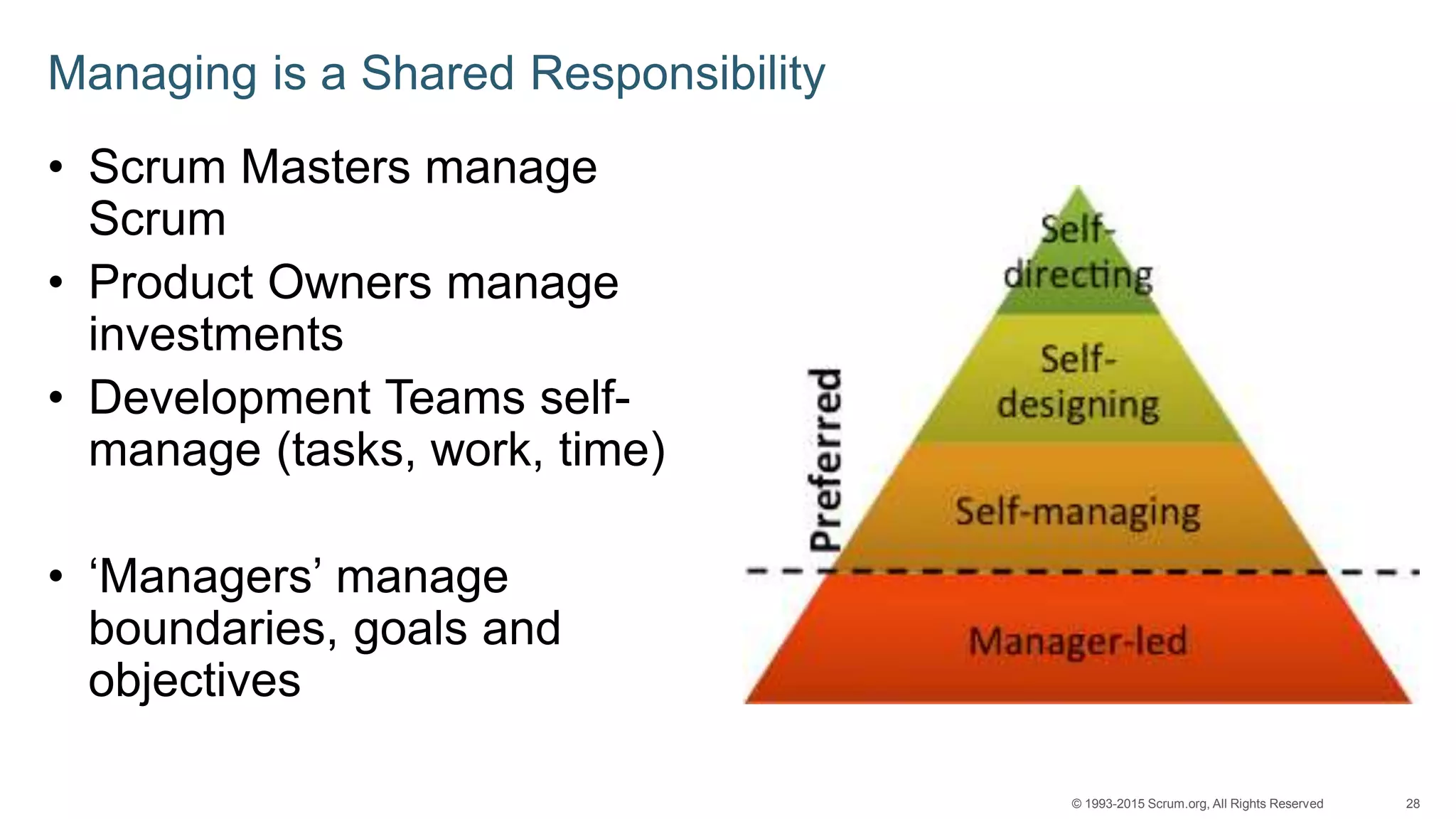
Managing is a Shared Responsibility
• Scrum Masters manage
Scrum
• Product Owners manage
investments
• Development Teams self-
manage (tasks, work, time)
• ‘Managers’ manage
boundaries, goals and
objectives
29© 1993-2015 Scrum.org, All Rights Reserved
The Scrum Stance for ‘Managers’
• Inspect the value of software
– Use key value indicators to
create transparency
• So how work is done can be
adapted
– By facilitating change to the
organization, the environment,
the teams
30© 1993-2015 Scrum.org, All Rights Reserved
Empirical Management
– Implements the Scrum Stance
– Optimizes Software Value
– Employs Primary Evidence
31© 1993-2015 Scrum.org, All Rights Reserved
Scrum to Grow Change
Agility is a Path
“Adopting a mindset of empiricism and adaptiveness is
beneficial to entire organizations.”
-Gunther Verheyen
32© 1993-2015 Scrum.org, All Rights Reserved
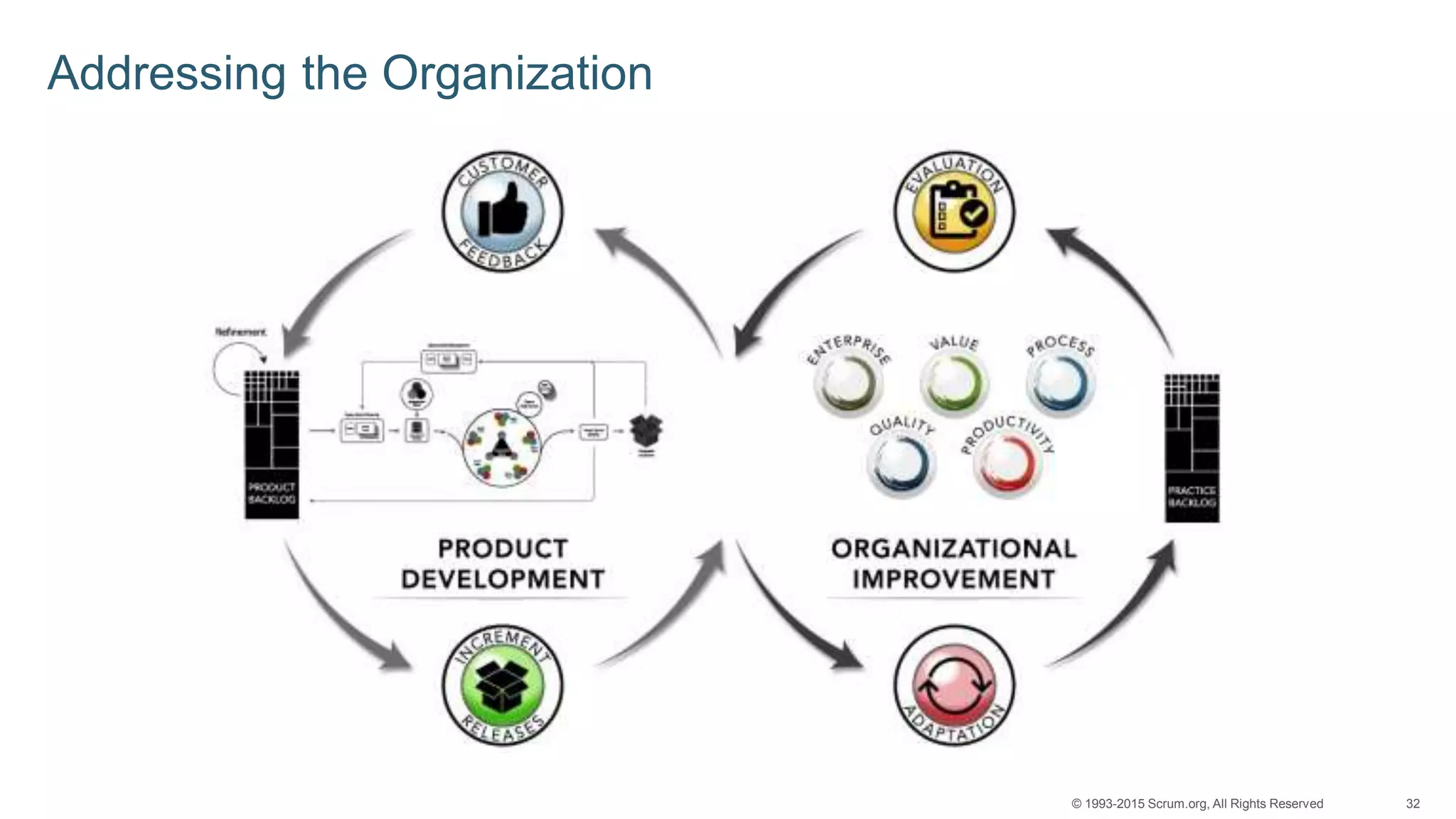
Addressing the Organization
33© 1993-2015 Scrum.org, All Rights Reserved
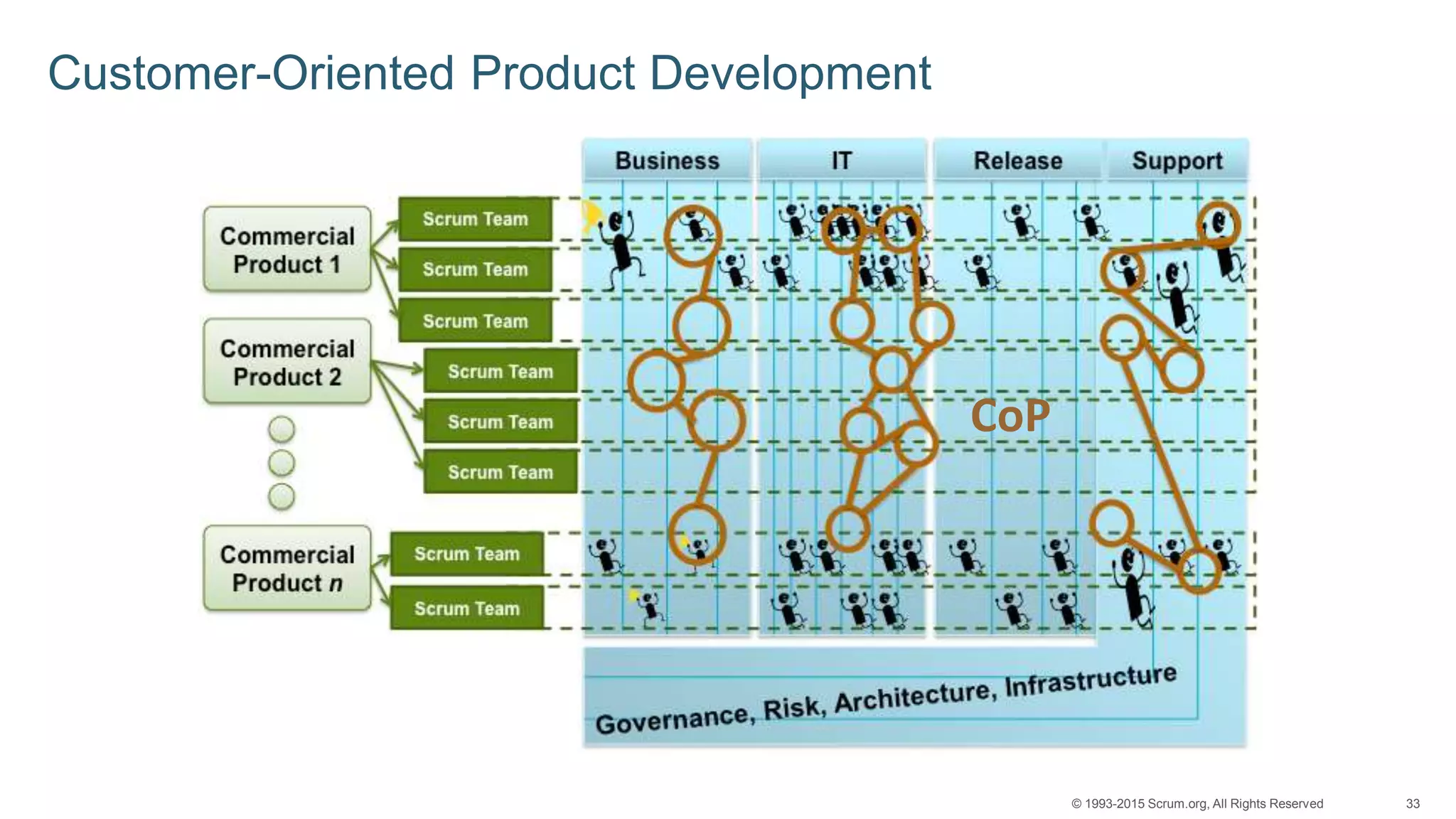
Customer-Oriented Product Development
CoP
34© 1993-2015 Scrum.org, All Rights Reserved
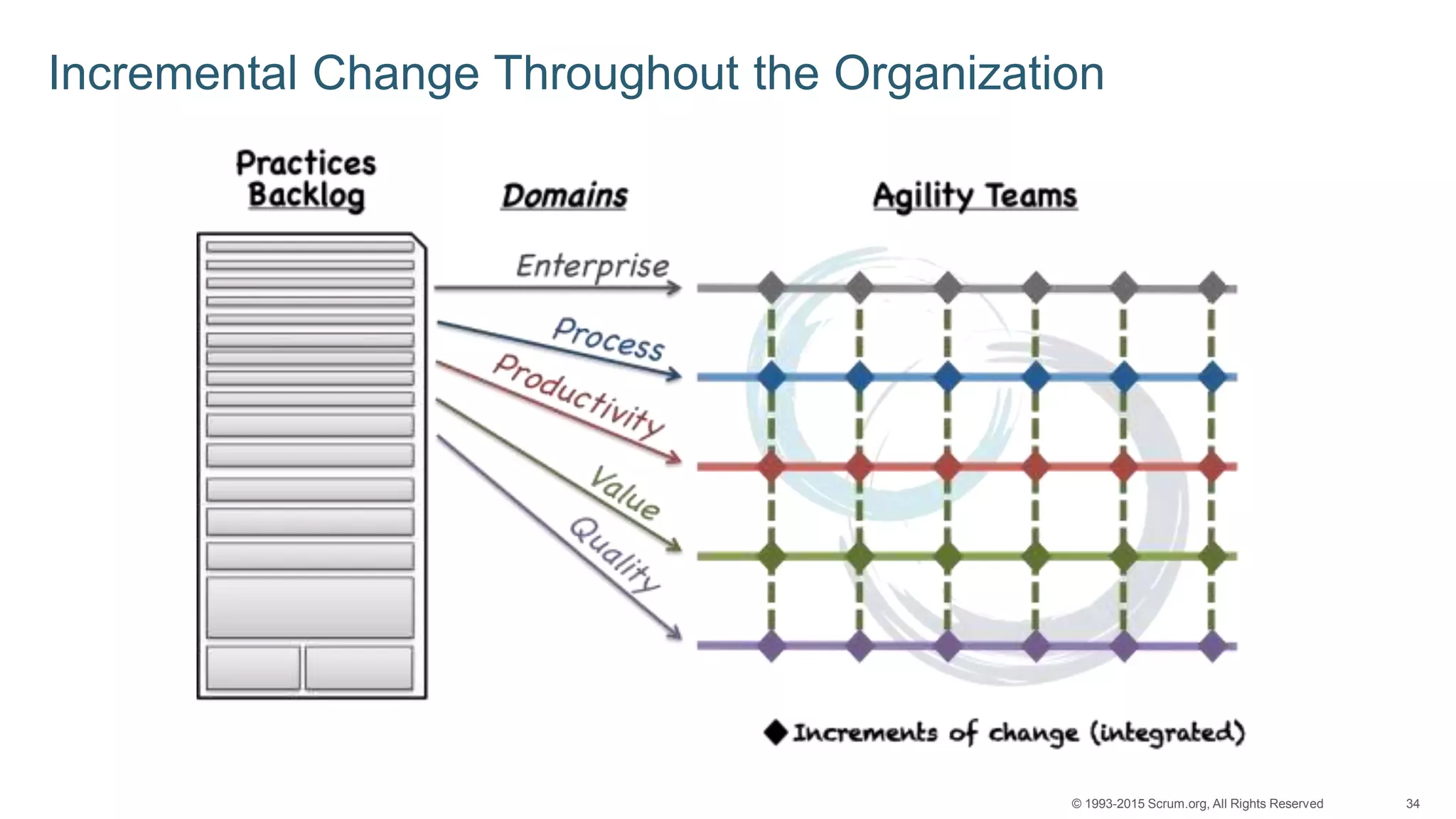
Incremental Change Throughout the Organization
35© 1993-2015 Scrum.org, All Rights Reserved
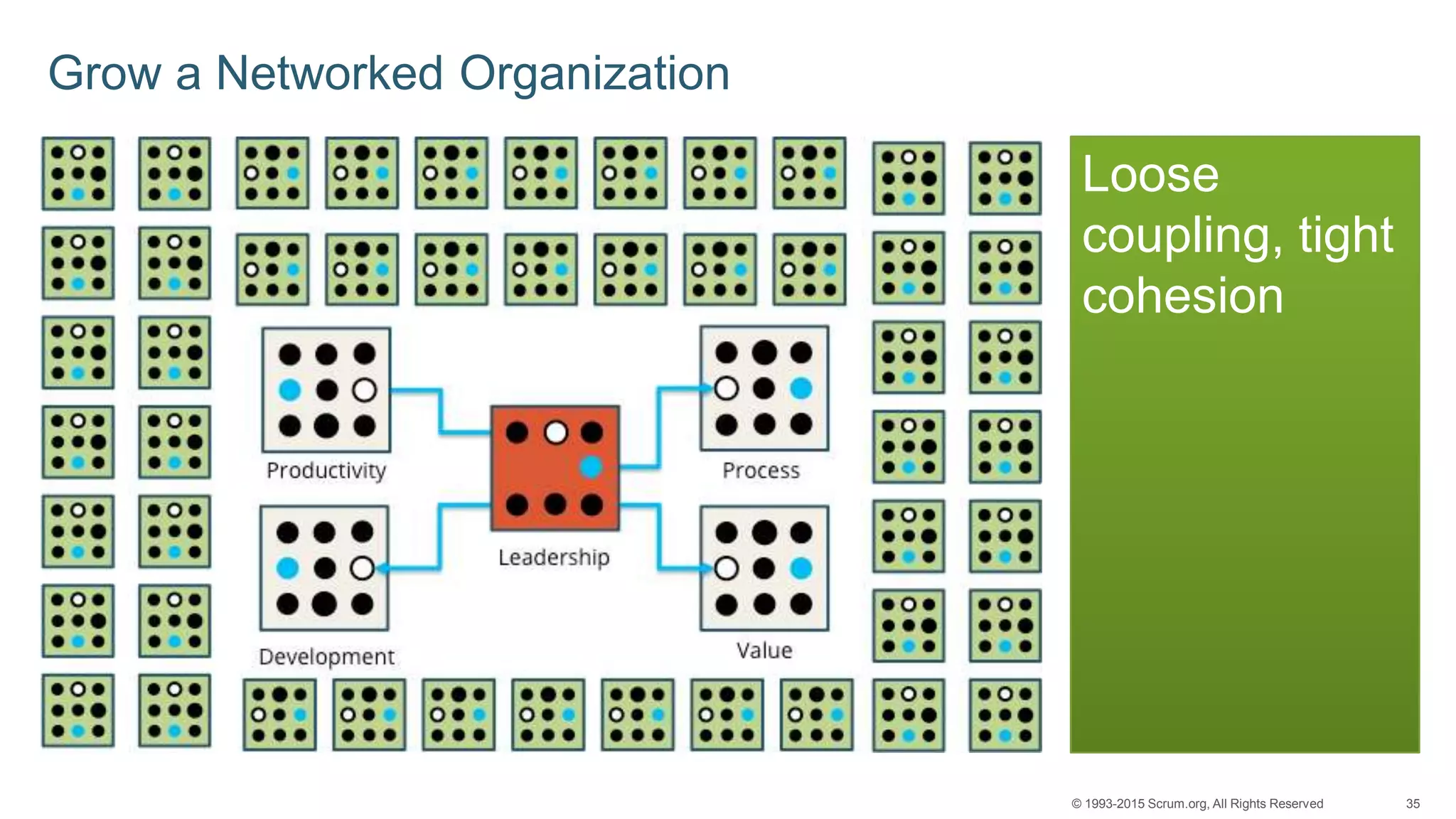
Grow a Networked Organization
Loose
coupling, tight
cohesion
36© 1993-2015 Scrum.org, All Rights Reserved
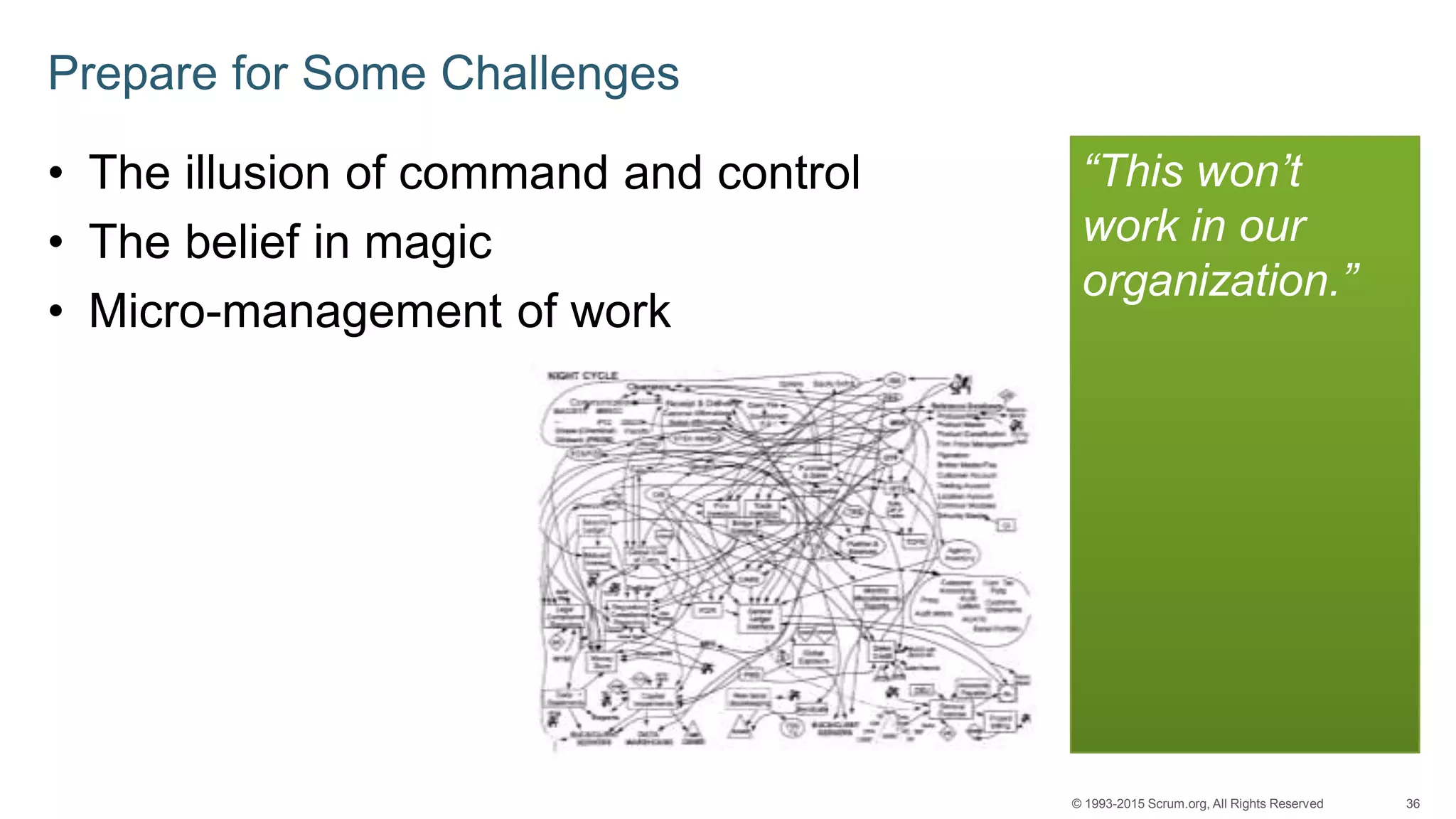
Prepare for Some Challenges
• The illusion of command and control
• The belief in magic
• Micro-management of work
“This won’t
work in our
organization.”
37© 1993-2015 Scrum.org, All Rights Reserved
Agility is a managed state of continuous
adaptation toward optimizing value:
– Agility can’t be planned
– Agility can’t be dictated
– Agility has no end state
38© 1993-2015 Scrum.org, All Rights Reserved
Closing
Empirical Management Explored
39© 1993-2015 Scrum.org, All Rights Reserved
“The future state of Scrum will no longer
be called ‘Scrum’. What we now call
Scrum will have become the norm,
and organizations have re-invented
themselves around it.”
Source: Gunther Verheyen, “Scrum – A Pocket Guide (A Smart Travel Companion)”, 2013
40© 1993-2015 Scrum.org, All Rights Reserved
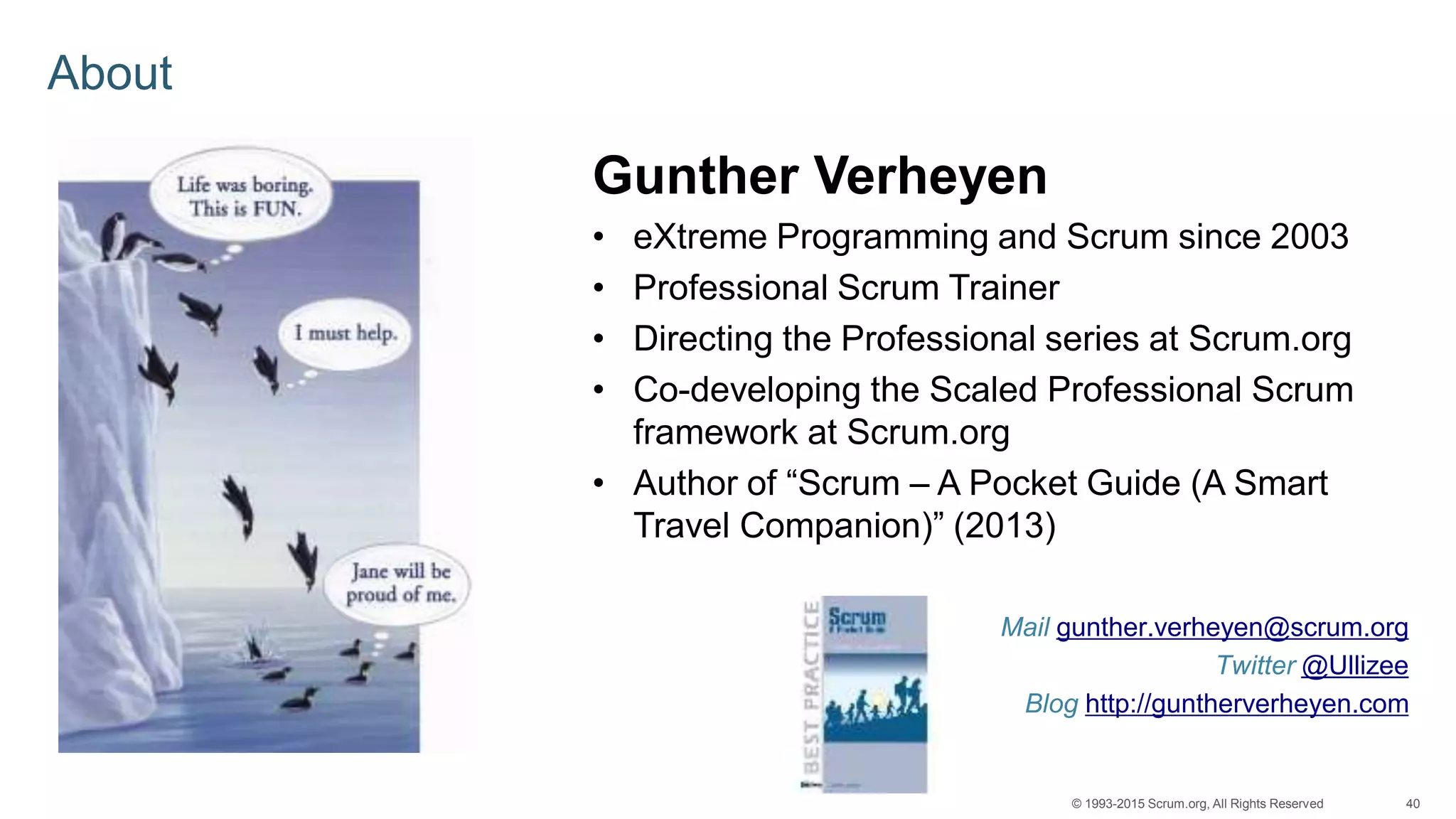
About
Gunther Verheyen
• eXtreme Programming and Scrum since 2003
• Professional Scrum Trainer
• Directing the Professional series at Scrum.org
• Co-developing the Scaled Professional Scrum
framework at Scrum.org
• Author of “Scrum – A Pocket Guide (A Smart
Travel Companion)” (2013)
Mail gunther.verheyen@scrum.org
Twitter @Ullizee
Blog http://guntherverheyen.com
41© 1993-2015 Scrum.org, All Rights Reserved
Scrum.org is a community. Connect.
Twitter
@scrumdotorg
LinkedIn
LinkedIn.com
/company/Scrum.or
g
Facebook
Facebook.com
/Scrum.org
Forums
Scrum.org
/Community
RSS
Scrum.org/RSS
42© 1993-2015 Scrum.org, All Rights Reserved
Thank you

Empirical Management - Scrum Days Poland 2015

  • 1.
    by Scrum.org –Improving the Profession of Software Development Empirical Management Explored Evidence-Based Managing of Software Gunther Verheyen Shepherding the Professional series Scrum.org Scrum Days Poland Exec Track May 29, 2015 Warsaw
  • 2.
    2© 1993-2015 Scrum.org,All Rights Reserved MIN 3 What kind of organization do you work at? Raise your hand if: • It’s a pure software company • Software is crucial (critical) for your company • Scrum is used for software development • It’s an Agile organization • An organization that is gradually becoming Agile • An organization where Agile is seen as the new fad (like Prince2, CMMi, Lean, etc.) Short Survey About You
  • 3.
    3© 1993-2015 Scrum.org,All Rights Reserved Have you also heard? “Managers are useless and not needed in (an) Agile (organization).” An endangered species?
  • 4.
    4© 1993-2015 Scrum.org,All Rights Reserved An Agile Organization? Looking for a definition "If you haven't found it yet, keep looking. Don't settle. As with all matters of the heart, you'll know when you find it.” -Steve Jobs
  • 5.
    5© 1993-2015 Scrum.org,All Rights Reserved “Agile” The mindset expressed in the 4 value statements and 12 principles of the “Manifesto for Agile Software Development”
  • 6.
    6© 1993-2015 Scrum.org,All Rights Reserved Fascinating opinions exist on the state of Agile
  • 7.
    7© 1993-2015 Scrum.org,All Rights Reserved Agile Is Dead “[Agile] has been greatly abetted by the legions of Agile consultants. By stressing the practices, they have corrupted what Agile was about.” http://www.drdobbs.com/architecture-and-design/the-corruption-of-agile/240166698
  • 8.
    8© 1993-2015 Scrum.org,All Rights Reserved Agile Is Not Dead “Fact is, most teams are doing Scrum wrong; plenty of people misapply Kanban; and most organizations have no idea how to introduce Management 3.0 practices. But that’s nothing new.” http://www.noop.nl/2014/06/agile-is-not-dead.html
  • 9.
    9© 1993-2015 Scrum.org,All Rights Reserved Agile Has Failed “The original agile manifesto was very much about self organizing teams, it would be great if we could get back to that. In the meantime, the word ‘agile’ has become so abused, that we should stop using it.” http://java.dzone.com/articles/coconut-headphones-why-agile
  • 10.
    10© 1993-2015 Scrum.org,All Rights Reserved Agile Is The Future “The Agile Manifesto was written to express shared values of people who saw a new way of developing software. […] many in our industry will continue to build better and better software based on these values.” http://kenschwaber.wordpress.com/2013/06/11/agile-fad/
  • 11.
    11© 1993-2015 Scrum.org,All Rights Reserved MIN 2 What is the state of Agile and Scrum in your organization? The State of Agile (2015)
  • 12.
    12© 1993-2015 Scrum.org,All Rights Reserved “Agility” • Agility is a state envisioned by moving to Agile processes. – The adoption of Agile processes for product development is an important foundation. • Agility is the state of constant re-invention, and high responsiveness, speed and adaptiveness, while controlling risks and maintaining the creation of value. – It takes time for agility to settle in the hearts and minds of the people.
  • 13.
    13© 1993-2015 Scrum.org,All Rights Reserved Remember? “Our highest priority is to satisfy the customer through early and continuous delivery of valuable software.” How is that for a purpose?
  • 14.
    14© 1993-2015 Scrum.org,All Rights Reserved “Our highest priority is to satisfy the customer through early and continuous delivery of valuable products and services.” A Suggested Purpose for an Agile Organization
  • 15.
    15© 1993-2015 Scrum.org,All Rights Reserved Scrum is a Stance (too) Empirical Management Explored "If you haven't found it yet, keep looking. Don't settle. As with all matters of the heart, you'll know when you find it.” -Steve Jobs
  • 16.
    16© 1993-2015 Scrum.org,All Rights Reserved Scrum Resolves Complexity (1995)
  • 17.
    17© 1993-2015 Scrum.org,All Rights Reserved Scrum Expresses Agile (2001) A bounded environment for action • People centered • Controls risk (time-boxing) • Feedback loops for validated learning • Goal driven • Thrives on discovery • Delivers Value
  • 18.
    18© 1993-2015 Scrum.org,All Rights Reserved Scrum Is a Stance (too) Embrace simplicity, rather than adding complexity.
  • 19.
    19© 1993-2015 Scrum.org,All Rights Reserved Grow your Implementation of Scrum The Scrum Framework The Scrum Stance Professional Scrum Professional Scrum Starter Scrum Values and Principles Technical Excellence
  • 20.
    20© 1993-2015 Scrum.org,All Rights Reserved People employ empiricism to optimize the value of their work. The Scrum Stance
  • 21.
    21© 1993-2015 Scrum.org,All Rights Reserved Managing for Value Empirical Management Explored “Scrum Teams manage themselves. You don’t manage them. You set goals.” -Ken Schwaber
  • 22.
    22© 1993-2015 Scrum.org,All Rights Reserved How Software Development Is Typically Managed • IT is a cost center. • Software development is an expense, some of which may be capitalized. • Expenditures are ‘managed’ through projects. • Scrum is the new methodological flavor for ‘delivery’ (from IT to business). Success = f { Planned_Time, Predicted_Scope, Allocated_Budget }
  • 23.
    23© 1993-2015 Scrum.org,All Rights Reserved Are you looking to increase output, or optimize the value of your output? Delighting Customers?
  • 24.
    24© 1993-2015 Scrum.org,All Rights Reserved MIN 2 How would you define ‘value’ for your organization? Understanding Value
  • 25.
    25© 1993-2015 Scrum.org,All Rights Reserved Three Foundational Questions for Agility 1. Are we currently creating value? 2. Are we able to sustain that value? 3. Are we able to discover new value?
  • 26.
    26© 1993-2015 Scrum.org,All Rights Reserved Measure One Level Up. Valuable software, not teams. 1. Direct Value 3. Ability to innovate 2. Time to Market Key Value Areas Release Frequency Release Stabilization Cycle Time Installed Version Index Usage Index Innovation Rate Defect Density Revenue per Employee Employee Satisfaction Customer Satisfaction
  • 27.
    27© 1993-2015 Scrum.org,All Rights Reserved Feedback Loops to Maximize Value Measure Facilitate Change • Skills, Knowledge, Understanding  Product managers  Managers  Developers • Practices, Tools, Standards Secondary Measurements Primary Measurements
  • 28.
    28© 1993-2015 Scrum.org,All Rights Reserved Managing is a Shared Responsibility • Scrum Masters manage Scrum • Product Owners manage investments • Development Teams self- manage (tasks, work, time) • ‘Managers’ manage boundaries, goals and objectives
  • 29.
    29© 1993-2015 Scrum.org,All Rights Reserved The Scrum Stance for ‘Managers’ • Inspect the value of software – Use key value indicators to create transparency • So how work is done can be adapted – By facilitating change to the organization, the environment, the teams
  • 30.
    30© 1993-2015 Scrum.org,All Rights Reserved Empirical Management – Implements the Scrum Stance – Optimizes Software Value – Employs Primary Evidence
  • 31.
    31© 1993-2015 Scrum.org,All Rights Reserved Scrum to Grow Change Agility is a Path “Adopting a mindset of empiricism and adaptiveness is beneficial to entire organizations.” -Gunther Verheyen
  • 32.
    32© 1993-2015 Scrum.org,All Rights Reserved Addressing the Organization
  • 33.
    33© 1993-2015 Scrum.org,All Rights Reserved Customer-Oriented Product Development CoP
  • 34.
    34© 1993-2015 Scrum.org,All Rights Reserved Incremental Change Throughout the Organization
  • 35.
    35© 1993-2015 Scrum.org,All Rights Reserved Grow a Networked Organization Loose coupling, tight cohesion
  • 36.
    36© 1993-2015 Scrum.org,All Rights Reserved Prepare for Some Challenges • The illusion of command and control • The belief in magic • Micro-management of work “This won’t work in our organization.”
  • 37.
    37© 1993-2015 Scrum.org,All Rights Reserved Agility is a managed state of continuous adaptation toward optimizing value: – Agility can’t be planned – Agility can’t be dictated – Agility has no end state
  • 38.
    38© 1993-2015 Scrum.org,All Rights Reserved Closing Empirical Management Explored
  • 39.
    39© 1993-2015 Scrum.org,All Rights Reserved “The future state of Scrum will no longer be called ‘Scrum’. What we now call Scrum will have become the norm, and organizations have re-invented themselves around it.” Source: Gunther Verheyen, “Scrum – A Pocket Guide (A Smart Travel Companion)”, 2013
  • 40.
    40© 1993-2015 Scrum.org,All Rights Reserved About Gunther Verheyen • eXtreme Programming and Scrum since 2003 • Professional Scrum Trainer • Directing the Professional series at Scrum.org • Co-developing the Scaled Professional Scrum framework at Scrum.org • Author of “Scrum – A Pocket Guide (A Smart Travel Companion)” (2013) Mail gunther.verheyen@scrum.org Twitter @Ullizee Blog http://guntherverheyen.com
  • 41.
    41© 1993-2015 Scrum.org,All Rights Reserved Scrum.org is a community. Connect. Twitter @scrumdotorg LinkedIn LinkedIn.com /company/Scrum.or g Facebook Facebook.com /Scrum.org Forums Scrum.org /Community RSS Scrum.org/RSS
  • 42.
    42© 1993-2015 Scrum.org,All Rights Reserved Thank you

Editor's Notes

  • #2 Short Abstract Many organizations demonstrate a compelling desire to become Agile. Where the Agile movement, sprung from the Manifesto for Agile Software Development, focuses on software development, management might feel left out. But is that really the case? One of the core objectives of the agile movement was to shift the focus of software development to creating more valuable software, frequently. It can be expected that the act of managing in an agile environment therefore puts value at its heart; over holding on to old, ‘industrial’ parameters like scope, budget, time. In a value-centered environment, informed management decisions to maximize value cannot be made without transparency over the question whether the software is indeed valuable; valuable to the organization, its users and the wider ecosystem. There is absolutely value in applying the Scrum Stance in the managerial domain. Indicators of value become the primary source for inspection, in order to adapt how the software is being produced. Enter a new management culture, Empirical Management, thriving on evidence-based decision-making. Gunther explores the idea of Empirical Management through the lens of Scrum’s history and the current, compelling desire of many organizations to scale Scrum. Gunther shepherds the Professional Series at Scrum.org and is a partner of Ken Schwaber. “If no evidence is collected on the value of software, informed management decisions to maximize it cannot be made. Software development deserves a professional way of managing, a way of managing that is more than mere intuition, opinion and position.” Learning Objectives Inspire by challenging some common understanding of ‘agile’ Participants will be challenged on their understanding of agile, and the purpose of agile at a business and management level. Participants will be challenged to shift their focus from how the development work is done, to the outcome of the work, and its impact on the market. Participants will get an insight into a possible future of agile, the future of agile in its next decade of existence. Audience For: Decision makers, leaders, managers looking to reground themselves in a context of 'agile'. Typical Elapse Time 1 hour
  • #4 Indeed, the Agile movement promotes emergence. Indeed, Agile thrives on self-organization. Indeed, Scrum has no defined role of ‘manager’. But is that sufficient to label managers as useless or not needed? The Agile movement successfully established a set of values and principles that better fit the creative and complex nature of software development. The focus is on teams, collaboration, people, self-directed discovery. The Scrum framework provides a great foundation for organizations to grasp ‘Agility’. The adoption of the Agile thinking via Scrum represents a major and on-going shift in our industry. Even without Scrum having prescriptions for management, it is clear that the self-organizing fundaments of Scrum have a profound impact on the role, approach and act of managing. The challenge is to discover and implement the new needs and demands for managers. Self-organization requires boundaries, and shared goals and objectives. Self-organizing teams benefit from the provision of information on the market and company strategie. Self-organizing teams benefit from facilitation with standards, expectations, infrastructure and tools.
  • #6 Agile became a success through the adoption of the methods/processes for Agile Software Development. Agile is not “do anything you want”.
  • #8 March 18th, 2014 article.
  • #9 Author: Jurgen Appelo (Management 3.0)
  • #14 Not forgetting the other principles, specifically those focusing on emergence (as opposed to up-front planning) and bottom-up knowledge creation (treating ALL co-workers as knowledge workers).
  • #18 The Agile movement successfully established a set of values and principles that better fit the creative and complex nature of software development. The focus is on teams, collaboration, people, self-directed discovery. The Scrum framework provides a great foundation for organizations to grasp ‘Agility’. The adoption of the Agile thinking via Scrum represents a major and on-going shift in our industry. Even without Scrum having prescriptions for management, it is clear that the self-organizing fundaments of Scrum have a profound impact on the role, approach and act of managing. The challenge is to discover and implement the new needs and demands for managers, and organizations aspiring to be Agile.
  • #19 Scrum, ultimately can only be fully comprehended when its rules and roles are read as an expression of the values and principles of the Manifesto for Agile Software Development. is an operating system for the values and principles of the Manifesto. The kernel of the OS is the Scrum Stance.
  • #20 Scrum, ultimately can only be fully comprehended when its rules and roles are read as an expression of the values and principles of the Manifesto for Agile Software Development. is an operating system for the values and principles of the Manifesto. The kernel of the OS is the Scrum Stance. Professional Scrum: Any Scrum instance that implements Scrum’s mechanics, its values and principles, and technical excellence.
  • #23 An activity without value. The ideal victim for cost cutting.
  • #41 About Gunther Verheyen Gunther Verheyen (gunther.verheyen@scrum.org) is a seasoned Scrum professional. He works for Scrum.org, the home of Scrum. He represents Scrum co-creator Ken Schwaber and Scrum.org in Europe. Gunther ventured into IT and software development after graduating as Industrial Engineer in 1992. His Agile journey started with eXtreme Programming and Scrum in 2003. Years of dedication followed, of working with several teams and organizations, of using Scrum in diverse circumstances. Building on the experience gained, Gunther became the driving force behind some large-scale enterprise transformations. Gunther left consulting to partner with Ken Schwaber, Scrum co-creator, at Scrum.org in 2013. He is Professional Scrum trainer, directs the ‘Professional Scrum’ series and co-created the framework for Evidence-Based Management of Scrum.org. He shepherds classes, trainers, courseware and assessments for the programs of Professional Scrum Foundations (PSF), Professional Scrum Developer (PSD), Professional Scrum Master (PSM), and Professional Scrum Product Owner (PSPO). In 2013 Gunther published his highly appraised book “Scrum – A Pocket Guide,” a ‘smart travel companion’ to Scrum. Gunther lives in Antwerp (Belgium) with his wife Natascha, and their children Ian, Jente and Nienke. Find Gunther on Twitter as @ullizee or read more of his musings on Scrum on his personal blog, http://guntherverheyen.com/tag/scrum/.