KENT GRAZIANO
@KentGraziano | kentgraziano.com
AGILE METHODS AND DATA
WAREHOUSING:
HOW TO DELIVER FASTER
Agenda
 My Bio
 Why Agile & DW
 Agile Manifesto
 12 Agile Principles
 Agile Concepts
 Two week iterations?
 Becoming Agile
 Agile DevOps
 Agile Data Modeling
 Conclusion
© Data Warrior LLC
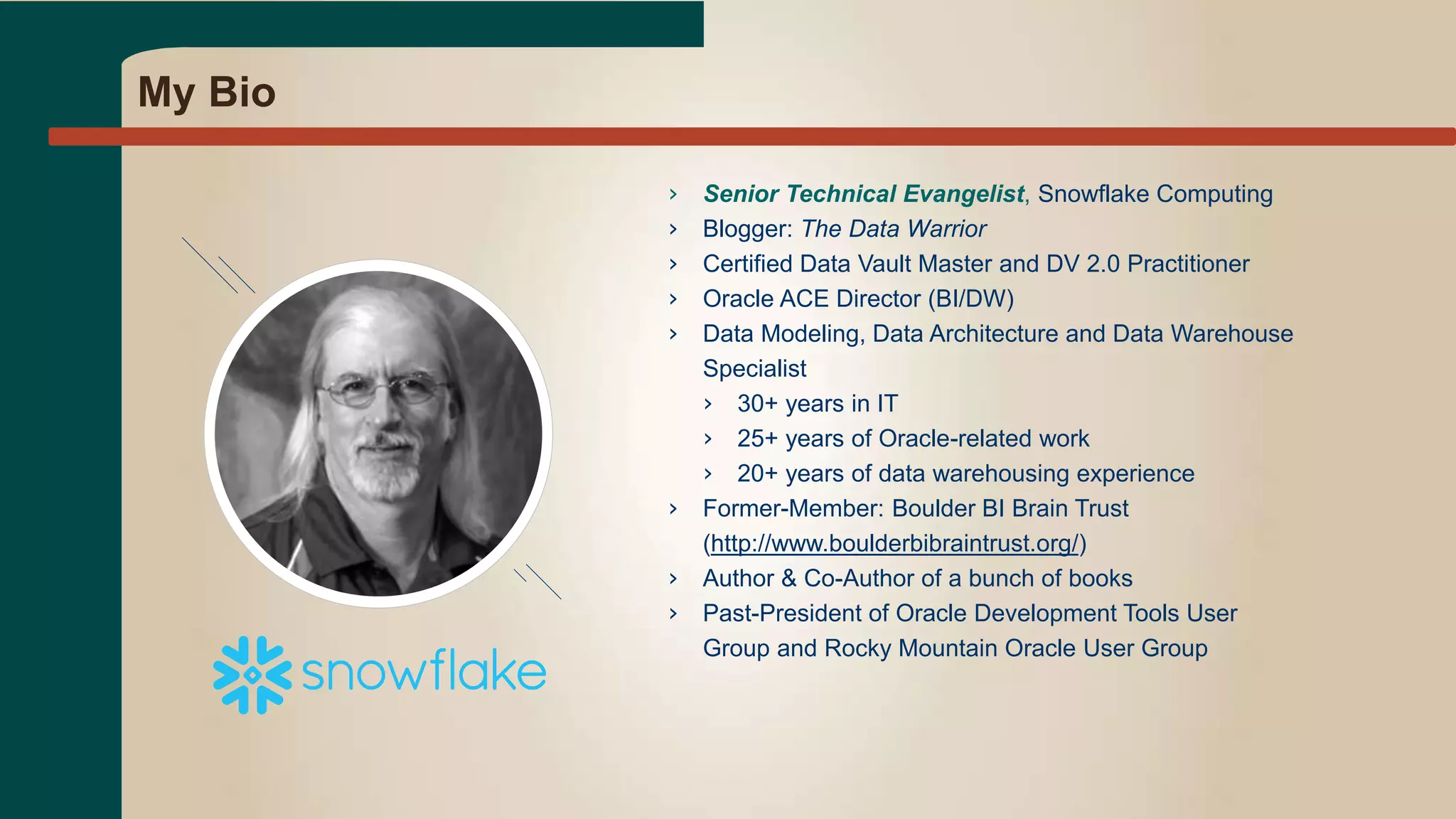
My Bio
› Senior Technical Evangelist, Snowflake Computing
› Blogger: The Data Warrior
› Certified Data Vault Master and DV 2.0 Practitioner
› Oracle ACE Director (BI/DW)
› Data Modeling, Data Architecture and Data Warehouse
Specialist
› 30+ years in IT
› 25+ years of Oracle-related work
› 20+ years of data warehousing experience
› Former-Member: Boulder BI Brain Trust
(http://www.boulderbibraintrust.org/)
› Author & Co-Author of a bunch of books
› Past-President of Oracle Development Tools User
Group and Rocky Mountain Oracle User Group
Why Agile & DW?
 Perceptions
● DW too slow to produce results
● DW projects “fail”
● DW projects fail to adapt to business changes
 Goal
● Change perceptions
● Deliver value
● Be more adaptable and flexible
© Data Warrior LLC
Objectives
 Understand what is meant by “agile”
 Try to apply some agile ideas to data warehouse and business
intelligence efforts
 Answer the question – can we deliver results faster?
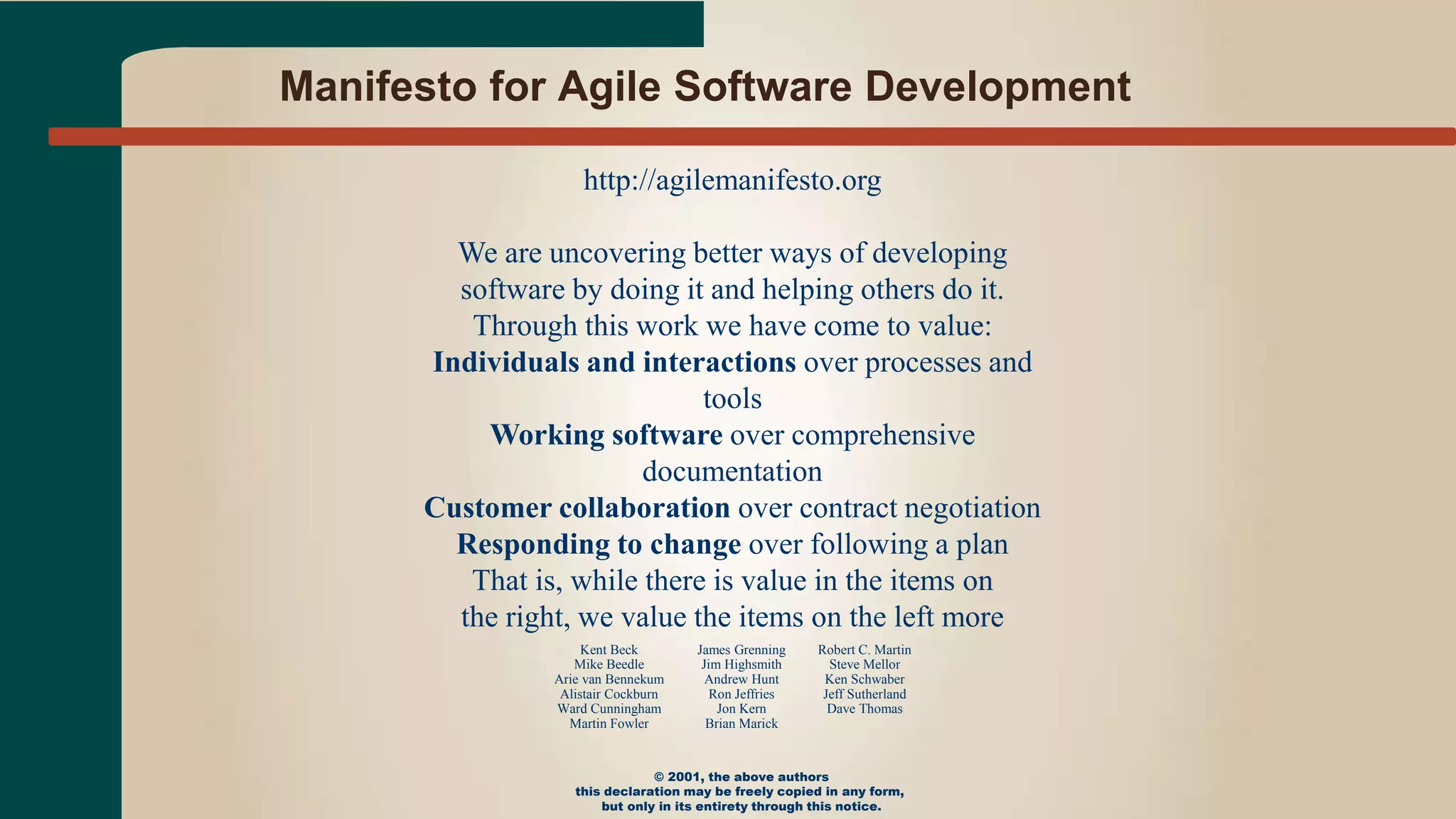
Manifesto for Agile Software Development
http://agilemanifesto.org
We are uncovering better ways of developing
software by doing it and helping others do it.
Through this work we have come to value:
Individuals and interactions over processes and
tools
Working software over comprehensive
documentation
Customer collaboration over contract negotiation
Responding to change over following a plan
That is, while there is value in the items on
the right, we value the items on the left more
Kent Beck
Mike Beedle
Arie van Bennekum
Alistair Cockburn
Ward Cunningham
Martin Fowler
James Grenning
Jim Highsmith
Andrew Hunt
Ron Jeffries
Jon Kern
Brian Marick
Robert C. Martin
Steve Mellor
Ken Schwaber
Jeff Sutherland
Dave Thomas
© 2001, the above authors
this declaration may be freely copied in any form,
but only in its entirety through this notice.
THE PRINCIPLES OF AGILE
Principle #1
 Our highest priority is to satisfy the
customer through early and continuous
delivery of valuable software.
● Who is the customer?
● What is “valuable software” in data
warehousing?
● BI reports
● Dashboard interface
● Working ETL code?
● In the context of the customer!
● Once we start – keep going!
© Data Warrior LLC
Principle #2
 Welcome changing requirements, even
late in development. Agile processes
harness change for the customer's
competitive advantage.
● Must be flexible and adaptable in thinking and
design
● User Stories
● Use code generators
● Agile data engineering techniques
● Flexible and performant data platform
© Data Warrior LLC
Principle #3
 Deliver working software frequently, from
a couple of weeks to a couple of months,
with a preference to the shorter
timescale.
●Need good scope control!
● Prioritized Backlog
●One subject area at a time
● What is a subject area?
●Think Data Vault
© Data Warrior LLC
Principle #4
 Business people and developers
must work together daily throughout
the project.
● DW MUST have the business involved
● One of the Top 10 reasons for failure
● This applies for BI reports
● Daily interaction would be great!
● But – politics and priorities may interfere!
● At HP GBI/EDW – we used “war” room
● At MSH – daily standups with Biz
© Data Warrior LLC
Principle #5
 Build projects around motivated
individuals. Give them the environment
and support they need, and trust them to
get the job done.
● Need people who WANT to be on the project
● Lose the dead weight
● Get training if needed
● Keep units of work small to create an
atmosphere of success
● Don’t try a Big Bang EDW
© Data Warrior LLC
Principle #6
 The most efficient and effective method of
conveying information to and within a
development team is face-to-face
conversation.
● Daily team huddles
● Co-located work space
● While face-to-face is efficient, still need some
documentation (or meta-data) for later
● Use a tool like JIRA, VersionOne, Rally, LeanKit
© Data Warrior LLC
Principle #7
 Working software is the primary measure
of progress.
●Applied to DW:
● What is “working software?”
● BI reports?
● Tables definitions and working ETL
code?
●Think more broadly – it is not just a data
entry screen
© Data Warrior LLC
Principle #8
 Agile processes promote sustainable development. The
sponsors, developers, and users should be able to
maintain a constant pace indefinitely.
● DW Programs last a long time – don’t burn the team
out with unreasonable deadlines
● See P#5 – Motivated individuals
● Good planning and scope control
● No all nighters!
● Smallest valuable unit of work possible (MVP)
● Keep it moving like a production line
● Pick (or develop) a standard, repeatable
methodology
● Study the Agile methods and adopt what works for your team
● Data Vault Modeling Methodology
© Data Warrior LLC
Principle #9
 Continuous attention to technical
excellence and good design enhances
agility.
● Bad design + bad architecture = trouble
● Symptom: can’t build a requested data mart
● Frequent design reviews a must
● Improves team skills – provides cross training
● Over time – better designs, shorter review cycles
● Faster delivery
© Data Warrior LLC
Principle #10
 Simplicity--the art of maximizing the
amount of work not done--is essential.
● KISS – Keep it Simple Stupid
● Write less code by hand
● Use code generators! (No syntax errors – ever)
● Oracle SDDM, ERWin, Vertabelo
● Oracle Data Integrator, SSIS
● AnalytxDS, WhereScape RED
● Modifications are easier – just regenerate the code
● Virtualize initial reporting layers
● Agile DevOps!
© Data Warrior LLC
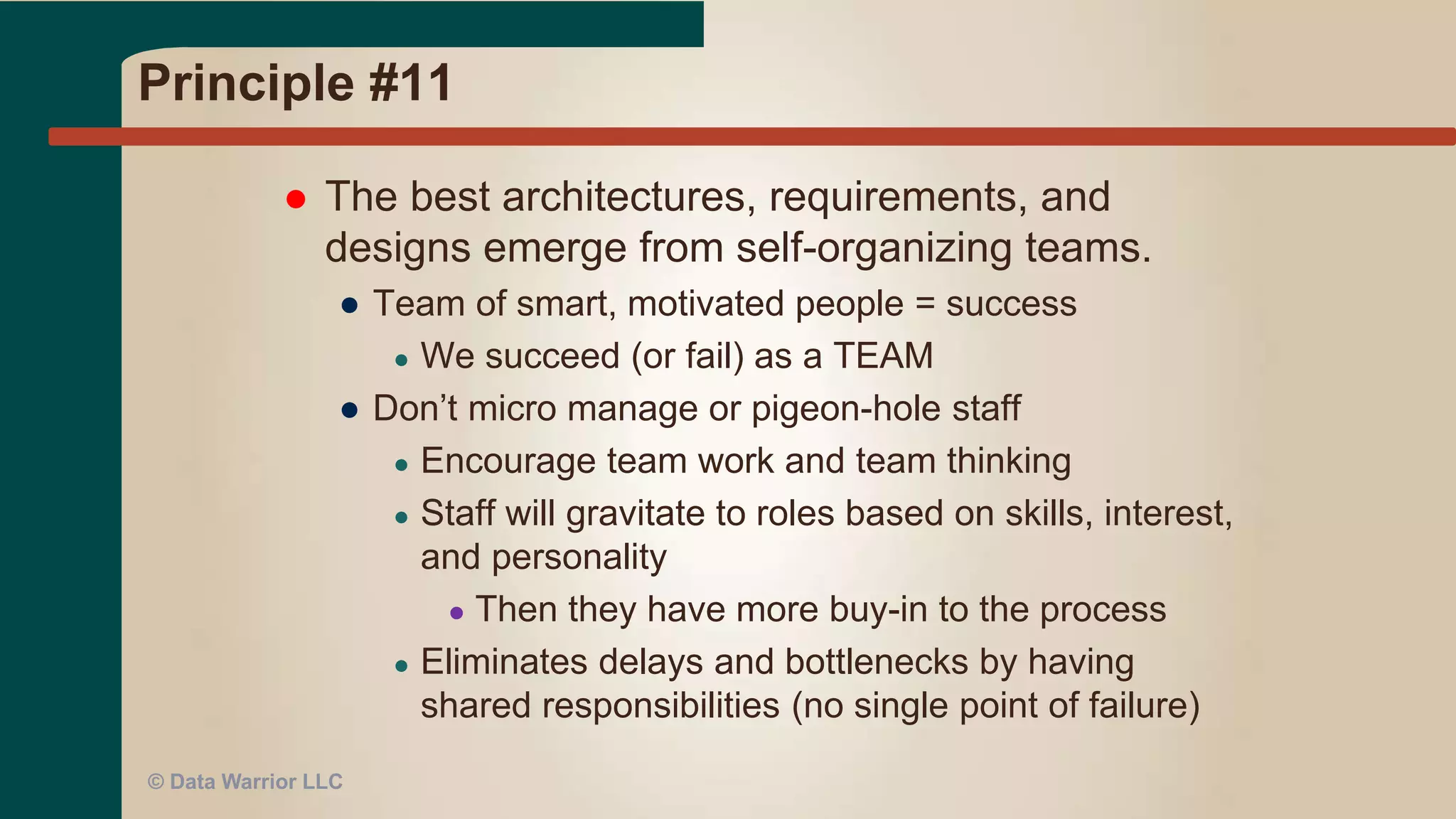
Principle #11
 The best architectures, requirements, and
designs emerge from self-organizing teams.
● Team of smart, motivated people = success
● We succeed (or fail) as a TEAM
● Don’t micro manage or pigeon-hole staff
● Encourage team work and team thinking
● Staff will gravitate to roles based on skills, interest,
and personality
● Then they have more buy-in to the process
● Eliminates delays and bottlenecks by having
shared responsibilities (no single point of failure)
© Data Warrior LLC
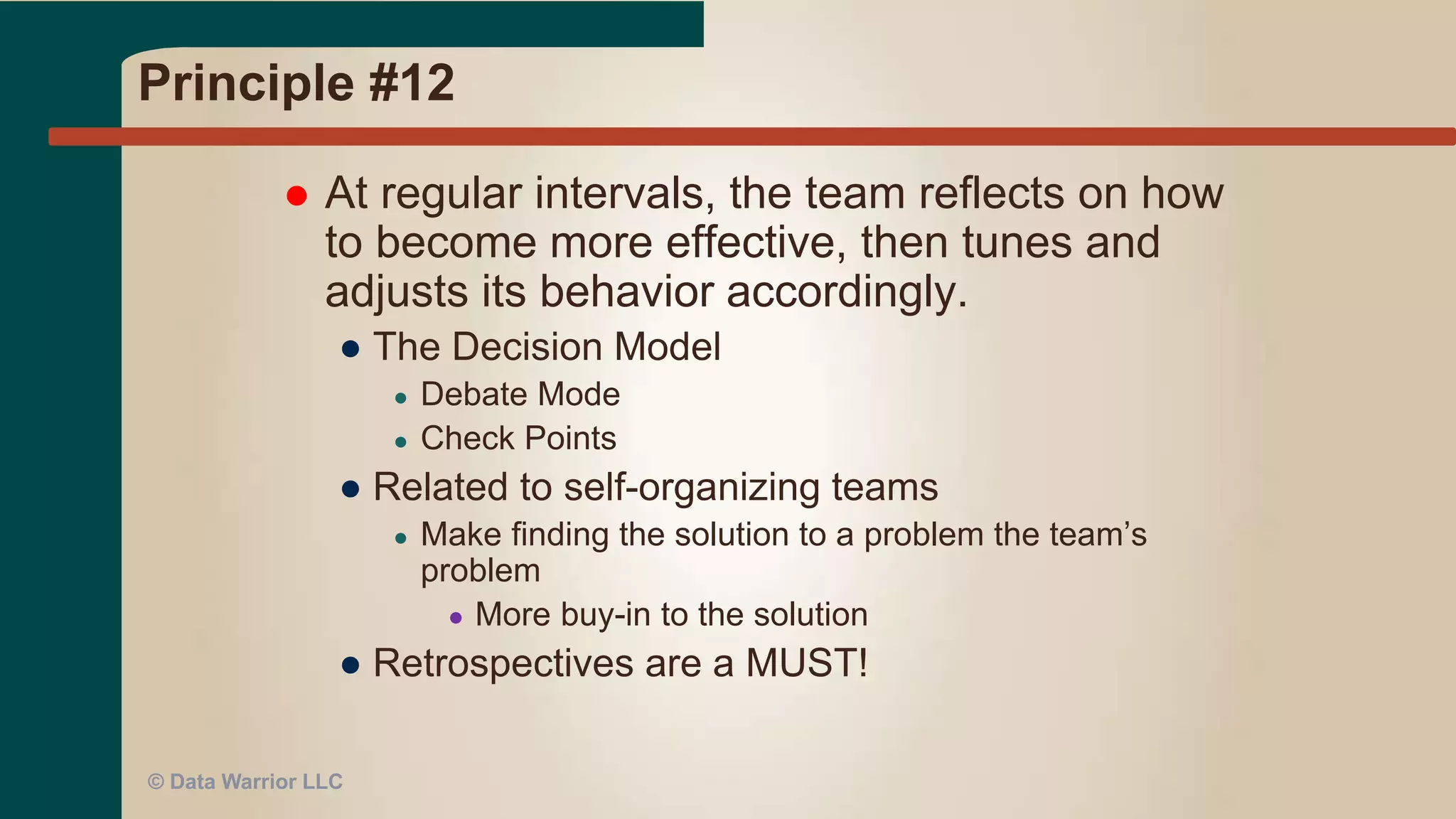
Principle #12
 At regular intervals, the team reflects on how
to become more effective, then tunes and
adjusts its behavior accordingly.
● The Decision Model
● Debate Mode
● Check Points
● Related to self-organizing teams
● Make finding the solution to a problem the team’s
problem
● More buy-in to the solution
● Retrospectives are a MUST!
© Data Warrior LLC
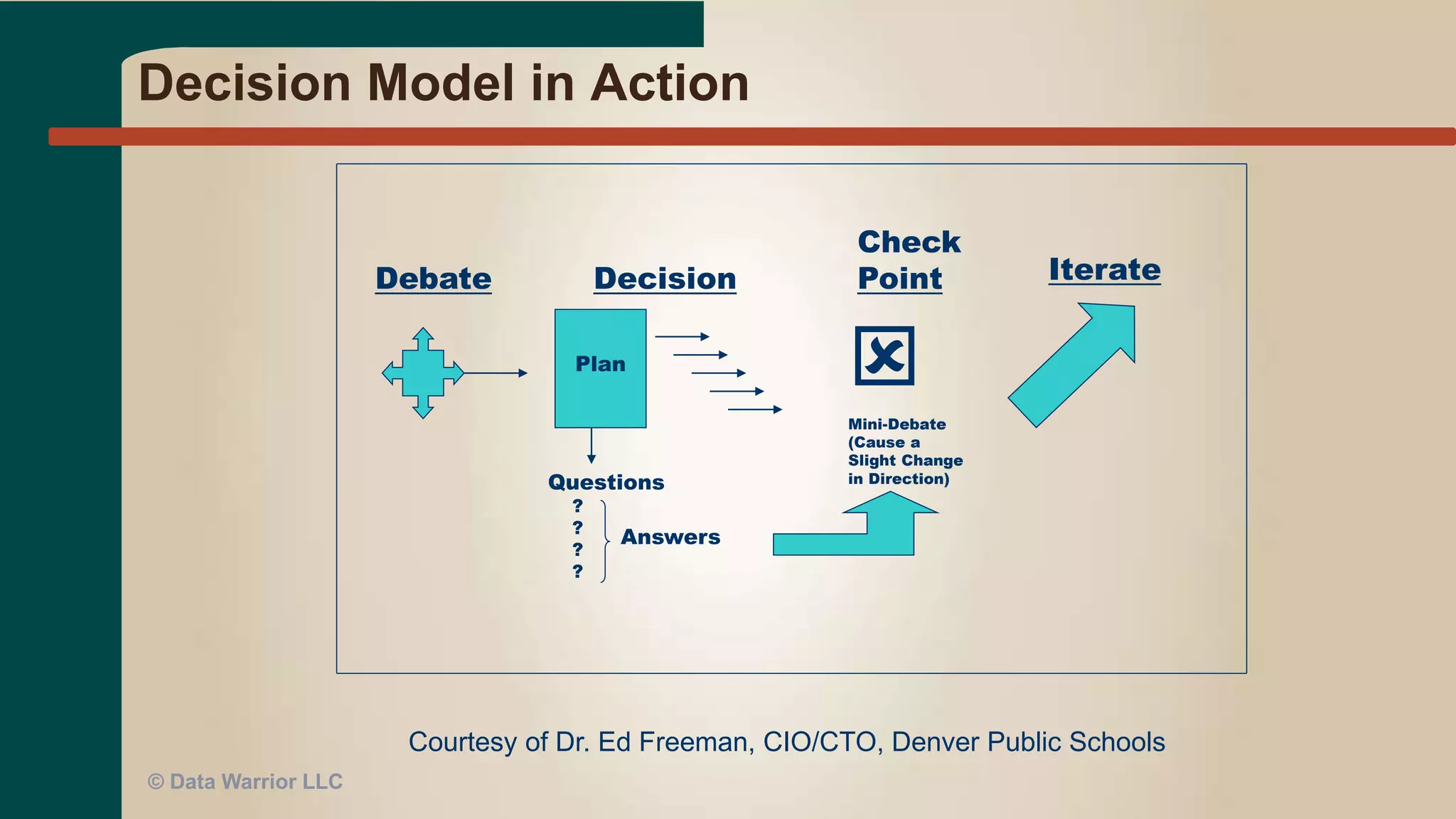
Decision Model in Action
Plan
Debate Decision

Check
Point
Questions
?
?
?
?
Answers
Mini-Debate
(Cause a
Slight Change
in Direction)
Iterate
Courtesy of Dr. Ed Freeman, CIO/CTO, Denver Public Schools
© Data Warrior LLC
USING AGILE CONCEPTS
Agile Concepts for DW
 Team Huddles (Morning Scrum)
 Extreme Programming
 Pair Programming
© Data Warrior LLC
Team Huddles
 Daily Standup Meeting
● AKA Scum
● Morning Roll Call (FDD)
 Short meeting (< 15 minutes)
● Every morning, mandatory attendance
● Review assignments, accomplishments, backlogs,
blockers
● 3 Questions
 Immediate feedback and assistance
● Keeps team motivated and on track (P #5)
● Identifies constraints and bottlenecks early in the process
● Eliminates backlogs more quickly via re-assignments
 Improves team work
 Supports self-organizing teams (P #11)
© Data Warrior LLC
Extreme Programming (XP)
 Programmer works directly with the end user
● At MSH used conference room or devloper’s cube
● At HP used Virtual Classroom or NetMeeting
● At DFA used WebEx
 In DW:
● Best with developing BI reports
● DW or data mart must already be populated
© Data Warrior LLC
Extreme Programming (XP)
 Reports developed using BI tool
● With the user in the room (or virtual)
● With constant user reviews and input using a web
reporting tool (via email even!)
 Also applies to developing a dashboard or portal
interface
 Works for ETL as well!
● Used war room with business to get near instant
validation of ETL changes
© Data Warrior LLC
Pair/Mob Programming
 Part of XP
 Programmers work side-by-side
● One terminal
● One codes, the other reviews
● Two terminals, one cube
● One programming, one documenting
● Could also be done virtually!
 In DW:
● Writing ETL Code
● Pair data modeling
● Report Development
© Data Warrior LLC
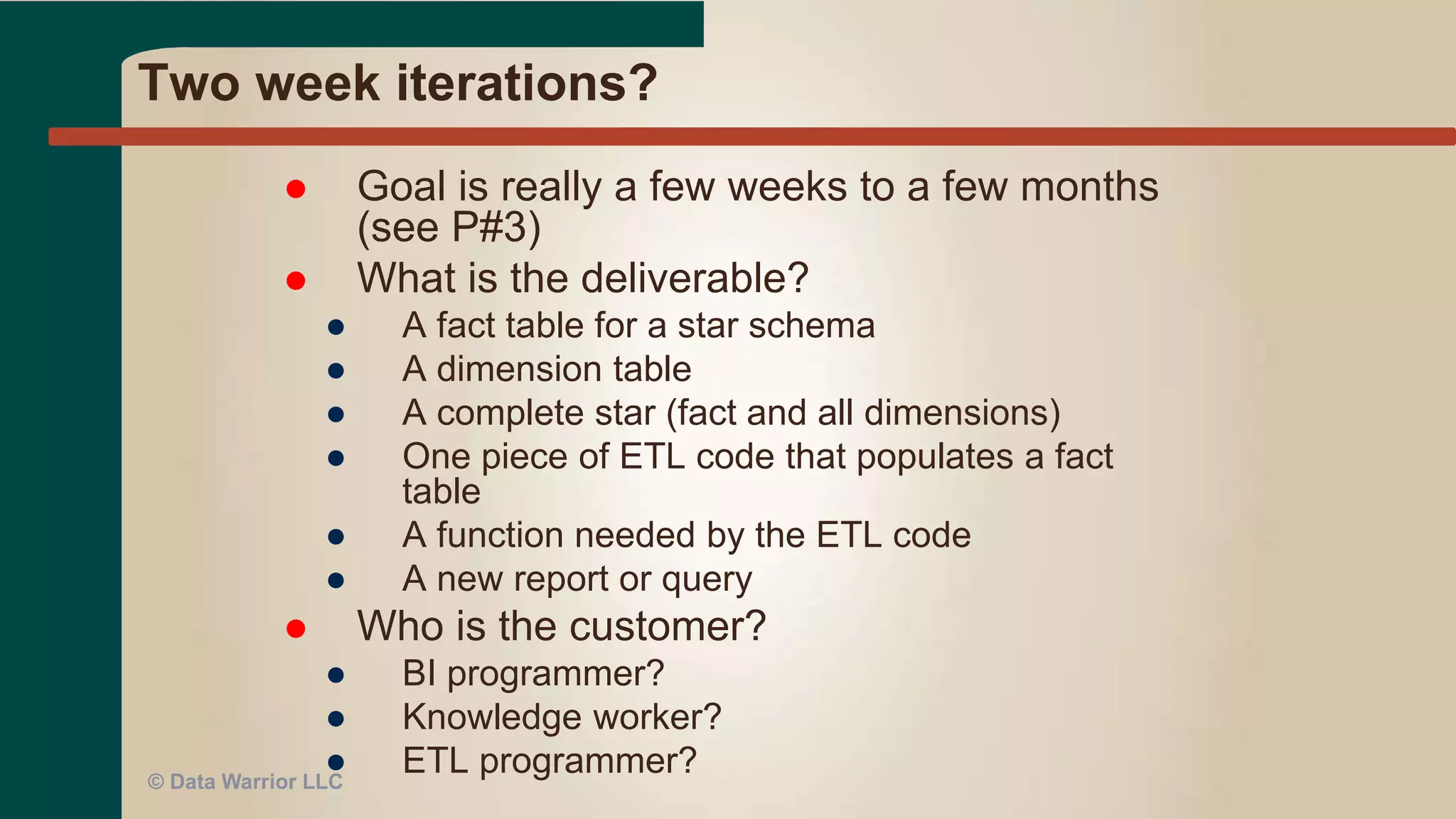
Two week iterations?
 Goal is really a few weeks to a few months
(see P#3)
 What is the deliverable?
● A fact table for a star schema
● A dimension table
● A complete star (fact and all dimensions)
● One piece of ETL code that populates a fact
table
● A function needed by the ETL code
● A new report or query
 Who is the customer?
● BI programmer?
● Knowledge worker?
● ETL programmer?© Data Warrior LLC
REAL WORLD METRICS
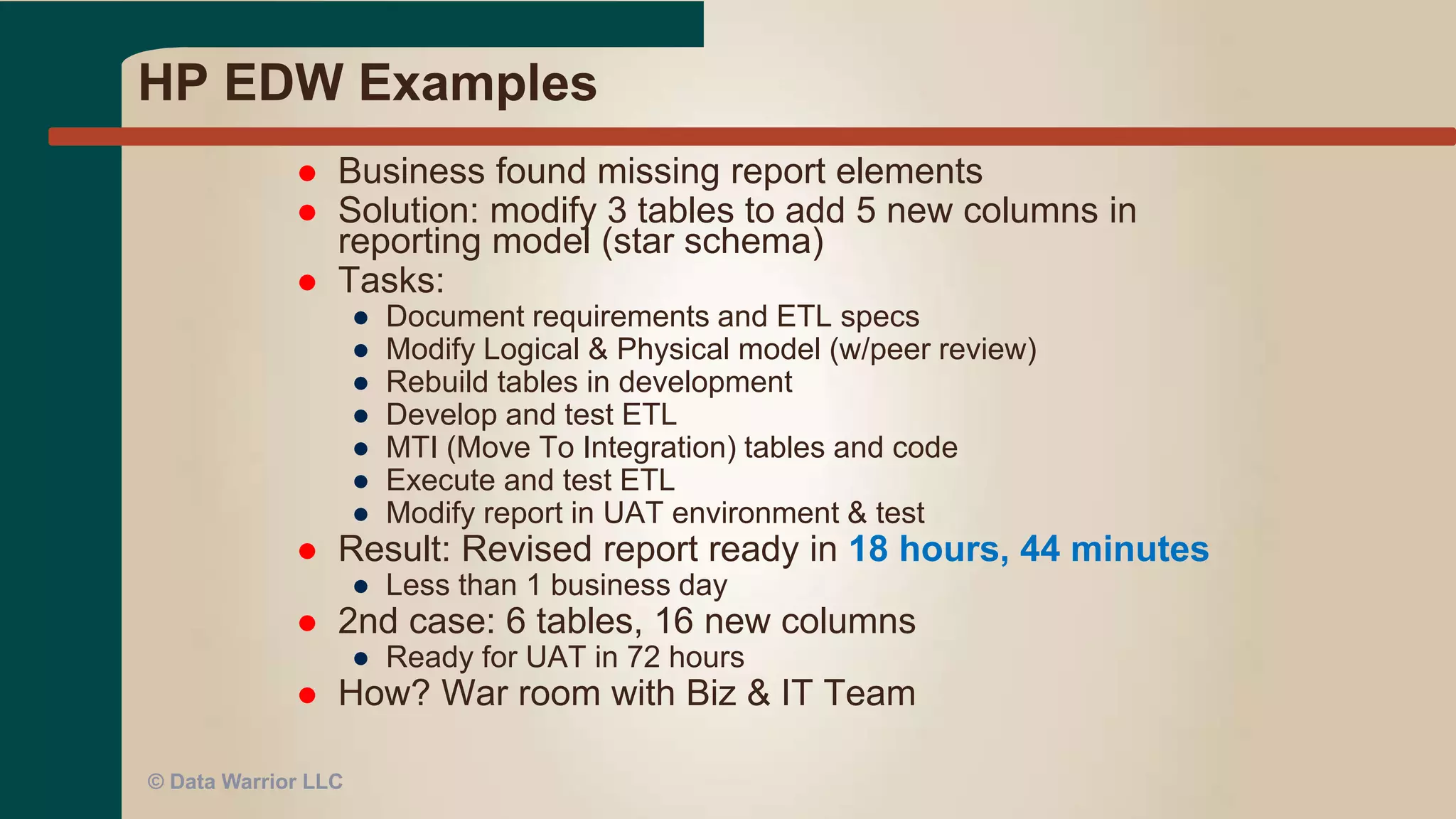
HP EDW Examples
 Business found missing report elements
 Solution: modify 3 tables to add 5 new columns in
reporting model (star schema)
 Tasks:
● Document requirements and ETL specs
● Modify Logical & Physical model (w/peer review)
● Rebuild tables in development
● Develop and test ETL
● MTI (Move To Integration) tables and code
● Execute and test ETL
● Modify report in UAT environment & test
 Result: Revised report ready in 18 hours, 44 minutes
● Less than 1 business day
 2nd case: 6 tables, 16 new columns
● Ready for UAT in 72 hours
 How? War room with Biz & IT Team
© Data Warrior LLC
BECOMING AGILE
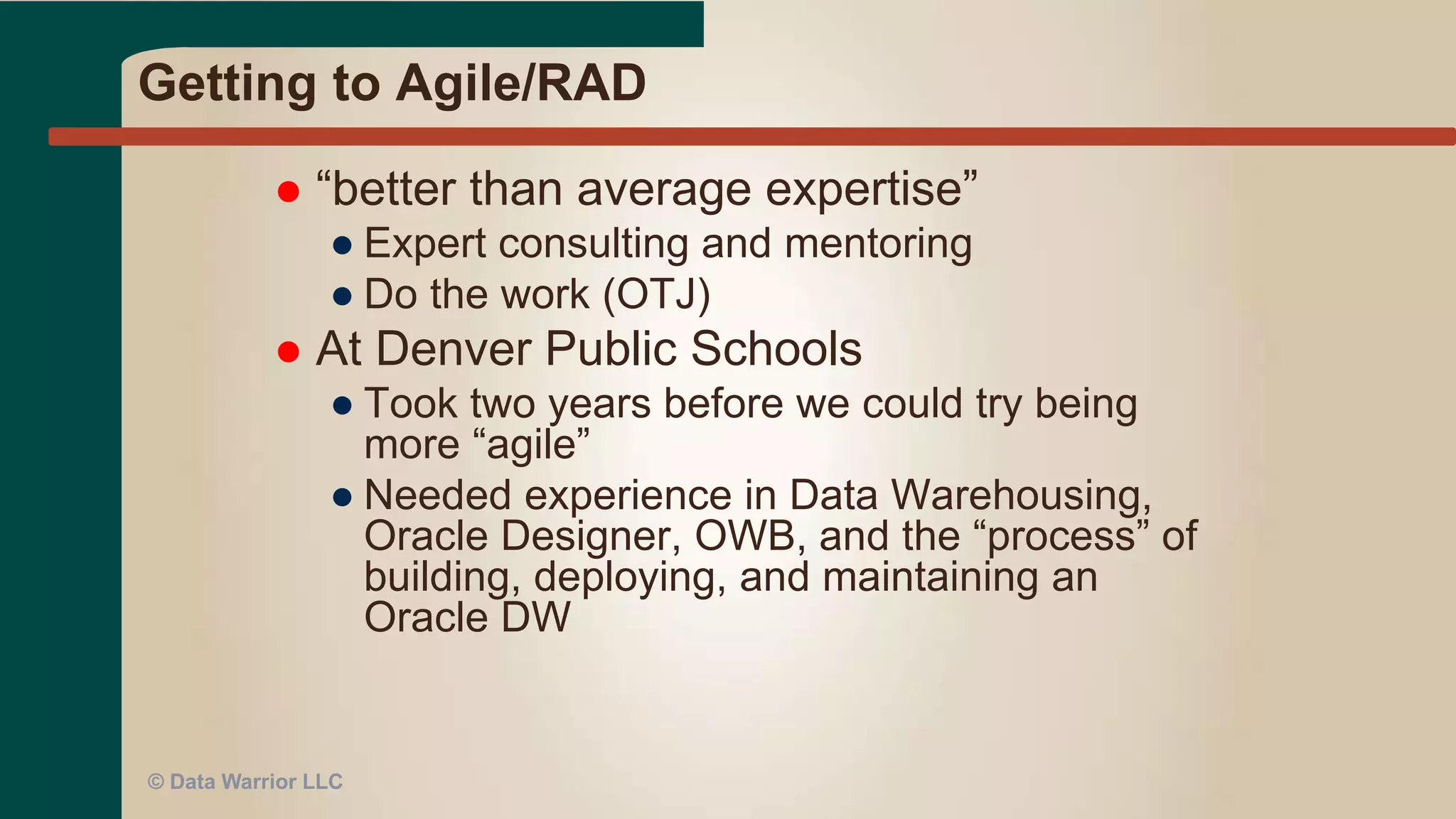
Getting to Agile/RAD
 “better than average expertise”
● Expert consulting and mentoring
● Do the work (OTJ)
 At Denver Public Schools
● Took two years before we could try being
more “agile”
● Needed experience in Data Warehousing,
Oracle Designer, OWB, and the “process” of
building, deploying, and maintaining an
Oracle DW
© Data Warrior LLC
Getting to Agile/RAD
 At HP GBI/EDW it took about a year
● Needed the right team and the right
management support
● Also the right project with willing business
users
 At McKesson over a year setting
standards and training staff
● Built templates in JIRA for repeatable tasks
● Then 3 week sprints
 At DFA – Day 1!
● Experienced team with agile BI/DW coach
● Used modified KanBan
© Data Warrior LLC
Getting to Agile
 Cannot instantly become “agile”
 Must develop and agile mindset & culture
 Implement agile tools, processes, and methods
 Get an Agile Coach if necessary
● Specfically an agile BI/DW or Data Coach
© Data Warrior LLC
AGILE DEVOPS
“the art of maximizing the amount of work not done”
 Remember Principle #10!
 Need a dev setup that let’s you be agile
● Painless & fast setup and configuration
● Easy to add more space and compute on demand
● Minimal resource contention
● Automated query optimization
● Easy cloning of data sets
 Automated Regression Testing!
● DBFit, iCEDQ, AnalytixDS, WhereScape
● Roll your own – basic SQL scripts
© Data Warrior LLC
AGILE DATA MODELING
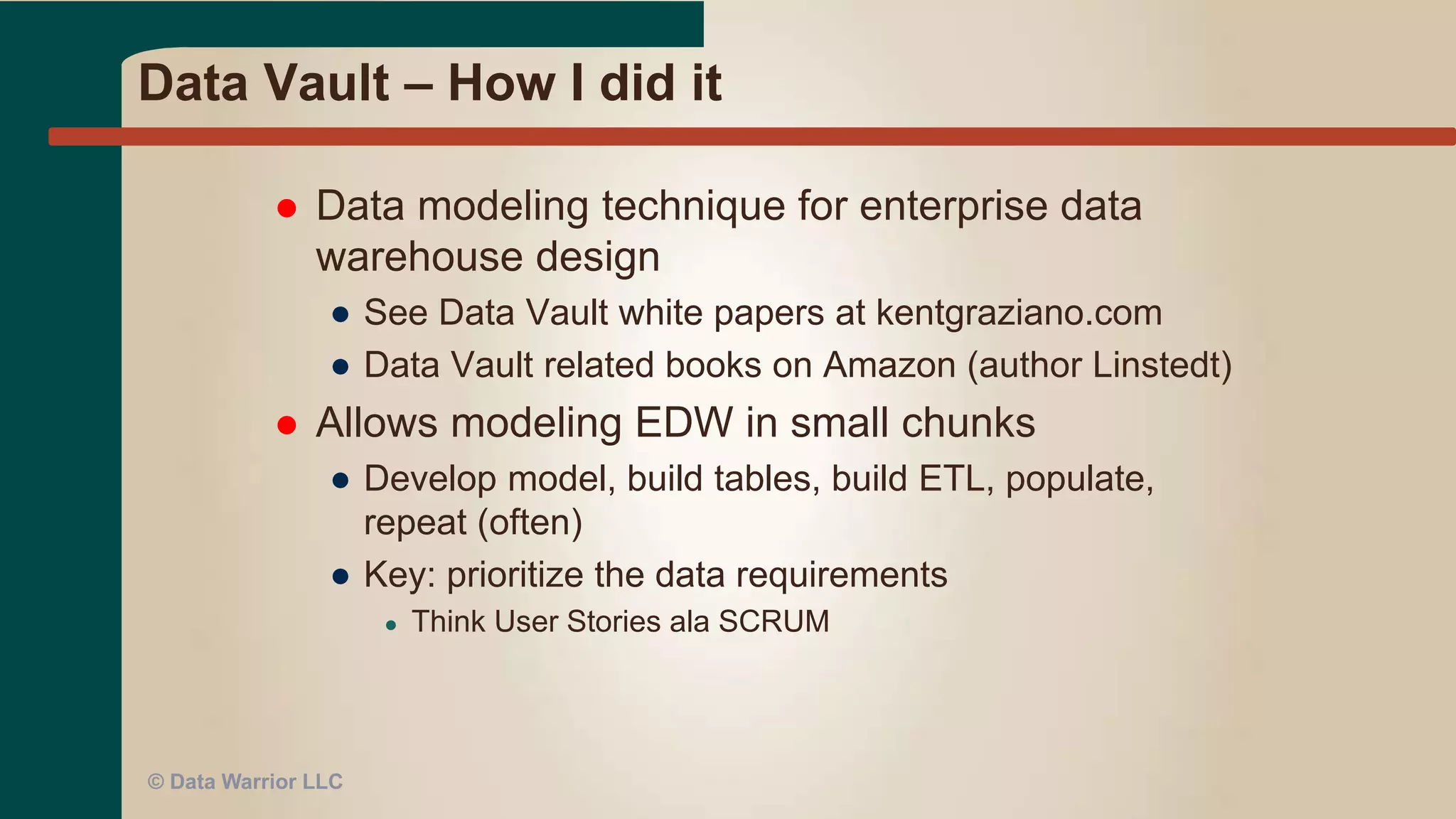
Data Vault – How I did it
 Data modeling technique for enterprise data
warehouse design
● See Data Vault white papers at kentgraziano.com
● Data Vault related books on Amazon (author Linstedt)
 Allows modeling EDW in small chunks
● Develop model, build tables, build ETL, populate,
repeat (often)
● Key: prioritize the data requirements
● Think User Stories and Backlog ala SCRUM
© Data Warrior LLC
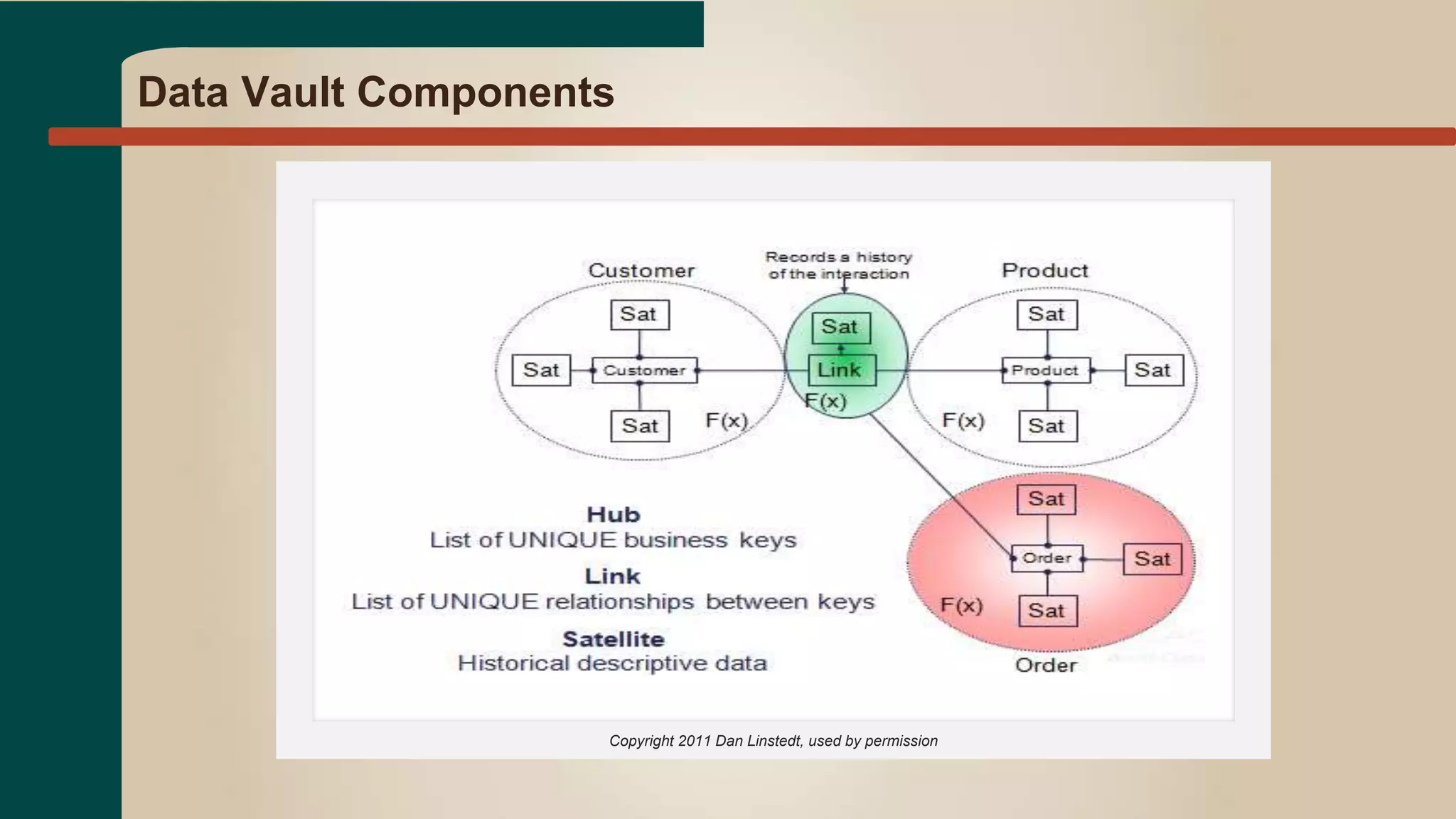
Data Vault Components
Copyright 2011 Dan Linstedt, used by permission
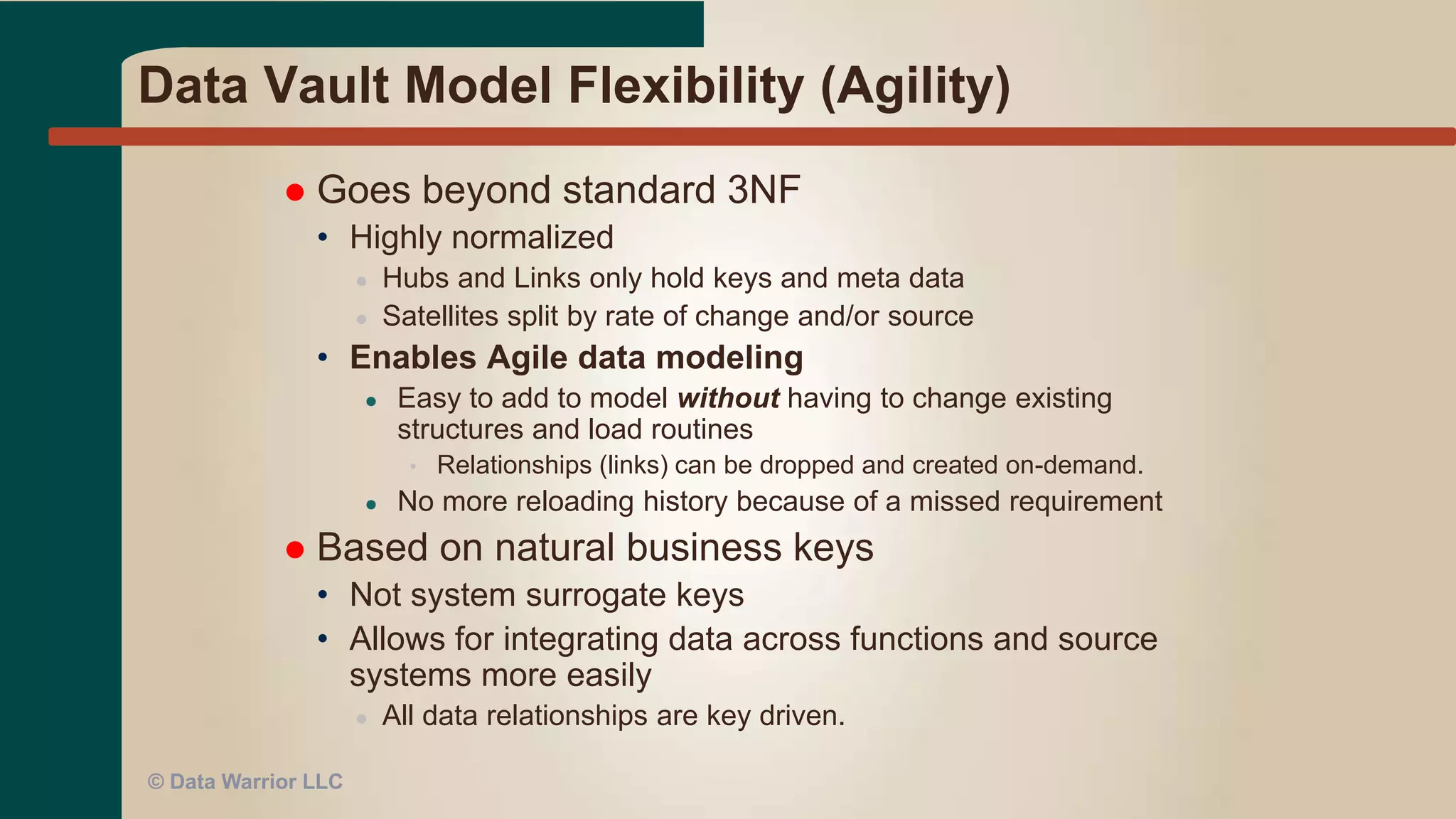
Data Vault Model Flexibility (Agility)
 Goes beyond standard 3NF
• Highly normalized
● Hubs and Links only hold keys and meta data
● Satellites split by rate of change and/or source
• Enables Agile data modeling
● Easy to add to model without having to change existing
structures and load routines
• Relationships (links) can be dropped and created on-demand.
● No more reloading history because of a missed requirement
 Based on natural business keys
• Not system surrogate keys
• Allows for integrating data across functions and source
systems more easily
● All data relationships are key driven.
© Data Warrior LLC
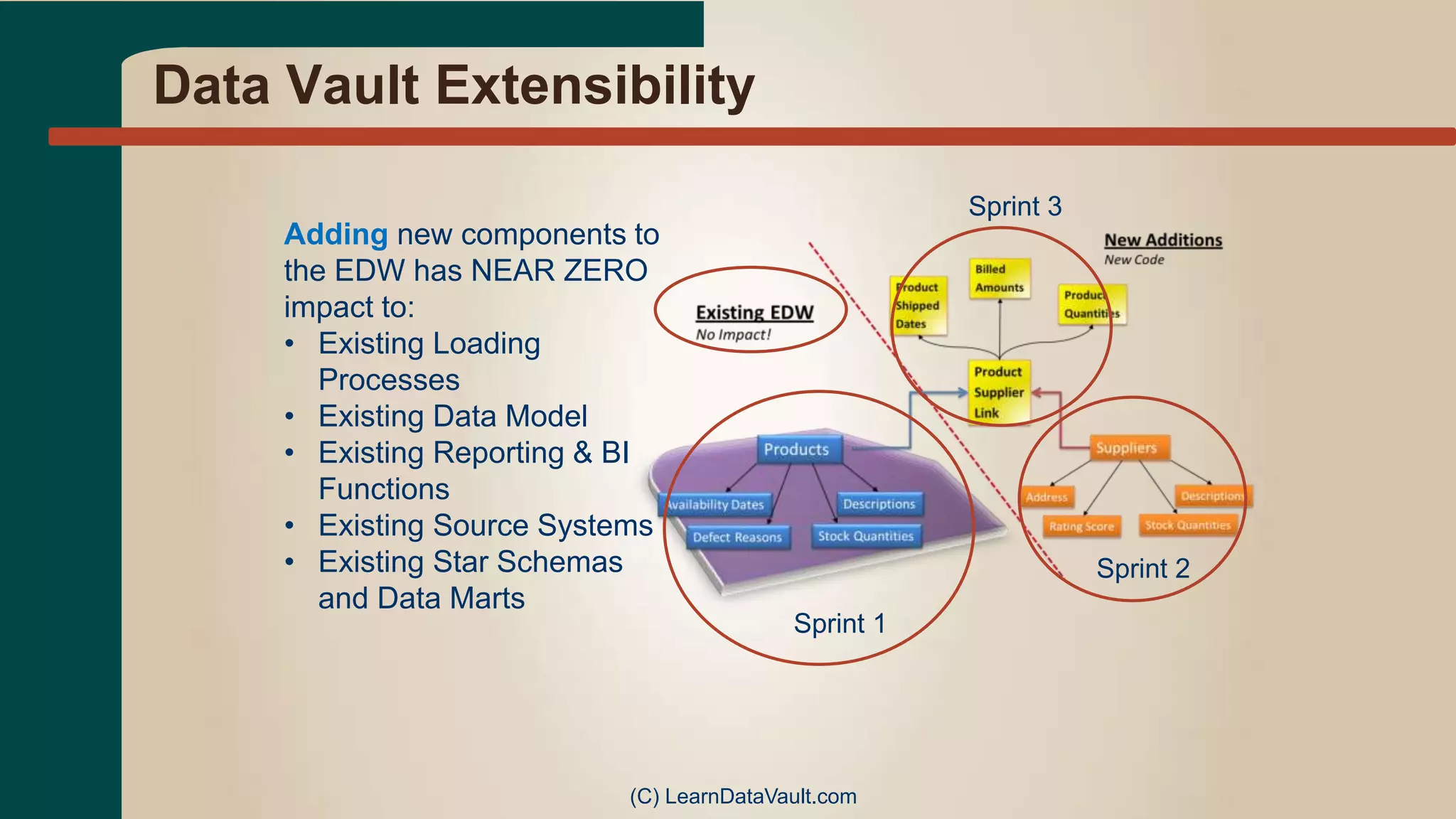
Data Vault Extensibility
Adding new components to
the EDW has NEAR ZERO
impact to:
• Existing Loading
Processes
• Existing Data Model
• Existing Reporting & BI
Functions
• Existing Source Systems
• Existing Star Schemas
and Data Marts
(C) LearnDataVault.com
Sprint 1
Sprint 2
Sprint 3
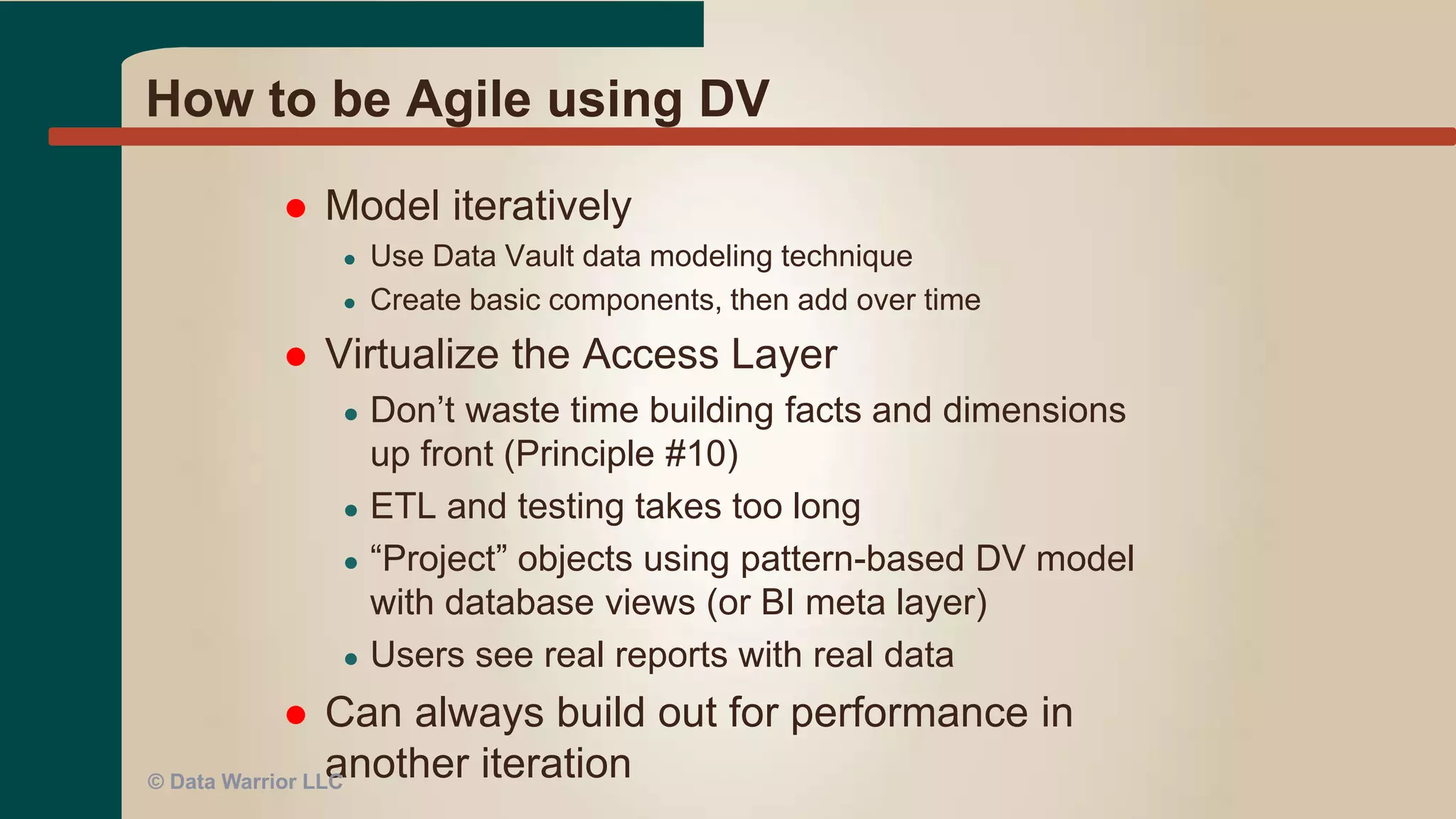
How to be Agile using DV
 Model iteratively
● Use Data Vault data modeling technique
● Create basic components, then add over time
 Virtualize the Access Layer
● Don’t waste time building facts and dimensions
up front (Principle #10)
● ETL and testing takes too long
● “Project” objects using pattern-based DV model
with database views (or BI meta layer)
● Users see real reports with real data
 Can always build out for performance in
another iteration
© Data Warrior LLC
SHAMELESS PLUG: My Intro Book
Available on
Amazon.com
http://www.amazon.com/Better-
Data-Modeling-Introduction-
Engineering-
ebook/dp/B018BREV1C/
New DV 2.0 Book
› Available on Amazon:
http://www.amazon.com/Building-
Scalable-Data-Warehouse-
Vault/dp/0128025107/
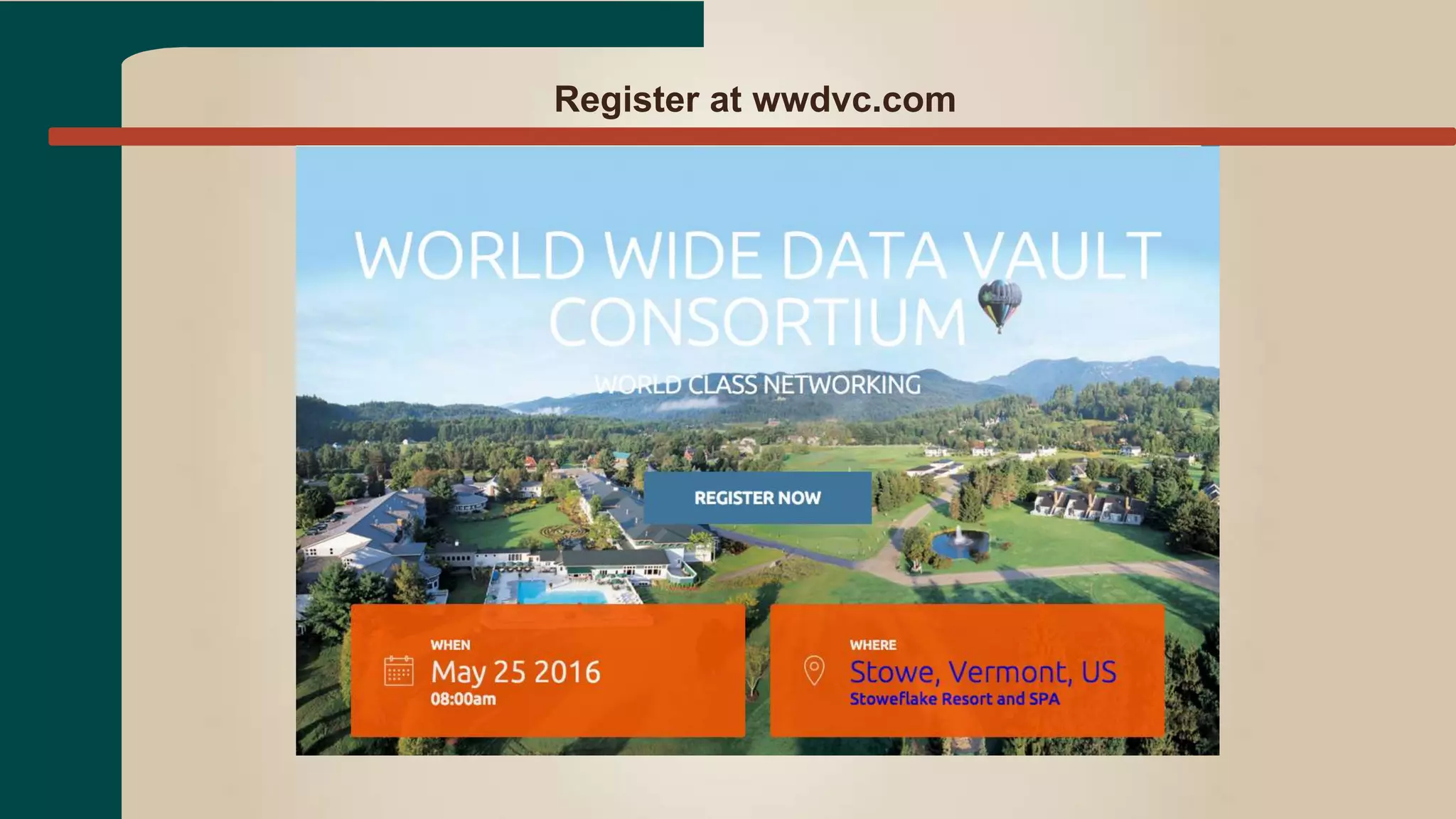
Register at wwdvc.com
Other References
 Agile Management for Software Engineering:
Applying the Theory of Constraints for Business
Results by David J. Anderson
 CASE Method Fast-track: A RAD Approach by
Richard Barker & Dai Clegg
 The Goal by Eliyahu M. Goldratt
 The Business of Data Vault Modeling by Dan
Linstedt, Kent Graziano, & Hans Hultgren
 Super Charge Your Data Warehouse by Dan
Linstedt
 Test Automation by Lynn Winterboer
http://www.slideshare.net/AgileDenver/lynn-
winterboer-test-automation
© Data Warrior LLC
Conclusion
 Agile concepts can be applied to data
warehouse and BI projects
● Not a purist definition!
● Try to apply the principles – be creative
 Suggested approaches
● Data Vault 2.0!
● Use Snowflake Elastic DW!
● Use team huddles
● Use pair programming to increase quality and cross
training
● Use code generators
● Read about Agile Methods
● Read Oracle CASE Method Fast-Track
 Be flexible and give it a try
© Data Warrior LLC
QUESTIONS?
DISCUSSION?
CONTACT
INFORMATION
KENT GRAZIANO
Snowflake Computing
Snowflake.net
kent.graziano@snowflake.net
@KentGraziano
http://kentgraziano.com

Agile Methods and Data Warehousing (2016 update)

  • 1.
    KENT GRAZIANO @KentGraziano |kentgraziano.com AGILE METHODS AND DATA WAREHOUSING: HOW TO DELIVER FASTER
  • 2.
    Agenda  My Bio Why Agile & DW  Agile Manifesto  12 Agile Principles  Agile Concepts  Two week iterations?  Becoming Agile  Agile DevOps  Agile Data Modeling  Conclusion © Data Warrior LLC
  • 3.
    My Bio › SeniorTechnical Evangelist, Snowflake Computing › Blogger: The Data Warrior › Certified Data Vault Master and DV 2.0 Practitioner › Oracle ACE Director (BI/DW) › Data Modeling, Data Architecture and Data Warehouse Specialist › 30+ years in IT › 25+ years of Oracle-related work › 20+ years of data warehousing experience › Former-Member: Boulder BI Brain Trust (http://www.boulderbibraintrust.org/) › Author & Co-Author of a bunch of books › Past-President of Oracle Development Tools User Group and Rocky Mountain Oracle User Group
  • 4.
    Why Agile &DW?  Perceptions ● DW too slow to produce results ● DW projects “fail” ● DW projects fail to adapt to business changes  Goal ● Change perceptions ● Deliver value ● Be more adaptable and flexible © Data Warrior LLC
  • 5.
    Objectives  Understand whatis meant by “agile”  Try to apply some agile ideas to data warehouse and business intelligence efforts  Answer the question – can we deliver results faster?
  • 6.
    Manifesto for AgileSoftware Development http://agilemanifesto.org We are uncovering better ways of developing software by doing it and helping others do it. Through this work we have come to value: Individuals and interactions over processes and tools Working software over comprehensive documentation Customer collaboration over contract negotiation Responding to change over following a plan That is, while there is value in the items on the right, we value the items on the left more Kent Beck Mike Beedle Arie van Bennekum Alistair Cockburn Ward Cunningham Martin Fowler James Grenning Jim Highsmith Andrew Hunt Ron Jeffries Jon Kern Brian Marick Robert C. Martin Steve Mellor Ken Schwaber Jeff Sutherland Dave Thomas © 2001, the above authors this declaration may be freely copied in any form, but only in its entirety through this notice.
  • 7.
  • 8.
    Principle #1  Ourhighest priority is to satisfy the customer through early and continuous delivery of valuable software. ● Who is the customer? ● What is “valuable software” in data warehousing? ● BI reports ● Dashboard interface ● Working ETL code? ● In the context of the customer! ● Once we start – keep going! © Data Warrior LLC
  • 9.
    Principle #2  Welcomechanging requirements, even late in development. Agile processes harness change for the customer's competitive advantage. ● Must be flexible and adaptable in thinking and design ● User Stories ● Use code generators ● Agile data engineering techniques ● Flexible and performant data platform © Data Warrior LLC
  • 10.
    Principle #3  Deliverworking software frequently, from a couple of weeks to a couple of months, with a preference to the shorter timescale. ●Need good scope control! ● Prioritized Backlog ●One subject area at a time ● What is a subject area? ●Think Data Vault © Data Warrior LLC
  • 11.
    Principle #4  Businesspeople and developers must work together daily throughout the project. ● DW MUST have the business involved ● One of the Top 10 reasons for failure ● This applies for BI reports ● Daily interaction would be great! ● But – politics and priorities may interfere! ● At HP GBI/EDW – we used “war” room ● At MSH – daily standups with Biz © Data Warrior LLC
  • 12.
    Principle #5  Buildprojects around motivated individuals. Give them the environment and support they need, and trust them to get the job done. ● Need people who WANT to be on the project ● Lose the dead weight ● Get training if needed ● Keep units of work small to create an atmosphere of success ● Don’t try a Big Bang EDW © Data Warrior LLC
  • 13.
    Principle #6  Themost efficient and effective method of conveying information to and within a development team is face-to-face conversation. ● Daily team huddles ● Co-located work space ● While face-to-face is efficient, still need some documentation (or meta-data) for later ● Use a tool like JIRA, VersionOne, Rally, LeanKit © Data Warrior LLC
  • 14.
    Principle #7  Workingsoftware is the primary measure of progress. ●Applied to DW: ● What is “working software?” ● BI reports? ● Tables definitions and working ETL code? ●Think more broadly – it is not just a data entry screen © Data Warrior LLC
  • 15.
    Principle #8  Agileprocesses promote sustainable development. The sponsors, developers, and users should be able to maintain a constant pace indefinitely. ● DW Programs last a long time – don’t burn the team out with unreasonable deadlines ● See P#5 – Motivated individuals ● Good planning and scope control ● No all nighters! ● Smallest valuable unit of work possible (MVP) ● Keep it moving like a production line ● Pick (or develop) a standard, repeatable methodology ● Study the Agile methods and adopt what works for your team ● Data Vault Modeling Methodology © Data Warrior LLC
  • 16.
    Principle #9  Continuousattention to technical excellence and good design enhances agility. ● Bad design + bad architecture = trouble ● Symptom: can’t build a requested data mart ● Frequent design reviews a must ● Improves team skills – provides cross training ● Over time – better designs, shorter review cycles ● Faster delivery © Data Warrior LLC
  • 17.
    Principle #10  Simplicity--theart of maximizing the amount of work not done--is essential. ● KISS – Keep it Simple Stupid ● Write less code by hand ● Use code generators! (No syntax errors – ever) ● Oracle SDDM, ERWin, Vertabelo ● Oracle Data Integrator, SSIS ● AnalytxDS, WhereScape RED ● Modifications are easier – just regenerate the code ● Virtualize initial reporting layers ● Agile DevOps! © Data Warrior LLC
  • 18.
    Principle #11  Thebest architectures, requirements, and designs emerge from self-organizing teams. ● Team of smart, motivated people = success ● We succeed (or fail) as a TEAM ● Don’t micro manage or pigeon-hole staff ● Encourage team work and team thinking ● Staff will gravitate to roles based on skills, interest, and personality ● Then they have more buy-in to the process ● Eliminates delays and bottlenecks by having shared responsibilities (no single point of failure) © Data Warrior LLC
  • 19.
    Principle #12  Atregular intervals, the team reflects on how to become more effective, then tunes and adjusts its behavior accordingly. ● The Decision Model ● Debate Mode ● Check Points ● Related to self-organizing teams ● Make finding the solution to a problem the team’s problem ● More buy-in to the solution ● Retrospectives are a MUST! © Data Warrior LLC
  • 20.
    Decision Model inAction Plan Debate Decision  Check Point Questions ? ? ? ? Answers Mini-Debate (Cause a Slight Change in Direction) Iterate Courtesy of Dr. Ed Freeman, CIO/CTO, Denver Public Schools © Data Warrior LLC
  • 21.
  • 22.
    Agile Concepts forDW  Team Huddles (Morning Scrum)  Extreme Programming  Pair Programming © Data Warrior LLC
  • 23.
    Team Huddles  DailyStandup Meeting ● AKA Scum ● Morning Roll Call (FDD)  Short meeting (< 15 minutes) ● Every morning, mandatory attendance ● Review assignments, accomplishments, backlogs, blockers ● 3 Questions  Immediate feedback and assistance ● Keeps team motivated and on track (P #5) ● Identifies constraints and bottlenecks early in the process ● Eliminates backlogs more quickly via re-assignments  Improves team work  Supports self-organizing teams (P #11) © Data Warrior LLC
  • 24.
    Extreme Programming (XP) Programmer works directly with the end user ● At MSH used conference room or devloper’s cube ● At HP used Virtual Classroom or NetMeeting ● At DFA used WebEx  In DW: ● Best with developing BI reports ● DW or data mart must already be populated © Data Warrior LLC
  • 25.
    Extreme Programming (XP) Reports developed using BI tool ● With the user in the room (or virtual) ● With constant user reviews and input using a web reporting tool (via email even!)  Also applies to developing a dashboard or portal interface  Works for ETL as well! ● Used war room with business to get near instant validation of ETL changes © Data Warrior LLC
  • 26.
    Pair/Mob Programming  Partof XP  Programmers work side-by-side ● One terminal ● One codes, the other reviews ● Two terminals, one cube ● One programming, one documenting ● Could also be done virtually!  In DW: ● Writing ETL Code ● Pair data modeling ● Report Development © Data Warrior LLC
  • 27.
    Two week iterations? Goal is really a few weeks to a few months (see P#3)  What is the deliverable? ● A fact table for a star schema ● A dimension table ● A complete star (fact and all dimensions) ● One piece of ETL code that populates a fact table ● A function needed by the ETL code ● A new report or query  Who is the customer? ● BI programmer? ● Knowledge worker? ● ETL programmer?© Data Warrior LLC
  • 28.
  • 29.
    HP EDW Examples Business found missing report elements  Solution: modify 3 tables to add 5 new columns in reporting model (star schema)  Tasks: ● Document requirements and ETL specs ● Modify Logical & Physical model (w/peer review) ● Rebuild tables in development ● Develop and test ETL ● MTI (Move To Integration) tables and code ● Execute and test ETL ● Modify report in UAT environment & test  Result: Revised report ready in 18 hours, 44 minutes ● Less than 1 business day  2nd case: 6 tables, 16 new columns ● Ready for UAT in 72 hours  How? War room with Biz & IT Team © Data Warrior LLC
  • 30.
  • 31.
    Getting to Agile/RAD “better than average expertise” ● Expert consulting and mentoring ● Do the work (OTJ)  At Denver Public Schools ● Took two years before we could try being more “agile” ● Needed experience in Data Warehousing, Oracle Designer, OWB, and the “process” of building, deploying, and maintaining an Oracle DW © Data Warrior LLC
  • 32.
    Getting to Agile/RAD At HP GBI/EDW it took about a year ● Needed the right team and the right management support ● Also the right project with willing business users  At McKesson over a year setting standards and training staff ● Built templates in JIRA for repeatable tasks ● Then 3 week sprints  At DFA – Day 1! ● Experienced team with agile BI/DW coach ● Used modified KanBan © Data Warrior LLC
  • 33.
    Getting to Agile Cannot instantly become “agile”  Must develop and agile mindset & culture  Implement agile tools, processes, and methods  Get an Agile Coach if necessary ● Specfically an agile BI/DW or Data Coach © Data Warrior LLC
  • 34.
  • 35.
    “the art ofmaximizing the amount of work not done”  Remember Principle #10!  Need a dev setup that let’s you be agile ● Painless & fast setup and configuration ● Easy to add more space and compute on demand ● Minimal resource contention ● Automated query optimization ● Easy cloning of data sets  Automated Regression Testing! ● DBFit, iCEDQ, AnalytixDS, WhereScape ● Roll your own – basic SQL scripts © Data Warrior LLC
  • 36.
  • 37.
    Data Vault –How I did it  Data modeling technique for enterprise data warehouse design ● See Data Vault white papers at kentgraziano.com ● Data Vault related books on Amazon (author Linstedt)  Allows modeling EDW in small chunks ● Develop model, build tables, build ETL, populate, repeat (often) ● Key: prioritize the data requirements ● Think User Stories and Backlog ala SCRUM © Data Warrior LLC
  • 38.
    Data Vault Components Copyright2011 Dan Linstedt, used by permission
  • 39.
    Data Vault ModelFlexibility (Agility)  Goes beyond standard 3NF • Highly normalized ● Hubs and Links only hold keys and meta data ● Satellites split by rate of change and/or source • Enables Agile data modeling ● Easy to add to model without having to change existing structures and load routines • Relationships (links) can be dropped and created on-demand. ● No more reloading history because of a missed requirement  Based on natural business keys • Not system surrogate keys • Allows for integrating data across functions and source systems more easily ● All data relationships are key driven. © Data Warrior LLC
  • 40.
    Data Vault Extensibility Addingnew components to the EDW has NEAR ZERO impact to: • Existing Loading Processes • Existing Data Model • Existing Reporting & BI Functions • Existing Source Systems • Existing Star Schemas and Data Marts (C) LearnDataVault.com Sprint 1 Sprint 2 Sprint 3
  • 41.
    How to beAgile using DV  Model iteratively ● Use Data Vault data modeling technique ● Create basic components, then add over time  Virtualize the Access Layer ● Don’t waste time building facts and dimensions up front (Principle #10) ● ETL and testing takes too long ● “Project” objects using pattern-based DV model with database views (or BI meta layer) ● Users see real reports with real data  Can always build out for performance in another iteration © Data Warrior LLC
  • 42.
    SHAMELESS PLUG: MyIntro Book Available on Amazon.com http://www.amazon.com/Better- Data-Modeling-Introduction- Engineering- ebook/dp/B018BREV1C/
  • 43.
    New DV 2.0Book › Available on Amazon: http://www.amazon.com/Building- Scalable-Data-Warehouse- Vault/dp/0128025107/
  • 44.
  • 45.
    Other References  AgileManagement for Software Engineering: Applying the Theory of Constraints for Business Results by David J. Anderson  CASE Method Fast-track: A RAD Approach by Richard Barker & Dai Clegg  The Goal by Eliyahu M. Goldratt  The Business of Data Vault Modeling by Dan Linstedt, Kent Graziano, & Hans Hultgren  Super Charge Your Data Warehouse by Dan Linstedt  Test Automation by Lynn Winterboer http://www.slideshare.net/AgileDenver/lynn- winterboer-test-automation © Data Warrior LLC
  • 46.
    Conclusion  Agile conceptscan be applied to data warehouse and BI projects ● Not a purist definition! ● Try to apply the principles – be creative  Suggested approaches ● Data Vault 2.0! ● Use Snowflake Elastic DW! ● Use team huddles ● Use pair programming to increase quality and cross training ● Use code generators ● Read about Agile Methods ● Read Oracle CASE Method Fast-Track  Be flexible and give it a try © Data Warrior LLC
  • 47.
  • 48.