1
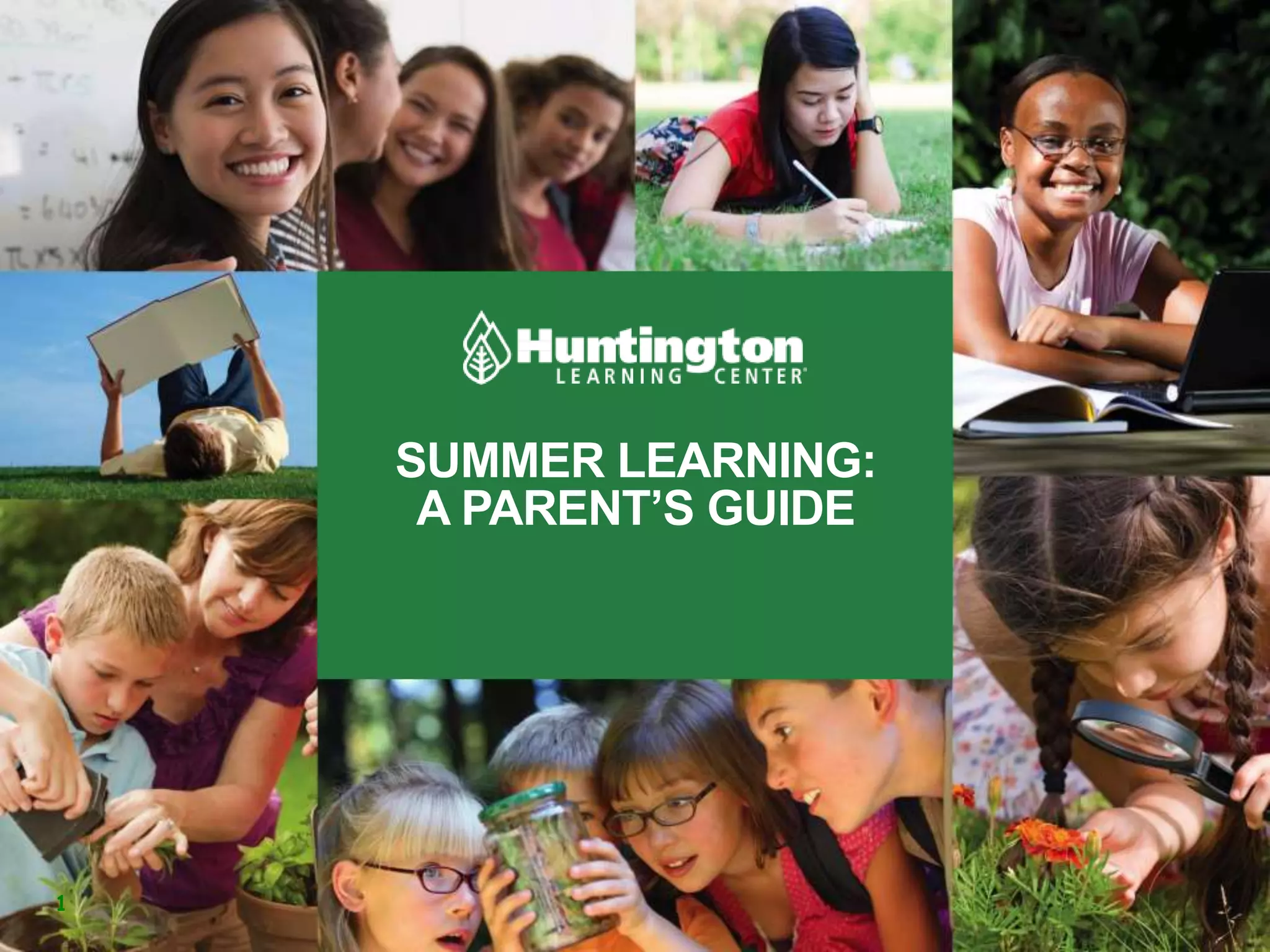
SUMMER LEARNING:
A PARENT’S GUIDE
A practical workshop
offering parents the
advice they need to keep
learning alive while
school is out.
2
Summer Learning:
Keep Learning Alive Over the
Summer!
2
©2017 Huntington Mark, LLC. Independently Owned and Operated. HPT101a
SUMMER LEARNING
What does Summer Break Mean to You?
POSITIVE NEGATIVE
Fewer activities More childcare needs
Less pressure Children get bored
More time spent
outdoors
Children are removed from learning
3
SUMMER LEARNING
4
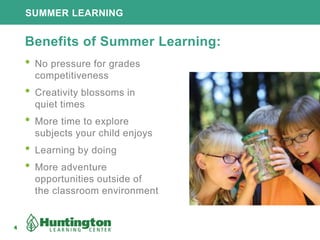
Benefits of Summer Learning:
• No pressure for grades
competitiveness
• Creativity blossoms in
quiet times
• More time to explore
subjects your child enjoys
• Learning by doing
• More adventure
opportunities outside of
the classroom environment
SUMMER LEARNING
5
The “Summer Slide!”
• Without educational activity
during the summer, all
students experience learning loss
• Students have lower test scores at the end of summer
vacation than at the beginning
• Math skills decline even more than reading skills
• Summer learning loss accounts for about two-thirds of
the difference in the likelihood of pursuing a college
preparatory path in high school
• Parents can readily provide educational experiences to
prevent “Summer Slide”
6
SUMMER LEARNING
6
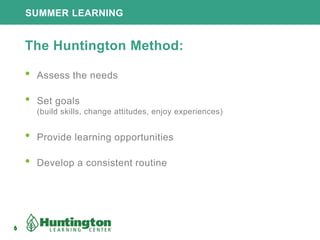
The Huntington Method:
• Assess the needs
• Set goals
(build skills, change attitudes, enjoy experiences)
• Provide learning opportunities
• Develop a consistent routine
7
SUMMER LEARNING
7
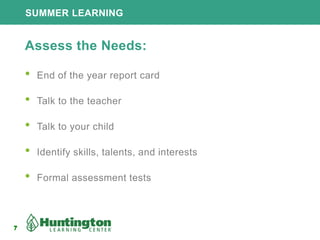
Assess the Needs:
• End of the year report card
• Talk to the teacher
• Talk to your child
• Identify skills, talents, and interests
• Formal assessment tests
8
SUMMER LEARNING
8
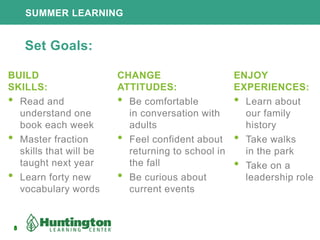
BUILD
SKILLS:
• Read and
understand one
book each week
• Master fraction
skills that will be
taught next year
• Learn forty new
vocabulary words
CHANGE
ATTITUDES:
• Be comfortable
in conversation with
adults
• Feel confident about
returning to school in
the fall
• Be curious about
current events
ENJOY
EXPERIENCES:
• Learn about
our family
history
• Take walks
in the park
• Take on a
leadership role
Set Goals:
9
SUMMER LEARNING
9
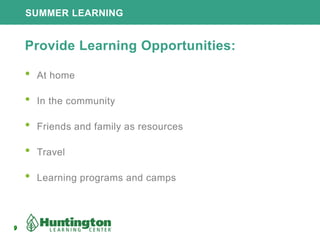
Provide Learning Opportunities:
• At home
• In the community
• Friends and family as resources
• Travel
• Learning programs and camps
10
SUMMER LEARNING
10
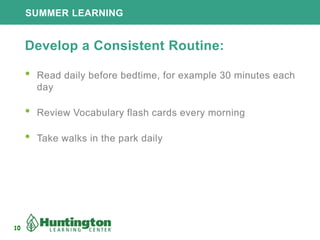
Develop a Consistent Routine:
• Read daily before bedtime, for example 30 minutes each
day
• Review Vocabulary flash cards every morning
• Take walks in the park daily
11
SUMMER LEARNING
11
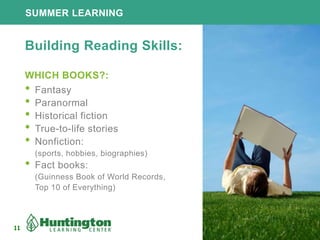
Building Reading Skills:
WHICH BOOKS?:
• Fantasy
• Paranormal
• Historical fiction
• True-to-life stories
• Nonfiction:
(sports, hobbies, biographies)
• Fact books:
(Guinness Book of World Records,
Top 10 of Everything)
12
SUMMER LEARNING
12
Building Reading Skills:
OTHER PUBLICATIONS:
• Online encyclopedia:
(Wikipedia, Fact Monster, Infoplease.com)
• Magazines:
For elementary school age:
Highlights for Children; National Geographic for Kids; Sports
Illustrated for Kids; Cobblestone; Odyssey.
For teens:
Girls’ Life; Boys’ Life, Discovery; Discovery Girls;
Sports Illustrated
• Comic books:
(Superman, Spiderman, Batman)
• Daily Newspapers
13
SUMMER LEARNING
13
Helping Your Child be a Better Reader:
• Be a role model
• Praise and encourage
• Create opportunities
• Participate before and after reading
• Preview and predict
• Ask questions
• Sketch or report
SUMMER LEARNING
Working on Specific
Reading Problems:
POSITIVE NEGATIVE
Decoding: Reorder: Pan hand cannot
Vocabulary Look up meanings
Use new words in conversation
Fluency Reading smoothly in phrases
14
15
SUMMER LEARNING
15
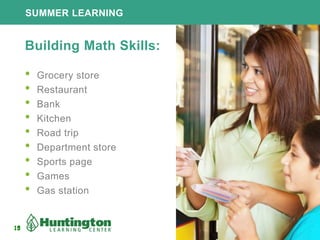
Building Math Skills:
• Grocery store
• Restaurant
• Bank
• Kitchen
• Road trip
• Department store
• Sports page
• Games
• Gas station
16
SUMMER LEARNING
16
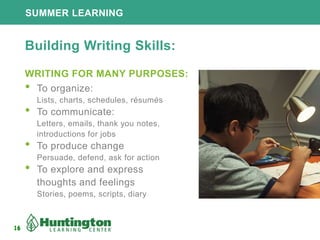
Building Writing Skills:
WRITING FOR MANY PURPOSES:
• To organize:
Lists, charts, schedules, résumés
• To communicate:
Letters, emails, thank you notes,
introductions for jobs
• To produce change
Persuade, defend, ask for action
• To explore and express
thoughts and feelings
Stories, poems, scripts, diary
17
SUMMER LEARNING
17
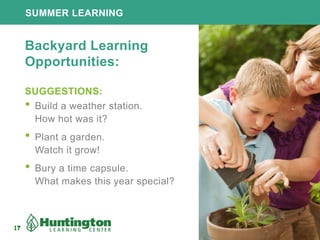
Backyard Learning
Opportunities:
SUGGESTIONS:
• Build a weather station.
How hot was it?
• Plant a garden.
Watch it grow!
• Bury a time capsule.
What makes this year special?
18
SUMMER LEARNING
18
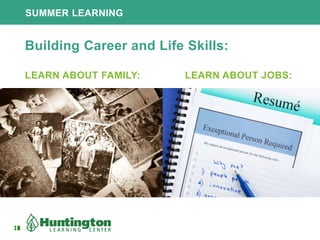
Building Career and Life Skills:
LEARN ABOUT FAMILY: LEARN ABOUT JOBS:
19
SUMMER LEARNING
19
Learning About Geography:
SUGGESTIONS:
• Where are your favorite teams located?
• Best route for the band’s summer tour
• Track the life of your hero
• Map out a summer trip
• Where did this computer
come from?
• Where are the colleges
I am interested in?
20
SUMMER LEARNING
20
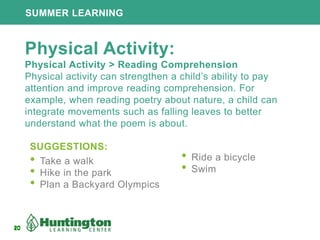
Physical Activity:
Physical Activity > Reading Comprehension
Physical activity can strengthen a child’s ability to pay
attention and improve reading comprehension. For
example, when reading poetry about nature, a child can
integrate movements such as falling leaves to better
understand what the poem is about.
SUGGESTIONS:
• Take a walk
• Hike in the park
• Plan a Backyard Olympics
• Ride a bicycle
• Swim
21
SUMMER LEARNING
21
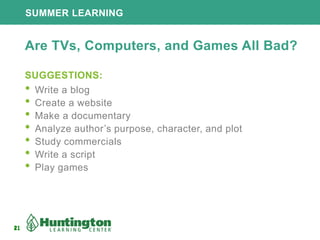
Are TVs, Computers, and Games All Bad?
SUGGESTIONS:
• Write a blog
• Create a website
• Make a documentary
• Analyze author’s purpose, character, and plot
• Study commercials
• Write a script
• Play games
22
SUMMER LEARNING
22
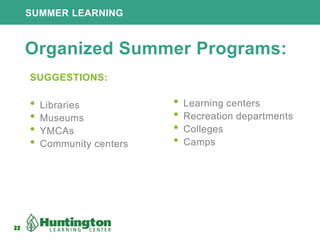
Organized Summer Programs:
SUGGESTIONS:
• Libraries
• Museums
• YMCAs
• Community centers
• Learning centers
• Recreation departments
• Colleges
• Camps
23
SUMMER LEARNING
23
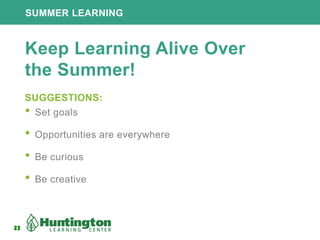
Keep Learning Alive Over
the Summer!
SUGGESTIONS:
• Set goals
• Opportunities are everywhere
• Be curious
• Be creative
THANK YOU
This workshop has been presented
as a public service by Huntington
Learning Center.

Summer learning parent's guide linked in version

  • 1.
  • 2.
    A practical workshop offeringparents the advice they need to keep learning alive while school is out. 2 Summer Learning: Keep Learning Alive Over the Summer! 2 ©2017 Huntington Mark, LLC. Independently Owned and Operated. HPT101a
  • 3.
    SUMMER LEARNING What doesSummer Break Mean to You? POSITIVE NEGATIVE Fewer activities More childcare needs Less pressure Children get bored More time spent outdoors Children are removed from learning 3
  • 4.
    SUMMER LEARNING 4 Benefits ofSummer Learning: • No pressure for grades competitiveness • Creativity blossoms in quiet times • More time to explore subjects your child enjoys • Learning by doing • More adventure opportunities outside of the classroom environment
  • 5.
    SUMMER LEARNING 5 The “SummerSlide!” • Without educational activity during the summer, all students experience learning loss • Students have lower test scores at the end of summer vacation than at the beginning • Math skills decline even more than reading skills • Summer learning loss accounts for about two-thirds of the difference in the likelihood of pursuing a college preparatory path in high school • Parents can readily provide educational experiences to prevent “Summer Slide”
  • 6.
    6 SUMMER LEARNING 6 The HuntingtonMethod: • Assess the needs • Set goals (build skills, change attitudes, enjoy experiences) • Provide learning opportunities • Develop a consistent routine
  • 7.
    7 SUMMER LEARNING 7 Assess theNeeds: • End of the year report card • Talk to the teacher • Talk to your child • Identify skills, talents, and interests • Formal assessment tests
  • 8.
    8 SUMMER LEARNING 8 BUILD SKILLS: • Readand understand one book each week • Master fraction skills that will be taught next year • Learn forty new vocabulary words CHANGE ATTITUDES: • Be comfortable in conversation with adults • Feel confident about returning to school in the fall • Be curious about current events ENJOY EXPERIENCES: • Learn about our family history • Take walks in the park • Take on a leadership role Set Goals:
  • 9.
    9 SUMMER LEARNING 9 Provide LearningOpportunities: • At home • In the community • Friends and family as resources • Travel • Learning programs and camps
  • 10.
    10 SUMMER LEARNING 10 Develop aConsistent Routine: • Read daily before bedtime, for example 30 minutes each day • Review Vocabulary flash cards every morning • Take walks in the park daily
  • 11.
    11 SUMMER LEARNING 11 Building ReadingSkills: WHICH BOOKS?: • Fantasy • Paranormal • Historical fiction • True-to-life stories • Nonfiction: (sports, hobbies, biographies) • Fact books: (Guinness Book of World Records, Top 10 of Everything)
  • 12.
    12 SUMMER LEARNING 12 Building ReadingSkills: OTHER PUBLICATIONS: • Online encyclopedia: (Wikipedia, Fact Monster, Infoplease.com) • Magazines: For elementary school age: Highlights for Children; National Geographic for Kids; Sports Illustrated for Kids; Cobblestone; Odyssey. For teens: Girls’ Life; Boys’ Life, Discovery; Discovery Girls; Sports Illustrated • Comic books: (Superman, Spiderman, Batman) • Daily Newspapers
  • 13.
    13 SUMMER LEARNING 13 Helping YourChild be a Better Reader: • Be a role model • Praise and encourage • Create opportunities • Participate before and after reading • Preview and predict • Ask questions • Sketch or report
  • 14.
    SUMMER LEARNING Working onSpecific Reading Problems: POSITIVE NEGATIVE Decoding: Reorder: Pan hand cannot Vocabulary Look up meanings Use new words in conversation Fluency Reading smoothly in phrases 14
  • 15.
    15 SUMMER LEARNING 15 Building MathSkills: • Grocery store • Restaurant • Bank • Kitchen • Road trip • Department store • Sports page • Games • Gas station
  • 16.
    16 SUMMER LEARNING 16 Building WritingSkills: WRITING FOR MANY PURPOSES: • To organize: Lists, charts, schedules, résumés • To communicate: Letters, emails, thank you notes, introductions for jobs • To produce change Persuade, defend, ask for action • To explore and express thoughts and feelings Stories, poems, scripts, diary
  • 17.
    17 SUMMER LEARNING 17 Backyard Learning Opportunities: SUGGESTIONS: •Build a weather station. How hot was it? • Plant a garden. Watch it grow! • Bury a time capsule. What makes this year special?
  • 18.
    18 SUMMER LEARNING 18 Building Careerand Life Skills: LEARN ABOUT FAMILY: LEARN ABOUT JOBS:
  • 19.
    19 SUMMER LEARNING 19 Learning AboutGeography: SUGGESTIONS: • Where are your favorite teams located? • Best route for the band’s summer tour • Track the life of your hero • Map out a summer trip • Where did this computer come from? • Where are the colleges I am interested in?
  • 20.
    20 SUMMER LEARNING 20 Physical Activity: PhysicalActivity > Reading Comprehension Physical activity can strengthen a child’s ability to pay attention and improve reading comprehension. For example, when reading poetry about nature, a child can integrate movements such as falling leaves to better understand what the poem is about. SUGGESTIONS: • Take a walk • Hike in the park • Plan a Backyard Olympics • Ride a bicycle • Swim
  • 21.
    21 SUMMER LEARNING 21 Are TVs,Computers, and Games All Bad? SUGGESTIONS: • Write a blog • Create a website • Make a documentary • Analyze author’s purpose, character, and plot • Study commercials • Write a script • Play games
  • 22.
    22 SUMMER LEARNING 22 Organized SummerPrograms: SUGGESTIONS: • Libraries • Museums • YMCAs • Community centers • Learning centers • Recreation departments • Colleges • Camps
  • 23.
    23 SUMMER LEARNING 23 Keep LearningAlive Over the Summer! SUGGESTIONS: • Set goals • Opportunities are everywhere • Be curious • Be creative
  • 24.
    THANK YOU This workshophas been presented as a public service by Huntington Learning Center.