Agents
Motivation
agents are usedto provide a consistent viewpoint on
various topics in the field AI
agents require essential skills to perform tasks that
require intelligence
intelligent agents use methods and techniques from
the field of AI
3.
Agents
Objectives
introduce the essentialconcepts of intelligent agents
define some basic requirements for the behavior and
structure of agents
establish mechanisms for agents to interact with
their environment
4.
Agents
What is anAgent?
in general, an entity that interacts with its
environment
perception through sensors
actions through effectors or actuators
5.
Agents
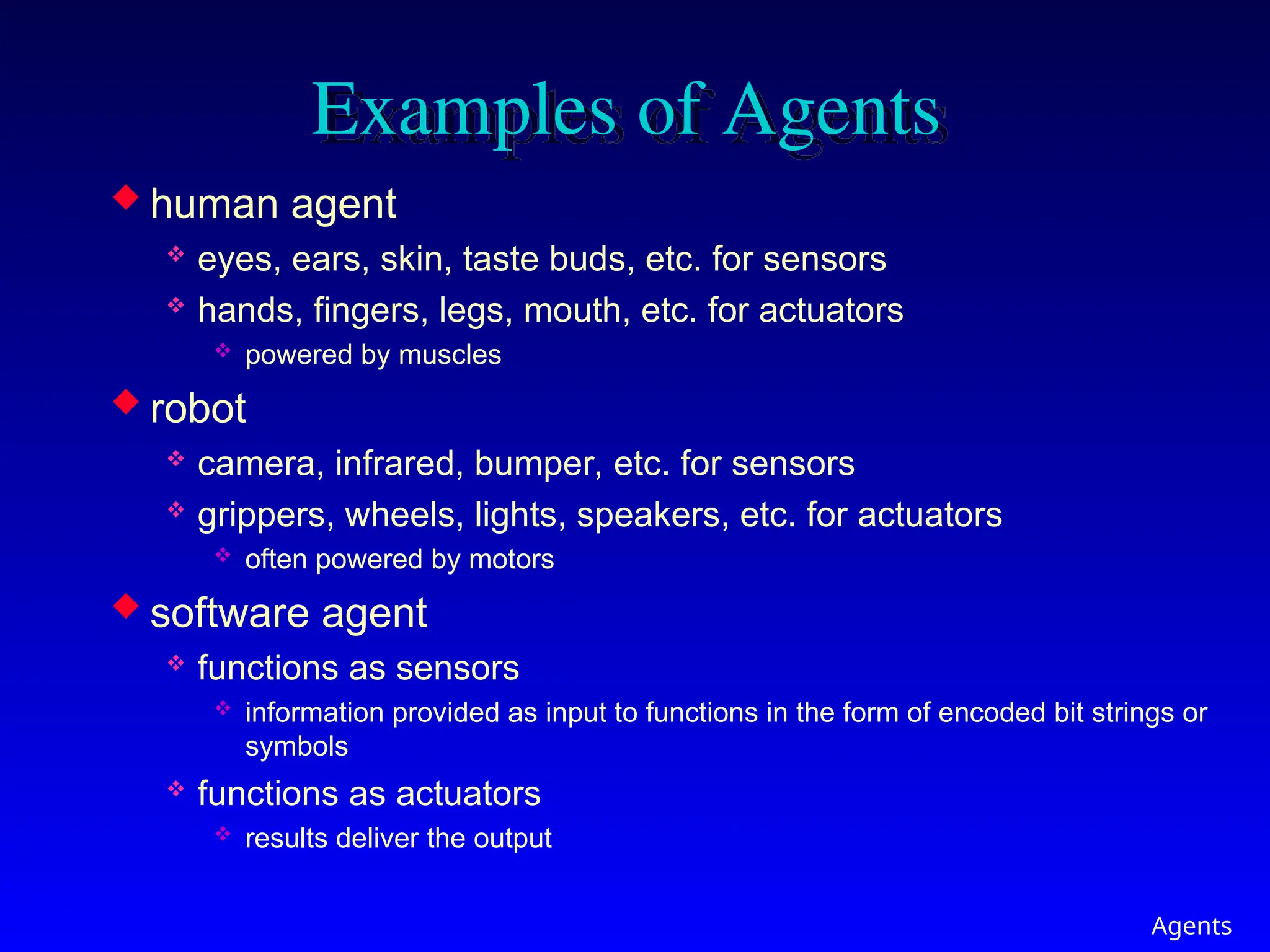
Examples of Agents
human agent
eyes, ears, skin, taste buds, etc. for sensors
hands, fingers, legs, mouth, etc. for actuators
powered by muscles
robot
camera, infrared, bumper, etc. for sensors
grippers, wheels, lights, speakers, etc. for actuators
often powered by motors
software agent
functions as sensors
information provided as input to functions in the form of encoded bit strings or
symbols
functions as actuators
results deliver the output
6.
Agents
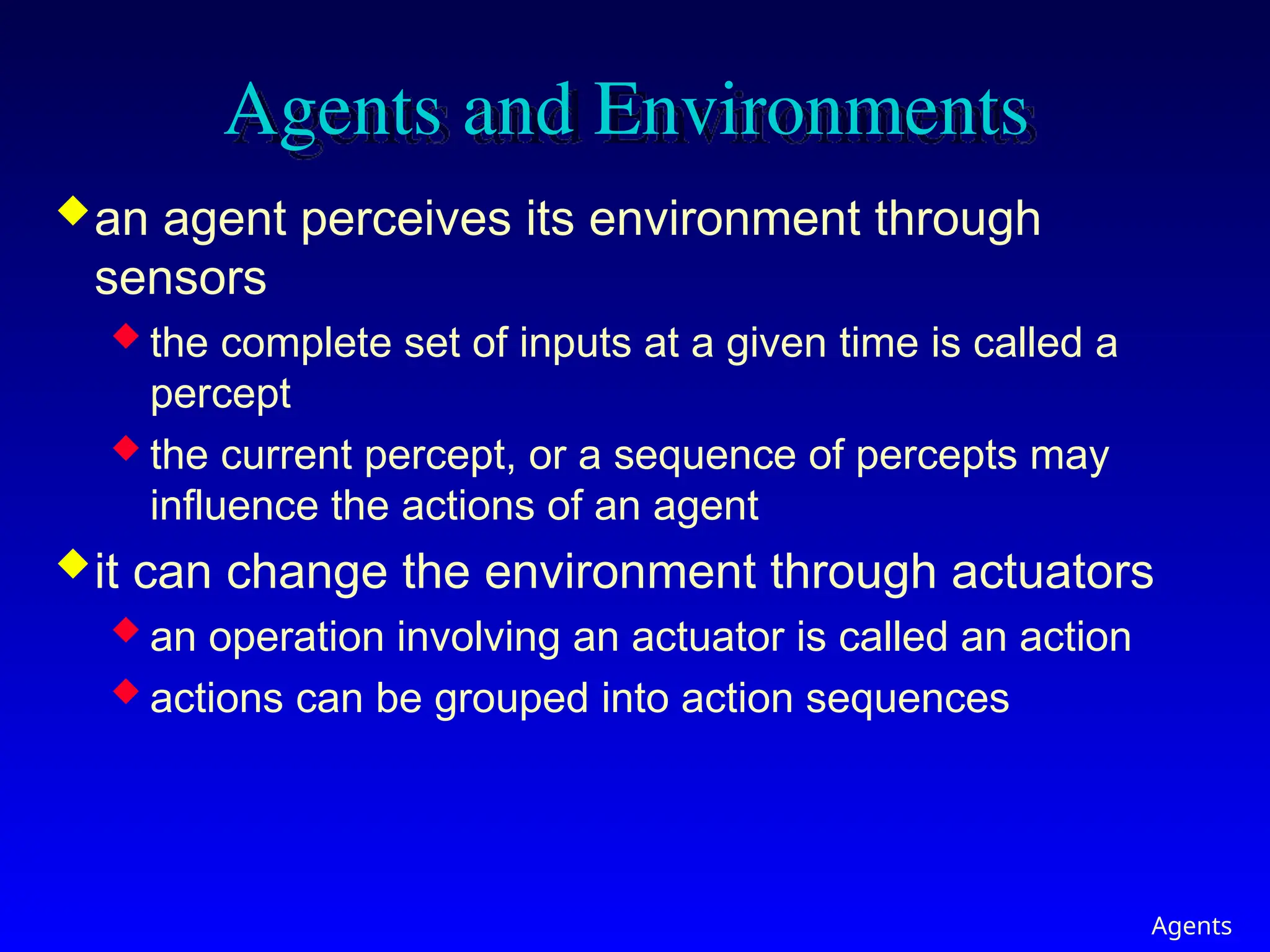
Agents and Environments
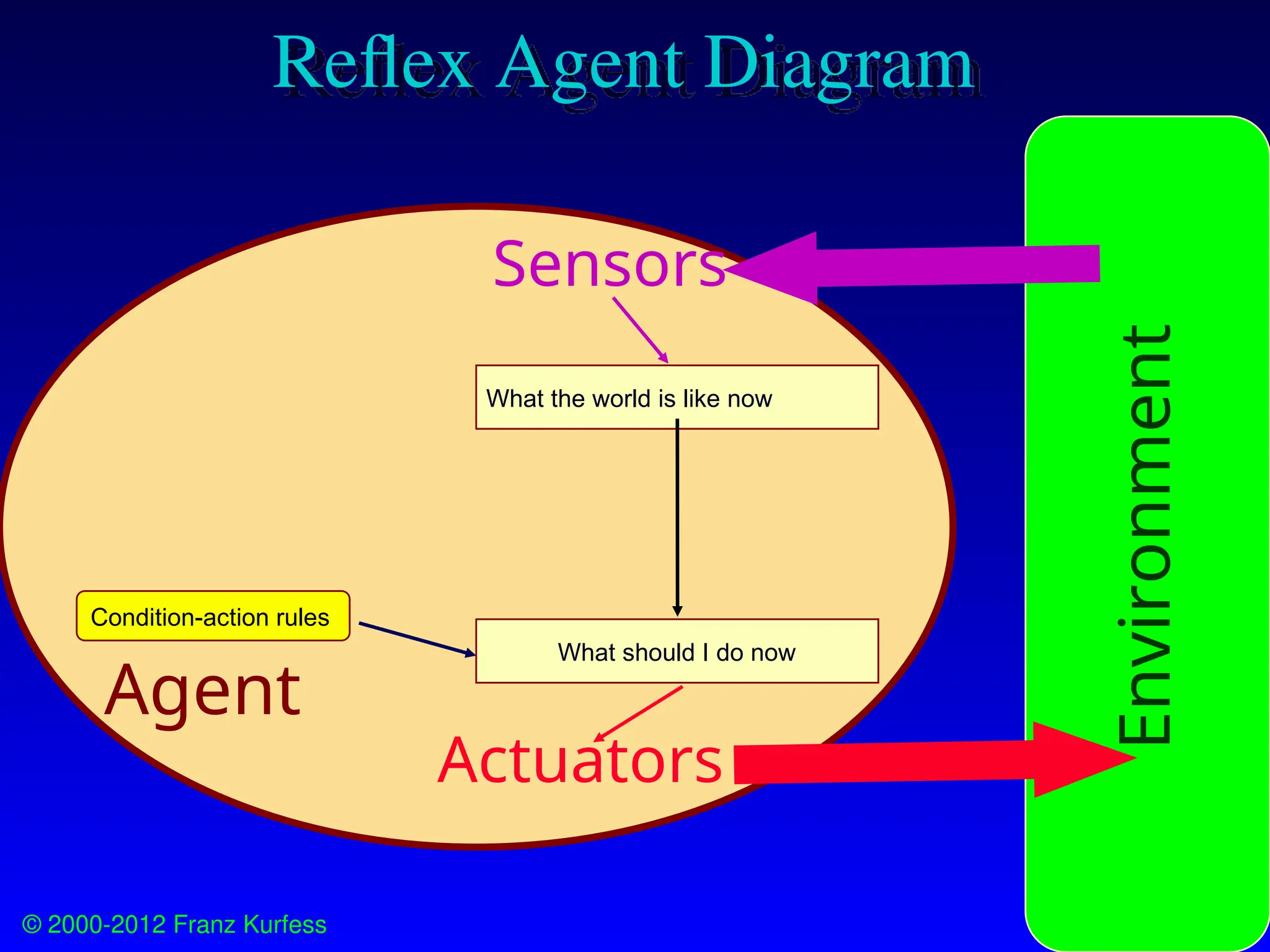
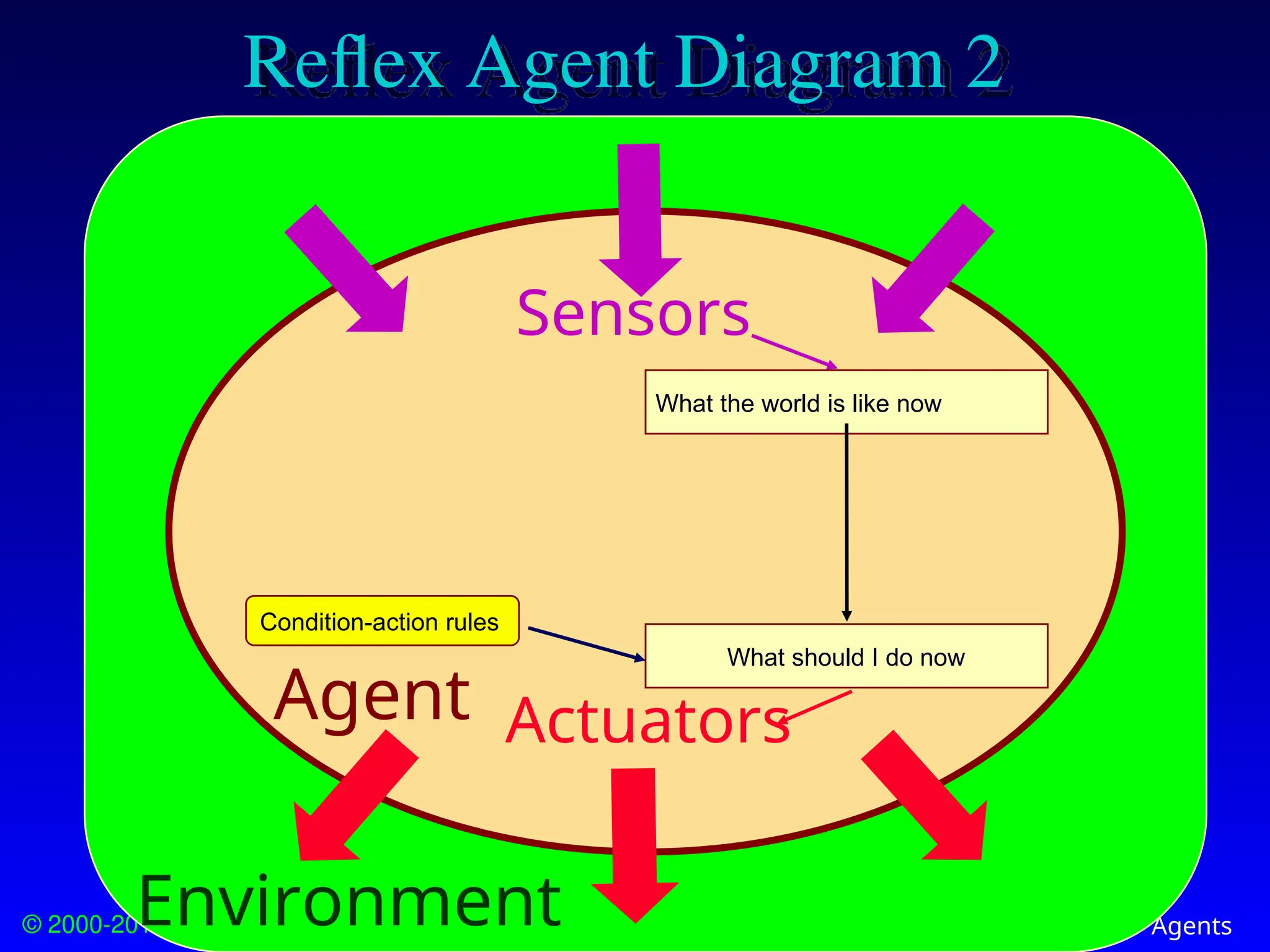
anagent perceives its environment through
sensors
the complete set of inputs at a given time is called a
percept
the current percept, or a sequence of percepts may
influence the actions of an agent
it can change the environment through actuators
an operation involving an actuator is called an action
actions can be grouped into action sequences
7.
Agents
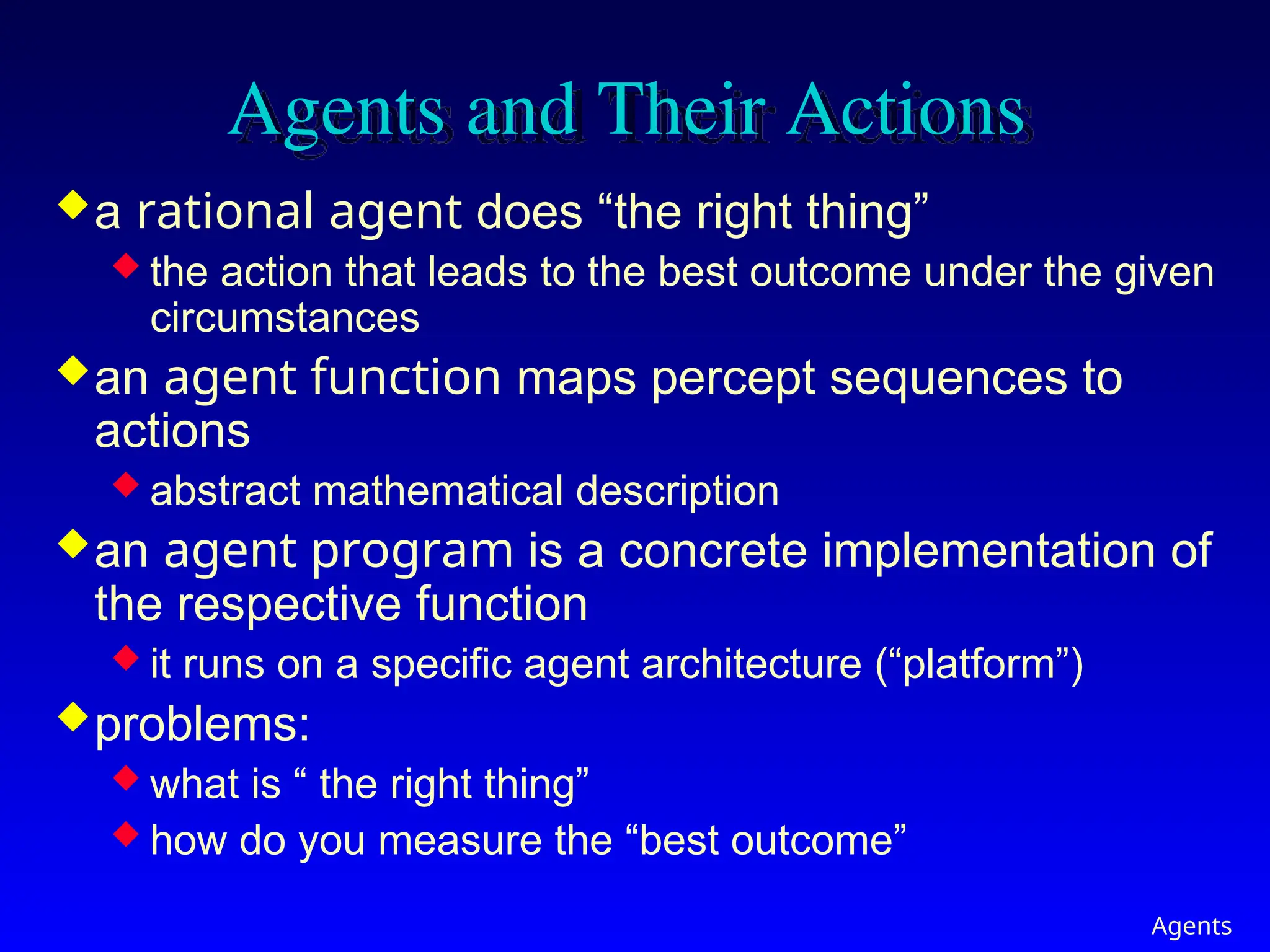
Agents and TheirActions
a rational agent does “the right thing”
the action that leads to the best outcome under the given
circumstances
an agent function maps percept sequences to
actions
abstract mathematical description
an agent program is a concrete implementation of
the respective function
it runs on a specific agent architecture (“platform”)
problems:
what is “ the right thing”
how do you measure the “best outcome”
8.
Agents
Performance of Agents
criteriafor measuring the outcome and the expenses
of the agent
often subjective, but should be objective
task dependent
time may be important
9.
Agents
Performance Evaluation Examples
vacuumagent
number of tiles cleaned during a certain period
based on the agent’s report, or validated by an objective authority
doesn’t consider expenses of the agent, side effects
energy, noise, loss of useful objects, damaged furniture, scratched floor
might lead to unwanted activities
agent re-cleans clean tiles, covers only part of the room, drops dirt on tiles to
have more tiles to clean, etc.
10.
Agents
Rational Agent
selects theaction that is expected to maximize its
performance
based on a performance measure
depends on the percept sequence, background
knowledge, and feasible actions
11.
Agents
Rational Agent Considerations
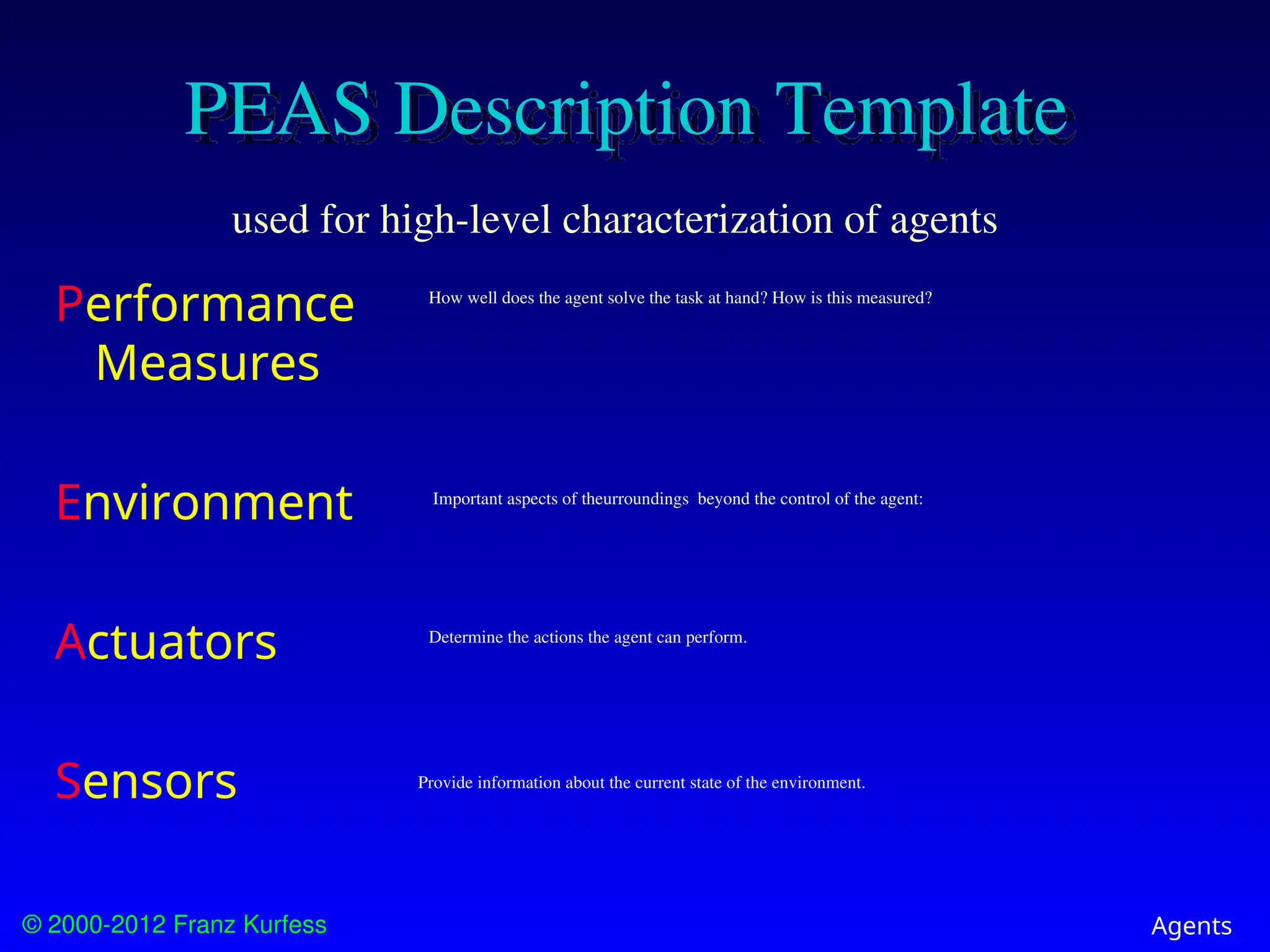
performancemeasure for the successful completion
of a task
complete perceptual history (percept sequence)
background knowledge
especially about the environment
dimensions, structure, basic “laws”
task, user, other agents
feasible actions
capabilities of the agent
12.
Agents
Omniscience
a rational agentis not omniscient
it doesn’t know the actual outcome of its actions
it may not know certain aspects of its environment
rationality takes into account the limitations of the
agent
percept sequence, background knowledge, feasible
actions
it deals with the expected outcome of actions
13.
Agents
Environments
determine to alarge degree the interaction between
the “outside world” and the agent
the “outside world” is not necessarily the “real world” as we
perceive it
it may be a real or virtual environment the agent lives in
in many cases, environments are implemented
within computers
they may or may not have a close correspondence to the
“real world”
14.
Agents
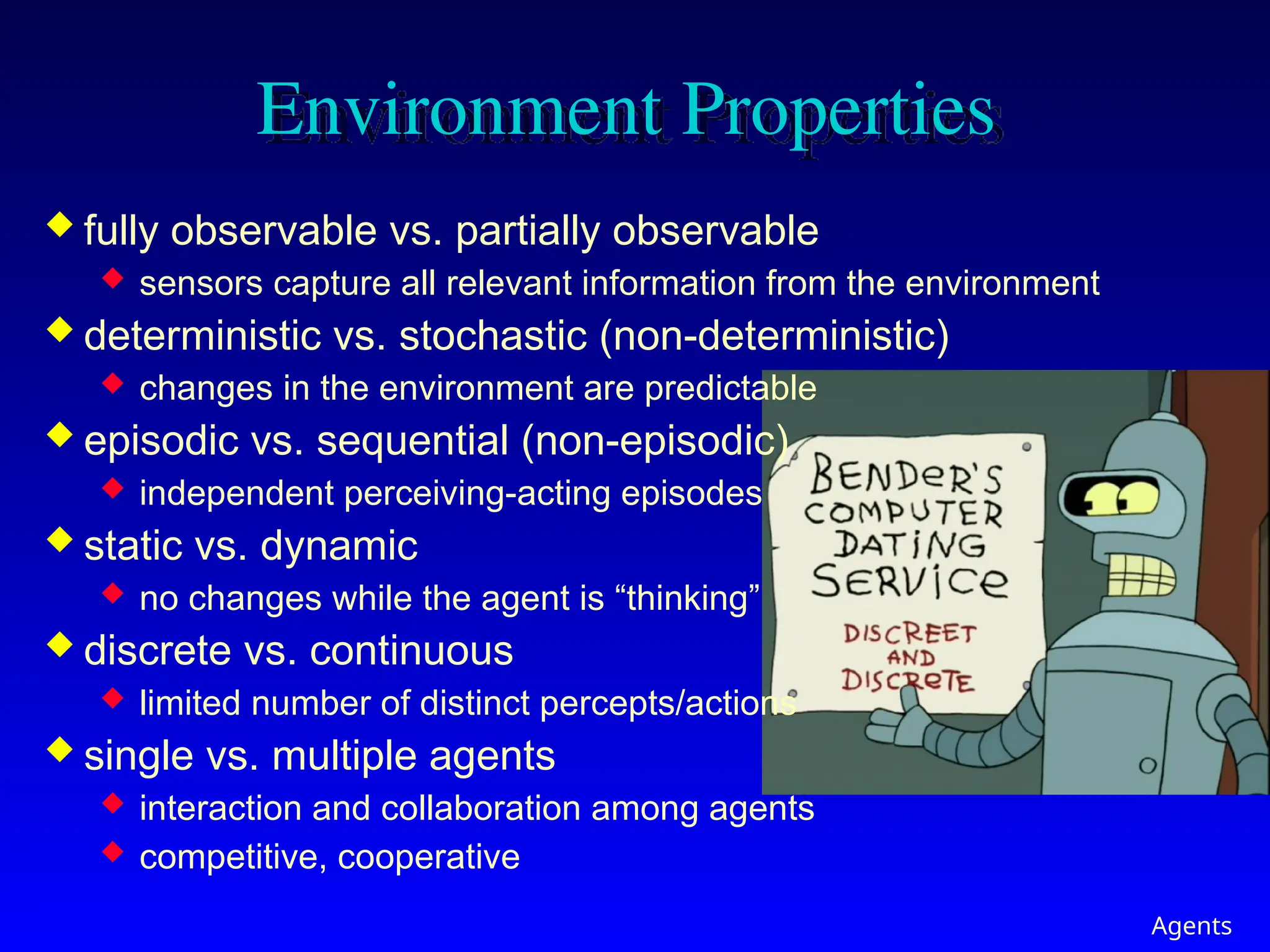
Environment Properties
fullyobservable vs. partially observable
sensors capture all relevant information from the environment
deterministic vs. stochastic (non-deterministic)
changes in the environment are predictable
episodic vs. sequential (non-episodic)
independent perceiving-acting episodes
static vs. dynamic
no changes while the agent is “thinking”
discrete vs. continuous
limited number of distinct percepts/actions
single vs. multiple agents
interaction and collaboration among agents
competitive, cooperative
15.
Agents
Environment Programs
environment simulatorsfor experiments with agents
gives a percept to an agent
receives an action
updates the environment
often divided into environment classes for related
tasks or types of agents
the environment frequently provides mechanisms for
measuring the performance of agents
16.
Agents
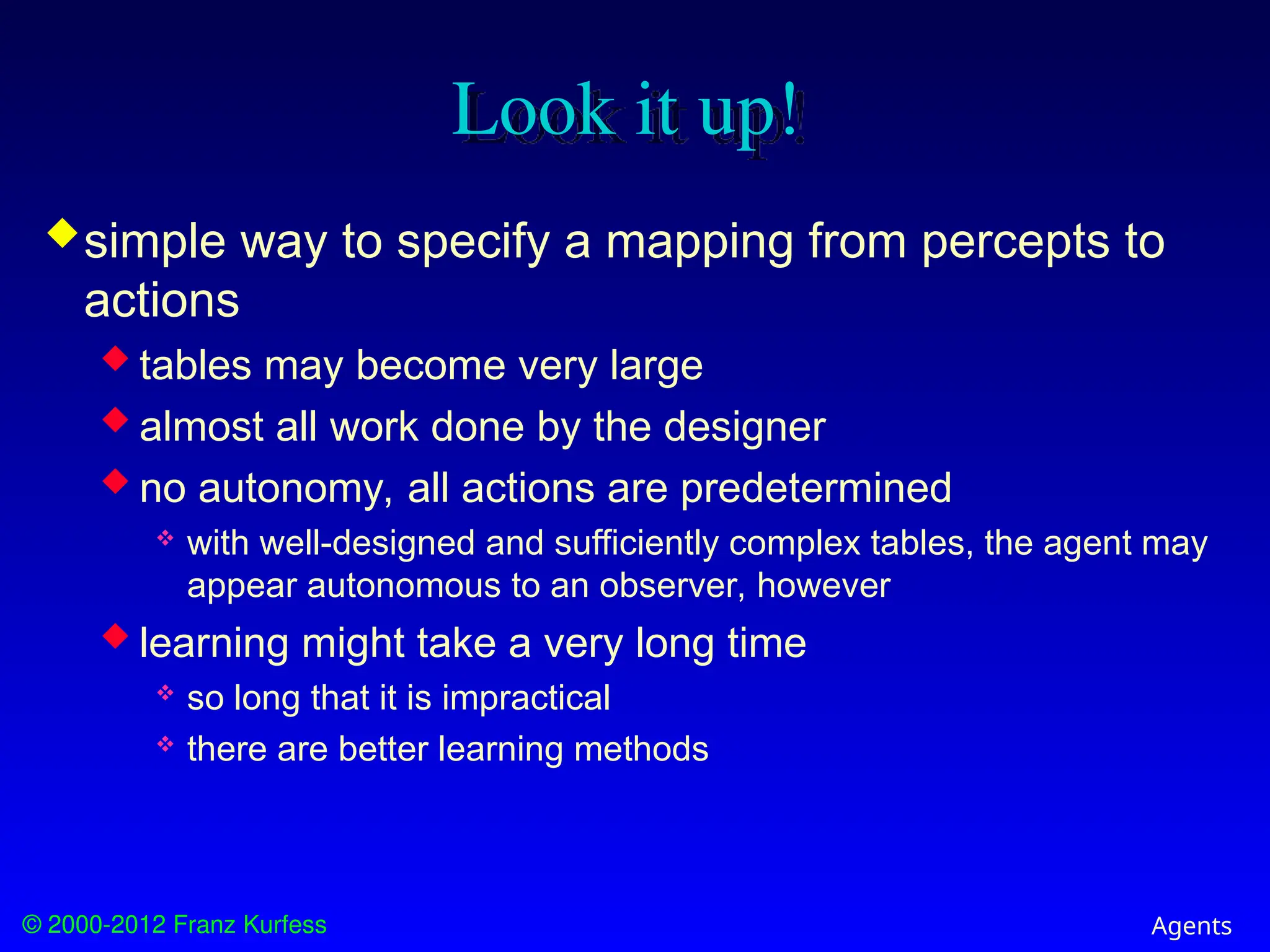
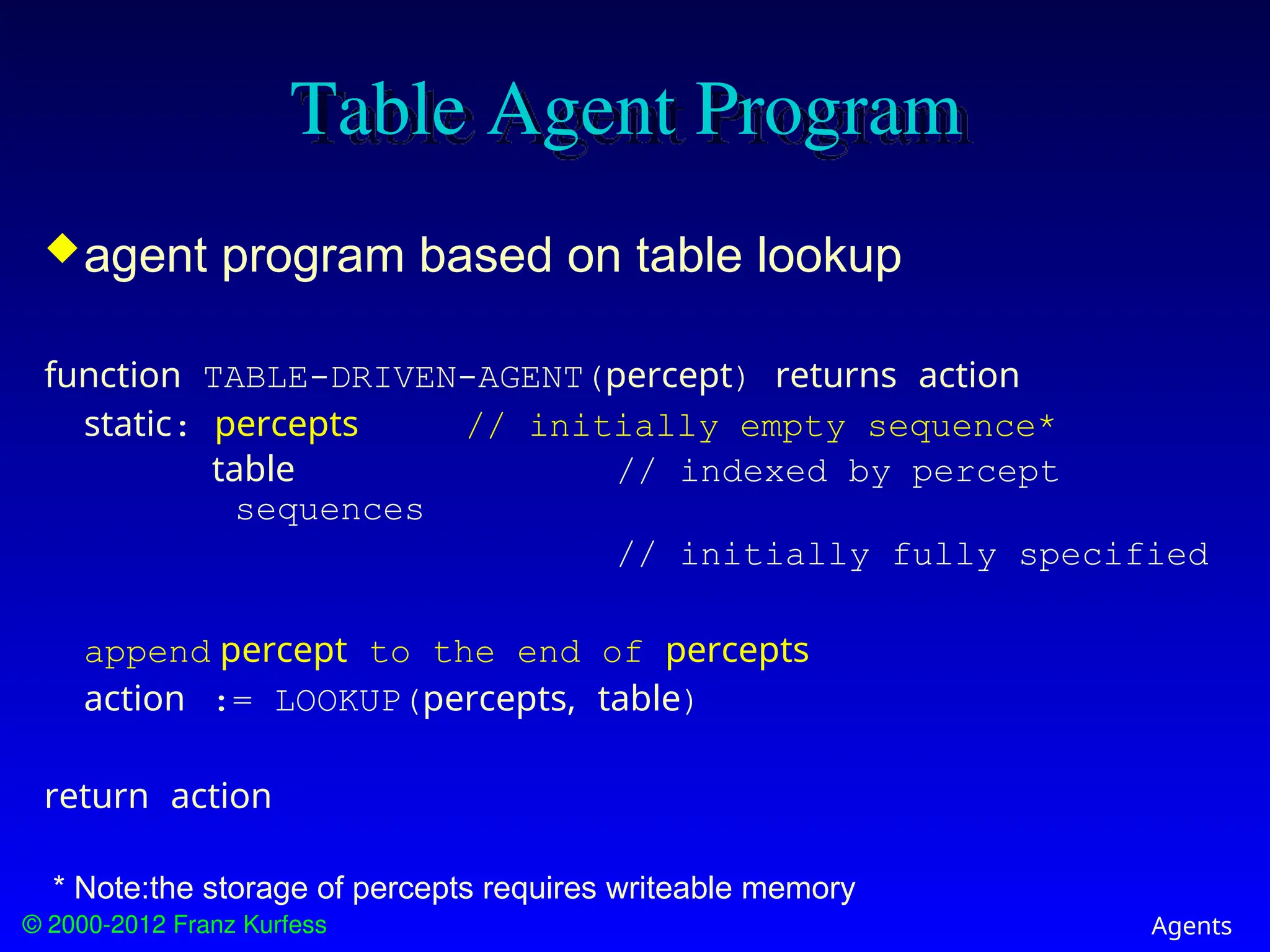
From Percepts toActions
mapping from percept sequences to actions
if an agent only reacts to its percepts, a table can describe
this mapping
instead of a table, a simple function may also be used
can be conveniently used to describe simple agents that solve well-
defined problems in a well-defined environment
e.g. calculation of mathematical functions
serious limitations
see discussion of “reflex agents”
17.
Agents
Agent or Program
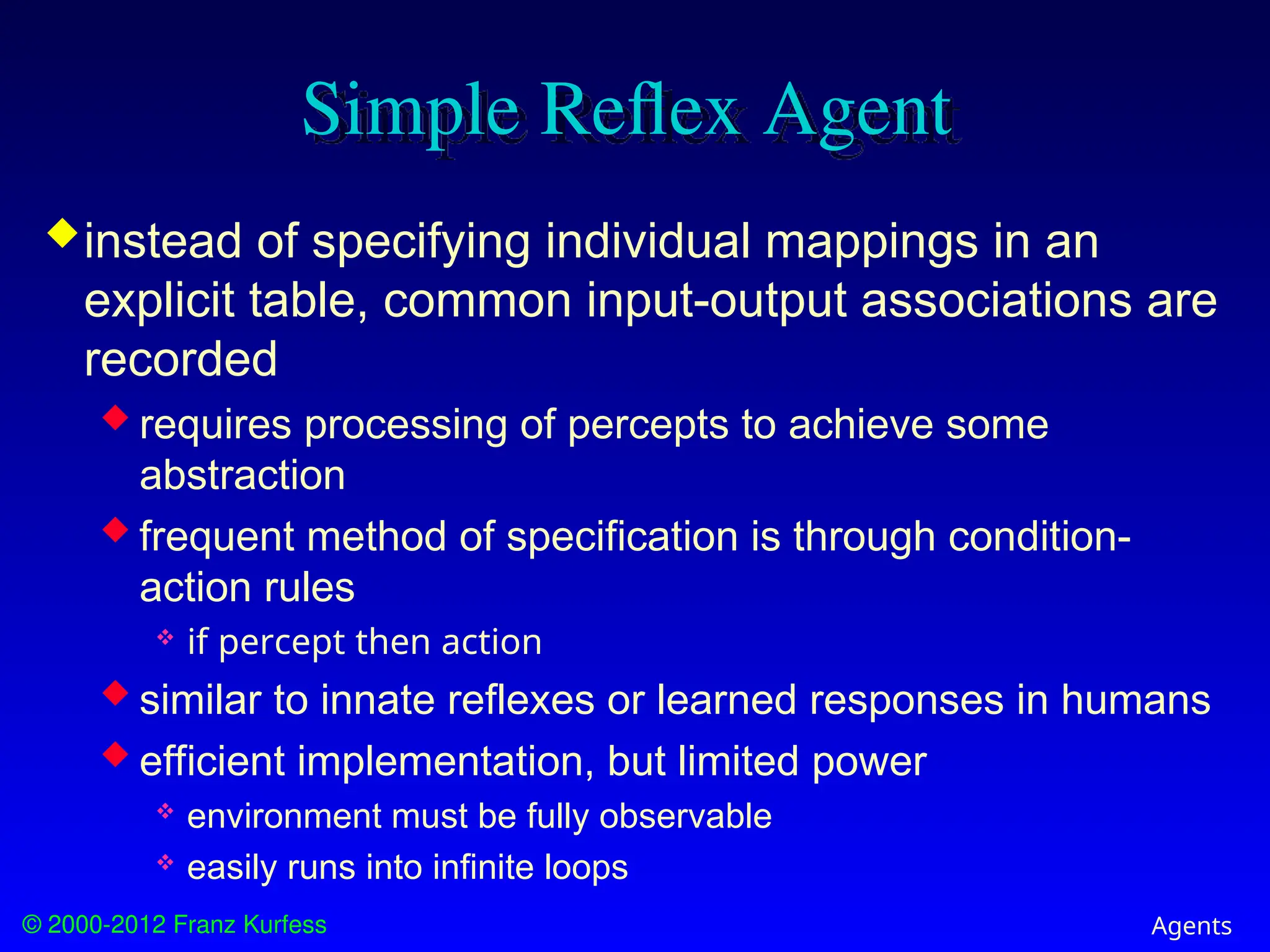
ourcriteria so far seem to apply equally well to
software agents and to regular programs
autonomy
agents solve tasks largely independently
programs depend on users or other programs for
“guidance”
autonomous systems base their actions on their own
experience and knowledge
requires initial knowledge together with the ability to learn
provides flexibility for more complex tasks
18.
Agents
Structure of IntelligentAgents
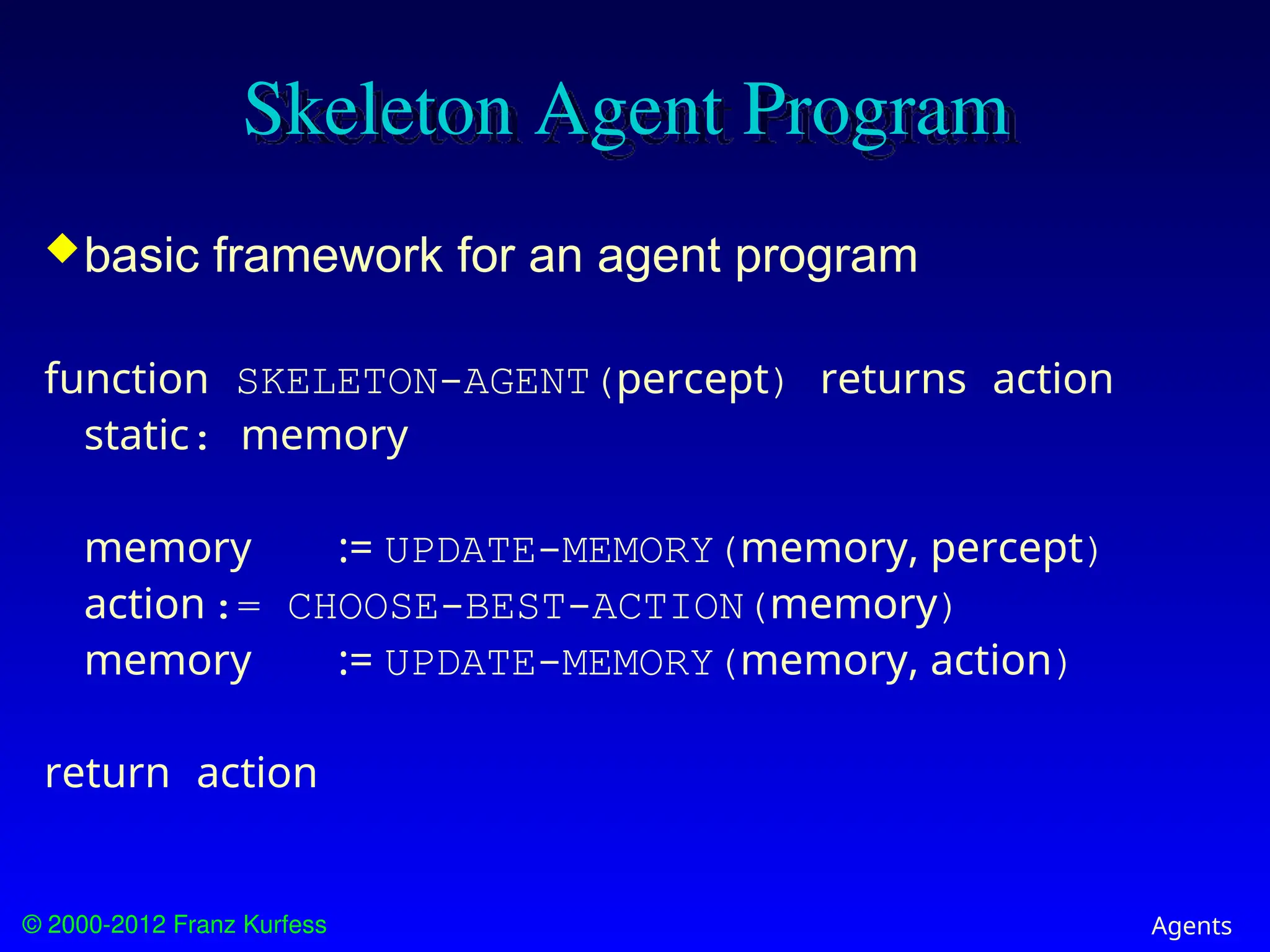
Agent = Architecture + Program
architecture
operating platform of the agent
computer system, specific hardware, possibly OS functions
program
function that implements the mapping from percepts to
actions
19.
Agents
Software Agents
also referredto as “softbots”
live in artificial environments where computers and
networks provide the infrastructure
may be very complex with strong requirements on
the agent
World Wide Web, real-time constraints,
natural and artificial environments may be merged
user interaction
sensors and actuators in the real world
camera, temperature, arms, wheels, etc.


![© 2000-2012 Franz Kurfess Agents
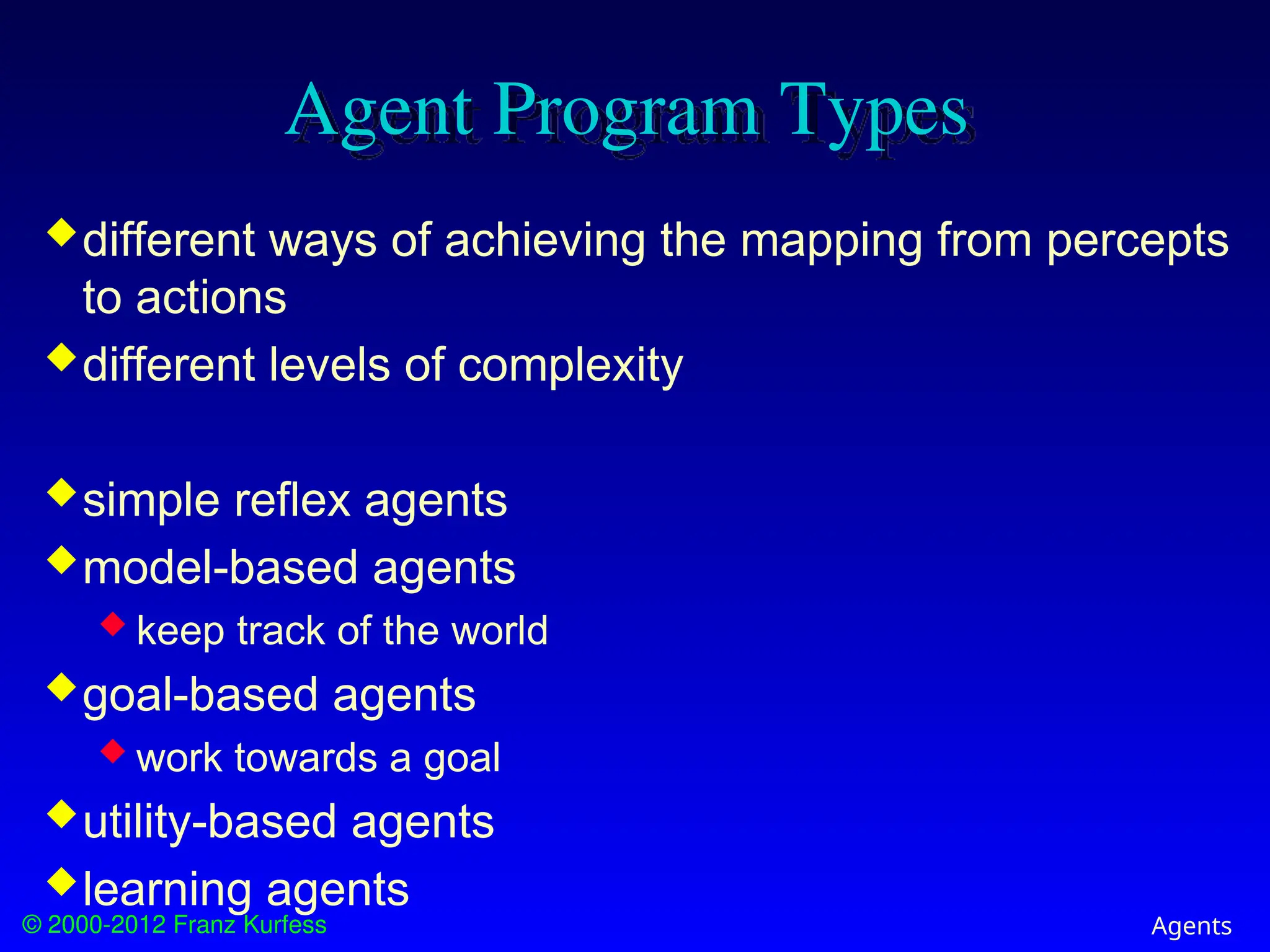
Model-Based Reflex Agent Program
application of simple rules to situations
function REFLEX-AGENT-WITH-STATE(percept) returns action
static: rules //set of condition-action rules
state //description of the current world
state
action //most recent action, initially none
state := UPDATE-STATE(state, action, percept)
rule := RULE-MATCH(state, rules)
action := RULE-ACTION[rule]
return action](https://image.slidesharecdn.com/2-agents-250513201119-c7f680ae/75/Agents-chapter-of-Artificial-intelligence-35-2048.jpg)