Assignment No:1
Industrialization in Pakistan
Course: Contemporary World
Submitted to
Mr. Ali Raza
Submitted By
Hafsa Abbasi
10823
1 | P a g e
Content:
- Introduction
- Early Ages
- Brief History
Establishing Industries (1947-1970)
Industrial Decline (1971-1977)
- Growth Trend
- Current Scenario of Industries
Improvise Majors have started to taken for betterment
- Major Exports of Pakistan
- Which Industry You Recommend would flourish
Industrialization in Pakistan
Introduction
Pakistan though the 6th most populated country with a 34th position among the biggest economics of
the world, is a fertile land of pures but it have been facing crisis because of some internal and some
external affairs.
Pakistan has faced varying economic growth since its inception. Growth has been slow during the civilian
rules; while three long periods of military rule have seen remarkable recovery. Despite being a very poor
2 | P a g e
country in 1947, the growth rate has been better than the global average during the subsequent five
decades, but slowed a bit in the late 1990s. However, Pakistan's economy gained its momentum again
and grew at an average rate of 7 percent between 2003 and 2007 which enables the government to rise
development spending. As a result, the poverty headcount was reduced by more than 10 percent from
34.5 percent in 2001 to 22.3 percent in 2006. But after that boosting period of Industries, instability in
government policies was lead to deceleration.
Early ages
The land forming modern-day Pakistan was home to the ancient Indus Valley Civilization from 2800 BC
to 1800 BC; historical evidence suggests that the civilization relied on and carried trade *agricultural
products* through the Indus River, and its inhabitants were some of the most resourceful traders. Since
independence the economic growth has meant an increase in average income of about 150 percent
over 1950–96. But Pakistan, like many other developing countries, has not been able to narrow the gap
between itself and rich industrial nations which have grown faster on a per head basis.
Brief History
Out of 955 industrial units operating in the British India, Pakistan got only 34 industries i.e. 4% of the
total industries established in the Subcontinent, which were not enough for newly born country to face
industrialized world, the rest were located in India. The industries which came to the share of Pakistan
were of a comparatively small size and were based on raw material. These industries included small
sugar mills, cotton ginning factories, flour mills, rice husking mills and canning factories etc.
* Establishing Industries
The following year in a conference it was suggested by the Government to establish industries which use
locally produced raw material like jute, cotton, hide and skins. Other financial and investment setups
were also made by the government in 1948.
In the period from 1947 to 1950, the private entrepreneurs invested in those industries which showed
the highest profit. The contribution of industrial sector was 6.9% to GDP in 1950. In 1952 the
Government took the initiative and established Pakistan Industrial Development Corporation (PIDC) to
invest in those industries which require heavy initial investment and their major investments were in
paper and paper board, cement, fertilizer, jute mills and the Sui Karachi gas pipeline. PIDC by June, 1971
had completed 59 industrial units and created a base for self sustained growth in the industrial sector.
The production capacity of the already existing units like fertilizers, jute and paper was considerably
expanded. The share of industrial sector to GDP rose from 9.7% in 1954-55 to 11.9% in 1959-60.
In 1960’s there was a shift in the establishment of consumer goods industries to heavy industries such as
machine tools, petro-chemical, electrical complex and iron and steel. The industrial performance in
terms of growth, export and productivity increased during the Second Five Year Plan period. The share
of industrial sector to GNP went up to 11.8% from 1960 to 1965. The manufacturing sector could
3 | P a g e
achieve a growth rate of 7.8% against the Plan target of 10%.
* Industrial Decline
The industrial performance in terms of growth, exports and production was disappointing from 1971 to
1977. There were various reasons for the poor performance of the manufacturing sector. The main
reason for this poor performance was Separation of East Pakistan (Bangladesh) from West Pakistan
(Pakistan). The annual growth rate fell to 2.8% in the industrial sector in this period.
The suspension of foreign aid, loss of indigenous market (East Pakistan), fall in exports, devaluation to
the extent of 131% nationalization of industries labor unrest, unfavorable investment climate, floods,
recession in world trade and reduction in investment incentives caused a fall in the output of large scale
industries.
The annual growth rate in manufacturing sector was 8.2% in the 1989's. The growth of large scale
manufacturing slowed down to an average of 4.7% in the first half and further to 2.5% in the 2nd half of
the 1990's.
Growth Trend During Last 10 Years
Pakistan's industries are going through one of the toughest periods in decades But they have spend their
best period in early 2000's.
The growth trend of industrial sector during last 10 years. Since 2002 it was steadily growing and it
increased abruptly in 2004 showing a jump from 5.8% to 13.1% growth. This sudden sharp curve was
due to higher Input Prices, Monetarily Policy, Financial Discipline, Consistency and Continuity of
Development Policies, Strengthening of Domestic Demand, Continuously Improving Macroeconomic
Environment, A Stable Rate and Global Expansion of Markets due To Liberalization Of Trade In 2005,
record high exports and friendly relation building with other countries. During 2007, Pakistan economy
went through worst political and economic instability due to Benazir Bhutto’s assassination followed by
unstable law and order situations. Moving ahead in 2008 the industrial sector showed record negative
growth due to financial church in global economy resulting in slow down in economy growth chased by
soaring oil, food and other commodity prices, softening of external demand and turmoil in the
international financial market. The economy is also going through the most terrible energy crisis
affecting the performance of the industries.
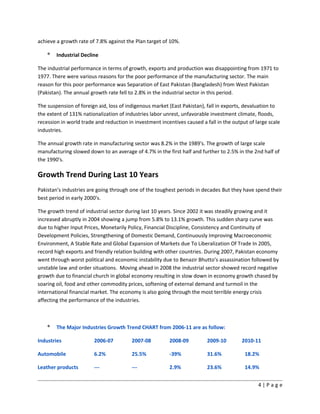
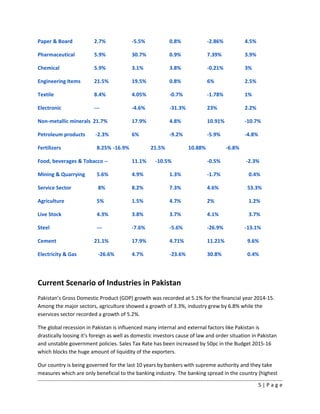
* The Major Industries Growth Trend CHART from 2006-11 are as follow:
Industries 2006-07 2007-08 2008-09 2009-10 2010-11
Automobile 6.2% 25.5% -39% 31.6% 18.2%
Leather products --- --- 2.9% 23.6% 14.9%
4 | P a g e
Paper & Board 2.7% -5.5% 0.8% -2.86% 4.5%
Pharmaceutical 5.9% 30.7% 0.9% 7.39% 3.9%
Chemical 5.9% 3.1% 3.8% -0.21% 3%
Engineering Items 21.5% 19.5% 0.8% 6% 2.5%
Textile 8.4% 4.05% -0.7% -1.78% 1%
Electronic --- -4.6% -31.3% 23% 2.2%
Non-metallic minerals 21.7% 17.9% 4.8% 10.91% -10.7%
Petroleum products -2.3% 6% -9.2% -5.9% -4.8%
Fertilizers 8.25% -16.9% 21.5% 10.88% -6.8%
Food, beverages & Tobacco -- 11.1% -10.5% -0.5% -2.3%
Mining & Quarrying 5.6% 4.9% 1.3% -1.7% 0.4%
Service Sector 8% 8.2% 7.3% 4.6% 53.3%
Agriculture 5% 1.5% 4.7% 2% 1.2%
Live Stock 4.3% 3.8% 3.7% 4.1% 3.7%
Steel --- -7.6% -5.6% -26.9% -13.1%
Cement 21.1% 17.9% 4.71% 11.21% 9.6%
Electricity & Gas -26.6% 4.7% -23.6% 30.8% 0.4%
Current Scenario of Industries in Pakistan
Pakistan’s Gross Domestic Product (GDP) growth was recorded at 5.1% for the financial year 2014-15.
Among the major sectors, agriculture showed a growth of 3.3%, industry grew by 6.8% while the
eservices sector recorded a growth of 5.2%.
The global recession in Pakistan is influenced many internal and external factors like Pakistan is
drastically loosing it's foreign as well as domestic investors cause of law and order situation in Pakistan
and unstable government policies. Sales Tax Rate has been increased by 50pc in the Budget 2015-16
which blocks the huge amount of liquidity of the exporters.
Our country is being governed for the last 10 years by bankers with supreme authority and they take
measures which are only beneficial to the banking industry. The banking spread in the country (highest
5 | P a g e
in the world) is 7.8 per cent and needs to be cut down by two per cent at least. This will save us from the
control of financial institutions like the IMF, World Bank and the Asian Development Bank (ADB). The
interest rate should be brought down to a single digit. The gross domestic product (GDP) growth has
declined due to an economic slowdown following the tight monetary policy. The high interest rates is
the main reason behind the fall in the country’s industrial output. The downfall in auto, textile,
electronic, petroleum, and other key sectors adversely affected the performance of large scale
manufacturing (LSM) in the country. We have no competitive edge, as our exporters are facing a lot of
difficulties due to high cost of production. Cutting interest rates to a single digit will produce multiple
benefits for the economy, as it will lower the cost of doing business, give a strong boost to business and
industrial activities, provide easy credit and loaning facilities to trade and industry, promote better
investment and exports, and generate more tax revenue for the government. Sadly, studies highlighting
the major problems and suggesting corrective measures have been falling on deaf ears.
* Improvise Majors have started to taken for betterment
The start of the year wasn’t encouraging since the major province of the country, Punjab, was facing
serious floods while the political instability and terrorism marred the confidence of the investors in the
country. However, the situation started to improve by the end of 2014 and the major economic
indicators started to improve.
The government of Pakistan had announced special budget policy for different industries but the newly
elected chairman have requested to renounced the policy with some amendments and ensures a
congenial environment to double the exports in the next five years so they can invest more and make
their best efforts to take the industries out of crisis like situation.
As the IMF had said that Pakistan’s economy continues to gradually improve, helped by macroeconomic
stability, lower oil prices, robust remittances, and higher supply of gas and electricity. Real GDP growth
is expected to reach 4.1 percent this fiscal year and accelerate to 4.5 percent next year. Remittance
inflows have continued to increase over the years, and these remittances will cover around 45 percent
of the country’s imports amount.
Major Exports of Pakistan:
Pakistan exports lots of different items to a dozen of countries. Following is the list of exports items.
1. Rice
2. Raw Cotton
3. Leather.
4. Sports Goods
5. Chemicals and Fertilizers.
6 | P a g e
6. Fish, Fruits and vegetables
7. Cement
Top 5 Export destinations of Pakistan United States (14%), China (12%), Afghanistan (9.0%), Germany
(5.1%), and United Kingdom (5.0%)
Which Industry You Recommend would flourish
A country is represented by the outcomes its industries produce. A fashion industry also plays significant
role in country's success because there lies the brilliant work of fashion designers, artists and also the
revenue generated by exports of fashion accessories, products.
In fashion Industry their isn't monopoly or other competitive disadvantages as compared to other
industries as every country has it's own culture and people overseas are taking interest to know more
about fashion industry of Pakistan so we should strive more to let them know some perspective of
Pakistani Fashion Industry.
as this is the era of modernization and people of this era are more likely to adopt new things so if put
more efforts in flourishing fashion industry we can somehow generate revenue for our country from the
people like overseas investors who want to invest their money by opening fashion based boutiques,
outlets or by setting industry for fashion based clothes manufacturing.
Although Pakistani Fashion Industry is not at its initial stages, they have advanced to higher level in
terms of contributions and achievements for Fashion in Pakistan. Our talented designers/ artists are now
rich in ideas, innovations and production and they can't be ignored.
In Pakistan,this industry is growing steadily and more students are inclined towards this profession, so
we should also increase the number of Fashion Institutes and provide scholarships to new talent to
study abroad and gain more for their country, both on private and government basis.
7 | P a g e

Pak industries

  • 1.
    Assignment No:1 Industrialization inPakistan Course: Contemporary World Submitted to Mr. Ali Raza Submitted By Hafsa Abbasi 10823 1 | P a g e
  • 2.
    Content: - Introduction - EarlyAges - Brief History Establishing Industries (1947-1970) Industrial Decline (1971-1977) - Growth Trend - Current Scenario of Industries Improvise Majors have started to taken for betterment - Major Exports of Pakistan - Which Industry You Recommend would flourish Industrialization in Pakistan Introduction Pakistan though the 6th most populated country with a 34th position among the biggest economics of the world, is a fertile land of pures but it have been facing crisis because of some internal and some external affairs. Pakistan has faced varying economic growth since its inception. Growth has been slow during the civilian rules; while three long periods of military rule have seen remarkable recovery. Despite being a very poor 2 | P a g e
  • 3.
    country in 1947,the growth rate has been better than the global average during the subsequent five decades, but slowed a bit in the late 1990s. However, Pakistan's economy gained its momentum again and grew at an average rate of 7 percent between 2003 and 2007 which enables the government to rise development spending. As a result, the poverty headcount was reduced by more than 10 percent from 34.5 percent in 2001 to 22.3 percent in 2006. But after that boosting period of Industries, instability in government policies was lead to deceleration. Early ages The land forming modern-day Pakistan was home to the ancient Indus Valley Civilization from 2800 BC to 1800 BC; historical evidence suggests that the civilization relied on and carried trade *agricultural products* through the Indus River, and its inhabitants were some of the most resourceful traders. Since independence the economic growth has meant an increase in average income of about 150 percent over 1950–96. But Pakistan, like many other developing countries, has not been able to narrow the gap between itself and rich industrial nations which have grown faster on a per head basis. Brief History Out of 955 industrial units operating in the British India, Pakistan got only 34 industries i.e. 4% of the total industries established in the Subcontinent, which were not enough for newly born country to face industrialized world, the rest were located in India. The industries which came to the share of Pakistan were of a comparatively small size and were based on raw material. These industries included small sugar mills, cotton ginning factories, flour mills, rice husking mills and canning factories etc. * Establishing Industries The following year in a conference it was suggested by the Government to establish industries which use locally produced raw material like jute, cotton, hide and skins. Other financial and investment setups were also made by the government in 1948. In the period from 1947 to 1950, the private entrepreneurs invested in those industries which showed the highest profit. The contribution of industrial sector was 6.9% to GDP in 1950. In 1952 the Government took the initiative and established Pakistan Industrial Development Corporation (PIDC) to invest in those industries which require heavy initial investment and their major investments were in paper and paper board, cement, fertilizer, jute mills and the Sui Karachi gas pipeline. PIDC by June, 1971 had completed 59 industrial units and created a base for self sustained growth in the industrial sector. The production capacity of the already existing units like fertilizers, jute and paper was considerably expanded. The share of industrial sector to GDP rose from 9.7% in 1954-55 to 11.9% in 1959-60. In 1960’s there was a shift in the establishment of consumer goods industries to heavy industries such as machine tools, petro-chemical, electrical complex and iron and steel. The industrial performance in terms of growth, export and productivity increased during the Second Five Year Plan period. The share of industrial sector to GNP went up to 11.8% from 1960 to 1965. The manufacturing sector could 3 | P a g e
  • 4.
    achieve a growthrate of 7.8% against the Plan target of 10%. * Industrial Decline The industrial performance in terms of growth, exports and production was disappointing from 1971 to 1977. There were various reasons for the poor performance of the manufacturing sector. The main reason for this poor performance was Separation of East Pakistan (Bangladesh) from West Pakistan (Pakistan). The annual growth rate fell to 2.8% in the industrial sector in this period. The suspension of foreign aid, loss of indigenous market (East Pakistan), fall in exports, devaluation to the extent of 131% nationalization of industries labor unrest, unfavorable investment climate, floods, recession in world trade and reduction in investment incentives caused a fall in the output of large scale industries. The annual growth rate in manufacturing sector was 8.2% in the 1989's. The growth of large scale manufacturing slowed down to an average of 4.7% in the first half and further to 2.5% in the 2nd half of the 1990's. Growth Trend During Last 10 Years Pakistan's industries are going through one of the toughest periods in decades But they have spend their best period in early 2000's. The growth trend of industrial sector during last 10 years. Since 2002 it was steadily growing and it increased abruptly in 2004 showing a jump from 5.8% to 13.1% growth. This sudden sharp curve was due to higher Input Prices, Monetarily Policy, Financial Discipline, Consistency and Continuity of Development Policies, Strengthening of Domestic Demand, Continuously Improving Macroeconomic Environment, A Stable Rate and Global Expansion of Markets due To Liberalization Of Trade In 2005, record high exports and friendly relation building with other countries. During 2007, Pakistan economy went through worst political and economic instability due to Benazir Bhutto’s assassination followed by unstable law and order situations. Moving ahead in 2008 the industrial sector showed record negative growth due to financial church in global economy resulting in slow down in economy growth chased by soaring oil, food and other commodity prices, softening of external demand and turmoil in the international financial market. The economy is also going through the most terrible energy crisis affecting the performance of the industries. * The Major Industries Growth Trend CHART from 2006-11 are as follow: Industries 2006-07 2007-08 2008-09 2009-10 2010-11 Automobile 6.2% 25.5% -39% 31.6% 18.2% Leather products --- --- 2.9% 23.6% 14.9% 4 | P a g e
  • 5.
    Paper & Board2.7% -5.5% 0.8% -2.86% 4.5% Pharmaceutical 5.9% 30.7% 0.9% 7.39% 3.9% Chemical 5.9% 3.1% 3.8% -0.21% 3% Engineering Items 21.5% 19.5% 0.8% 6% 2.5% Textile 8.4% 4.05% -0.7% -1.78% 1% Electronic --- -4.6% -31.3% 23% 2.2% Non-metallic minerals 21.7% 17.9% 4.8% 10.91% -10.7% Petroleum products -2.3% 6% -9.2% -5.9% -4.8% Fertilizers 8.25% -16.9% 21.5% 10.88% -6.8% Food, beverages & Tobacco -- 11.1% -10.5% -0.5% -2.3% Mining & Quarrying 5.6% 4.9% 1.3% -1.7% 0.4% Service Sector 8% 8.2% 7.3% 4.6% 53.3% Agriculture 5% 1.5% 4.7% 2% 1.2% Live Stock 4.3% 3.8% 3.7% 4.1% 3.7% Steel --- -7.6% -5.6% -26.9% -13.1% Cement 21.1% 17.9% 4.71% 11.21% 9.6% Electricity & Gas -26.6% 4.7% -23.6% 30.8% 0.4% Current Scenario of Industries in Pakistan Pakistan’s Gross Domestic Product (GDP) growth was recorded at 5.1% for the financial year 2014-15. Among the major sectors, agriculture showed a growth of 3.3%, industry grew by 6.8% while the eservices sector recorded a growth of 5.2%. The global recession in Pakistan is influenced many internal and external factors like Pakistan is drastically loosing it's foreign as well as domestic investors cause of law and order situation in Pakistan and unstable government policies. Sales Tax Rate has been increased by 50pc in the Budget 2015-16 which blocks the huge amount of liquidity of the exporters. Our country is being governed for the last 10 years by bankers with supreme authority and they take measures which are only beneficial to the banking industry. The banking spread in the country (highest 5 | P a g e
  • 6.
    in the world)is 7.8 per cent and needs to be cut down by two per cent at least. This will save us from the control of financial institutions like the IMF, World Bank and the Asian Development Bank (ADB). The interest rate should be brought down to a single digit. The gross domestic product (GDP) growth has declined due to an economic slowdown following the tight monetary policy. The high interest rates is the main reason behind the fall in the country’s industrial output. The downfall in auto, textile, electronic, petroleum, and other key sectors adversely affected the performance of large scale manufacturing (LSM) in the country. We have no competitive edge, as our exporters are facing a lot of difficulties due to high cost of production. Cutting interest rates to a single digit will produce multiple benefits for the economy, as it will lower the cost of doing business, give a strong boost to business and industrial activities, provide easy credit and loaning facilities to trade and industry, promote better investment and exports, and generate more tax revenue for the government. Sadly, studies highlighting the major problems and suggesting corrective measures have been falling on deaf ears. * Improvise Majors have started to taken for betterment The start of the year wasn’t encouraging since the major province of the country, Punjab, was facing serious floods while the political instability and terrorism marred the confidence of the investors in the country. However, the situation started to improve by the end of 2014 and the major economic indicators started to improve. The government of Pakistan had announced special budget policy for different industries but the newly elected chairman have requested to renounced the policy with some amendments and ensures a congenial environment to double the exports in the next five years so they can invest more and make their best efforts to take the industries out of crisis like situation. As the IMF had said that Pakistan’s economy continues to gradually improve, helped by macroeconomic stability, lower oil prices, robust remittances, and higher supply of gas and electricity. Real GDP growth is expected to reach 4.1 percent this fiscal year and accelerate to 4.5 percent next year. Remittance inflows have continued to increase over the years, and these remittances will cover around 45 percent of the country’s imports amount. Major Exports of Pakistan: Pakistan exports lots of different items to a dozen of countries. Following is the list of exports items. 1. Rice 2. Raw Cotton 3. Leather. 4. Sports Goods 5. Chemicals and Fertilizers. 6 | P a g e
  • 7.
    6. Fish, Fruitsand vegetables 7. Cement Top 5 Export destinations of Pakistan United States (14%), China (12%), Afghanistan (9.0%), Germany (5.1%), and United Kingdom (5.0%) Which Industry You Recommend would flourish A country is represented by the outcomes its industries produce. A fashion industry also plays significant role in country's success because there lies the brilliant work of fashion designers, artists and also the revenue generated by exports of fashion accessories, products. In fashion Industry their isn't monopoly or other competitive disadvantages as compared to other industries as every country has it's own culture and people overseas are taking interest to know more about fashion industry of Pakistan so we should strive more to let them know some perspective of Pakistani Fashion Industry. as this is the era of modernization and people of this era are more likely to adopt new things so if put more efforts in flourishing fashion industry we can somehow generate revenue for our country from the people like overseas investors who want to invest their money by opening fashion based boutiques, outlets or by setting industry for fashion based clothes manufacturing. Although Pakistani Fashion Industry is not at its initial stages, they have advanced to higher level in terms of contributions and achievements for Fashion in Pakistan. Our talented designers/ artists are now rich in ideas, innovations and production and they can't be ignored. In Pakistan,this industry is growing steadily and more students are inclined towards this profession, so we should also increase the number of Fashion Institutes and provide scholarships to new talent to study abroad and gain more for their country, both on private and government basis. 7 | P a g e