Article
Affective Context of Sadness
and Physiological Response Patterns
Dmitry M. Davydov,1
Emmanuelle Zech,2
and Olivier Luminet2,3
1
P. K. Anokhin Institute of Normal Physiology, Moscow, Russia, 2
Research Institute for Psychological
Sciences, Université Catholique de Louvain, Belgium, 3
Belgian National Fund for Scientific Research
(FRS-FNRS), Brussels, Belgium
Abstract. This study was conducted to test the hypothesis that two films that induce a sad feeling would elicit different physiological responses
depending on an additional context of the film contents related to either avoidance (disgust) or attachment (tenderness). Reactivity was evaluated
for facial behavior, heart rate, pulse transit time, skin conductance, and subjective experience. Participants reported feeling less happy and showed
increased facial activity related to the sad content of both films. The sad film related to avoidance induced an increase in skin conductance level
and response rate. In contrast, the sad film related to attachment induced a decrease in amplitude of skin conductance responses and heart rate.
The study showed that while the common sad content of both films disturbed mood or provoked negative feelings, additional affective contexts
induced either a decrease or an increase in physiological arousal.
Keywords: affective induction, film content appraisal, emotion, arousal, autonomic activity, facial activity
Emotion is defined as a complex response with subjective,
cognitive, motor, and autonomic components. Experiential,
behavioral, and physiological response systems have been
considered to show more or less coupled reactions depending
onthe durationandvalidity of themeasures of emotionandits
intensity (Mauss, Levenson, McCarter, Wilhelm, & Gross,
2005). However, under long-lasting conditions such as
stressful events in everyday life, the coexistence of different
emotions with either the same valence (e.g., two negative
emotions) or different valences (i.e., one negative with one
positive emotion) is common. In these conditions, simple
affective stimuli (phrases, words, pictures, events, etc.) take
place in different contexts that may obscure or transform
perception of their emotional content (Medford et al., 2005;
Uryvaev,Davydov,& Gavrilenko,1988,1991).Thismay fur-
ther complicate the evaluation of the relationships between
different response systems (Shapiro, Jamner, Goldstein, &
Delfino, 2001). These complications have forced most
researchers to restrict studies of emotional reactions to
short-term periods and to the analysis of responses related to
separate affective dimensions, for example, happiness, anger,
or sadness (Bradley, Codispoti, Cuthbert, & Lang, 2001;
Kreibig, Wilhelm, Roth, & Gross, 2007; Mauss et al., 2005;
Stemmler, Aue, & Wacker, 2007; Stemmler, Heldmann,
Pauls, & Scherer, 2001). However, emotional reactions are
not simply short-term responses disappearing within a few
seconds. Some response components can last longer, for min-
utes or hours, and in pathological cases can be transformed
into long-lasting moods or affective disorders, such as obses-
sive worry and ruminations. Mental rumination and social
sharing of emotion (the urge to talk about the affective expe-
rience) are very frequent even after exposure to moderately
arousing stimuli such as emotional films (Luminet, Bouts,
Delie, Manstead, & Rimé, 2000; Rimé, Finkenauer, Luminet,
Zech, & Philippot, 1998; Rimé, Philippot, Boca, & Mesquita,
1992). These long-lasting components may in turn modify
emotional reactions related to the emotional events (Zech &
Rimé, 2005).
Several studieshaveactuallyfoundthatamixtureof oppo-
site-valenced emotions can be experienced at the same time.
For example, some people have been found to smile during
or following negative emotional experiences (Ekman,
1989). In support of this, Fredrickson and Levenson (1998)
showed that 50 subjects out of a sample of 72 spontaneously
smiled at least once while viewing a sad film. Compared to
subjectswhodidnotsmile,thosewhosmiledexhibitedamore
rapid return to pre-film levels of cardiovascular activation.
However, theyproposedthatwhena person smiles, especially
in a negative emotional context, that person is not necessarily
experiencing a positive emotion. Given the known connec-
tions between facial action and autonomic nervous system
activation, they proposed that facial configurations indicative
of positive emotions, namely smiles, might have the ability to
speedrecovery from thecardiovascular sequelae of a negative
emotion,withor withoutaccompanyingchangesinsubjective
experience. In contrast, Shapiro et al. (2001) showed that it
was the subjective experience of positive affect, which com-
pensated for the physiological changes associated with nega-
tiveaffect.Intheir study,whenaffectivesubjectiveexperience
was analyzed for two affects (two of negative valence or two
Hogrefe Publishing Journal of Psychophysiology 2011; Vol. 25(2):67–80
DOI: 10.1027/0269-8803/a000031
 2011 Federation of European Psychophysiology Societies
of opposite valence) at a time, physiological responses were
affected.Theauthorsindicatedthatanyaffectmayhavediffer-
ent implications for blood pressure or heart rate,dependingon
concurrent changes in the other affective dimensions. A posi-
tive experience may undo the effects of a negative mood,
whereaswhen two negative affectsare atrelatively high levels
of intensity, the physiological effects are augmented.
Recent data of Schaefer, Nils, Sanchez, and Philippot
(2008) showed that emotional film clips of about 5–7 min
of duration may elicit a mixture of two negative (e.g., sadness
and disgust) feelings or a mixture of two opposite: negative
(e.g., sadness) and positive (e.g., tenderness) feelings at the
same time. The content of the sad film excerpts (‘‘The
Champ’’ and ‘‘Steel Magnolias’’) used in Fredrickson and
Levenson’s study (1998) had a negative content (sadness
related to loss) presented in a positive (tenderness or friend-
ship for a dead close relative) affective context (Lovell 
Zeffirelli, 1979; Stark, Stone, White,  Ross, 1989). How-
ever, Fredrickson and Levenson did not study responses to
films with the negative content (e.g., sadness) presented in a
negative (e.g., disgust) context. The current study was con-
ducted to test the hypothesis thattwo affectivefilms whicheli-
cit a common negative emotion (e.g., sadness) would elicit
different physiological responses depending on an additional
affectivecontext,eithernegativeorpositive.Differentcompo-
nentsoftheemotionalreactionwereproposedtobeevaluated:
behavioral, autonomic, subjective cognitive (appraisals), and
experiential (feelings and sensations) in order to compare the
response systems synergy (cooperative action) in processing
of different contexts of the same affect. The present study is
a laboratory-based context in which we explored some of
the ideas raised in Fredrickson and Levenson (1998) and
Shapiroet al.(2001),forexample,toinvestigatewhetherthere
is an addedphysiological ‘‘cost’’ (increase in autonomic arou-
sal) of experiencing multiple negative emotions simulta-
neously and whether negative emotions can potentially be
mitigatedbypositive ones.WhileShapiroetal.’s (2001) study
proposed a parallel interaction of multiple feelings in their
(mitigating or augmenting) effect on physiological arousal
in everyday life, Fredrickson and Levenson’s (1998) study
proposed that these arousal-relatedeffects of multiple feelings
would be in sequence, that is, with a delay from period of film
viewingtorecoveryperiod.These two different (‘‘sequential’’
and ‘‘parallel’’) concepts proposed two viewpoints on a con-
tent appraisal mechanism during and after exposure to emo-
tional films: A sequential appraisal of the several emotional
componentsofcomplexstimulioraparallelappraisalofthese
emotional components of films at the same time. Similar par-
allel or sequentialpatterningof objectiveindicatorsoffeelings
(facial expression) and mitigated or augmented physiological
arousal (autonomic activity) in response to two different stim-
uli was proposed to support one of the viewpoints.
Beside sadness, the additional affective contextual
information of the film clips had to induce another strong
emotion, either negative or positive. In the current study,
sadness was chosen as the common negative emotion to rep-
licate the study of Fredrickson and Levenson (1998). Two
additional emotions, either disgust (negative) or tenderness
(positive), were chosen, which demonstrate either avoidance
(antipathy) or attachment (empathy) moral behavior. Disgust
is one of the basic negative emotions, and it plays a special
role in moral judgment, moral conflict, and in a variety of
phobias, and is related to avoidance behavior in social rela-
tionships (Ortony  Turner, 1990; Rozin, 1999). In many
cases, disgust emotion is accompanied by fear of the object
eliciting disgust. In the present study, the sad film with dis-
gust context was designated as ‘‘avoidance’’ based on rela-
tionships between these two (i.e., fear and disgust) emotions
to common avoidance behavior. In contrast to disgust, ten-
derness is a complex emotional state (related to attachment)
which promotes positive subjective experiences such as soft,
loving, friendship, warm, and joyful feelings directed toward
someone else (Koelsch et al., 2007). Thus, the effects of an
‘‘avoidance’’ film (a sad film involving an additional nega-
tive experience of antipathy or disgust) were compared with
those of an ‘‘approach’’ film (a sad film involving an addi-
tional positive experience related to empathy or tenderness).
In sum, one viewpoint suggests a sequential appraisal of
the two (main and supplementary) emotional components of
films (Figure 1a). It proposes that the first physiological
reaction to the two short film clips (i.e., during their presen-
tation) will be similar and related to the main negative con-
tent of films, that is, there will be no within-subject
difference in reactivity to the films compared to the baseline
level. However, there will be a within-subject contrast for
recovery periods after the two films: extension (i.e., prolon-
gation) effects on physiological reactivity from the addi-
tional negative context (‘‘avoidance’’ film) in contrast to
mitigation effects on physiological reactivity from the addi-
tional positive context (‘‘approach’’ film). The contrast will
be manifested by the difference from the baseline level to
the recovery period, when participants regulate their emo-
tions through rumination (perseverative cognition, Luminet
et al., 2000; Ottaviani, Shapiro, Davydov,  Goldstein,
2008; Rimé et al., 1992). A second viewpoint supposes a
parallel appraisal of the two emotional components of films
at the same time (Figure 1b). At the physiological level, it
proposes that the first physiological reaction to the two films
(i.e., already during their presentation) will be different and
detected by within-subject contrast compared to the baseline
level in reactivity to the film viewing, when the appraisals
are made in parallel. The contrast will be related to arousal
augmentation effect of the additional negative context
(‘‘avoidance’’ film) and arousal mitigation effects related
to the additional positive context (‘‘approach’’ film). In
general, arousal-modulation effects were mainly expected
on sympathetic branch of the autonomic nervous system
(Kreibig et al., 2007), which could be assessed by skin con-
ductance and cardiovascular reactivity.
Since the films could elicit more than two discrete emo-
tions, different negative and positive feelings were evaluated
to assess effects against dimensional and discrete approaches
in a study on affect (Stemmler et al., 2007; Watson, Clark, 
Tellegen, 1988). Ratings of these feelings were aggregated
in scores related to separate negative and positive affective
dimensions. Objective variables of emotional responses
(facial expression as indicator of smiling and frowning
behaviors) were considered together with subjective (experi-
ential or feeling) ratings of the predicted emotions. In addi-
tion to autonomic responses, subjects’ bodily sensations
68 D. M. Davydov et al.: Sadness and Physiological Response Patterns
Journal of Psychophysiology 2011; Vol. 25(2):67–80 Hogrefe Publishing
were scaled to compare affective induction effects on both
subjective (sensations) and objective (physiology) measures
of somatic reactivity. Autonomic responses and changes in
bodily sensations during film presentation were expected
to show arousal component of the emotional responses.
Cognitive appraisals of film contents were used to account
for the variance in cognitive load (mental effort) and attrib-
uted to individual differences in perception of film content
(typicality, clarity, importance, and valence of situations pre-
sented in short clips). Thus, different groups of variables
were evaluated: motor or behavioral (facial expression),
autonomic (electrodermal and cardiovascular), subjective
cognitive (appraisals), and experiential (feelings and sensa-
tions) components of emotional reaction (domains of affec-
tive response). Concordance between and within these
response domains would help to test the hypothesis of cor-
respondence of a common sad experience assessed by sad
feeling and related facial expressions with either mitigated
or augmented arousal of autonomic activity assessed
by somatic sensations, electrodermal (sympathetic) and
cardiovascular (sympathetic/parasympathetic) activity in
two contexts validated by assessment of additional feelings,
appraisals, and related facial expressions. The time-related
pattern of these responses (see Figure 1) would help to test
the parallel and sequential mechanisms of complex affective
content processing.
Method
Participants
Twenty-six healthy female students at the Université Catho-
lique de Louvain, Belgium, took part in the experiment.
In Fredrickson and Levenson’s study (1998), women were
more reactive to the sad film than men. For this reason, in
the present study, only female participants were studied.
Their mean age was 20 years (SD = 1.3). All participants
were French-speaking Belgian citizens. Written informed
consent was obtained after the procedures were fully
explained. They received course credit for their participa-
tion. The participants were treated according to ethical stan-
dards and fully debriefed.
Materials, Apparatus, and Measures
Visual Materials
Films are holistic creative compositions, which content
cannot easily be composed from and decomposed to all con-
textual elements and components for stimuli standardization
or selection procedure. However, more complex stimuli
were found to determine more accurate experience of pre-
sented emotions and content-related arousal than their par-
ticular components presented separately (Baumgartner,
Esslen,  Jäncke, 2006). Film effects cannot be determined
or explained by their component parts alone. Instead, the
film as a whole determines in an important way how the
parts (content and context) affect a subject. In the present
selection strategy common and different, primary and sec-
ondary affective elements of film content were evaluated
by combination of two subjective variables – scores related
to feelings elicited by film clip viewing as a whole: ‘‘discrete
emotional ratings’’ and ‘‘discreteness of emotional states’’
(see below).
The film clips were selected based on Schaefer et al.’s
study (2008) (http://nemo.psp.ucl.ac.be/FilmStim/). Find-
ings from this study have widely been used in recent studies
Figure 1. Schema of two pro-
posed viewpoints on negative
film perception with main nega-
tive (sad) contents and supple-
mentary negative (disgust, SN
film) or positive (tenderness, SP
film) emotional components
(contexts) in relation to physio-
logical arousal changes.
D. M. Davydov et al.: Sadness and Physiological Response Patterns 69
Hogrefe Publishing Journal of Psychophysiology 2011; Vol. 25(2):67–80
(Gračanin, Kardum,  Hudek-Knežević, 2007; Kreibig et
al., 2007; Van Gucht et al., 2008) and provide data on
self-reported emotional intensity scores, positive and nega-
tive affect levels (PANAS; Watson et al., 1988), 16 discrete
emotional ratings (Schaefer et al., 2003), and discreteness of
the emotion scores for these film clips (see Table 1). Dis-
crete emotional ratings are assessments of the intensity of
particular feelings related to the 16 differential emotions
scales. Discreteness of emotional states is the degree to
which one emotional state is uniquely activated while other
possible emotions are less activated: the mean score of the
scale targeting one particular emotion (from the discrete
emotional ratings) minus the averaged mean scores of the
scales targeting the other emotions. For example, a higher
score on a sadness self-report item while other items like
anger or happiness yield lower scores suggests that a state
of sadness has been activated with higher degree of discrete-
ness. Level of emotional intensity of a film clip is related to
how efficient the stimulus is in determining not a particular
emotion or an emotional dimension, but the global emo-
tional state (from no emotion to very intense emotion).
The clips were also evaluated on the PANAS global positive
and negative affect subscales. Three clips ‘‘Sadness with
Negative context’’ (SN) and seven clips ‘‘Sadness with Posi-
tive context’’ (SP) were first picked according to the global
affect indicated by the PANAS (positive affect – negative
affect). Then, the selected SN and SP clips were balanced
on length, rating, discreteness of the common emotion (sad-
ness), and global emotional intensity. The clips were also
appraised for contrasts in ratings and discreteness of addi-
tional emotions (disgust and tenderness). Two short clips
known to elicit sadness plus an additional emotion (either
negative – disgust, or positive – tenderness), high global
emotional intensity, and interest were used in this study.
Table 1. Attributes of two sad film clips with different additional ‘‘Positive’’ (SP) or ‘‘Negative’’ (SN) emotional contexts
(from Schaefer et al., 2008)
Sad film with ‘‘Positive’’
(‘‘attachment’’) context (SP)
Sad film with ‘‘Negative’’
(‘‘avoidance’’) context (SN)
Variable ‘‘Philadelphia’’ ‘‘Dead man walking’’
Time 50
2800
60
4000
Global emotional intensity rating score 5.24 5.87
General affect (positive – negative
affects measured with PANAS)
0.47 (1.94–1.47) 0.63 (1.99–2.31)
A priori emotional category of the film excerpt Sadness Sadness
SADness rating score 4.37 4.21
Discreteness of SADness (score) 2.27 1.02
Additional strong emotion (rating score) Tenderness (4.35) Disgust (5.30)
Discreteness of additional emotion (score) 2.25 2.33
Ratings of feeling (7-point scales):
Interested 5.81 5.91
Fearful 1.94 3.46
Anxious 2.31 4.64
Moved 4.35 2.23
Angry 1.57 3.96
Ashamed 1.28 1.84
Warmhearted 1.33 1.14
Joyful 1.22 1.02
Sad 4.37 4.21
Satisfied 1.35 1.29
Surprised 1.48 2.18
Loving 1.89 1.27
Guilty 1.50 1.70
Disgusted 1.41 5.30
Disdainful 1.07 3.20
Calm 3.93 2.36
Discreteness (highest [7] to lowest [ 7]) of
Joy 1.51 2.82
Tenderness 2.25 1.36
Anger 1.09 0.72
Sadness 2.27 1.02
Fear 0.64 0.12
Disgust 1.29 2.33
70 D. M. Davydov et al.: Sadness and Physiological Response Patterns
Journal of Psychophysiology 2011; Vol. 25(2):67–80 Hogrefe Publishing
Since high scores of some other negative emotional ratings
(e.g., fear and anger) for the SN film were coupled with low
discreteness, this combination was attributed to their second-
ary role in a general ‘‘avoidance’’ domain as in some sub-
jects with spider phobia (de Jong, Peters,  Vanderhallen,
2002) and autism (Buitelaar, 1995).
Sad films were chosen to address themes of unjust suffer-
ing, loss, and grief. The SN (‘‘avoidance’’) film clip (drawn
from the feature film ‘‘Dead Man Walking’’) shows the exe-
cution by injection of Matthew (Sean Penn): He is tied on the
execution table, and the scene shows the lethal substance
being progressively injected in his veins; the execution is car-
ried out in the presence of a nun exchanging a caring gaze
with him. The SP (‘‘approach’’) film clip (drawn from the fea-
ture film ‘‘Philadelphia’’) shows Andrew (Tom Hanks) and
Joe (Denzel Washington) listening to an opera aria. Andrew
describes to Joe the pain and passion felt by the opera char-
acter. Data from Schaefer et al. (2008) assured that these films
would elicit the targeted feelings. The film clips were
between 5 and 7 min long and presented with sound. The
small difference in the length of the film clips was accepted
to make sure that the thematic content was understandable
and involving. A neutral clip was not included in the design
of the study because the main objective of the study was to
compare two sad conditions contrasted with an additional
emotional context. Two clips with the same target emotion
(sadness) allowed to test whether reactions compared to base-
line were specific to that emotional domain or to the addi-
tional specific emotional contexts of the clips.
Self- and Film-Evaluation Rating Scales
Emotional Experience
To verify that the films elicited the targeted emotional states,
participants’ responses to the film were assessed using a
comprehensive questionnaire with various scales (Schaefer
et al., 2003). The same scales were used to evaluate baseline
state at the start of experiment. Seven-point scales ranging
from not at all (0) to very much (6) were used to evaluate
subjective responses for the following 12 emotions: interest,
joy, sadness, anger, fear, anxiety, disgust, contempt, surprise,
shame, guilt, and happiness. Two specifically moral or social
emotions (shame and guilt) were added for evaluation since
both films contained context related to violation of social
and/or internal values.
Bodily Sensations
Similar 7-point scales ranging from not at all (0) to very
much (6) were used to evaluate the extent to which partici-
pants were experiencing the following bodily sensations
while watching the clips: lump in the throat, pounding heart,
change of breath, heavy chest, stomach sensations, perspira-
tion, hot head, cold shivers, tension in muscles, shivering,
relaxation, impression of ‘‘blood boiling,’’ and blushing
(see Wallbott  Scherer, 1986). The same scales were used
to evaluate baseline state at the start of experiment.
Film Content Appraisals
Participants rated the extent to which they assessed the
situation of the film on eight 7-point bipolar scales (Luminet
et al., 2000) ranging from 3 to +3 for typicality (familiar/
strange, banal/exceptional, usual/unusual), clarity (clear/
confused, comprehensible/incomprehensible), importance
(insignificant/serious, no consequence/full of consequences),
and valence (enjoyable/unpleasant).
Emotional Upset (Rimé et al., 1992)
Participants rated on an 11-point scale ranging from not at
all (0) to a great deal (10) how upset they felt while watch-
ing the film excerpt.
Film Familiarity
Participants were asked whether they had ever seen the film
before (Yes-No).
Personality Questionnaires (Not Reported
in the Present Study)
Individual differences in alexithymia, social desirability,
depression, and dispositional affect were assessed to exam-
ine their moderating impact on the physiological responses
(data not presented here).
Presentation Equipment
The film clips were presented on a 66-cm diagonal color
television monitor at a viewing distance of 2 m in a subject
room with low ambient light. A remotely controlled video
camera positioned behind darkened glass was used to
monitor the participants’ behaviors and body movements
(Roberts, Levenson,  Gross, 2008). The subject room
was also equipped with a microphone for communication
between the participant and the experimenter. The correct
timing, sound, and quality of the film presentation during
the experiment was controlled by a small television monitor
and speakers.
Physiological Recording Equipment
Surface Electromyographic (EMG) Activity of Facial
Muscles
This activity was recorded to verify successful induction of
and to assess the level of targeted emotions induced by the
film excerpts. As an index of facial smiling and frowning
behaviors, activity of the Orbicularis Oculi (pars lateralis)
and Corrugator Supercilii muscles was measured on the left
side of the face in a bipolar configuration as recommended
by Fridlund and Cacioppo (1986), using Ag/AgCl miniature
D. M. Davydov et al.: Sadness and Physiological Response Patterns 71
Hogrefe Publishing Journal of Psychophysiology 2011; Vol. 25(2):67–80
electrodes (Biopac System, Inc., Santa Barbara, CA, USA)
filled with Biopac electrode gel and Biopac bioamplifiers.
Interelectrode distance (center to center) was 1 cm for each
recording site. Signals were band-pass filtered from 5 to
5,000 Hz and sampled at 1,000 Hz. The action of the
Orbicularis Oculi, pars lateralis (EMGorb), is proposed to
be a reliable sign of genuine enjoyment (sincere and invol-
untary smile), and the action of the Corrugator Supercilii
(EMGcor) is a reliable sign of genuine sadness (Ekman,
2003).
Cardiovascular System
Continuous recordings of the electrocardiogram (ECG) were
made using two standard Ag/AgCl electrodes filled with
Biopac electrode gel and placed on each of the participant’s
forearms. The signal was amplified and filtered by a Biopac
bioamplifier with high and low cutoffs set at 40 and 8 Hz,
respectively, and sampled at 2,000 Hz controlled by
AcqKnowledge software.
An infrared transducer was attached to the distal pha-
lange of the middle finger of the right hand, and beat-to-beat
pulse volume was measured using a peripheral pulse ampli-
fier (Contact Precision Instruments, London, UK). The sig-
nal was sampled at 2,000 Hz via Biopac A/D converter by
control of the AcqKnowledge software.
Skin Conductance Level and Responses
These parameters were recorded using two Ag/AgCl elec-
trodes and 0.05-M NaCl electrolyte. Electrodes were placed
on the distal phalanges of the index and third fingers of the
left hand. A constant voltage of 0.5 V was applied across
the electrodes, and skin conductance was measured using
a Biopac preamplifier and sampled at 125 Hz. The signal
was calibrated to detect activity in the range from 0 to 20
microSiemens (lS).
Recommendations of Boucsein (1992) were used for
treatment of electrodes for skin conductance recording. Prior
to application of the other electrodes, the designated sites
were cleaned with alcohol to reduce skin impedance.
Procedure
On arrival at the laboratory, participants signed a consent
form informing them that the study would consist of psy-
chological testing and presentation of unpleasant film mate-
rial, as well as attachment of devices to record their
physiological responses, and that they would be free to with-
draw at any time. All procedures were conducted in a 6 ·
3-m electrically and acoustically isolated chamber. Partici-
pants were seated in a comfortable armchair, and their fore-
arms rested on armrests at heart level. To get baseline
self-evaluation, participants were asked to rate by paper
and pencil the 12 emotions and 13 bodily sensations they
were experiencing. To avoid possible order effects, film
presentations were counterbalanced. Physiological channels
were continuously sampled during the film presentations,
baseline, and recovery periods. Instructions were given from
an adjacent room via an intercom. Following an orientation
period and attachment of physiological sensors, participants
were asked to find a comfortable sitting position, to relax, to
empty the mind of all thoughts, feelings, and memories, and
reminded to avoid any unnecessary movements and speech.
They were to stay alert and look at the white cross on the
television monitor.
After a short period (1–2 min) of monitoring to insure
proper equipment functioning, the first baseline recording
of physiological activity was completed (6 min). Then, the
first film presentation (5 min 28 s or 6 min 40 s) followed
after a short instruction to watch the whole scene attentively.
After presentation of the film clip, physiological activity was
recorded during the first recovery period (5 min). Then, the
film familiarity, emotional upset, 12 emotions, 13 bodily
sensations, and 8 film content appraisal scales were com-
pleted. The same procedure was repeated for the second
film. During the baseline and post-film recovery periods,
the television monitor was black. Following detachment of
electrodes, the personality questionnaires were administered
and participants were fully debriefed. Total time for the
experiment was about 60–80 min.
Physiological and Subjective Data Reduction
and Processing
Physiological Variables
The raw EMG signal was subjected to a 10–500-Hz digital
band-pass filter, rectified, and smoothed using a 1-s time
constant and downsampled to 10 Hz. The interbeat intervals
(IBI) were calculated as the time in milliseconds between
successive R waves in the ECG and were edited for outliers
(artifacts or ectopic myocardial activity). Successive differ-
ences between IBIs were measured to assess IBI variability
(IBIV; in ms). Respiration was derived from the recorded
ECG signals by the amplitude demodulation (R-wave ampli-
tude time series) method related to mechanical cardiorespi-
ratory coupling to chest and diaphragm motion, which has
a high correlation with the respiration derived by other tech-
niques (see, e.g., Felblinger  Boesch, 1997). Respiration
data are not presented in the current report. Finger pulse
amplitude (FPA), the trough-to-peak amplitude (in Volts)
of each finger pulse, was measured. To obtain pulse transit
time (PTT) to the finger, the interval was timed between
the peak of each R wave and the beginning of the upstroke
of the pulse wave at the finger. Skin conductance level
(SCL) was measured in microSiemens (lS), rate of nonspe-
cific skin conductance responses (SRR) in number per min-
ute of short-term skin conductance increases (SCRs)
exceeding 0.04 lS from preceding zero-slope baselines,
and mean SCR amplitude (SRA) of nonspecific SCRs in
lS as the average amplitude of the SCRs. Data processing
of physiological signals for detection of level, interval,
rate, amplitude and variability with artifact search and
72 D. M. Davydov et al.: Sadness and Physiological Response Patterns
Journal of Psychophysiology 2011; Vol. 25(2):67–80 Hogrefe Publishing
replacement was performed off-line with customized inter-
active computer programs written in the Spike2 program-
ming environment (Cambridge Electronic Design,
Cambridge, UK; programs written by DMD, see Davydov,
Shapiro, Cook,  Goldstein, 2007; Davydov, Shapiro, 
Goldstein, 2010).
This set of measures was selected to allow for continu-
ous measurement, to be as unobtrusive as possible, and to
sample broadly from the autonomic system. Whereas heart
period (IBI) is under both sympathetic and parasympathetic
control, FPA (an index of peripheral vasoconstriction), PTT
(an inverse index of blood pressure changes, see, e.g., Pollak
 Obrist, 1983), and skin conductance measures (SCL,
SRR, SRA) track processes mediated by the sympathetic
nervous system, and IBIV traces mainly changes in
cardiac vagal control (Friedman, Allen, Christie,  Santucci,
2002).
Raw scores were defined as the arithmetic mean of the
physiological data within each experimental condition
(two rest baselines, two film presentations, and two recovery
periods). This approach likely leads to a conservative esti-
mate of emotional response specificity, as subjects are unli-
kely to manifest a strong emotional response at a consistent
magnitude at the very beginning and throughout the film
period. Reactivity for each variable (EMGcor and EMGorb
levels, IBI, IBIV, FPA, PTT, SCL, SRR, SRA) was defined
as difference scores calculated by subtracting the prior base-
line mean score (i.e., the average of the quiet sitting period
immediately preceding each film clip) from the film and
recovery raw mean scores. Finally, variables were assessed
for normality of distribution.
Emotional Experience
Composite scores for subjective data were computed for
each participant by averaging the ratings of joy and happi-
ness (positive feeling domain, Cronbach’s a = .92) and sad-
ness, anger, fear, anxiety, disgust, and contempt (negative
feeling domain, Cronbach’s a = .86). Though interest and
surprise seemed to be related to the same arousal domain,
they were considered as separate uncorrelated vigilance
and orienting arousal processes (Cronbach’s a = .28) and
were evaluated independently. The two socially-orienting
feelings (shame and guilt) were also considered as two
weakly-correlated processes (Cronbach’s a = .57) and were
used as separate measures.
Bodily Sensations
Composite scores for subjective data were computed for
each participant by averaging the ratings for perspiration,
hot head, and blushing (heat sensation domain, Cronbach’s
a = .82), lump in the throat, pounding heart, change of
breath, heavy chest, stomach sensations, and tension in their
muscles (organ sensation domain, Cronbach’s a = .84).
Other uncorrelated sensation terms were analyzed as unique
variables: cold shivers (cold sensation domain), body
relaxation (in inverse scale as body tension domain), shiver-
ing, and impression of ‘‘blood boiling.’’ General somatic
arousal scores were computed by averaging subjective
bodily sensation terms for baseline and two post-film
periods.
Film Content Appraisals
Composite scores for film content appraisals were computed
for each participant by averaging ratings of the terms famil-
iar/strange, banal/exceptional, and usual/unusual (‘‘typical-
ity’’ or ‘‘familiarity’’ content domain, Cronbach’s a = .79),
clear/confused, comprehensible/incomprehensible (‘‘clarity’’
content domain, Cronbach’s a = .78), enjoyable/unpleasant,
no consequence/full of consequences, insignificant/serious
(‘‘valence’’ content domain, Cronbach’s a = .86).
Statistical Analysis
Data analysis was performed with SPSS, Release 12.0
(SPSS Science, Chicago, IL) using General Linear Models
(GLM). Respective assumptions (e.g., normality and linear-
ity) for regression models were tested. Differences at
p  .05 were regarded as significant, and g2
 .15 was
defined as the appropriate (medium or large) effect size, con-
cerning the balance between Type I and Type II errors due to
the small sample size. Since some subjective measures did
not fit a normal distribution, the Friedman Test (v2
) with
Spearman’s rank-order correlation coefficient (q) were used
as the nonparametric alternatives to the one-way repeated-
measures GLM analyses with a g2
measure of effect size
(marked in the Tables).
Film familiarity (‘‘film already seen’’) and order of the
film presentation were used as covariates in all analyses to
control for the effects of these factors on dependent behav-
ioral, physiological, and subjective responses. For manipula-
tion check, all measures of emotional experience and bodily
sensations (scores of subjective scales), as well as of emo-
tional expressive behavior (EMG levels) between baseline
and film periods (period factor), were subjected to
repeated-measures GLM analyses for each dependent
variable.
To test the hypothesis on the difference in physiological
reactivity between the SN and SP films, two sets of tests
were conducted. Each physiological variable was first tested
for significant differences between baseline and film and
between baseline and recovery periods by GLM analyses.
Additionally, difference scores of physiological reactivity
adjusted to respective covariates (the ‘‘film order’’ and ‘‘film
already seen’’) were tested for significant differences
between the two film conditions (Condition factor: SN
and SP) by the t-tests. Since the ‘‘film already seen’’ factor
varied within each subject as a specific element related to a
particular film, repeated-measures GLM could not be uti-
lized for these between-film contrast analyses. Since the
study was conducted for a single inference related to two
alternative hypotheses no compensations for the number
of inferences (i.e., multiple testing correction) were made.
D. M. Davydov et al.: Sadness and Physiological Response Patterns 73
Hogrefe Publishing Journal of Psychophysiology 2011; Vol. 25(2):67–80
To clarify the second viewpoint (if the first physiological
reaction to the two films would be different), within-subject
variations in physiological reactions, various feelings and
sensations between films were evaluated for correspondence
by appropriate product-moment or rank correlation (e.g., for
D body tension ratings and D SCLs as within-subject SN-SP
difference of these values between films) to explain the nat-
ure of physiological reactivity difference between films as
related to: (a) between-film variation in induction of sad
feeling associated with a common sad content; (b) the pres-
ence of other between-film factors determining variation in
subject’s attention (interest, significance, or orienting) asso-
ciated with content contrast or in subject’s tension associated
with physical (visual or acoustical) contrasts between stim-
uli; or (c) between-film difference in induction of negative
moral feelings (shame avoidance vs. guilty attachment)
associated with difference in moral disgust (avoidance)
and tenderness (attachment) contexts.
Results
Experiential Responses (Subjective Ratings)
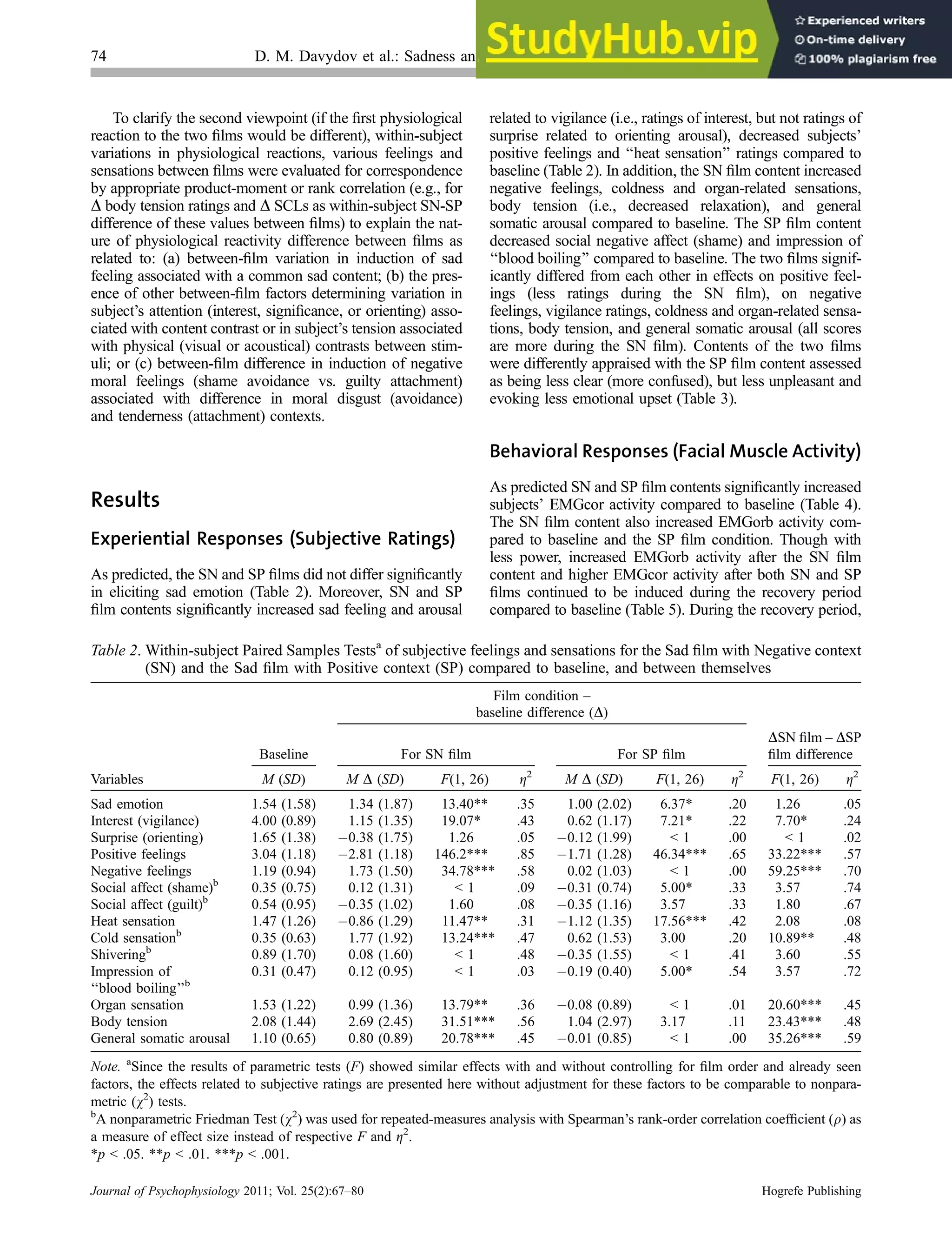
As predicted, the SN and SP films did not differ significantly
in eliciting sad emotion (Table 2). Moreover, SN and SP
film contents significantly increased sad feeling and arousal
related to vigilance (i.e., ratings of interest, but not ratings of
surprise related to orienting arousal), decreased subjects’
positive feelings and ‘‘heat sensation’’ ratings compared to
baseline (Table 2). In addition, the SN film content increased
negative feelings, coldness and organ-related sensations,
body tension (i.e., decreased relaxation), and general
somatic arousal compared to baseline. The SP film content
decreased social negative affect (shame) and impression of
‘‘blood boiling’’ compared to baseline. The two films signif-
icantly differed from each other in effects on positive feel-
ings (less ratings during the SN film), on negative
feelings, vigilance ratings, coldness and organ-related sensa-
tions, body tension, and general somatic arousal (all scores
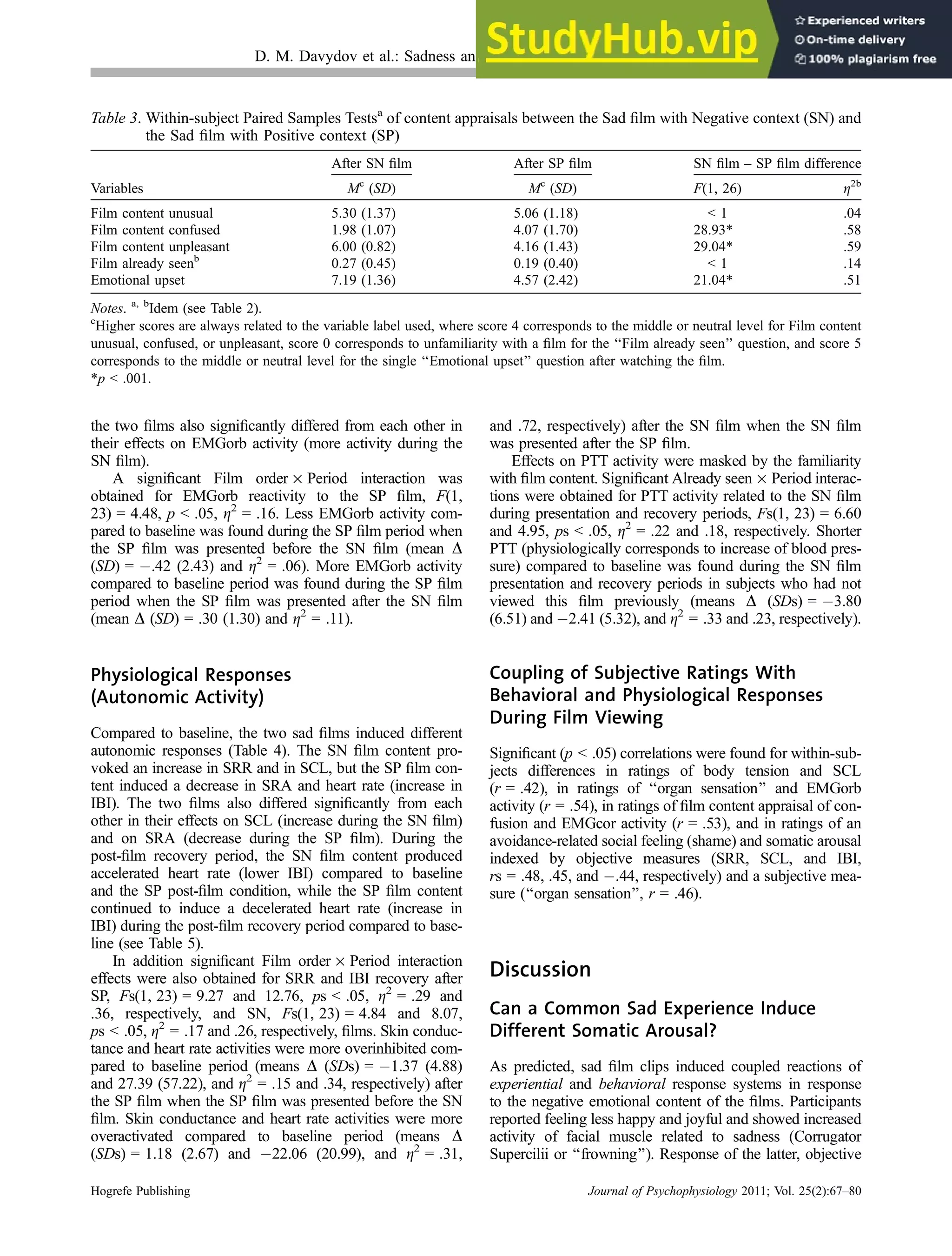
are more during the SN film). Contents of the two films
were differently appraised with the SP film content assessed
as being less clear (more confused), but less unpleasant and
evoking less emotional upset (Table 3).
Behavioral Responses (Facial Muscle Activity)
As predicted SN and SP film contents significantly increased
subjects’ EMGcor activity compared to baseline (Table 4).
The SN film content also increased EMGorb activity com-
pared to baseline and the SP film condition. Though with
less power, increased EMGorb activity after the SN film
content and higher EMGcor activity after both SN and SP
films continued to be induced during the recovery period
compared to baseline (Table 5). During the recovery period,
Table 2. Within-subject Paired Samples Testsa
of subjective feelings and sensations for the Sad film with Negative context
(SN) and the Sad film with Positive context (SP) compared to baseline, and between themselves
Film condition –
baseline difference (D)
Baseline For SN film For SP film
DSN film – DSP
film difference
Variables M (SD) M D (SD) F(1, 26) g2
M D (SD) F(1, 26) g2
F(1, 26) g2
Sad emotion 1.54 (1.58) 1.34 (1.87) 13.40** .35 1.00 (2.02) 6.37* .20 1.26 .05
Interest (vigilance) 4.00 (0.89) 1.15 (1.35) 19.07* .43 0.62 (1.17) 7.21* .22 7.70* .24
Surprise (orienting) 1.65 (1.38) 0.38 (1.75) 1.26 .05 0.12 (1.99)  1 .00  1 .02
Positive feelings 3.04 (1.18) 2.81 (1.18) 146.2*** .85 1.71 (1.28) 46.34*** .65 33.22*** .57
Negative feelings 1.19 (0.94) 1.73 (1.50) 34.78*** .58 0.02 (1.03)  1 .00 59.25*** .70
Social affect (shame)b
0.35 (0.75) 0.12 (1.31)  1 .09 0.31 (0.74) 5.00* .33 3.57 .74
Social affect (guilt)b
0.54 (0.95) 0.35 (1.02) 1.60 .08 0.35 (1.16) 3.57 .33 1.80 .67
Heat sensation 1.47 (1.26) 0.86 (1.29) 11.47** .31 1.12 (1.35) 17.56*** .42 2.08 .08
Cold sensationb
0.35 (0.63) 1.77 (1.92) 13.24*** .47 0.62 (1.53) 3.00 .20 10.89** .48
Shiveringb
0.89 (1.70) 0.08 (1.60)  1 .48 0.35 (1.55)  1 .41 3.60 .55
Impression of
‘‘blood boiling’’b
0.31 (0.47) 0.12 (0.95)  1 .03 0.19 (0.40) 5.00* .54 3.57 .72
Organ sensation 1.53 (1.22) 0.99 (1.36) 13.79** .36 0.08 (0.89)  1 .01 20.60*** .45
Body tension 2.08 (1.44) 2.69 (2.45) 31.51*** .56 1.04 (2.97) 3.17 .11 23.43*** .48
General somatic arousal 1.10 (0.65) 0.80 (0.89) 20.78*** .45 0.01 (0.85)  1 .00 35.26*** .59
Note. a
Since the results of parametric tests (F) showed similar effects with and without controlling for film order and already seen
factors, the effects related to subjective ratings are presented here without adjustment for these factors to be comparable to nonpara-
metric (v2
) tests.
b
A nonparametric Friedman Test (v2
) was used for repeated-measures analysis with Spearman’s rank-order correlation coefficient (q) as
a measure of effect size instead of respective F and g2
.
*p  .05. **p  .01. ***p  .001.
74 D. M. Davydov et al.: Sadness and Physiological Response Patterns
Journal of Psychophysiology 2011; Vol. 25(2):67–80 Hogrefe Publishing
the two films also significantly differed from each other in
their effects on EMGorb activity (more activity during the
SN film).
A significant Film order · Period interaction was
obtained for EMGorb reactivity to the SP film, F(1,
23) = 4.48, p  .05, g2
= .16. Less EMGorb activity com-
pared to baseline was found during the SP film period when
the SP film was presented before the SN film (mean D
(SD) = .42 (2.43) and g2
= .06). More EMGorb activity
compared to baseline period was found during the SP film
period when the SP film was presented after the SN film
(mean D (SD) = .30 (1.30) and g2
= .11).
Physiological Responses
(Autonomic Activity)
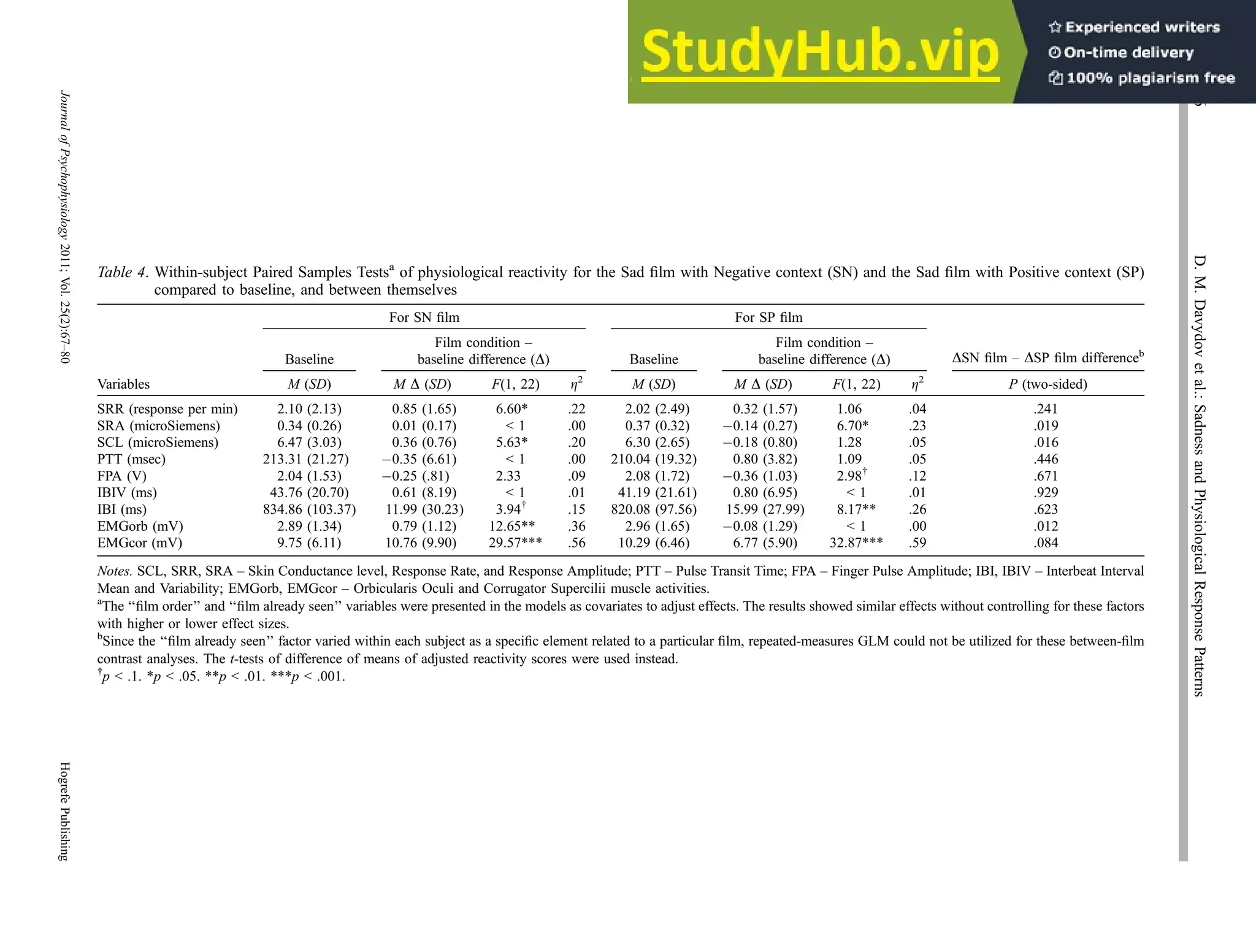
Compared to baseline, the two sad films induced different
autonomic responses (Table 4). The SN film content pro-
voked an increase in SRR and in SCL, but the SP film con-
tent induced a decrease in SRA and heart rate (increase in
IBI). The two films also differed significantly from each
other in their effects on SCL (increase during the SN film)
and on SRA (decrease during the SP film). During the
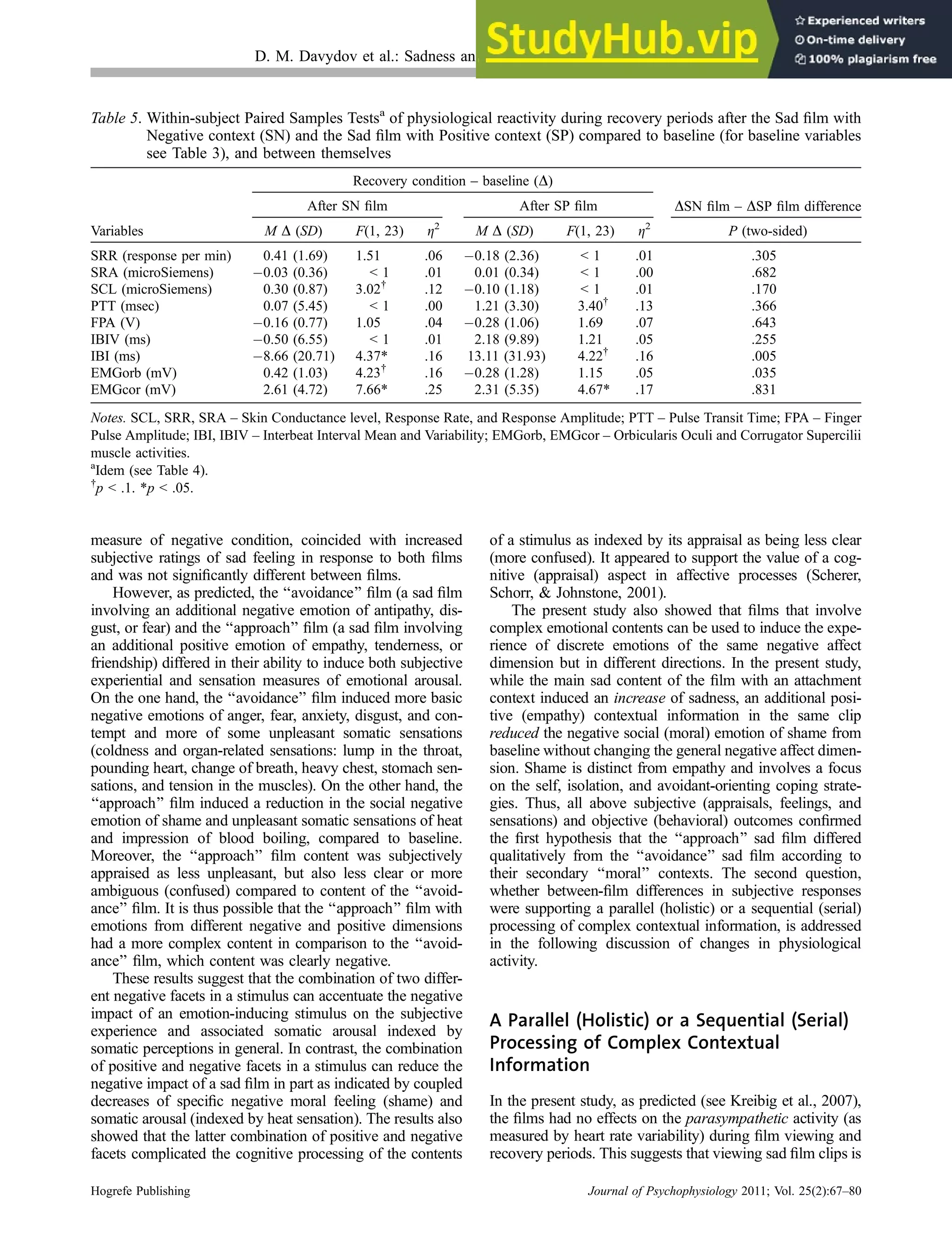
post-film recovery period, the SN film content produced
accelerated heart rate (lower IBI) compared to baseline
and the SP post-film condition, while the SP film content
continued to induce a decelerated heart rate (increase in
IBI) during the post-film recovery period compared to base-
line (see Table 5).
In addition significant Film order · Period interaction
effects were also obtained for SRR and IBI recovery after
SP, Fs(1, 23) = 9.27 and 12.76, ps  .05, g2
= .29 and
.36, respectively, and SN, Fs(1, 23) = 4.84 and 8.07,
ps  .05, g2
= .17 and .26, respectively, films. Skin conduc-
tance and heart rate activities were more overinhibited com-
pared to baseline period (means D (SDs) = 1.37 (4.88)
and 27.39 (57.22), and g2
= .15 and .34, respectively) after
the SP film when the SP film was presented before the SN
film. Skin conductance and heart rate activities were more
overactivated compared to baseline period (means D
(SDs) = 1.18 (2.67) and 22.06 (20.99), and g2
= .31,
and .72, respectively) after the SN film when the SN film
was presented after the SP film.
Effects on PTT activity were masked by the familiarity
with film content. Significant Already seen · Period interac-
tions were obtained for PTT activity related to the SN film
during presentation and recovery periods, Fs(1, 23) = 6.60
and 4.95, ps  .05, g2
= .22 and .18, respectively. Shorter
PTT (physiologically corresponds to increase of blood pres-
sure) compared to baseline was found during the SN film
presentation and recovery periods in subjects who had not
viewed this film previously (means D (SDs) = 3.80
(6.51) and 2.41 (5.32), and g2
= .33 and .23, respectively).
Coupling of Subjective Ratings With
Behavioral and Physiological Responses
During Film Viewing
Significant (p  .05) correlations were found for within-sub-
jects differences in ratings of body tension and SCL
(r = .42), in ratings of ‘‘organ sensation’’ and EMGorb
activity (r = .54), in ratings of film content appraisal of con-
fusion and EMGcor activity (r = .53), and in ratings of an
avoidance-related social feeling (shame) and somatic arousal
indexed by objective measures (SRR, SCL, and IBI,
rs = .48, .45, and .44, respectively) and a subjective mea-
sure (‘‘organ sensation’’, r = .46).
Discussion
Can a Common Sad Experience Induce
Different Somatic Arousal?
As predicted, sad film clips induced coupled reactions of
experiential and behavioral response systems in response
to the negative emotional content of the films. Participants
reported feeling less happy and joyful and showed increased
activity of facial muscle related to sadness (Corrugator
Supercilii or ‘‘frowning’’). Response of the latter, objective
Table 3. Within-subject Paired Samples Testsa
of content appraisals between the Sad film with Negative context (SN) and
the Sad film with Positive context (SP)
After SN film After SP film SN film – SP film difference
Variables Mc
(SD) Mc
(SD) F(1, 26) g2b
Film content unusual 5.30 (1.37) 5.06 (1.18)  1 .04
Film content confused 1.98 (1.07) 4.07 (1.70) 28.93* .58
Film content unpleasant 6.00 (0.82) 4.16 (1.43) 29.04* .59
Film already seenb
0.27 (0.45) 0.19 (0.40)  1 .14
Emotional upset 7.19 (1.36) 4.57 (2.42) 21.04* .51
Notes. a, b
Idem (see Table 2).
c
Higher scores are always related to the variable label used, where score 4 corresponds to the middle or neutral level for Film content
unusual, confused, or unpleasant, score 0 corresponds to unfamiliarity with a film for the ‘‘Film already seen’’ question, and score 5
corresponds to the middle or neutral level for the single ‘‘Emotional upset’’ question after watching the film.
*p  .001.
D. M. Davydov et al.: Sadness and Physiological Response Patterns 75
Hogrefe Publishing Journal of Psychophysiology 2011; Vol. 25(2):67–80
Table 4. Within-subject Paired Samples Testsa
of physiological reactivity for the Sad film with Negative context (SN) and the Sad film with Positive context (SP)
compared to baseline, and between themselves
For SN film For SP film
DSN film – DSP film differenceb
Baseline
Film condition –
baseline difference (D) Baseline
Film condition –
baseline difference (D)
Variables M (SD) M D (SD) F(1, 22) g2
M (SD) M D (SD) F(1, 22) g2
P (two-sided)
SRR (response per min) 2.10 (2.13) 0.85 (1.65) 6.60* .22 2.02 (2.49) 0.32 (1.57) 1.06 .04 .241
SRA (microSiemens) 0.34 (0.26) 0.01 (0.17)  1 .00 0.37 (0.32) 0.14 (0.27) 6.70* .23 .019
SCL (microSiemens) 6.47 (3.03) 0.36 (0.76) 5.63* .20 6.30 (2.65) 0.18 (0.80) 1.28 .05 .016
PTT (msec) 213.31 (21.27) 0.35 (6.61)  1 .00 210.04 (19.32) 0.80 (3.82) 1.09 .05 .446
FPA (V) 2.04 (1.53) 0.25 (.81) 2.33 .09 2.08 (1.72) 0.36 (1.03) 2.98 .12 .671
IBIV (ms) 43.76 (20.70) 0.61 (8.19)  1 .01 41.19 (21.61) 0.80 (6.95)  1 .01 .929
IBI (ms) 834.86 (103.37) 11.99 (30.23) 3.94 .15 820.08 (97.56) 15.99 (27.99) 8.17** .26 .623
EMGorb (mV) 2.89 (1.34) 0.79 (1.12) 12.65** .36 2.96 (1.65) 0.08 (1.29)  1 .00 .012
EMGcor (mV) 9.75 (6.11) 10.76 (9.90) 29.57*** .56 10.29 (6.46) 6.77 (5.90) 32.87*** .59 .084
Notes. SCL, SRR, SRA – Skin Conductance level, Response Rate, and Response Amplitude; PTT – Pulse Transit Time; FPA – Finger Pulse Amplitude; IBI, IBIV – Interbeat Interval
Mean and Variability; EMGorb, EMGcor – Orbicularis Oculi and Corrugator Supercilii muscle activities.
a
The ‘‘film order’’ and ‘‘film already seen’’ variables were presented in the models as covariates to adjust effects. The results showed similar effects without controlling for these factors
with higher or lower effect sizes.
b
Since the ‘‘film already seen’’ factor varied within each subject as a specific element related to a particular film, repeated-measures GLM could not be utilized for these between-film
contrast analyses. The t-tests of difference of means of adjusted reactivity scores were used instead.
p  .1. *p  .05. **p  .01. ***p  .001.
76
D.
M.
Davydov
et
al.:
Sadness
and
Physiological
Response
Patterns
Journal
of
Psychophysiology
2011;
Vol.
25(2):67–80
Hogrefe
Publishing
measure of negative condition, coincided with increased
subjective ratings of sad feeling in response to both films
and was not significantly different between films.
However, as predicted, the ‘‘avoidance’’ film (a sad film
involving an additional negative emotion of antipathy, dis-
gust, or fear) and the ‘‘approach’’ film (a sad film involving
an additional positive emotion of empathy, tenderness, or
friendship) differed in their ability to induce both subjective
experiential and sensation measures of emotional arousal.
On the one hand, the ‘‘avoidance’’ film induced more basic
negative emotions of anger, fear, anxiety, disgust, and con-
tempt and more of some unpleasant somatic sensations
(coldness and organ-related sensations: lump in the throat,
pounding heart, change of breath, heavy chest, stomach sen-
sations, and tension in the muscles). On the other hand, the
‘‘approach’’ film induced a reduction in the social negative
emotion of shame and unpleasant somatic sensations of heat
and impression of blood boiling, compared to baseline.
Moreover, the ‘‘approach’’ film content was subjectively
appraised as less unpleasant, but also less clear or more
ambiguous (confused) compared to content of the ‘‘avoid-
ance’’ film. It is thus possible that the ‘‘approach’’ film with
emotions from different negative and positive dimensions
had a more complex content in comparison to the ‘‘avoid-
ance’’ film, which content was clearly negative.
These results suggest that the combination of two differ-
ent negative facets in a stimulus can accentuate the negative
impact of an emotion-inducing stimulus on the subjective
experience and associated somatic arousal indexed by
somatic perceptions in general. In contrast, the combination
of positive and negative facets in a stimulus can reduce the
negative impact of a sad film in part as indicated by coupled
decreases of specific negative moral feeling (shame) and
somatic arousal (indexed by heat sensation). The results also
showed that the latter combination of positive and negative
facets complicated the cognitive processing of the contents
of a stimulus as indexed by its appraisal as being less clear
(more confused). It appeared to support the value of a cog-
nitive (appraisal) aspect in affective processes (Scherer,
Schorr,  Johnstone, 2001).
The present study also showed that films that involve
complex emotional contents can be used to induce the expe-
rience of discrete emotions of the same negative affect
dimension but in different directions. In the present study,
while the main sad content of the film with an attachment
context induced an increase of sadness, an additional posi-
tive (empathy) contextual information in the same clip
reduced the negative social (moral) emotion of shame from
baseline without changing the general negative affect dimen-
sion. Shame is distinct from empathy and involves a focus
on the self, isolation, and avoidant-orienting coping strate-
gies. Thus, all above subjective (appraisals, feelings, and
sensations) and objective (behavioral) outcomes confirmed
the first hypothesis that the ‘‘approach’’ sad film differed
qualitatively from the ‘‘avoidance’’ sad film according to
their secondary ‘‘moral’’ contexts. The second question,
whether between-film differences in subjective responses
were supporting a parallel (holistic) or a sequential (serial)
processing of complex contextual information, is addressed
in the following discussion of changes in physiological
activity.
A Parallel (Holistic) or a Sequential (Serial)
Processing of Complex Contextual
Information
In the present study, as predicted (see Kreibig et al., 2007),
the films had no effects on the parasympathetic activity (as
measured by heart rate variability) during film viewing and
recovery periods. This suggests that viewing sad film clips is
Table 5. Within-subject Paired Samples Testsa
of physiological reactivity during recovery periods after the Sad film with
Negative context (SN) and the Sad film with Positive context (SP) compared to baseline (for baseline variables
see Table 3), and between themselves
Recovery condition – baseline (D)
DSN film – DSP film difference
After SN film After SP film
Variables M D (SD) F(1, 23) g2
M D (SD) F(1, 23) g2
P (two-sided)
SRR (response per min) 0.41 (1.69) 1.51 .06 0.18 (2.36)  1 .01 .305
SRA (microSiemens) 0.03 (0.36)  1 .01 0.01 (0.34)  1 .00 .682
SCL (microSiemens) 0.30 (0.87) 3.02 .12 0.10 (1.18)  1 .01 .170
PTT (msec) 0.07 (5.45)  1 .00 1.21 (3.30) 3.40 .13 .366
FPA (V) 0.16 (0.77) 1.05 .04 0.28 (1.06) 1.69 .07 .643
IBIV (ms) 0.50 (6.55)  1 .01 2.18 (9.89) 1.21 .05 .255
IBI (ms) 8.66 (20.71) 4.37* .16 13.11 (31.93) 4.22 .16 .005
EMGorb (mV) 0.42 (1.03) 4.23 .16 0.28 (1.28) 1.15 .05 .035
EMGcor (mV) 2.61 (4.72) 7.66* .25 2.31 (5.35) 4.67* .17 .831
Notes. SCL, SRR, SRA – Skin Conductance level, Response Rate, and Response Amplitude; PTT – Pulse Transit Time; FPA – Finger
Pulse Amplitude; IBI, IBIV – Interbeat Interval Mean and Variability; EMGorb, EMGcor – Orbicularis Oculi and Corrugator Supercilii
muscle activities.
a
Idem (see Table 4).
p  .1. *p  .05.
D. M. Davydov et al.: Sadness and Physiological Response Patterns 77
Hogrefe Publishing Journal of Psychophysiology 2011; Vol. 25(2):67–80
a relatively passive task that cannot evoke an active engage-
ment or that would need affect regulation in a healthy sam-
ple (Mauss et al., 2005; Volokhov  Demaree, 2010).
Indeed active engagement or affective regulation has been
associated with vagus activity changes in active laboratory
challenges (Ottaviani et al., 2008). As a consequence, the
physiological changes found in the present study were attrib-
uted to sympathetic arousal variations. Compared to the rest-
ing (baseline) period, the ‘‘avoidance’’ film viewing induced
an increase in sympathetic arousal as indexed by an increase
in SCL and response rate in all subjects and by lower PTT in
subjects who had not previously seen this film. The condi-
tion of an augmented sympathetic arousal was extended to
the recovery period after this film presentation. This was
then indexed by a higher heart rate in all subjects and by
a lower PTT in subjects who had not previously seen this
film. In contrast, compared to the resting (baseline) period,
the ‘‘approach’’ film induced a decrease in sympathetic
arousal as indexed during the film viewing by a decrease
in amplitude of skin conductance responses and during both
periods by lower heart rate.
Thus, the films induced a qualitative (bidirectional or
binary: 1/ 1) contrast in physiological arousal responses
since responses went in different directions relative to base-
line and this started already during film presentation. It con-
firmed the somatic arousal differences between the
‘‘approach’’ and the ‘‘avoidance’’ sad films indicated by
subjective sensations. This result answers the second ques-
tion as to whether between-film differences in subjective
responses were supporting a parallel (holistic) or a sequen-
tial (serial) processing of complex contextual information.
It appeared to support the viewpoint of a parallel (holistic)
rather than a serial processing of complex contextual infor-
mation submitted by films. Indeed, the results of the present
study showed that, although two sad films were both asso-
ciated with higher negative affective (subjective and behav-
ioral) responses, they determined physiological arousal in
opposite directions (up or down) from the baseline levels.
The within-subject arousal variations were induced already
during the films viewing by the cognitive appraisals of the
same common sad or depression-like content (unjust suffer-
ing, loss, and grief) presenting in the two different contexts.
This arousal-related contrast of autonomic and behavioral
activities continued to spread through the post-film ‘‘recov-
ery’’ period and was not dependent on differences in other
arousal-related factors such as interest and tension. These
results thus appeared to support the viewpoint that the level
of physiological arousal would be simultaneously (Shapiro
et al., 2001), but not serially (Fredrickson  Levenson,
1998), modulated by an additional emotional context of
the sad stimulus. Indeed, if it were serially modulated, only
the post-film recovery period would have shown the
detected differences in physiological arousal (see Figure 1).
In addition, the results of the present study showed that
an additional affective context affected physiological arousal
not according to an ‘‘undo’’ mechanism. This mechanism
would have been found if the physiological ‘‘cost’’ of
experiencing a negative emotion was found to be mitigated
by the simultaneous living of a positive one (Fredrickson 
Levenson, 1998; Shapiro et al., 2001). This was not the
case. Indeed, a temporal coupling of the negative affects
of sadness and disgust at relatively high levels of intensity
was related to augmented physiological arousal above base-
line levels, thus indexing an arousal-increasing condition.
On the contrary, an affect related to the positive experience
of tenderness did not just undo the effects of an intense neg-
ative sad subjective experience, but the coupling of these
two emotions was associated with decreased physiological
arousal below baseline levels, and thus indexing an arou-
sal-over-decreasing condition. This overdecreased physio-
logical arousal condition corresponds to the previously
described hypoarousal affective conditions associated with
attachment coping behavior suitable to the present
‘‘approach’’ film’s context (Davydov, Shapiro, Goldstein,
 Chicz-DeMet, 2005, 2007; Gold  Chrousos, 2002;
Nolen-Hoeksema, 1991).
Thus, negative subjective experiences within a partici-
pant induced by viewing of a sad film were accompanied
by either an up- or downshift in physiological and bodily
sensation components of arousal from baseline coupled
with either avoidance or attachment context, respectively.
The midarousal condition of the baseline resting period
was associated with a less disturbed state of subjective expe-
rience.
Some challenges related to behavioral responses should
be taken into account. Indeed, on the one hand, the viewing
of the ‘‘approach’’ film was found to be associated with the
expected coupling of a decrease of positive feelings and a
decrease in activity of the Orbicularis Oculi, pars lateralis,
a facial muscle known to be related to enjoyment and invol-
untary smile (Ekman, 2003). On the other hand, the ‘‘avoid-
ance’’ film was found to be associated with the coupling of a
decrease of positive feelings and an increase in activity of the
Orbicularis Oculi muscle. Ekman (2003) proposed that, in
some cases, activity over the Orbicularis Oculi muscle could
be a sign of disgust and not of enjoyment. In the present
study, the sad ‘‘avoidance’’ film content induced the emotion
of disgust. Also, the proposed association of the Orbicularis
Oculi muscle activity with disgust was supported by the find-
ings of within-subject variations in this muscle activity cou-
pled with variations in ‘‘organ sensation’’ ratings, which
could be attributed to a somatic dimension of the disgust
emotion. A moderate heart rate decrease during the ‘‘avoid-
ance’’ film viewing was also attributed to the additional dis-
gust context of its content (Rohrmann  Hopp, 2008). These
results suggest that activity over the Orbicularis Oculi muscle
should be controlled for this specific negative emotion effect,
which could be considered as an objective sign of intensity of
the positive emotional response. Finally, the study also
showed that part of the within-subject variation in facial
activity associated with negative emotions (Corrugator
Supercilii or ‘‘frowning’’ muscle) could be attributed to the
variations in subject’s efforts to process the complex film
content during film viewing (i.e., cognitive load).
78 D. M. Davydov et al.: Sadness and Physiological Response Patterns
Journal of Psychophysiology 2011; Vol. 25(2):67–80 Hogrefe Publishing
Limitations and Recommendations
for Future Research
This initial study supported the feasibility of assessing com-
plex emotions, but it is necessarily limited. Definitive inter-
pretations may require well-focused further work. The
selection of films was based on previous literature ratings.
However, the use of two different films might not have been
an optimal experimental strategy in that context, since the
films may differ in other emotional and non-emotional
domains affecting physiology and behavior and which could
not be easily controlled for. In future studies, more attention
should be applied to standardization of stimuli to diminish the
potential influence from other factors. For example, the same
stimuli could be presented with different sound tracks with
more negative-related or more positive-related information.
The method of inducing mood states by means of the
presentation of films with a particular emotional (e.g., sad)
content is widely used in experimental laboratory studies
examining its effects on cognition, behavior, and physiolog-
ical arousal (Fredrickson  Levenson, 1998; Gračanin et al.,
2007; Kreibig et al., 2007; Mauss et al., 2005; Van der Does,
2002; Van Gucht et al., 2008; Volokhov  Demaree, 2010).
This procedure relies on the ‘‘pureness’’ of the induced emo-
tion based on the self-reported perception of a majority of
viewers. It should however be noted that previous findings
have shown inconsistencies in the effects of this induction
method of complex stimuli compared to induction proce-
dures of less complex stimuli such as fixed pictures (e.g.,
Lang, Bradley,  Cuthbert, 1997). The present results
should thus be replicated with a larger sample including
both genders. Also, future studies should ideally include a
‘‘pure’’ emotion-induced condition as a control group to
which the mixed emotional states conditions could be com-
pared to. The induction of a single emotional state in com-
parison to emotional films inducing multiple primary
emotions (e.g., happiness, anger, fear, and sadness) would
allow to test in a more controlled way the direction of the
effects (arousal increasing or decreasing from baseline and
in comparison to a ‘‘pure’’ condition). The effects of the pre-
sentation order and of the familiarity with films on facial
expressions and autonomic reactivity and recovery found
in the present study should also be taken into account in
future studies. The designs should be constructed according
to potential emotional interference of thoughts related to the
second film content with probable long-lasting ruminations
associated with the previous film content.
Summary and Conclusion
The present study dealt with the complexity of emotional
states induced by films with similar sad contents. The general
subjective experience evaluations of sadness and the behav-
ioral responses indexed by the ‘‘frowning’’ facial activity
corresponded to the common sad content in both films. Their
additional negative (avoidance) or positive (attachment) con-
texts were found to be distinguished by the measurement of
other discrete subjective experiential, sensation, and apprai-
sal evaluations, by behavioral responses and, in particular,
by the autonomic responses.
Acknowledgments
The authors would like to thank Professor David Shapiro
(UCLA, USA) for his comments and suggestions on a pre-
vious version of this manuscript. This research was sup-
ported by a postdoc position from the Research Fund of
the Université Catholique de Louvain (FSR), Belgium
granted to Dmitry M. Davydov and by Grant 1.5.175.06
from the Belgian National Fund for Scientific Research
(FRS-FNRS) granted to Olivier Luminet.
References
Baumgartner, T., Esslen, M.,  Jäncke, L. (2006). From emotion
perception to emotion experience: emotions evoked by
pictures and classical music. International Journal of
Psychophysiology, 60, 34–43.
Boucsein, W. (1992). Electrodermal activity. New York, NY:
Plenum Press.
Bradley, M. M., Codispoti, M., Cuthbert, B. N.,  Lang, P. J.
(2001). Emotion and motivation I: Defensive and appetitive
reactions in picture processing. Emotion, 1, 276–298.
Buitelaar, J. K. (1995). Attachment and social withdrawal in
autism: Hypotheses and findings. Behaviour, 132, 319–350.
Davydov, D. M., Shapiro, D.,  Goldstein, I. B. (2010). Relation
of resting baroreflex activity to 24-hour blood pressure and
mood in healthy subjects. Journal of Psychophysiology, 24,
149–160.
Davydov, D. M., Shapiro, D., Cook, I. A.,  Goldstein, I. B.
(2007). Baroreflex mechanisms in major depression.
Progress in Neuro-Psychopharmacology  Biological
Psychiatry, 31, 164–177.
Davydov, D. M., Shapiro, D., Goldstein, I. B.,  Chicz-DeMet,
A. (2005). Moods in everyday situations: Effects of
menstrual cycle, work, and stress hormones. Journal of
Psychosomatic Research, 58, 343–349.
Davydov, D. M., Shapiro, D., Goldstein, I. B.,  Chicz-DeMet,
A. (2007). Moods in everyday situations: Effects of combi-
nation of different arousal-related factors. Journal of Psy-
chosomatic Research, 62, 321–329.
de Jong, P. J., Peters, M.,  Vanderhallen, I. (2002). Disgust and
disgust sensitivity in spider phobia: Facial EMG in response
to spider and oral disgust imagery. Journal of Anxiety
Disorders, 16, 477–493.
Ekman, P. (1989). The argument and evidence about universals
in facial expressions of emotion. In H. Wagner,  A.
Manstead (Eds.), Handbook of social psychophysiology (pp.
143–164). London, UK: Wiley.
Ekman, P. (2003). Darwin, deception, and facial expression.
Annals of the New York Academy of Sciences, 1000, 205–221.
Felblinger, J.,  Boesch, C. (1997). Amplitude demodulation of
the electrocardiogram signal (ECG) for respiration monitor-
ing and compensation during MR examinations. Magnetic
Resonance in Medicine, 38, 129–136.
Fredrickson, B. L.,  Levenson, R. W. (1998). Positive emotions
speed recovery from the cardiovascular sequelae of negative
emotions. Cognition  Emotion, 12, 191–220.
Fridlund, A. J.,  Cacioppo, J. T. (1986). Guidelines for human
electromyographic research. Psychophysiology, 23, 567–589.
Friedman, B. H., Allen, M. T., Christie, I. C.,  Santucci, A. K.
(2002). Quantification issues in time- and frequency-domain
measures of heart rate variability. IEEE Engineering in
Medicine and Biology Magazine, 21, 35–40.
D. M. Davydov et al.: Sadness and Physiological Response Patterns 79
Hogrefe Publishing Journal of Psychophysiology 2011; Vol. 25(2):67–80
Gold, P. W.,  Chrousos, G. P. (2002). Organization of the stress
system and its dysregulation in melancholic and atypical
depression: high vs low CRH/NE states. Molecular Psychi-
atry, 7, 254–275.
Gračanin, A., Kardum, I.,  Hudek-Knežević, J. (2007).
Relations between dispositional expressivity and physiolog-
ical changes during acute positive and negative affect.
Psychological Topics, 16, 311–328.
Koelsch, S., Remppis, A., Sammler, D., Jentschke, S., Mietchen,
D., Fritz, T., Bonnemeier, H.,  Siebel, W. A. (2007). A
cardiac signature of emotionality. The European Journal of
Neuroscience, 26, 3328–3338.
Kreibig, S. D., Wilhelm, F. H., Roth, W. T.,  Gross, J. J. (2007).
Cardiovascular, electrodermal, and respiratory response pat-
terns to fear- and sadness-inducing films. Psychophysiology,
44, 787–806.
Lang, P. J., Bradley, M. M.,  Cuthbert, B. N. (1997). International
Affective Picture System(IAPS): Technical Manualand Affective
Ratings. Gainesville, FL: NIMH Center for the Study of
Emotion and Attention, University of Florida.
Lovell, D. (Producer) (1979). Zeffirelli, F. (Director) (1979). The
Champ [Film]. Culver City, CA: MGM/UA.
Luminet, O., Bouts, P., Delie, F., Manstead, A. S. R.,  Rimé, B.
(2000). Social sharing of emotion following exposure to a
negatively valenced situation. Cognition  Emotion, 14,
661–688.
Mauss,I.B.,Levenson,R.W.,McCarter,L.,Wilhelm,F.H.,Gross,
J. J. (2005). The tie that binds? Coherence among emotion
experience, behavior, and physiology. Emotion, 5, 175–190.
Medford, N., Phillips, M. L., Brierley, B., Brammer, M.,
Bullmore, E. T.,  David, A. S. (2005). Emotional memory:
Separating content and context. Psychiatry Research: Neu-
roimaging, 138, 247–258.
Nolen-Hoeksema, S. (1991). Responses to depression and their
effects on the duration of depressive episodes. Journal of
Abnormal Psychology, 100, 569–582.
Ortony, A.,  Turner, T. J. (1990). What’s basic about basic
emotions? Psychological Review, 97, 315–331.
Ottaviani, C., Shapiro, D., Davydov, D. M.,  Goldstein, I. B.
(2008). Autonomic stress response modes and ambulatory
heart rate level and variability. Journal of Psychophysiology,
22, 28–40.
Pollak, M. H.,  Obrist, P. A. (1983). Aortic-radial pulse transit
time and ECG Q-wave to radial pulse wave interval as
indices of beat-by-beat blood pressure change. Psychophys-
iology, 20, 21–28.
Rimé, B., Finkenauer, C., Luminet, O., Zech, E.,  Philippot, P.
(1998). Social sharing of emotion: New evidence and new
questions. In W. Stroebe,  M. Hewstone (Eds.), European
Review of Social Psychology (Vol. 9, pp. 145–189).
Chichester, UK: Wiley.
Rimé, B., Philippot, P., Boca, S.,  Mesquita, B. (1992). Long-
lasting cognitive and social consequences of emotion: Social
sharing and rumination. In W. Stroebe,  M. Hewstone
(Eds.), European Review of Social Psychology (Vol. 3, pp.
225–258). Chichester, UK: Wiley.
Roberts, N. A., Levenson, R. W.,  Gross, J. J. (2008).
Cardiovascular costs of emotion suppression cross ethnic
lines. International Journal of Psychophysiology, 70, 82–87.
Rohrmann, S.,  Hopp, H. (2008). Cardiovascular indicators of
disgust. International Journal of Psychophysiology, 68, 201–
208.
Rozin, P. (1999). Preadaptation and the puzzles and properties of
pleasure. In D. Kahneman, E. Diener,  N. Schwarz (Eds.),
Well being: The foundations of hedonic psychology (pp. 109–
133). New York, NY: Russell Sage.
Schaefer, A., Collette, F., Philippot, P., Vanderlinden, M.,
Laureys, S., Delfiore, G., . . . Salmon, E. (2003). Neural
correlates of ‘‘hot’’ and ‘‘cold’’ emotional processing: A
multilevel approach to the functional anatomy of emotions.
Neuroimage, 18, 938–949.
Schaefer, A., Nils, F., Sanchez, X.,  Philippot, P. (2008).
Assessing the effectiveness of a large database of emotion-
eliciting films: A new tool for emotion researchers. Technical
report, University of Louvain, 10 Place du Cardinal Mercier,
1348-Louvain-La-Neuve, Belgium.
Scherer, K. R., Schorr, A.,  Johnstone, T. (2001). Appraisal
processes in emotion: Theory, methods, research. New York,
NY: Oxford University Press.
Shapiro, D., Jamner, L. D., Goldstein, I. B.,  Delfino, R. J.
(2001). Striking a chord: Moods, blood pressure, and heart
rate in everyday life. Psychophysiology, 38, 197–204.
Stark, R., Stone, A., White, V. (Producers),  Ross, H. (Director)
(1989). Steel Magnolias [Film]. TriStar Pictures.
Stemmler, G., Aue, T.,  Wacker, J. (2007). Anger and fear:
Separable effects of emotion and motivational direction on
somatovisceral responses. International Journal of Psycho-
physiology, 66, 141–153.
Stemmler, G., Heldmann, M., Pauls, C. A.,  Scherer, T. (2001).
Constraints for emotion specificity in fear and anger: The
context counts. Psychophysiology, 38, 275–291.
Uryvaev, Iu. V., Davydov, D. M.,  Gavrilenko, A. Ia. (1988).
An improved method of speech audiometry. Vestnik Otori-
nolaringologii [Bulletin of Otolaryngology], 3, 34–39.
Uryvaev, Iu. V., Davydov, D. M.,  Gavrilenko, A. Ia. (1991).
Study of food dominants by means of a verbal test.
Fiziologiia Cheloveka [Human Physiology], 17, 67–72.
Van der Does, W. (2002). Different types of experimentally
induced sad mood? Behavior Therapy, 33, 551–561.
Van Gucht, D., Vansteenwegen, D., Beckers, T., Hermans, D.,
Baeyens, F.,  Van den Bergh, O. (2008). Repeated cue
exposure effects on subjective and physiological indices of
chocolate craving. Appetite, 50, 19–24.
Volokhov, R. N.,  Demaree, H. A. (2010). Spontaneous
emotion regulation to positive and negative stimuli. Brain
and Cognition, 73, 1–6.
Wallbott, H. G.,  Scherer, K. R. (1986). How universal and
specific is emotional experience? Evidence from 27 countries
on five continents. Social Science Information, 25, 763–795.
Watson, D., Clark, L. A.,  Tellegen, A. (1988). Development
and validation of brief measures of positive and negative
affect: The PANAS scales. Journal of Personality and Social
Psychology, 54, 1063–1070.
Zech, E.,  Rimé, B. (2005). Is talking about an emotional
experience helpful? Effects on emotional recovery and
perceived benefits. Clinical Psychology  Psychotherapy,
12, 270–287.
Accepted for publication: June 15, 2010
Dmitry M. Davydov
P. K. Anokhin Institute of Normal Physiology
11-4 Mokhovaya ulitsa
Moscow, 125009
Russia
Tel. +7 495 496-5234
E-mail d.m.davydov@gmail.com
80 D. M. Davydov et al.: Sadness and Physiological Response Patterns
Journal of Psychophysiology 2011; Vol. 25(2):67–80 Hogrefe Publishing

Affective Context Of Sadness And Physiological Response Patterns

  • 1.
    Article Affective Context ofSadness and Physiological Response Patterns Dmitry M. Davydov,1 Emmanuelle Zech,2 and Olivier Luminet2,3 1 P. K. Anokhin Institute of Normal Physiology, Moscow, Russia, 2 Research Institute for Psychological Sciences, Université Catholique de Louvain, Belgium, 3 Belgian National Fund for Scientific Research (FRS-FNRS), Brussels, Belgium Abstract. This study was conducted to test the hypothesis that two films that induce a sad feeling would elicit different physiological responses depending on an additional context of the film contents related to either avoidance (disgust) or attachment (tenderness). Reactivity was evaluated for facial behavior, heart rate, pulse transit time, skin conductance, and subjective experience. Participants reported feeling less happy and showed increased facial activity related to the sad content of both films. The sad film related to avoidance induced an increase in skin conductance level and response rate. In contrast, the sad film related to attachment induced a decrease in amplitude of skin conductance responses and heart rate. The study showed that while the common sad content of both films disturbed mood or provoked negative feelings, additional affective contexts induced either a decrease or an increase in physiological arousal. Keywords: affective induction, film content appraisal, emotion, arousal, autonomic activity, facial activity Emotion is defined as a complex response with subjective, cognitive, motor, and autonomic components. Experiential, behavioral, and physiological response systems have been considered to show more or less coupled reactions depending onthe durationandvalidity of themeasures of emotionandits intensity (Mauss, Levenson, McCarter, Wilhelm, & Gross, 2005). However, under long-lasting conditions such as stressful events in everyday life, the coexistence of different emotions with either the same valence (e.g., two negative emotions) or different valences (i.e., one negative with one positive emotion) is common. In these conditions, simple affective stimuli (phrases, words, pictures, events, etc.) take place in different contexts that may obscure or transform perception of their emotional content (Medford et al., 2005; Uryvaev,Davydov,& Gavrilenko,1988,1991).Thismay fur- ther complicate the evaluation of the relationships between different response systems (Shapiro, Jamner, Goldstein, & Delfino, 2001). These complications have forced most researchers to restrict studies of emotional reactions to short-term periods and to the analysis of responses related to separate affective dimensions, for example, happiness, anger, or sadness (Bradley, Codispoti, Cuthbert, & Lang, 2001; Kreibig, Wilhelm, Roth, & Gross, 2007; Mauss et al., 2005; Stemmler, Aue, & Wacker, 2007; Stemmler, Heldmann, Pauls, & Scherer, 2001). However, emotional reactions are not simply short-term responses disappearing within a few seconds. Some response components can last longer, for min- utes or hours, and in pathological cases can be transformed into long-lasting moods or affective disorders, such as obses- sive worry and ruminations. Mental rumination and social sharing of emotion (the urge to talk about the affective expe- rience) are very frequent even after exposure to moderately arousing stimuli such as emotional films (Luminet, Bouts, Delie, Manstead, & Rimé, 2000; Rimé, Finkenauer, Luminet, Zech, & Philippot, 1998; Rimé, Philippot, Boca, & Mesquita, 1992). These long-lasting components may in turn modify emotional reactions related to the emotional events (Zech & Rimé, 2005). Several studieshaveactuallyfoundthatamixtureof oppo- site-valenced emotions can be experienced at the same time. For example, some people have been found to smile during or following negative emotional experiences (Ekman, 1989). In support of this, Fredrickson and Levenson (1998) showed that 50 subjects out of a sample of 72 spontaneously smiled at least once while viewing a sad film. Compared to subjectswhodidnotsmile,thosewhosmiledexhibitedamore rapid return to pre-film levels of cardiovascular activation. However, theyproposedthatwhena person smiles, especially in a negative emotional context, that person is not necessarily experiencing a positive emotion. Given the known connec- tions between facial action and autonomic nervous system activation, they proposed that facial configurations indicative of positive emotions, namely smiles, might have the ability to speedrecovery from thecardiovascular sequelae of a negative emotion,withor withoutaccompanyingchangesinsubjective experience. In contrast, Shapiro et al. (2001) showed that it was the subjective experience of positive affect, which com- pensated for the physiological changes associated with nega- tiveaffect.Intheir study,whenaffectivesubjectiveexperience was analyzed for two affects (two of negative valence or two Hogrefe Publishing Journal of Psychophysiology 2011; Vol. 25(2):67–80 DOI: 10.1027/0269-8803/a000031 2011 Federation of European Psychophysiology Societies
  • 2.
    of opposite valence)at a time, physiological responses were affected.Theauthorsindicatedthatanyaffectmayhavediffer- ent implications for blood pressure or heart rate,dependingon concurrent changes in the other affective dimensions. A posi- tive experience may undo the effects of a negative mood, whereaswhen two negative affectsare atrelatively high levels of intensity, the physiological effects are augmented. Recent data of Schaefer, Nils, Sanchez, and Philippot (2008) showed that emotional film clips of about 5–7 min of duration may elicit a mixture of two negative (e.g., sadness and disgust) feelings or a mixture of two opposite: negative (e.g., sadness) and positive (e.g., tenderness) feelings at the same time. The content of the sad film excerpts (‘‘The Champ’’ and ‘‘Steel Magnolias’’) used in Fredrickson and Levenson’s study (1998) had a negative content (sadness related to loss) presented in a positive (tenderness or friend- ship for a dead close relative) affective context (Lovell Zeffirelli, 1979; Stark, Stone, White, Ross, 1989). How- ever, Fredrickson and Levenson did not study responses to films with the negative content (e.g., sadness) presented in a negative (e.g., disgust) context. The current study was con- ducted to test the hypothesis thattwo affectivefilms whicheli- cit a common negative emotion (e.g., sadness) would elicit different physiological responses depending on an additional affectivecontext,eithernegativeorpositive.Differentcompo- nentsoftheemotionalreactionwereproposedtobeevaluated: behavioral, autonomic, subjective cognitive (appraisals), and experiential (feelings and sensations) in order to compare the response systems synergy (cooperative action) in processing of different contexts of the same affect. The present study is a laboratory-based context in which we explored some of the ideas raised in Fredrickson and Levenson (1998) and Shapiroet al.(2001),forexample,toinvestigatewhetherthere is an addedphysiological ‘‘cost’’ (increase in autonomic arou- sal) of experiencing multiple negative emotions simulta- neously and whether negative emotions can potentially be mitigatedbypositive ones.WhileShapiroetal.’s (2001) study proposed a parallel interaction of multiple feelings in their (mitigating or augmenting) effect on physiological arousal in everyday life, Fredrickson and Levenson’s (1998) study proposed that these arousal-relatedeffects of multiple feelings would be in sequence, that is, with a delay from period of film viewingtorecoveryperiod.These two different (‘‘sequential’’ and ‘‘parallel’’) concepts proposed two viewpoints on a con- tent appraisal mechanism during and after exposure to emo- tional films: A sequential appraisal of the several emotional componentsofcomplexstimulioraparallelappraisalofthese emotional components of films at the same time. Similar par- allel or sequentialpatterningof objectiveindicatorsoffeelings (facial expression) and mitigated or augmented physiological arousal (autonomic activity) in response to two different stim- uli was proposed to support one of the viewpoints. Beside sadness, the additional affective contextual information of the film clips had to induce another strong emotion, either negative or positive. In the current study, sadness was chosen as the common negative emotion to rep- licate the study of Fredrickson and Levenson (1998). Two additional emotions, either disgust (negative) or tenderness (positive), were chosen, which demonstrate either avoidance (antipathy) or attachment (empathy) moral behavior. Disgust is one of the basic negative emotions, and it plays a special role in moral judgment, moral conflict, and in a variety of phobias, and is related to avoidance behavior in social rela- tionships (Ortony Turner, 1990; Rozin, 1999). In many cases, disgust emotion is accompanied by fear of the object eliciting disgust. In the present study, the sad film with dis- gust context was designated as ‘‘avoidance’’ based on rela- tionships between these two (i.e., fear and disgust) emotions to common avoidance behavior. In contrast to disgust, ten- derness is a complex emotional state (related to attachment) which promotes positive subjective experiences such as soft, loving, friendship, warm, and joyful feelings directed toward someone else (Koelsch et al., 2007). Thus, the effects of an ‘‘avoidance’’ film (a sad film involving an additional nega- tive experience of antipathy or disgust) were compared with those of an ‘‘approach’’ film (a sad film involving an addi- tional positive experience related to empathy or tenderness). In sum, one viewpoint suggests a sequential appraisal of the two (main and supplementary) emotional components of films (Figure 1a). It proposes that the first physiological reaction to the two short film clips (i.e., during their presen- tation) will be similar and related to the main negative con- tent of films, that is, there will be no within-subject difference in reactivity to the films compared to the baseline level. However, there will be a within-subject contrast for recovery periods after the two films: extension (i.e., prolon- gation) effects on physiological reactivity from the addi- tional negative context (‘‘avoidance’’ film) in contrast to mitigation effects on physiological reactivity from the addi- tional positive context (‘‘approach’’ film). The contrast will be manifested by the difference from the baseline level to the recovery period, when participants regulate their emo- tions through rumination (perseverative cognition, Luminet et al., 2000; Ottaviani, Shapiro, Davydov, Goldstein, 2008; Rimé et al., 1992). A second viewpoint supposes a parallel appraisal of the two emotional components of films at the same time (Figure 1b). At the physiological level, it proposes that the first physiological reaction to the two films (i.e., already during their presentation) will be different and detected by within-subject contrast compared to the baseline level in reactivity to the film viewing, when the appraisals are made in parallel. The contrast will be related to arousal augmentation effect of the additional negative context (‘‘avoidance’’ film) and arousal mitigation effects related to the additional positive context (‘‘approach’’ film). In general, arousal-modulation effects were mainly expected on sympathetic branch of the autonomic nervous system (Kreibig et al., 2007), which could be assessed by skin con- ductance and cardiovascular reactivity. Since the films could elicit more than two discrete emo- tions, different negative and positive feelings were evaluated to assess effects against dimensional and discrete approaches in a study on affect (Stemmler et al., 2007; Watson, Clark, Tellegen, 1988). Ratings of these feelings were aggregated in scores related to separate negative and positive affective dimensions. Objective variables of emotional responses (facial expression as indicator of smiling and frowning behaviors) were considered together with subjective (experi- ential or feeling) ratings of the predicted emotions. In addi- tion to autonomic responses, subjects’ bodily sensations 68 D. M. Davydov et al.: Sadness and Physiological Response Patterns Journal of Psychophysiology 2011; Vol. 25(2):67–80 Hogrefe Publishing
  • 3.
    were scaled tocompare affective induction effects on both subjective (sensations) and objective (physiology) measures of somatic reactivity. Autonomic responses and changes in bodily sensations during film presentation were expected to show arousal component of the emotional responses. Cognitive appraisals of film contents were used to account for the variance in cognitive load (mental effort) and attrib- uted to individual differences in perception of film content (typicality, clarity, importance, and valence of situations pre- sented in short clips). Thus, different groups of variables were evaluated: motor or behavioral (facial expression), autonomic (electrodermal and cardiovascular), subjective cognitive (appraisals), and experiential (feelings and sensa- tions) components of emotional reaction (domains of affec- tive response). Concordance between and within these response domains would help to test the hypothesis of cor- respondence of a common sad experience assessed by sad feeling and related facial expressions with either mitigated or augmented arousal of autonomic activity assessed by somatic sensations, electrodermal (sympathetic) and cardiovascular (sympathetic/parasympathetic) activity in two contexts validated by assessment of additional feelings, appraisals, and related facial expressions. The time-related pattern of these responses (see Figure 1) would help to test the parallel and sequential mechanisms of complex affective content processing. Method Participants Twenty-six healthy female students at the Université Catho- lique de Louvain, Belgium, took part in the experiment. In Fredrickson and Levenson’s study (1998), women were more reactive to the sad film than men. For this reason, in the present study, only female participants were studied. Their mean age was 20 years (SD = 1.3). All participants were French-speaking Belgian citizens. Written informed consent was obtained after the procedures were fully explained. They received course credit for their participa- tion. The participants were treated according to ethical stan- dards and fully debriefed. Materials, Apparatus, and Measures Visual Materials Films are holistic creative compositions, which content cannot easily be composed from and decomposed to all con- textual elements and components for stimuli standardization or selection procedure. However, more complex stimuli were found to determine more accurate experience of pre- sented emotions and content-related arousal than their par- ticular components presented separately (Baumgartner, Esslen, Jäncke, 2006). Film effects cannot be determined or explained by their component parts alone. Instead, the film as a whole determines in an important way how the parts (content and context) affect a subject. In the present selection strategy common and different, primary and sec- ondary affective elements of film content were evaluated by combination of two subjective variables – scores related to feelings elicited by film clip viewing as a whole: ‘‘discrete emotional ratings’’ and ‘‘discreteness of emotional states’’ (see below). The film clips were selected based on Schaefer et al.’s study (2008) (http://nemo.psp.ucl.ac.be/FilmStim/). Find- ings from this study have widely been used in recent studies Figure 1. Schema of two pro- posed viewpoints on negative film perception with main nega- tive (sad) contents and supple- mentary negative (disgust, SN film) or positive (tenderness, SP film) emotional components (contexts) in relation to physio- logical arousal changes. D. M. Davydov et al.: Sadness and Physiological Response Patterns 69 Hogrefe Publishing Journal of Psychophysiology 2011; Vol. 25(2):67–80
  • 4.
    (Gračanin, Kardum, Hudek-Knežević, 2007; Kreibig et al., 2007; Van Gucht et al., 2008) and provide data on self-reported emotional intensity scores, positive and nega- tive affect levels (PANAS; Watson et al., 1988), 16 discrete emotional ratings (Schaefer et al., 2003), and discreteness of the emotion scores for these film clips (see Table 1). Dis- crete emotional ratings are assessments of the intensity of particular feelings related to the 16 differential emotions scales. Discreteness of emotional states is the degree to which one emotional state is uniquely activated while other possible emotions are less activated: the mean score of the scale targeting one particular emotion (from the discrete emotional ratings) minus the averaged mean scores of the scales targeting the other emotions. For example, a higher score on a sadness self-report item while other items like anger or happiness yield lower scores suggests that a state of sadness has been activated with higher degree of discrete- ness. Level of emotional intensity of a film clip is related to how efficient the stimulus is in determining not a particular emotion or an emotional dimension, but the global emo- tional state (from no emotion to very intense emotion). The clips were also evaluated on the PANAS global positive and negative affect subscales. Three clips ‘‘Sadness with Negative context’’ (SN) and seven clips ‘‘Sadness with Posi- tive context’’ (SP) were first picked according to the global affect indicated by the PANAS (positive affect – negative affect). Then, the selected SN and SP clips were balanced on length, rating, discreteness of the common emotion (sad- ness), and global emotional intensity. The clips were also appraised for contrasts in ratings and discreteness of addi- tional emotions (disgust and tenderness). Two short clips known to elicit sadness plus an additional emotion (either negative – disgust, or positive – tenderness), high global emotional intensity, and interest were used in this study. Table 1. Attributes of two sad film clips with different additional ‘‘Positive’’ (SP) or ‘‘Negative’’ (SN) emotional contexts (from Schaefer et al., 2008) Sad film with ‘‘Positive’’ (‘‘attachment’’) context (SP) Sad film with ‘‘Negative’’ (‘‘avoidance’’) context (SN) Variable ‘‘Philadelphia’’ ‘‘Dead man walking’’ Time 50 2800 60 4000 Global emotional intensity rating score 5.24 5.87 General affect (positive – negative affects measured with PANAS) 0.47 (1.94–1.47) 0.63 (1.99–2.31) A priori emotional category of the film excerpt Sadness Sadness SADness rating score 4.37 4.21 Discreteness of SADness (score) 2.27 1.02 Additional strong emotion (rating score) Tenderness (4.35) Disgust (5.30) Discreteness of additional emotion (score) 2.25 2.33 Ratings of feeling (7-point scales): Interested 5.81 5.91 Fearful 1.94 3.46 Anxious 2.31 4.64 Moved 4.35 2.23 Angry 1.57 3.96 Ashamed 1.28 1.84 Warmhearted 1.33 1.14 Joyful 1.22 1.02 Sad 4.37 4.21 Satisfied 1.35 1.29 Surprised 1.48 2.18 Loving 1.89 1.27 Guilty 1.50 1.70 Disgusted 1.41 5.30 Disdainful 1.07 3.20 Calm 3.93 2.36 Discreteness (highest [7] to lowest [ 7]) of Joy 1.51 2.82 Tenderness 2.25 1.36 Anger 1.09 0.72 Sadness 2.27 1.02 Fear 0.64 0.12 Disgust 1.29 2.33 70 D. M. Davydov et al.: Sadness and Physiological Response Patterns Journal of Psychophysiology 2011; Vol. 25(2):67–80 Hogrefe Publishing
  • 5.
    Since high scoresof some other negative emotional ratings (e.g., fear and anger) for the SN film were coupled with low discreteness, this combination was attributed to their second- ary role in a general ‘‘avoidance’’ domain as in some sub- jects with spider phobia (de Jong, Peters, Vanderhallen, 2002) and autism (Buitelaar, 1995). Sad films were chosen to address themes of unjust suffer- ing, loss, and grief. The SN (‘‘avoidance’’) film clip (drawn from the feature film ‘‘Dead Man Walking’’) shows the exe- cution by injection of Matthew (Sean Penn): He is tied on the execution table, and the scene shows the lethal substance being progressively injected in his veins; the execution is car- ried out in the presence of a nun exchanging a caring gaze with him. The SP (‘‘approach’’) film clip (drawn from the fea- ture film ‘‘Philadelphia’’) shows Andrew (Tom Hanks) and Joe (Denzel Washington) listening to an opera aria. Andrew describes to Joe the pain and passion felt by the opera char- acter. Data from Schaefer et al. (2008) assured that these films would elicit the targeted feelings. The film clips were between 5 and 7 min long and presented with sound. The small difference in the length of the film clips was accepted to make sure that the thematic content was understandable and involving. A neutral clip was not included in the design of the study because the main objective of the study was to compare two sad conditions contrasted with an additional emotional context. Two clips with the same target emotion (sadness) allowed to test whether reactions compared to base- line were specific to that emotional domain or to the addi- tional specific emotional contexts of the clips. Self- and Film-Evaluation Rating Scales Emotional Experience To verify that the films elicited the targeted emotional states, participants’ responses to the film were assessed using a comprehensive questionnaire with various scales (Schaefer et al., 2003). The same scales were used to evaluate baseline state at the start of experiment. Seven-point scales ranging from not at all (0) to very much (6) were used to evaluate subjective responses for the following 12 emotions: interest, joy, sadness, anger, fear, anxiety, disgust, contempt, surprise, shame, guilt, and happiness. Two specifically moral or social emotions (shame and guilt) were added for evaluation since both films contained context related to violation of social and/or internal values. Bodily Sensations Similar 7-point scales ranging from not at all (0) to very much (6) were used to evaluate the extent to which partici- pants were experiencing the following bodily sensations while watching the clips: lump in the throat, pounding heart, change of breath, heavy chest, stomach sensations, perspira- tion, hot head, cold shivers, tension in muscles, shivering, relaxation, impression of ‘‘blood boiling,’’ and blushing (see Wallbott Scherer, 1986). The same scales were used to evaluate baseline state at the start of experiment. Film Content Appraisals Participants rated the extent to which they assessed the situation of the film on eight 7-point bipolar scales (Luminet et al., 2000) ranging from 3 to +3 for typicality (familiar/ strange, banal/exceptional, usual/unusual), clarity (clear/ confused, comprehensible/incomprehensible), importance (insignificant/serious, no consequence/full of consequences), and valence (enjoyable/unpleasant). Emotional Upset (Rimé et al., 1992) Participants rated on an 11-point scale ranging from not at all (0) to a great deal (10) how upset they felt while watch- ing the film excerpt. Film Familiarity Participants were asked whether they had ever seen the film before (Yes-No). Personality Questionnaires (Not Reported in the Present Study) Individual differences in alexithymia, social desirability, depression, and dispositional affect were assessed to exam- ine their moderating impact on the physiological responses (data not presented here). Presentation Equipment The film clips were presented on a 66-cm diagonal color television monitor at a viewing distance of 2 m in a subject room with low ambient light. A remotely controlled video camera positioned behind darkened glass was used to monitor the participants’ behaviors and body movements (Roberts, Levenson, Gross, 2008). The subject room was also equipped with a microphone for communication between the participant and the experimenter. The correct timing, sound, and quality of the film presentation during the experiment was controlled by a small television monitor and speakers. Physiological Recording Equipment Surface Electromyographic (EMG) Activity of Facial Muscles This activity was recorded to verify successful induction of and to assess the level of targeted emotions induced by the film excerpts. As an index of facial smiling and frowning behaviors, activity of the Orbicularis Oculi (pars lateralis) and Corrugator Supercilii muscles was measured on the left side of the face in a bipolar configuration as recommended by Fridlund and Cacioppo (1986), using Ag/AgCl miniature D. M. Davydov et al.: Sadness and Physiological Response Patterns 71 Hogrefe Publishing Journal of Psychophysiology 2011; Vol. 25(2):67–80
  • 6.
    electrodes (Biopac System,Inc., Santa Barbara, CA, USA) filled with Biopac electrode gel and Biopac bioamplifiers. Interelectrode distance (center to center) was 1 cm for each recording site. Signals were band-pass filtered from 5 to 5,000 Hz and sampled at 1,000 Hz. The action of the Orbicularis Oculi, pars lateralis (EMGorb), is proposed to be a reliable sign of genuine enjoyment (sincere and invol- untary smile), and the action of the Corrugator Supercilii (EMGcor) is a reliable sign of genuine sadness (Ekman, 2003). Cardiovascular System Continuous recordings of the electrocardiogram (ECG) were made using two standard Ag/AgCl electrodes filled with Biopac electrode gel and placed on each of the participant’s forearms. The signal was amplified and filtered by a Biopac bioamplifier with high and low cutoffs set at 40 and 8 Hz, respectively, and sampled at 2,000 Hz controlled by AcqKnowledge software. An infrared transducer was attached to the distal pha- lange of the middle finger of the right hand, and beat-to-beat pulse volume was measured using a peripheral pulse ampli- fier (Contact Precision Instruments, London, UK). The sig- nal was sampled at 2,000 Hz via Biopac A/D converter by control of the AcqKnowledge software. Skin Conductance Level and Responses These parameters were recorded using two Ag/AgCl elec- trodes and 0.05-M NaCl electrolyte. Electrodes were placed on the distal phalanges of the index and third fingers of the left hand. A constant voltage of 0.5 V was applied across the electrodes, and skin conductance was measured using a Biopac preamplifier and sampled at 125 Hz. The signal was calibrated to detect activity in the range from 0 to 20 microSiemens (lS). Recommendations of Boucsein (1992) were used for treatment of electrodes for skin conductance recording. Prior to application of the other electrodes, the designated sites were cleaned with alcohol to reduce skin impedance. Procedure On arrival at the laboratory, participants signed a consent form informing them that the study would consist of psy- chological testing and presentation of unpleasant film mate- rial, as well as attachment of devices to record their physiological responses, and that they would be free to with- draw at any time. All procedures were conducted in a 6 · 3-m electrically and acoustically isolated chamber. Partici- pants were seated in a comfortable armchair, and their fore- arms rested on armrests at heart level. To get baseline self-evaluation, participants were asked to rate by paper and pencil the 12 emotions and 13 bodily sensations they were experiencing. To avoid possible order effects, film presentations were counterbalanced. Physiological channels were continuously sampled during the film presentations, baseline, and recovery periods. Instructions were given from an adjacent room via an intercom. Following an orientation period and attachment of physiological sensors, participants were asked to find a comfortable sitting position, to relax, to empty the mind of all thoughts, feelings, and memories, and reminded to avoid any unnecessary movements and speech. They were to stay alert and look at the white cross on the television monitor. After a short period (1–2 min) of monitoring to insure proper equipment functioning, the first baseline recording of physiological activity was completed (6 min). Then, the first film presentation (5 min 28 s or 6 min 40 s) followed after a short instruction to watch the whole scene attentively. After presentation of the film clip, physiological activity was recorded during the first recovery period (5 min). Then, the film familiarity, emotional upset, 12 emotions, 13 bodily sensations, and 8 film content appraisal scales were com- pleted. The same procedure was repeated for the second film. During the baseline and post-film recovery periods, the television monitor was black. Following detachment of electrodes, the personality questionnaires were administered and participants were fully debriefed. Total time for the experiment was about 60–80 min. Physiological and Subjective Data Reduction and Processing Physiological Variables The raw EMG signal was subjected to a 10–500-Hz digital band-pass filter, rectified, and smoothed using a 1-s time constant and downsampled to 10 Hz. The interbeat intervals (IBI) were calculated as the time in milliseconds between successive R waves in the ECG and were edited for outliers (artifacts or ectopic myocardial activity). Successive differ- ences between IBIs were measured to assess IBI variability (IBIV; in ms). Respiration was derived from the recorded ECG signals by the amplitude demodulation (R-wave ampli- tude time series) method related to mechanical cardiorespi- ratory coupling to chest and diaphragm motion, which has a high correlation with the respiration derived by other tech- niques (see, e.g., Felblinger Boesch, 1997). Respiration data are not presented in the current report. Finger pulse amplitude (FPA), the trough-to-peak amplitude (in Volts) of each finger pulse, was measured. To obtain pulse transit time (PTT) to the finger, the interval was timed between the peak of each R wave and the beginning of the upstroke of the pulse wave at the finger. Skin conductance level (SCL) was measured in microSiemens (lS), rate of nonspe- cific skin conductance responses (SRR) in number per min- ute of short-term skin conductance increases (SCRs) exceeding 0.04 lS from preceding zero-slope baselines, and mean SCR amplitude (SRA) of nonspecific SCRs in lS as the average amplitude of the SCRs. Data processing of physiological signals for detection of level, interval, rate, amplitude and variability with artifact search and 72 D. M. Davydov et al.: Sadness and Physiological Response Patterns Journal of Psychophysiology 2011; Vol. 25(2):67–80 Hogrefe Publishing
  • 7.
    replacement was performedoff-line with customized inter- active computer programs written in the Spike2 program- ming environment (Cambridge Electronic Design, Cambridge, UK; programs written by DMD, see Davydov, Shapiro, Cook, Goldstein, 2007; Davydov, Shapiro, Goldstein, 2010). This set of measures was selected to allow for continu- ous measurement, to be as unobtrusive as possible, and to sample broadly from the autonomic system. Whereas heart period (IBI) is under both sympathetic and parasympathetic control, FPA (an index of peripheral vasoconstriction), PTT (an inverse index of blood pressure changes, see, e.g., Pollak Obrist, 1983), and skin conductance measures (SCL, SRR, SRA) track processes mediated by the sympathetic nervous system, and IBIV traces mainly changes in cardiac vagal control (Friedman, Allen, Christie, Santucci, 2002). Raw scores were defined as the arithmetic mean of the physiological data within each experimental condition (two rest baselines, two film presentations, and two recovery periods). This approach likely leads to a conservative esti- mate of emotional response specificity, as subjects are unli- kely to manifest a strong emotional response at a consistent magnitude at the very beginning and throughout the film period. Reactivity for each variable (EMGcor and EMGorb levels, IBI, IBIV, FPA, PTT, SCL, SRR, SRA) was defined as difference scores calculated by subtracting the prior base- line mean score (i.e., the average of the quiet sitting period immediately preceding each film clip) from the film and recovery raw mean scores. Finally, variables were assessed for normality of distribution. Emotional Experience Composite scores for subjective data were computed for each participant by averaging the ratings of joy and happi- ness (positive feeling domain, Cronbach’s a = .92) and sad- ness, anger, fear, anxiety, disgust, and contempt (negative feeling domain, Cronbach’s a = .86). Though interest and surprise seemed to be related to the same arousal domain, they were considered as separate uncorrelated vigilance and orienting arousal processes (Cronbach’s a = .28) and were evaluated independently. The two socially-orienting feelings (shame and guilt) were also considered as two weakly-correlated processes (Cronbach’s a = .57) and were used as separate measures. Bodily Sensations Composite scores for subjective data were computed for each participant by averaging the ratings for perspiration, hot head, and blushing (heat sensation domain, Cronbach’s a = .82), lump in the throat, pounding heart, change of breath, heavy chest, stomach sensations, and tension in their muscles (organ sensation domain, Cronbach’s a = .84). Other uncorrelated sensation terms were analyzed as unique variables: cold shivers (cold sensation domain), body relaxation (in inverse scale as body tension domain), shiver- ing, and impression of ‘‘blood boiling.’’ General somatic arousal scores were computed by averaging subjective bodily sensation terms for baseline and two post-film periods. Film Content Appraisals Composite scores for film content appraisals were computed for each participant by averaging ratings of the terms famil- iar/strange, banal/exceptional, and usual/unusual (‘‘typical- ity’’ or ‘‘familiarity’’ content domain, Cronbach’s a = .79), clear/confused, comprehensible/incomprehensible (‘‘clarity’’ content domain, Cronbach’s a = .78), enjoyable/unpleasant, no consequence/full of consequences, insignificant/serious (‘‘valence’’ content domain, Cronbach’s a = .86). Statistical Analysis Data analysis was performed with SPSS, Release 12.0 (SPSS Science, Chicago, IL) using General Linear Models (GLM). Respective assumptions (e.g., normality and linear- ity) for regression models were tested. Differences at p .05 were regarded as significant, and g2 .15 was defined as the appropriate (medium or large) effect size, con- cerning the balance between Type I and Type II errors due to the small sample size. Since some subjective measures did not fit a normal distribution, the Friedman Test (v2 ) with Spearman’s rank-order correlation coefficient (q) were used as the nonparametric alternatives to the one-way repeated- measures GLM analyses with a g2 measure of effect size (marked in the Tables). Film familiarity (‘‘film already seen’’) and order of the film presentation were used as covariates in all analyses to control for the effects of these factors on dependent behav- ioral, physiological, and subjective responses. For manipula- tion check, all measures of emotional experience and bodily sensations (scores of subjective scales), as well as of emo- tional expressive behavior (EMG levels) between baseline and film periods (period factor), were subjected to repeated-measures GLM analyses for each dependent variable. To test the hypothesis on the difference in physiological reactivity between the SN and SP films, two sets of tests were conducted. Each physiological variable was first tested for significant differences between baseline and film and between baseline and recovery periods by GLM analyses. Additionally, difference scores of physiological reactivity adjusted to respective covariates (the ‘‘film order’’ and ‘‘film already seen’’) were tested for significant differences between the two film conditions (Condition factor: SN and SP) by the t-tests. Since the ‘‘film already seen’’ factor varied within each subject as a specific element related to a particular film, repeated-measures GLM could not be uti- lized for these between-film contrast analyses. Since the study was conducted for a single inference related to two alternative hypotheses no compensations for the number of inferences (i.e., multiple testing correction) were made. D. M. Davydov et al.: Sadness and Physiological Response Patterns 73 Hogrefe Publishing Journal of Psychophysiology 2011; Vol. 25(2):67–80
  • 8.
    To clarify thesecond viewpoint (if the first physiological reaction to the two films would be different), within-subject variations in physiological reactions, various feelings and sensations between films were evaluated for correspondence by appropriate product-moment or rank correlation (e.g., for D body tension ratings and D SCLs as within-subject SN-SP difference of these values between films) to explain the nat- ure of physiological reactivity difference between films as related to: (a) between-film variation in induction of sad feeling associated with a common sad content; (b) the pres- ence of other between-film factors determining variation in subject’s attention (interest, significance, or orienting) asso- ciated with content contrast or in subject’s tension associated with physical (visual or acoustical) contrasts between stim- uli; or (c) between-film difference in induction of negative moral feelings (shame avoidance vs. guilty attachment) associated with difference in moral disgust (avoidance) and tenderness (attachment) contexts. Results Experiential Responses (Subjective Ratings) As predicted, the SN and SP films did not differ significantly in eliciting sad emotion (Table 2). Moreover, SN and SP film contents significantly increased sad feeling and arousal related to vigilance (i.e., ratings of interest, but not ratings of surprise related to orienting arousal), decreased subjects’ positive feelings and ‘‘heat sensation’’ ratings compared to baseline (Table 2). In addition, the SN film content increased negative feelings, coldness and organ-related sensations, body tension (i.e., decreased relaxation), and general somatic arousal compared to baseline. The SP film content decreased social negative affect (shame) and impression of ‘‘blood boiling’’ compared to baseline. The two films signif- icantly differed from each other in effects on positive feel- ings (less ratings during the SN film), on negative feelings, vigilance ratings, coldness and organ-related sensa- tions, body tension, and general somatic arousal (all scores are more during the SN film). Contents of the two films were differently appraised with the SP film content assessed as being less clear (more confused), but less unpleasant and evoking less emotional upset (Table 3). Behavioral Responses (Facial Muscle Activity) As predicted SN and SP film contents significantly increased subjects’ EMGcor activity compared to baseline (Table 4). The SN film content also increased EMGorb activity com- pared to baseline and the SP film condition. Though with less power, increased EMGorb activity after the SN film content and higher EMGcor activity after both SN and SP films continued to be induced during the recovery period compared to baseline (Table 5). During the recovery period, Table 2. Within-subject Paired Samples Testsa of subjective feelings and sensations for the Sad film with Negative context (SN) and the Sad film with Positive context (SP) compared to baseline, and between themselves Film condition – baseline difference (D) Baseline For SN film For SP film DSN film – DSP film difference Variables M (SD) M D (SD) F(1, 26) g2 M D (SD) F(1, 26) g2 F(1, 26) g2 Sad emotion 1.54 (1.58) 1.34 (1.87) 13.40** .35 1.00 (2.02) 6.37* .20 1.26 .05 Interest (vigilance) 4.00 (0.89) 1.15 (1.35) 19.07* .43 0.62 (1.17) 7.21* .22 7.70* .24 Surprise (orienting) 1.65 (1.38) 0.38 (1.75) 1.26 .05 0.12 (1.99) 1 .00 1 .02 Positive feelings 3.04 (1.18) 2.81 (1.18) 146.2*** .85 1.71 (1.28) 46.34*** .65 33.22*** .57 Negative feelings 1.19 (0.94) 1.73 (1.50) 34.78*** .58 0.02 (1.03) 1 .00 59.25*** .70 Social affect (shame)b 0.35 (0.75) 0.12 (1.31) 1 .09 0.31 (0.74) 5.00* .33 3.57 .74 Social affect (guilt)b 0.54 (0.95) 0.35 (1.02) 1.60 .08 0.35 (1.16) 3.57 .33 1.80 .67 Heat sensation 1.47 (1.26) 0.86 (1.29) 11.47** .31 1.12 (1.35) 17.56*** .42 2.08 .08 Cold sensationb 0.35 (0.63) 1.77 (1.92) 13.24*** .47 0.62 (1.53) 3.00 .20 10.89** .48 Shiveringb 0.89 (1.70) 0.08 (1.60) 1 .48 0.35 (1.55) 1 .41 3.60 .55 Impression of ‘‘blood boiling’’b 0.31 (0.47) 0.12 (0.95) 1 .03 0.19 (0.40) 5.00* .54 3.57 .72 Organ sensation 1.53 (1.22) 0.99 (1.36) 13.79** .36 0.08 (0.89) 1 .01 20.60*** .45 Body tension 2.08 (1.44) 2.69 (2.45) 31.51*** .56 1.04 (2.97) 3.17 .11 23.43*** .48 General somatic arousal 1.10 (0.65) 0.80 (0.89) 20.78*** .45 0.01 (0.85) 1 .00 35.26*** .59 Note. a Since the results of parametric tests (F) showed similar effects with and without controlling for film order and already seen factors, the effects related to subjective ratings are presented here without adjustment for these factors to be comparable to nonpara- metric (v2 ) tests. b A nonparametric Friedman Test (v2 ) was used for repeated-measures analysis with Spearman’s rank-order correlation coefficient (q) as a measure of effect size instead of respective F and g2 . *p .05. **p .01. ***p .001. 74 D. M. Davydov et al.: Sadness and Physiological Response Patterns Journal of Psychophysiology 2011; Vol. 25(2):67–80 Hogrefe Publishing
  • 9.
    the two filmsalso significantly differed from each other in their effects on EMGorb activity (more activity during the SN film). A significant Film order · Period interaction was obtained for EMGorb reactivity to the SP film, F(1, 23) = 4.48, p .05, g2 = .16. Less EMGorb activity com- pared to baseline was found during the SP film period when the SP film was presented before the SN film (mean D (SD) = .42 (2.43) and g2 = .06). More EMGorb activity compared to baseline period was found during the SP film period when the SP film was presented after the SN film (mean D (SD) = .30 (1.30) and g2 = .11). Physiological Responses (Autonomic Activity) Compared to baseline, the two sad films induced different autonomic responses (Table 4). The SN film content pro- voked an increase in SRR and in SCL, but the SP film con- tent induced a decrease in SRA and heart rate (increase in IBI). The two films also differed significantly from each other in their effects on SCL (increase during the SN film) and on SRA (decrease during the SP film). During the post-film recovery period, the SN film content produced accelerated heart rate (lower IBI) compared to baseline and the SP post-film condition, while the SP film content continued to induce a decelerated heart rate (increase in IBI) during the post-film recovery period compared to base- line (see Table 5). In addition significant Film order · Period interaction effects were also obtained for SRR and IBI recovery after SP, Fs(1, 23) = 9.27 and 12.76, ps .05, g2 = .29 and .36, respectively, and SN, Fs(1, 23) = 4.84 and 8.07, ps .05, g2 = .17 and .26, respectively, films. Skin conduc- tance and heart rate activities were more overinhibited com- pared to baseline period (means D (SDs) = 1.37 (4.88) and 27.39 (57.22), and g2 = .15 and .34, respectively) after the SP film when the SP film was presented before the SN film. Skin conductance and heart rate activities were more overactivated compared to baseline period (means D (SDs) = 1.18 (2.67) and 22.06 (20.99), and g2 = .31, and .72, respectively) after the SN film when the SN film was presented after the SP film. Effects on PTT activity were masked by the familiarity with film content. Significant Already seen · Period interac- tions were obtained for PTT activity related to the SN film during presentation and recovery periods, Fs(1, 23) = 6.60 and 4.95, ps .05, g2 = .22 and .18, respectively. Shorter PTT (physiologically corresponds to increase of blood pres- sure) compared to baseline was found during the SN film presentation and recovery periods in subjects who had not viewed this film previously (means D (SDs) = 3.80 (6.51) and 2.41 (5.32), and g2 = .33 and .23, respectively). Coupling of Subjective Ratings With Behavioral and Physiological Responses During Film Viewing Significant (p .05) correlations were found for within-sub- jects differences in ratings of body tension and SCL (r = .42), in ratings of ‘‘organ sensation’’ and EMGorb activity (r = .54), in ratings of film content appraisal of con- fusion and EMGcor activity (r = .53), and in ratings of an avoidance-related social feeling (shame) and somatic arousal indexed by objective measures (SRR, SCL, and IBI, rs = .48, .45, and .44, respectively) and a subjective mea- sure (‘‘organ sensation’’, r = .46). Discussion Can a Common Sad Experience Induce Different Somatic Arousal? As predicted, sad film clips induced coupled reactions of experiential and behavioral response systems in response to the negative emotional content of the films. Participants reported feeling less happy and joyful and showed increased activity of facial muscle related to sadness (Corrugator Supercilii or ‘‘frowning’’). Response of the latter, objective Table 3. Within-subject Paired Samples Testsa of content appraisals between the Sad film with Negative context (SN) and the Sad film with Positive context (SP) After SN film After SP film SN film – SP film difference Variables Mc (SD) Mc (SD) F(1, 26) g2b Film content unusual 5.30 (1.37) 5.06 (1.18) 1 .04 Film content confused 1.98 (1.07) 4.07 (1.70) 28.93* .58 Film content unpleasant 6.00 (0.82) 4.16 (1.43) 29.04* .59 Film already seenb 0.27 (0.45) 0.19 (0.40) 1 .14 Emotional upset 7.19 (1.36) 4.57 (2.42) 21.04* .51 Notes. a, b Idem (see Table 2). c Higher scores are always related to the variable label used, where score 4 corresponds to the middle or neutral level for Film content unusual, confused, or unpleasant, score 0 corresponds to unfamiliarity with a film for the ‘‘Film already seen’’ question, and score 5 corresponds to the middle or neutral level for the single ‘‘Emotional upset’’ question after watching the film. *p .001. D. M. Davydov et al.: Sadness and Physiological Response Patterns 75 Hogrefe Publishing Journal of Psychophysiology 2011; Vol. 25(2):67–80
  • 10.
    Table 4. Within-subjectPaired Samples Testsa of physiological reactivity for the Sad film with Negative context (SN) and the Sad film with Positive context (SP) compared to baseline, and between themselves For SN film For SP film DSN film – DSP film differenceb Baseline Film condition – baseline difference (D) Baseline Film condition – baseline difference (D) Variables M (SD) M D (SD) F(1, 22) g2 M (SD) M D (SD) F(1, 22) g2 P (two-sided) SRR (response per min) 2.10 (2.13) 0.85 (1.65) 6.60* .22 2.02 (2.49) 0.32 (1.57) 1.06 .04 .241 SRA (microSiemens) 0.34 (0.26) 0.01 (0.17) 1 .00 0.37 (0.32) 0.14 (0.27) 6.70* .23 .019 SCL (microSiemens) 6.47 (3.03) 0.36 (0.76) 5.63* .20 6.30 (2.65) 0.18 (0.80) 1.28 .05 .016 PTT (msec) 213.31 (21.27) 0.35 (6.61) 1 .00 210.04 (19.32) 0.80 (3.82) 1.09 .05 .446 FPA (V) 2.04 (1.53) 0.25 (.81) 2.33 .09 2.08 (1.72) 0.36 (1.03) 2.98 .12 .671 IBIV (ms) 43.76 (20.70) 0.61 (8.19) 1 .01 41.19 (21.61) 0.80 (6.95) 1 .01 .929 IBI (ms) 834.86 (103.37) 11.99 (30.23) 3.94 .15 820.08 (97.56) 15.99 (27.99) 8.17** .26 .623 EMGorb (mV) 2.89 (1.34) 0.79 (1.12) 12.65** .36 2.96 (1.65) 0.08 (1.29) 1 .00 .012 EMGcor (mV) 9.75 (6.11) 10.76 (9.90) 29.57*** .56 10.29 (6.46) 6.77 (5.90) 32.87*** .59 .084 Notes. SCL, SRR, SRA – Skin Conductance level, Response Rate, and Response Amplitude; PTT – Pulse Transit Time; FPA – Finger Pulse Amplitude; IBI, IBIV – Interbeat Interval Mean and Variability; EMGorb, EMGcor – Orbicularis Oculi and Corrugator Supercilii muscle activities. a The ‘‘film order’’ and ‘‘film already seen’’ variables were presented in the models as covariates to adjust effects. The results showed similar effects without controlling for these factors with higher or lower effect sizes. b Since the ‘‘film already seen’’ factor varied within each subject as a specific element related to a particular film, repeated-measures GLM could not be utilized for these between-film contrast analyses. The t-tests of difference of means of adjusted reactivity scores were used instead. p .1. *p .05. **p .01. ***p .001. 76 D. M. Davydov et al.: Sadness and Physiological Response Patterns Journal of Psychophysiology 2011; Vol. 25(2):67–80 Hogrefe Publishing
  • 11.
    measure of negativecondition, coincided with increased subjective ratings of sad feeling in response to both films and was not significantly different between films. However, as predicted, the ‘‘avoidance’’ film (a sad film involving an additional negative emotion of antipathy, dis- gust, or fear) and the ‘‘approach’’ film (a sad film involving an additional positive emotion of empathy, tenderness, or friendship) differed in their ability to induce both subjective experiential and sensation measures of emotional arousal. On the one hand, the ‘‘avoidance’’ film induced more basic negative emotions of anger, fear, anxiety, disgust, and con- tempt and more of some unpleasant somatic sensations (coldness and organ-related sensations: lump in the throat, pounding heart, change of breath, heavy chest, stomach sen- sations, and tension in the muscles). On the other hand, the ‘‘approach’’ film induced a reduction in the social negative emotion of shame and unpleasant somatic sensations of heat and impression of blood boiling, compared to baseline. Moreover, the ‘‘approach’’ film content was subjectively appraised as less unpleasant, but also less clear or more ambiguous (confused) compared to content of the ‘‘avoid- ance’’ film. It is thus possible that the ‘‘approach’’ film with emotions from different negative and positive dimensions had a more complex content in comparison to the ‘‘avoid- ance’’ film, which content was clearly negative. These results suggest that the combination of two differ- ent negative facets in a stimulus can accentuate the negative impact of an emotion-inducing stimulus on the subjective experience and associated somatic arousal indexed by somatic perceptions in general. In contrast, the combination of positive and negative facets in a stimulus can reduce the negative impact of a sad film in part as indicated by coupled decreases of specific negative moral feeling (shame) and somatic arousal (indexed by heat sensation). The results also showed that the latter combination of positive and negative facets complicated the cognitive processing of the contents of a stimulus as indexed by its appraisal as being less clear (more confused). It appeared to support the value of a cog- nitive (appraisal) aspect in affective processes (Scherer, Schorr, Johnstone, 2001). The present study also showed that films that involve complex emotional contents can be used to induce the expe- rience of discrete emotions of the same negative affect dimension but in different directions. In the present study, while the main sad content of the film with an attachment context induced an increase of sadness, an additional posi- tive (empathy) contextual information in the same clip reduced the negative social (moral) emotion of shame from baseline without changing the general negative affect dimen- sion. Shame is distinct from empathy and involves a focus on the self, isolation, and avoidant-orienting coping strate- gies. Thus, all above subjective (appraisals, feelings, and sensations) and objective (behavioral) outcomes confirmed the first hypothesis that the ‘‘approach’’ sad film differed qualitatively from the ‘‘avoidance’’ sad film according to their secondary ‘‘moral’’ contexts. The second question, whether between-film differences in subjective responses were supporting a parallel (holistic) or a sequential (serial) processing of complex contextual information, is addressed in the following discussion of changes in physiological activity. A Parallel (Holistic) or a Sequential (Serial) Processing of Complex Contextual Information In the present study, as predicted (see Kreibig et al., 2007), the films had no effects on the parasympathetic activity (as measured by heart rate variability) during film viewing and recovery periods. This suggests that viewing sad film clips is Table 5. Within-subject Paired Samples Testsa of physiological reactivity during recovery periods after the Sad film with Negative context (SN) and the Sad film with Positive context (SP) compared to baseline (for baseline variables see Table 3), and between themselves Recovery condition – baseline (D) DSN film – DSP film difference After SN film After SP film Variables M D (SD) F(1, 23) g2 M D (SD) F(1, 23) g2 P (two-sided) SRR (response per min) 0.41 (1.69) 1.51 .06 0.18 (2.36) 1 .01 .305 SRA (microSiemens) 0.03 (0.36) 1 .01 0.01 (0.34) 1 .00 .682 SCL (microSiemens) 0.30 (0.87) 3.02 .12 0.10 (1.18) 1 .01 .170 PTT (msec) 0.07 (5.45) 1 .00 1.21 (3.30) 3.40 .13 .366 FPA (V) 0.16 (0.77) 1.05 .04 0.28 (1.06) 1.69 .07 .643 IBIV (ms) 0.50 (6.55) 1 .01 2.18 (9.89) 1.21 .05 .255 IBI (ms) 8.66 (20.71) 4.37* .16 13.11 (31.93) 4.22 .16 .005 EMGorb (mV) 0.42 (1.03) 4.23 .16 0.28 (1.28) 1.15 .05 .035 EMGcor (mV) 2.61 (4.72) 7.66* .25 2.31 (5.35) 4.67* .17 .831 Notes. SCL, SRR, SRA – Skin Conductance level, Response Rate, and Response Amplitude; PTT – Pulse Transit Time; FPA – Finger Pulse Amplitude; IBI, IBIV – Interbeat Interval Mean and Variability; EMGorb, EMGcor – Orbicularis Oculi and Corrugator Supercilii muscle activities. a Idem (see Table 4). p .1. *p .05. D. M. Davydov et al.: Sadness and Physiological Response Patterns 77 Hogrefe Publishing Journal of Psychophysiology 2011; Vol. 25(2):67–80
  • 12.
    a relatively passivetask that cannot evoke an active engage- ment or that would need affect regulation in a healthy sam- ple (Mauss et al., 2005; Volokhov Demaree, 2010). Indeed active engagement or affective regulation has been associated with vagus activity changes in active laboratory challenges (Ottaviani et al., 2008). As a consequence, the physiological changes found in the present study were attrib- uted to sympathetic arousal variations. Compared to the rest- ing (baseline) period, the ‘‘avoidance’’ film viewing induced an increase in sympathetic arousal as indexed by an increase in SCL and response rate in all subjects and by lower PTT in subjects who had not previously seen this film. The condi- tion of an augmented sympathetic arousal was extended to the recovery period after this film presentation. This was then indexed by a higher heart rate in all subjects and by a lower PTT in subjects who had not previously seen this film. In contrast, compared to the resting (baseline) period, the ‘‘approach’’ film induced a decrease in sympathetic arousal as indexed during the film viewing by a decrease in amplitude of skin conductance responses and during both periods by lower heart rate. Thus, the films induced a qualitative (bidirectional or binary: 1/ 1) contrast in physiological arousal responses since responses went in different directions relative to base- line and this started already during film presentation. It con- firmed the somatic arousal differences between the ‘‘approach’’ and the ‘‘avoidance’’ sad films indicated by subjective sensations. This result answers the second ques- tion as to whether between-film differences in subjective responses were supporting a parallel (holistic) or a sequen- tial (serial) processing of complex contextual information. It appeared to support the viewpoint of a parallel (holistic) rather than a serial processing of complex contextual infor- mation submitted by films. Indeed, the results of the present study showed that, although two sad films were both asso- ciated with higher negative affective (subjective and behav- ioral) responses, they determined physiological arousal in opposite directions (up or down) from the baseline levels. The within-subject arousal variations were induced already during the films viewing by the cognitive appraisals of the same common sad or depression-like content (unjust suffer- ing, loss, and grief) presenting in the two different contexts. This arousal-related contrast of autonomic and behavioral activities continued to spread through the post-film ‘‘recov- ery’’ period and was not dependent on differences in other arousal-related factors such as interest and tension. These results thus appeared to support the viewpoint that the level of physiological arousal would be simultaneously (Shapiro et al., 2001), but not serially (Fredrickson Levenson, 1998), modulated by an additional emotional context of the sad stimulus. Indeed, if it were serially modulated, only the post-film recovery period would have shown the detected differences in physiological arousal (see Figure 1). In addition, the results of the present study showed that an additional affective context affected physiological arousal not according to an ‘‘undo’’ mechanism. This mechanism would have been found if the physiological ‘‘cost’’ of experiencing a negative emotion was found to be mitigated by the simultaneous living of a positive one (Fredrickson Levenson, 1998; Shapiro et al., 2001). This was not the case. Indeed, a temporal coupling of the negative affects of sadness and disgust at relatively high levels of intensity was related to augmented physiological arousal above base- line levels, thus indexing an arousal-increasing condition. On the contrary, an affect related to the positive experience of tenderness did not just undo the effects of an intense neg- ative sad subjective experience, but the coupling of these two emotions was associated with decreased physiological arousal below baseline levels, and thus indexing an arou- sal-over-decreasing condition. This overdecreased physio- logical arousal condition corresponds to the previously described hypoarousal affective conditions associated with attachment coping behavior suitable to the present ‘‘approach’’ film’s context (Davydov, Shapiro, Goldstein, Chicz-DeMet, 2005, 2007; Gold Chrousos, 2002; Nolen-Hoeksema, 1991). Thus, negative subjective experiences within a partici- pant induced by viewing of a sad film were accompanied by either an up- or downshift in physiological and bodily sensation components of arousal from baseline coupled with either avoidance or attachment context, respectively. The midarousal condition of the baseline resting period was associated with a less disturbed state of subjective expe- rience. Some challenges related to behavioral responses should be taken into account. Indeed, on the one hand, the viewing of the ‘‘approach’’ film was found to be associated with the expected coupling of a decrease of positive feelings and a decrease in activity of the Orbicularis Oculi, pars lateralis, a facial muscle known to be related to enjoyment and invol- untary smile (Ekman, 2003). On the other hand, the ‘‘avoid- ance’’ film was found to be associated with the coupling of a decrease of positive feelings and an increase in activity of the Orbicularis Oculi muscle. Ekman (2003) proposed that, in some cases, activity over the Orbicularis Oculi muscle could be a sign of disgust and not of enjoyment. In the present study, the sad ‘‘avoidance’’ film content induced the emotion of disgust. Also, the proposed association of the Orbicularis Oculi muscle activity with disgust was supported by the find- ings of within-subject variations in this muscle activity cou- pled with variations in ‘‘organ sensation’’ ratings, which could be attributed to a somatic dimension of the disgust emotion. A moderate heart rate decrease during the ‘‘avoid- ance’’ film viewing was also attributed to the additional dis- gust context of its content (Rohrmann Hopp, 2008). These results suggest that activity over the Orbicularis Oculi muscle should be controlled for this specific negative emotion effect, which could be considered as an objective sign of intensity of the positive emotional response. Finally, the study also showed that part of the within-subject variation in facial activity associated with negative emotions (Corrugator Supercilii or ‘‘frowning’’ muscle) could be attributed to the variations in subject’s efforts to process the complex film content during film viewing (i.e., cognitive load). 78 D. M. Davydov et al.: Sadness and Physiological Response Patterns Journal of Psychophysiology 2011; Vol. 25(2):67–80 Hogrefe Publishing
  • 13.
    Limitations and Recommendations forFuture Research This initial study supported the feasibility of assessing com- plex emotions, but it is necessarily limited. Definitive inter- pretations may require well-focused further work. The selection of films was based on previous literature ratings. However, the use of two different films might not have been an optimal experimental strategy in that context, since the films may differ in other emotional and non-emotional domains affecting physiology and behavior and which could not be easily controlled for. In future studies, more attention should be applied to standardization of stimuli to diminish the potential influence from other factors. For example, the same stimuli could be presented with different sound tracks with more negative-related or more positive-related information. The method of inducing mood states by means of the presentation of films with a particular emotional (e.g., sad) content is widely used in experimental laboratory studies examining its effects on cognition, behavior, and physiolog- ical arousal (Fredrickson Levenson, 1998; Gračanin et al., 2007; Kreibig et al., 2007; Mauss et al., 2005; Van der Does, 2002; Van Gucht et al., 2008; Volokhov Demaree, 2010). This procedure relies on the ‘‘pureness’’ of the induced emo- tion based on the self-reported perception of a majority of viewers. It should however be noted that previous findings have shown inconsistencies in the effects of this induction method of complex stimuli compared to induction proce- dures of less complex stimuli such as fixed pictures (e.g., Lang, Bradley, Cuthbert, 1997). The present results should thus be replicated with a larger sample including both genders. Also, future studies should ideally include a ‘‘pure’’ emotion-induced condition as a control group to which the mixed emotional states conditions could be com- pared to. The induction of a single emotional state in com- parison to emotional films inducing multiple primary emotions (e.g., happiness, anger, fear, and sadness) would allow to test in a more controlled way the direction of the effects (arousal increasing or decreasing from baseline and in comparison to a ‘‘pure’’ condition). The effects of the pre- sentation order and of the familiarity with films on facial expressions and autonomic reactivity and recovery found in the present study should also be taken into account in future studies. The designs should be constructed according to potential emotional interference of thoughts related to the second film content with probable long-lasting ruminations associated with the previous film content. Summary and Conclusion The present study dealt with the complexity of emotional states induced by films with similar sad contents. The general subjective experience evaluations of sadness and the behav- ioral responses indexed by the ‘‘frowning’’ facial activity corresponded to the common sad content in both films. Their additional negative (avoidance) or positive (attachment) con- texts were found to be distinguished by the measurement of other discrete subjective experiential, sensation, and apprai- sal evaluations, by behavioral responses and, in particular, by the autonomic responses. Acknowledgments The authors would like to thank Professor David Shapiro (UCLA, USA) for his comments and suggestions on a pre- vious version of this manuscript. This research was sup- ported by a postdoc position from the Research Fund of the Université Catholique de Louvain (FSR), Belgium granted to Dmitry M. Davydov and by Grant 1.5.175.06 from the Belgian National Fund for Scientific Research (FRS-FNRS) granted to Olivier Luminet. References Baumgartner, T., Esslen, M., Jäncke, L. (2006). From emotion perception to emotion experience: emotions evoked by pictures and classical music. International Journal of Psychophysiology, 60, 34–43. Boucsein, W. (1992). Electrodermal activity. New York, NY: Plenum Press. Bradley, M. M., Codispoti, M., Cuthbert, B. N., Lang, P. J. (2001). Emotion and motivation I: Defensive and appetitive reactions in picture processing. Emotion, 1, 276–298. Buitelaar, J. K. (1995). Attachment and social withdrawal in autism: Hypotheses and findings. Behaviour, 132, 319–350. Davydov, D. M., Shapiro, D., Goldstein, I. B. (2010). Relation of resting baroreflex activity to 24-hour blood pressure and mood in healthy subjects. Journal of Psychophysiology, 24, 149–160. Davydov, D. M., Shapiro, D., Cook, I. A., Goldstein, I. B. (2007). Baroreflex mechanisms in major depression. Progress in Neuro-Psychopharmacology Biological Psychiatry, 31, 164–177. Davydov, D. M., Shapiro, D., Goldstein, I. B., Chicz-DeMet, A. (2005). Moods in everyday situations: Effects of menstrual cycle, work, and stress hormones. Journal of Psychosomatic Research, 58, 343–349. Davydov, D. M., Shapiro, D., Goldstein, I. B., Chicz-DeMet, A. (2007). Moods in everyday situations: Effects of combi- nation of different arousal-related factors. Journal of Psy- chosomatic Research, 62, 321–329. de Jong, P. J., Peters, M., Vanderhallen, I. (2002). Disgust and disgust sensitivity in spider phobia: Facial EMG in response to spider and oral disgust imagery. Journal of Anxiety Disorders, 16, 477–493. Ekman, P. (1989). The argument and evidence about universals in facial expressions of emotion. In H. Wagner, A. Manstead (Eds.), Handbook of social psychophysiology (pp. 143–164). London, UK: Wiley. Ekman, P. (2003). Darwin, deception, and facial expression. Annals of the New York Academy of Sciences, 1000, 205–221. Felblinger, J., Boesch, C. (1997). Amplitude demodulation of the electrocardiogram signal (ECG) for respiration monitor- ing and compensation during MR examinations. Magnetic Resonance in Medicine, 38, 129–136. Fredrickson, B. L., Levenson, R. W. (1998). Positive emotions speed recovery from the cardiovascular sequelae of negative emotions. Cognition Emotion, 12, 191–220. Fridlund, A. J., Cacioppo, J. T. (1986). Guidelines for human electromyographic research. Psychophysiology, 23, 567–589. Friedman, B. H., Allen, M. T., Christie, I. C., Santucci, A. K. (2002). Quantification issues in time- and frequency-domain measures of heart rate variability. IEEE Engineering in Medicine and Biology Magazine, 21, 35–40. D. M. Davydov et al.: Sadness and Physiological Response Patterns 79 Hogrefe Publishing Journal of Psychophysiology 2011; Vol. 25(2):67–80
  • 14.
    Gold, P. W., Chrousos, G. P. (2002). Organization of the stress system and its dysregulation in melancholic and atypical depression: high vs low CRH/NE states. Molecular Psychi- atry, 7, 254–275. Gračanin, A., Kardum, I., Hudek-Knežević, J. (2007). Relations between dispositional expressivity and physiolog- ical changes during acute positive and negative affect. Psychological Topics, 16, 311–328. Koelsch, S., Remppis, A., Sammler, D., Jentschke, S., Mietchen, D., Fritz, T., Bonnemeier, H., Siebel, W. A. (2007). A cardiac signature of emotionality. The European Journal of Neuroscience, 26, 3328–3338. Kreibig, S. D., Wilhelm, F. H., Roth, W. T., Gross, J. J. (2007). Cardiovascular, electrodermal, and respiratory response pat- terns to fear- and sadness-inducing films. Psychophysiology, 44, 787–806. Lang, P. J., Bradley, M. M., Cuthbert, B. N. (1997). International Affective Picture System(IAPS): Technical Manualand Affective Ratings. Gainesville, FL: NIMH Center for the Study of Emotion and Attention, University of Florida. Lovell, D. (Producer) (1979). Zeffirelli, F. (Director) (1979). The Champ [Film]. Culver City, CA: MGM/UA. Luminet, O., Bouts, P., Delie, F., Manstead, A. S. R., Rimé, B. (2000). Social sharing of emotion following exposure to a negatively valenced situation. Cognition Emotion, 14, 661–688. Mauss,I.B.,Levenson,R.W.,McCarter,L.,Wilhelm,F.H.,Gross, J. J. (2005). The tie that binds? Coherence among emotion experience, behavior, and physiology. Emotion, 5, 175–190. Medford, N., Phillips, M. L., Brierley, B., Brammer, M., Bullmore, E. T., David, A. S. (2005). Emotional memory: Separating content and context. Psychiatry Research: Neu- roimaging, 138, 247–258. Nolen-Hoeksema, S. (1991). Responses to depression and their effects on the duration of depressive episodes. Journal of Abnormal Psychology, 100, 569–582. Ortony, A., Turner, T. J. (1990). What’s basic about basic emotions? Psychological Review, 97, 315–331. Ottaviani, C., Shapiro, D., Davydov, D. M., Goldstein, I. B. (2008). Autonomic stress response modes and ambulatory heart rate level and variability. Journal of Psychophysiology, 22, 28–40. Pollak, M. H., Obrist, P. A. (1983). Aortic-radial pulse transit time and ECG Q-wave to radial pulse wave interval as indices of beat-by-beat blood pressure change. Psychophys- iology, 20, 21–28. Rimé, B., Finkenauer, C., Luminet, O., Zech, E., Philippot, P. (1998). Social sharing of emotion: New evidence and new questions. In W. Stroebe, M. Hewstone (Eds.), European Review of Social Psychology (Vol. 9, pp. 145–189). Chichester, UK: Wiley. Rimé, B., Philippot, P., Boca, S., Mesquita, B. (1992). Long- lasting cognitive and social consequences of emotion: Social sharing and rumination. In W. Stroebe, M. Hewstone (Eds.), European Review of Social Psychology (Vol. 3, pp. 225–258). Chichester, UK: Wiley. Roberts, N. A., Levenson, R. W., Gross, J. J. (2008). Cardiovascular costs of emotion suppression cross ethnic lines. International Journal of Psychophysiology, 70, 82–87. Rohrmann, S., Hopp, H. (2008). Cardiovascular indicators of disgust. International Journal of Psychophysiology, 68, 201– 208. Rozin, P. (1999). Preadaptation and the puzzles and properties of pleasure. In D. Kahneman, E. Diener, N. Schwarz (Eds.), Well being: The foundations of hedonic psychology (pp. 109– 133). New York, NY: Russell Sage. Schaefer, A., Collette, F., Philippot, P., Vanderlinden, M., Laureys, S., Delfiore, G., . . . Salmon, E. (2003). Neural correlates of ‘‘hot’’ and ‘‘cold’’ emotional processing: A multilevel approach to the functional anatomy of emotions. Neuroimage, 18, 938–949. Schaefer, A., Nils, F., Sanchez, X., Philippot, P. (2008). Assessing the effectiveness of a large database of emotion- eliciting films: A new tool for emotion researchers. Technical report, University of Louvain, 10 Place du Cardinal Mercier, 1348-Louvain-La-Neuve, Belgium. Scherer, K. R., Schorr, A., Johnstone, T. (2001). Appraisal processes in emotion: Theory, methods, research. New York, NY: Oxford University Press. Shapiro, D., Jamner, L. D., Goldstein, I. B., Delfino, R. J. (2001). Striking a chord: Moods, blood pressure, and heart rate in everyday life. Psychophysiology, 38, 197–204. Stark, R., Stone, A., White, V. (Producers), Ross, H. (Director) (1989). Steel Magnolias [Film]. TriStar Pictures. Stemmler, G., Aue, T., Wacker, J. (2007). Anger and fear: Separable effects of emotion and motivational direction on somatovisceral responses. International Journal of Psycho- physiology, 66, 141–153. Stemmler, G., Heldmann, M., Pauls, C. A., Scherer, T. (2001). Constraints for emotion specificity in fear and anger: The context counts. Psychophysiology, 38, 275–291. Uryvaev, Iu. V., Davydov, D. M., Gavrilenko, A. Ia. (1988). An improved method of speech audiometry. Vestnik Otori- nolaringologii [Bulletin of Otolaryngology], 3, 34–39. Uryvaev, Iu. V., Davydov, D. M., Gavrilenko, A. Ia. (1991). Study of food dominants by means of a verbal test. Fiziologiia Cheloveka [Human Physiology], 17, 67–72. Van der Does, W. (2002). Different types of experimentally induced sad mood? Behavior Therapy, 33, 551–561. Van Gucht, D., Vansteenwegen, D., Beckers, T., Hermans, D., Baeyens, F., Van den Bergh, O. (2008). Repeated cue exposure effects on subjective and physiological indices of chocolate craving. Appetite, 50, 19–24. Volokhov, R. N., Demaree, H. A. (2010). Spontaneous emotion regulation to positive and negative stimuli. Brain and Cognition, 73, 1–6. Wallbott, H. G., Scherer, K. R. (1986). How universal and specific is emotional experience? Evidence from 27 countries on five continents. Social Science Information, 25, 763–795. Watson, D., Clark, L. A., Tellegen, A. (1988). Development and validation of brief measures of positive and negative affect: The PANAS scales. Journal of Personality and Social Psychology, 54, 1063–1070. Zech, E., Rimé, B. (2005). Is talking about an emotional experience helpful? Effects on emotional recovery and perceived benefits. Clinical Psychology Psychotherapy, 12, 270–287. Accepted for publication: June 15, 2010 Dmitry M. Davydov P. K. Anokhin Institute of Normal Physiology 11-4 Mokhovaya ulitsa Moscow, 125009 Russia Tel. +7 495 496-5234 E-mail d.m.davydov@gmail.com 80 D. M. Davydov et al.: Sadness and Physiological Response Patterns Journal of Psychophysiology 2011; Vol. 25(2):67–80 Hogrefe Publishing