Advice for the Wise
February 2016
Contents
From the desk
of the CEO
Did you
know?
Domestic
Equity
Outlook
Global Equity
Outlook
Domestic
Debt Outlook
Domestic
Debt Strategy
Global Debt
Outlook
Global
Economy
Update
Foreign
Exchange
Commodities
Real Estate
Outlook
What’s
Trending?
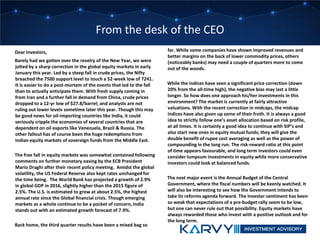
From the desk of the CEO
Dear Investors,
Barely had we gotten over the revelry of the New Year, we were
jolted by a sharp correction in the global equity markets in early
January this year. Led by a steep fall in crude prices, the Nifty
breached the 7500 support level to touch a 52-week low of 7241.
It is easier to do a post-mortem of the events that led to the fall
than to actually anticipate them. With fresh supply coming in
from Iran and a further fall in demand from China, crude prices
dropped to a 12-yr low of $27.8/barrel; and analysts are not
ruling out lower levels sometime later this year. Though this may
be good news for oil-importing countries like India, it could
seriously cripple the economies of several countries that are
dependent on oil exports like Venezuela, Brazil & Russia. The
other fallout has of course been the huge redemptions from
Indian equity markets of sovereign funds from the Middle East.
The free fall in equity markets was somewhat contained following
comments on further monetary easing by the ECB President
Mario Draghi after their recent policy meeting. Amidst the global
volatility, the US Federal Reserve also kept rates unchanged for
the time being. The World Bank has projected a growth of 2.9%
in global GDP in 2016, slightly higher than the 2015 figure of
2.5%. The U.S. is estimated to grow at about 2.5%, the highest
annual rate since the Global financial crisis. Though emerging
markets as a whole continue to be a pocket of concern, India
stands out with an estimated growth forecast of 7.9%.
Back home, the third quarter results have been a mixed bag so
far. While some companies have shown improved revenues and
better margins on the back of lower commodity prices, others
(noticeably banks) may need a couple of quarters more to come
out of the woods.
While the indices have seen a significant price correction (down
20% from the all-time high), the negative bias may last a little
longer. So how does one approach his/her investments in this
environment? The market is currently at fairly attractive
valuations. With the recent correction in midcaps, the midcap
indices have also given up some of their froth. It is always a good
idea to strictly follow one’s asset allocation based on risk profile,
at all times. It is certainly a good idea to continue with SIP’s and
also start new ones in equity mutual funds; they will give the
double benefit of rupee cost averaging as well as the power of
compounding in the long run. The risk-reward ratio at this point
of time appears favourable, and long term investors could even
consider lumpsum investments in equity while more conservative
investors could look at balanced funds.
The next major event is the Annual Budget of the Central
Government, where the fiscal numbers will be keenly watched. It
will also be interesting to see how the Government intends to
take its reforms agenda forward. The investor sentiment has been
so weak that expectations of a pre-budget rally seem to be low,
but one can never rule out that possibility. Equity markets have
always rewarded those who invest with a positive outlook and for
the long term.
Did You Know?
#Source: investinganswers
The U.S. takes the top spot in the
foreign direct investment
confidence index from last 3
years.
India has overtaken Thailand as
the world’s largest rice exporter in
2015.
Switzerland has been the most
globally competitive country in
terms of innovation, R & D and
stable macro environment.
Domestic Equity Outlook
As on 25th
Jan 2016
1 month
change
1 year
change
Equity
Markets
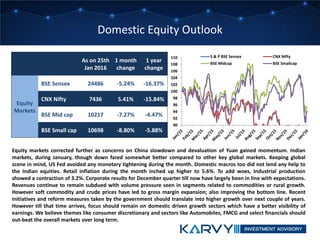
BSE Sensex 24486 -5.24% -16.37%
CNX Nifty 7436 5.41% -15.84%
BSE Mid cap 10217 -7.27% -4.47%
BSE Small cap 10698 -8.80% -5.88%
Equity markets corrected further as concerns on China slowdown and devaluation of Yuan gained momentum. Indian
markets, during January, though down fared somewhat better compared to other key global markets. Keeping global
scene in mind, US Fed avoided any monetary tightening during the month. Domestic macros too did not lend any help to
the Indian equities. Retail inflation during the month inched up higher to 5.6%. To add woes, Industrial production
showed a contraction of 3.2%. Corporate results for December quarter till now have largely been in line with expectations.
Revenues continue to remain subdued with volume pressure seen in segments related to commodities or rural growth.
However soft commodity and crude prices have led to gross margin expansion; also improving the bottom line. Recent
initiatives and reform measures taken by the government should translate into higher growth over next couple of years.
However till that time arrives, focus should remain on domestic driven growth sectors which have a better visibility of
earnings. We believe themes like consumer discretionary and sectors like Automobiles, FMCG and select financials should
out-beat the overall markets over long term.
90
92
94
96
98
100
102
104
106
108
110 S & P BSE Sensex CNX Nifty
BSE Midcap BSE Smallcap
Domestic Equity Outlook
Government Policy
With no great progress in the winter session of Parliament, focus would now be on the forthcoming budget session.
Market participants would keenly monitor how the government plans various strategies related to rural boost, Make In
India theme and re-working of the fiscal math.
Domestic Equity Outlook
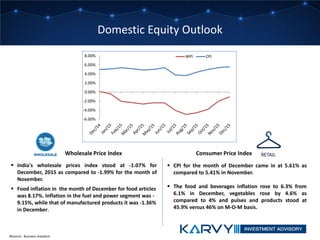
 India's wholesale prices index stood at -1.07% for
December, 2015 as compared to -1.99% for the month of
November.
 Food inflation in the month of December for food articles
was 8.17%. Inflation in the fuel and power segment was -
9.15%, while that of manufactured products it was -1.36%
in December.
 CPI for the month of December came in at 5.61% as
compared to 5.41% in November.
 The food and beverages inflation rose to 6.3% from
6.1% in December, vegetables rose by 4.6% as
compared to 4% and pulses and products stood at
45.9% versus 46% on M-O-M basis.
Wholesale Price Index Consumer Price Index
#Source: Business standard
-6.00%
-4.00%
-2.00%
0.00%
2.00%
4.00%
6.00%
8.00% WPI CPI
Domestic Equity Outlook
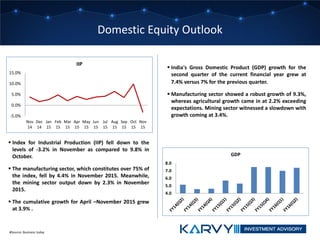
 Index for Industrial Production (IIP) fell down to the
levels of -3.2% in November as compared to 9.8% in
October.
 The manufacturing sector, which constitutes over 75% of
the index, fell by 4.4% in November 2015. Meanwhile,
the mining sector output down by 2.3% in November
2015.
 The cumulative growth for April –November 2015 grew
at 3.9% .
 India's Gross Domestic Product (GDP) growth for the
second quarter of the current financial year grew at
7.4% versus 7% for the previous quarter.
 Manufacturing sector showed a robust growth of 9.3%,
whereas agricultural growth came in at 2.2% exceeding
expectations. Mining sector witnessed a slowdown with
growth coming at 3.4%.
#Source: Business today
4.0
5.0
6.0
7.0
8.0
GDP
-5.0%
0.0%
5.0%
10.0%
15.0%
Nov
14
Dec
14
Jan
15
Feb
15
Mar
15
Apr
15
May
15
Jun
15
Jul
15
Aug
15
Sep
15
Oct
15
Nov
15
IIP
Sector Outlook
Sector Stance Remarks
Automobiles
Passenger vehicles and CVs to outperform two-wheeler segment. Tractors could benefit on
base effect. Auto-ancillaries expected to do well due to revival of demand.
IT/ITES
Select verticals displaying better growth. Long term outlook to improve once global
uncertainties come down.
FMCG
We prefer “discretionary consumption” theme within FMCG. Key beneficiaries such as
durables and branded garments, as the growth in this segment will be disproportionately
higher vis-à-vis the increase in disposable incomes. Gross margin expansion to tone down as
cos will be expected to share the benefits.
Energy
With the price deregulation of diesel, we believe the total subsidy burden on Oil PSU’s will
come down significantly this year. Govt. has decided to pay full subsidy to OMC’s .
Power Utilities
Lack of fuel linkages , poor SEB health, adverse CERC guidelines have compromised the ROE’s
leading to de-rating in near term. Reform initiatives through UDAY can improve sector
prospects in long run.
Cement
Cement volumes and realizations continue to witness pressure. Cost benefits would drive
earnings. Pricing would be key for sector valuations.
Sector Outlook
Sector Stance Remarks
Healthcare
Regulatory risks have become more evident and frequent with FDA inspections for pharma
sector. Additionally, M&A and currency movements poses additional risk to earnings of cos.
E&C
Order inflows expected to improve as spending and capital expenditure likely to move up on
economic recovery.
BFSI
Retail focused Private sector banks continued to deliver stable earnings in line with expectations.
However, PSUs to deliver muted numbers on asset quality concerns and lower credit growth. We
expect this trend to continue going forward.
Telecom
Regulatory uncertainties have come down. However, aggressive bids for spectrum has revived
fears of sub-optimal returns on capital. Further, expected launch of R-Jio at competitive prices in
4QFY16 will have negative implications.
Metals
Lower global growth and Chinese slowdown has kept the growth subdued. Absence of US
monetary stimulus will lead to further downward pressure on prices.
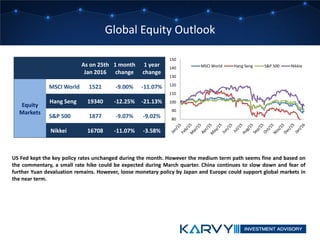
Global Equity Outlook
As on 25th
Jan 2016
1 month
change
1 year
change
Equity
Markets
MSCI World 1521 -9.00% -11.07%
Hang Seng 19340 -12.25% -21.13%
S&P 500 1877 -9.07% -9.02%
Nikkei 16708 -11.07% -3.58%
US Fed kept the key policy rates unchanged during the month. However the medium term path seems fine and based on
the commentary, a small rate hike could be expected during March quarter. China continues to slow down and fear of
further Yuan devaluation remains. However, loose monetary policy by Japan and Europe could support global markets in
the near term.
80
90
100
110
120
130
140
150
MSCI World Hang Seng S&P 500 Nikkie
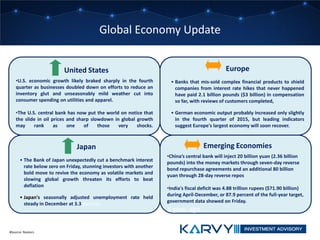
Global Economy Update
United States
•U.S. economic growth likely braked sharply in the fourth
quarter as businesses doubled down on efforts to reduce an
inventory glut and unseasonably mild weather cut into
consumer spending on utilities and apparel.
•The U.S. central bank has now put the world on notice that
the slide in oil prices and sharp slowdown in global growth
may rank as one of those very shocks.
Emerging Economies
•China’s central bank will inject 20 billion yuan (2.36 billion
pounds) into the money markets through seven-day reverse
bond repurchase agreements and an additional 80 billion
yuan through 28-day reverse repos
•India's fiscal deficit was 4.88 trillion rupees ($71.90 billion)
during April-December, or 87.9 percent of the full-year target,
government data showed on Friday.
a year ago
Japan
• The Bank of Japan unexpectedly cut a benchmark interest
rate below zero on Friday, stunning investors with another
bold move to revive the economy as volatile markets and
slowing global growth threaten its efforts to beat
deflation.
• Japan's seasonally adjusted unemployment rate held
steady in December at 3.3 percent,
Europe
• Banks that mis-sold complex financial products to shield
companies from interest rate hikes that never happened
have paid 2.1 billion pounds ($3 billion) in compensation
so far, with reviews of customers completed,
• German economic output probably increased only slightly
in the fourth quarter of 2015, but leading indicators
suggest Europe's largest economy will soon recover.
#Source: Reuters
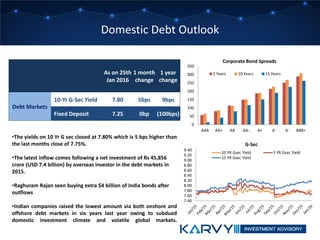
Domestic Debt Outlook
•The yields on 10 Yr G sec closed at 7.80% which is 5 bps higher than
the last months close of 7.75%.
•The latest inflow comes following a net investment of Rs 45,856
crore (USD 7.4 billion) by overseas investor in the debt markets in
2015.
•Raghuram Rajan seen buying extra $4 billion of India bonds after
outflows
•Indian companies raised the lowest amount via both onshore and
offshore debt markets in six years last year owing to subdued
domestic investment climate and volatile global markets.
As on 25th
Jan 2016
1 month
change
1 year
change
Debt Markets
10-Yr G-Sec Yield 7.80 5bps 9bps
Fixed Deposit 7.25 0bp (100bps)
0
50
100
150
200
250
300
350
AAA AA+ AA AA- A+ A A- BBB+
Corporate Bond Spreads
5 Years 10 Years 15 Years
7.40
7.60
7.80
8.00
8.20
8.40
8.60
8.80
9.00
9.20
9.40
G-Sec
10 YR Gsec Yield 5 YR Gsec Yield
15 YR Gsec Yield
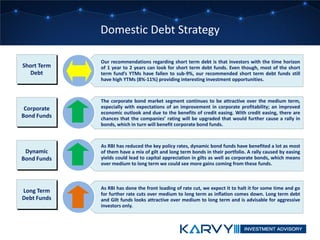
Domestic Debt Strategy
Our recommendations regarding short term debt is that investors with the time horizon
of 1 year to 2 years can look for short term debt funds. Even though, most of the short
term fund’s YTMs have fallen to sub-9%, our recommended short term debt funds still
have high YTMs (8%-11%) providing interesting investment opportunities.
The corporate bond market segment continues to be attractive over the medium term,
especially with expectations of an improvement in corporate profitability; an improved
economic outlook and due to the benefits of credit easing. With credit easing, there are
chances that the companies’ rating will be upgraded that would further cause a rally in
bonds, which in turn will benefit corporate bond funds.
As RBI has reduced the key policy rates, dynamic bond funds have benefited a lot as most
of them have a mix of gilt and long term bonds in their portfolio. A rally caused by easing
yields could lead to capital appreciation in gilts as well as corporate bonds, which means
over medium to long term we could see more gains coming from these funds.
As RBI has done the front loading of rate cut, we expect it to halt it for some time and go
for further rate cuts over medium to long term as inflation comes down. Long term debt
and Gilt funds looks attractive over medium to long term and is advisable for aggressive
investors only.
Short Term
Debt
Corporate
Bond Funds
Dynamic
Bond Funds
Long Term
Debt Funds
Global Debt Outlook
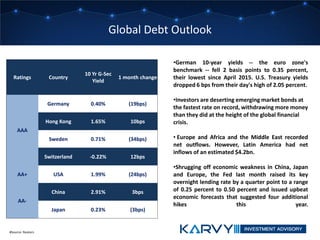
•German 10-year yields -- the euro zone's
benchmark -- fell 2 basis points to 0.35 percent,
their lowest since April 2015. U.S. Treasury yields
dropped 6 bps from their day's high of 2.05 percent.
•Investors are deserting emerging market bonds at
the fastest rate on record, withdrawing more money
than they did at the height of the global financial
crisis.
• Europe and Africa and the Middle East recorded
net outflows. However, Latin America had net
inflows of an estimated $4.2bn.
•Shrugging off economic weakness in China, Japan
and Europe, the Fed last month raised its key
overnight lending rate by a quarter point to a range
of 0.25 percent to 0.50 percent and issued upbeat
economic forecasts that suggested four additional
hikes this year.
#Source: Reuters
Ratings Country
10 Yr G-Sec
Yield
1 month change
AAA
Germany 0.40% (19bps)
Hong Kong 1.65% 10bps
Sweden 0.71% (34bps)
Switzerland -0.22% 12bps
AA+ USA 1.99% (24bps)
AA-
China 2.91% 3bps
Japan 0.23% (3bps)
Commodities
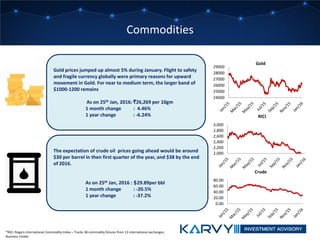
Gold prices jumped up almost 5% during January. Flight to safety
and fragile currency globally were primary reasons for upward
movement in Gold. For near to medium term, the larger band of
$1000-1200 remains..
.
. As on 25th Jan, 2016: `26,269 per 10gm
1 month change : 4.46%
1 year change : -6.24%
The expectation of crude oil prices going ahead would be around
$30 per barrel in then first quarter of the year, and $38 by the end
of 2016.
As on 25th Jan, 2016 : $29.89per bbl
1 month change : -20.5%
1 year change : -37.2%
*RICI: Rogers International Commodity Index – Tracks 38 commodity futures from 13 international exchanges,
Business Insider
24000
25000
26000
27000
28000
29000
Gold
2,000
2,200
2,400
2,600
2,800
3,000
RICI
0.00
20.00
40.00
60.00
80.00
Crude
Foreign Exchange
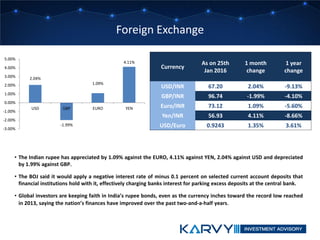
• The Indian rupee has appreciated by 1.09% against the EURO, 4.11% against YEN, 2.04% against USD and depreciated
by 1.99% against GBP.
• The BOJ said it would apply a negative interest rate of minus 0.1 percent on selected current account deposits that
financial institutions hold with it, effectively charging banks interest for parking excess deposits at the central bank.
• Global investors are keeping faith in India’s rupee bonds, even as the currency inches toward the record low reached
in 2013, saying the nation’s finances have improved over the past two-and-a-half years.
Currency
As on 25th
Jan 2016
1 month
change
1 year
change
USD/INR 67.20 2.04% -9.13%
GBP/INR 96.74 -1.99% -4.10%
Euro/INR 73.12 1.09% -5.60%
Yen/INR 56.93 4.11% -8.66%
USD/Euro 0.9243 1.35% 3.61%
2.04%
-1.99%
1.09%
4.11%
-3.00%
-2.00%
-1.00%
0.00%
1.00%
2.00%
3.00%
4.00%
5.00%
USD GBP EURO YEN
Real Estate Outlook
Tier I
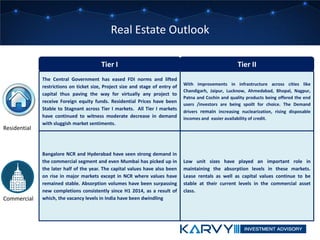
The Central Government has eased FDI norms and lifted
restrictions on ticket size, Project size and stage of entry of
capital thus paving the way for virtually any project to
receive Foreign equity funds. Residential Prices have been
Stable to Stagnant across Tier I markets. All Tier I markets
have continued to witness moderate decrease in demand
with sluggish market sentiments.
Tier II
Bangalore NCR and Hyderabad have seen strong demand in
the commercial segment and even Mumbai has picked up in
the later half of the year. The capital values have also been
on rise in major markets except in NCR where values have
remained stable. Absorption volumes have been surpassing
new completions consistently since H1 2014, as a result of
which, the vacancy levels in India have been dwindling
Low unit sizes have played an important role in
maintaining the absorption levels in these markets.
Lease rentals as well as capital values continue to be
stable at their current levels in the commercial asset
class.
With improvements in infrastructure across cities like
Chandigarh, Jaipur, Lucknow, Ahmedabad, Bhopal, Nagpur,
Patna and Cochin and quality products being offered the end
users /investors are being spoilt for choice. The Demand
drivers remain increasing nuclearization, rising disposable
incomes and easier availability of credit.
Residential
Commercial
Tier I Tier II
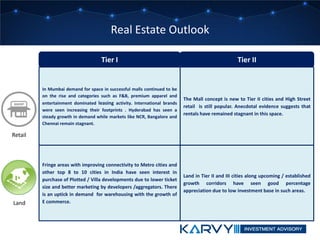
The Mall concept is new to Tier II cities and High Street
retail is still popular. Anecdotal evidence suggests that
rentals have remained stagnant in this space.
In Mumbai demand for space in successful malls continued to be
on the rise and categories such as F&B, premium apparel and
entertainment dominated leasing activity. International brands
were seen increasing their footprints . Hyderabad has seen a
steady growth in demand while markets like NCR, Bangalore and
Chennai remain stagnant.
Land in Tier II and III cities along upcoming / established
growth corridors have seen good percentage
appreciation due to low investment base in such areas.
Fringe areas with improving connectivity to Metro cities and
other top 8 to 10 cities in India have seen interest in
purchase of Plotted / Villa developments due to lower ticket
size and better marketing by developers /aggregators. There
is an uptick in demand for warehousing with the growth of
E commerce.
Retail
Land
Real Estate Outlook
Crude Reality:
What is it?
Oil is a vital source of energy for the world and will likely remain so for many decades to come, even under
the most optimistic assumptions about the growth in alternative energy sources. Most countries are
significantly affected by developments in the oil market, either as producers, consumers, or both. the
decline has been dramatic since last year as crude cracked during this period. The reasons attributed to this
crash in oil prices are, first, increased production in non-OPEC (Organization of the Petroleum Exporting
Countries) countries, Slowing economic activity in regions such as Europe, Japan and China is also said to be
contributing to the decline.
Impact of Rate Hike?
Simply put, at the country level, fall in oil prices will benefit net importers, while exporters would be worse
off. However, at the aggregate level, fall in oil prices is said to be a positive for the global economy.
Oil importers will benefit from a falling oil price because the value of their oil imports will drop. This will
reduce the current account deficit of oil importers; this is important for a country like India who imports
75% of oil consumption and currently has a large current account deficit.
•
What’s Trending?
Karvy Investment Advisory Services Limited [KIASL] is a SEBI registered Investment Advisor and provides advisory services. The information in this newsletter has been prepared by
KIASL based on information obtained from public sources and sources believed to be reliable, but no independent verification has been made nor is its accuracy or completeness
guaranteed and the same are subject to change without any notice. This newsletter and information herein is solely for informational purpose and may not be used or considered as
an offer document or solicitation of offer to buy or sell or subscribe to the securities mentioned. The securities discussed and opinions expressed in this newsletter may not be taken
in substitution for the exercise of independent judgment by any recipient as the same may not be suitable for all investors, who must make their own investment decisions, based on
their own investment objectives, financial positions and needs of specific recipient. The information given in this document is for guidance only. Final investment decisions have to be
made by the recipients themselves after independent evaluation of the investment risk. Recipients are advised to consult their respective tax advisers to understand the specific tax
incidence applicable to them. Affiliates of KIASL may from time to time, be engaged in any other transaction involving such securities/commodities and earn brokerage or other
compensation or act as a market maker in the securities/commodities discussed herein or have other potential conflict of interest with respect to any recommendation and related
information and opinions. Wherever products offered by the Karvy Group entities may be recommended, it is to be noted that KIASL does not provide execution services and further
KIASL does not receive any monetary or non monetary benefit as regards such recommendations made.This newsletter and information contained herein is strictly confidential and
meant solely for the selected recipient and may not be altered in any way, transmitted to, copied or distributed, in part or in whole, to any other person or to the media or
reproduced in any form, without prior written consent of KIASL. Past performance is not necessarily a guide to future performance. KIASL and its Group companies or any person
connected with it accepts no liability whatsoever for the content of this newsletter, or for the consequences of any actions taken on the basis of the information provided therein or
for any loss or damage of any kind arising out of the use of this newsletter.
Nothing in this newsletter constitutes investment, legal, accounting and tax advice or a representation that any of the investment mentioned is suitable or appropriate to your specific
circumstances. The information given in this document on tax is for guidance only, and should not be construed as tax advice. Investors are advised to consult their respective tax
advisers to understand the specific tax incidence applicable to them. While we would endeavor to update the information herein on reasonable basis, KIASL , its associated
companies, their directors and employees (“Karvy Group”) are under no obligation to update or keep the information current. Also, there may be regulatory, compliance or other
reasons that may prevent KIASL from doing so. KIASL will not treat recipients as customers by virtue of their receiving this newsletter. The value and return of investment may vary
because of changes in interest rates or any other reason. Karvy Group may have issued other reports that are inconsistent with and reach different conclusion from the information
presented in this newsletter.Recipients are advised to see the offer documents provided by the Issuers/ Product Providers to understand the risks associated before making
investments in the products mentioned. Recipients are cautioned that any forward-looking statements are not predictions and may be subject to change without notice.KIASL
operates from within India and is subject to Indian regulations. This newsletter is not directed or intended for distribution to, or use by, any person or entity who is a citizen or
resident of or located in any locality, state, country or other jurisdiction, where such distribution, publication, availability or use would be contrary to law, regulation or which would
subject KIASL and affiliates to any registration or licensing requirement within such jurisdiction. Certain category of investors in certain jurisdictions may or may not be eligible to
invest in securities mentioned in the newsletter. Persons in whose possession this document may come are required to inform themselves of and to observe such restriction.Entities
of the Karvy Group provide execution services in the capacity of being stock broker, depository participant, portfolio managers and the like. Recipients may choose to execute their
transactions through entities of the Karvy group and pay applicable charge for the same.
Registered office Address:Karvy Investment Advisory Services Limited, ‘Karvy House’, 46, Avenue 4, Street No. 1, Banjara Hills, Hyderabad - 500034
SEBI Registration No: INA200001959
Disclaimer

Advice For The Wise - February, 2016

  • 1.
    Advice for theWise February 2016
  • 2.
    Contents From the desk ofthe CEO Did you know? Domestic Equity Outlook Global Equity Outlook Domestic Debt Outlook Domestic Debt Strategy Global Debt Outlook Global Economy Update Foreign Exchange Commodities Real Estate Outlook What’s Trending?
  • 3.
    From the deskof the CEO Dear Investors, Barely had we gotten over the revelry of the New Year, we were jolted by a sharp correction in the global equity markets in early January this year. Led by a steep fall in crude prices, the Nifty breached the 7500 support level to touch a 52-week low of 7241. It is easier to do a post-mortem of the events that led to the fall than to actually anticipate them. With fresh supply coming in from Iran and a further fall in demand from China, crude prices dropped to a 12-yr low of $27.8/barrel; and analysts are not ruling out lower levels sometime later this year. Though this may be good news for oil-importing countries like India, it could seriously cripple the economies of several countries that are dependent on oil exports like Venezuela, Brazil & Russia. The other fallout has of course been the huge redemptions from Indian equity markets of sovereign funds from the Middle East. The free fall in equity markets was somewhat contained following comments on further monetary easing by the ECB President Mario Draghi after their recent policy meeting. Amidst the global volatility, the US Federal Reserve also kept rates unchanged for the time being. The World Bank has projected a growth of 2.9% in global GDP in 2016, slightly higher than the 2015 figure of 2.5%. The U.S. is estimated to grow at about 2.5%, the highest annual rate since the Global financial crisis. Though emerging markets as a whole continue to be a pocket of concern, India stands out with an estimated growth forecast of 7.9%. Back home, the third quarter results have been a mixed bag so far. While some companies have shown improved revenues and better margins on the back of lower commodity prices, others (noticeably banks) may need a couple of quarters more to come out of the woods. While the indices have seen a significant price correction (down 20% from the all-time high), the negative bias may last a little longer. So how does one approach his/her investments in this environment? The market is currently at fairly attractive valuations. With the recent correction in midcaps, the midcap indices have also given up some of their froth. It is always a good idea to strictly follow one’s asset allocation based on risk profile, at all times. It is certainly a good idea to continue with SIP’s and also start new ones in equity mutual funds; they will give the double benefit of rupee cost averaging as well as the power of compounding in the long run. The risk-reward ratio at this point of time appears favourable, and long term investors could even consider lumpsum investments in equity while more conservative investors could look at balanced funds. The next major event is the Annual Budget of the Central Government, where the fiscal numbers will be keenly watched. It will also be interesting to see how the Government intends to take its reforms agenda forward. The investor sentiment has been so weak that expectations of a pre-budget rally seem to be low, but one can never rule out that possibility. Equity markets have always rewarded those who invest with a positive outlook and for the long term.
  • 4.
    Did You Know? #Source:investinganswers The U.S. takes the top spot in the foreign direct investment confidence index from last 3 years. India has overtaken Thailand as the world’s largest rice exporter in 2015. Switzerland has been the most globally competitive country in terms of innovation, R & D and stable macro environment.
  • 5.
    Domestic Equity Outlook Ason 25th Jan 2016 1 month change 1 year change Equity Markets BSE Sensex 24486 -5.24% -16.37% CNX Nifty 7436 5.41% -15.84% BSE Mid cap 10217 -7.27% -4.47% BSE Small cap 10698 -8.80% -5.88% Equity markets corrected further as concerns on China slowdown and devaluation of Yuan gained momentum. Indian markets, during January, though down fared somewhat better compared to other key global markets. Keeping global scene in mind, US Fed avoided any monetary tightening during the month. Domestic macros too did not lend any help to the Indian equities. Retail inflation during the month inched up higher to 5.6%. To add woes, Industrial production showed a contraction of 3.2%. Corporate results for December quarter till now have largely been in line with expectations. Revenues continue to remain subdued with volume pressure seen in segments related to commodities or rural growth. However soft commodity and crude prices have led to gross margin expansion; also improving the bottom line. Recent initiatives and reform measures taken by the government should translate into higher growth over next couple of years. However till that time arrives, focus should remain on domestic driven growth sectors which have a better visibility of earnings. We believe themes like consumer discretionary and sectors like Automobiles, FMCG and select financials should out-beat the overall markets over long term. 90 92 94 96 98 100 102 104 106 108 110 S & P BSE Sensex CNX Nifty BSE Midcap BSE Smallcap
  • 6.
    Domestic Equity Outlook GovernmentPolicy With no great progress in the winter session of Parliament, focus would now be on the forthcoming budget session. Market participants would keenly monitor how the government plans various strategies related to rural boost, Make In India theme and re-working of the fiscal math.
  • 7.
    Domestic Equity Outlook India's wholesale prices index stood at -1.07% for December, 2015 as compared to -1.99% for the month of November.  Food inflation in the month of December for food articles was 8.17%. Inflation in the fuel and power segment was - 9.15%, while that of manufactured products it was -1.36% in December.  CPI for the month of December came in at 5.61% as compared to 5.41% in November.  The food and beverages inflation rose to 6.3% from 6.1% in December, vegetables rose by 4.6% as compared to 4% and pulses and products stood at 45.9% versus 46% on M-O-M basis. Wholesale Price Index Consumer Price Index #Source: Business standard -6.00% -4.00% -2.00% 0.00% 2.00% 4.00% 6.00% 8.00% WPI CPI
  • 8.
    Domestic Equity Outlook Index for Industrial Production (IIP) fell down to the levels of -3.2% in November as compared to 9.8% in October.  The manufacturing sector, which constitutes over 75% of the index, fell by 4.4% in November 2015. Meanwhile, the mining sector output down by 2.3% in November 2015.  The cumulative growth for April –November 2015 grew at 3.9% .  India's Gross Domestic Product (GDP) growth for the second quarter of the current financial year grew at 7.4% versus 7% for the previous quarter.  Manufacturing sector showed a robust growth of 9.3%, whereas agricultural growth came in at 2.2% exceeding expectations. Mining sector witnessed a slowdown with growth coming at 3.4%. #Source: Business today 4.0 5.0 6.0 7.0 8.0 GDP -5.0% 0.0% 5.0% 10.0% 15.0% Nov 14 Dec 14 Jan 15 Feb 15 Mar 15 Apr 15 May 15 Jun 15 Jul 15 Aug 15 Sep 15 Oct 15 Nov 15 IIP
  • 9.
    Sector Outlook Sector StanceRemarks Automobiles Passenger vehicles and CVs to outperform two-wheeler segment. Tractors could benefit on base effect. Auto-ancillaries expected to do well due to revival of demand. IT/ITES Select verticals displaying better growth. Long term outlook to improve once global uncertainties come down. FMCG We prefer “discretionary consumption” theme within FMCG. Key beneficiaries such as durables and branded garments, as the growth in this segment will be disproportionately higher vis-à-vis the increase in disposable incomes. Gross margin expansion to tone down as cos will be expected to share the benefits. Energy With the price deregulation of diesel, we believe the total subsidy burden on Oil PSU’s will come down significantly this year. Govt. has decided to pay full subsidy to OMC’s . Power Utilities Lack of fuel linkages , poor SEB health, adverse CERC guidelines have compromised the ROE’s leading to de-rating in near term. Reform initiatives through UDAY can improve sector prospects in long run. Cement Cement volumes and realizations continue to witness pressure. Cost benefits would drive earnings. Pricing would be key for sector valuations.
  • 10.
    Sector Outlook Sector StanceRemarks Healthcare Regulatory risks have become more evident and frequent with FDA inspections for pharma sector. Additionally, M&A and currency movements poses additional risk to earnings of cos. E&C Order inflows expected to improve as spending and capital expenditure likely to move up on economic recovery. BFSI Retail focused Private sector banks continued to deliver stable earnings in line with expectations. However, PSUs to deliver muted numbers on asset quality concerns and lower credit growth. We expect this trend to continue going forward. Telecom Regulatory uncertainties have come down. However, aggressive bids for spectrum has revived fears of sub-optimal returns on capital. Further, expected launch of R-Jio at competitive prices in 4QFY16 will have negative implications. Metals Lower global growth and Chinese slowdown has kept the growth subdued. Absence of US monetary stimulus will lead to further downward pressure on prices.
  • 11.
    Global Equity Outlook Ason 25th Jan 2016 1 month change 1 year change Equity Markets MSCI World 1521 -9.00% -11.07% Hang Seng 19340 -12.25% -21.13% S&P 500 1877 -9.07% -9.02% Nikkei 16708 -11.07% -3.58% US Fed kept the key policy rates unchanged during the month. However the medium term path seems fine and based on the commentary, a small rate hike could be expected during March quarter. China continues to slow down and fear of further Yuan devaluation remains. However, loose monetary policy by Japan and Europe could support global markets in the near term. 80 90 100 110 120 130 140 150 MSCI World Hang Seng S&P 500 Nikkie
  • 12.
    Global Economy Update UnitedStates •U.S. economic growth likely braked sharply in the fourth quarter as businesses doubled down on efforts to reduce an inventory glut and unseasonably mild weather cut into consumer spending on utilities and apparel. •The U.S. central bank has now put the world on notice that the slide in oil prices and sharp slowdown in global growth may rank as one of those very shocks. Emerging Economies •China’s central bank will inject 20 billion yuan (2.36 billion pounds) into the money markets through seven-day reverse bond repurchase agreements and an additional 80 billion yuan through 28-day reverse repos •India's fiscal deficit was 4.88 trillion rupees ($71.90 billion) during April-December, or 87.9 percent of the full-year target, government data showed on Friday. a year ago Japan • The Bank of Japan unexpectedly cut a benchmark interest rate below zero on Friday, stunning investors with another bold move to revive the economy as volatile markets and slowing global growth threaten its efforts to beat deflation. • Japan's seasonally adjusted unemployment rate held steady in December at 3.3 percent, Europe • Banks that mis-sold complex financial products to shield companies from interest rate hikes that never happened have paid 2.1 billion pounds ($3 billion) in compensation so far, with reviews of customers completed, • German economic output probably increased only slightly in the fourth quarter of 2015, but leading indicators suggest Europe's largest economy will soon recover. #Source: Reuters
  • 13.
    Domestic Debt Outlook •Theyields on 10 Yr G sec closed at 7.80% which is 5 bps higher than the last months close of 7.75%. •The latest inflow comes following a net investment of Rs 45,856 crore (USD 7.4 billion) by overseas investor in the debt markets in 2015. •Raghuram Rajan seen buying extra $4 billion of India bonds after outflows •Indian companies raised the lowest amount via both onshore and offshore debt markets in six years last year owing to subdued domestic investment climate and volatile global markets. As on 25th Jan 2016 1 month change 1 year change Debt Markets 10-Yr G-Sec Yield 7.80 5bps 9bps Fixed Deposit 7.25 0bp (100bps) 0 50 100 150 200 250 300 350 AAA AA+ AA AA- A+ A A- BBB+ Corporate Bond Spreads 5 Years 10 Years 15 Years 7.40 7.60 7.80 8.00 8.20 8.40 8.60 8.80 9.00 9.20 9.40 G-Sec 10 YR Gsec Yield 5 YR Gsec Yield 15 YR Gsec Yield
  • 14.
    Domestic Debt Strategy Ourrecommendations regarding short term debt is that investors with the time horizon of 1 year to 2 years can look for short term debt funds. Even though, most of the short term fund’s YTMs have fallen to sub-9%, our recommended short term debt funds still have high YTMs (8%-11%) providing interesting investment opportunities. The corporate bond market segment continues to be attractive over the medium term, especially with expectations of an improvement in corporate profitability; an improved economic outlook and due to the benefits of credit easing. With credit easing, there are chances that the companies’ rating will be upgraded that would further cause a rally in bonds, which in turn will benefit corporate bond funds. As RBI has reduced the key policy rates, dynamic bond funds have benefited a lot as most of them have a mix of gilt and long term bonds in their portfolio. A rally caused by easing yields could lead to capital appreciation in gilts as well as corporate bonds, which means over medium to long term we could see more gains coming from these funds. As RBI has done the front loading of rate cut, we expect it to halt it for some time and go for further rate cuts over medium to long term as inflation comes down. Long term debt and Gilt funds looks attractive over medium to long term and is advisable for aggressive investors only. Short Term Debt Corporate Bond Funds Dynamic Bond Funds Long Term Debt Funds
  • 15.
    Global Debt Outlook •German10-year yields -- the euro zone's benchmark -- fell 2 basis points to 0.35 percent, their lowest since April 2015. U.S. Treasury yields dropped 6 bps from their day's high of 2.05 percent. •Investors are deserting emerging market bonds at the fastest rate on record, withdrawing more money than they did at the height of the global financial crisis. • Europe and Africa and the Middle East recorded net outflows. However, Latin America had net inflows of an estimated $4.2bn. •Shrugging off economic weakness in China, Japan and Europe, the Fed last month raised its key overnight lending rate by a quarter point to a range of 0.25 percent to 0.50 percent and issued upbeat economic forecasts that suggested four additional hikes this year. #Source: Reuters Ratings Country 10 Yr G-Sec Yield 1 month change AAA Germany 0.40% (19bps) Hong Kong 1.65% 10bps Sweden 0.71% (34bps) Switzerland -0.22% 12bps AA+ USA 1.99% (24bps) AA- China 2.91% 3bps Japan 0.23% (3bps)
  • 16.
    Commodities Gold prices jumpedup almost 5% during January. Flight to safety and fragile currency globally were primary reasons for upward movement in Gold. For near to medium term, the larger band of $1000-1200 remains.. . . As on 25th Jan, 2016: `26,269 per 10gm 1 month change : 4.46% 1 year change : -6.24% The expectation of crude oil prices going ahead would be around $30 per barrel in then first quarter of the year, and $38 by the end of 2016. As on 25th Jan, 2016 : $29.89per bbl 1 month change : -20.5% 1 year change : -37.2% *RICI: Rogers International Commodity Index – Tracks 38 commodity futures from 13 international exchanges, Business Insider 24000 25000 26000 27000 28000 29000 Gold 2,000 2,200 2,400 2,600 2,800 3,000 RICI 0.00 20.00 40.00 60.00 80.00 Crude
  • 17.
    Foreign Exchange • TheIndian rupee has appreciated by 1.09% against the EURO, 4.11% against YEN, 2.04% against USD and depreciated by 1.99% against GBP. • The BOJ said it would apply a negative interest rate of minus 0.1 percent on selected current account deposits that financial institutions hold with it, effectively charging banks interest for parking excess deposits at the central bank. • Global investors are keeping faith in India’s rupee bonds, even as the currency inches toward the record low reached in 2013, saying the nation’s finances have improved over the past two-and-a-half years. Currency As on 25th Jan 2016 1 month change 1 year change USD/INR 67.20 2.04% -9.13% GBP/INR 96.74 -1.99% -4.10% Euro/INR 73.12 1.09% -5.60% Yen/INR 56.93 4.11% -8.66% USD/Euro 0.9243 1.35% 3.61% 2.04% -1.99% 1.09% 4.11% -3.00% -2.00% -1.00% 0.00% 1.00% 2.00% 3.00% 4.00% 5.00% USD GBP EURO YEN
  • 18.
    Real Estate Outlook TierI The Central Government has eased FDI norms and lifted restrictions on ticket size, Project size and stage of entry of capital thus paving the way for virtually any project to receive Foreign equity funds. Residential Prices have been Stable to Stagnant across Tier I markets. All Tier I markets have continued to witness moderate decrease in demand with sluggish market sentiments. Tier II Bangalore NCR and Hyderabad have seen strong demand in the commercial segment and even Mumbai has picked up in the later half of the year. The capital values have also been on rise in major markets except in NCR where values have remained stable. Absorption volumes have been surpassing new completions consistently since H1 2014, as a result of which, the vacancy levels in India have been dwindling Low unit sizes have played an important role in maintaining the absorption levels in these markets. Lease rentals as well as capital values continue to be stable at their current levels in the commercial asset class. With improvements in infrastructure across cities like Chandigarh, Jaipur, Lucknow, Ahmedabad, Bhopal, Nagpur, Patna and Cochin and quality products being offered the end users /investors are being spoilt for choice. The Demand drivers remain increasing nuclearization, rising disposable incomes and easier availability of credit. Residential Commercial
  • 19.
    Tier I TierII The Mall concept is new to Tier II cities and High Street retail is still popular. Anecdotal evidence suggests that rentals have remained stagnant in this space. In Mumbai demand for space in successful malls continued to be on the rise and categories such as F&B, premium apparel and entertainment dominated leasing activity. International brands were seen increasing their footprints . Hyderabad has seen a steady growth in demand while markets like NCR, Bangalore and Chennai remain stagnant. Land in Tier II and III cities along upcoming / established growth corridors have seen good percentage appreciation due to low investment base in such areas. Fringe areas with improving connectivity to Metro cities and other top 8 to 10 cities in India have seen interest in purchase of Plotted / Villa developments due to lower ticket size and better marketing by developers /aggregators. There is an uptick in demand for warehousing with the growth of E commerce. Retail Land Real Estate Outlook
  • 20.
    Crude Reality: What isit? Oil is a vital source of energy for the world and will likely remain so for many decades to come, even under the most optimistic assumptions about the growth in alternative energy sources. Most countries are significantly affected by developments in the oil market, either as producers, consumers, or both. the decline has been dramatic since last year as crude cracked during this period. The reasons attributed to this crash in oil prices are, first, increased production in non-OPEC (Organization of the Petroleum Exporting Countries) countries, Slowing economic activity in regions such as Europe, Japan and China is also said to be contributing to the decline. Impact of Rate Hike? Simply put, at the country level, fall in oil prices will benefit net importers, while exporters would be worse off. However, at the aggregate level, fall in oil prices is said to be a positive for the global economy. Oil importers will benefit from a falling oil price because the value of their oil imports will drop. This will reduce the current account deficit of oil importers; this is important for a country like India who imports 75% of oil consumption and currently has a large current account deficit. • What’s Trending?
  • 21.
    Karvy Investment AdvisoryServices Limited [KIASL] is a SEBI registered Investment Advisor and provides advisory services. The information in this newsletter has been prepared by KIASL based on information obtained from public sources and sources believed to be reliable, but no independent verification has been made nor is its accuracy or completeness guaranteed and the same are subject to change without any notice. This newsletter and information herein is solely for informational purpose and may not be used or considered as an offer document or solicitation of offer to buy or sell or subscribe to the securities mentioned. The securities discussed and opinions expressed in this newsletter may not be taken in substitution for the exercise of independent judgment by any recipient as the same may not be suitable for all investors, who must make their own investment decisions, based on their own investment objectives, financial positions and needs of specific recipient. The information given in this document is for guidance only. Final investment decisions have to be made by the recipients themselves after independent evaluation of the investment risk. Recipients are advised to consult their respective tax advisers to understand the specific tax incidence applicable to them. Affiliates of KIASL may from time to time, be engaged in any other transaction involving such securities/commodities and earn brokerage or other compensation or act as a market maker in the securities/commodities discussed herein or have other potential conflict of interest with respect to any recommendation and related information and opinions. Wherever products offered by the Karvy Group entities may be recommended, it is to be noted that KIASL does not provide execution services and further KIASL does not receive any monetary or non monetary benefit as regards such recommendations made.This newsletter and information contained herein is strictly confidential and meant solely for the selected recipient and may not be altered in any way, transmitted to, copied or distributed, in part or in whole, to any other person or to the media or reproduced in any form, without prior written consent of KIASL. Past performance is not necessarily a guide to future performance. KIASL and its Group companies or any person connected with it accepts no liability whatsoever for the content of this newsletter, or for the consequences of any actions taken on the basis of the information provided therein or for any loss or damage of any kind arising out of the use of this newsletter. Nothing in this newsletter constitutes investment, legal, accounting and tax advice or a representation that any of the investment mentioned is suitable or appropriate to your specific circumstances. The information given in this document on tax is for guidance only, and should not be construed as tax advice. Investors are advised to consult their respective tax advisers to understand the specific tax incidence applicable to them. While we would endeavor to update the information herein on reasonable basis, KIASL , its associated companies, their directors and employees (“Karvy Group”) are under no obligation to update or keep the information current. Also, there may be regulatory, compliance or other reasons that may prevent KIASL from doing so. KIASL will not treat recipients as customers by virtue of their receiving this newsletter. The value and return of investment may vary because of changes in interest rates or any other reason. Karvy Group may have issued other reports that are inconsistent with and reach different conclusion from the information presented in this newsletter.Recipients are advised to see the offer documents provided by the Issuers/ Product Providers to understand the risks associated before making investments in the products mentioned. Recipients are cautioned that any forward-looking statements are not predictions and may be subject to change without notice.KIASL operates from within India and is subject to Indian regulations. This newsletter is not directed or intended for distribution to, or use by, any person or entity who is a citizen or resident of or located in any locality, state, country or other jurisdiction, where such distribution, publication, availability or use would be contrary to law, regulation or which would subject KIASL and affiliates to any registration or licensing requirement within such jurisdiction. Certain category of investors in certain jurisdictions may or may not be eligible to invest in securities mentioned in the newsletter. Persons in whose possession this document may come are required to inform themselves of and to observe such restriction.Entities of the Karvy Group provide execution services in the capacity of being stock broker, depository participant, portfolio managers and the like. Recipients may choose to execute their transactions through entities of the Karvy group and pay applicable charge for the same. Registered office Address:Karvy Investment Advisory Services Limited, ‘Karvy House’, 46, Avenue 4, Street No. 1, Banjara Hills, Hyderabad - 500034 SEBI Registration No: INA200001959 Disclaimer