Advice For
Public
Speaking As
An Introvert
Dominic Carter
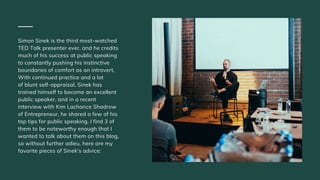
Simon Sinek is the third most-watched
TED Talk presenter ever, and he credits
much of his success at public speaking
to constantly pushing his instinctive
boundaries of comfort as an introvert.
With continued practice and a lot
of blunt self-appraisal, Sinek has
trained himself to become an excellent
public speaker, and in a recent
interview with Kim Lachance Shadrow
of Entrepreneur, he shared a few of his
top tips for public speaking. I find 3 of
them to be noteworthy enough that I
wanted to talk about them on this blog,
so without further adieu, here are my
favorite pieces of Sinek’s advice:
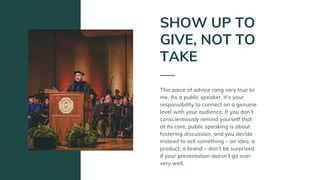
This piece of advice rang very true to
me. As a public speaker, it’s your
responsibility to connect on a genuine
level with your audience. If you don’t
conscientiously remind yourself that
at its core, public speaking is about
fostering discussion, and you decide
instead to sell something – an idea, a
product, a brand – don’t be surprised
if your presentation doesn’t go over
very well.
SHOW UP TO
GIVE, NOT TO
TAKE
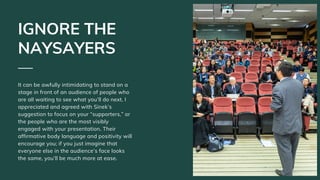
It can be awfully intimidating to stand on a
stage in front of an audience of people who
are all waiting to see what you’ll do next. I
appreciated and agreed with Sinek’s
suggestion to focus on your “supporters,” or
the people who are the most visibly
engaged with your presentation. Their
affirmative body language and positivity will
encourage you; if you just imagine that
everyone else in the audience’s face looks
the same, you’ll be much more at ease.
IGNORE THE
NAYSAYERS
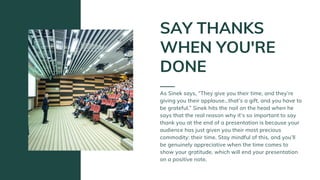
As Sinek says, “They give you their time, and they’re
giving you their applause…that’s a gift, and you have to
be grateful.” Sinek hits the nail on the head when he
says that the real reason why it’s so important to say
thank you at the end of a presentation is because your
audience has just given you their most precious
commodity: their time. Stay mindful of this, and you’ll
be genuinely appreciative when the time comes to
show your gratitude, which will end your presentation
on a positive note.
SAY THANKS
WHEN YOU'RE
DONE
THANKS!
Website: DominicCarter.org
Twitter: @DominicTV
LinkedIn: Dominic Carter TV

Advice For Public Speaking As An Introvert

  • 1.
    Advice For Public Speaking As AnIntrovert Dominic Carter
  • 2.
    Simon Sinek is thethird most-watched TED Talk presenter ever, and he credits much of his success at public speaking to constantly pushing his instinctive boundaries of comfort as an introvert. With continued practice and a lot of blunt self-appraisal, Sinek has trained himself to become an excellent public speaker, and in a recent interview with Kim Lachance Shadrow of Entrepreneur, he shared a few of his top tips for public speaking. I find 3 of them to be noteworthy enough that I wanted to talk about them on this blog, so without further adieu, here are my favorite pieces of Sinek’s advice:
  • 3.
    This piece ofadvice rang very true to me. As a public speaker, it’s your responsibility to connect on a genuine level with your audience. If you don’t conscientiously remind yourself that at its core, public speaking is about fostering discussion, and you decide instead to sell something – an idea, a product, a brand – don’t be surprised if your presentation doesn’t go over very well. SHOW UP TO GIVE, NOT TO TAKE
  • 4.
    It can beawfully intimidating to stand on a stage in front of an audience of people who are all waiting to see what you’ll do next. I appreciated and agreed with Sinek’s suggestion to focus on your “supporters,” or the people who are the most visibly engaged with your presentation. Their affirmative body language and positivity will encourage you; if you just imagine that everyone else in the audience’s face looks the same, you’ll be much more at ease. IGNORE THE NAYSAYERS
  • 5.
    As Sinek says,“They give you their time, and they’re giving you their applause…that’s a gift, and you have to be grateful.” Sinek hits the nail on the head when he says that the real reason why it’s so important to say thank you at the end of a presentation is because your audience has just given you their most precious commodity: their time. Stay mindful of this, and you’ll be genuinely appreciative when the time comes to show your gratitude, which will end your presentation on a positive note. SAY THANKS WHEN YOU'RE DONE
  • 6.