Adventures in
Optimization
David Golden • @xdg!
NY.pm • July 2014
The problem…
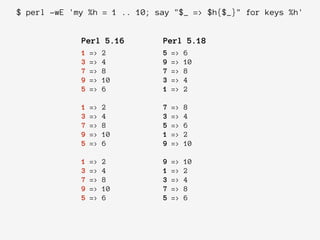
Perl hashes are
unordered maps
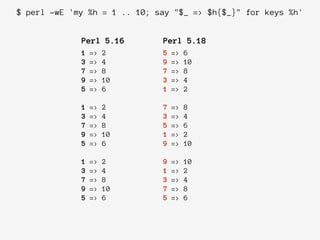
Perl hashes are random

unordered maps
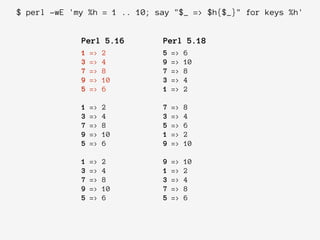
Perl 5.16 Perl 5.18
1 => 2
3 => 4
7 => 8
9 => 10
5 => 6
!
1 => 2
3 => 4
7 => 8
9 => 10
5 => 6
!
1 => 2
3 => 4
7 => 8
9 => 10
5 => 6
5 => 6
9 => 10
7 => 8
3 => 4
1 => 2
!
7 => 8
3 => 4
5 => 6
1 => 2
9 => 10
!
9 => 10
1 => 2
3 => 4
7 => 8
5 => 6
$ perl -wE 'my %h = 1 .. 10; say "$_ => $h{$_}" for keys %h'
Perl 5.16 Perl 5.18
1 => 2
3 => 4
7 => 8
9 => 10
5 => 6
!
1 => 2
3 => 4
7 => 8
9 => 10
5 => 6
!
1 => 2
3 => 4
7 => 8
9 => 10
5 => 6
5 => 6
9 => 10
7 => 8
3 => 4
1 => 2
!
7 => 8
3 => 4
5 => 6
1 => 2
9 => 10
!
9 => 10
1 => 2
3 => 4
7 => 8
5 => 6
$ perl -wE 'my %h = 1 .. 10; say "$_ => $h{$_}" for keys %h'
Perl 5.16 Perl 5.18
1 => 2
3 => 4
7 => 8
9 => 10
5 => 6
!
1 => 2
3 => 4
7 => 8
9 => 10
5 => 6
!
1 => 2
3 => 4
7 => 8
9 => 10
5 => 6
5 => 6
9 => 10
7 => 8
3 => 4
1 => 2
!
7 => 8
3 => 4
5 => 6
1 => 2
9 => 10
!
9 => 10
1 => 2
3 => 4
7 => 8
5 => 6
$ perl -wE 'my %h = 1 .. 10; say "$_ => $h{$_}" for keys %h'
What if order matters?
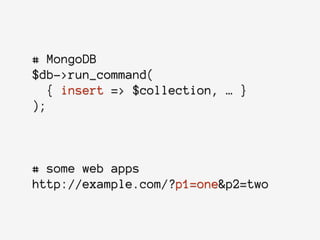
# MongoDB

$db->run_command(

{ insert => $collection, … }

);


# some web apps

http://example.com/?p1=one&p2=two
Order isn’t free
• Arrays of pairs — no quick random access!
• Objects — method call overhead!
• Tied hashes — tie + method overhead
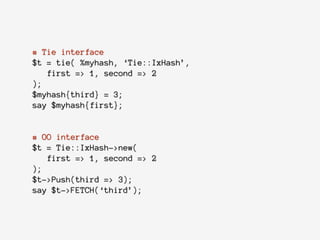
Tie::IxHash?
# Tie interface
$t = tie( %myhash, ‘Tie::IxHash’,
first => 1, second => 2
);
$myhash{third} = 3;
say $myhash{first};
!
# OO interface
$t = Tie::IxHash->new(
first => 1, second => 2
);
$t->Push(third => 3);
say $t->FETCH(‘third’);
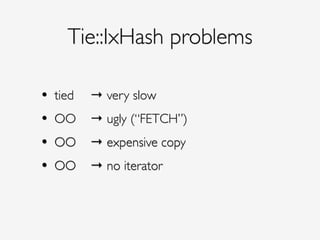
Tie::IxHash problems
• tied!! → very slow!
• OO ! → ugly (“FETCH”)!
• OO ! → expensive copy!
• OO ! → no iterator
Maybe I could patch it
Tie::IxHash guts
sub TIEHASH {
my($c) = shift;
my($s) = [];
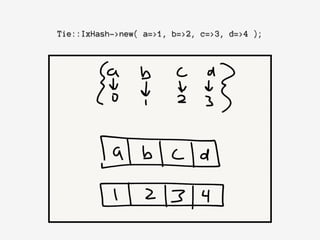
$s->[0] = {}; # hashkey index
$s->[1] = []; # array of keys
$s->[2] = []; # array of data
$s->[3] = 0; # iter count
bless $s, $c;
$s->Push(@_) if @_;
return $s;
}
sub TIEHASH {
my($c) = shift;
my($s) = [];
$s->[0] = {}; # hashkey index
$s->[1] = []; # array of keys
$s->[2] = []; # array of data
$s->[3] = 0; # iter count
bless $s, $c;
$s->Push(@_) if @_;
return $s;
}
WTF???
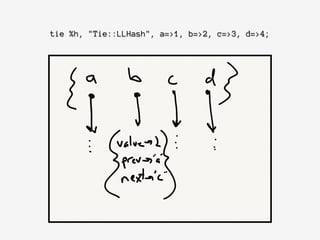
Tie::IxHash->new( a=>1, b=>2, c=>3, d=>4 );
sub FETCH {
my($s, $k) = (shift, shift);
return exists( $s->[0]{$k} ) ? $s->[2][ $s->[0]{$k} ] : undef;
}
Expensive fetch
• exists call!
• ternary op!
• 6 dereferences!
sub STORE {
my($s, $k, $v) = (shift, shift, shift);
if (exists $s->[0]{$k}) {
my($i) = $s->[0]{$k};
$s->[1][$i] = $k;
$s->[2][$i] = $v;
$s->[0]{$k} = $i;
}
else {
push(@{$s->[1]}, $k);
push(@{$s->[2]}, $v);
$s->[0]{$k} = $#{$s->[1]};
}
}
Expensive store
sub STORE {
my($s, $k, $v) = (shift, shift, shift);
if (exists $s->[0]{$k}) {
my($i) = $s->[0]{$k};
$s->[1][$i] = $k;
$s->[2][$i] = $v;
$s->[0]{$k} = $i;
}
else {
push(@{$s->[1]}, $k);
push(@{$s->[2]}, $v);
$s->[0]{$k} = $#{$s->[1]};
}
}
Anyone notice this?
Alternatives?
Tie::LLHash
tie %h, "Tie::LLHash", a=>1, b=>2, c=>3, d=>4;
sub last {
my $self = shift;
!
if (@_) { # Set it
my $newkey = shift;
my $newvalue = shift;
!
croak ("'$newkey' already exists") if $self->EXISTS($newkey);
!
# Create the new node
$self->{'nodes'}{$newkey} =
{
'next' => undef,
'value' => $newvalue,
'prev' => undef,
};
!
# Put it in its relative place
if (defined $self->{'last'}) {
$self->{'nodes'}{$newkey}{'prev'} = $self->{'last'};
$self->{'nodes'}{ $self->{'last'} }{'next'} = $newkey;
}
!
# Finally, make this node the last node
$self->{'last'} = $newkey;
!
# If this is an empty hash, make it the first node too
$self->{'first'} = $newkey unless (defined $self->{'first'});
}
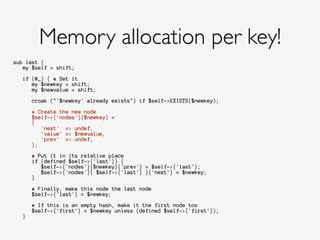
Memory allocation per key!
Array::AsHash
Array::AsHash->new({array =>[a=>1,b=>2,c=>3,d=>4]});
sub get {
my ( $self, @keys ) = @_;
my @get;
foreach my $key (@keys) {
$key = $self->$_actual_key($key);
next unless defined $key;
my $exists = $self->exists($key);
if ( $self->{is_strict} && !$exists ) {
$self->$_croak("Cannot get non-existent key ($key)");
}
if ($exists) {
CORE::push @get, $self->{array_for}[ $self->$_index($key) + 1 ];
}
elsif ( @keys > 1 ) {
CORE::push @get, undef;
}
else {
return;
}
}
return wantarray ? @get
: @keys > 1 ? @get
: $get[0];
}
!
my $_actual_key = sub {
my ( $self, $key ) = @_;
if ( ref $key ) {
my $new_key = $self->{curr_key_of}{ refaddr $key};
return refaddr $key unless defined $new_key;
$key = $new_key;
}
return $key;
};
Subroutine call per key!
sub get {
my ( $self, @keys ) = @_;
my @get;
foreach my $key (@keys) {
$key = $self->$_actual_key($key);
next unless defined $key;
my $exists = $self->exists($key);
if ( $self->{is_strict} && !$exists ) {
$self->$_croak("Cannot get non-existent key ($key)");
}
if ($exists) {
CORE::push @get, $self->{array_for}[ $self->$_index($key) + 1 ];
}
elsif ( @keys > 1 ) {
CORE::push @get, undef;
}
else {
return;
}
}
return wantarray ? @get
: @keys > 1 ? @get
: $get[0];
}
!
my $_actual_key = sub {
my ( $self, $key ) = @_;
if ( ref $key ) {
my $new_key = $self->{curr_key_of}{ refaddr $key};
return refaddr $key unless defined $new_key;
$key = $new_key;
}
return $key;
};
Single key fetch overhead!
Tie::Hash::Indexed
XS, but flawed
• Opaque data: Perl hash of doubly-linked list
of C structs !
• Fails tests since Perl 5.18 randomization!
• Actually, not all that fast (benchmarks later)
What else?
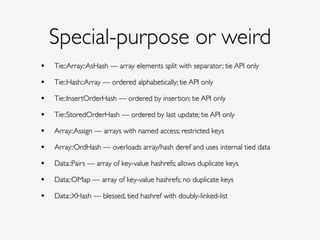
Special-purpose or weird
• Tie::Array::AsHash — array elements split with separator; tie API only!
• Tie::Hash::Array — ordered alphabetically; tie API only!
• Tie::InsertOrderHash — ordered by insertion; tie API only!
• Tie::StoredOrderHash — ordered by last update; tie API only!
• Array::Assign — arrays with named access; restricted keys!
• Array::OrdHash — overloads array/hash deref and uses internal tied data!
• Data::Pairs — array of key-value hashrefs; allows duplicate keys!
• Data::OMap — array of key-value hashrefs; no duplicate keys!
• Data::XHash — blessed, tied hashref with doubly-linked-list!
!
Complexity → Bad
What is the simplest
thing that could work?
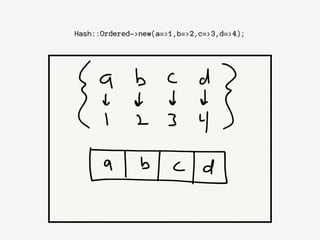
• Hash of keys and values!
• Array of key order
bless { {a=>1, b=>2}, [‘a’, ‘b’] }
I couldn’t find it on CPAN
So I wrote it
Hash::Ordered
Hash::Ordered->new(a=>1,b=>2,c=>3,d=>4);
sub get {
my ( $self, $key ) = @_;
return $self->[_DATA]{$key};
}
Cheap get
• only 2 dereferences!
• no need to test exists()
sub set {
my ( $self, $key, $value ) = @_;
if ( !exists $self->[_DATA]{$key} ) {
push @{ $self->[_KEYS] }, $key;
}
return $self->[_DATA]{$key} = $value;
}
Cheap-ish set
• exists plus 4-6 dereferences and maybe push!
• comparable toTie::IxHash::FETCH
sub clone {
my ( $self, @keys ) = @_;
my $clone;
if (@keys) {
my %subhash;
@subhash{@keys} = @{ $self->[_DATA] }{@keys};
$clone = [ %subhash, @keys ];
}
else {
$clone = [ { %{ $self->[_DATA] } }, [ @{ $self->[_KEYS] } ] ];
}
return bless $clone, ref $self;
}
Got my shallow copy
sub iterator {
my ( $self, @keys ) = @_;
@keys = @{ $self->[_KEYS] } unless @keys;
my $data = $self->[_DATA];
return sub {
return unless @keys;
my $key = CORE::shift(@keys);
return ( $key => $data->{$key} );
};
}
Got my iterator
sub delete {
my ( $self, $key ) = @_;
if ( exists $self->[_DATA]{$key} ) {
my $r = $self->[_KEYS];
my $i = List::Util::first { $r->[$_] eq $key } 0 .. $#$r;
splice @$r, $i, 1;
return delete $self->[_DATA]{$key};
}
return undef;
}
But, delete is expensive
Good tradeoffs?
• It’s ::Tiny — only about 130 SLOC!
• Faster get and set!
• Faster copy!
• Slower delete
But is it actually fast?
Benchmarking is

not profiling
Profiling!! ! ! → ! finding hot spots in code!
Benchmarking! → ! comparing different code

! ! ! ! ! ! ! ! to do the same thing
Scale can reveal ‘Big-O’
issues in algorithms
Constants matter!
even for O(1)
Combinations
• Different ordered hash modules!
• Different operations (create, get, set)!
• Different scales (10, 100, 1000 elements)
Benchmarking tools
• Benchmark.pm!
• Dumbbench!
• Other stuff on CPAN
Don’t make timing
distribution assumptions
Kolmogorov–Smirnov test
• Compare empirical CDFs!
• Non-parametric!
• Unequal-variance!
• Sensitive to CDF location and shape
Doesn’t exist on CPAN
I haven’t written it
yet
KISS → Benchmark.pm
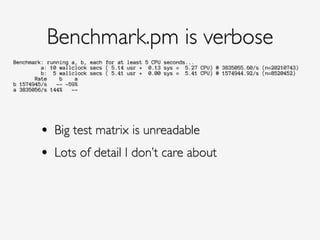
Benchmark: running a, b, each for at least 5 CPU seconds...
a: 10 wallclock secs ( 5.14 usr + 0.13 sys = 5.27 CPU) @ 3835055.60/s (n=20210743)
b: 5 wallclock secs ( 5.41 usr + 0.00 sys = 5.41 CPU) @ 1574944.92/s (n=8520452)
Rate b a
b 1574945/s -- -59%
a 3835056/s 144% --
Benchmark.pm is verbose
!
• Big test matrix is unreadable!
• Lots of detail I don’t care about
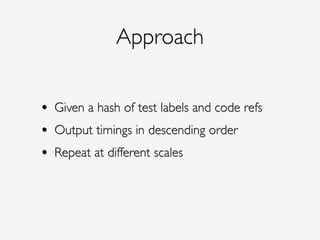
Approach
• Given a hash of test labels and code refs!
• Output timings in descending order!
• Repeat at different scales
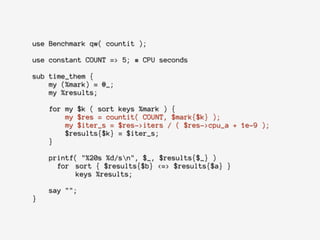
use Benchmark qw( countit );
!
use constant COUNT => 5; # CPU seconds
!
sub time_them {
my (%mark) = @_;
my %results;
!
for my $k ( sort keys %mark ) {
my $res = countit( COUNT, $mark{$k} );
my $iter_s = $res->iters / ( $res->cpu_a + 1e-9 );
$results{$k} = $iter_s;
}
!
printf( "%20s %d/sn", $_, $results{$_} )
for sort { $results{$b} <=> $results{$a} }
keys %results;
!
say "";
}
Use varied, but constant!
test data across runs
use Math::Random::MT::Auto qw/irand/;
!
use constant NUMS => [ 10, 100, 1000 ];
!
my %PAIRS = (
map {
$_ => [ map { irand() => irand() } 1 .. $_ ]
} @{ NUMS() }
);
for my $size ( @{ NUMS() } ) {
!
say my $title = "Results for ordered hash creation for $size elements";
!
my %mark;
!
$mark{"h:o"} = sub { my $h = Hash::Ordered->new( @{ $PAIRS{$size} } ) };
!
$mark{"t:ix_oo"} = sub { my $h = Tie::IxHash->new( @{ $PAIRS{$size} } ) };
!
$mark{"t:ix_th"} = sub { tie my %h, 'Tie::IxHash', @{ $PAIRS{$size} } };
!
$mark{"t:llh"} = sub { tie my %h, 'Tie::LLHash', @{ $PAIRS{$size} } };
!
# …
!
time_them(%mark);
!
}
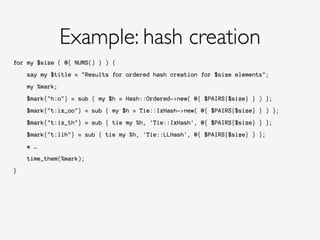
Example: hash creation
for my $size ( @{ NUMS() } ) {
!
say my $title = "Results for ordered hash creation for $size elements";
!
my %mark;
!
$mark{"h:o"} = sub { my $h = Hash::Ordered->new( @{ $PAIRS{$size} } ) };
!
$mark{"t:ix_oo"} = sub { my $h = Tie::IxHash->new( @{ $PAIRS{$size} } ) };
!
$mark{"t:ix_th"} = sub { tie my %h, 'Tie::IxHash', @{ $PAIRS{$size} } };
!
$mark{"t:llh"} = sub { tie my %h, 'Tie::LLHash', @{ $PAIRS{$size} } };
!
# …
!
time_them(%mark);
!
}
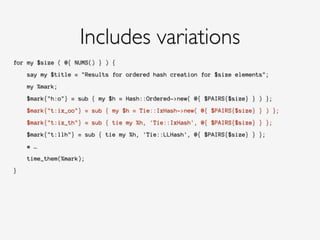
Includes variations
for my $size ( @{ NUMS() } ) {
!
say my $title = "Results for fetching ~10% of $size elements";
!
my $oh = Hash::Ordered->new( @{ $PAIRS{$size} } );
my $tix_oo = Tie::IxHash->new( @{ $PAIRS{$size} } );
tie my %tix_th, 'Tie::IxHash', @{ $PAIRS{$size} };
tie my %tllh, 'Tie::LLHash', @{ $PAIRS{$size} };
# …
!
my ( %mark, $v );
my @keys = keys %{ { @{ $PAIRS{$size} } } };
!
my $n = int( .1 * scalar @keys ) || 1;
my @lookup = map { $keys[ int( rand( scalar @keys ) ) ] } 1 .. $n;
!
$mark{"h:o"} = sub { $v = $oh->get($_) for @lookup };
$mark{"t:ix_oo"} = sub { $v = $tix_oo->FETCH($_) for @lookup };
$mark{"t:ix_th"} = sub { $v = $tix_th{$_} for @lookup };
$mark{"t:llh"} = sub { $v = $tllh{$_} for @lookup };
# …
!
time_them(%mark);
}
!
Example: fetch elements
for my $size ( @{ NUMS() } ) {
!
say my $title = "Results for fetching ~10% of $size elements";
!
my $oh = Hash::Ordered->new( @{ $PAIRS{$size} } );
my $tix_oo = Tie::IxHash->new( @{ $PAIRS{$size} } );
tie my %tix_th, 'Tie::IxHash', @{ $PAIRS{$size} };
tie my %tllh, 'Tie::LLHash', @{ $PAIRS{$size} };
# …
!
my ( %mark, $v );
my @keys = keys %{ { @{ $PAIRS{$size} } } };
!
my $n = int( .1 * scalar @keys ) || 1;
my @lookup = map { $keys[ int( rand( scalar @keys ) ) ] } 1 .. $n;
!
$mark{"h:o"} = sub { $v = $oh->get($_) for @lookup };
$mark{"t:ix_oo"} = sub { $v = $tix_oo->FETCH($_) for @lookup };
$mark{"t:ix_th"} = sub { $v = $tix_th{$_} for @lookup };
$mark{"t:llh"} = sub { $v = $tllh{$_} for @lookup };
# …
!
time_them(%mark);
}
!
Pre-generates hashes
for my $size ( @{ NUMS() } ) {
!
say my $title = "Results for fetching ~10% of $size elements";
!
my $oh = Hash::Ordered->new( @{ $PAIRS{$size} } );
my $tix_oo = Tie::IxHash->new( @{ $PAIRS{$size} } );
tie my %tix_th, 'Tie::IxHash', @{ $PAIRS{$size} };
tie my %tllh, 'Tie::LLHash', @{ $PAIRS{$size} };
# …
!
my ( %mark, $v );
my @keys = keys %{ { @{ $PAIRS{$size} } } };
!
my $n = int( .1 * scalar @keys ) || 1;
my @lookup = map { $keys[ int( rand( scalar @keys ) ) ] } 1 .. $n;
!
$mark{"h:o"} = sub { $v = $oh->get($_) for @lookup };
$mark{"t:ix_oo"} = sub { $v = $tix_oo->FETCH($_) for @lookup };
$mark{"t:ix_th"} = sub { $v = $tix_th{$_} for @lookup };
$mark{"t:llh"} = sub { $v = $tllh{$_} for @lookup };
# …
!
time_them(%mark);
}
!
Pre-generates test keys
for my $size ( @{ NUMS() } ) {
!
say my $title = "Results for fetching ~10% of $size elements";
!
my $oh = Hash::Ordered->new( @{ $PAIRS{$size} } );
my $tix_oo = Tie::IxHash->new( @{ $PAIRS{$size} } );
tie my %tix_th, 'Tie::IxHash', @{ $PAIRS{$size} };
tie my %tllh, 'Tie::LLHash', @{ $PAIRS{$size} };
# …
!
my ( %mark, $v );
my @keys = keys %{ { @{ $PAIRS{$size} } } };
!
my $n = int( .1 * scalar @keys ) || 1;
my @lookup = map { $keys[ int( rand( scalar @keys ) ) ] } 1 .. $n;
!
$mark{"h:o"} = sub { $v = $oh->get($_) for @lookup };
$mark{"t:ix_oo"} = sub { $v = $tix_oo->FETCH($_) for @lookup };
$mark{"t:ix_th"} = sub { $v = $tix_th{$_} for @lookup };
$mark{"t:llh"} = sub { $v = $tllh{$_} for @lookup };
# …
!
time_them(%mark);
}
!
Benchmark just the fetch
for my $size ( @{ NUMS() } ) {
!
say my $title = "Results for creating $size element hash then deleting ~10%";
!
my ( %mark, $v );
my @keys = keys %{ { @{ $PAIRS{$size} } } };
!
my $n = int( .1 * scalar @keys ) || 1;
my @lookup = map { $keys[ int( rand( scalar @keys ) ) ] } 1 .. $n;
!
$mark{"h:o"} = sub {
my $oh = Hash::Ordered->new( @{ $PAIRS{$size} } );
$oh->delete($_) for @lookup;
};
!
$mark{"t:ix_oo"} = sub {
my $tix_oo = Tie::IxHash->new( @{ $PAIRS{$size} } );
$tix_oo->DELETE($_) for @lookup;
};
!
# …
!
time_them(%mark);
}
!
Example: deleting elements
for my $size ( @{ NUMS() } ) {
!
say my $title = "Results for creating $size element hash then deleting ~10%";
!
my ( %mark, $v );
my @keys = keys %{ { @{ $PAIRS{$size} } } };
!
my $n = int( .1 * scalar @keys ) || 1;
my @lookup = map { $keys[ int( rand( scalar @keys ) ) ] } 1 .. $n;
!
$mark{"h:o"} = sub {
my $oh = Hash::Ordered->new( @{ $PAIRS{$size} } );
$oh->delete($_) for @lookup;
};
!
$mark{"t:ix_oo"} = sub {
my $tix_oo = Tie::IxHash->new( @{ $PAIRS{$size} } );
$tix_oo->DELETE($_) for @lookup;
};
!
# …
!
time_them(%mark);
}
!
But, we can’t isolate delete
Results…
https://www.flickr.com/photos/tarikb/111831472/
Don’t web-surf while
benchmarking!
Modules & abbreviations
• Hash::Ordered ! ! → h:o! ! [data hash + keys array]!
!
• Array::AsHash ! ! → a:ah! ! [data array + index hash]!
!
• Tie::IxHash ! ! ! → t:ix! ! [tie + hash + 2 x array]!
!
• Tie::LLHash ! ! ! → t:llh! ! [tie + hash + 2LL]!
!
• Tie::Hash::Indexed !! → t:h:i! ! [XS + tie + hash + 2LL]!
!
• Array::OrdHash! ! → a:oh!! [overloaded + private ties]!
!
• Data::XHash! ! ! → d:xh!! [tie + double linked list]!
!
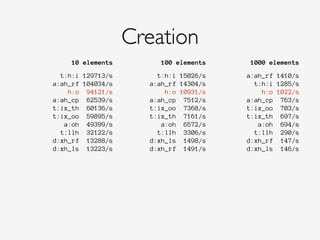
Creation
10 elements 100 elements 1000 elements
t:h:i 129713/s
a:ah_rf 104034/s
h:o 94121/s
a:ah_cp 62539/s
t:ix_th 60136/s
t:ix_oo 59895/s
a:oh 49399/s
t:llh 32122/s
d:xh_rf 13288/s
d:xh_ls 13223/s
t:h:i 15026/s
a:ah_rf 14304/s
h:o 10931/s
a:ah_cp 7512/s
t:ix_oo 7368/s
t:ix_th 7161/s
a:oh 6572/s
t:llh 3306/s
d:xh_ls 1498/s
d:xh_rf 1491/s
a:ah_rf 1410/s
t:h:i 1285/s
h:o 1022/s
a:ah_cp 763/s
t:ix_oo 703/s
t:ix_th 697/s
a:oh 694/s
t:llh 290/s
d:xh_rf 147/s
d:xh_ls 146/s
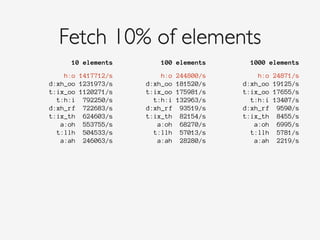
Fetch 10% of elements
10 elements 100 elements 1000 elements
h:o 1417712/s
d:xh_oo 1231973/s
t:ix_oo 1120271/s
t:h:i 792250/s
d:xh_rf 722683/s
t:ix_th 624603/s
a:oh 553755/s
t:llh 504533/s
a:ah 246063/s
h:o 244800/s
d:xh_oo 181520/s
t:ix_oo 175981/s
t:h:i 132963/s
d:xh_rf 93519/s
t:ix_th 82154/s
a:oh 68270/s
t:llh 57013/s
a:ah 28280/s
h:o 24871/s
d:xh_oo 19125/s
t:ix_oo 17655/s
t:h:i 13407/s
d:xh_rf 9590/s
t:ix_th 8455/s
a:oh 6995/s
t:llh 5781/s
a:ah 2219/s
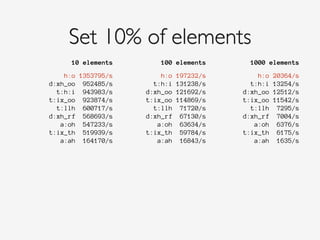
Set 10% of elements
10 elements 100 elements 1000 elements
h:o 1353795/s
d:xh_oo 952485/s
t:h:i 943983/s
t:ix_oo 923874/s
t:llh 600717/s
d:xh_rf 568693/s
a:oh 547233/s
t:ix_th 519939/s
a:ah 164170/s
h:o 197232/s
t:h:i 131238/s
d:xh_oo 121692/s
t:ix_oo 114869/s
t:llh 71720/s
d:xh_rf 67130/s
a:oh 63634/s
t:ix_th 59784/s
a:ah 16843/s
h:o 20364/s
t:h:i 13254/s
d:xh_oo 12512/s
t:ix_oo 11542/s
t:llh 7295/s
d:xh_rf 7004/s
a:oh 6376/s
t:ix_th 6175/s
a:ah 1635/s
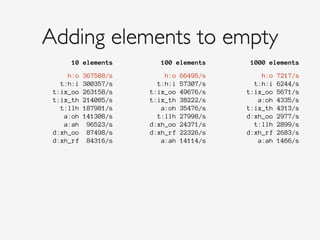
Adding elements to empty
10 elements 100 elements 1000 elements
h:o 367588/s
t:h:i 300357/s
t:ix_oo 263158/s
t:ix_th 214085/s
t:llh 187981/s
a:oh 141308/s
a:ah 96523/s
d:xh_oo 87498/s
d:xh_rf 84316/s
h:o 66495/s
t:h:i 57307/s
t:ix_oo 49676/s
t:ix_th 38222/s
a:oh 35476/s
t:llh 27998/s
d:xh_oo 24371/s
d:xh_rf 22326/s
a:ah 14114/s
h:o 7217/s
t:h:i 6244/s
t:ix_oo 5671/s
a:oh 4335/s
t:ix_th 4313/s
d:xh_oo 2977/s
t:llh 2899/s
d:xh_rf 2683/s
a:ah 1466/s
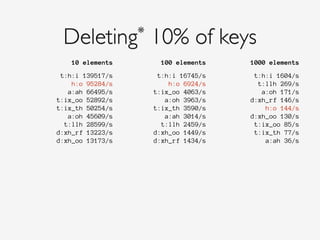
Deleting* 10% of keys
10 elements 100 elements 1000 elements
t:h:i 139517/s
h:o 95284/s
a:ah 66495/s
t:ix_oo 52892/s
t:ix_th 50254/s
a:oh 45609/s
t:llh 28599/s
d:xh_rf 13223/s
d:xh_oo 13173/s
t:h:i 16745/s
h:o 6924/s
t:ix_oo 4063/s
a:oh 3963/s
t:ix_th 3590/s
a:ah 3014/s
t:llh 2459/s
d:xh_oo 1449/s
d:xh_rf 1434/s
t:h:i 1604/s
t:llh 269/s
a:oh 171/s
d:xh_rf 146/s
h:o 144/s
d:xh_oo 130/s
t:ix_oo 85/s
t:ix_th 77/s
a:ah 36/s
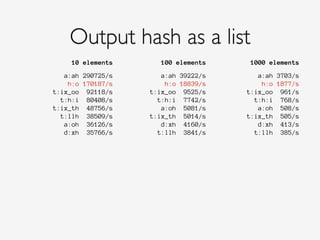
Output hash as a list
10 elements 100 elements 1000 elements
a:ah 290725/s
h:o 170187/s
t:ix_oo 92118/s
t:h:i 80408/s
t:ix_th 48756/s
t:llh 38509/s
a:oh 36126/s
d:xh 35766/s
a:ah 39222/s
h:o 18839/s
t:ix_oo 9525/s
t:h:i 7742/s
a:oh 5081/s
t:ix_th 5014/s
d:xh 4160/s
t:llh 3841/s
a:ah 3703/s
h:o 1877/s
t:ix_oo 961/s
t:h:i 768/s
a:oh 508/s
t:ix_th 505/s
d:xh 413/s
t:llh 385/s
Conclusions…
Tying sucks
Module choice matters a lot
• 7 CPAN modules tested!
• 10x performance difference on some tasks!
• Look inside modules before you use them!
Simplicity pays off
• Less indirection!
• Less memory allocation!
• Fewer ops per call
Hash::Ordered::XS!
might really rock!
Questions?

Adventures in Optimization

  • 1.
    Adventures in Optimization David Golden• @xdg! NY.pm • July 2014
  • 2.
  • 3.
  • 4.
    Perl hashes arerandom
 unordered maps
  • 5.
    Perl 5.16 Perl5.18 1 => 2 3 => 4 7 => 8 9 => 10 5 => 6 ! 1 => 2 3 => 4 7 => 8 9 => 10 5 => 6 ! 1 => 2 3 => 4 7 => 8 9 => 10 5 => 6 5 => 6 9 => 10 7 => 8 3 => 4 1 => 2 ! 7 => 8 3 => 4 5 => 6 1 => 2 9 => 10 ! 9 => 10 1 => 2 3 => 4 7 => 8 5 => 6 $ perl -wE 'my %h = 1 .. 10; say "$_ => $h{$_}" for keys %h'
  • 6.
    Perl 5.16 Perl5.18 1 => 2 3 => 4 7 => 8 9 => 10 5 => 6 ! 1 => 2 3 => 4 7 => 8 9 => 10 5 => 6 ! 1 => 2 3 => 4 7 => 8 9 => 10 5 => 6 5 => 6 9 => 10 7 => 8 3 => 4 1 => 2 ! 7 => 8 3 => 4 5 => 6 1 => 2 9 => 10 ! 9 => 10 1 => 2 3 => 4 7 => 8 5 => 6 $ perl -wE 'my %h = 1 .. 10; say "$_ => $h{$_}" for keys %h'
  • 7.
    Perl 5.16 Perl5.18 1 => 2 3 => 4 7 => 8 9 => 10 5 => 6 ! 1 => 2 3 => 4 7 => 8 9 => 10 5 => 6 ! 1 => 2 3 => 4 7 => 8 9 => 10 5 => 6 5 => 6 9 => 10 7 => 8 3 => 4 1 => 2 ! 7 => 8 3 => 4 5 => 6 1 => 2 9 => 10 ! 9 => 10 1 => 2 3 => 4 7 => 8 5 => 6 $ perl -wE 'my %h = 1 .. 10; say "$_ => $h{$_}" for keys %h'
  • 8.
    What if ordermatters?
  • 9.
    # MongoDB
 $db->run_command(
 { insert=> $collection, … }
 );


 # some web apps
 http://example.com/?p1=one&p2=two
  • 10.
    Order isn’t free •Arrays of pairs — no quick random access! • Objects — method call overhead! • Tied hashes — tie + method overhead
  • 11.
  • 12.
    # Tie interface $t= tie( %myhash, ‘Tie::IxHash’, first => 1, second => 2 ); $myhash{third} = 3; say $myhash{first}; ! # OO interface $t = Tie::IxHash->new( first => 1, second => 2 ); $t->Push(third => 3); say $t->FETCH(‘third’);
  • 13.
    Tie::IxHash problems • tied!!→ very slow! • OO ! → ugly (“FETCH”)! • OO ! → expensive copy! • OO ! → no iterator
  • 14.
    Maybe I couldpatch it
  • 15.
    Tie::IxHash guts sub TIEHASH{ my($c) = shift; my($s) = []; $s->[0] = {}; # hashkey index $s->[1] = []; # array of keys $s->[2] = []; # array of data $s->[3] = 0; # iter count bless $s, $c; $s->Push(@_) if @_; return $s; }
  • 16.
    sub TIEHASH { my($c)= shift; my($s) = []; $s->[0] = {}; # hashkey index $s->[1] = []; # array of keys $s->[2] = []; # array of data $s->[3] = 0; # iter count bless $s, $c; $s->Push(@_) if @_; return $s; } WTF???
  • 17.
  • 18.
    sub FETCH { my($s,$k) = (shift, shift); return exists( $s->[0]{$k} ) ? $s->[2][ $s->[0]{$k} ] : undef; } Expensive fetch • exists call! • ternary op! • 6 dereferences!
  • 19.
    sub STORE { my($s,$k, $v) = (shift, shift, shift); if (exists $s->[0]{$k}) { my($i) = $s->[0]{$k}; $s->[1][$i] = $k; $s->[2][$i] = $v; $s->[0]{$k} = $i; } else { push(@{$s->[1]}, $k); push(@{$s->[2]}, $v); $s->[0]{$k} = $#{$s->[1]}; } } Expensive store
  • 20.
    sub STORE { my($s,$k, $v) = (shift, shift, shift); if (exists $s->[0]{$k}) { my($i) = $s->[0]{$k}; $s->[1][$i] = $k; $s->[2][$i] = $v; $s->[0]{$k} = $i; } else { push(@{$s->[1]}, $k); push(@{$s->[2]}, $v); $s->[0]{$k} = $#{$s->[1]}; } } Anyone notice this?
  • 21.
  • 22.
  • 23.
    tie %h, "Tie::LLHash",a=>1, b=>2, c=>3, d=>4;
  • 24.
    sub last { my$self = shift; ! if (@_) { # Set it my $newkey = shift; my $newvalue = shift; ! croak ("'$newkey' already exists") if $self->EXISTS($newkey); ! # Create the new node $self->{'nodes'}{$newkey} = { 'next' => undef, 'value' => $newvalue, 'prev' => undef, }; ! # Put it in its relative place if (defined $self->{'last'}) { $self->{'nodes'}{$newkey}{'prev'} = $self->{'last'}; $self->{'nodes'}{ $self->{'last'} }{'next'} = $newkey; } ! # Finally, make this node the last node $self->{'last'} = $newkey; ! # If this is an empty hash, make it the first node too $self->{'first'} = $newkey unless (defined $self->{'first'}); } Memory allocation per key!
  • 25.
  • 26.
  • 27.
    sub get { my( $self, @keys ) = @_; my @get; foreach my $key (@keys) { $key = $self->$_actual_key($key); next unless defined $key; my $exists = $self->exists($key); if ( $self->{is_strict} && !$exists ) { $self->$_croak("Cannot get non-existent key ($key)"); } if ($exists) { CORE::push @get, $self->{array_for}[ $self->$_index($key) + 1 ]; } elsif ( @keys > 1 ) { CORE::push @get, undef; } else { return; } } return wantarray ? @get : @keys > 1 ? @get : $get[0]; } ! my $_actual_key = sub { my ( $self, $key ) = @_; if ( ref $key ) { my $new_key = $self->{curr_key_of}{ refaddr $key}; return refaddr $key unless defined $new_key; $key = $new_key; } return $key; }; Subroutine call per key!
  • 28.
    sub get { my( $self, @keys ) = @_; my @get; foreach my $key (@keys) { $key = $self->$_actual_key($key); next unless defined $key; my $exists = $self->exists($key); if ( $self->{is_strict} && !$exists ) { $self->$_croak("Cannot get non-existent key ($key)"); } if ($exists) { CORE::push @get, $self->{array_for}[ $self->$_index($key) + 1 ]; } elsif ( @keys > 1 ) { CORE::push @get, undef; } else { return; } } return wantarray ? @get : @keys > 1 ? @get : $get[0]; } ! my $_actual_key = sub { my ( $self, $key ) = @_; if ( ref $key ) { my $new_key = $self->{curr_key_of}{ refaddr $key}; return refaddr $key unless defined $new_key; $key = $new_key; } return $key; }; Single key fetch overhead!
  • 29.
  • 30.
    XS, but flawed •Opaque data: Perl hash of doubly-linked list of C structs ! • Fails tests since Perl 5.18 randomization! • Actually, not all that fast (benchmarks later)
  • 31.
  • 32.
    Special-purpose or weird •Tie::Array::AsHash — array elements split with separator; tie API only! • Tie::Hash::Array — ordered alphabetically; tie API only! • Tie::InsertOrderHash — ordered by insertion; tie API only! • Tie::StoredOrderHash — ordered by last update; tie API only! • Array::Assign — arrays with named access; restricted keys! • Array::OrdHash — overloads array/hash deref and uses internal tied data! • Data::Pairs — array of key-value hashrefs; allows duplicate keys! • Data::OMap — array of key-value hashrefs; no duplicate keys! • Data::XHash — blessed, tied hashref with doubly-linked-list! !
  • 33.
  • 34.
    What is thesimplest thing that could work?
  • 35.
    • Hash ofkeys and values! • Array of key order bless { {a=>1, b=>2}, [‘a’, ‘b’] }
  • 36.
  • 37.
  • 38.
  • 39.
  • 40.
    sub get { my( $self, $key ) = @_; return $self->[_DATA]{$key}; } Cheap get • only 2 dereferences! • no need to test exists()
  • 41.
    sub set { my( $self, $key, $value ) = @_; if ( !exists $self->[_DATA]{$key} ) { push @{ $self->[_KEYS] }, $key; } return $self->[_DATA]{$key} = $value; } Cheap-ish set • exists plus 4-6 dereferences and maybe push! • comparable toTie::IxHash::FETCH
  • 42.
    sub clone { my( $self, @keys ) = @_; my $clone; if (@keys) { my %subhash; @subhash{@keys} = @{ $self->[_DATA] }{@keys}; $clone = [ %subhash, @keys ]; } else { $clone = [ { %{ $self->[_DATA] } }, [ @{ $self->[_KEYS] } ] ]; } return bless $clone, ref $self; } Got my shallow copy
  • 43.
    sub iterator { my( $self, @keys ) = @_; @keys = @{ $self->[_KEYS] } unless @keys; my $data = $self->[_DATA]; return sub { return unless @keys; my $key = CORE::shift(@keys); return ( $key => $data->{$key} ); }; } Got my iterator
  • 44.
    sub delete { my( $self, $key ) = @_; if ( exists $self->[_DATA]{$key} ) { my $r = $self->[_KEYS]; my $i = List::Util::first { $r->[$_] eq $key } 0 .. $#$r; splice @$r, $i, 1; return delete $self->[_DATA]{$key}; } return undef; } But, delete is expensive
  • 45.
    Good tradeoffs? • It’s::Tiny — only about 130 SLOC! • Faster get and set! • Faster copy! • Slower delete
  • 46.
    But is itactually fast?
  • 47.
  • 48.
    Profiling!! ! !→ ! finding hot spots in code! Benchmarking! → ! comparing different code
 ! ! ! ! ! ! ! ! to do the same thing
  • 49.
    Scale can reveal‘Big-O’ issues in algorithms
  • 50.
  • 51.
    Combinations • Different orderedhash modules! • Different operations (create, get, set)! • Different scales (10, 100, 1000 elements)
  • 52.
    Benchmarking tools • Benchmark.pm! •Dumbbench! • Other stuff on CPAN
  • 53.
  • 54.
    Kolmogorov–Smirnov test • Compareempirical CDFs! • Non-parametric! • Unequal-variance! • Sensitive to CDF location and shape
  • 55.
  • 56.
  • 57.
  • 58.
    Benchmark: running a,b, each for at least 5 CPU seconds... a: 10 wallclock secs ( 5.14 usr + 0.13 sys = 5.27 CPU) @ 3835055.60/s (n=20210743) b: 5 wallclock secs ( 5.41 usr + 0.00 sys = 5.41 CPU) @ 1574944.92/s (n=8520452) Rate b a b 1574945/s -- -59% a 3835056/s 144% -- Benchmark.pm is verbose ! • Big test matrix is unreadable! • Lots of detail I don’t care about
  • 59.
    Approach • Given ahash of test labels and code refs! • Output timings in descending order! • Repeat at different scales
  • 60.
    use Benchmark qw(countit ); ! use constant COUNT => 5; # CPU seconds ! sub time_them { my (%mark) = @_; my %results; ! for my $k ( sort keys %mark ) { my $res = countit( COUNT, $mark{$k} ); my $iter_s = $res->iters / ( $res->cpu_a + 1e-9 ); $results{$k} = $iter_s; } ! printf( "%20s %d/sn", $_, $results{$_} ) for sort { $results{$b} <=> $results{$a} } keys %results; ! say ""; }
  • 61.
    Use varied, butconstant! test data across runs
  • 62.
    use Math::Random::MT::Auto qw/irand/; ! useconstant NUMS => [ 10, 100, 1000 ]; ! my %PAIRS = ( map { $_ => [ map { irand() => irand() } 1 .. $_ ] } @{ NUMS() } );
  • 63.
    for my $size( @{ NUMS() } ) { ! say my $title = "Results for ordered hash creation for $size elements"; ! my %mark; ! $mark{"h:o"} = sub { my $h = Hash::Ordered->new( @{ $PAIRS{$size} } ) }; ! $mark{"t:ix_oo"} = sub { my $h = Tie::IxHash->new( @{ $PAIRS{$size} } ) }; ! $mark{"t:ix_th"} = sub { tie my %h, 'Tie::IxHash', @{ $PAIRS{$size} } }; ! $mark{"t:llh"} = sub { tie my %h, 'Tie::LLHash', @{ $PAIRS{$size} } }; ! # … ! time_them(%mark); ! } Example: hash creation
  • 64.
    for my $size( @{ NUMS() } ) { ! say my $title = "Results for ordered hash creation for $size elements"; ! my %mark; ! $mark{"h:o"} = sub { my $h = Hash::Ordered->new( @{ $PAIRS{$size} } ) }; ! $mark{"t:ix_oo"} = sub { my $h = Tie::IxHash->new( @{ $PAIRS{$size} } ) }; ! $mark{"t:ix_th"} = sub { tie my %h, 'Tie::IxHash', @{ $PAIRS{$size} } }; ! $mark{"t:llh"} = sub { tie my %h, 'Tie::LLHash', @{ $PAIRS{$size} } }; ! # … ! time_them(%mark); ! } Includes variations
  • 65.
    for my $size( @{ NUMS() } ) { ! say my $title = "Results for fetching ~10% of $size elements"; ! my $oh = Hash::Ordered->new( @{ $PAIRS{$size} } ); my $tix_oo = Tie::IxHash->new( @{ $PAIRS{$size} } ); tie my %tix_th, 'Tie::IxHash', @{ $PAIRS{$size} }; tie my %tllh, 'Tie::LLHash', @{ $PAIRS{$size} }; # … ! my ( %mark, $v ); my @keys = keys %{ { @{ $PAIRS{$size} } } }; ! my $n = int( .1 * scalar @keys ) || 1; my @lookup = map { $keys[ int( rand( scalar @keys ) ) ] } 1 .. $n; ! $mark{"h:o"} = sub { $v = $oh->get($_) for @lookup }; $mark{"t:ix_oo"} = sub { $v = $tix_oo->FETCH($_) for @lookup }; $mark{"t:ix_th"} = sub { $v = $tix_th{$_} for @lookup }; $mark{"t:llh"} = sub { $v = $tllh{$_} for @lookup }; # … ! time_them(%mark); } ! Example: fetch elements
  • 66.
    for my $size( @{ NUMS() } ) { ! say my $title = "Results for fetching ~10% of $size elements"; ! my $oh = Hash::Ordered->new( @{ $PAIRS{$size} } ); my $tix_oo = Tie::IxHash->new( @{ $PAIRS{$size} } ); tie my %tix_th, 'Tie::IxHash', @{ $PAIRS{$size} }; tie my %tllh, 'Tie::LLHash', @{ $PAIRS{$size} }; # … ! my ( %mark, $v ); my @keys = keys %{ { @{ $PAIRS{$size} } } }; ! my $n = int( .1 * scalar @keys ) || 1; my @lookup = map { $keys[ int( rand( scalar @keys ) ) ] } 1 .. $n; ! $mark{"h:o"} = sub { $v = $oh->get($_) for @lookup }; $mark{"t:ix_oo"} = sub { $v = $tix_oo->FETCH($_) for @lookup }; $mark{"t:ix_th"} = sub { $v = $tix_th{$_} for @lookup }; $mark{"t:llh"} = sub { $v = $tllh{$_} for @lookup }; # … ! time_them(%mark); } ! Pre-generates hashes
  • 67.
    for my $size( @{ NUMS() } ) { ! say my $title = "Results for fetching ~10% of $size elements"; ! my $oh = Hash::Ordered->new( @{ $PAIRS{$size} } ); my $tix_oo = Tie::IxHash->new( @{ $PAIRS{$size} } ); tie my %tix_th, 'Tie::IxHash', @{ $PAIRS{$size} }; tie my %tllh, 'Tie::LLHash', @{ $PAIRS{$size} }; # … ! my ( %mark, $v ); my @keys = keys %{ { @{ $PAIRS{$size} } } }; ! my $n = int( .1 * scalar @keys ) || 1; my @lookup = map { $keys[ int( rand( scalar @keys ) ) ] } 1 .. $n; ! $mark{"h:o"} = sub { $v = $oh->get($_) for @lookup }; $mark{"t:ix_oo"} = sub { $v = $tix_oo->FETCH($_) for @lookup }; $mark{"t:ix_th"} = sub { $v = $tix_th{$_} for @lookup }; $mark{"t:llh"} = sub { $v = $tllh{$_} for @lookup }; # … ! time_them(%mark); } ! Pre-generates test keys
  • 68.
    for my $size( @{ NUMS() } ) { ! say my $title = "Results for fetching ~10% of $size elements"; ! my $oh = Hash::Ordered->new( @{ $PAIRS{$size} } ); my $tix_oo = Tie::IxHash->new( @{ $PAIRS{$size} } ); tie my %tix_th, 'Tie::IxHash', @{ $PAIRS{$size} }; tie my %tllh, 'Tie::LLHash', @{ $PAIRS{$size} }; # … ! my ( %mark, $v ); my @keys = keys %{ { @{ $PAIRS{$size} } } }; ! my $n = int( .1 * scalar @keys ) || 1; my @lookup = map { $keys[ int( rand( scalar @keys ) ) ] } 1 .. $n; ! $mark{"h:o"} = sub { $v = $oh->get($_) for @lookup }; $mark{"t:ix_oo"} = sub { $v = $tix_oo->FETCH($_) for @lookup }; $mark{"t:ix_th"} = sub { $v = $tix_th{$_} for @lookup }; $mark{"t:llh"} = sub { $v = $tllh{$_} for @lookup }; # … ! time_them(%mark); } ! Benchmark just the fetch
  • 69.
    for my $size( @{ NUMS() } ) { ! say my $title = "Results for creating $size element hash then deleting ~10%"; ! my ( %mark, $v ); my @keys = keys %{ { @{ $PAIRS{$size} } } }; ! my $n = int( .1 * scalar @keys ) || 1; my @lookup = map { $keys[ int( rand( scalar @keys ) ) ] } 1 .. $n; ! $mark{"h:o"} = sub { my $oh = Hash::Ordered->new( @{ $PAIRS{$size} } ); $oh->delete($_) for @lookup; }; ! $mark{"t:ix_oo"} = sub { my $tix_oo = Tie::IxHash->new( @{ $PAIRS{$size} } ); $tix_oo->DELETE($_) for @lookup; }; ! # … ! time_them(%mark); } ! Example: deleting elements
  • 70.
    for my $size( @{ NUMS() } ) { ! say my $title = "Results for creating $size element hash then deleting ~10%"; ! my ( %mark, $v ); my @keys = keys %{ { @{ $PAIRS{$size} } } }; ! my $n = int( .1 * scalar @keys ) || 1; my @lookup = map { $keys[ int( rand( scalar @keys ) ) ] } 1 .. $n; ! $mark{"h:o"} = sub { my $oh = Hash::Ordered->new( @{ $PAIRS{$size} } ); $oh->delete($_) for @lookup; }; ! $mark{"t:ix_oo"} = sub { my $tix_oo = Tie::IxHash->new( @{ $PAIRS{$size} } ); $tix_oo->DELETE($_) for @lookup; }; ! # … ! time_them(%mark); } ! But, we can’t isolate delete
  • 71.
  • 72.
  • 73.
  • 74.
    Modules & abbreviations •Hash::Ordered ! ! → h:o! ! [data hash + keys array]! ! • Array::AsHash ! ! → a:ah! ! [data array + index hash]! ! • Tie::IxHash ! ! ! → t:ix! ! [tie + hash + 2 x array]! ! • Tie::LLHash ! ! ! → t:llh! ! [tie + hash + 2LL]! ! • Tie::Hash::Indexed !! → t:h:i! ! [XS + tie + hash + 2LL]! ! • Array::OrdHash! ! → a:oh!! [overloaded + private ties]! ! • Data::XHash! ! ! → d:xh!! [tie + double linked list]! !
  • 75.
    Creation 10 elements 100elements 1000 elements t:h:i 129713/s a:ah_rf 104034/s h:o 94121/s a:ah_cp 62539/s t:ix_th 60136/s t:ix_oo 59895/s a:oh 49399/s t:llh 32122/s d:xh_rf 13288/s d:xh_ls 13223/s t:h:i 15026/s a:ah_rf 14304/s h:o 10931/s a:ah_cp 7512/s t:ix_oo 7368/s t:ix_th 7161/s a:oh 6572/s t:llh 3306/s d:xh_ls 1498/s d:xh_rf 1491/s a:ah_rf 1410/s t:h:i 1285/s h:o 1022/s a:ah_cp 763/s t:ix_oo 703/s t:ix_th 697/s a:oh 694/s t:llh 290/s d:xh_rf 147/s d:xh_ls 146/s
  • 76.
    Fetch 10% ofelements 10 elements 100 elements 1000 elements h:o 1417712/s d:xh_oo 1231973/s t:ix_oo 1120271/s t:h:i 792250/s d:xh_rf 722683/s t:ix_th 624603/s a:oh 553755/s t:llh 504533/s a:ah 246063/s h:o 244800/s d:xh_oo 181520/s t:ix_oo 175981/s t:h:i 132963/s d:xh_rf 93519/s t:ix_th 82154/s a:oh 68270/s t:llh 57013/s a:ah 28280/s h:o 24871/s d:xh_oo 19125/s t:ix_oo 17655/s t:h:i 13407/s d:xh_rf 9590/s t:ix_th 8455/s a:oh 6995/s t:llh 5781/s a:ah 2219/s
  • 77.
    Set 10% ofelements 10 elements 100 elements 1000 elements h:o 1353795/s d:xh_oo 952485/s t:h:i 943983/s t:ix_oo 923874/s t:llh 600717/s d:xh_rf 568693/s a:oh 547233/s t:ix_th 519939/s a:ah 164170/s h:o 197232/s t:h:i 131238/s d:xh_oo 121692/s t:ix_oo 114869/s t:llh 71720/s d:xh_rf 67130/s a:oh 63634/s t:ix_th 59784/s a:ah 16843/s h:o 20364/s t:h:i 13254/s d:xh_oo 12512/s t:ix_oo 11542/s t:llh 7295/s d:xh_rf 7004/s a:oh 6376/s t:ix_th 6175/s a:ah 1635/s
  • 78.
    Adding elements toempty 10 elements 100 elements 1000 elements h:o 367588/s t:h:i 300357/s t:ix_oo 263158/s t:ix_th 214085/s t:llh 187981/s a:oh 141308/s a:ah 96523/s d:xh_oo 87498/s d:xh_rf 84316/s h:o 66495/s t:h:i 57307/s t:ix_oo 49676/s t:ix_th 38222/s a:oh 35476/s t:llh 27998/s d:xh_oo 24371/s d:xh_rf 22326/s a:ah 14114/s h:o 7217/s t:h:i 6244/s t:ix_oo 5671/s a:oh 4335/s t:ix_th 4313/s d:xh_oo 2977/s t:llh 2899/s d:xh_rf 2683/s a:ah 1466/s
  • 79.
    Deleting* 10% ofkeys 10 elements 100 elements 1000 elements t:h:i 139517/s h:o 95284/s a:ah 66495/s t:ix_oo 52892/s t:ix_th 50254/s a:oh 45609/s t:llh 28599/s d:xh_rf 13223/s d:xh_oo 13173/s t:h:i 16745/s h:o 6924/s t:ix_oo 4063/s a:oh 3963/s t:ix_th 3590/s a:ah 3014/s t:llh 2459/s d:xh_oo 1449/s d:xh_rf 1434/s t:h:i 1604/s t:llh 269/s a:oh 171/s d:xh_rf 146/s h:o 144/s d:xh_oo 130/s t:ix_oo 85/s t:ix_th 77/s a:ah 36/s
  • 80.
    Output hash asa list 10 elements 100 elements 1000 elements a:ah 290725/s h:o 170187/s t:ix_oo 92118/s t:h:i 80408/s t:ix_th 48756/s t:llh 38509/s a:oh 36126/s d:xh 35766/s a:ah 39222/s h:o 18839/s t:ix_oo 9525/s t:h:i 7742/s a:oh 5081/s t:ix_th 5014/s d:xh 4160/s t:llh 3841/s a:ah 3703/s h:o 1877/s t:ix_oo 961/s t:h:i 768/s a:oh 508/s t:ix_th 505/s d:xh 413/s t:llh 385/s
  • 81.
  • 82.
  • 83.
    Module choice mattersa lot • 7 CPAN modules tested! • 10x performance difference on some tasks! • Look inside modules before you use them!
  • 84.
    Simplicity pays off •Less indirection! • Less memory allocation! • Fewer ops per call
  • 85.
  • 86.