1 of 15 
 
Electrophoresis Technology
Electrophoresis is a separation technique based on the movement of charged molecules in
an electric field. Dissimilar molecules move at different rates and the components of a
mixture will be separated when an electric field is applied. It is a widely used technique,
particularly for the analysis of complex mixtures or for the verification of purity
(homogeneity) of isolated biomolecules.
While electrophoresis is mostly used for the separation of charged macromolecules,
techniques are available for high resolution separations of small molecules such as amino
acids.
Electrophoretic separation of proteins has many applications, including clinical diagnosis.
However, the principles apply equally to other molecules.
The electrophoretic mobility of a charged molecule depends on the following:
• Net charge – negatively charged molecules (anions) migrate towards the anode (),
while positively charged molecules (cations) migrate towards the cathode (_); highly
charged molecules move faster towards the electrode of opposite charge than those
with lesser charge.
• Size – frictional resistance exerted on molecules moving in a solution means that
smaller molecules migrate faster than large molecules.
• Shape – the effect of friction also means that the shape of the molecule will affect
mobility, e.g. globular proteins compared with fibrous proteins, linear DNA
compared with circular DNA.
• Electrical field strength – mobility increases with increasing electrical potential
(voltage), but there are practical limitations to using high voltages, especially because
of heating effects.
Electrophoresis and the separation of proteins
The net charge of a sample molecule determines its direction of movement and
significantly affects its mobility. The net charge of a protein molecule is pH-dependent, and
is determined by the relative numbers of positively and negatively charged amino acid side
chains at a given pH. The degree of ionisation of each amino acid side chain is pH-
dependent, resulting in a variation of net charge on the protein at different pH values.
Since an individual protein will have a unique content of ionisable amino acids, each
 
2 of 15 
 
protein will have a characteristic ‘titration curve’ when net charge is plotted against pH.
Thus, electrophoresis is always carried out at constant pH and a suitable buffer must be
present along with the sample to maintain that pH. If the proteins were subjected to
electrophoresis at pH 9.0, and if the proteins were of similar size and shape, then the rate at
which protein A (net charge, -3) migrates towards the anode would be faster than that for
protein B (net charge, -1). Separation of proteins is usually carried out at alkaline pH,
where most proteins carry a net negative charge.
Types of supporting media
• Inert media – these provide physical support and minimise convection: separation is
based on charge density only (e.g. cellulose acetate);
• Porous media – these introduce molecular sieving as an additional effect: their pore
size is of the same order as the size of molecules being separated, restricting the
movement of larger molecules relative to smaller ones. Thus, separation depends on
both the charge density and the size of the molecule.
o Cellulose acetate
Acetylation of the hydroxyl groups of cellulose produces a less hydrophilic structure than
cellulose in the form of paper: as a result it holds less water and diffusion is reduced, with a
corresponding increase in resolution. Cellulose acetate is often used in the electrophoretic
separation of plasma proteins in clinical diagnosis – it can be carried out quickly (~45
min) and its resolution is adequate to detect gross differences in various types of protein
(e.g. paraproteins in myeloma). Cellulose acetate has a fairly uniform pore structure and
the pores are large enough to allow unrestricted passage of all but the largest of molecules
as they migrate through the medium.
o Agarose
Agarose is the neutral, linear polysaccharide component of agar (from seaweed), consisting
of repeating galactose and 3,6-anhydrogalactose subunits . Powdered agarose is mixed
with electrophoresis buffer at concentrations of 0.5–3.0%w/v, boiled until the mixture
becomes clear, poured onto a glass plate, then allowed to cool until it forms a gel. Gelation
is due to the formation of hydrogen bonds both between and within the agarose polymers,
resulting in the formation of pores.
 
3 of 15 
 
The pore size depends on the agarose concentration. Low concentrations produce gels
with large pores relative to the size of proteins, allowing them to migrate relatively
unhindered through the gel, as determined by their individual charge densities. Low
concentrations of agarose gel are suitable for techniques such as immunoelectrophoresis
and isoelectric focusing, where charge is the main basis of separation. The smaller pores
produced by higher concentrations of agarose may result in molecular sieving. When
agarose gels are used for the separation of DNA, the large fragment size means that
molecular sieving is observed, even with low concentration gels. This is the basis of the
electrophoretic separation of nucleic acids.
o Polyacrylamide
Polyacrylamide gel electrophoresis (PAGE) plays a major role in protein analysis, both for
one-dimensional and two-dimensional separations. The gel is formed by polymerising
acrylamide monomer into long chains and cross-linking these chains using N,N0-
methylene bisacrylamide (often abbreviated to ‘bis’). In most protocols, polymerisation is
initiated by free radicals produced by ammonium persulphate in the presence of N,
N,N0,N0-tetramethylethylenediamine (TEMED).
Gels of <2.5% are necessary for molecular sieving of molecules of Mr > 106, but
such gels are almost fluid and require 0.5% agarose to make them solid. Note that a gel of
3% will separate DNA by molecular sieving, owing to the large size of the nucleic acid
molecules.
General strategy for separation
Rod or slab gels – flat slab gels are formed between glass plates, using plastic spacers 0.75–
1.5mm thick: rod gels are made in narrow bore tubes. For most separations using several
samples, a slab gel saves time because up to 25 samples can be separated under identical
conditions in a single gel, while rod gels can only be used for individual samples.
Rectangular slab gels are also easier to read, by densitometry, and photograph. However,
rod gels are useful in preliminary separations, for determining a suitable pH and gel
concentration, and for applications where the gel is sliced to extract and assay proteins of
interest.
Dissociating or non-dissociating conditions – the most widely used PAGE protein
separation technique uses an ionic detergent, usually sodium dodecyl sulphate (SDS),
which dissociates proteins into their individual polypeptide subunits and gives a uniform
 
4 of 15 
 
net charge along each denatured polypeptide. This technique, known as SDS-PAGE, On the
other hand, if it is necessary to preserve the native protein conformation and biological
activity, non-dissociating conditions are used, i.e. no SDS is added. In SDS-PAGE the sample
protein is normally heated to 100 8C for 2 min, in buffer containing 1% (w/v) SDS and 1%
(w/v) 2-mercaptoethanol, the latter to cleave any disulphide bonds.
Continuous or discontinuous buffer systems – a continuous system is where the same
buffer ions are present in the sample, gel and buffer reservoirs, all at the same pH. The
sample is loaded directly onto a gel (the ‘separating gel’ or ‘resolving gel’) that has pores
small enough to introduce molecular sieving. In contrast, discontinuous systems have
different buffers in the gel compared to the reservoirs, both in terms of buffer ions and pH.
The sample is loaded onto a large-pore ‘stacking gel’, previously polymerised on top of a
small-pore separating gel . The individual proteins in the sample concentrate into very
narrow zones during their migration through the large-pore gel and stack up according to
their charge densities, prior to separation in the small-pore gel, giving enhanced results
compared with continuous systems.
Post-electrophoretic procedures
Handling of the supporting medium
Staining and analysis (Coomassie Blue R-250 (PAGE, protein), silver staining (PAGE,
protein and nucleic acid), ethidium bromide (agarose GL nucleic acid)
Detection of separated components includes:
autoradiography for proteins labelled with 32
P or 125
I
Fluorescence for proteins pre-labelled with fluorescent dyes.
Periodic acid-Schiff (PAS) stain using dansyl hydrazine for glycoproteins.
Separation of DNA by agarose and polyacrylamide gel electrophoresis
Electrophoresis is the term used to describe the movement of ions in an applied electrical
field. DNA molecules are negatively charged, migrating through an agarose gel towards the
anode at a rate that is dependent upon molecular size – smaller, compact DNA molecules
can pass through the sieve-like agarose matrix more easily than large, extended fragments.
Electrophoresis of plasmid DNA is usually carried out using a submerged agarose gel. The
amount of agarose is adjusted, depending on the size of the DNA molecules to be separated,
 
5 of 15 
 
e.g. 0.3% w/v agarose is used for large fragments (>20 000 bp) while 0.8% is used for
smaller fragments. Very small fragments are best separated using a polyacrylamide gel.
Electrophoretic separation of RNA
Total cellular RNA or purified mRNA can be separated on the basis of size by
electrophoretic separations similar to those used for DNA fragments. However, under the
conditions used to separate dsDNA, RNA molecules tend to develop a secondary structure,
and this leads to anomalous mobilities. To eliminate RNA secondary structure, samples are
pretreated by heating in dilute formamide or glyoxal, and electrophoresis is carried out in
‘denaturing gels’ which include buffers containing formaldehyde.
Pulsed field gel electrophoresis (PFGE)
If structural information is to be gained about large stretches of genomic DNA, then the
order of the relatively short DNA segments (generated by the restriction enzymes) needs to
be established. This is technically possible when dealing with large chromosomes such as
those from yeast (a few Mbp) and humans (50–100 Mb), in contrast to the smaller
genomes of bacteria and viruses. The technique of PFGE allows separation of DNA
fragments of up to _12Mb. Very large DNA fragments (>100 kbp) can be generated from
chromosomal DNA by the use of certain restriction enzymes that recognise base sequences
that are present at relatively low frequency, e.g. the enzyme Not I, which recognises a
sequence of 8 bp rather than 4–6bp. These enzymes are sometimes called ‘rare cutters’.
Genomic DNA prepared in the normal way is not suitable for digestion by these enzymes,
as shearing during extraction fragments the DNA. Therefore, genomic DNA for analysis by
PFGE is prepared as follows:
o cells are embedded in an agarose block;
o The block is incubated in solutions containing detergent, RNase and proteinase K,
lysing the cells and hydrolysing RNA and proteins. The products of RNase and
proteinase digestion diffuse away, leaving behind genomic DNA molecules exceeding
several thousand kbp
o The block is incubated in situ in a buffered solution containing an appropriate ‘rare
cutter’: restriction fragments are produced, of up to _800 kbp.
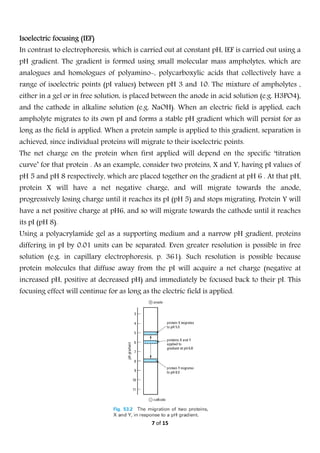
PFGE differs from conventional electrophoresis in that it uses two or more alternating
electric fields. An explanation for the effectivess of the technique is that large DNA
 
6 of 15 
 
fragments will be distorted by the voltage gradient, tending to elongate in the direction of
the electric field and ‘snaking’ through pores in the gel. If the original electric field is
removed, and a second is applied at an angle to the first, the DNA must reorientate before it
can migrate in the new direction. Larger (longer) DNA molecules will take more time to
reorientate than smaller molecules, resulting in size-dependent separations.
It can even be used to separate whole chromosomes. For example, the protozoan parasite
Leishmania has chromosomes that are too small to be seen using a light microscope but
which have been separated by PFGE.
 
7 of 15 
 
Isoelectric focusing (IEF)
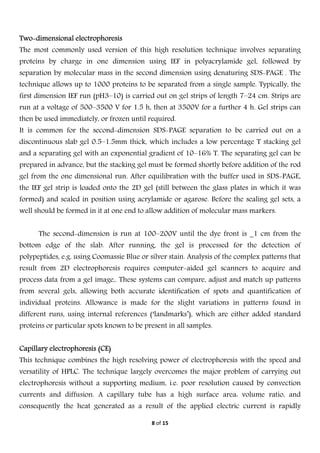
In contrast to electrophoresis, which is carried out at constant pH, IEF is carried out using a
pH gradient. The gradient is formed using small molecular mass ampholytes, which are
analogues and homologues of polyamino-, polycarboxylic acids that collectively have a
range of isoelectric points (pI values) between pH 3 and 10. The mixture of ampholytes ,
either in a gel or in free solution, is placed between the anode in acid solution (e.g. H3PO4),
and the cathode in alkaline solution (e.g. NaOH). When an electric field is applied, each
ampholyte migrates to its own pI and forms a stable pH gradient which will persist for as
long as the field is applied. When a protein sample is applied to this gradient, separation is
achieved, since individual proteins will migrate to their isoelectric points.
The net charge on the protein when first applied will depend on the specific ‘titration
curve’ for that protein . As an example, consider two proteins, X and Y, having pI values of
pH 5 and pH 8 respectively, which are placed together on the gradient at pH 6 . At that pH,
protein X will have a net negative charge, and will migrate towards the anode,
progressively losing charge until it reaches its pI (pH 5) and stops migrating. Protein Y will
have a net positive charge at pH6, and so will migrate towards the cathode until it reaches
its pI (pH 8).
Using a polyacrylamide gel as a supporting medium and a narrow pH gradient, proteins
differing in pI by 0.01 units can be separated. Even greater resolution is possible in free
solution (e.g. in capillary electrophoresis, p. 361). Such resolution is possible because
protein molecules that diffuse away from the pI will acquire a net charge (negative at
increased pH, positive at decreased pH) and immediately be focused back to their pI. This
focusing effect will continue for as long as the electric field is applied.
 
8 of 15 
 
Two-dimensional electrophoresis
The most commonly used version of this high resolution technique involves separating
proteins by charge in one dimension using IEF in polyacrylamide gel, followed by
separation by molecular mass in the second dimension using denaturing SDS-PAGE . The
technique allows up to 1000 proteins to be separated from a single sample. Typically, the
first dimension IEF run (pH3–10) is carried out on gel strips of length 7–24 cm. Strips are
run at a voltage of 500–3500 V for 1.5 h, then at 3500V for a further 4 h. Gel strips can
then be used immediately, or frozen until required.
It is common for the second-dimension SDS-PAGE separation to be carried out on a
discontinuous slab gel 0.5–1.5mm thick, which includes a low percentage T stacking gel
and a separating gel with an exponential gradient of 10–16% T. The separating gel can be
prepared in advance, but the stacking gel must be formed shortly before addition of the rod
gel from the one dimensional run. After equilibration with the buffer used in SDS-PAGE,
the IEF gel strip is loaded onto the 2D gel (still between the glass plates in which it was
formed) and sealed in position using acrylamide or agarose. Before the sealing gel sets, a
well should be formed in it at one end to allow addition of molecular mass markers.
The second-dimension is run at 100–200V until the dye front is _1 cm from the
bottom edge of the slab. After running, the gel is processed for the detection of
polypeptides, e.g. using Coomassie Blue or silver stain. Analysis of the complex patterns that
result from 2D electrophoresis requires computer-aided gel scanners to acquire and
process data from a gel image,. These systems can compare, adjust and match up patterns
from several gels, allowing both accurate identification of spots and quantification of
individual proteins. Allowance is made for the slight variations in patterns found in
different runs, using internal references (‘landmarks’), which are either added standard
proteins or particular spots known to be present in all samples.
Capillary electrophoresis (CE)
This technique combines the high resolving power of electrophoresis with the speed and
versatility of HPLC. The technique largely overcomes the major problem of carrying out
electrophoresis without a supporting medium, i.e. poor resolution caused by convection
currents and diffusion. A capillary tube has a high surface area: volume ratio, and
consequently the heat generated as a result of the applied electric current is rapidly
 
9 of 15 
 
dissipated. A further advantage is that very small sample volumes (5–10 nl) can be
analysed. The versatility of CE is demonstrated by its use in the separation of a range of
biomolecules, e.g. amino acids, proteins, nucleic acids, drugs, vitamins, organic acids and
inorganic ions; CE can even separate neutral species, e.g. steroids, aromatic hydrocarbons .
The capillary is made of fused silica and externally coated with a polymer for mechanical
strength. The internal diameter is usually 25–50 mm, a compromise between efficient heat
dissipation and the need for a light path that is not too short for detection using UV/visible
spectrophotometry. A gap in the polymer coating provides a window for detection
purposes. Samples are injected into the capillary by a variety of means, e.g. electrophoretic
loading or displacement. In the former, the inlet end of the capillary is immersed in the
sample and a pulse of high voltage is applied.
The displacement method involves forcing the sample into the capillary, either by
applying pressure in the sample vial using an inert gas, or by introducing a vacuum at the
outlet. The detectors used in CE are similar to those used in chromatography, e.g. UV/visible
spectrophotometric systems. Fluorescence detection is more sensitive, but this may require
sample derivatisation. Electrochemical and conductivity detection is also used in some
applications, e.g. conductivity detection of inorganic cations such as Na and K. Electro-
osmotic flow (EOF), described on page 351, is essential to the most commonly used types of
CE. The existence of EOF in the capillary is the result of the net negative charge on the
fused silica surface at pH values over 3.0. The resulting solvent flow towards the cathode is
greater than the attraction of anions towards the anode, so they will flow towards the
cathode (note that the detector is situated at the cathodic end of the capillary). The greater
the net negative charge on an anion, the greater is its resistance to the EOF and the lower
its mobility. Separated components migrate towards the cathode in the order: (1) cations,
(2) neutral species, (3) anions.
Capillary gel electrophoresis (CGE)
The underlying principle of this technique is directly comparable with that of conventional
PAGE, i.e. the capillary contains a polymer that acts as a molecular sieve. As charged sample
molecules migrate through the polymer network, larger molecules are hindered to a
greater extent than smaller ones and will tend to move more slowly. CGE differs from CZE
and MEKC in that the inner surface of the capillary is polymer-coated to prevent EOF; this
means that for most applications (e.g. polypeptide or oligonucleotide separations) sample
 
10 of 15 
 
components will migrate towards the anode at a rate determined by their size. The
technique also differs from conventional PAGE in that a ‘polymer network’ is used rather
than a gel: the polymer network may be polyacrylamide or agarose.
CGE offers the following advantages over conventional electrophoresis:
o efficient heat dissipation means that a high electrical field can be applied,
giving shorter separation times;
o detection of the separated components as they move towards the anodic end of
the capillary (e.g. using a UV/visible detector) means that staining is
unnecessary
o Automation is feasible.
Capillary isoelectric focusing (CIEF)
This is used mainly for protein separation. Here, the principles of IEF are valid as long as
EOF is prevented by using capillaries that are polymer coated on their inner surface.
Sample components migrate to their isoelectric points and become stationary. Once
separated (<10 min), the components must be mobilised so that they flow past the detector.
This is achieved by changing the NaOH solution in the cathodic reservoir with a
NaOH/NaCl solution. When the electric field is reapplied, Cl_ enters the capillary, causing
a decrease in pH at the cathodic end and the subsequent migration of sample components.
Techniques to study allelic diversity
In some circumstances, genetic diagnosis is difficult or impossible because the gene studied
is mutated but carries a rare mutation, undetected in a routine test, or even a mutation as
yet unidentified.
The establishment of the diagnosis requires screening strategies, that is to say a systematic
search for a mutation along the entire gene sequence. This search can be difficult due to
the size of the gene, notably if it has many large introns. When this is not the case, it is
possible to amplify the exons by PCR and to sequence them, bearing in mind that PCR
fragment sequencing has now become a simple, reliable and not that expensive routine.
However, some mutations can be missed during the sequential analysis of the exons
(intronic mutations or mutations in the promoter or the 3_ end of the gene).
 
11 of 15 
 
When the sequencing is not possible other more appropriate strategies have been
developed by researchers, with four being quite frequently used: single-strand
conformation polymorphism (SSCP), denaturing gradient gel electrophoresis (DGGE), DNA
high-performance liquid chromatography (DHPLC) and the protein truncation test (PTT)
whose purpose is to identify a mutation/polymorphism in the gene sequence without
requiring systematic sequencing.
Heteroduplex analyses are alternative tools for detecting DNA polymorphisms
Genetic mutations and, more generally, polymorphisms carrying a single nucleotide
change can be identified by the fact that the hybridization between the wild type DNA
strand and the mutated one leads to a local mismatch that can be observed using an
adapted apparatus, avoiding the cost and the time required by older techniques such as
Southern blot, dot blot or reverse dot. These analyses are: single-strand conformation
polymorphism (SSCP), denaturing gradient gel electrophoresis (DGGE) and DNA high-
performance liquid chromatography (DHPLC), in order of increasing usage and efficiency.
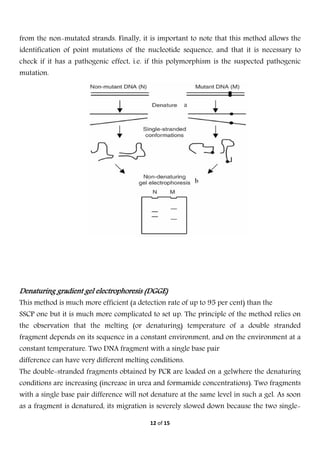
Single-strand conformation polymorphism (SSCP)
This consists of amplifying many fragments of the studied gene using PCR, then denaturing
them before cooling them very rapidly in order to prevent renaturing, leading to the
folding of the single strands in a conformation specific of their respective sequence (at
least, that is what is expected) during a non-denaturing gel
electrophoresis. If the two copies of a gene are identical, all the PCR of the different
fragments of the gene will contain only one type of double-stranded DNA fragment and
two types of single-stranded DNA, appearing on the gel as two different bands if their
conformation leads to a different migration speed.
If the two copies of a gene differ for a point mutation, one of the PCRs – the one involving
the segment carrying the mutation – will contain two types of double-strand DNA
fragments, one normal and the other one mutated, and four types of single strand
fragment, appearing on the gel as four different bands if their conformation leads to a
different migration speed.
This method is simple and widely used despite the fact that many mutations stay
undetectable (detection level is about 70 per cent) because they do not have a large enough
effect on the conformation of the mutated strands for their migration to be distinguishable
 
12 of 15 
 
from the non-mutated strands. Finally, it is important to note that this method allows the
identification of point mutations of the nucleotide sequence, and that it is necessary to
check if it has a pathogenic effect, i.e. if this polymorphism is the suspected pathogenic
mutation.
Denaturing gradient gel electrophoresis (DGGE)
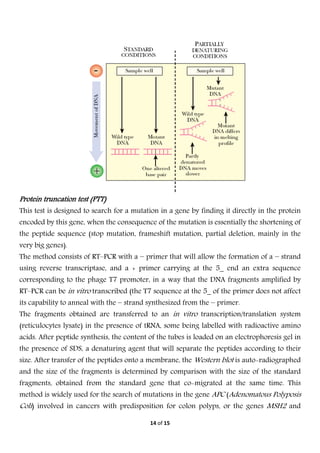
This method is much more efficient (a detection rate of up to 95 per cent) than the
SSCP one but it is much more complicated to set up. The principle of the method relies on
the observation that the melting (or denaturing) temperature of a double stranded
fragment depends on its sequence in a constant environment, and on the environment at a
constant temperature. Two DNA fragment with a single base pair
difference can have very different melting conditions.
The double-stranded fragments obtained by PCR are loaded on a gelwhere the denaturing
conditions are increasing (increase in urea and formamide concentrations). Two fragments
with a single base pair difference will not denature at the same level in such a gel. As soon
as a fragment is denatured, its migration is severely slowed down because the two single-
 
13 of 15 
 
stranded DNA are still bound to each other thanks to a Psoralene molecule added at their
extremities after the PCR, which suddenly increases its volume and therefore its resistance
to passing through the gel matrix. If two copies of a gene are identical, all PCRs will contain
a single type of double stranded DNA fragment, leading to a single band on a denaturing
gel. If the two copies of a gene are mutated and carry the same mutation, all PCRs will
contain one single type of mutated double-stranded DNA fragment leading to a single band
but at a level that can be different from the level reached by the non-mutated fragment. If
the two copies of a gene differ for a point mutation, one of the PCRs of the gene, involving
the segment carrying the mutations will contain two types of fragments called a
‘heteroduplex’ made up of one normal + strand renatured with a mutated – strand and a
normal − strand renaturated with a mutated + strand (with a mismatch at the level of the
mutation). Indeed, these heteroduplexes form spontaneously during PCR and a final
additive step can even favour their formation, which is interesting for the analysis because
their presence confirms that a polymorphism (a mutation) is present. The DGGE can show
up to four bands corresponding to four types of fragments if the melting conditions differ.
The gradient of denaturing agent concentration should be adapted to the sequence of the
studied fragments, the standard fragment being the reference to determine the denaturing
conditions. As is the case for the SSCP, it must be noted that this method reveals a
polymorphism in the nucleotide sequence, but it must be tested to check if it is the
suspected pathogenic mutation.
DGGE is used in the analysis of mutations, especially those such as base substitutions,
which do not change the length of the DNA. For example, DGGE has been used to screen
mutations in the BRCA1 and BRCA2 genes that are involved in causing breast cancer. In
addition, DGGE is widely used in screening natural populations for genetic variability
and/or relatedness. In particular, PCR of DNA extracted from soil or other natural habitat
followed by DGGE has been used to analyze the phylogenetic relationships of microbial
populations without the need to culture living microorganisms.
 
14 of 15 
 
Protein truncation test (PTT)
This test is designed to search for a mutation in a gene by finding it directly in the protein
encoded by this gene, when the consequence of the mutation is essentially the shortening of
the peptide sequence (stop mutation, frameshift mutation, partial deletion, mainly in the
very big genes).
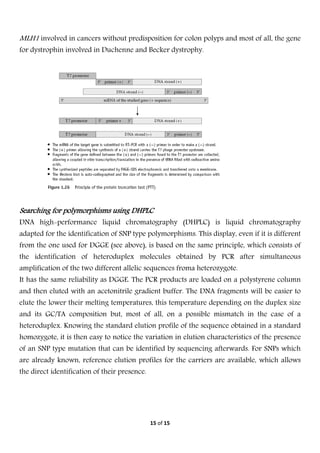
The method consists of RT–PCR with a − primer that will allow the formation of a − strand
using reverse transcriptase, and a + primer carrying at the 5_ end an extra sequence
corresponding to the phage T7 promoter, in a way that the DNA fragments amplified by
RT–PCR can be in vitro transcribed (the T7 sequence at the 5_ of the primer does not affect
its capability to anneal with the − strand synthesized from the − primer.
The fragments obtained are transferred to an in vitro transcription/translation system
(reticulocytes lysate) in the presence of tRNA, some being labelled with radioactive amino
acids. After peptide synthesis, the content of the tubes is loaded on an electrophoresis gel in
the presence of SDS, a denaturing agent that will separate the peptides according to their
size. After transfer of the peptides onto a membrane, the Western blot is auto-radiographed
and the size of the fragments is determined by comparison with the size of the standard
fragments, obtained from the standard gene that co-migrated at the same time. This
method is widely used for the search of mutations in the gene APC (Adenomatous Polyposis
Coli) involved in cancers with predisposition for colon polyps, or the genes MSH2 and
 
15 of 15 
 
MLH1 involved in cancers without predisposition for colon polyps and most of all, the gene
for dystrophin involved in Duchenne and Becker dystrophy.
Searching for polymorphisms using DHPLC
DNA high-performance liquid chromatography (DHPLC) is liquid chromatography
adapted for the identification of SNP type polymorphisms. This display, even if it is different
from the one used for DGGE (see above), is based on the same principle, which consists of
the identification of heteroduplex molecules obtained by PCR after simultaneous
amplification of the two different allelic sequences froma heterozygote.
It has the same reliability as DGGE. The PCR products are loaded on a polystyrene column
and then eluted with an acetonitrile gradient buffer. The DNA fragments will be easier to
elute the lower their melting temperatures, this temperature depending on the duplex size
and its GC/TA composition but, most of all, on a possible mismatch in the case of a
heteroduplex. Knowing the standard elution profile of the sequence obtained in a standard
homozygote, it is then easy to notice the variation in elution characteristics of the presence
of an SNP type mutation that can be identified by sequencing afterwards. For SNPs which
are already known, reference elution profiles for the carriers are available, which allows
the direct identification of their presence.

advanced electrophoresis

  • 1.
      1 of 15    Electrophoresis Technology Electrophoresis isa separation technique based on the movement of charged molecules in an electric field. Dissimilar molecules move at different rates and the components of a mixture will be separated when an electric field is applied. It is a widely used technique, particularly for the analysis of complex mixtures or for the verification of purity (homogeneity) of isolated biomolecules. While electrophoresis is mostly used for the separation of charged macromolecules, techniques are available for high resolution separations of small molecules such as amino acids. Electrophoretic separation of proteins has many applications, including clinical diagnosis. However, the principles apply equally to other molecules. The electrophoretic mobility of a charged molecule depends on the following: • Net charge – negatively charged molecules (anions) migrate towards the anode (), while positively charged molecules (cations) migrate towards the cathode (_); highly charged molecules move faster towards the electrode of opposite charge than those with lesser charge. • Size – frictional resistance exerted on molecules moving in a solution means that smaller molecules migrate faster than large molecules. • Shape – the effect of friction also means that the shape of the molecule will affect mobility, e.g. globular proteins compared with fibrous proteins, linear DNA compared with circular DNA. • Electrical field strength – mobility increases with increasing electrical potential (voltage), but there are practical limitations to using high voltages, especially because of heating effects. Electrophoresis and the separation of proteins The net charge of a sample molecule determines its direction of movement and significantly affects its mobility. The net charge of a protein molecule is pH-dependent, and is determined by the relative numbers of positively and negatively charged amino acid side chains at a given pH. The degree of ionisation of each amino acid side chain is pH- dependent, resulting in a variation of net charge on the protein at different pH values. Since an individual protein will have a unique content of ionisable amino acids, each
  • 2.
      2 of 15    protein will havea characteristic ‘titration curve’ when net charge is plotted against pH. Thus, electrophoresis is always carried out at constant pH and a suitable buffer must be present along with the sample to maintain that pH. If the proteins were subjected to electrophoresis at pH 9.0, and if the proteins were of similar size and shape, then the rate at which protein A (net charge, -3) migrates towards the anode would be faster than that for protein B (net charge, -1). Separation of proteins is usually carried out at alkaline pH, where most proteins carry a net negative charge. Types of supporting media • Inert media – these provide physical support and minimise convection: separation is based on charge density only (e.g. cellulose acetate); • Porous media – these introduce molecular sieving as an additional effect: their pore size is of the same order as the size of molecules being separated, restricting the movement of larger molecules relative to smaller ones. Thus, separation depends on both the charge density and the size of the molecule. o Cellulose acetate Acetylation of the hydroxyl groups of cellulose produces a less hydrophilic structure than cellulose in the form of paper: as a result it holds less water and diffusion is reduced, with a corresponding increase in resolution. Cellulose acetate is often used in the electrophoretic separation of plasma proteins in clinical diagnosis – it can be carried out quickly (~45 min) and its resolution is adequate to detect gross differences in various types of protein (e.g. paraproteins in myeloma). Cellulose acetate has a fairly uniform pore structure and the pores are large enough to allow unrestricted passage of all but the largest of molecules as they migrate through the medium. o Agarose Agarose is the neutral, linear polysaccharide component of agar (from seaweed), consisting of repeating galactose and 3,6-anhydrogalactose subunits . Powdered agarose is mixed with electrophoresis buffer at concentrations of 0.5–3.0%w/v, boiled until the mixture becomes clear, poured onto a glass plate, then allowed to cool until it forms a gel. Gelation is due to the formation of hydrogen bonds both between and within the agarose polymers, resulting in the formation of pores.
  • 3.
      3 of 15    The pore sizedepends on the agarose concentration. Low concentrations produce gels with large pores relative to the size of proteins, allowing them to migrate relatively unhindered through the gel, as determined by their individual charge densities. Low concentrations of agarose gel are suitable for techniques such as immunoelectrophoresis and isoelectric focusing, where charge is the main basis of separation. The smaller pores produced by higher concentrations of agarose may result in molecular sieving. When agarose gels are used for the separation of DNA, the large fragment size means that molecular sieving is observed, even with low concentration gels. This is the basis of the electrophoretic separation of nucleic acids. o Polyacrylamide Polyacrylamide gel electrophoresis (PAGE) plays a major role in protein analysis, both for one-dimensional and two-dimensional separations. The gel is formed by polymerising acrylamide monomer into long chains and cross-linking these chains using N,N0- methylene bisacrylamide (often abbreviated to ‘bis’). In most protocols, polymerisation is initiated by free radicals produced by ammonium persulphate in the presence of N, N,N0,N0-tetramethylethylenediamine (TEMED). Gels of <2.5% are necessary for molecular sieving of molecules of Mr > 106, but such gels are almost fluid and require 0.5% agarose to make them solid. Note that a gel of 3% will separate DNA by molecular sieving, owing to the large size of the nucleic acid molecules. General strategy for separation Rod or slab gels – flat slab gels are formed between glass plates, using plastic spacers 0.75– 1.5mm thick: rod gels are made in narrow bore tubes. For most separations using several samples, a slab gel saves time because up to 25 samples can be separated under identical conditions in a single gel, while rod gels can only be used for individual samples. Rectangular slab gels are also easier to read, by densitometry, and photograph. However, rod gels are useful in preliminary separations, for determining a suitable pH and gel concentration, and for applications where the gel is sliced to extract and assay proteins of interest. Dissociating or non-dissociating conditions – the most widely used PAGE protein separation technique uses an ionic detergent, usually sodium dodecyl sulphate (SDS), which dissociates proteins into their individual polypeptide subunits and gives a uniform
  • 4.
      4 of 15    net charge alongeach denatured polypeptide. This technique, known as SDS-PAGE, On the other hand, if it is necessary to preserve the native protein conformation and biological activity, non-dissociating conditions are used, i.e. no SDS is added. In SDS-PAGE the sample protein is normally heated to 100 8C for 2 min, in buffer containing 1% (w/v) SDS and 1% (w/v) 2-mercaptoethanol, the latter to cleave any disulphide bonds. Continuous or discontinuous buffer systems – a continuous system is where the same buffer ions are present in the sample, gel and buffer reservoirs, all at the same pH. The sample is loaded directly onto a gel (the ‘separating gel’ or ‘resolving gel’) that has pores small enough to introduce molecular sieving. In contrast, discontinuous systems have different buffers in the gel compared to the reservoirs, both in terms of buffer ions and pH. The sample is loaded onto a large-pore ‘stacking gel’, previously polymerised on top of a small-pore separating gel . The individual proteins in the sample concentrate into very narrow zones during their migration through the large-pore gel and stack up according to their charge densities, prior to separation in the small-pore gel, giving enhanced results compared with continuous systems. Post-electrophoretic procedures Handling of the supporting medium Staining and analysis (Coomassie Blue R-250 (PAGE, protein), silver staining (PAGE, protein and nucleic acid), ethidium bromide (agarose GL nucleic acid) Detection of separated components includes: autoradiography for proteins labelled with 32 P or 125 I Fluorescence for proteins pre-labelled with fluorescent dyes. Periodic acid-Schiff (PAS) stain using dansyl hydrazine for glycoproteins. Separation of DNA by agarose and polyacrylamide gel electrophoresis Electrophoresis is the term used to describe the movement of ions in an applied electrical field. DNA molecules are negatively charged, migrating through an agarose gel towards the anode at a rate that is dependent upon molecular size – smaller, compact DNA molecules can pass through the sieve-like agarose matrix more easily than large, extended fragments. Electrophoresis of plasmid DNA is usually carried out using a submerged agarose gel. The amount of agarose is adjusted, depending on the size of the DNA molecules to be separated,
  • 5.
      5 of 15    e.g. 0.3% w/vagarose is used for large fragments (>20 000 bp) while 0.8% is used for smaller fragments. Very small fragments are best separated using a polyacrylamide gel. Electrophoretic separation of RNA Total cellular RNA or purified mRNA can be separated on the basis of size by electrophoretic separations similar to those used for DNA fragments. However, under the conditions used to separate dsDNA, RNA molecules tend to develop a secondary structure, and this leads to anomalous mobilities. To eliminate RNA secondary structure, samples are pretreated by heating in dilute formamide or glyoxal, and electrophoresis is carried out in ‘denaturing gels’ which include buffers containing formaldehyde. Pulsed field gel electrophoresis (PFGE) If structural information is to be gained about large stretches of genomic DNA, then the order of the relatively short DNA segments (generated by the restriction enzymes) needs to be established. This is technically possible when dealing with large chromosomes such as those from yeast (a few Mbp) and humans (50–100 Mb), in contrast to the smaller genomes of bacteria and viruses. The technique of PFGE allows separation of DNA fragments of up to _12Mb. Very large DNA fragments (>100 kbp) can be generated from chromosomal DNA by the use of certain restriction enzymes that recognise base sequences that are present at relatively low frequency, e.g. the enzyme Not I, which recognises a sequence of 8 bp rather than 4–6bp. These enzymes are sometimes called ‘rare cutters’. Genomic DNA prepared in the normal way is not suitable for digestion by these enzymes, as shearing during extraction fragments the DNA. Therefore, genomic DNA for analysis by PFGE is prepared as follows: o cells are embedded in an agarose block; o The block is incubated in solutions containing detergent, RNase and proteinase K, lysing the cells and hydrolysing RNA and proteins. The products of RNase and proteinase digestion diffuse away, leaving behind genomic DNA molecules exceeding several thousand kbp o The block is incubated in situ in a buffered solution containing an appropriate ‘rare cutter’: restriction fragments are produced, of up to _800 kbp. PFGE differs from conventional electrophoresis in that it uses two or more alternating electric fields. An explanation for the effectivess of the technique is that large DNA
  • 6.
      6 of 15    fragments will bedistorted by the voltage gradient, tending to elongate in the direction of the electric field and ‘snaking’ through pores in the gel. If the original electric field is removed, and a second is applied at an angle to the first, the DNA must reorientate before it can migrate in the new direction. Larger (longer) DNA molecules will take more time to reorientate than smaller molecules, resulting in size-dependent separations. It can even be used to separate whole chromosomes. For example, the protozoan parasite Leishmania has chromosomes that are too small to be seen using a light microscope but which have been separated by PFGE.
  • 7.
      7 of 15    Isoelectric focusing (IEF) Incontrast to electrophoresis, which is carried out at constant pH, IEF is carried out using a pH gradient. The gradient is formed using small molecular mass ampholytes, which are analogues and homologues of polyamino-, polycarboxylic acids that collectively have a range of isoelectric points (pI values) between pH 3 and 10. The mixture of ampholytes , either in a gel or in free solution, is placed between the anode in acid solution (e.g. H3PO4), and the cathode in alkaline solution (e.g. NaOH). When an electric field is applied, each ampholyte migrates to its own pI and forms a stable pH gradient which will persist for as long as the field is applied. When a protein sample is applied to this gradient, separation is achieved, since individual proteins will migrate to their isoelectric points. The net charge on the protein when first applied will depend on the specific ‘titration curve’ for that protein . As an example, consider two proteins, X and Y, having pI values of pH 5 and pH 8 respectively, which are placed together on the gradient at pH 6 . At that pH, protein X will have a net negative charge, and will migrate towards the anode, progressively losing charge until it reaches its pI (pH 5) and stops migrating. Protein Y will have a net positive charge at pH6, and so will migrate towards the cathode until it reaches its pI (pH 8). Using a polyacrylamide gel as a supporting medium and a narrow pH gradient, proteins differing in pI by 0.01 units can be separated. Even greater resolution is possible in free solution (e.g. in capillary electrophoresis, p. 361). Such resolution is possible because protein molecules that diffuse away from the pI will acquire a net charge (negative at increased pH, positive at decreased pH) and immediately be focused back to their pI. This focusing effect will continue for as long as the electric field is applied.
  • 8.
      8 of 15    Two-dimensional electrophoresis The mostcommonly used version of this high resolution technique involves separating proteins by charge in one dimension using IEF in polyacrylamide gel, followed by separation by molecular mass in the second dimension using denaturing SDS-PAGE . The technique allows up to 1000 proteins to be separated from a single sample. Typically, the first dimension IEF run (pH3–10) is carried out on gel strips of length 7–24 cm. Strips are run at a voltage of 500–3500 V for 1.5 h, then at 3500V for a further 4 h. Gel strips can then be used immediately, or frozen until required. It is common for the second-dimension SDS-PAGE separation to be carried out on a discontinuous slab gel 0.5–1.5mm thick, which includes a low percentage T stacking gel and a separating gel with an exponential gradient of 10–16% T. The separating gel can be prepared in advance, but the stacking gel must be formed shortly before addition of the rod gel from the one dimensional run. After equilibration with the buffer used in SDS-PAGE, the IEF gel strip is loaded onto the 2D gel (still between the glass plates in which it was formed) and sealed in position using acrylamide or agarose. Before the sealing gel sets, a well should be formed in it at one end to allow addition of molecular mass markers. The second-dimension is run at 100–200V until the dye front is _1 cm from the bottom edge of the slab. After running, the gel is processed for the detection of polypeptides, e.g. using Coomassie Blue or silver stain. Analysis of the complex patterns that result from 2D electrophoresis requires computer-aided gel scanners to acquire and process data from a gel image,. These systems can compare, adjust and match up patterns from several gels, allowing both accurate identification of spots and quantification of individual proteins. Allowance is made for the slight variations in patterns found in different runs, using internal references (‘landmarks’), which are either added standard proteins or particular spots known to be present in all samples. Capillary electrophoresis (CE) This technique combines the high resolving power of electrophoresis with the speed and versatility of HPLC. The technique largely overcomes the major problem of carrying out electrophoresis without a supporting medium, i.e. poor resolution caused by convection currents and diffusion. A capillary tube has a high surface area: volume ratio, and consequently the heat generated as a result of the applied electric current is rapidly
  • 9.
      9 of 15    dissipated. A furtheradvantage is that very small sample volumes (5–10 nl) can be analysed. The versatility of CE is demonstrated by its use in the separation of a range of biomolecules, e.g. amino acids, proteins, nucleic acids, drugs, vitamins, organic acids and inorganic ions; CE can even separate neutral species, e.g. steroids, aromatic hydrocarbons . The capillary is made of fused silica and externally coated with a polymer for mechanical strength. The internal diameter is usually 25–50 mm, a compromise between efficient heat dissipation and the need for a light path that is not too short for detection using UV/visible spectrophotometry. A gap in the polymer coating provides a window for detection purposes. Samples are injected into the capillary by a variety of means, e.g. electrophoretic loading or displacement. In the former, the inlet end of the capillary is immersed in the sample and a pulse of high voltage is applied. The displacement method involves forcing the sample into the capillary, either by applying pressure in the sample vial using an inert gas, or by introducing a vacuum at the outlet. The detectors used in CE are similar to those used in chromatography, e.g. UV/visible spectrophotometric systems. Fluorescence detection is more sensitive, but this may require sample derivatisation. Electrochemical and conductivity detection is also used in some applications, e.g. conductivity detection of inorganic cations such as Na and K. Electro- osmotic flow (EOF), described on page 351, is essential to the most commonly used types of CE. The existence of EOF in the capillary is the result of the net negative charge on the fused silica surface at pH values over 3.0. The resulting solvent flow towards the cathode is greater than the attraction of anions towards the anode, so they will flow towards the cathode (note that the detector is situated at the cathodic end of the capillary). The greater the net negative charge on an anion, the greater is its resistance to the EOF and the lower its mobility. Separated components migrate towards the cathode in the order: (1) cations, (2) neutral species, (3) anions. Capillary gel electrophoresis (CGE) The underlying principle of this technique is directly comparable with that of conventional PAGE, i.e. the capillary contains a polymer that acts as a molecular sieve. As charged sample molecules migrate through the polymer network, larger molecules are hindered to a greater extent than smaller ones and will tend to move more slowly. CGE differs from CZE and MEKC in that the inner surface of the capillary is polymer-coated to prevent EOF; this means that for most applications (e.g. polypeptide or oligonucleotide separations) sample
  • 10.
      10 of 15    components will migratetowards the anode at a rate determined by their size. The technique also differs from conventional PAGE in that a ‘polymer network’ is used rather than a gel: the polymer network may be polyacrylamide or agarose. CGE offers the following advantages over conventional electrophoresis: o efficient heat dissipation means that a high electrical field can be applied, giving shorter separation times; o detection of the separated components as they move towards the anodic end of the capillary (e.g. using a UV/visible detector) means that staining is unnecessary o Automation is feasible. Capillary isoelectric focusing (CIEF) This is used mainly for protein separation. Here, the principles of IEF are valid as long as EOF is prevented by using capillaries that are polymer coated on their inner surface. Sample components migrate to their isoelectric points and become stationary. Once separated (<10 min), the components must be mobilised so that they flow past the detector. This is achieved by changing the NaOH solution in the cathodic reservoir with a NaOH/NaCl solution. When the electric field is reapplied, Cl_ enters the capillary, causing a decrease in pH at the cathodic end and the subsequent migration of sample components. Techniques to study allelic diversity In some circumstances, genetic diagnosis is difficult or impossible because the gene studied is mutated but carries a rare mutation, undetected in a routine test, or even a mutation as yet unidentified. The establishment of the diagnosis requires screening strategies, that is to say a systematic search for a mutation along the entire gene sequence. This search can be difficult due to the size of the gene, notably if it has many large introns. When this is not the case, it is possible to amplify the exons by PCR and to sequence them, bearing in mind that PCR fragment sequencing has now become a simple, reliable and not that expensive routine. However, some mutations can be missed during the sequential analysis of the exons (intronic mutations or mutations in the promoter or the 3_ end of the gene).
  • 11.
      11 of 15    When the sequencingis not possible other more appropriate strategies have been developed by researchers, with four being quite frequently used: single-strand conformation polymorphism (SSCP), denaturing gradient gel electrophoresis (DGGE), DNA high-performance liquid chromatography (DHPLC) and the protein truncation test (PTT) whose purpose is to identify a mutation/polymorphism in the gene sequence without requiring systematic sequencing. Heteroduplex analyses are alternative tools for detecting DNA polymorphisms Genetic mutations and, more generally, polymorphisms carrying a single nucleotide change can be identified by the fact that the hybridization between the wild type DNA strand and the mutated one leads to a local mismatch that can be observed using an adapted apparatus, avoiding the cost and the time required by older techniques such as Southern blot, dot blot or reverse dot. These analyses are: single-strand conformation polymorphism (SSCP), denaturing gradient gel electrophoresis (DGGE) and DNA high- performance liquid chromatography (DHPLC), in order of increasing usage and efficiency. Single-strand conformation polymorphism (SSCP) This consists of amplifying many fragments of the studied gene using PCR, then denaturing them before cooling them very rapidly in order to prevent renaturing, leading to the folding of the single strands in a conformation specific of their respective sequence (at least, that is what is expected) during a non-denaturing gel electrophoresis. If the two copies of a gene are identical, all the PCR of the different fragments of the gene will contain only one type of double-stranded DNA fragment and two types of single-stranded DNA, appearing on the gel as two different bands if their conformation leads to a different migration speed. If the two copies of a gene differ for a point mutation, one of the PCRs – the one involving the segment carrying the mutation – will contain two types of double-strand DNA fragments, one normal and the other one mutated, and four types of single strand fragment, appearing on the gel as four different bands if their conformation leads to a different migration speed. This method is simple and widely used despite the fact that many mutations stay undetectable (detection level is about 70 per cent) because they do not have a large enough effect on the conformation of the mutated strands for their migration to be distinguishable
  • 12.
      12 of 15    from the non-mutatedstrands. Finally, it is important to note that this method allows the identification of point mutations of the nucleotide sequence, and that it is necessary to check if it has a pathogenic effect, i.e. if this polymorphism is the suspected pathogenic mutation. Denaturing gradient gel electrophoresis (DGGE) This method is much more efficient (a detection rate of up to 95 per cent) than the SSCP one but it is much more complicated to set up. The principle of the method relies on the observation that the melting (or denaturing) temperature of a double stranded fragment depends on its sequence in a constant environment, and on the environment at a constant temperature. Two DNA fragment with a single base pair difference can have very different melting conditions. The double-stranded fragments obtained by PCR are loaded on a gelwhere the denaturing conditions are increasing (increase in urea and formamide concentrations). Two fragments with a single base pair difference will not denature at the same level in such a gel. As soon as a fragment is denatured, its migration is severely slowed down because the two single-
  • 13.
      13 of 15    stranded DNA arestill bound to each other thanks to a Psoralene molecule added at their extremities after the PCR, which suddenly increases its volume and therefore its resistance to passing through the gel matrix. If two copies of a gene are identical, all PCRs will contain a single type of double stranded DNA fragment, leading to a single band on a denaturing gel. If the two copies of a gene are mutated and carry the same mutation, all PCRs will contain one single type of mutated double-stranded DNA fragment leading to a single band but at a level that can be different from the level reached by the non-mutated fragment. If the two copies of a gene differ for a point mutation, one of the PCRs of the gene, involving the segment carrying the mutations will contain two types of fragments called a ‘heteroduplex’ made up of one normal + strand renatured with a mutated – strand and a normal − strand renaturated with a mutated + strand (with a mismatch at the level of the mutation). Indeed, these heteroduplexes form spontaneously during PCR and a final additive step can even favour their formation, which is interesting for the analysis because their presence confirms that a polymorphism (a mutation) is present. The DGGE can show up to four bands corresponding to four types of fragments if the melting conditions differ. The gradient of denaturing agent concentration should be adapted to the sequence of the studied fragments, the standard fragment being the reference to determine the denaturing conditions. As is the case for the SSCP, it must be noted that this method reveals a polymorphism in the nucleotide sequence, but it must be tested to check if it is the suspected pathogenic mutation. DGGE is used in the analysis of mutations, especially those such as base substitutions, which do not change the length of the DNA. For example, DGGE has been used to screen mutations in the BRCA1 and BRCA2 genes that are involved in causing breast cancer. In addition, DGGE is widely used in screening natural populations for genetic variability and/or relatedness. In particular, PCR of DNA extracted from soil or other natural habitat followed by DGGE has been used to analyze the phylogenetic relationships of microbial populations without the need to culture living microorganisms.
  • 14.
      14 of 15    Protein truncation test(PTT) This test is designed to search for a mutation in a gene by finding it directly in the protein encoded by this gene, when the consequence of the mutation is essentially the shortening of the peptide sequence (stop mutation, frameshift mutation, partial deletion, mainly in the very big genes). The method consists of RT–PCR with a − primer that will allow the formation of a − strand using reverse transcriptase, and a + primer carrying at the 5_ end an extra sequence corresponding to the phage T7 promoter, in a way that the DNA fragments amplified by RT–PCR can be in vitro transcribed (the T7 sequence at the 5_ of the primer does not affect its capability to anneal with the − strand synthesized from the − primer. The fragments obtained are transferred to an in vitro transcription/translation system (reticulocytes lysate) in the presence of tRNA, some being labelled with radioactive amino acids. After peptide synthesis, the content of the tubes is loaded on an electrophoresis gel in the presence of SDS, a denaturing agent that will separate the peptides according to their size. After transfer of the peptides onto a membrane, the Western blot is auto-radiographed and the size of the fragments is determined by comparison with the size of the standard fragments, obtained from the standard gene that co-migrated at the same time. This method is widely used for the search of mutations in the gene APC (Adenomatous Polyposis Coli) involved in cancers with predisposition for colon polyps, or the genes MSH2 and
  • 15.
      15 of 15    MLH1 involved incancers without predisposition for colon polyps and most of all, the gene for dystrophin involved in Duchenne and Becker dystrophy. Searching for polymorphisms using DHPLC DNA high-performance liquid chromatography (DHPLC) is liquid chromatography adapted for the identification of SNP type polymorphisms. This display, even if it is different from the one used for DGGE (see above), is based on the same principle, which consists of the identification of heteroduplex molecules obtained by PCR after simultaneous amplification of the two different allelic sequences froma heterozygote. It has the same reliability as DGGE. The PCR products are loaded on a polystyrene column and then eluted with an acetonitrile gradient buffer. The DNA fragments will be easier to elute the lower their melting temperatures, this temperature depending on the duplex size and its GC/TA composition but, most of all, on a possible mismatch in the case of a heteroduplex. Knowing the standard elution profile of the sequence obtained in a standard homozygote, it is then easy to notice the variation in elution characteristics of the presence of an SNP type mutation that can be identified by sequencing afterwards. For SNPs which are already known, reference elution profiles for the carriers are available, which allows the direct identification of their presence.