© Copyright 2013 Hewlett-Packard Development Company, L.P. The information contained herein is subject to change without notice. HP Restricted.1
Business Communication
© Copyright 2013 Hewlett-Packard Development Company, L.P. The information contained herein is subject to change without notice. HP Restricted.2
Today’s Agenda
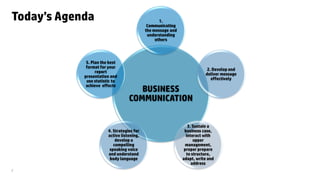
BUSINESS
COMMUNICATION
1.
Communicating
the message and
understanding
others
2. Develop and
deliver message
effectively
3. Sustain a
business case,
interact with
upper
management,
proper prepare
to structure,
adapt, write and
address
4. Strategies for
active listening,
develop a
compelling
speaking voice
and understand
body language
5. Plan the best
format for your
report
presentation and
use statistic to
achieve effects
© Copyright 2013 Hewlett-Packard Development Company, L.P. The information contained herein is subject to change without notice. HP Restricted.3
Communicating the Message
What is Business Communication?
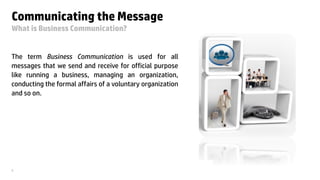
The term Business Communication is used for all
messages that we send and receive for official purpose
like running a business, managing an organization,
conducting the formal affairs of a voluntary organization
and so on.
© Copyright 2013 Hewlett-Packard Development Company, L.P. The information contained herein is subject to change without notice. HP Restricted.4
Communicating the Message
Fuel for Communication
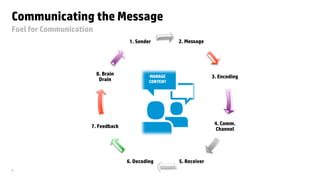
2. Message
3. Encoding
4. Comm.
Channel
5. Receiver6. Decoding
7. Feedback
8. Brain
Drain
1. Sender
© Copyright 2013 Hewlett-Packard Development Company, L.P. The information contained herein is subject to change without notice. HP Restricted.5
Communicating the Message
Forms of Communication
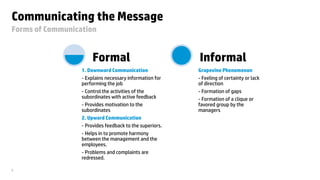
1. Downward Communication
- Explains necessary information for
performing the job
- Control the activities of the
subordinates with active feedback
- Provides motivation to the
subordinates
2. Upward Communication
- Provides feedback to the superiors.
- Helps in to promote harmony
between the management and the
employees.
- Problems and complaints are
redressed.
Formal
Grapevine Phenomenon
- Feeling of certainty or lack
of direction
- Formation of gaps
- Formation of a clique or
favored group by the
managers
Informal
© Copyright 2013 Hewlett-Packard Development Company, L.P. The information contained herein is subject to change without notice. HP Restricted.6
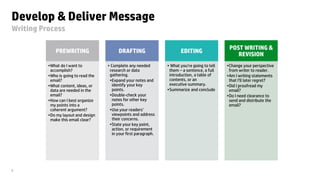
Develop & Deliver Message
Writing Process
PREWRITING
•What do I want to
accomplish?
•Who is going to read the
email?
•What content, ideas, or
data are needed in the
email?
•How can I best organize
my points into a
coherent argument?
•Do my layout and design
make this email clear?
DRAFTING
• Complete any needed
research or data
gathering.
•Expand your notes and
identify your key
points.
•Double-check your
notes for other key
points.
•Use your readers’
viewpoints and address
their concerns.
•State your key point,
action, or requirement
in your first paragraph.
EDITING
• What you’re going to tell
them – a sentence, a full
introduction, a table of
contents, or an
executive summary.
•Summarize and conclude
POST WRITING &
REVISION
•Change your perspective
from writer to reader.
•Am I writing statements
that I'll later regret?
•Did I proofread my
email?
•Do I need clearance to
send and distribute the
email?
© Copyright 2013 Hewlett-Packard Development Company, L.P. The information contained herein is subject to change without notice. HP Restricted.7
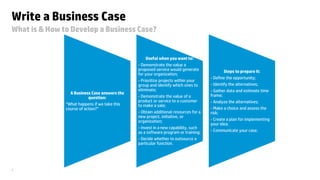
Write a Business Case
What is & How to Develop a Business Case?
A Business Case answers the
question:
“What happens if we take this
course of action?”
Useful when you want to:
- Demonstrate the value a
proposed service would generate
for your organization;
- Prioritize projects within your
group and identify which ones to
eliminate;
- Demonstrate the value of a
product or service to a customer
to make a sale;
- Obtain additional resources for a
new project, initiative, or
organization;
- Invest in a new capability, such
as a software program or training;
- Decide whether to outsource a
particular function.
Steps to prepare it:
- Define the opportunity;
- Identify the alternatives;
- Gather data and estimate time
frame;
- Analyze the alternatives;
- Make a choice and assess the
risk;
- Create a plan for implementing
your idea;
- Communicate your case.
© Copyright 2013 Hewlett-Packard Development Company, L.P. The information contained herein is subject to change without notice. HP Restricted.8
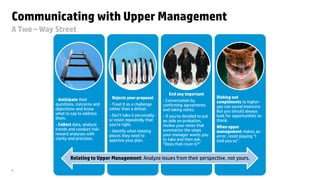
Communicating with Upper Management
A Two – Way Street
- Anticipate their
questions, concerns and
objections-and know
what to say to address
them.
- Collect data, analyze
trends and conduct risk-
reward analyses with
clarity and precision.
Rejects your proposal
- Treat it as a challenge
rather than a defeat.
- Don't take it personally
or insist repeatedly that
you're right.
- Identify what missing
pieces they need to
approve your plan.
End any important
- Conversation by
confirming agreements
and taking notes.
- If you've decided to put
an aide on probation,
review your notes that
summarize the steps
your manager wants you
to take and then ask,
“Does that cover it?”
Dishing out
compliments to higher-
ups can sound insincere.
But you should always
look for opportunities to
thank.
When upper
management makes an
error, resist playing “I
told you so” .
Relating to Upper Management: Analyze issues from their perspective, not yours.
© Copyright 2013 Hewlett-Packard Development Company, L.P. The information contained herein is subject to change without notice. HP Restricted.9
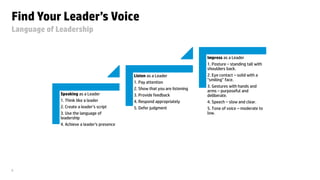
Find Your Leader’s Voice
Language of Leadership
Speaking as a Leader
1. Think like a leader
2. Create a leader’s script
3. Use the language of
leadership
4. Achieve a leader's presence
Listen as a Leader
1. Pay attention
2. Show that you are listening
3. Provide feedback
4. Respond appropriately
5. Defer judgment
Impress as a Leader
1. Posture – standing tall with
shoulders back.
2. Eye contact – solid with a
"smiling" face.
3. Gestures with hands and
arms – purposeful and
deliberate.
4. Speech – slow and clear.
5. Tone of voice – moderate to
low.
© Copyright 2013 Hewlett-Packard Development Company, L.P. The information contained herein is subject to change without notice. HP Restricted.10
Communication in Today’s Business Environment
Where Do the Narratives, Goals and Milestones Go?
So if they are written poorly/hard to understand
1. This reflects badly on you and Operations
2. Threatens deadlines
3. Creates rework as you will need to be contacted to clarify
High Level Guidelines:
1. Written from a “rookie” point of view i.e. after writing, ask yourself “Would ANYONE (not
just experts), understand this?” If no, rewrite and check with a colleague
2. Don’t try to impress your audience, it will just leave them confused and frustrated
3. Verbalize, “This is a great success because….this is an achievement because….” It helps
to be told why something is important, helps audience draw conclusions and correlations
quicker
4. So why is this good? What is the benefit? Be explicit
© Copyright 2013 Hewlett-Packard Development Company, L.P. The information contained herein is subject to change without notice. HP Restricted.11
Communication in Today’s Business Environment
Writing Good Narratives , Goals and Milestones
• Make it Measurable
• Concise & Clear – Meaningful Terms
• Past Tense for Achievements
• Use Verbs
• Clear call to actions
• Do not use acronyms or abbreviations
• Ask yourself: So why is this good? What is the
benefit? Be explicit
© Copyright 2013 Hewlett-Packard Development Company, L.P. The information contained herein is subject to change without notice. HP Restricted.
Thankyou!

Advanced Business Communication 2013

  • 1.
    © Copyright 2013Hewlett-Packard Development Company, L.P. The information contained herein is subject to change without notice. HP Restricted.1 Business Communication
  • 2.
    © Copyright 2013Hewlett-Packard Development Company, L.P. The information contained herein is subject to change without notice. HP Restricted.2 Today’s Agenda BUSINESS COMMUNICATION 1. Communicating the message and understanding others 2. Develop and deliver message effectively 3. Sustain a business case, interact with upper management, proper prepare to structure, adapt, write and address 4. Strategies for active listening, develop a compelling speaking voice and understand body language 5. Plan the best format for your report presentation and use statistic to achieve effects
  • 3.
    © Copyright 2013Hewlett-Packard Development Company, L.P. The information contained herein is subject to change without notice. HP Restricted.3 Communicating the Message What is Business Communication? The term Business Communication is used for all messages that we send and receive for official purpose like running a business, managing an organization, conducting the formal affairs of a voluntary organization and so on.
  • 4.
    © Copyright 2013Hewlett-Packard Development Company, L.P. The information contained herein is subject to change without notice. HP Restricted.4 Communicating the Message Fuel for Communication 2. Message 3. Encoding 4. Comm. Channel 5. Receiver6. Decoding 7. Feedback 8. Brain Drain 1. Sender
  • 5.
    © Copyright 2013Hewlett-Packard Development Company, L.P. The information contained herein is subject to change without notice. HP Restricted.5 Communicating the Message Forms of Communication 1. Downward Communication - Explains necessary information for performing the job - Control the activities of the subordinates with active feedback - Provides motivation to the subordinates 2. Upward Communication - Provides feedback to the superiors. - Helps in to promote harmony between the management and the employees. - Problems and complaints are redressed. Formal Grapevine Phenomenon - Feeling of certainty or lack of direction - Formation of gaps - Formation of a clique or favored group by the managers Informal
  • 6.
    © Copyright 2013Hewlett-Packard Development Company, L.P. The information contained herein is subject to change without notice. HP Restricted.6 Develop & Deliver Message Writing Process PREWRITING •What do I want to accomplish? •Who is going to read the email? •What content, ideas, or data are needed in the email? •How can I best organize my points into a coherent argument? •Do my layout and design make this email clear? DRAFTING • Complete any needed research or data gathering. •Expand your notes and identify your key points. •Double-check your notes for other key points. •Use your readers’ viewpoints and address their concerns. •State your key point, action, or requirement in your first paragraph. EDITING • What you’re going to tell them – a sentence, a full introduction, a table of contents, or an executive summary. •Summarize and conclude POST WRITING & REVISION •Change your perspective from writer to reader. •Am I writing statements that I'll later regret? •Did I proofread my email? •Do I need clearance to send and distribute the email?
  • 7.
    © Copyright 2013Hewlett-Packard Development Company, L.P. The information contained herein is subject to change without notice. HP Restricted.7 Write a Business Case What is & How to Develop a Business Case? A Business Case answers the question: “What happens if we take this course of action?” Useful when you want to: - Demonstrate the value a proposed service would generate for your organization; - Prioritize projects within your group and identify which ones to eliminate; - Demonstrate the value of a product or service to a customer to make a sale; - Obtain additional resources for a new project, initiative, or organization; - Invest in a new capability, such as a software program or training; - Decide whether to outsource a particular function. Steps to prepare it: - Define the opportunity; - Identify the alternatives; - Gather data and estimate time frame; - Analyze the alternatives; - Make a choice and assess the risk; - Create a plan for implementing your idea; - Communicate your case.
  • 8.
    © Copyright 2013Hewlett-Packard Development Company, L.P. The information contained herein is subject to change without notice. HP Restricted.8 Communicating with Upper Management A Two – Way Street - Anticipate their questions, concerns and objections-and know what to say to address them. - Collect data, analyze trends and conduct risk- reward analyses with clarity and precision. Rejects your proposal - Treat it as a challenge rather than a defeat. - Don't take it personally or insist repeatedly that you're right. - Identify what missing pieces they need to approve your plan. End any important - Conversation by confirming agreements and taking notes. - If you've decided to put an aide on probation, review your notes that summarize the steps your manager wants you to take and then ask, “Does that cover it?” Dishing out compliments to higher- ups can sound insincere. But you should always look for opportunities to thank. When upper management makes an error, resist playing “I told you so” . Relating to Upper Management: Analyze issues from their perspective, not yours.
  • 9.
    © Copyright 2013Hewlett-Packard Development Company, L.P. The information contained herein is subject to change without notice. HP Restricted.9 Find Your Leader’s Voice Language of Leadership Speaking as a Leader 1. Think like a leader 2. Create a leader’s script 3. Use the language of leadership 4. Achieve a leader's presence Listen as a Leader 1. Pay attention 2. Show that you are listening 3. Provide feedback 4. Respond appropriately 5. Defer judgment Impress as a Leader 1. Posture – standing tall with shoulders back. 2. Eye contact – solid with a "smiling" face. 3. Gestures with hands and arms – purposeful and deliberate. 4. Speech – slow and clear. 5. Tone of voice – moderate to low.
  • 10.
    © Copyright 2013Hewlett-Packard Development Company, L.P. The information contained herein is subject to change without notice. HP Restricted.10 Communication in Today’s Business Environment Where Do the Narratives, Goals and Milestones Go? So if they are written poorly/hard to understand 1. This reflects badly on you and Operations 2. Threatens deadlines 3. Creates rework as you will need to be contacted to clarify High Level Guidelines: 1. Written from a “rookie” point of view i.e. after writing, ask yourself “Would ANYONE (not just experts), understand this?” If no, rewrite and check with a colleague 2. Don’t try to impress your audience, it will just leave them confused and frustrated 3. Verbalize, “This is a great success because….this is an achievement because….” It helps to be told why something is important, helps audience draw conclusions and correlations quicker 4. So why is this good? What is the benefit? Be explicit
  • 11.
    © Copyright 2013Hewlett-Packard Development Company, L.P. The information contained herein is subject to change without notice. HP Restricted.11 Communication in Today’s Business Environment Writing Good Narratives , Goals and Milestones • Make it Measurable • Concise & Clear – Meaningful Terms • Past Tense for Achievements • Use Verbs • Clear call to actions • Do not use acronyms or abbreviations • Ask yourself: So why is this good? What is the benefit? Be explicit
  • 12.
    © Copyright 2013Hewlett-Packard Development Company, L.P. The information contained herein is subject to change without notice. HP Restricted. Thankyou!