WELCOME!The Christian In A Secular AmericaParkside Bible FellowshipAdult Summer Sunday SchoolSeptember 13, 200914th Session (last session)
The Separation of Church and State
CHURCH AND STATEToday’s Meaning of“Separation of Church and State”“Over the past half century, the U.S. Supreme Court has accomplished a feat America’s Founders would surely have found to be inconceivable. They have created a perverse cloud of confusion over the question of religious liberty and the place of religious language and symbols in the public square.”Exodus 18:21, Ezra 7:25Albert Mohler from his book, Culture Shift
CHURCH AND STATEFor more than 50 yearsThe ACLU(American Civil Liberties Union) has attempted to eliminate public expression of our nation's faith and heritage. Through fear, intimidation, disinformation and lawsuits, threats of lawsuits that would:  Eliminate Christian and historic faith symbols
Ban public prayer in schools and at school functions
Deny Christians the right to use public facilities
Stop Christians from expressing their faith at workCHURCH AND STATEIn 1947, US Supreme Court's decision in Everson v. Board of Education,Courtgave an absolute definition of the Establishment Clause
Went beyond the original intent of Founding Fathers
Paved the way for further restriction of religious expression."The First Amendment has erected a wall between church and state. That wall must be kept high and impregnable. We could not approve the slightest breach."
CHURCH AND STATEIn 1947, US Supreme Court's decision in Everson v. Board of Education,First Separation of Church and State case in US History.FACTS OF THE CASE The Court formally adopted Jefferson’s metaphor “a wall of separation of church and state as law.”
Held that the “wall must be kept high and impregnable”CHURCH AND STATEThe Court also held that the First Amendment’s Establishment Clause imposed a restraint on the STATESBefore this point in time, the First Amendment was understood to limit the federal government onlyWas Jefferson’s understandingSince Everson, the relationship between church and state has been radically altered.
Jefferson’s Wall of SeparationLeft the States alone. National Government could not create a national church.Supreme Court’s Wall--1947Radically altered church and state. Eliminate religious beliefs from the public forum.
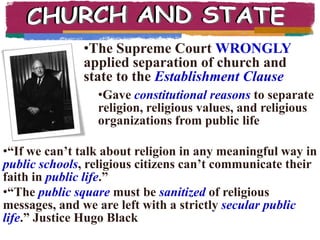
CHURCH AND STATEThe Supreme Court WRONGLY applied separation of church and state to the Establishment Clause
Gave constitutional reasons to separate religion, religious values, and religious organizations from public life
“If we can’t talk about religion in any meaningful way in public schools, religious citizens can’t communicate their faith in public life.”
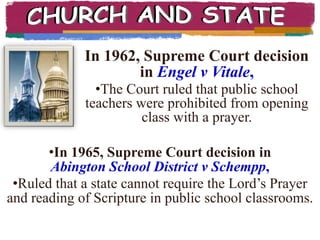
“The public square must be sanitized of religious messages, and we are left with a strictly secular public life.” Justice Hugo BlackCHURCH AND STATEIn 1962, Supreme Court decision in Engel v Vitale,The Court ruled that public school teachers were prohibited from opening class with a prayer.
In 1965, Supreme Court decision in Abington School District v Schempp,
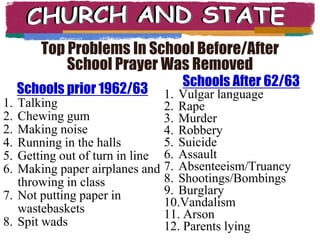
Ruled that a state cannot require the Lord’s Prayer and reading of Scripture in public school classrooms.CHURCH AND STATEIn 1968, Supreme Court decision in Eperson v. Arkansas,The Court held that a state cannot prohibit the teaching of evolution in public school without violating the Establishment Clause of the 1st AmendmentIn 1980, Supreme Court decision in Stone v. Graham,The Court struck down a state law requiring posting of the Ten Commandmentsinpublic school classrooms.CHURCH AND STATETop Problems In School Before/After School Prayer Was RemovedSchools After 62/63Vulgar languageRapeMurderRobberySuicideAssaultAbsenteeism/TruancyShootings/BombingsBurglaryVandalism Arson Parents lyingSchools prior 1962/63TalkingChewing gumMaking noiseRunning in the hallsGetting out of turn in lineMaking paper airplanes and throwing in classNot putting paper in wastebasketsSpit wads
CHURCH AND STATEOVER THE LAST 20 YEARS, organizations such as the ADF, ACLJ and Liberty Counsel have dedicated themselves to advancing religious freedom, the sanctity of human life and the traditional family.They have argued successfully and won key Supreme Court decisions to “CHIP” away at the wall of separation of Church and State.
A STUDENT’S BILL OF RIGHTSTHE RIGHT to Meet With School Officials.The First Amendment to the Constitution forbids Congress to make any law that would restrict the right of the people to petition the Government or school officials.
THE RIGHT to Identify Your Religious Beliefs Through Signs and SymbolsStudents are free to express their religious beliefs through signs and symbols. Tinker vs. Des MoinesTHE RIGHT to Talk About Your Religious Beliefs On Campus.Freedom of Speech is a fundamental right mandated in the Constitution and does exclude the school yard. Westside Community Board vs. Mergens, 1990
THE RIGHT to Distribute Religious Literature On CampusDistributing literature on campus may not be restricted simply because it is religious. 1st Amendment---Free SpeechTHE RIGHT to Carry Or Study Your Bible on Campus.The Supreme Court has said that only state directed Bible readings are unconstitutional. Stone vs Graham
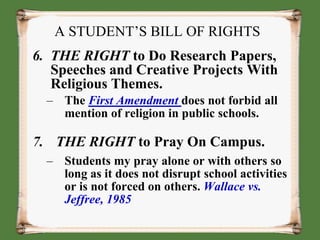
A STUDENT’S BILL OF RIGHTSTHE RIGHT to Do Research Papers, Speeches and Creative Projects With Religious Themes.The First Amendment does not forbid all mention of religion in public schools.THE RIGHT to Pray On Campus.Students my pray alone or with others so long as it does not disrupt school activities or is not forced on others. Wallace vs. Jeffree, 1985
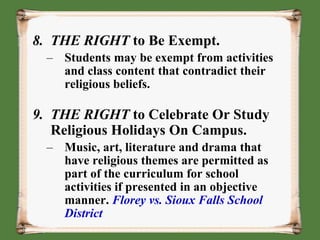
THE RIGHT to Be Exempt.Students may be exempt from activities and class content that contradict their religious beliefs.THE RIGHT to Celebrate Or Study Religious Holidays On Campus.Music, art, literature and drama that have religious themes are permitted as part of the curriculum for school activities if presented in an objective manner. Florey vs. Sioux Falls School District
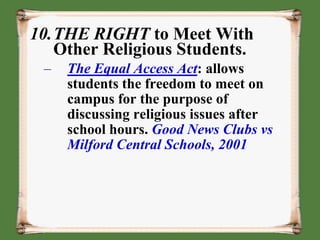
THE RIGHT to Meet With Other Religious Students.The Equal Access Act: allows students the freedom to meet on campus for the purpose of discussing religious issues after school hours. Good News Clubs vs Milford Central Schools, 2001
CHURCH AND STATEDirector, Finn Laursen of CEAIOur mission is "To Encourage, Equip and Empower Educators according to Biblical Principles." We are the only professional association for Christians who are called to serve in public schools. Our members have served the youth of America since 1953 through classroom teachers, administrators, and para-professionals in education.
CHRISTIAN RESPONSEChristianity Is At A CROSSROADS In America. How Should We Respond As Christians To Our Government And Society That Is Becoming Increasingly Hostile Towards Christianity?
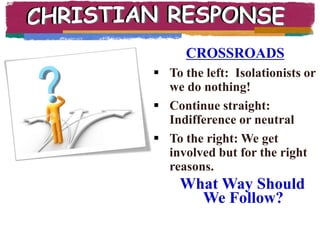
CHRISTIAN RESPONSECROSSROADSTo the left:  Isolationists or we do nothing!
Continue straight:  Indifference or neutral
To the right: We get involved but for the right reasons.What Way Should We Follow?
CHRISTIAN RESPONSEWE SHOULDN’T BE SURPRISED! America is turning away from our Christian roots!2 Tim. 3: 1—52 Thess. 2: 7—12 1 Tim.4: 1—5 2 Pet. 3:3What should be our FOCUS?The Great Commission

Christian In A Secular America, Sept. 13

  • 1.
    WELCOME!The Christian InA Secular AmericaParkside Bible FellowshipAdult Summer Sunday SchoolSeptember 13, 200914th Session (last session)
  • 2.
    The Separation ofChurch and State
  • 3.
    CHURCH AND STATEToday’sMeaning of“Separation of Church and State”“Over the past half century, the U.S. Supreme Court has accomplished a feat America’s Founders would surely have found to be inconceivable. They have created a perverse cloud of confusion over the question of religious liberty and the place of religious language and symbols in the public square.”Exodus 18:21, Ezra 7:25Albert Mohler from his book, Culture Shift
  • 4.
    CHURCH AND STATEFormore than 50 yearsThe ACLU(American Civil Liberties Union) has attempted to eliminate public expression of our nation's faith and heritage. Through fear, intimidation, disinformation and lawsuits, threats of lawsuits that would: Eliminate Christian and historic faith symbols
  • 5.
    Ban public prayerin schools and at school functions
  • 6.
    Deny Christians theright to use public facilities
  • 7.
    Stop Christians fromexpressing their faith at workCHURCH AND STATEIn 1947, US Supreme Court's decision in Everson v. Board of Education,Courtgave an absolute definition of the Establishment Clause
  • 8.
    Went beyond theoriginal intent of Founding Fathers
  • 9.
    Paved the wayfor further restriction of religious expression."The First Amendment has erected a wall between church and state. That wall must be kept high and impregnable. We could not approve the slightest breach."
  • 10.
    CHURCH AND STATEIn1947, US Supreme Court's decision in Everson v. Board of Education,First Separation of Church and State case in US History.FACTS OF THE CASE The Court formally adopted Jefferson’s metaphor “a wall of separation of church and state as law.”
  • 11.
    Held that the“wall must be kept high and impregnable”CHURCH AND STATEThe Court also held that the First Amendment’s Establishment Clause imposed a restraint on the STATESBefore this point in time, the First Amendment was understood to limit the federal government onlyWas Jefferson’s understandingSince Everson, the relationship between church and state has been radically altered.
  • 12.
    Jefferson’s Wall ofSeparationLeft the States alone. National Government could not create a national church.Supreme Court’s Wall--1947Radically altered church and state. Eliminate religious beliefs from the public forum.
  • 13.
    CHURCH AND STATETheSupreme Court WRONGLY applied separation of church and state to the Establishment Clause
  • 14.
    Gave constitutional reasonsto separate religion, religious values, and religious organizations from public life
  • 15.
    “If we can’ttalk about religion in any meaningful way in public schools, religious citizens can’t communicate their faith in public life.”
  • 16.
    “The public squaremust be sanitized of religious messages, and we are left with a strictly secular public life.” Justice Hugo BlackCHURCH AND STATEIn 1962, Supreme Court decision in Engel v Vitale,The Court ruled that public school teachers were prohibited from opening class with a prayer.
  • 17.
    In 1965, SupremeCourt decision in Abington School District v Schempp,
  • 18.
    Ruled that astate cannot require the Lord’s Prayer and reading of Scripture in public school classrooms.CHURCH AND STATEIn 1968, Supreme Court decision in Eperson v. Arkansas,The Court held that a state cannot prohibit the teaching of evolution in public school without violating the Establishment Clause of the 1st AmendmentIn 1980, Supreme Court decision in Stone v. Graham,The Court struck down a state law requiring posting of the Ten Commandmentsinpublic school classrooms.CHURCH AND STATETop Problems In School Before/After School Prayer Was RemovedSchools After 62/63Vulgar languageRapeMurderRobberySuicideAssaultAbsenteeism/TruancyShootings/BombingsBurglaryVandalism Arson Parents lyingSchools prior 1962/63TalkingChewing gumMaking noiseRunning in the hallsGetting out of turn in lineMaking paper airplanes and throwing in classNot putting paper in wastebasketsSpit wads
  • 19.
    CHURCH AND STATEOVERTHE LAST 20 YEARS, organizations such as the ADF, ACLJ and Liberty Counsel have dedicated themselves to advancing religious freedom, the sanctity of human life and the traditional family.They have argued successfully and won key Supreme Court decisions to “CHIP” away at the wall of separation of Church and State.
  • 20.
    A STUDENT’S BILLOF RIGHTSTHE RIGHT to Meet With School Officials.The First Amendment to the Constitution forbids Congress to make any law that would restrict the right of the people to petition the Government or school officials.
  • 21.
    THE RIGHT toIdentify Your Religious Beliefs Through Signs and SymbolsStudents are free to express their religious beliefs through signs and symbols. Tinker vs. Des MoinesTHE RIGHT to Talk About Your Religious Beliefs On Campus.Freedom of Speech is a fundamental right mandated in the Constitution and does exclude the school yard. Westside Community Board vs. Mergens, 1990
  • 22.
    THE RIGHT toDistribute Religious Literature On CampusDistributing literature on campus may not be restricted simply because it is religious. 1st Amendment---Free SpeechTHE RIGHT to Carry Or Study Your Bible on Campus.The Supreme Court has said that only state directed Bible readings are unconstitutional. Stone vs Graham
  • 23.
    A STUDENT’S BILLOF RIGHTSTHE RIGHT to Do Research Papers, Speeches and Creative Projects With Religious Themes.The First Amendment does not forbid all mention of religion in public schools.THE RIGHT to Pray On Campus.Students my pray alone or with others so long as it does not disrupt school activities or is not forced on others. Wallace vs. Jeffree, 1985
  • 24.
    THE RIGHT toBe Exempt.Students may be exempt from activities and class content that contradict their religious beliefs.THE RIGHT to Celebrate Or Study Religious Holidays On Campus.Music, art, literature and drama that have religious themes are permitted as part of the curriculum for school activities if presented in an objective manner. Florey vs. Sioux Falls School District
  • 25.
    THE RIGHT toMeet With Other Religious Students.The Equal Access Act: allows students the freedom to meet on campus for the purpose of discussing religious issues after school hours. Good News Clubs vs Milford Central Schools, 2001
  • 26.
    CHURCH AND STATEDirector,Finn Laursen of CEAIOur mission is "To Encourage, Equip and Empower Educators according to Biblical Principles." We are the only professional association for Christians who are called to serve in public schools. Our members have served the youth of America since 1953 through classroom teachers, administrators, and para-professionals in education.
  • 27.
    CHRISTIAN RESPONSEChristianity IsAt A CROSSROADS In America. How Should We Respond As Christians To Our Government And Society That Is Becoming Increasingly Hostile Towards Christianity?
  • 28.
    CHRISTIAN RESPONSECROSSROADSTo theleft: Isolationists or we do nothing!
  • 29.
    Continue straight: Indifference or neutral
  • 30.
    To the right:We get involved but for the right reasons.What Way Should We Follow?
  • 31.
    CHRISTIAN RESPONSEWE SHOULDN’TBE SURPRISED! America is turning away from our Christian roots!2 Tim. 3: 1—52 Thess. 2: 7—12 1 Tim.4: 1—5 2 Pet. 3:3What should be our FOCUS?The Great Commission