FUNDAMENTAL
S OF ABM 1
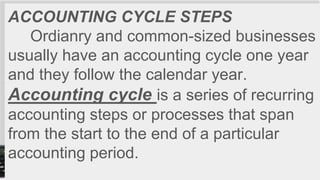
ACCOUNTING CYCLE STEPS
Ordianry and common-sized businesses
usually have an accounting cycle one year
and they follow the calendar year.
Accounting cycle is a series of recurring
accounting steps or processes that span
from the start to the end of a particular
accounting period.
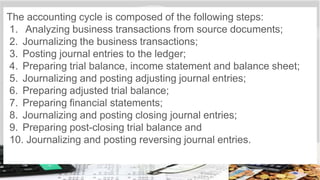
The accounting cycle is composed of the following steps:
1. Analyzing business transactions from source documents;
2. Journalizing the business transactions;
3. Posting journal entries to the ledger;
4. Preparing trial balance, income statement and balance sheet;
5. Journalizing and posting adjusting journal entries;
6. Preparing adjusted trial balance;
7. Preparing financial statements;
8. Journalizing and posting closing journal entries;
9. Preparing post-closing trial balance and
10. Journalizing and posting reversing journal entries.
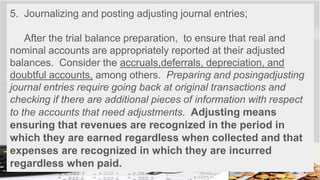
5. Journalizing and posting adjusting journal entries;
After the trial balance preparation, to ensure that real and
nominal accounts are appropriately reported at their adjusted
balances. Consider the accruals,deferrals, depreciation, and
doubtful accounts, among others. Preparing and posingadjusting
journal entries require going back at original transactions and
checking if there are additional pieces of information with respect
to the accounts that need adjustments. Adjusting means
ensuring that revenues are recognized in the period in
which they are earned regardless when collected and that
expenses are recognized in which they are incurred
regardless when paid.
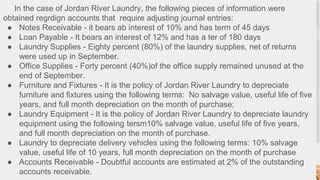
In the case of Jordan River Laundry, the following pieces of information were
obtained regrdign accounts that require adjusting journal entries:
● Notes Receivable - it bears ab interest of 10% and has term of 45 days
● Loan Payable - It bears an interest of 12% and has a ter of 180 days
● Laundry Supplies - Eighty percent (80%) of the laundry supplies, net of returns
were used up in September.
● Office Supplies - Forty percent (40%)of the office supply remained unused at the
end of September.
● Furniture and Fixtures - It is the policy of Jordan River Laundry to depreciate
furniture and fixtures using the following terms: No salvage value, useful life of five
years, and full month depreciation on the month of purchase;
● Laundry Equipment - It is the policy of Jordan River Laundry to depreciate laundry
equipment using the following tersm10% salvage value, useful life of five years,
and full month depreciation on the month of purchase.
● Laundry to depreciate delivery vehicles using the following terms: 10% salvage
value, useful life of 10 years, full month depreciation on the month of purchase
● Accounts Receivable - Doubtful accounts are estimated at 2% of the outstanding
accounts receivable.
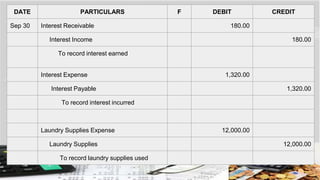
DATE PARTICULARS F DEBIT CREDIT
Sep 30 Interest Receivable 180.00
Interest Income 180.00
To record interest earned
Interest Expense 1,320.00
Interest Payable 1,320.00
To record interest incurred
Laundry Supplies Expense 12,000.00
Laundry Supplies 12,000.00
To record laundry supplies used
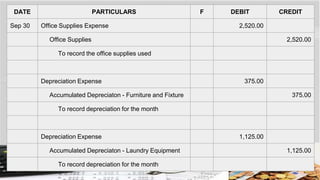
DATE PARTICULARS F DEBIT CREDIT
Sep 30 Office Supplies Expense 2,520.00
Office Supplies 2,520.00
To record the office supplies used
Depreciation Expense 375.00
Accumulated Depreciaton - Furniture and Fixture 375.00
To record depreciation for the month
Depreciation Expense 1,125.00
Accumulated Depreciaton - Laundry Equipment 1,125.00
To record depreciation for the month
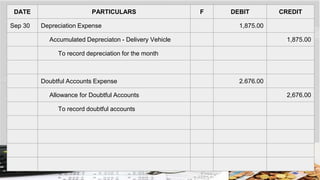
DATE PARTICULARS F DEBIT CREDIT
Sep 30 Depreciation Expense 1,875.00
Accumulated Depreciaton - Delivery Vehicle 1,875.00
To record depreciation for the month
Doubtful Accounts Expense 2.676.00
Allowance for Doubtful Accounts 2,676.00
To record doubtful accounts
Check the ledger and update it using the
adjusting entries for Jordan River
Laundry and look how the ledger
balances would appear after posting the
adjusting journal entries.
6. Preparing the adjusted trial balance.
After all the adjusting entries have been journalized and
posted, the adjusted trial balance.
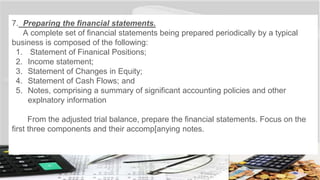
7. Preparing the financial statements.
A complete set of financial statements being prepared periodically by a typical
business is composed of the following:
1. Statement of Finanical Positions;
2. Income statement;
3. Statement of Changes in Equity;
4. Statement of Cash Flows; and
5. Notes, comprising a summary of significant accounting policies and other
explnatory information
From the adjusted trial balance, prepare the financial statements. Focus on the
first three components and their accomp[anying notes.
ADJUSTING ENTRIES-ABM1-WK3-3RDQTR-23-24.pptx

ADJUSTING ENTRIES-ABM1-WK3-3RDQTR-23-24.pptx

  • 1.
  • 2.
    ACCOUNTING CYCLE STEPS Ordianryand common-sized businesses usually have an accounting cycle one year and they follow the calendar year. Accounting cycle is a series of recurring accounting steps or processes that span from the start to the end of a particular accounting period.
  • 3.
    The accounting cycleis composed of the following steps: 1. Analyzing business transactions from source documents; 2. Journalizing the business transactions; 3. Posting journal entries to the ledger; 4. Preparing trial balance, income statement and balance sheet; 5. Journalizing and posting adjusting journal entries; 6. Preparing adjusted trial balance; 7. Preparing financial statements; 8. Journalizing and posting closing journal entries; 9. Preparing post-closing trial balance and 10. Journalizing and posting reversing journal entries.
  • 4.
    5. Journalizing andposting adjusting journal entries; After the trial balance preparation, to ensure that real and nominal accounts are appropriately reported at their adjusted balances. Consider the accruals,deferrals, depreciation, and doubtful accounts, among others. Preparing and posingadjusting journal entries require going back at original transactions and checking if there are additional pieces of information with respect to the accounts that need adjustments. Adjusting means ensuring that revenues are recognized in the period in which they are earned regardless when collected and that expenses are recognized in which they are incurred regardless when paid.
  • 5.
    In the caseof Jordan River Laundry, the following pieces of information were obtained regrdign accounts that require adjusting journal entries: ● Notes Receivable - it bears ab interest of 10% and has term of 45 days ● Loan Payable - It bears an interest of 12% and has a ter of 180 days ● Laundry Supplies - Eighty percent (80%) of the laundry supplies, net of returns were used up in September. ● Office Supplies - Forty percent (40%)of the office supply remained unused at the end of September. ● Furniture and Fixtures - It is the policy of Jordan River Laundry to depreciate furniture and fixtures using the following terms: No salvage value, useful life of five years, and full month depreciation on the month of purchase; ● Laundry Equipment - It is the policy of Jordan River Laundry to depreciate laundry equipment using the following tersm10% salvage value, useful life of five years, and full month depreciation on the month of purchase. ● Laundry to depreciate delivery vehicles using the following terms: 10% salvage value, useful life of 10 years, full month depreciation on the month of purchase ● Accounts Receivable - Doubtful accounts are estimated at 2% of the outstanding accounts receivable.
  • 6.
    DATE PARTICULARS FDEBIT CREDIT Sep 30 Interest Receivable 180.00 Interest Income 180.00 To record interest earned Interest Expense 1,320.00 Interest Payable 1,320.00 To record interest incurred Laundry Supplies Expense 12,000.00 Laundry Supplies 12,000.00 To record laundry supplies used
  • 7.
    DATE PARTICULARS FDEBIT CREDIT Sep 30 Office Supplies Expense 2,520.00 Office Supplies 2,520.00 To record the office supplies used Depreciation Expense 375.00 Accumulated Depreciaton - Furniture and Fixture 375.00 To record depreciation for the month Depreciation Expense 1,125.00 Accumulated Depreciaton - Laundry Equipment 1,125.00 To record depreciation for the month
  • 8.
    DATE PARTICULARS FDEBIT CREDIT Sep 30 Depreciation Expense 1,875.00 Accumulated Depreciaton - Delivery Vehicle 1,875.00 To record depreciation for the month Doubtful Accounts Expense 2.676.00 Allowance for Doubtful Accounts 2,676.00 To record doubtful accounts
  • 9.
    Check the ledgerand update it using the adjusting entries for Jordan River Laundry and look how the ledger balances would appear after posting the adjusting journal entries.
  • 10.
    6. Preparing theadjusted trial balance. After all the adjusting entries have been journalized and posted, the adjusted trial balance.
  • 11.
    7. Preparing thefinancial statements. A complete set of financial statements being prepared periodically by a typical business is composed of the following: 1. Statement of Finanical Positions; 2. Income statement; 3. Statement of Changes in Equity; 4. Statement of Cash Flows; and 5. Notes, comprising a summary of significant accounting policies and other explnatory information From the adjusted trial balance, prepare the financial statements. Focus on the first three components and their accomp[anying notes.