Adjective
degrees
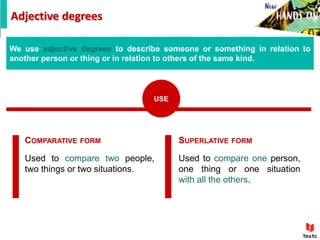
COMPARATIVE FORM
Used to compare two people,
two things or two situations.
SUPERLATIVE FORM
Used to compare one person,
one thing or one situation
with all the others.
Adjective degrees
Adjective degrees
We use adjective degrees to describe someone or something in relation to
another person or thing or in relation to others of the same kind.
USE
One syllable adjectives
Most two syllable adjectives
Two syllable adjectives ending in -y
Three or more syllable adjectives
Irregular adjectives
longer than
more careful than
easier than
more difficult than
good – better than
bad – worse than
far – farther / further than
• One-syllable adjectives that end in consonant, vowel, consonant (cvc),
double the consonant and add -er (e.g. fat - fatter)
• “than” can be omitted when the term of the comparison is implicit in the
sentence
Comparatives
FORM
Adjective degrees
COMPARATIVE
Two syllable adjectives ending in -er,
-le, -on, -ow – 2 forms adjectives
cleverer than / more clever than
1. English schools are ____________ (popular) than French ones.
2. Speaking a language is ________ (easy) than writing it.
3. Diana is ____________ (thin) she looks on TV.
4. He may be ______________ (famous) than Mike, who knows?
5. Kimberley’s hair is _____________ (long) her sister’s.
6. She is ____________ (careful) with her looks than before.
more popular
easier
thinner than
more famous
longer than
more careful
Use the comparative form of the adjectives to complete
the sentences.
One syllable adjectives
Most two syllable adjectives
Two syllable adjectives ending in -y
Three or more syllable adjectives
Irregular adjectives
the longest
the most careful
the easiest
the most difficult
good – the best
bad – the worst
far – the farthest/ furthest
• One-syllable adjectives that end in consonant, vowel, consonant (cvc),
double the consonant and add -est (e.g. fat- fattest).
SUPERLATIVE
Adjective degrees
Two syllable adjectives ending in -er,
-le, -on, -ow – 2 forms adjectives
the cleverest / the most clever
This / be / great / world’s / exchange programme
1. ________________________________________ .
2. _____________________________________.
3. ______________________________________________.
4. __________________________________.
5. ______________________________________________.
This is the world’s greatest exchange programme
That is the most expensive laptop in the store
Your sister is the most beautiful girl in the neighbourhood
She is the youngest Nobel Prize winner
English is the most common language spoken abroad
That / be / expensive / laptop / in the store
Your sister / be / beautiful / girl / in the neighbourhood
She / be / young / Nobel Prize winner
English / be / common / language spoken abroad
Write sentences with the words below. Use the superlative form
of the adjectives.
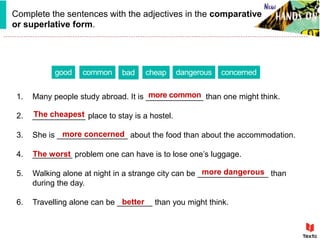
1. Many people study abroad. It is _____________ than one might think.
2. ____________ place to stay is a hostel.
3. She is ________________ about the food than about the accommodation.
4. _________ problem one can have is to lose one’s luggage.
5. Walking alone at night in a strange city can be ________________ than
during the day.
6. Travelling alone can be ________ than you might think.
more common
The cheapest
more concerned
The worst
more dangerous
better
good common bad cheap dangerous concerned
Complete the sentences with the adjectives in the comparative
or superlative form.

Adjective degrees.ppt

  • 1.
  • 2.
    COMPARATIVE FORM Used tocompare two people, two things or two situations. SUPERLATIVE FORM Used to compare one person, one thing or one situation with all the others. Adjective degrees Adjective degrees We use adjective degrees to describe someone or something in relation to another person or thing or in relation to others of the same kind. USE
  • 3.
    One syllable adjectives Mosttwo syllable adjectives Two syllable adjectives ending in -y Three or more syllable adjectives Irregular adjectives longer than more careful than easier than more difficult than good – better than bad – worse than far – farther / further than • One-syllable adjectives that end in consonant, vowel, consonant (cvc), double the consonant and add -er (e.g. fat - fatter) • “than” can be omitted when the term of the comparison is implicit in the sentence Comparatives FORM Adjective degrees COMPARATIVE Two syllable adjectives ending in -er, -le, -on, -ow – 2 forms adjectives cleverer than / more clever than
  • 4.
    1. English schoolsare ____________ (popular) than French ones. 2. Speaking a language is ________ (easy) than writing it. 3. Diana is ____________ (thin) she looks on TV. 4. He may be ______________ (famous) than Mike, who knows? 5. Kimberley’s hair is _____________ (long) her sister’s. 6. She is ____________ (careful) with her looks than before. more popular easier thinner than more famous longer than more careful Use the comparative form of the adjectives to complete the sentences.
  • 5.
    One syllable adjectives Mosttwo syllable adjectives Two syllable adjectives ending in -y Three or more syllable adjectives Irregular adjectives the longest the most careful the easiest the most difficult good – the best bad – the worst far – the farthest/ furthest • One-syllable adjectives that end in consonant, vowel, consonant (cvc), double the consonant and add -est (e.g. fat- fattest). SUPERLATIVE Adjective degrees Two syllable adjectives ending in -er, -le, -on, -ow – 2 forms adjectives the cleverest / the most clever
  • 6.
    This / be/ great / world’s / exchange programme 1. ________________________________________ . 2. _____________________________________. 3. ______________________________________________. 4. __________________________________. 5. ______________________________________________. This is the world’s greatest exchange programme That is the most expensive laptop in the store Your sister is the most beautiful girl in the neighbourhood She is the youngest Nobel Prize winner English is the most common language spoken abroad That / be / expensive / laptop / in the store Your sister / be / beautiful / girl / in the neighbourhood She / be / young / Nobel Prize winner English / be / common / language spoken abroad Write sentences with the words below. Use the superlative form of the adjectives.
  • 7.
    1. Many peoplestudy abroad. It is _____________ than one might think. 2. ____________ place to stay is a hostel. 3. She is ________________ about the food than about the accommodation. 4. _________ problem one can have is to lose one’s luggage. 5. Walking alone at night in a strange city can be ________________ than during the day. 6. Travelling alone can be ________ than you might think. more common The cheapest more concerned The worst more dangerous better good common bad cheap dangerous concerned Complete the sentences with the adjectives in the comparative or superlative form.