Adjective clauses

Lic. Cristina Morocho
• Also called relative clauses → identify or add
  information about nouns.
• Directly follows the noun it refers to.
• It often begins with a relative pronoun: who,
  that, which, whose, where, or when.

Loja, which is the most expensive city in Ecuador,
                 is a beautiful place.
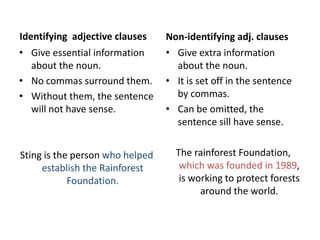
Identifying adjective clauses    Non-identifying adj. clauses
• Give essential information     • Give extra information
  about the noun.                  about the noun.
• No commas surround them.       • It is set off in the sentence
• Without them, the sentence       by commas.
  will not have sense.           • Can be omitted, the
                                   sentence sill have sense.


Sting is the person who helped     The rainforest Foundation,
     establish the Rainforest       which was founded in 1989,
            Foundation.             is working to protect forests
                                         around the world.
• To refer to people, use who or that as the
  subjects of verbs in adjective clauses.
     Luis, who is very smart, designed a new
             application for cellphones.

• To refer to things, use which or that.
 Jipiro, which is a beautiful park, receives lots of
                  people on holidays.
• That cannot be used in a nonidentifying
   adjective clause or after a preposition.
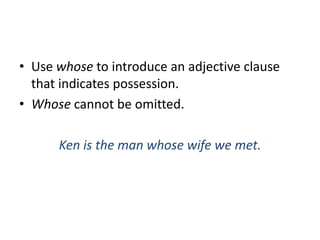
• Use whose to introduce an adjective clause
  that indicates possession.
• Whose cannot be omitted.

      Ken is the man whose wife we met.
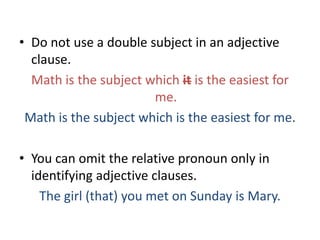
• Do not use a double subject in an adjective
  clause.
  Math is the subject which it is the easiest for
                       me.
 Math is the subject which is the easiest for me.

• You can omit the relative pronoun only in
  identifying adjective clauses.
    The girl (that) you met on Sunday is Mary.
Thank you!

Adjective clauses

  • 1.
  • 2.
    • Also calledrelative clauses → identify or add information about nouns. • Directly follows the noun it refers to. • It often begins with a relative pronoun: who, that, which, whose, where, or when. Loja, which is the most expensive city in Ecuador, is a beautiful place.
  • 3.
    Identifying adjective clauses Non-identifying adj. clauses • Give essential information • Give extra information about the noun. about the noun. • No commas surround them. • It is set off in the sentence • Without them, the sentence by commas. will not have sense. • Can be omitted, the sentence sill have sense. Sting is the person who helped The rainforest Foundation, establish the Rainforest which was founded in 1989, Foundation. is working to protect forests around the world.
  • 4.
    • To referto people, use who or that as the subjects of verbs in adjective clauses. Luis, who is very smart, designed a new application for cellphones. • To refer to things, use which or that. Jipiro, which is a beautiful park, receives lots of people on holidays. • That cannot be used in a nonidentifying adjective clause or after a preposition.
  • 5.
    • Use whoseto introduce an adjective clause that indicates possession. • Whose cannot be omitted. Ken is the man whose wife we met.
  • 6.
    • Do notuse a double subject in an adjective clause. Math is the subject which it is the easiest for me. Math is the subject which is the easiest for me. • You can omit the relative pronoun only in identifying adjective clauses. The girl (that) you met on Sunday is Mary.
  • 7.