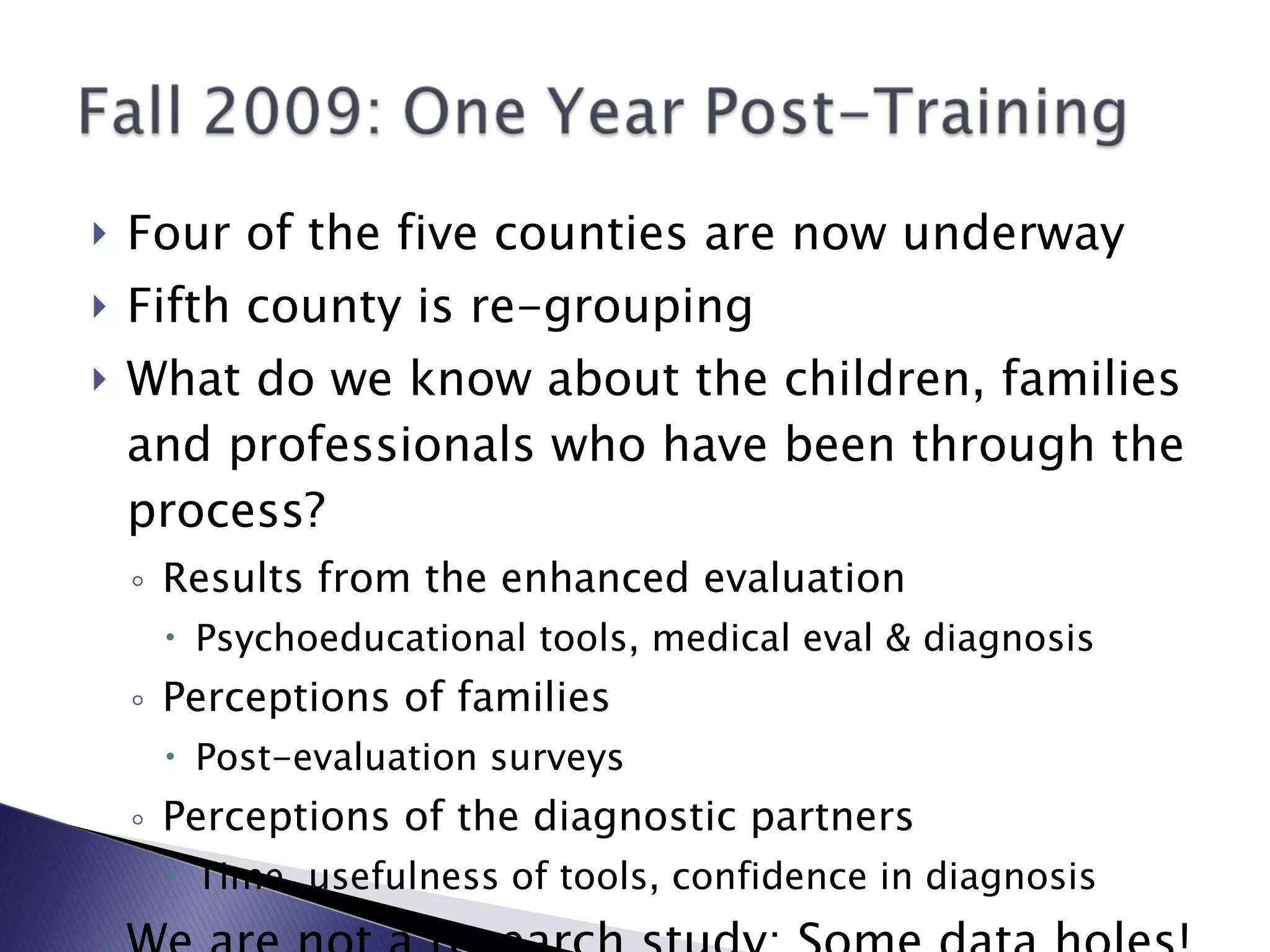
Four of the five counties are now underway Fifth county is re-grouping What do we know about the children, families and professionals who have been through the process? Results from the enhanced evaluation Psychoeducational tools, medical eval & diagnosis Perceptions of families Post-evaluation surveys Perceptions of the diagnostic partners Time, usefulness of tools, confidence in diagnosis We are not a research study: Some data holes!
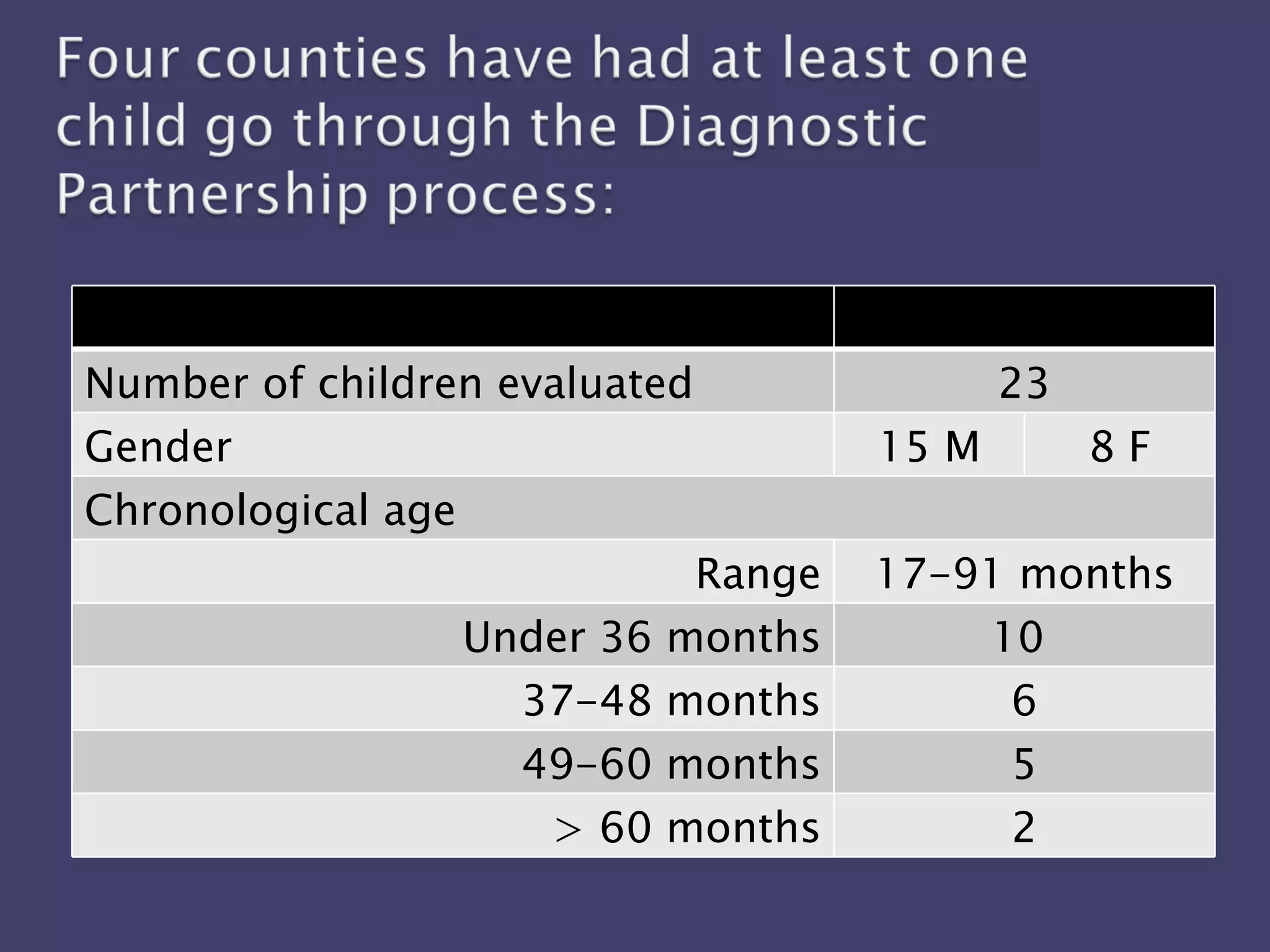
Number of children evaluated 23 Gender 15 M 8 F Chronological age Range 17-91 months Under 36 months 10  37-48 months 6 49-60 months 5 > 60 months 2
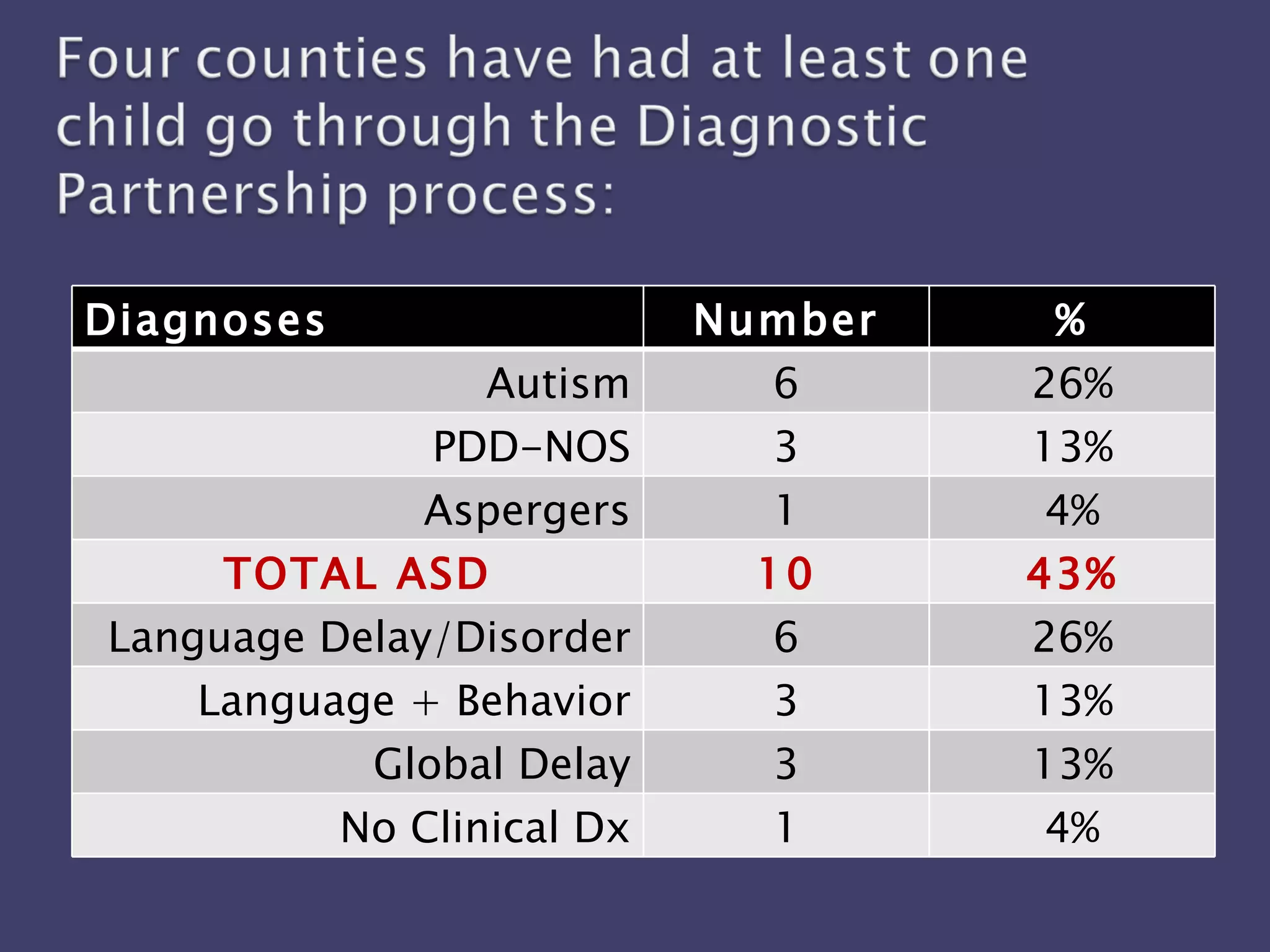
Diagnoses Number % Autism 6 26% PDD-NOS 3 13% Aspergers 1 4% TOTAL ASD 10 43% Language Delay/Disorder 6 26% Language + Behavior 3 13% Global Delay 3 13% No Clinical Dx 1 4%
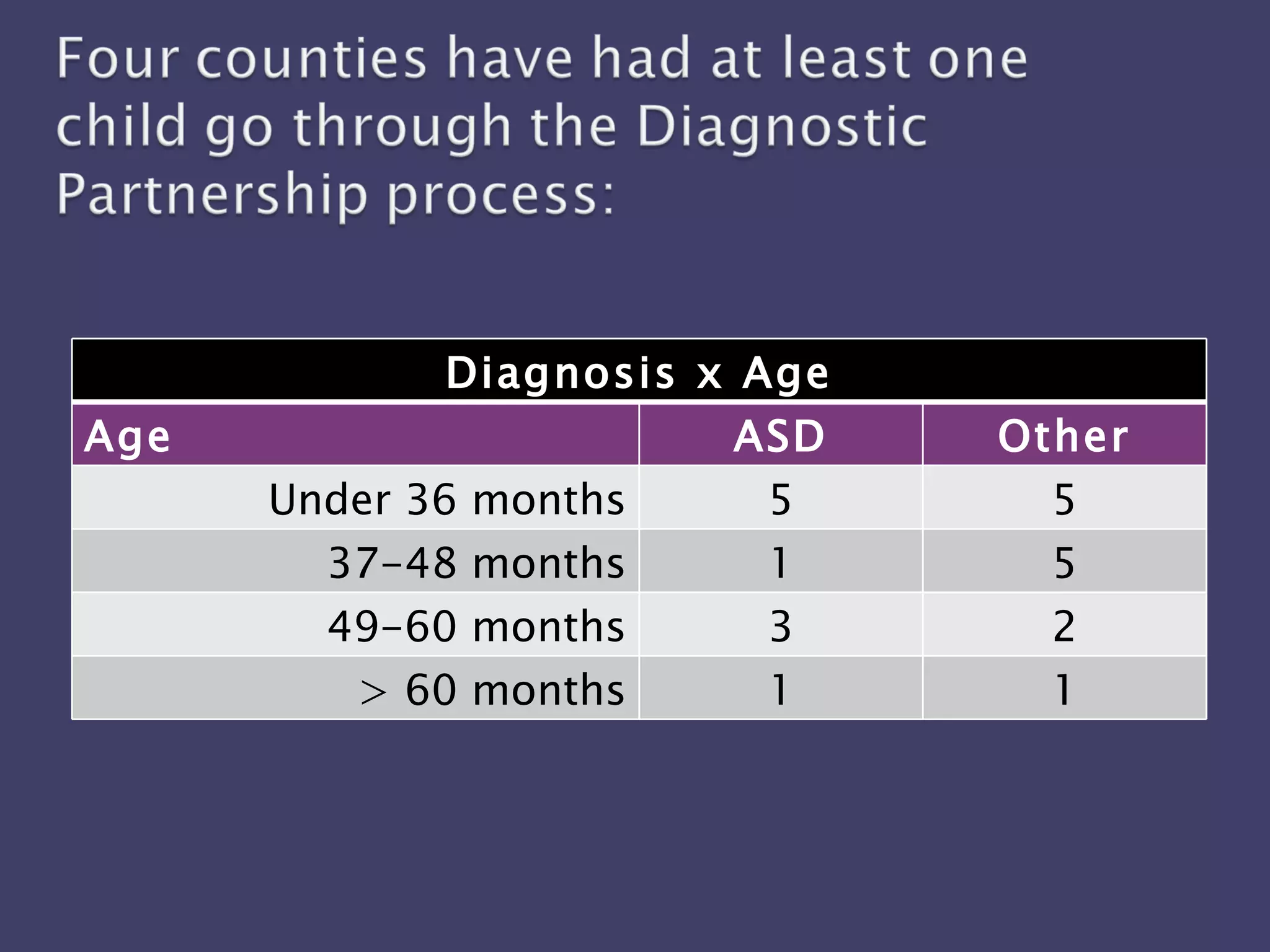
Diagnosis x Age Age ASD Other Under 36 months 5 5 37-48 months 1 5 49-60 months 3 2 > 60 months 1 1
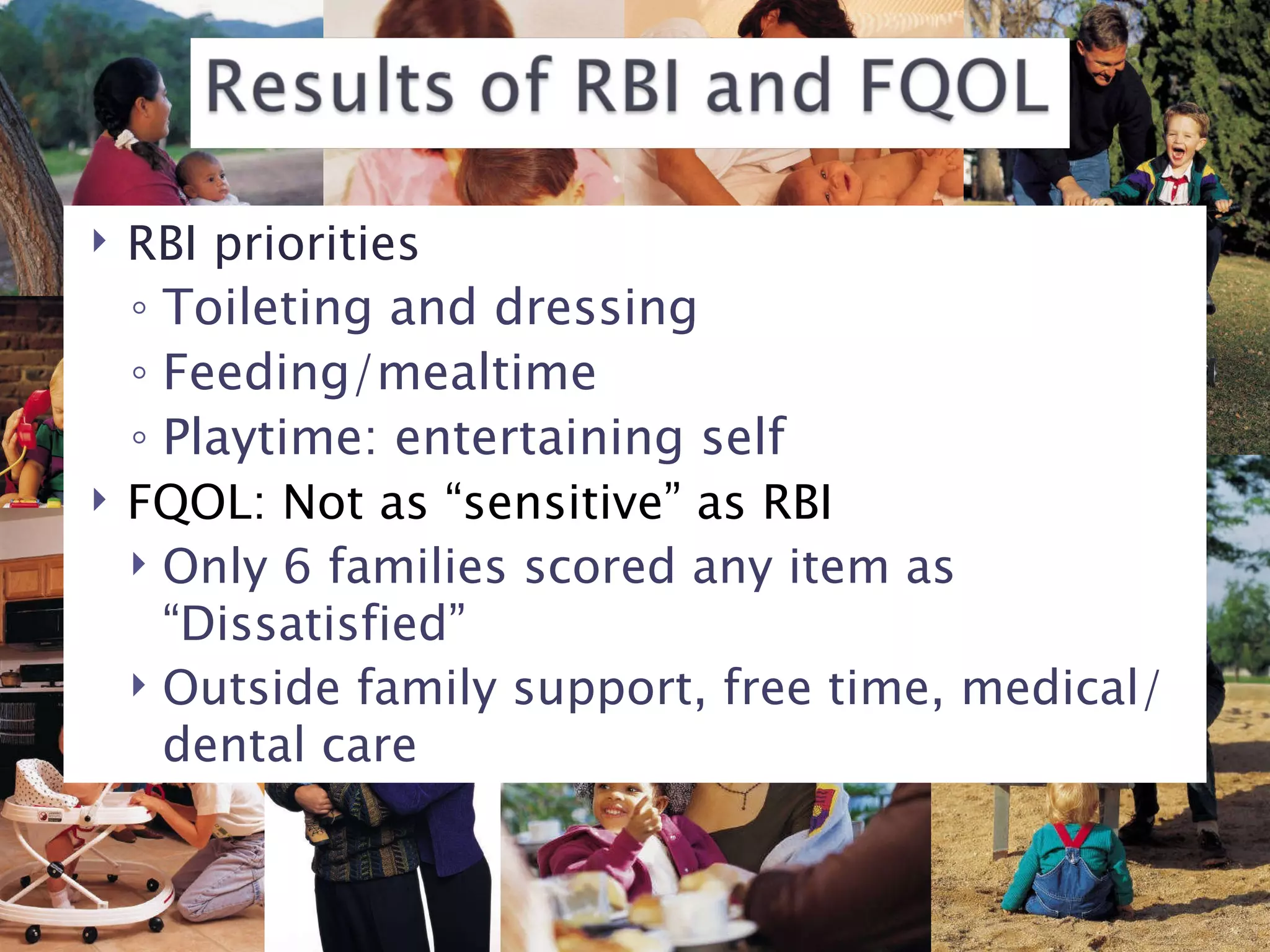
RBI priorities Toileting and dressing Feeding/mealtime Playtime: entertaining self FQOL: Not as “sensitive” as RBI Only 6 families scored any item as “Dissatisfied” Outside family support, free time, medical/dental care
Two surveys: Family-Centered Practices Scale following the psychoeducational evaluation Satisfaction Survey following the medical evaluation/diagnosis Responses from 17 of the 23 families
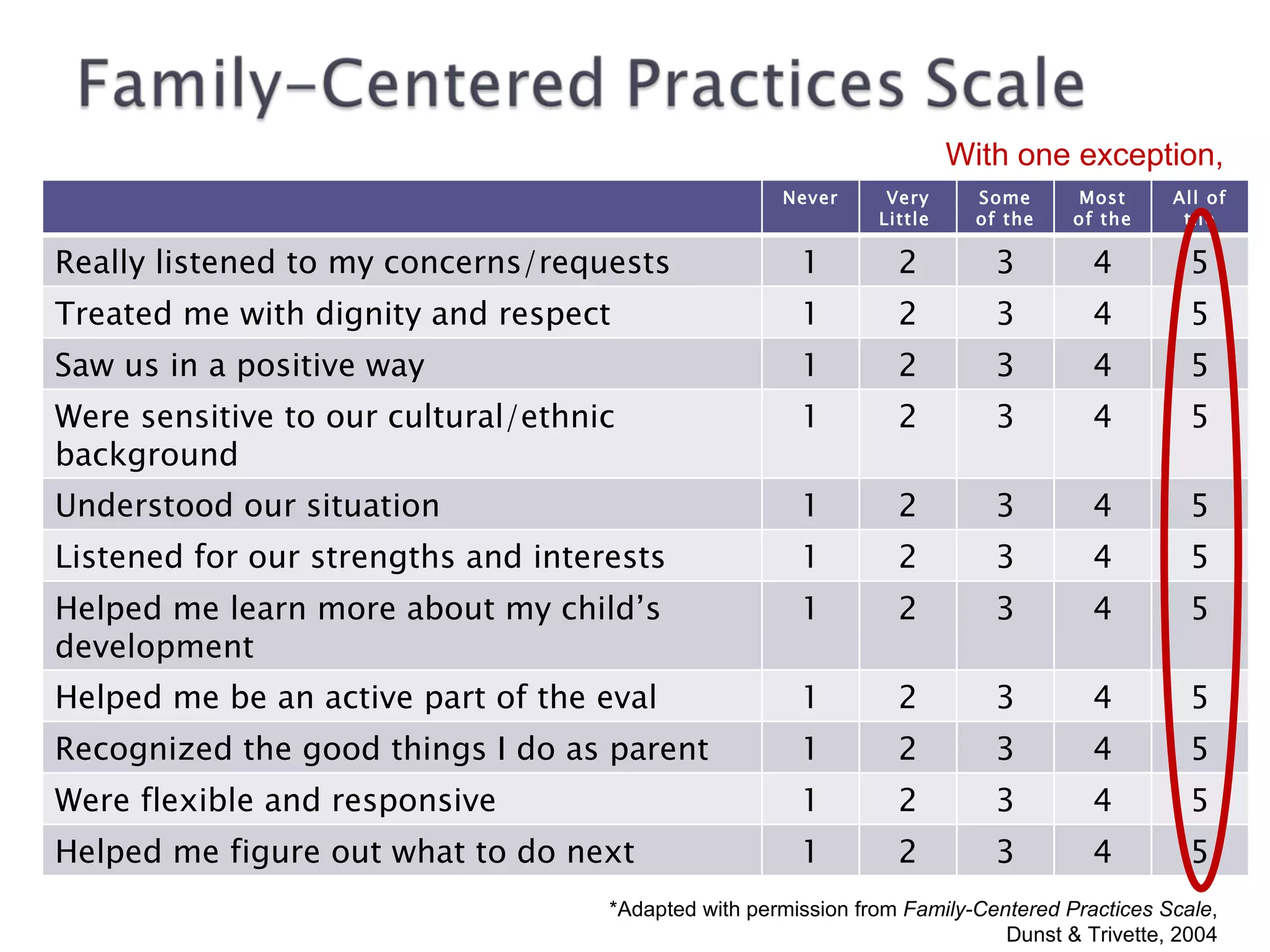
*Adapted with permission from  Family-Centered Practices Scale , Dunst & Trivette, 2004 With one exception, Never Very Little  Some of the time Most of the time All of the time Really listened to my concerns/requests 1 2 3 4 5 Treated me with dignity and respect 1 2 3 4 5 Saw us in a positive way 1 2 3 4 5 Were sensitive to our cultural/ethnic background 1 2 3 4 5 Understood our situation 1 2 3 4 5 Listened for our strengths and interests 1 2 3 4 5 Helped me learn more about my child’s development 1 2 3 4 5 Helped me be an active part of the eval 1 2 3 4 5 Recognized the good things I do as parent 1 2 3 4 5 Were flexible and responsive 1 2 3 4 5 Helped me figure out what to do next 1 2 3 4 5
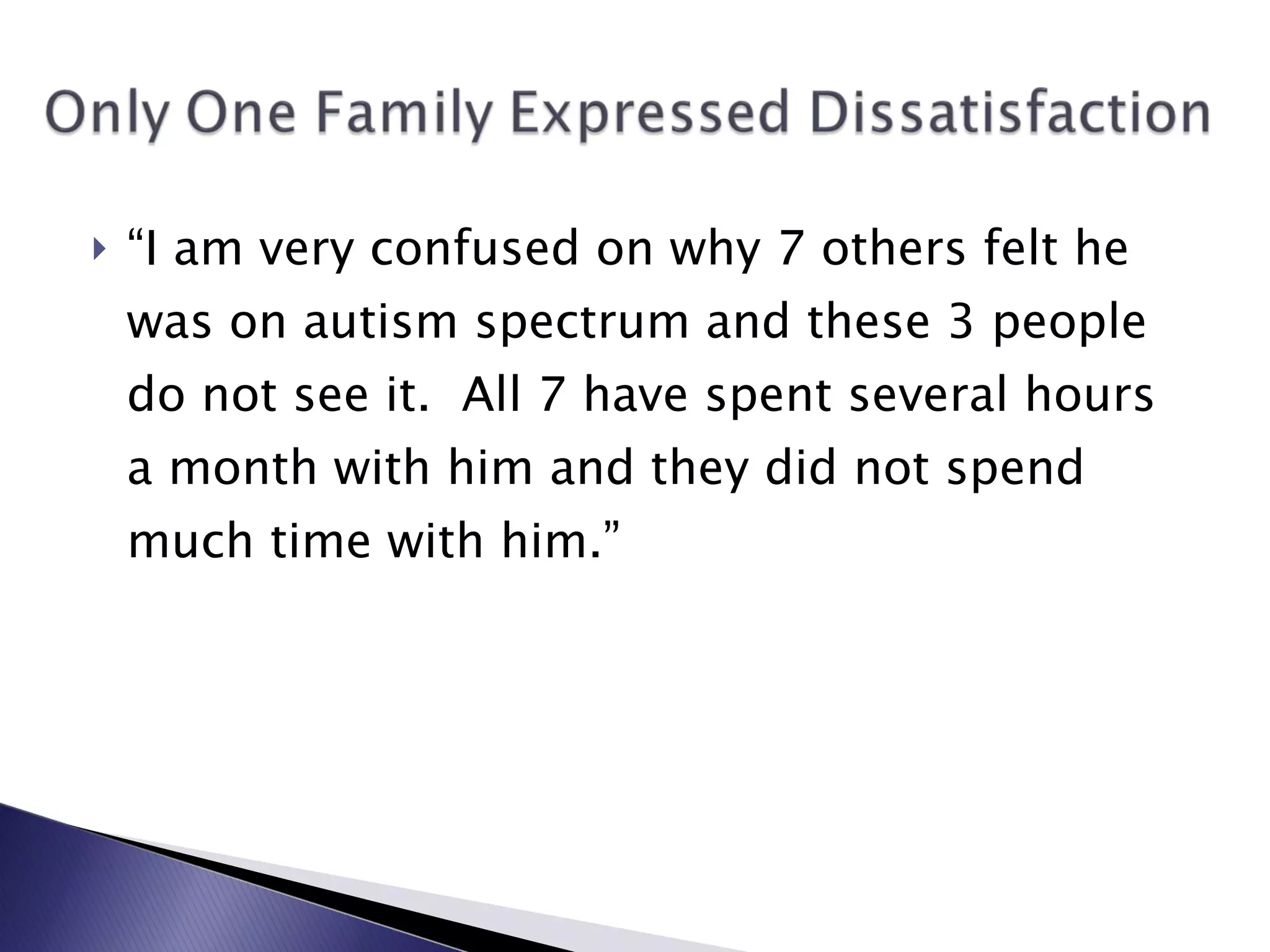
“ I am very confused on why 7 others felt he was on autism spectrum and these 3 people do not see it.  All 7 have spent several hours a month with him and they did not spend much time with him.”
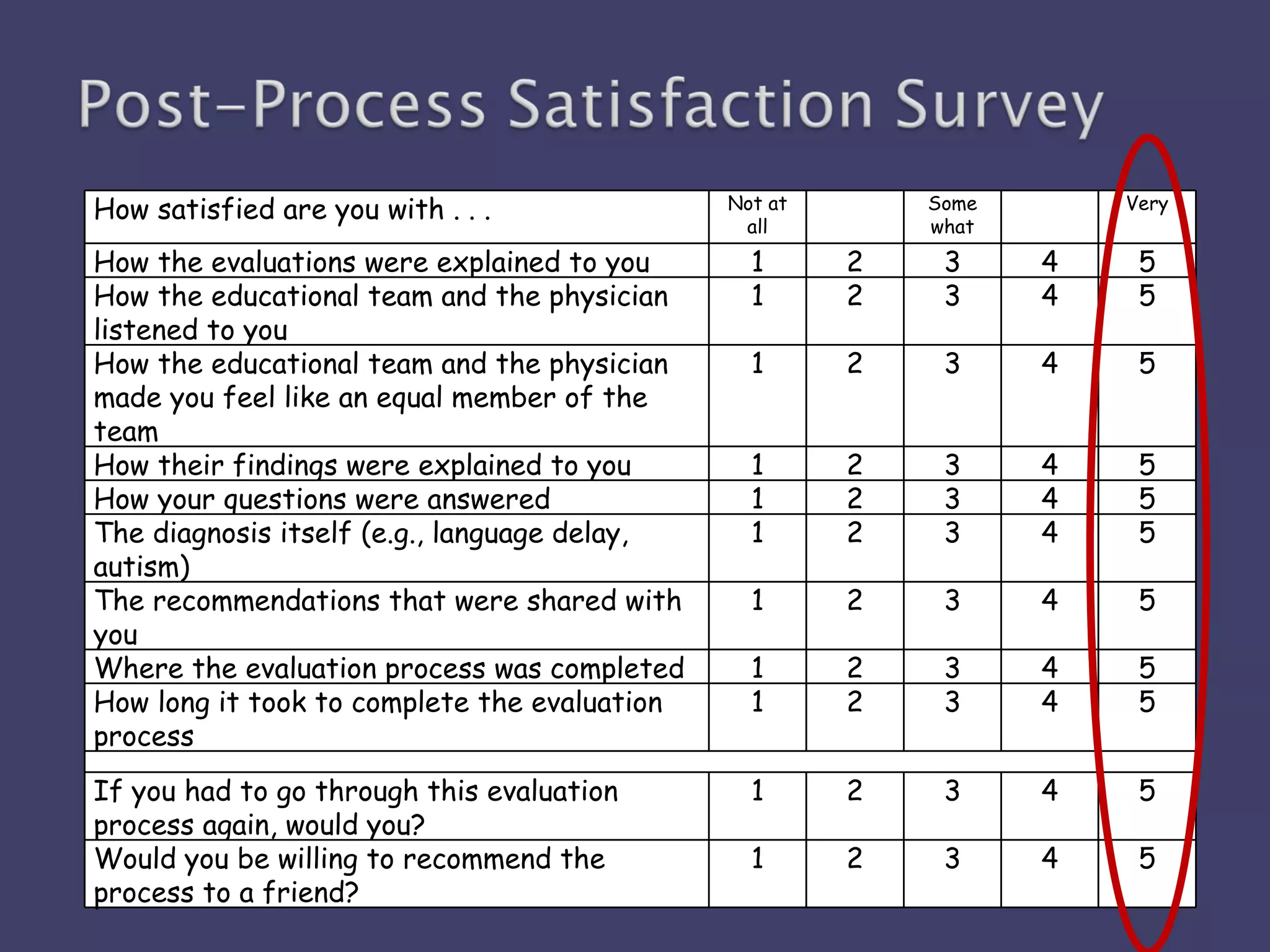
How satisfied are you with . . . Not at all Some what Very How the evaluations were explained to you 1 2 3 4 5 How the educational team and the physician listened to you 1 2 3 4 5 How the educational team and the physician made you feel like an equal member of the team 1 2 3 4 5 How their findings were explained to you 1 2 3 4 5 How your questions were answered 1 2 3 4 5 The diagnosis itself (e.g., language delay, autism) 1 2 3 4 5 The recommendations that were shared with you 1 2 3 4 5 Where the evaluation process was completed 1 2 3 4 5 How long it took to complete the evaluation process 1 2 3 4 5 If you had to go through this evaluation process again, would you? 1 2 3 4 5 Would you be willing to recommend the process to a friend? 1 2 3 4 5
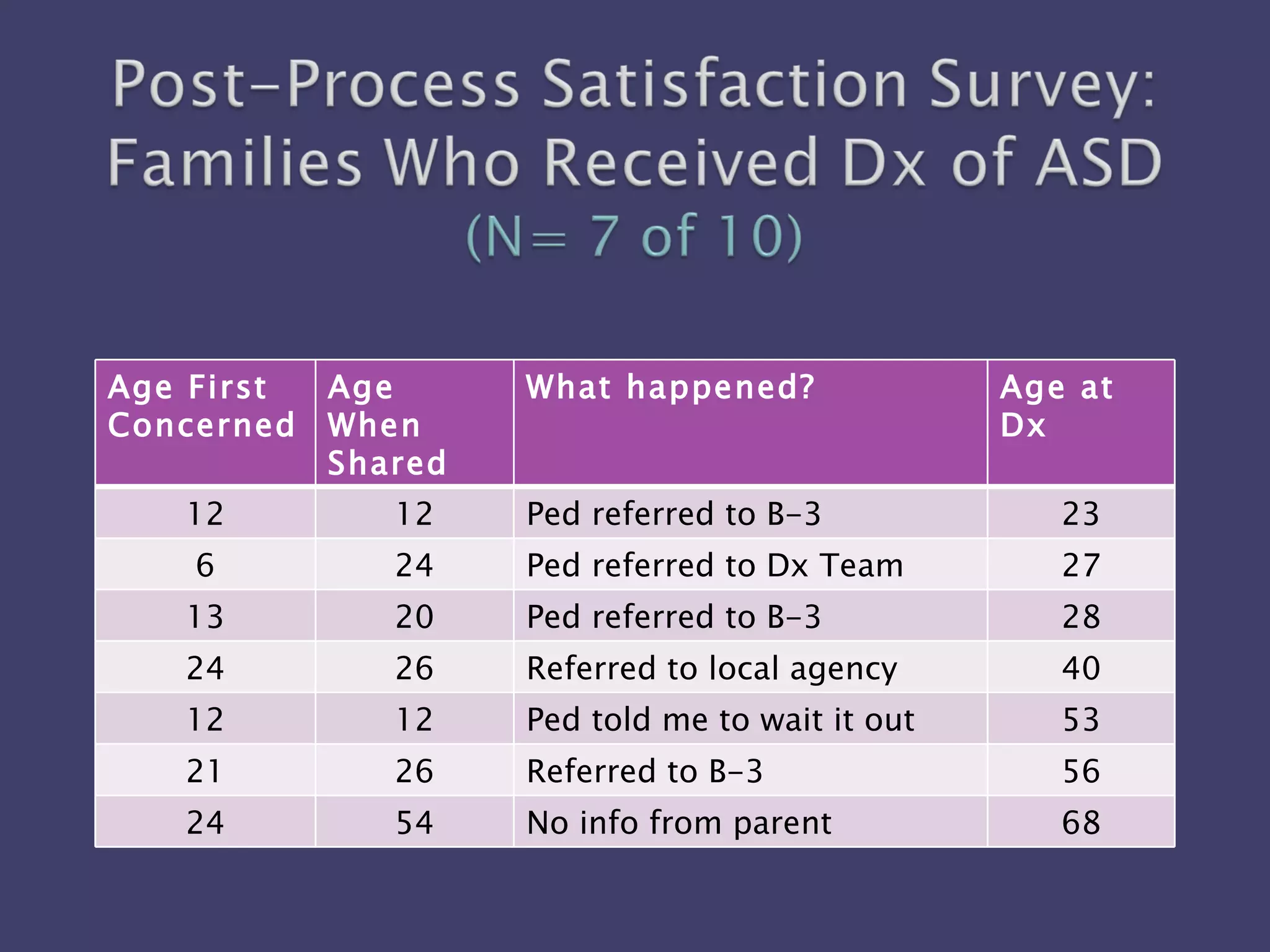
Age First Concerned Age When Shared Concern What happened? Age at Dx 12 12 Ped referred to B-3 23 6 24 Ped referred to Dx Team 27 13 20 Ped referred to B-3 28 24 26 Referred to local agency 40 12 12 Ped told me to wait it out 53 21 26 Referred to B-3 56 24 54 No info from parent 68
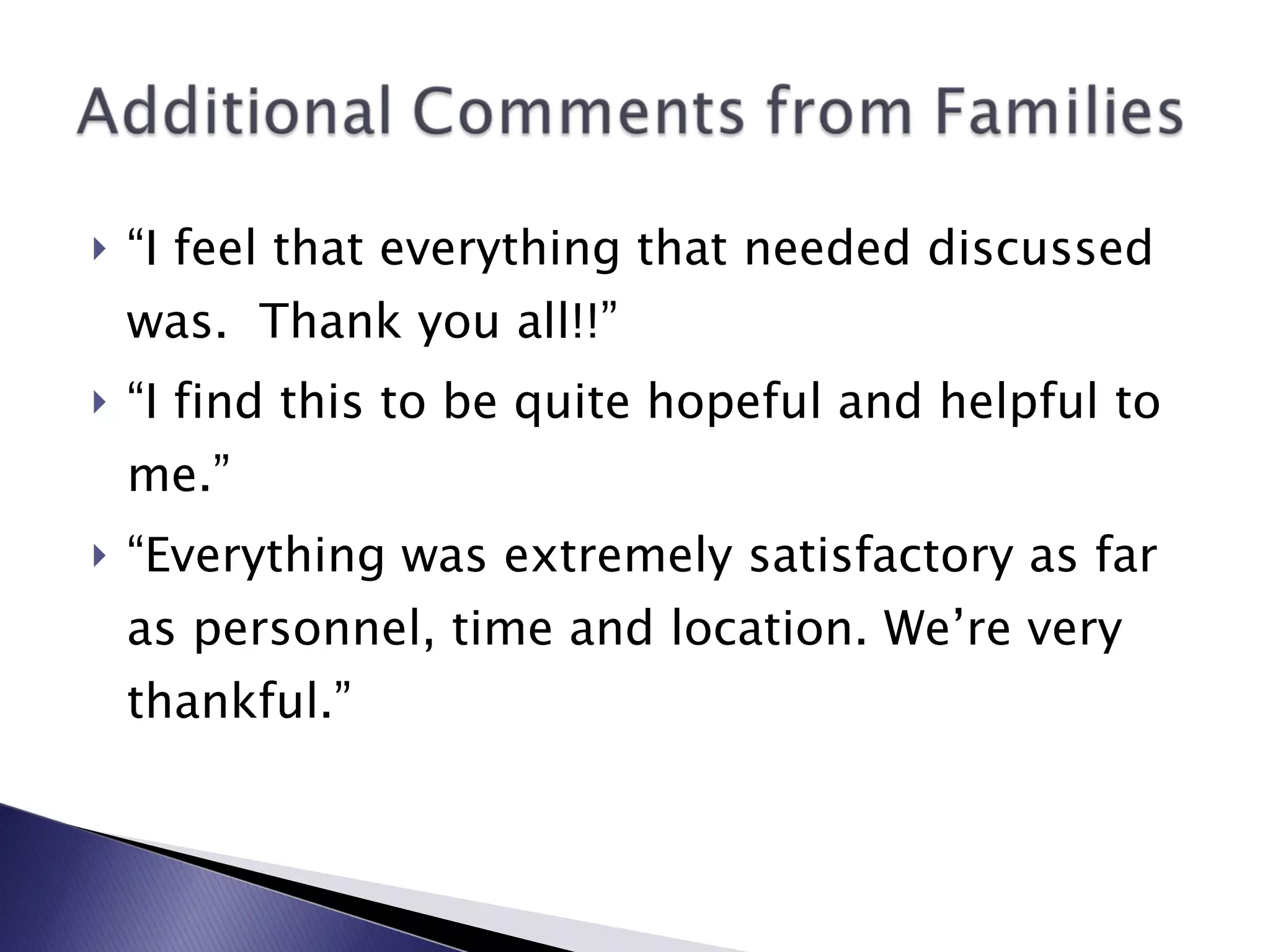
“ I feel that everything that needed discussed was.  Thank you all!!” “ I find this to be quite hopeful and helpful to me.” “ Everything was extremely satisfactory as far as personnel, time and location. We’re very thankful.”
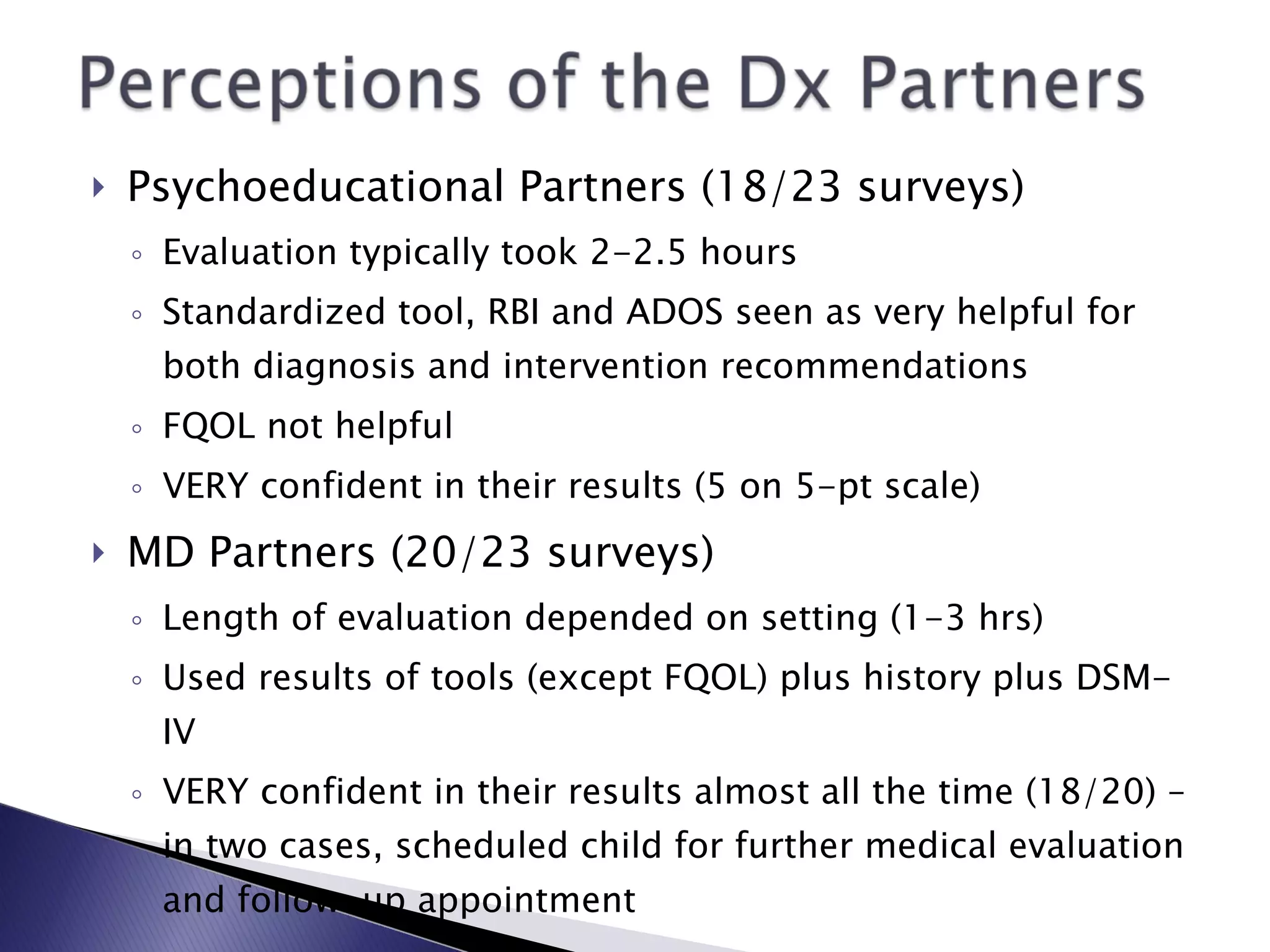
Psychoeducational Partners (18/23 surveys) Evaluation typically took 2-2.5 hours Standardized tool, RBI and ADOS seen as very helpful for both diagnosis and intervention recommendations FQOL not helpful VERY confident in their results (5 on 5-pt scale) MD Partners (20/23 surveys) Length of evaluation depended on setting (1-3 hrs) Used results of tools (except FQOL) plus history plus DSM-IV  VERY confident in their results almost all the time (18/20) – in two cases, scheduled child for further medical evaluation and follow-up appointment
Regarding the RBI: Seen as valuable as the ADOS, but for different reasons “ It’s so personal and so vivid.” “ I’m not going into the ADOS blind.” “ How else would you know that the child gets up and watches cartoons all day without the RBI?” “ The parent is right next me looking at the computer . . . You just can’t believe the look on these families’ faces.” “ I read every page before I see the child.”  (the MD Partner!!) Regarding the ADOS: “ The manual is my Bible.” “ A lot of stuff to take in . . . A lot of stuff to write down.” “ I’m getting more comfortable every time.” Advice: “Score it right away!”
“ It’s fun.” “ This has been fabulous for families.  They don’t have to travel.” “ We’re doing better all the time. The first ones were shaky as we were learning the tools.” “ We feel that taking the time to be together and DISCUSS is invaluable.” “ Families have had a weight lifted off their shoulders.”
 

ADEPP DX Partner Data

  • 1.
    Four of thefive counties are now underway Fifth county is re-grouping What do we know about the children, families and professionals who have been through the process? Results from the enhanced evaluation Psychoeducational tools, medical eval & diagnosis Perceptions of families Post-evaluation surveys Perceptions of the diagnostic partners Time, usefulness of tools, confidence in diagnosis We are not a research study: Some data holes!
  • 2.
    Number of childrenevaluated 23 Gender 15 M 8 F Chronological age Range 17-91 months Under 36 months 10 37-48 months 6 49-60 months 5 > 60 months 2
  • 3.
    Diagnoses Number %Autism 6 26% PDD-NOS 3 13% Aspergers 1 4% TOTAL ASD 10 43% Language Delay/Disorder 6 26% Language + Behavior 3 13% Global Delay 3 13% No Clinical Dx 1 4%
  • 4.
    Diagnosis x AgeAge ASD Other Under 36 months 5 5 37-48 months 1 5 49-60 months 3 2 > 60 months 1 1
  • 5.
    RBI priorities Toiletingand dressing Feeding/mealtime Playtime: entertaining self FQOL: Not as “sensitive” as RBI Only 6 families scored any item as “Dissatisfied” Outside family support, free time, medical/dental care
  • 6.
    Two surveys: Family-CenteredPractices Scale following the psychoeducational evaluation Satisfaction Survey following the medical evaluation/diagnosis Responses from 17 of the 23 families
  • 7.
    *Adapted with permissionfrom Family-Centered Practices Scale , Dunst & Trivette, 2004 With one exception, Never Very Little Some of the time Most of the time All of the time Really listened to my concerns/requests 1 2 3 4 5 Treated me with dignity and respect 1 2 3 4 5 Saw us in a positive way 1 2 3 4 5 Were sensitive to our cultural/ethnic background 1 2 3 4 5 Understood our situation 1 2 3 4 5 Listened for our strengths and interests 1 2 3 4 5 Helped me learn more about my child’s development 1 2 3 4 5 Helped me be an active part of the eval 1 2 3 4 5 Recognized the good things I do as parent 1 2 3 4 5 Were flexible and responsive 1 2 3 4 5 Helped me figure out what to do next 1 2 3 4 5
  • 8.
    “ I amvery confused on why 7 others felt he was on autism spectrum and these 3 people do not see it. All 7 have spent several hours a month with him and they did not spend much time with him.”
  • 9.
    How satisfied areyou with . . . Not at all Some what Very How the evaluations were explained to you 1 2 3 4 5 How the educational team and the physician listened to you 1 2 3 4 5 How the educational team and the physician made you feel like an equal member of the team 1 2 3 4 5 How their findings were explained to you 1 2 3 4 5 How your questions were answered 1 2 3 4 5 The diagnosis itself (e.g., language delay, autism) 1 2 3 4 5 The recommendations that were shared with you 1 2 3 4 5 Where the evaluation process was completed 1 2 3 4 5 How long it took to complete the evaluation process 1 2 3 4 5 If you had to go through this evaluation process again, would you? 1 2 3 4 5 Would you be willing to recommend the process to a friend? 1 2 3 4 5
  • 10.
    Age First ConcernedAge When Shared Concern What happened? Age at Dx 12 12 Ped referred to B-3 23 6 24 Ped referred to Dx Team 27 13 20 Ped referred to B-3 28 24 26 Referred to local agency 40 12 12 Ped told me to wait it out 53 21 26 Referred to B-3 56 24 54 No info from parent 68
  • 11.
    “ I feelthat everything that needed discussed was. Thank you all!!” “ I find this to be quite hopeful and helpful to me.” “ Everything was extremely satisfactory as far as personnel, time and location. We’re very thankful.”
  • 12.
    Psychoeducational Partners (18/23surveys) Evaluation typically took 2-2.5 hours Standardized tool, RBI and ADOS seen as very helpful for both diagnosis and intervention recommendations FQOL not helpful VERY confident in their results (5 on 5-pt scale) MD Partners (20/23 surveys) Length of evaluation depended on setting (1-3 hrs) Used results of tools (except FQOL) plus history plus DSM-IV VERY confident in their results almost all the time (18/20) – in two cases, scheduled child for further medical evaluation and follow-up appointment
  • 13.
    Regarding the RBI:Seen as valuable as the ADOS, but for different reasons “ It’s so personal and so vivid.” “ I’m not going into the ADOS blind.” “ How else would you know that the child gets up and watches cartoons all day without the RBI?” “ The parent is right next me looking at the computer . . . You just can’t believe the look on these families’ faces.” “ I read every page before I see the child.” (the MD Partner!!) Regarding the ADOS: “ The manual is my Bible.” “ A lot of stuff to take in . . . A lot of stuff to write down.” “ I’m getting more comfortable every time.” Advice: “Score it right away!”
  • 14.
    “ It’s fun.”“ This has been fabulous for families. They don’t have to travel.” “ We’re doing better all the time. The first ones were shaky as we were learning the tools.” “ We feel that taking the time to be together and DISCUSS is invaluable.” “ Families have had a weight lifted off their shoulders.”
  • 15.