Adding Rules on
Existing Hypermedia
APIs
Michael Petychakis, Fenareti Lampathaki, Dimitrios
Askounis
National Technical University of Athens
WS-REST, 18th May 2015, Florence Italy
Who I am
Michael Petychakis
Researcher in DSS lab, National Technical University of
Athens (NTUA)
PhD Candidate in NTUA
Electrical and Computer Engineer, Dipl.-M.Eng., NTUA
Research Interests
APIs/Linked Data/Web 3.0
@mpetyx
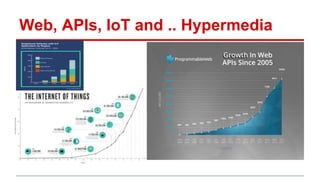
Web, APIs, IoT and .. Hypermedia
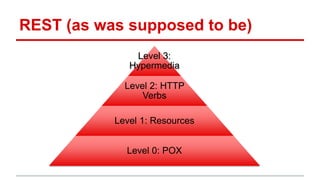
REST (as was supposed to be)
Level 3:
Hypermedia
Level 2: HTTP
Verbs
Level 1: Resources
Level 0: POX
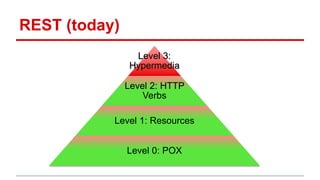
REST (today)
Level 3:
Hypermedia
Level 2: HTTP
Verbs
Level 1: Resources
Level 0: POX
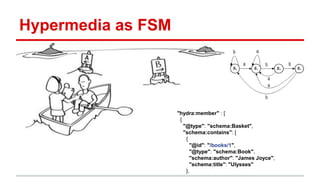
Hypermedia as FSM
"hydra:member" : [
{
"@type": "schema:Basket",
"schema:contains": [
{
"@id": "/books/1",
"@type": "schema:Book",
"schema:author": "James Joyce",
"schema:title": "Ulysses"
},
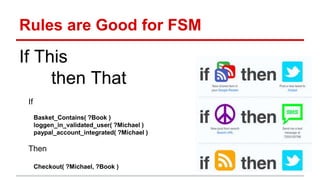
Rules are Good for FSM
If This
then That
If
Basket_Contains( ?Book )
loggen_in_validated_user( ?Michael )
paypal_account_integrated( ?Michael )
Then
Checkout( ?Michael, ?Book )
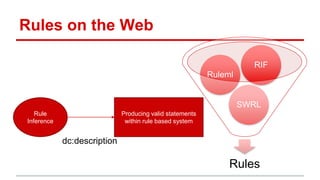
Rules on the Web
dc:description
Rules
SWRL
Ruleml
RIF
Rule
Inference
Producing valid statements
within rule based system
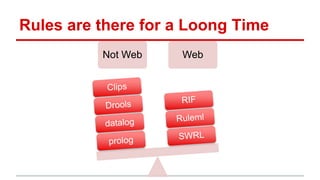
Rules are there for a Loong Time
Not Web Web
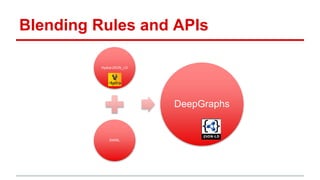
Blending Rules and APIs
Hydra/JSON_LD
SWRL
DeepGraphs
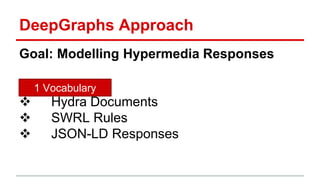
DeepGraphs Approach
Goal: Modelling Hypermedia Responses
1 Vocabulary
 Hydra Documents
 SWRL Rules
 JSON-LD Responses
1 Vocabulary
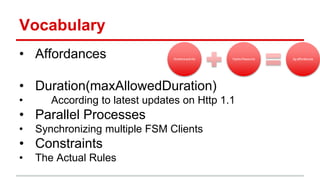
Vocabulary
• Affordances
• Duration(maxAllowedDuration)
• According to latest updates on Http 1.1
• Parallel Processes
• Synchronizing multiple FSM Clients
• Constraints
• The Actual Rules
Schema:activity Hydra:Resource dg:affordances
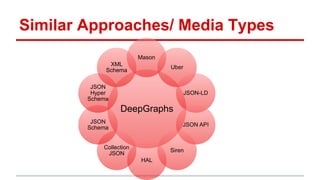
Similar Approaches/ Media Types
DeepGraphs
Mason
Uber
JSON-LD
JSON API
Siren
HAL
Collection
JSON
JSON
Schema
JSON
Hyper
Schema
XML
Schema
Example: Bookstore
"dg:affordances": [
{
"@type": ["schema:Action","hydra:Operation"],
"@id": "/RemoveBook",
"hydra:method": "DELETE",
"hydra:expects": "schema:Book",
"hydra:title": "Deletes a Book resource.",
"hydra:returns": "owl:Nothing",
"rdfs:label": "Deletes the Book resource."
},
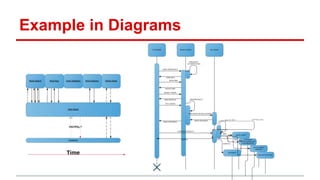
Example in Diagrams
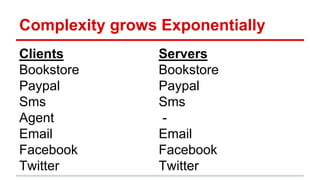
Complexity grows Exponentially
Clients
Bookstore
Paypal
Sms
Agent
Email
Facebook
Twitter
Servers
Bookstore
Paypal
Sms
-
Email
Facebook
Twitter
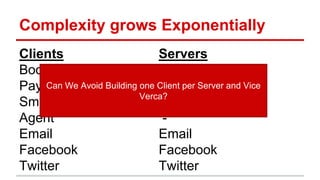
Complexity grows Exponentially
Clients
Bookstore
Paypal
Sms
Agent
Email
Facebook
Twitter
Servers
Bookstore
Paypal
Sms
-
Email
Facebook
Twitter
Can We Avoid Building one Client per Server and Vice
Versa?
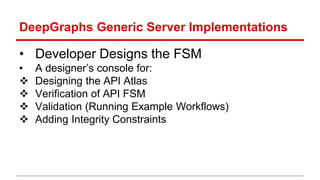
DeepGraphs Generic Server Implementations
• Developer Designs the FSM
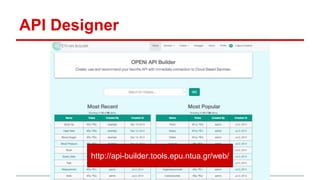
• A designer’s console for:
 Designing the API Atlas
 Verification of API FSM
 Validation (Running Example Workflows)
 Adding Integrity Constraints
Defining the Business Logic through Rules
API Designer
http://api-builder.tools.epu.ntua.gr/web/
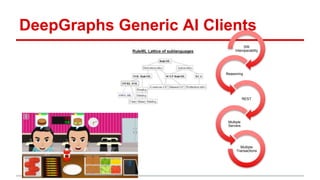
DeepGraphs Generic AI Clients
SW
Interoperabilty
Reasoning
REST
Multiple
Servers
Multiple
Transactions
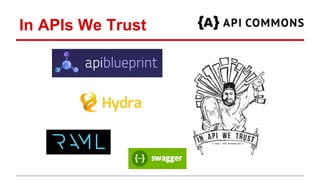
In APIs We Trust
Tools Around Spec
● API Builder
● PyAPI
o from [Swagger, API Blueprints, Hydra, WADL, RAML] to
[Swagger, API Blueprints, Hydra, RAML]
● PyRIF
o from [RuleML, RIF, SWRL] to [RuleML, RIF, SWRL]
● DeepGraphs Parser ( Soon )
● DeepGraphs Reasoner ( Soon )
o Datalog Approach
o FSM resolver implemented now
o Fluent Editor has been used for Evaluation
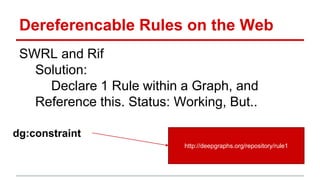
Dereferencable Rules on the Web
SWRL and Rif
Solution:
Declare 1 Rule within a Graph, and
Reference this. Status: Working, But..
dg:constraint
http://deepgraphs.org/repository/rule1
Advances of the Methodology
• DeepGraphs is not only REST
XMPP
MQTT
CoAP, DDS, AMQP (and more!)
• DeepGraphs aims into reusing Existing APIs that
speak Swagger, RAML, etc
• DeepGraphs aims to facilitate:
• Distributed Reasoning over the web with Affordances
Next Steps
1. First Release of the Specification on June
2. Create a public Community Group
3. DeepGraphs Tools
• Parser
• Client
• Reasoner
• Designer
4. More Events
5. Address Rule Dereferencability by open discussion
Thank you
Michael Petychakis
<a
href="mailto:mpetyx@epu.ntua.gr?Subject=
Hello" target="_top">Drop me an e-mail</a>
@mpetyx
This work has been created in the context of the EU-funded
project OPENi (Open-Source, Web-Based, Framework for
Integrating Applications with Social Media Services and Personal
Cloudlets), Contract No: FP7-ICT-317883.

Adding Rules on Existing Hypermedia APIs

Editor's Notes

  • #4 http://theconnectivist-img.s3.amazonaws.com/wp-content/uploads/2014/05/Unknown.png http://blogs-images.forbes.com/gilpress/files/2014/08/iconsWithImages_page-5.jpg
  • #5 Level 0: Swamp of POX Level 0 uses its implementing protocol (normally HTTP, but it doesn't have to be) like a transport protocol. That is, it tunnels requests and responses through its protocol without using the protocol to indicate application state. It will use only one entry point (URI) and one kind of method (in HTTP, this normally is the POST method). Examples of these are SOAP and XML-RPC. Level 1: Resources When your API can distinguish between different resources, it might be level 1. This level uses multiple URIs, where where every URI is the entrypoint to a specific resource. Instead of going through http://example.org/articles, you actually distinguish between http://example.org/article/1 and http://example.org/article/2. Still, this level uses only one single method like POST. Level 2: HTTP verbs To be honest, I don't like this level. This is because this level suggests that in order to be truly RESTful, your API MUST use HTTP verbs. It doesn't. REST is completely protocol agnostic, so if you want to use a different protocol, your API can still be RESTful. This level indicates that your API should use the protocol properties in order to deal with scalability and failures. Don't use a single POST method for all, but make use of GET when you are requesting resources, and use the DELETE method when you want to delete a resources. Also, use the response codes of your application protocol. Don't use 200 (OK) code when something went wrong for instance. By doing this for the HTTP application protocol, or any other application protocol you like to use, you have reached level 2. Level 3: Hypermedia controls Level 3, the highest level, uses HATEOAS to deal with discovering the possibilities of your API towards the clients. More information about HATEOAS can be found below. - See more at: http://restcookbook.com/Miscellaneous/richardsonmaturitymodel/#sthash.7wi9wqne.dpuf
  • #6 API discoverability and documentation Reuse of state transition logic across clients Ease of client development More flexibility for servers to evolve
  • #7 http://csunplugged.org/wp-content/uploads/2015/03/rowboat_0.png1286488551 http://oldblogimages.metawrap.com/DFAsmall.png
  • #8 http://cdn.makeuseof.com/wp-content/uploads/2011/09/ifttt-icon.png?92a7a3
  • #21 https://lh3.ggpht.com/K2afaPvqzzq-36aXKmdVgniDGKy3bDURiuYRGcltAcIYoL9oABqIvU5hwtP0wlyOYA=h900