International Journal of Control Theory and Computer Modelling (IJCTCM) Vol.1, No.1, July 2011
1
ADAPTIVE CONTROL AND SYNCHRONIZATION OF
HYPERCHAOTIC CAI SYSTEM
Sundarapandian Vaidyanathan1
1
Research and Development Centre, Vel Tech Dr. RR & Dr. SR Technical University
Avadi, Chennai-600 062, Tamil Nadu, INDIA
sundarvtu@gmail.com
ABSTRACT
The hyperchaotic Cai system (Wang, Cai, Miao and Tian, 2010) is one of the important paradigms of four-
dimensional hyperchaotic systems. This paper investigates the adaptive control and synchronization of
hyperchaotic Cai system with unknown parameters. First, adaptive control laws are designed to stabilize
the hyperchaotic Cai system to its unstable equilibrium point at the origin based on the adaptive control
theory and Lyapunov stability theory. Then adaptive control laws are derived to achieve global chaos
synchronization of identical hyperchaotic Cai systems with unknown parameters. Numerical simulations
are shown to demonstrate the effectiveness of the proposed adaptive control and synchronization schemes.
KEYWORDS
Adaptive Control, Stabilization, Chaos Synchronization, Hyperchaos, Hyperchaotic Cai System.
1. INTRODUCTION
Chaotic systems are dynamical systems that are highly sensitive to initial conditions. The
sensitive nature of chaotic systems is commonly called as the butterfly effect [1]. Since chaos
phenomenon in weather models was first observed by Lorenz in 1961, a large number of chaos
phenomena and chaos behaviour have been discovered in physical, social, economical, biological
and electrical systems.
The control of chaotic systems is to design state feedback control laws that stabilizes the chaotic
systems around the unstable equilibrium points. Active control technique is used when the system
parameters are known and adaptive control technique is used when the system parameters are
unknown [2-4].
Synchronization of chaotic systems is a phenomenon that may occur when two or more chaotic
oscillators are coupled or when a chaotic oscillator drives another chaotic oscillator. Because of
the butterfly effect, which causes the exponential divergence of the trajectories of two identical
chaotic systems started with nearly the same initial conditions, synchronizing two chaotic systems
is seemingly a very challenging problem in the chaos literature [5-16].
In 1990, Pecora and Carroll [5] introduced a method to synchronize two identical chaotic systems
and showed that it was possible for some chaotic systems to be completely synchronized. From
then on, chaos synchronization has been widely explored in a variety of fields including physical
systems [6], chemical systems [7], ecological systems [8], secure communications [9-10], etc.
International Journal of Control Theory and Computer Modelling (IJCTCM) Vol.1, No.1, July 2011
2
In most of the chaos synchronization approaches, the master-slave or drive-response formalism
has been used. If a particular chaotic system is called the master or drive system and another
chaotic system is called the slave or response system, then the idea of synchronization is to use
the output of the master system to control the slave system so that the output of the slave system
tracks the output of the master system asymptotically.
Since the seminal work by Pecora and Carroll [5], a variety of impressive approaches have been
proposed for the synchronization of chaotic systems such as the OGY method [11], active control
method [12-15], adaptive control method [16-18], sampled-data feedback synchronization method
[19], time-delay feedback method [20], backstepping method [21], sliding mode control method
[22-24], etc.
Over the last two decades, hyperchaos has been intensively studied in many engineering oriented
applied fields such as nonlinear circuits, secure communications, lasers, neural networks and so
on.
Hyperchaotic system is usually defined as a chaotic system with at least two positive Lyapunov
exponents, implying that its dynamics are expanded in several different directions simultaneously.
It means that hyperchaotic systems have more complex dynamical behaviours which can be used
to improve the security of a chaotic communication system. Thus, the theoretical design and
circuit realization of various hyperchaotic signals have become important research topics [25].
In this paper, we investigate the adaptive control and synchronization of hyperchaotic Cai
systems with unknown parameters. First, we devise adaptive stabilization scheme using state
feedback control for the hyperchaotic Cai system about its equilibrium at the origin. Then, we
devise adaptive synchronization scheme for identical hyperchaotic Cai systems with unknown
parameters. The stability results derived in this paper are established using Lyapunov stability
theory.
This paper has been organized as follows. In Section 2, we give a system description of the
hyperchaotic Cai system (2010). In Section 3, we derive results for the adaptive stabilization of
hyperchaotic Cai system with unknown parameters. In Section 4, we derive results for the
adaptive synchronization of hyperchaotic Cai systems with unknown parameters. In Section 5,
we summarize the main results obtained in this paper.
2. SYSTEM DESCRIPTION
The hyperchaotic Cai system (Wang, Cai, Miao, Tian, [26], 2010) is one of the important models
of four-dimensional hyperchaotic systems, which is described by the dynamics
1 2 1
2 1 2 1 3 4
2
3 2 3
4 1
( )x a x x
x bx cx x x x
x x rx
x sx
= −
= + − +
= −
= −
&
&
&
&
(1)
where ( 1,2,3,4)ix i = are the state variables and , , , ,a b c r s are positive constants.
The system (1) is hyperchaotic when the parameter values are taken as
27.5, 3, 19.3, 2.9a b c r= = = = and 3.3.s = (2)
International Journal of Control Theory and Computer Modelling (IJCTCM) Vol.1, No.1, July 2011
3
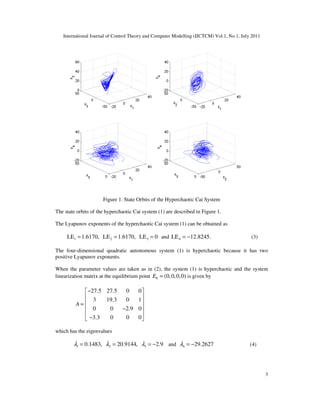
Figure 1. State Orbits of the Hyperchaotic Cai System
The state orbits of the hyperchaotic Cai system (1) are described in Figure 1.
The Lyapunov exponents of the hyperchaotic Cai system (1) can be obtained as
1 2 3LE 1.6170, LE 1.6170, LE 0= = = and 4LE 12.8245.= − (3)
The four-dimensional quadratic autonomous system (1) is hyperchaotic because it has two
positive Lyapunov exponents.
When the parameter values are taken as in (2), the system (1) is hyperchaotic and the system
linearization matrix at the equilibrium point 0 (0,0,0,0)E = is given by
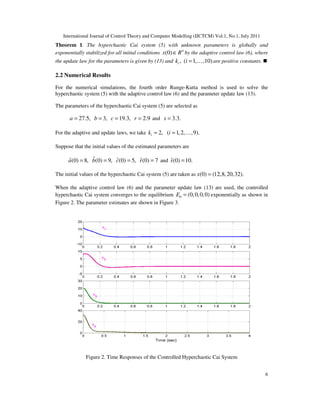
27.5 27.5 0 0
3 19.3 0 1
0 0 2.9 0
3.3 0 0 0
A
− 
 
 =
 −
 
− 
which has the eigenvalues
1 2 30.1483, 20.9144, 2.9λ λ λ= = = − and 4 29.2627λ = − (4)
International Journal of Control Theory and Computer Modelling (IJCTCM) Vol.1, No.1, July 2011
4
Since 1 2,λ λ are eigenvalues with positive real part, it is immediate from Lyapunov stability
theory [27] that the system (1) is unstable at the equilibrium point 0 (0,0,0,0).E =
3. ADAPTIVE CONTROL OF HYPERCHAOTIC CAI SYSTEM
3.1 Theoretical Results
In this section, we design adaptive control law for globally stabilizing the hyperchaotic system (1)
when the parameter values are unknown.
Thus, we consider the controlled hyperchaotic Cai system as follows.
1 2 1 1
2 1 2 1 3 4 2
2
3 2 3 3
4 1 4
( )x a x x u
x bx cx x x x u
x x rx u
x sx u
= − +
= + − + +
= − +
= − +
&
&
&
&
(5)
where 1 2 3, ,u u u and 4u are feedback controllers to be designed using the states and estimates of
the unknown parameters of the system.
In order to ensure that the controlled system (5) globally converges to the origin asymptotically,
we consider the following adaptive control functions
1 2 1 1 1
2 1 2 1 3 4 2 2
2
3 2 3 3 3
4 1 4 4
ˆ( )
ˆ ˆ
ˆ
ˆ
u a x x k x
u bx cx x x x k x
u x rx k x
u sx k x
= − − −
= − − + − −
= − + −
= − −
(6)
where ˆˆ ˆ ˆ, , ,a b c r and ˆs are estimates of the parameters , , ,a b c r and ,s respectively, and
,( 1,2,3,4)ik i = are positive constants.
Substituting the control law (6) into the hyperchaotic Cai dynamics (5), we obtain
1 2 1 1 1
2 1 2 2 2
3 3 3 3
4 1 4 4
ˆ( ) ( )
ˆ ˆ( ) ( )
ˆ( )
ˆ( )
x a a x x k x
x b b x c c x k x
x r r x k x
x s s x k x
= − − −
= − + − −
= − − −
= − − −
&
&
&
&
(7)
Let us now define the parameter errors as
ˆˆ ˆ, ,
ˆ ˆ,
a b c
r s
e a a e b b e c c
e r r e s s
= − = − = −
= − = −
(8)
International Journal of Control Theory and Computer Modelling (IJCTCM) Vol.1, No.1, July 2011
5
Using (8), the closed-loop dynamics (7) can be written compactly as
1 2 1 1 1
2 1 2 2 2
3 3 3 3
4 1 4 4
( )a
b c
r
s
x e x x k x
x e x e x k x
x e x k x
x e x k x
= − −
= + −
= − −
= − −
&
&
&
&
(9)
For the derivation of the update law for adjusting the parameter estimates ˆˆ ˆ ˆ ˆ, , , , ,a b c r s the
Lyapunov approach is used.
Consider the quadratic Lyapunov function
( )2 2 2 2 2 2 2 2 2
1 2 3 4
1
,
2
a b c r sV x x x x e e e e e= + + + + + + + + (10)
which is a positive definite function on 9
.R
Note also that
ˆˆ ˆ ˆ ˆ, , , , .a b c r se a e b e c e r e s= − = − = − = − = −
&& & & && & & & & (11)
Differentiating V along the trajectories of (9) and using (11), we obtain
2 2 2 2
1 1 2 2 3 3 4 4 1 2 1
2 2
1 2 2 3 1 4
ˆ( )
ˆ ˆ ˆ ˆ
a
b c r s
V k x k x k x k x e x x x a
e x x b e x c e x r e x x s
 = − − − − + − − 
       + − + − + − − + − −       
&&
& & & &
(12)
In view of Eq. (12), the estimated parameters are updated by the following law:
1 2 1 5
1 2 6
2
2 7
2
3 8
1 4 9
ˆ ( )
ˆ
ˆ
ˆ
ˆ
a
b
c
r
s
a x x x k e
b x x k e
c x k e
r x k e
s x x k e
= − +
= +
= +
= − +
= − +
&
&
&
&
&
(13)
where ,( 5, ,9)ik i = K are positive constants.
Substituting (13) into (12), we get
2 2 2 2 2 2 2 2 2
1 1 2 2 3 3 4 4 5 6 7 8 9a b c r sV k x k x k x k x k e k e k e k e k e= − − − − − − − − −& (14)
which is a negative definite function on 9
.R
Thus, by Lyapunov stability theory [27], we obtain the following result.
International Journal of Control Theory and Computer Modelling (IJCTCM) Vol.1, No.1, July 2011
6
Theorem 1. The hyperchaotic Cai system (5) with unknown parameters is globally and
exponentially stabilized for all initial conditions 4
(0)x R∈ by the adaptive control law (6), where
the update law for the parameters is given by (13) and , ( 1, ,10)ik i = K are positive constants.
2.2 Numerical Results
For the numerical simulations, the fourth order Runge-Kutta method is used to solve the
hyperchaotic system (5) with the adaptive control law (6) and the parameter update law (13).
The parameters of the hyperchaotic Cai system (5) are selected as
27.5, 3, 19.3, 2.9a b c r= = = = and 3.3.s =
For the adaptive and update laws, we take 2, ( 1,2, ,9).ik i= = K
Suppose that the initial values of the estimated parameters are
ˆˆ ˆ ˆ(0) 8, (0) 9, (0) 5, (0) 7a b c r= = = = and ˆ(0) 10.s =
The initial values of the hyperchaotic Cai system (5) are taken as (0) (12,8,20,32).x =
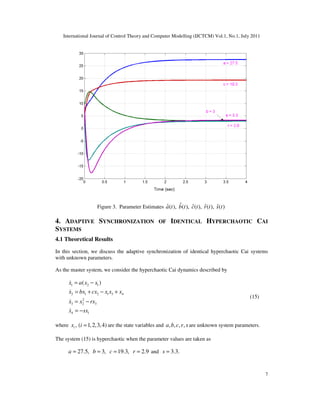
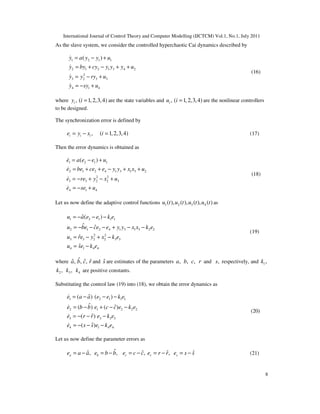
When the adaptive control law (6) and the parameter update law (13) are used, the controlled
hyperchaotic Cai system converges to the equilibrium 0 (0,0,0,0)E = exponentially as shown in
Figure 2. The parameter estimates are shown in Figure 3.
Figure 2. Time Responses of the Controlled Hyperchaotic Cai System
International Journal of Control Theory and Computer Modelling (IJCTCM) Vol.1, No.1, July 2011
7
Figure 3. Parameter Estimates ˆˆ ˆ ˆ ˆ( ), ( ), ( ), ( ), ( )a t b t c t r t s t
4. ADAPTIVE SYNCHRONIZATION OF IDENTICAL HYPERCHAOTIC CAI
SYSTEMS
4.1 Theoretical Results
In this section, we discuss the adaptive synchronization of identical hyperchaotic Cai systems
with unknown parameters.
As the master system, we consider the hyperchaotic Cai dynamics described by
1 2 1
2 1 2 1 3 4
2
3 2 3
4 1
( )x a x x
x bx cx x x x
x x rx
x sx
= −
= + − +
= −
= −
&
&
&
&
(15)
where , ( 1,2,3,4)ix i = are the state variables and , , , ,a b c r s are unknown system parameters.
The system (15) is hyperchaotic when the parameter values are taken as
27.5, 3, 19.3, 2.9a b c r= = = = and 3.3.s =
International Journal of Control Theory and Computer Modelling (IJCTCM) Vol.1, No.1, July 2011
8
As the slave system, we consider the controlled hyperchaotic Cai dynamics described by
1 2 1 1
2 1 2 1 3 4 2
2
3 2 3 3
4 1 4
( )y a y y u
y by cy y y y u
y y ry u
y sy u
= − +
= + − + +
= − +
= − +
&
&
&
&
(16)
where , ( 1,2,3,4)iy i = are the state variables and , ( 1,2,3,4)iu i = are the nonlinear controllers
to be designed.
The synchronization error is defined by
, ( 1,2,3,4)i i ie y x i= − = (17)
Then the error dynamics is obtained as
1 2 1 1
2 1 2 4 1 3 1 3 2
2 2
3 3 2 2 3
4 1 4
( )e a e e u
e be ce e y y x x u
e re y x u
e se u
= − +
= + + − + +
= − + − +
= − +
&
&
&
&
(18)
Let us now define the adaptive control functions 1 2 3 4( ), ( ), ( ), ( )u t u t u t u t as
1 2 1 1 1
2 1 2 4 1 3 1 3 2 2
2 2
3 3 2 2 3 3
4 1 4 4
ˆ( )
ˆ ˆ
ˆ
ˆ
u a e e k e
u be ce e y y x x k e
u re y x k e
u se k e
= − − −
= − − − + − −
= − + −
= −
(19)
where ˆ,a ˆ,b ˆ,c ˆr and ˆs are estimates of the parameters ,a ,b ,c r and ,s respectively, and 1,k
2 ,k 3,k 4k are positive constants.
Substituting the control law (19) into (18), we obtain the error dynamics as
1 2 1 1 1
2 1 2 2 2
3 3 3 3
4 1 4 4
ˆ( ) ( )
ˆ ˆ( ) ( )
ˆ( )
ˆ( )
e a a e e k e
e b b e c c e k e
e r r e k e
e s s e k e
= − − −
= − + − −
= − − −
= − − −
&
&
&
&
(20)
Let us now define the parameter errors as
ˆˆ ˆ ˆ ˆ, , , ,a b c r se a a e b b e c c e r r e s s= − = − = − = − = − (21)
International Journal of Control Theory and Computer Modelling (IJCTCM) Vol.1, No.1, July 2011
9
Substituting (21) into (20), the error dynamics simplifies to
1 2 1 1 1
2 1 2 2 2
3 3 3 3
4 1 4 4
( )a
b c
r
s
e e e e k e
e e e e e k e
e e e k e
e e e k e
= − −
= + −
= − −
= − −
&
&
&
&
(22)
For the derivation of the update law for adjusting the estimates of the parameters, the Lyapunov
approach is used.
Consider the quadratic Lyapunov function
( )2 2 2 2 2 2 2 2 2
1 2 3 4
1
2
a b c r sV e e e e e e e e e= + + + + + + + + (23)
which is a positive definite function on 9
.R
Note also that
ˆˆ ˆ ˆ ˆ, , , ,a b c r se a e b e c e r e s= − = − = − = − = −
&& & & && & & & & (24)
Differentiating V along the trajectories of (22) and using (24), we obtain
2 2 2 2
1 1 2 2 3 3 4 4 1 2 1 1 2
2 2
2 3 1 4
ˆˆ( )
ˆ ˆ ˆ
a b
c r s
V k e k e k e k e e e e e a e e e b
e e c e e r e e e s
  = − − − − + − − + −    
     + − + − − + − −     
&&&
& & &
(25)
In view of Eq. (25), the estimated parameters are updated by the following law:
1 2 1 5
1 2 6
2
2 7
2
3 8
1 4 9
ˆ ( )
ˆ
ˆ
ˆ
ˆ
a
b
c
r
s
a e e e k e
b e e k e
c e k e
r e k e
s e e k e
= − +
= +
= +
= − +
= − +
&
&
&
&
&
(26)
where ,( 5, ,9)ik i = K are positive constants.
Substituting (24) into (23), we get
2 2 2 2 2 2 2 2 2
1 1 2 2 3 3 4 4 5 6 7 8 9 ,a b c r sV k e k e k e k e k e k e k e k e k e= − − − − − − − − −& (27)
which is a negative definite function on 9
.R
International Journal of Control Theory and Computer Modelling (IJCTCM) Vol.1, No.1, July 2011
10
Thus, by Lyapunov stability theory [27], it is immediate that the synchronization error and the
parameter error decay to zero exponentially with time for all initial conditions.
Hence, we have proved the following result.
Theorem 2. The identical hyperchaotic Cai systems (15) and (16) with unknown parameters are
globally and exponentially synchronized for all initial conditions by the adaptive control law
(19), where the update law for parameters is given by (26) and ,( 1, ,9)ik i = K are positive
constants.
3.2 Numerical Results
For the numerical simulations, the fourth order Runge-Kutta method is used to solve the two
systems of differential equations (15) and (16) with the adaptive control law (19) and the
parameter update law (26).
For the adaptive synchronization of the hyperchaotic Cai systems with parameter values
27.5, 3, 19.3, 2.9a b c r= = = = and 3.3,s =
we apply the adaptive control law (19) and the parameter update law (26).
We take the positive constants , ( 1, ,9)ik i = K as
2ik = for 1,2, ,9.i = K
Suppose that the initial values of the estimated parameters are
ˆˆ ˆ ˆ(0) 8, (0) 12, (0) 9, (0) 6a b c r= = = = and ˆ(0) 7.s =
We take the initial values of the master system (13) as
1 2 3 4(0) 12, (0) 20, (0) 14, (0) 18x x x x= = = =
We take the initial values of the slave system (14) as
1 2 3 4(0) 25, (0) 30, (0) 22, (0) 28y y y y= = = =
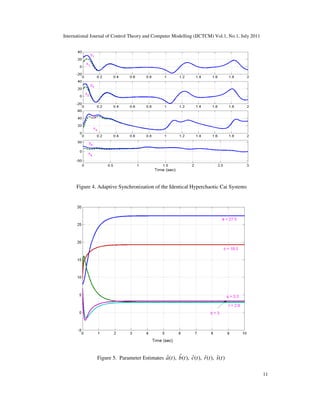
Figure 4 shows the adaptive chaos synchronization of the identical hyperchaotic Cai systems.
Figure 5 shows that the estimated values of the parameters ˆˆ ˆ ˆ ˆ, , , ,a b c r s converge to the system
parameters 27.5, 3, 19.3, 2.9a b c r= = = = and 3.3.s =
International Journal of Control Theory and Computer Modelling (IJCTCM) Vol.1, No.1, July 2011
11
Figure 4. Adaptive Synchronization of the Identical Hyperchaotic Cai Systems
Figure 5. Parameter Estimates ˆˆ ˆ ˆ ˆ( ), ( ), ( ), ( ), ( )a t b t c t r t s t
International Journal of Control Theory and Computer Modelling (IJCTCM) Vol.1, No.1, July 2011
12
5. CONCLUSIONS
In this paper, we applied adaptive control theory for the stabilization and synchronization of the
hyperchaotic Cai system (Wang, Cai, Miao, Tian, [26], 2010) with unknown system parameters.
First, we designed adaptive control laws to stabilize the hyperchaotic Cai system to its
equilibrium point at the origin based on the adaptive control theory and Lyapunov stability
theory. Then we derived adaptive synchronization scheme and update law for the estimation of
system parameters for identical hyperchaotic Cai systems with unknown parameters. Our
synchronization schemes were established using Lyapunov stability theory. Since the Lyapunov
exponents are not required for these calculations, the proposed adaptive control method is very
effective and convenient to achieve chaos control and synchronization of the hyperchaotic Cai
system. Numerical simulations are shown to demonstrate the effectiveness of the proposed
adaptive stabilization and synchronization schemes.
REFERENCES
[1] Alligood, K.T., Sauer, T. & Yorke, J.A. (1997) Chaos: An Introduction to Dynamical Systems,
Springer, New York.
[2] Ge, S.S., Wang, C. & Lee, T.H. (2000) “Adaptive backstepping control of a class of chaotic
systems,” Internat. J. Bifur. Chaos, Vol. 10, pp 1149-1156.
[3] Wang, X., Tian, L. & Yu, L. (2006) “Adaptive control and slow manifold analysis of a new
chaotic system,” Internat. J. Nonlinear Science, Vol. 21, pp 43-49.
[4] Sun, M., Tian, L., Jiang, S. & Xun, J. (2007) “Feedback control and adaptive control of the energy
resource chaotic system,” Chaos, Solitons & Fractals, Vol. 32, pp 168-180.
[5] Pecora, L.M. & Carroll, T.L. (1990) “Synchronization in chaotic systems”, Phys. Rev. Lett., Vol.
64, pp 821-824.
[6] Lakshmanan, M. & Murali, K. (1996) Nonlinear Oscillators: Controlling and Synchronization,
World Scientific, Singapore.
[7] Han, S.K., Kerrer, C. & Kuramoto, Y. (1995) “Dephasing and bursting in coupled neural
oscillators”, Phys. Rev. Lett., Vol. 75, pp 3190-3193.
[8] Blasius, B., Huppert, A. & Stone, L. (1999) “Complex dynamics and phase synchronization in
spatially extended ecological system”, Nature, Vol. 399, pp 354-359.
[9] Feki, M. (2003) “An adaptive chaos synchronization scheme applied to secure communication”,
Chaos, Solitons and Fractals, Vol. 18, pp 141-148.
[10] Murali, K. & Lakshmanan, M. (1998) “Secure communication using a compound signal from
generalized synchronizable chaotic systems”, Phys. Rev. Lett. A, Vol. 241, pp 303-310.
[11] Ott, E., Grebogi, C. & Yorke, J.A. (1990) “Controlling chaos”, Phys. Rev. Lett., Vol. 64, pp 1196-
1199.
[12] Wu, Y., Zhou, X. & Chen, J. (2009) “Chaos synchronization of a new chaotic system,” Chaos,
Solitons & Fractals, Vol. 42, pp. 1812-1819.
[13] Sundarapandian, V. & Karthikeyan, R. (2011), “Global chaos synchronization of four-scroll
chaotic systems by active nonlinear control,” International Journal of Control Theory and
Applications, Vol. 4, No. 1, pp. 73-83.
[14] Sundarapandian, V. (2011) “Hybrid chaos synchronization of hyperchaotic Liu and hyperchaotic
Chen systems by active nonlinear control,” International Journal of Computer Science,
Engineering and Information Technology, Vol. 1, No. 2, pp. 1-14.
[15] Sundarapandian, V. & Suresh, R. (2011) “Global chaos synchronization of hyperchaotic Qi and Jia
systems by nonlinear control,” International Journal of Distributed and Parallel Systems, Vol. 2,
No. 2, pp. 83-94.
International Journal of Control Theory and Computer Modelling (IJCTCM) Vol.1, No.1, July 2011
13
[16] Samuel, B. (2007) “Adaptive synchronization between two different chaotic systems,” Adaptive
Commun. Nonlinear Sci. Num. Simulation, Vol. 12, pp. 976-985.
[17] Liao, T.L. & Tsai. S.H. (2000) “Adaptive synchronization of chaotic systems and its applications
to secure communications,” Chaos, Solitons and Fractals, Vol. 11, pp. 1387-1396.
[18] Sundarapandian, V. (2011) “Adaptive control and synchronization of hyperchaotic Newton-
Leipnik system,” International Journal of Advanced Information Technology, Vol. 1, No. 3, pp.
22-33.
[19] Yang, T. & Chua, L.O. (1999) “Control of chaos using sampled-data feedback control”, Internat.
J. Bifurcat. Chaos, Vol. 9, pp 215-219.
[20] Park, J.H. & Kwon, O.M. (2003) “A novel criterion for delayed feedback control of time-delay
chaotic systems”, Chaos, Solitons and Fractals, Vol. 17, pp 709-716.
[21] Yu, Y.G. & Zhang, S.C. (2006) “Adaptive backstepping synchronization of uncertain chaotic
systems”, Chaos, Solitons and Fractals, Vol. 27, pp 1369-1375.
[22] Konishi, K., Hirai, M. & Kokame, H. (1998) “Sliding mode control for a class of chaotic
systems,” Phys. Lett. A, Vol. 245, pp. 511-517.
[23] Sundarapandian, V. (2011) “Global chaos synchronization of Pehlivan systems by sliding mode
control,” International Journal on Computer Science and Engineering, Vol. 3, No. 5, pp. 2163-
2169.
[24] Sundarapandian, V. & Sivaperumal, S. (2011), “Global chaos synchronization of hyperchaotic
Chen systems by sliding mode control,” International Journal of Engineering Science and
Technology, Vol. 3, No. 5, pp. 4265-4271.
[25] Cenys, A., Tamasevicius, A. & Baziliauskas, A. (2003) “Hyperchaos in coupled Colpitts
oscillators,” Chaos, Solitons and Fractals, Vol. 7, pp. 349-353.
[26] Wang, H., Cai, G., Miao, S. & Tian, L. (2010) “Nonlinear feedback control of a novel
hyperchaotic system and its circuit implementation,” Chinese Physics B, Vol. 19, No. 3, pp. 509-
516.
[27] Hahn, W. (1967) The Stability of Motion, Springer, New York.
Author
Dr. V. Sundarapandian is a Professor
(Systems and Control Engineering), Research
and Development Centre at Vel Tech Dr. RR &
Dr. SR Technical University, Chennai, India.
His current research areas are: Linear and
Nonlinear Control Systems, Chaos Theory,
Dynamical Systems and Stability Theory, etc.
He has published over 150 research articles in
international journals and two text-books with
Prentice-Hall of India, New Delhi, India. He has
published over 45 papers in International
Conferences and 90 papers in National
Conferences. He has delivered several Key Note
Lectures on Control Systems, Chaos Theory,
Scientific Computing, SCILAB, etc.

Adaptive Control and Synchronization of Hyperchaotic Cai System

  • 1.
    International Journal ofControl Theory and Computer Modelling (IJCTCM) Vol.1, No.1, July 2011 1 ADAPTIVE CONTROL AND SYNCHRONIZATION OF HYPERCHAOTIC CAI SYSTEM Sundarapandian Vaidyanathan1 1 Research and Development Centre, Vel Tech Dr. RR & Dr. SR Technical University Avadi, Chennai-600 062, Tamil Nadu, INDIA sundarvtu@gmail.com ABSTRACT The hyperchaotic Cai system (Wang, Cai, Miao and Tian, 2010) is one of the important paradigms of four- dimensional hyperchaotic systems. This paper investigates the adaptive control and synchronization of hyperchaotic Cai system with unknown parameters. First, adaptive control laws are designed to stabilize the hyperchaotic Cai system to its unstable equilibrium point at the origin based on the adaptive control theory and Lyapunov stability theory. Then adaptive control laws are derived to achieve global chaos synchronization of identical hyperchaotic Cai systems with unknown parameters. Numerical simulations are shown to demonstrate the effectiveness of the proposed adaptive control and synchronization schemes. KEYWORDS Adaptive Control, Stabilization, Chaos Synchronization, Hyperchaos, Hyperchaotic Cai System. 1. INTRODUCTION Chaotic systems are dynamical systems that are highly sensitive to initial conditions. The sensitive nature of chaotic systems is commonly called as the butterfly effect [1]. Since chaos phenomenon in weather models was first observed by Lorenz in 1961, a large number of chaos phenomena and chaos behaviour have been discovered in physical, social, economical, biological and electrical systems. The control of chaotic systems is to design state feedback control laws that stabilizes the chaotic systems around the unstable equilibrium points. Active control technique is used when the system parameters are known and adaptive control technique is used when the system parameters are unknown [2-4]. Synchronization of chaotic systems is a phenomenon that may occur when two or more chaotic oscillators are coupled or when a chaotic oscillator drives another chaotic oscillator. Because of the butterfly effect, which causes the exponential divergence of the trajectories of two identical chaotic systems started with nearly the same initial conditions, synchronizing two chaotic systems is seemingly a very challenging problem in the chaos literature [5-16]. In 1990, Pecora and Carroll [5] introduced a method to synchronize two identical chaotic systems and showed that it was possible for some chaotic systems to be completely synchronized. From then on, chaos synchronization has been widely explored in a variety of fields including physical systems [6], chemical systems [7], ecological systems [8], secure communications [9-10], etc.
  • 2.
    International Journal ofControl Theory and Computer Modelling (IJCTCM) Vol.1, No.1, July 2011 2 In most of the chaos synchronization approaches, the master-slave or drive-response formalism has been used. If a particular chaotic system is called the master or drive system and another chaotic system is called the slave or response system, then the idea of synchronization is to use the output of the master system to control the slave system so that the output of the slave system tracks the output of the master system asymptotically. Since the seminal work by Pecora and Carroll [5], a variety of impressive approaches have been proposed for the synchronization of chaotic systems such as the OGY method [11], active control method [12-15], adaptive control method [16-18], sampled-data feedback synchronization method [19], time-delay feedback method [20], backstepping method [21], sliding mode control method [22-24], etc. Over the last two decades, hyperchaos has been intensively studied in many engineering oriented applied fields such as nonlinear circuits, secure communications, lasers, neural networks and so on. Hyperchaotic system is usually defined as a chaotic system with at least two positive Lyapunov exponents, implying that its dynamics are expanded in several different directions simultaneously. It means that hyperchaotic systems have more complex dynamical behaviours which can be used to improve the security of a chaotic communication system. Thus, the theoretical design and circuit realization of various hyperchaotic signals have become important research topics [25]. In this paper, we investigate the adaptive control and synchronization of hyperchaotic Cai systems with unknown parameters. First, we devise adaptive stabilization scheme using state feedback control for the hyperchaotic Cai system about its equilibrium at the origin. Then, we devise adaptive synchronization scheme for identical hyperchaotic Cai systems with unknown parameters. The stability results derived in this paper are established using Lyapunov stability theory. This paper has been organized as follows. In Section 2, we give a system description of the hyperchaotic Cai system (2010). In Section 3, we derive results for the adaptive stabilization of hyperchaotic Cai system with unknown parameters. In Section 4, we derive results for the adaptive synchronization of hyperchaotic Cai systems with unknown parameters. In Section 5, we summarize the main results obtained in this paper. 2. SYSTEM DESCRIPTION The hyperchaotic Cai system (Wang, Cai, Miao, Tian, [26], 2010) is one of the important models of four-dimensional hyperchaotic systems, which is described by the dynamics 1 2 1 2 1 2 1 3 4 2 3 2 3 4 1 ( )x a x x x bx cx x x x x x rx x sx = − = + − + = − = − & & & & (1) where ( 1,2,3,4)ix i = are the state variables and , , , ,a b c r s are positive constants. The system (1) is hyperchaotic when the parameter values are taken as 27.5, 3, 19.3, 2.9a b c r= = = = and 3.3.s = (2)
  • 3.
    International Journal ofControl Theory and Computer Modelling (IJCTCM) Vol.1, No.1, July 2011 3 Figure 1. State Orbits of the Hyperchaotic Cai System The state orbits of the hyperchaotic Cai system (1) are described in Figure 1. The Lyapunov exponents of the hyperchaotic Cai system (1) can be obtained as 1 2 3LE 1.6170, LE 1.6170, LE 0= = = and 4LE 12.8245.= − (3) The four-dimensional quadratic autonomous system (1) is hyperchaotic because it has two positive Lyapunov exponents. When the parameter values are taken as in (2), the system (1) is hyperchaotic and the system linearization matrix at the equilibrium point 0 (0,0,0,0)E = is given by 27.5 27.5 0 0 3 19.3 0 1 0 0 2.9 0 3.3 0 0 0 A −     =  −   −  which has the eigenvalues 1 2 30.1483, 20.9144, 2.9λ λ λ= = = − and 4 29.2627λ = − (4)
  • 4.
    International Journal ofControl Theory and Computer Modelling (IJCTCM) Vol.1, No.1, July 2011 4 Since 1 2,λ λ are eigenvalues with positive real part, it is immediate from Lyapunov stability theory [27] that the system (1) is unstable at the equilibrium point 0 (0,0,0,0).E = 3. ADAPTIVE CONTROL OF HYPERCHAOTIC CAI SYSTEM 3.1 Theoretical Results In this section, we design adaptive control law for globally stabilizing the hyperchaotic system (1) when the parameter values are unknown. Thus, we consider the controlled hyperchaotic Cai system as follows. 1 2 1 1 2 1 2 1 3 4 2 2 3 2 3 3 4 1 4 ( )x a x x u x bx cx x x x u x x rx u x sx u = − + = + − + + = − + = − + & & & & (5) where 1 2 3, ,u u u and 4u are feedback controllers to be designed using the states and estimates of the unknown parameters of the system. In order to ensure that the controlled system (5) globally converges to the origin asymptotically, we consider the following adaptive control functions 1 2 1 1 1 2 1 2 1 3 4 2 2 2 3 2 3 3 3 4 1 4 4 ˆ( ) ˆ ˆ ˆ ˆ u a x x k x u bx cx x x x k x u x rx k x u sx k x = − − − = − − + − − = − + − = − − (6) where ˆˆ ˆ ˆ, , ,a b c r and ˆs are estimates of the parameters , , ,a b c r and ,s respectively, and ,( 1,2,3,4)ik i = are positive constants. Substituting the control law (6) into the hyperchaotic Cai dynamics (5), we obtain 1 2 1 1 1 2 1 2 2 2 3 3 3 3 4 1 4 4 ˆ( ) ( ) ˆ ˆ( ) ( ) ˆ( ) ˆ( ) x a a x x k x x b b x c c x k x x r r x k x x s s x k x = − − − = − + − − = − − − = − − − & & & & (7) Let us now define the parameter errors as ˆˆ ˆ, , ˆ ˆ, a b c r s e a a e b b e c c e r r e s s = − = − = − = − = − (8)
  • 5.
    International Journal ofControl Theory and Computer Modelling (IJCTCM) Vol.1, No.1, July 2011 5 Using (8), the closed-loop dynamics (7) can be written compactly as 1 2 1 1 1 2 1 2 2 2 3 3 3 3 4 1 4 4 ( )a b c r s x e x x k x x e x e x k x x e x k x x e x k x = − − = + − = − − = − − & & & & (9) For the derivation of the update law for adjusting the parameter estimates ˆˆ ˆ ˆ ˆ, , , , ,a b c r s the Lyapunov approach is used. Consider the quadratic Lyapunov function ( )2 2 2 2 2 2 2 2 2 1 2 3 4 1 , 2 a b c r sV x x x x e e e e e= + + + + + + + + (10) which is a positive definite function on 9 .R Note also that ˆˆ ˆ ˆ ˆ, , , , .a b c r se a e b e c e r e s= − = − = − = − = − && & & && & & & & (11) Differentiating V along the trajectories of (9) and using (11), we obtain 2 2 2 2 1 1 2 2 3 3 4 4 1 2 1 2 2 1 2 2 3 1 4 ˆ( ) ˆ ˆ ˆ ˆ a b c r s V k x k x k x k x e x x x a e x x b e x c e x r e x x s  = − − − − + − −         + − + − + − − + − −        && & & & & (12) In view of Eq. (12), the estimated parameters are updated by the following law: 1 2 1 5 1 2 6 2 2 7 2 3 8 1 4 9 ˆ ( ) ˆ ˆ ˆ ˆ a b c r s a x x x k e b x x k e c x k e r x k e s x x k e = − + = + = + = − + = − + & & & & & (13) where ,( 5, ,9)ik i = K are positive constants. Substituting (13) into (12), we get 2 2 2 2 2 2 2 2 2 1 1 2 2 3 3 4 4 5 6 7 8 9a b c r sV k x k x k x k x k e k e k e k e k e= − − − − − − − − −& (14) which is a negative definite function on 9 .R Thus, by Lyapunov stability theory [27], we obtain the following result.
  • 6.
    International Journal ofControl Theory and Computer Modelling (IJCTCM) Vol.1, No.1, July 2011 6 Theorem 1. The hyperchaotic Cai system (5) with unknown parameters is globally and exponentially stabilized for all initial conditions 4 (0)x R∈ by the adaptive control law (6), where the update law for the parameters is given by (13) and , ( 1, ,10)ik i = K are positive constants. 2.2 Numerical Results For the numerical simulations, the fourth order Runge-Kutta method is used to solve the hyperchaotic system (5) with the adaptive control law (6) and the parameter update law (13). The parameters of the hyperchaotic Cai system (5) are selected as 27.5, 3, 19.3, 2.9a b c r= = = = and 3.3.s = For the adaptive and update laws, we take 2, ( 1,2, ,9).ik i= = K Suppose that the initial values of the estimated parameters are ˆˆ ˆ ˆ(0) 8, (0) 9, (0) 5, (0) 7a b c r= = = = and ˆ(0) 10.s = The initial values of the hyperchaotic Cai system (5) are taken as (0) (12,8,20,32).x = When the adaptive control law (6) and the parameter update law (13) are used, the controlled hyperchaotic Cai system converges to the equilibrium 0 (0,0,0,0)E = exponentially as shown in Figure 2. The parameter estimates are shown in Figure 3. Figure 2. Time Responses of the Controlled Hyperchaotic Cai System
  • 7.
    International Journal ofControl Theory and Computer Modelling (IJCTCM) Vol.1, No.1, July 2011 7 Figure 3. Parameter Estimates ˆˆ ˆ ˆ ˆ( ), ( ), ( ), ( ), ( )a t b t c t r t s t 4. ADAPTIVE SYNCHRONIZATION OF IDENTICAL HYPERCHAOTIC CAI SYSTEMS 4.1 Theoretical Results In this section, we discuss the adaptive synchronization of identical hyperchaotic Cai systems with unknown parameters. As the master system, we consider the hyperchaotic Cai dynamics described by 1 2 1 2 1 2 1 3 4 2 3 2 3 4 1 ( )x a x x x bx cx x x x x x rx x sx = − = + − + = − = − & & & & (15) where , ( 1,2,3,4)ix i = are the state variables and , , , ,a b c r s are unknown system parameters. The system (15) is hyperchaotic when the parameter values are taken as 27.5, 3, 19.3, 2.9a b c r= = = = and 3.3.s =
  • 8.
    International Journal ofControl Theory and Computer Modelling (IJCTCM) Vol.1, No.1, July 2011 8 As the slave system, we consider the controlled hyperchaotic Cai dynamics described by 1 2 1 1 2 1 2 1 3 4 2 2 3 2 3 3 4 1 4 ( )y a y y u y by cy y y y u y y ry u y sy u = − + = + − + + = − + = − + & & & & (16) where , ( 1,2,3,4)iy i = are the state variables and , ( 1,2,3,4)iu i = are the nonlinear controllers to be designed. The synchronization error is defined by , ( 1,2,3,4)i i ie y x i= − = (17) Then the error dynamics is obtained as 1 2 1 1 2 1 2 4 1 3 1 3 2 2 2 3 3 2 2 3 4 1 4 ( )e a e e u e be ce e y y x x u e re y x u e se u = − + = + + − + + = − + − + = − + & & & & (18) Let us now define the adaptive control functions 1 2 3 4( ), ( ), ( ), ( )u t u t u t u t as 1 2 1 1 1 2 1 2 4 1 3 1 3 2 2 2 2 3 3 2 2 3 3 4 1 4 4 ˆ( ) ˆ ˆ ˆ ˆ u a e e k e u be ce e y y x x k e u re y x k e u se k e = − − − = − − − + − − = − + − = − (19) where ˆ,a ˆ,b ˆ,c ˆr and ˆs are estimates of the parameters ,a ,b ,c r and ,s respectively, and 1,k 2 ,k 3,k 4k are positive constants. Substituting the control law (19) into (18), we obtain the error dynamics as 1 2 1 1 1 2 1 2 2 2 3 3 3 3 4 1 4 4 ˆ( ) ( ) ˆ ˆ( ) ( ) ˆ( ) ˆ( ) e a a e e k e e b b e c c e k e e r r e k e e s s e k e = − − − = − + − − = − − − = − − − & & & & (20) Let us now define the parameter errors as ˆˆ ˆ ˆ ˆ, , , ,a b c r se a a e b b e c c e r r e s s= − = − = − = − = − (21)
  • 9.
    International Journal ofControl Theory and Computer Modelling (IJCTCM) Vol.1, No.1, July 2011 9 Substituting (21) into (20), the error dynamics simplifies to 1 2 1 1 1 2 1 2 2 2 3 3 3 3 4 1 4 4 ( )a b c r s e e e e k e e e e e e k e e e e k e e e e k e = − − = + − = − − = − − & & & & (22) For the derivation of the update law for adjusting the estimates of the parameters, the Lyapunov approach is used. Consider the quadratic Lyapunov function ( )2 2 2 2 2 2 2 2 2 1 2 3 4 1 2 a b c r sV e e e e e e e e e= + + + + + + + + (23) which is a positive definite function on 9 .R Note also that ˆˆ ˆ ˆ ˆ, , , ,a b c r se a e b e c e r e s= − = − = − = − = − && & & && & & & & (24) Differentiating V along the trajectories of (22) and using (24), we obtain 2 2 2 2 1 1 2 2 3 3 4 4 1 2 1 1 2 2 2 2 3 1 4 ˆˆ( ) ˆ ˆ ˆ a b c r s V k e k e k e k e e e e e a e e e b e e c e e r e e e s   = − − − − + − − + −          + − + − − + − −      &&& & & & (25) In view of Eq. (25), the estimated parameters are updated by the following law: 1 2 1 5 1 2 6 2 2 7 2 3 8 1 4 9 ˆ ( ) ˆ ˆ ˆ ˆ a b c r s a e e e k e b e e k e c e k e r e k e s e e k e = − + = + = + = − + = − + & & & & & (26) where ,( 5, ,9)ik i = K are positive constants. Substituting (24) into (23), we get 2 2 2 2 2 2 2 2 2 1 1 2 2 3 3 4 4 5 6 7 8 9 ,a b c r sV k e k e k e k e k e k e k e k e k e= − − − − − − − − −& (27) which is a negative definite function on 9 .R
  • 10.
    International Journal ofControl Theory and Computer Modelling (IJCTCM) Vol.1, No.1, July 2011 10 Thus, by Lyapunov stability theory [27], it is immediate that the synchronization error and the parameter error decay to zero exponentially with time for all initial conditions. Hence, we have proved the following result. Theorem 2. The identical hyperchaotic Cai systems (15) and (16) with unknown parameters are globally and exponentially synchronized for all initial conditions by the adaptive control law (19), where the update law for parameters is given by (26) and ,( 1, ,9)ik i = K are positive constants. 3.2 Numerical Results For the numerical simulations, the fourth order Runge-Kutta method is used to solve the two systems of differential equations (15) and (16) with the adaptive control law (19) and the parameter update law (26). For the adaptive synchronization of the hyperchaotic Cai systems with parameter values 27.5, 3, 19.3, 2.9a b c r= = = = and 3.3,s = we apply the adaptive control law (19) and the parameter update law (26). We take the positive constants , ( 1, ,9)ik i = K as 2ik = for 1,2, ,9.i = K Suppose that the initial values of the estimated parameters are ˆˆ ˆ ˆ(0) 8, (0) 12, (0) 9, (0) 6a b c r= = = = and ˆ(0) 7.s = We take the initial values of the master system (13) as 1 2 3 4(0) 12, (0) 20, (0) 14, (0) 18x x x x= = = = We take the initial values of the slave system (14) as 1 2 3 4(0) 25, (0) 30, (0) 22, (0) 28y y y y= = = = Figure 4 shows the adaptive chaos synchronization of the identical hyperchaotic Cai systems. Figure 5 shows that the estimated values of the parameters ˆˆ ˆ ˆ ˆ, , , ,a b c r s converge to the system parameters 27.5, 3, 19.3, 2.9a b c r= = = = and 3.3.s =
  • 11.
    International Journal ofControl Theory and Computer Modelling (IJCTCM) Vol.1, No.1, July 2011 11 Figure 4. Adaptive Synchronization of the Identical Hyperchaotic Cai Systems Figure 5. Parameter Estimates ˆˆ ˆ ˆ ˆ( ), ( ), ( ), ( ), ( )a t b t c t r t s t
  • 12.
    International Journal ofControl Theory and Computer Modelling (IJCTCM) Vol.1, No.1, July 2011 12 5. CONCLUSIONS In this paper, we applied adaptive control theory for the stabilization and synchronization of the hyperchaotic Cai system (Wang, Cai, Miao, Tian, [26], 2010) with unknown system parameters. First, we designed adaptive control laws to stabilize the hyperchaotic Cai system to its equilibrium point at the origin based on the adaptive control theory and Lyapunov stability theory. Then we derived adaptive synchronization scheme and update law for the estimation of system parameters for identical hyperchaotic Cai systems with unknown parameters. Our synchronization schemes were established using Lyapunov stability theory. Since the Lyapunov exponents are not required for these calculations, the proposed adaptive control method is very effective and convenient to achieve chaos control and synchronization of the hyperchaotic Cai system. Numerical simulations are shown to demonstrate the effectiveness of the proposed adaptive stabilization and synchronization schemes. REFERENCES [1] Alligood, K.T., Sauer, T. & Yorke, J.A. (1997) Chaos: An Introduction to Dynamical Systems, Springer, New York. [2] Ge, S.S., Wang, C. & Lee, T.H. (2000) “Adaptive backstepping control of a class of chaotic systems,” Internat. J. Bifur. Chaos, Vol. 10, pp 1149-1156. [3] Wang, X., Tian, L. & Yu, L. (2006) “Adaptive control and slow manifold analysis of a new chaotic system,” Internat. J. Nonlinear Science, Vol. 21, pp 43-49. [4] Sun, M., Tian, L., Jiang, S. & Xun, J. (2007) “Feedback control and adaptive control of the energy resource chaotic system,” Chaos, Solitons & Fractals, Vol. 32, pp 168-180. [5] Pecora, L.M. & Carroll, T.L. (1990) “Synchronization in chaotic systems”, Phys. Rev. Lett., Vol. 64, pp 821-824. [6] Lakshmanan, M. & Murali, K. (1996) Nonlinear Oscillators: Controlling and Synchronization, World Scientific, Singapore. [7] Han, S.K., Kerrer, C. & Kuramoto, Y. (1995) “Dephasing and bursting in coupled neural oscillators”, Phys. Rev. Lett., Vol. 75, pp 3190-3193. [8] Blasius, B., Huppert, A. & Stone, L. (1999) “Complex dynamics and phase synchronization in spatially extended ecological system”, Nature, Vol. 399, pp 354-359. [9] Feki, M. (2003) “An adaptive chaos synchronization scheme applied to secure communication”, Chaos, Solitons and Fractals, Vol. 18, pp 141-148. [10] Murali, K. & Lakshmanan, M. (1998) “Secure communication using a compound signal from generalized synchronizable chaotic systems”, Phys. Rev. Lett. A, Vol. 241, pp 303-310. [11] Ott, E., Grebogi, C. & Yorke, J.A. (1990) “Controlling chaos”, Phys. Rev. Lett., Vol. 64, pp 1196- 1199. [12] Wu, Y., Zhou, X. & Chen, J. (2009) “Chaos synchronization of a new chaotic system,” Chaos, Solitons & Fractals, Vol. 42, pp. 1812-1819. [13] Sundarapandian, V. & Karthikeyan, R. (2011), “Global chaos synchronization of four-scroll chaotic systems by active nonlinear control,” International Journal of Control Theory and Applications, Vol. 4, No. 1, pp. 73-83. [14] Sundarapandian, V. (2011) “Hybrid chaos synchronization of hyperchaotic Liu and hyperchaotic Chen systems by active nonlinear control,” International Journal of Computer Science, Engineering and Information Technology, Vol. 1, No. 2, pp. 1-14. [15] Sundarapandian, V. & Suresh, R. (2011) “Global chaos synchronization of hyperchaotic Qi and Jia systems by nonlinear control,” International Journal of Distributed and Parallel Systems, Vol. 2, No. 2, pp. 83-94.
  • 13.
    International Journal ofControl Theory and Computer Modelling (IJCTCM) Vol.1, No.1, July 2011 13 [16] Samuel, B. (2007) “Adaptive synchronization between two different chaotic systems,” Adaptive Commun. Nonlinear Sci. Num. Simulation, Vol. 12, pp. 976-985. [17] Liao, T.L. & Tsai. S.H. (2000) “Adaptive synchronization of chaotic systems and its applications to secure communications,” Chaos, Solitons and Fractals, Vol. 11, pp. 1387-1396. [18] Sundarapandian, V. (2011) “Adaptive control and synchronization of hyperchaotic Newton- Leipnik system,” International Journal of Advanced Information Technology, Vol. 1, No. 3, pp. 22-33. [19] Yang, T. & Chua, L.O. (1999) “Control of chaos using sampled-data feedback control”, Internat. J. Bifurcat. Chaos, Vol. 9, pp 215-219. [20] Park, J.H. & Kwon, O.M. (2003) “A novel criterion for delayed feedback control of time-delay chaotic systems”, Chaos, Solitons and Fractals, Vol. 17, pp 709-716. [21] Yu, Y.G. & Zhang, S.C. (2006) “Adaptive backstepping synchronization of uncertain chaotic systems”, Chaos, Solitons and Fractals, Vol. 27, pp 1369-1375. [22] Konishi, K., Hirai, M. & Kokame, H. (1998) “Sliding mode control for a class of chaotic systems,” Phys. Lett. A, Vol. 245, pp. 511-517. [23] Sundarapandian, V. (2011) “Global chaos synchronization of Pehlivan systems by sliding mode control,” International Journal on Computer Science and Engineering, Vol. 3, No. 5, pp. 2163- 2169. [24] Sundarapandian, V. & Sivaperumal, S. (2011), “Global chaos synchronization of hyperchaotic Chen systems by sliding mode control,” International Journal of Engineering Science and Technology, Vol. 3, No. 5, pp. 4265-4271. [25] Cenys, A., Tamasevicius, A. & Baziliauskas, A. (2003) “Hyperchaos in coupled Colpitts oscillators,” Chaos, Solitons and Fractals, Vol. 7, pp. 349-353. [26] Wang, H., Cai, G., Miao, S. & Tian, L. (2010) “Nonlinear feedback control of a novel hyperchaotic system and its circuit implementation,” Chinese Physics B, Vol. 19, No. 3, pp. 509- 516. [27] Hahn, W. (1967) The Stability of Motion, Springer, New York. Author Dr. V. Sundarapandian is a Professor (Systems and Control Engineering), Research and Development Centre at Vel Tech Dr. RR & Dr. SR Technical University, Chennai, India. His current research areas are: Linear and Nonlinear Control Systems, Chaos Theory, Dynamical Systems and Stability Theory, etc. He has published over 150 research articles in international journals and two text-books with Prentice-Hall of India, New Delhi, India. He has published over 45 papers in International Conferences and 90 papers in National Conferences. He has delivered several Key Note Lectures on Control Systems, Chaos Theory, Scientific Computing, SCILAB, etc.