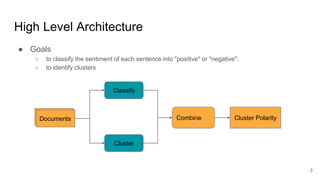
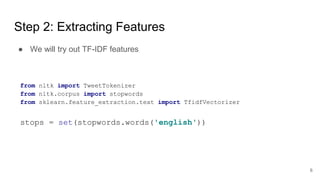
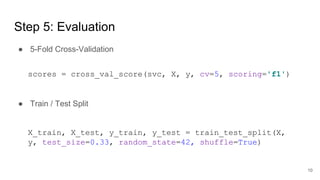
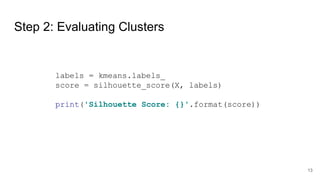
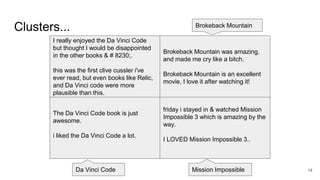
The document outlines a sentiment analysis demonstration focused on classifying sentiment as either 'positive' or 'negative' and identifying clusters using a dataset from Kaggle. It details the required tools, data loading, feature extraction using tf-idf, training a support vector classifier, and evaluation through cross-validation and clustering with K-means. Additionally, it discusses techniques for combining the classification and clustering results.
![Step 1: Loading Dataset
def read_dataset():
with open('../resc/data/training.txt', 'r', encoding='utf-8') as f:
records = list(zip(*[line.split('t') for line in f.readlines()]))
return records[1], records[0]
train_text, train_labels = read_dataset()
5](https://image.slidesharecdn.com/c8keqmu7ts2br7ko2lmj-signature-d3621076d925558bfd32ab9a66a4ca4f1370161b06bde9e79688b9e03786350e-poli-180712120947/85/Twitter-sentiment-analysis-5-320.jpg)


![Step 4: Training the Classifier
● Fix
ValueError: pos_label=1 is not a valid label: array(['0', '1'], dtype='<U1')
le = LabelEncoder()
y = le.fit_transform(train_labels)
svc = LinearSVC()
svc.fit(X_train, y_train)
● Oops!
9](https://image.slidesharecdn.com/c8keqmu7ts2br7ko2lmj-signature-d3621076d925558bfd32ab9a66a4ca4f1370161b06bde9e79688b9e03786350e-poli-180712120947/85/Twitter-sentiment-analysis-9-320.jpg)






![[DSC Europe 25] Nikola Vasiljevic - Player segmentation by combat playstyles ...](https://cdn.slidesharecdn.com/ss_thumbnails/mnvbf0yvrwaqsipzrrv3-2-nikola-vasiljevic-player-segmentation-by-playstyles-in-action-shooter-games-260114111931-b4d766cd-thumbnail.jpg?width=640&height=640&fit=bounds)

![[DSC Europe 25] Dragan Jerosimovic - The Anatomy of a Narrative Simulation.pdf](https://cdn.slidesharecdn.com/ss_thumbnails/vzputuprdqr6zwbrwdcw-1-dragan-jerosimovic-the-anatomy-of-a-narrative-simulation-260114111931-9d04fba2-thumbnail.jpg?width=640&height=640&fit=bounds)


![[DSC Europe 25] Mijat Kustudic - Building Financial Intelligence with AI Agen...](https://cdn.slidesharecdn.com/ss_thumbnails/38y2lb5lse6wstegtvas-3-mijat-kustudic-building-financial-intelligence-with-ai-agents-260114111931-1a4783ce-thumbnail.jpg?width=640&height=640&fit=bounds)
![[DSC Europe 25] Srba Markovic - From Pilot to Production: Overcoming AI Deplo...](https://cdn.slidesharecdn.com/ss_thumbnails/yjjmrtytmwbalxlba7px-4-srba-markovic-from-pilot-to-production-overcoming-ai-deployment-blockers-with-260114111931-4a892d44-thumbnail.jpg?width=640&height=640&fit=bounds)


![[DSC Europe 25] Danilo Djukanovic - From Vibes to KPIs: Turning Culture Into ...](https://cdn.slidesharecdn.com/ss_thumbnails/inqestws5wf0cik2glgv-3-danilo-djukanovic-from-vibes-to-kpis-presentation-260114111931-dacff81f-thumbnail.jpg?width=640&height=640&fit=bounds)
![[DSC Europe 25] Elena Menshikova - AI-Powered Operational Excellence: Revolut...](https://cdn.slidesharecdn.com/ss_thumbnails/es6nholbqy3zaao2c2yd-2-elena-menshikova-data-ai-in-decision-making-260115093812-4fba8b38-thumbnail.jpg?width=640&height=640&fit=bounds)

![[DSC Europe 25] Ivan Lukovic & Marija Djukic - From Data to Value: Why Maturi...](https://cdn.slidesharecdn.com/ss_thumbnails/ahrfps8xr6knowwhacxh-1-ivan-marija-dsc-2025-ld-v1-presentation-260115093812-be21adfc-thumbnail.jpg?width=640&height=640&fit=bounds)


