Actors’ behaviour
analysis in a
decentralised
energy system:
Overview of TIMES-Actors-Model
and the German supply sector
Ali Tash
Source: Getty
The 74th Semi-Annual ETSAP workshop, Stuttgart, Germany
• Project “Decentral”
• Motivation
• TIMES-Actors-Model (TAM)
• Model coupling
• Supply sector
• Introduction
• Methodology
• Scenario construction
• Preliminary results
• Discussion
17-Nov-18IER University of Stuttgart 2
Agenda
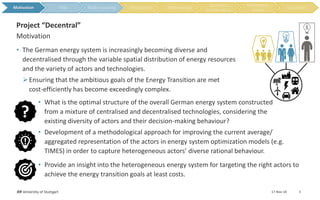
• The German energy system is increasingly becoming diverse and
decentralised through the variable spatial distribution of energy resources
and the variety of actors and technologies.
Ensuring that the ambitious goals of the Energy Transition are met
cost-efficiently has become exceedingly complex.
• What is the optimal structure of the overall German energy system constructed
from a mixture of centralised and decentralised technologies, considering the
existing diversity of actors and their decision-making behaviour?
• Development of a methodological approach for improving the current average/
aggregated representation of the actors in energy system optimization models (e.g.
TIMES) in order to capture heterogeneous actors’ diverse rational behaviour.
• Provide an insight into the heterogeneous energy system for targeting the right actors to
achieve the energy transition goals at least costs.
17-Nov-18IER University of Stuttgart 3
Motivation
Project “Decentral”
?
Motivation
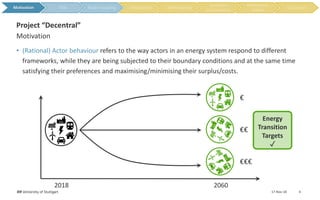
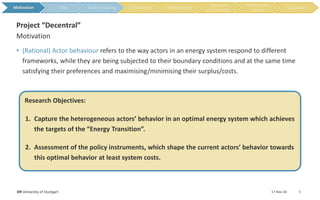
• (Rational) Actor behaviour refers to the way actors in an energy system respond to different
frameworks, while they are being subjected to their boundary conditions and at the same time
satisfying their preferences and maximising/minimising their surplus/costs.
17-Nov-18IER University of Stuttgart 4
Motivation
Project “Decentral”
Motivation
2018 2060
€
€€
€€€
Energy
Transition
Targets
✓
• (Rational) Actor behaviour refers to the way actors in an energy system respond to different
frameworks, while they are being subjected to their boundary conditions and at the same time
satisfying their preferences and maximising/minimising their surplus/costs.
Research Objectives:
1. Capture the heterogeneous actors’ behavior in an optimal energy system which achieves
the targets of the “Energy Transition”.
2. Assessment of the policy instruments, which shape the current actors’ behavior towards
this optimal behavior at least system costs.
17-Nov-18IER University of Stuttgart 5
Motivation
Project “Decentral”
Motivation
17-Nov-18IER University of Stuttgart 6
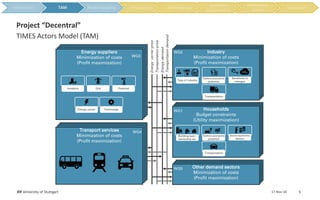
TIMES Actors Model (TAM)
Project “Decentral”
TAM
17-Nov-18IER University of Stuttgart 7
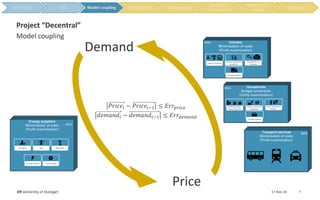
Model coupling
Project “Decentral”
Price
Demand
𝑃𝑟𝑖𝑐𝑒𝑖 − 𝑃𝑟𝑖𝑐𝑒𝑖−1 ≤ 𝐸𝑟𝑟𝑝𝑟𝑖𝑐𝑒
𝑑𝑒𝑚𝑎𝑛𝑑𝑖 − 𝑑𝑒𝑚𝑎𝑛𝑑𝑖−1 ≤ 𝐸𝑟𝑟𝑑𝑒𝑚𝑎𝑛𝑑
Model coupling
• Project “Decentral”
• Motivation
• TIMES-Actors-Model (TAM)
• Model coupling
• Supply sector
• Introduction
• Methodology
• Scenario construction
• Preliminary results
• Discussion
17-Nov-18IER University of Stuttgart 8
Agenda
17-Nov-18IER University of Stuttgart 9
Introduction
Supply sector
76%
24%
"Big 4" utilities
Others
Conventional
generation
capacity
(Total 94 GW)
42%
28%
17%
13%
Citizens
Institutional investors
Utilities
Others
Renewable
generation
capacity
(Total 100 GW)
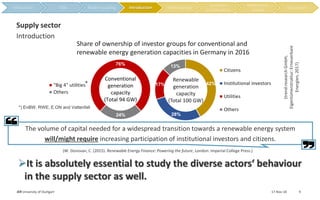
Share of ownership of investor groups for conventional and
renewable energy generation capacities in Germany in 2016
(trend:researchGmbH,
Eigentümerstruktur:Erneuerbare
Energien,2017)
The volume of capital needed for a widespread transition towards a renewable energy system
will/might require increasing participation of institutional investors and citizens.
(W. Donovan, C. (2015). Renewable Energy Finance: Powering the future, London: Imperial College Press.)
It is absolutely essential to study the diverse actors‘ behaviour
in the supply sector as well.
Introduction
*
*) EnBW, RWE, E.ON and Vattenfall
17-Nov-18IER University of Stuttgart 10
Methodology; Actors’ characteristics
Example: Actor’s investment decision-making
Supply sector
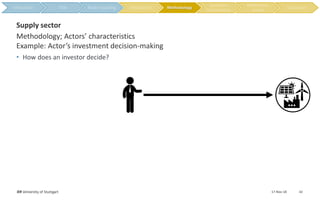
• How does an investor decide?
Methodology
17-Nov-18IER University of Stuttgart 11
Methodology; Actors’ characteristics
Example: Actor’s investment decision-making
Supply sector
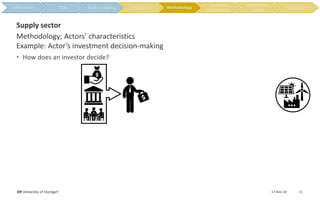
• How does an investor decide?
Methodology
17-Nov-18IER University of Stuttgart 12
Methodology; Actors’ characteristics
Example: Actor’s investment decision-making
Supply sector
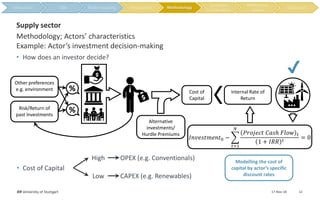
• How does an investor decide?
Internal Rate of
Return
Cost of
Capital
%
%
𝐼𝑛𝑣𝑒𝑠𝑡𝑚𝑒𝑛𝑡0 −
𝑡=1
𝑁
𝑃𝑟𝑜𝑗𝑒𝑐𝑡 𝐶𝑎𝑠ℎ 𝐹𝑙𝑜𝑤 𝑡
1 + 𝐼𝑅𝑅 𝑡
= 0
• Cost of Capital
High
Low
OPEX (e.g. Conventionals)
CAPEX (e.g. Renewables)
Alternative
investments/
Hurdle Premiums
Other preferences
e.g. environment
Risk/Return of
past Investments
✔
Modelling the cost of
capital by actor’s specific
discount rates
Methodology
17-Nov-18IER University of Stuttgart 13
Methodology; Actors’ environment
Example: Energy potentials & Grid
Supply sector
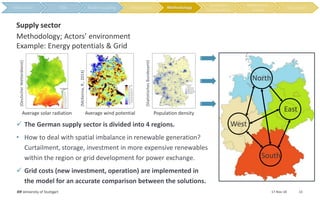
 The German supply sector is divided into 4 regions.
• How to deal with spatial imbalance in renewable generation?
Curtailment, storage, investment in more expensive renewables
within the region or grid development for power exchange.
 Grid costs (new investment, operation) are implemented in
the model for an accurate comparison between the solutions.
Average solar radiation Average wind potential Population density
(DeutscherWetterdienst)
(McKenna,R.,2014)
(StatistischesBundesamt)
Methodology
South
East
North
West
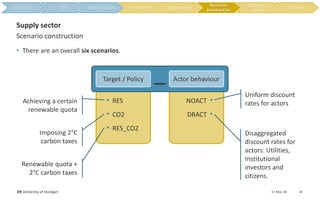
• There are an overall six scenarios.
17-Nov-18IER University of Stuttgart 14
Scenario construction
Supply sector
Target / Policy Actor behaviour
• RES
• CO2
• RES_CO2
•NOACT
•DRACT
Uniform discount
rates for actors
Disaggregated
discount rates for
actors: Utilities,
Institutional
investors and
citizens.
Achieving a certain
renewable quota
Imposing 2°C
carbon taxes
Renewable quota +
2°C carbon taxes
Scenarios
Construction
17-Nov-18IER University of Stuttgart 15
Scenario construction
Supply sector
(Bundesnetzagentur, Monitoringbericht, 2017) & (Coalition agreement, 2018) & (ETP, 2017)
(Steinbach et al., 2015)
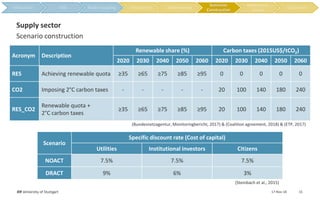
Acronym Description
Renewable share (%) Carbon taxes (2015US$/tCO2)
2020 2030 2040 2050 2060 2020 2030 2040 2050 2060
RES Achieving renewable quota ≥35 ≥65 ≥75 ≥85 ≥95 0 0 0 0 0
CO2 Imposing 2°C carbon taxes - - - - - 20 100 140 180 240
RES_CO2
Renewable quota +
2°C carbon taxes
≥35 ≥65 ≥75 ≥85 ≥95 20 100 140 180 240
Scenario
Specific discount rate (Cost of capital)
Utilities Institutional investors Citizens
NOACT 7.5% 7.5% 7.5%
DRACT 9% 6% 3%
Scenarios
Construction
17-Nov-18IER University of Stuttgart 16
Scenario construction
Supply sector
(trend:research GmbH, Eigentümerstruktur: Erneuerbare Energien, 2017)
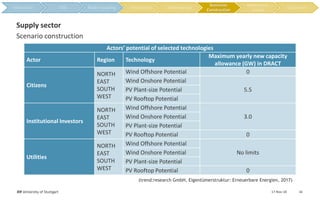
Actors’ potential of selected technologies
Actor Region Technology
Maximum yearly new capacity
allowance (GW) in DRACT
Citizens
NORTH
EAST
SOUTH
WEST
Wind Offshore Potential 0
Wind Onshore Potential
5.5PV Plant-size Potential
PV Rooftop Potential
Institutional Investors
NORTH
EAST
SOUTH
WEST
Wind Offshore Potential
3.0Wind Onshore Potential
PV Plant-size Potential
PV Rooftop Potential 0
Utilities
NORTH
EAST
SOUTH
WEST
Wind Offshore Potential
No limitsWind Onshore Potential
PV Plant-size Potential
PV Rooftop Potential 0
Scenarios
Construction
17-Nov-18IER University of Stuttgart 17
Preliminary results & discussion
Supply sector
Gross electricity generation by different energy carriers
0
100
200
300
400
500
600
Base-Year
RES_DRACT
RES_NOACT
CO2_DRACT
CO2_NOACT
RES_CO2_DRACT
RES_CO2_NOACT
RES_DRACT
RES_NOACT
CO2_DRACT
CO2_NOACT
RES_CO2_DRACT
RES_CO2_NOACT
RES_DRACT
RES_NOACT
CO2_DRACT
CO2_NOACT
RES_CO2_DRACT
RES_CO2_NOACT
RES_DRACT
RES_NOACT
CO2_DRACT
CO2_NOACT
RES_CO2_DRACT
RES_CO2_NOACT
RES_DRACT
RES_NOACT
CO2_DRACT
CO2_NOACT
RES_CO2_DRACT
RES_CO2_NOACT
2013 2020 2030 2040 2050 2060
Generation[TWh]
Hard Coal Hard Coal_CCS Lignite Lignite_CCS Nuclear Oil
Gas Gas_CCS Biomass Biomass_CCS Non-Ren Waste Ren Waste
Hydrogen Geothermal Hydro Wind_On Wind_Off Solar
Preliminary
results
17-Nov-18IER University of Stuttgart 18
Preliminary results
Supply sector
0
50
100
150
200
250
300
350
400
450
500
Base-Year
RES_DRACT
RES_NOACT
CO2_DRACT
CO2_NOACT
RES_CO2_DRACT
RES_CO2_NOACT
RES_DRACT
RES_NOACT
CO2_DRACT
CO2_NOACT
RES_CO2_DRACT
RES_CO2_NOACT
RES_DRACT
RES_NOACT
CO2_DRACT
CO2_NOACT
RES_CO2_DRACT
RES_CO2_NOACT
RES_DRACT
RES_NOACT
CO2_DRACT
CO2_NOACT
RES_CO2_DRACT
RES_CO2_NOACT
RES_DRACT
RES_NOACT
CO2_DRACT
CO2_NOACT
RES_CO2_DRACT
RES_CO2_NOACT
2013 2020 2030 2040 2050 2060
Generation[TWh]
Biomass Biomass_CCS Ren Waste Geothermal Hydro Wind_On Wind_Off Solar
Gross electricity generation by renewables
Preliminary
results
0
50
100
150
200
250
300
350
Base-Year
RES_DRACT
RES_NOACT
CO2_DRACT
CO2_NOACT
RES_CO2_DRACT
RES_CO2_NOACT
RES_DRACT
RES_NOACT
CO2_DRACT
CO2_NOACT
RES_CO2_DRACT
RES_CO2_NOACT
RES_DRACT
RES_NOACT
CO2_DRACT
CO2_NOACT
RES_CO2_DRACT
RES_CO2_NOACT
RES_DRACT
RES_NOACT
CO2_DRACT
CO2_NOACT
RES_CO2_DRACT
RES_CO2_NOACT
RES_DRACT
RES_NOACT
CO2_DRACT
CO2_NOACT
RES_CO2_DRACT
RES_CO2_NOACT
2013 2020 2030 2040 2050 2060
Emission[1000kt]
17-Nov-18IER University of Stuttgart 19
Preliminary results & discussion
Supply sector
Yearly CO2 emissions
Preliminary
results
WEST
SOUTH
EAST
NORTH
0%
20%
40%
60%
80%
100%
120%
140%
160%
Base-Year
RES_DRACT
RES_NOACT
CO2_DRACT
CO2_NOACT
RES_CO2_DRACT
RES_CO2_NOACT
RES_DRACT
RES_NOACT
CO2_DRACT
CO2_NOACT
RES_CO2_DRACT
RES_CO2_NOACT
RES_DRACT
RES_NOACT
CO2_DRACT
CO2_NOACT
RES_CO2_DRACT
RES_CO2_NOACT
RES_DRACT
RES_NOACT
CO2_DRACT
CO2_NOACT
RES_CO2_DRACT
RES_CO2_NOACT
RES_DRACT
RES_NOACT
CO2_DRACT
CO2_NOACT
RES_CO2_DRACT
RES_CO2_NOACT
2013 2020 2030 2040 2050 2060
Regions
Share[%]
17-Nov-18IER University of Stuttgart 20
Preliminary results & discussion
Supply sector
Regional share of renewables in gross electricity consumption
Preliminary
results
0
200
400
600
800
1000
1200
1400
1600
1800
2000
RES_DRACT
RES_NOACT
CO2_DRACT
CO2_NOACT
RES_CO2_DRACT
RES_CO2_NOACT
RES_DRACT
RES_NOACT
CO2_DRACT
CO2_NOACT
RES_CO2_DRACT
RES_CO2_NOACT
Export Import
Exchange[TWh]
WEST
SOUTH
EAST
NORTH
17-Nov-18IER University of Stuttgart 21
Preliminary results & discussion
Supply sector
Cumulative (2020 – 2060) net electricity exchange between regions
Preliminary
results
0%
10%
20%
30%
40%
50%
60%
70%
80%
90%
100%
RES_DRACT
CO2_DRACT
RES_CO2_DRACT
RES_DRACT
CO2_DRACT
RES_CO2_DRACT
RES_DRACT
CO2_DRACT
RES_CO2_DRACT
RES_DRACT
CO2_DRACT
RES_CO2_DRACT
NORTH EAST SOUTH WEST
Share[%]
Utilities
Institutional investors
Citizens
17-Nov-18IER University of Stuttgart 22
Preliminary results & discussion
Supply sector
Regional share of actors in the existing renewable capacity of the year 2050
Preliminary
results
• CO2 taxes are effective for reducing emissions from incumbent actors.
• The so-called challengers should be targeted by renewable generation incentives.
• The north of Germany should play a key role by exporting renewable electricity to other regions
especially through investments in more expensive technologies such as wind offshore by actors
with lower cost of capital.
• The more participation of the actors with lower cost of capital, the quicker and the cheaper the
energy system becomes decarbonised.
This can be done by securing the financial landscape of renewable energy investments.
17-Nov-18IER University of Stuttgart 23
Preliminary results & discussion
Supply sector
Discussion
Steinbach, Jan; Staniaszek, Dan (2015): Discount rates in energy system analysis. In Fraunhofer ISI, Building Performance Institute Europe (BPIE): Karlsruhe,
Germany.
trend:research GmbH (2017): Eigentümerstruktur: Erneuerbare Energien. Entwicklung der Akteursvielfalt, Rolle der Energieversorger, Ausblick bis 2020.
trend:research GmbH. Bremen.
Helms, Thorsten; Salm, Sarah; Wüstenhagen, Rolf (2015): Investor-Specific Cost of Capital and Renewable Energy Investment Decisions. Renewable Energy
Finance: Powering the Future. With assistance of Charles W.Donovan. London: Imperial College Press.
García-Gusano, Diego; Espegren, Kari; Lind, Arne; Kirkengen, Martin (2016): The role of the discount rates in energy systems optimisation models. In Renewable
and Sustainable Energy Reviews 59, pp. 56–72. DOI: 10.1016/j.rser.2015.12.359.
McKenna, R.; Hollnaicher, S.; Fichtner, W. (2014): Cost-potential curves for onshore wind energy: A high-resolution analysis for Germany. In Applied Energy 115,
pp. 103–115. DOI: 10.1016/j.apenergy.2013.10.030.
Fais, Birgit; Blesl, Markus; Fahl, Ulrich; Voß, Alfred (2014): Comparing different support schemes for renewable electricity in the scope of an energy systems
analysis. In Applied Energy 131 (Supplement C), pp. 479–489. DOI: 10.1016/j.apenergy.2014.06.046.
Cayla, Jean-Michel; Maïzi, Nadia (2015): Integrating household behaviour and heterogeneity into the TIMES-Households model. In Applied Energy 139, pp. 56–
67. DOI: 10.1016/j.apenergy.2014.11.015.
Schmid, Eva; Pechan, Anna; Mehnert, Marlene; Eisenack, Klaus (2017): Imagine all these futures. On heterogeneous preferences and mental models in the
German energy transition. In Energy Research & Social Science 27, pp. 45–56. DOI: 10.1016/j.erss.2017.02.012.
Loulou, Richard; Remme, Uwe; Kanudia, Amit; Lehtila, Antti; Goldstein, Gary (2016): Documentation for the TIMES Model Part I. In Energy technology systems
analysis programme (ETSAP).
Lilliestam, Johan; Hanger, Susanne (2016): Shades of green. Centralisation, decentralisation and controversy among European renewable electricity visions. In
Energy Research & Social Science 17, pp. 20–29. DOI: 10.1016/j.erss.2016.03.011.
Bundesnetzagentur, Bundeskartellamt (2017): Monitoringbericht, Monitoringbericht gemäß § 63 Abs. 3 i 35.
Agency, International Energy (2017): Energy Technology Perspectives 2017. Available online at https://www.oecd-ilibrary.org/content/publication/energy_tech-
2017-en.
17-Nov-18IER University of Stuttgart 24
References
e-mail
phone +49 (0) 711 685-
fax +49 (0) 711 685-
Universität Stuttgart
Thank you!
IER Institute for Energy Economics
and Rational Energy Use
Ali Tash
87500
87873
Institute of Energy Economics and Rational Energy Use (IER)
Department of Energy Economics and Social Analysis (ESA)
Heßbrühlstraße 49a, 70565 Stuttgart
ali.tash@ier.uni-stuttgart.de

Actors’ behaviour analysis in a decentralised energy system: Overview of TIMES-Actors Model and the German supply sector

  • 1.
    Actors’ behaviour analysis ina decentralised energy system: Overview of TIMES-Actors-Model and the German supply sector Ali Tash Source: Getty The 74th Semi-Annual ETSAP workshop, Stuttgart, Germany
  • 2.
    • Project “Decentral” •Motivation • TIMES-Actors-Model (TAM) • Model coupling • Supply sector • Introduction • Methodology • Scenario construction • Preliminary results • Discussion 17-Nov-18IER University of Stuttgart 2 Agenda
  • 3.
    • The Germanenergy system is increasingly becoming diverse and decentralised through the variable spatial distribution of energy resources and the variety of actors and technologies. Ensuring that the ambitious goals of the Energy Transition are met cost-efficiently has become exceedingly complex. • What is the optimal structure of the overall German energy system constructed from a mixture of centralised and decentralised technologies, considering the existing diversity of actors and their decision-making behaviour? • Development of a methodological approach for improving the current average/ aggregated representation of the actors in energy system optimization models (e.g. TIMES) in order to capture heterogeneous actors’ diverse rational behaviour. • Provide an insight into the heterogeneous energy system for targeting the right actors to achieve the energy transition goals at least costs. 17-Nov-18IER University of Stuttgart 3 Motivation Project “Decentral” ? Motivation
  • 4.
    • (Rational) Actorbehaviour refers to the way actors in an energy system respond to different frameworks, while they are being subjected to their boundary conditions and at the same time satisfying their preferences and maximising/minimising their surplus/costs. 17-Nov-18IER University of Stuttgart 4 Motivation Project “Decentral” Motivation 2018 2060 € €€ €€€ Energy Transition Targets ✓
  • 5.
    • (Rational) Actorbehaviour refers to the way actors in an energy system respond to different frameworks, while they are being subjected to their boundary conditions and at the same time satisfying their preferences and maximising/minimising their surplus/costs. Research Objectives: 1. Capture the heterogeneous actors’ behavior in an optimal energy system which achieves the targets of the “Energy Transition”. 2. Assessment of the policy instruments, which shape the current actors’ behavior towards this optimal behavior at least system costs. 17-Nov-18IER University of Stuttgart 5 Motivation Project “Decentral” Motivation
  • 6.
    17-Nov-18IER University ofStuttgart 6 TIMES Actors Model (TAM) Project “Decentral” TAM
  • 7.
    17-Nov-18IER University ofStuttgart 7 Model coupling Project “Decentral” Price Demand 𝑃𝑟𝑖𝑐𝑒𝑖 − 𝑃𝑟𝑖𝑐𝑒𝑖−1 ≤ 𝐸𝑟𝑟𝑝𝑟𝑖𝑐𝑒 𝑑𝑒𝑚𝑎𝑛𝑑𝑖 − 𝑑𝑒𝑚𝑎𝑛𝑑𝑖−1 ≤ 𝐸𝑟𝑟𝑑𝑒𝑚𝑎𝑛𝑑 Model coupling
  • 8.
    • Project “Decentral” •Motivation • TIMES-Actors-Model (TAM) • Model coupling • Supply sector • Introduction • Methodology • Scenario construction • Preliminary results • Discussion 17-Nov-18IER University of Stuttgart 8 Agenda
  • 9.
    17-Nov-18IER University ofStuttgart 9 Introduction Supply sector 76% 24% "Big 4" utilities Others Conventional generation capacity (Total 94 GW) 42% 28% 17% 13% Citizens Institutional investors Utilities Others Renewable generation capacity (Total 100 GW) Share of ownership of investor groups for conventional and renewable energy generation capacities in Germany in 2016 (trend:researchGmbH, Eigentümerstruktur:Erneuerbare Energien,2017) The volume of capital needed for a widespread transition towards a renewable energy system will/might require increasing participation of institutional investors and citizens. (W. Donovan, C. (2015). Renewable Energy Finance: Powering the future, London: Imperial College Press.) It is absolutely essential to study the diverse actors‘ behaviour in the supply sector as well. Introduction * *) EnBW, RWE, E.ON and Vattenfall
  • 10.
    17-Nov-18IER University ofStuttgart 10 Methodology; Actors’ characteristics Example: Actor’s investment decision-making Supply sector • How does an investor decide? Methodology
  • 11.
    17-Nov-18IER University ofStuttgart 11 Methodology; Actors’ characteristics Example: Actor’s investment decision-making Supply sector • How does an investor decide? Methodology
  • 12.
    17-Nov-18IER University ofStuttgart 12 Methodology; Actors’ characteristics Example: Actor’s investment decision-making Supply sector • How does an investor decide? Internal Rate of Return Cost of Capital % % 𝐼𝑛𝑣𝑒𝑠𝑡𝑚𝑒𝑛𝑡0 − 𝑡=1 𝑁 𝑃𝑟𝑜𝑗𝑒𝑐𝑡 𝐶𝑎𝑠ℎ 𝐹𝑙𝑜𝑤 𝑡 1 + 𝐼𝑅𝑅 𝑡 = 0 • Cost of Capital High Low OPEX (e.g. Conventionals) CAPEX (e.g. Renewables) Alternative investments/ Hurdle Premiums Other preferences e.g. environment Risk/Return of past Investments ✔ Modelling the cost of capital by actor’s specific discount rates Methodology
  • 13.
    17-Nov-18IER University ofStuttgart 13 Methodology; Actors’ environment Example: Energy potentials & Grid Supply sector  The German supply sector is divided into 4 regions. • How to deal with spatial imbalance in renewable generation? Curtailment, storage, investment in more expensive renewables within the region or grid development for power exchange.  Grid costs (new investment, operation) are implemented in the model for an accurate comparison between the solutions. Average solar radiation Average wind potential Population density (DeutscherWetterdienst) (McKenna,R.,2014) (StatistischesBundesamt) Methodology South East North West
  • 14.
    • There arean overall six scenarios. 17-Nov-18IER University of Stuttgart 14 Scenario construction Supply sector Target / Policy Actor behaviour • RES • CO2 • RES_CO2 •NOACT •DRACT Uniform discount rates for actors Disaggregated discount rates for actors: Utilities, Institutional investors and citizens. Achieving a certain renewable quota Imposing 2°C carbon taxes Renewable quota + 2°C carbon taxes Scenarios Construction
  • 15.
    17-Nov-18IER University ofStuttgart 15 Scenario construction Supply sector (Bundesnetzagentur, Monitoringbericht, 2017) & (Coalition agreement, 2018) & (ETP, 2017) (Steinbach et al., 2015) Acronym Description Renewable share (%) Carbon taxes (2015US$/tCO2) 2020 2030 2040 2050 2060 2020 2030 2040 2050 2060 RES Achieving renewable quota ≥35 ≥65 ≥75 ≥85 ≥95 0 0 0 0 0 CO2 Imposing 2°C carbon taxes - - - - - 20 100 140 180 240 RES_CO2 Renewable quota + 2°C carbon taxes ≥35 ≥65 ≥75 ≥85 ≥95 20 100 140 180 240 Scenario Specific discount rate (Cost of capital) Utilities Institutional investors Citizens NOACT 7.5% 7.5% 7.5% DRACT 9% 6% 3% Scenarios Construction
  • 16.
    17-Nov-18IER University ofStuttgart 16 Scenario construction Supply sector (trend:research GmbH, Eigentümerstruktur: Erneuerbare Energien, 2017) Actors’ potential of selected technologies Actor Region Technology Maximum yearly new capacity allowance (GW) in DRACT Citizens NORTH EAST SOUTH WEST Wind Offshore Potential 0 Wind Onshore Potential 5.5PV Plant-size Potential PV Rooftop Potential Institutional Investors NORTH EAST SOUTH WEST Wind Offshore Potential 3.0Wind Onshore Potential PV Plant-size Potential PV Rooftop Potential 0 Utilities NORTH EAST SOUTH WEST Wind Offshore Potential No limitsWind Onshore Potential PV Plant-size Potential PV Rooftop Potential 0 Scenarios Construction
  • 17.
    17-Nov-18IER University ofStuttgart 17 Preliminary results & discussion Supply sector Gross electricity generation by different energy carriers 0 100 200 300 400 500 600 Base-Year RES_DRACT RES_NOACT CO2_DRACT CO2_NOACT RES_CO2_DRACT RES_CO2_NOACT RES_DRACT RES_NOACT CO2_DRACT CO2_NOACT RES_CO2_DRACT RES_CO2_NOACT RES_DRACT RES_NOACT CO2_DRACT CO2_NOACT RES_CO2_DRACT RES_CO2_NOACT RES_DRACT RES_NOACT CO2_DRACT CO2_NOACT RES_CO2_DRACT RES_CO2_NOACT RES_DRACT RES_NOACT CO2_DRACT CO2_NOACT RES_CO2_DRACT RES_CO2_NOACT 2013 2020 2030 2040 2050 2060 Generation[TWh] Hard Coal Hard Coal_CCS Lignite Lignite_CCS Nuclear Oil Gas Gas_CCS Biomass Biomass_CCS Non-Ren Waste Ren Waste Hydrogen Geothermal Hydro Wind_On Wind_Off Solar Preliminary results
  • 18.
    17-Nov-18IER University ofStuttgart 18 Preliminary results Supply sector 0 50 100 150 200 250 300 350 400 450 500 Base-Year RES_DRACT RES_NOACT CO2_DRACT CO2_NOACT RES_CO2_DRACT RES_CO2_NOACT RES_DRACT RES_NOACT CO2_DRACT CO2_NOACT RES_CO2_DRACT RES_CO2_NOACT RES_DRACT RES_NOACT CO2_DRACT CO2_NOACT RES_CO2_DRACT RES_CO2_NOACT RES_DRACT RES_NOACT CO2_DRACT CO2_NOACT RES_CO2_DRACT RES_CO2_NOACT RES_DRACT RES_NOACT CO2_DRACT CO2_NOACT RES_CO2_DRACT RES_CO2_NOACT 2013 2020 2030 2040 2050 2060 Generation[TWh] Biomass Biomass_CCS Ren Waste Geothermal Hydro Wind_On Wind_Off Solar Gross electricity generation by renewables Preliminary results
  • 19.
  • 20.
  • 21.
  • 22.
    0% 10% 20% 30% 40% 50% 60% 70% 80% 90% 100% RES_DRACT CO2_DRACT RES_CO2_DRACT RES_DRACT CO2_DRACT RES_CO2_DRACT RES_DRACT CO2_DRACT RES_CO2_DRACT RES_DRACT CO2_DRACT RES_CO2_DRACT NORTH EAST SOUTHWEST Share[%] Utilities Institutional investors Citizens 17-Nov-18IER University of Stuttgart 22 Preliminary results & discussion Supply sector Regional share of actors in the existing renewable capacity of the year 2050 Preliminary results
  • 23.
    • CO2 taxesare effective for reducing emissions from incumbent actors. • The so-called challengers should be targeted by renewable generation incentives. • The north of Germany should play a key role by exporting renewable electricity to other regions especially through investments in more expensive technologies such as wind offshore by actors with lower cost of capital. • The more participation of the actors with lower cost of capital, the quicker and the cheaper the energy system becomes decarbonised. This can be done by securing the financial landscape of renewable energy investments. 17-Nov-18IER University of Stuttgart 23 Preliminary results & discussion Supply sector Discussion
  • 24.
    Steinbach, Jan; Staniaszek,Dan (2015): Discount rates in energy system analysis. In Fraunhofer ISI, Building Performance Institute Europe (BPIE): Karlsruhe, Germany. trend:research GmbH (2017): Eigentümerstruktur: Erneuerbare Energien. Entwicklung der Akteursvielfalt, Rolle der Energieversorger, Ausblick bis 2020. trend:research GmbH. Bremen. Helms, Thorsten; Salm, Sarah; Wüstenhagen, Rolf (2015): Investor-Specific Cost of Capital and Renewable Energy Investment Decisions. Renewable Energy Finance: Powering the Future. With assistance of Charles W.Donovan. London: Imperial College Press. García-Gusano, Diego; Espegren, Kari; Lind, Arne; Kirkengen, Martin (2016): The role of the discount rates in energy systems optimisation models. In Renewable and Sustainable Energy Reviews 59, pp. 56–72. DOI: 10.1016/j.rser.2015.12.359. McKenna, R.; Hollnaicher, S.; Fichtner, W. (2014): Cost-potential curves for onshore wind energy: A high-resolution analysis for Germany. In Applied Energy 115, pp. 103–115. DOI: 10.1016/j.apenergy.2013.10.030. Fais, Birgit; Blesl, Markus; Fahl, Ulrich; Voß, Alfred (2014): Comparing different support schemes for renewable electricity in the scope of an energy systems analysis. In Applied Energy 131 (Supplement C), pp. 479–489. DOI: 10.1016/j.apenergy.2014.06.046. Cayla, Jean-Michel; Maïzi, Nadia (2015): Integrating household behaviour and heterogeneity into the TIMES-Households model. In Applied Energy 139, pp. 56– 67. DOI: 10.1016/j.apenergy.2014.11.015. Schmid, Eva; Pechan, Anna; Mehnert, Marlene; Eisenack, Klaus (2017): Imagine all these futures. On heterogeneous preferences and mental models in the German energy transition. In Energy Research & Social Science 27, pp. 45–56. DOI: 10.1016/j.erss.2017.02.012. Loulou, Richard; Remme, Uwe; Kanudia, Amit; Lehtila, Antti; Goldstein, Gary (2016): Documentation for the TIMES Model Part I. In Energy technology systems analysis programme (ETSAP). Lilliestam, Johan; Hanger, Susanne (2016): Shades of green. Centralisation, decentralisation and controversy among European renewable electricity visions. In Energy Research & Social Science 17, pp. 20–29. DOI: 10.1016/j.erss.2016.03.011. Bundesnetzagentur, Bundeskartellamt (2017): Monitoringbericht, Monitoringbericht gemäß § 63 Abs. 3 i 35. Agency, International Energy (2017): Energy Technology Perspectives 2017. Available online at https://www.oecd-ilibrary.org/content/publication/energy_tech- 2017-en. 17-Nov-18IER University of Stuttgart 24 References
  • 25.
    e-mail phone +49 (0)711 685- fax +49 (0) 711 685- Universität Stuttgart Thank you! IER Institute for Energy Economics and Rational Energy Use Ali Tash 87500 87873 Institute of Energy Economics and Rational Energy Use (IER) Department of Energy Economics and Social Analysis (ESA) Heßbrühlstraße 49a, 70565 Stuttgart ali.tash@ier.uni-stuttgart.de