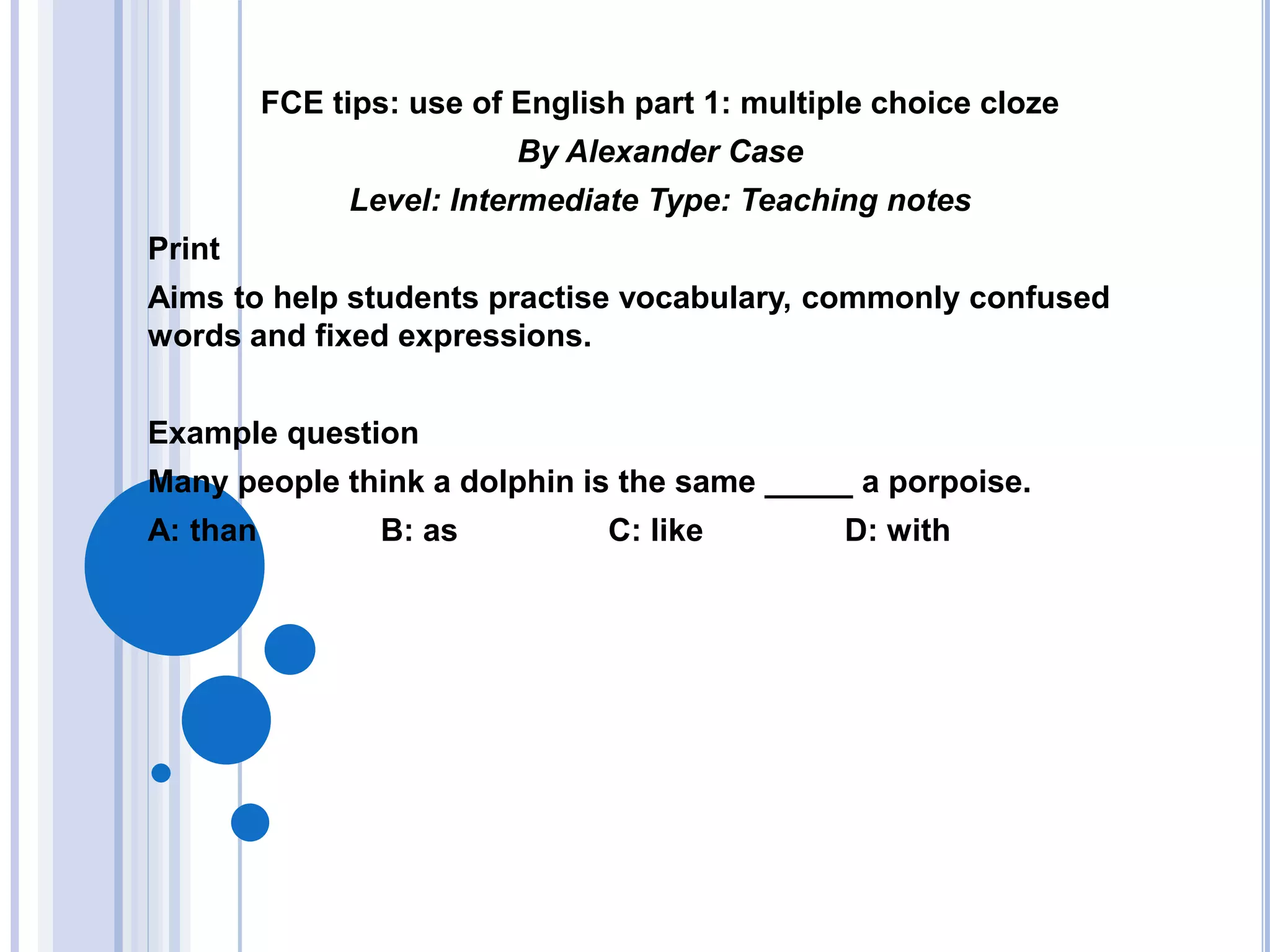
FCE tips: use of English part 1: multiple choice cloze
By Alexander Case
Level: Intermediate Type: Teaching notes
Print
Aims to help students practise vocabulary, commonly confused
words and fixed expressions.
Example question
Many people think a dolphin is the same _____ a porpoise.
A: than B: as C: like D: with
 Tip 1
The students will have to read a text and answer 12
questions like the one above. As in any part of the
FCE, students should read the whole text through
quickly first before even looking at the questions.
Lack of time is rarely an issue in the FCE.
 Tip 2
This part of the paper is a test of vocabulary rather
than grammar. Part 2, open cloze is the closest to
an equivalent test of grammar. The areas that often
come up in part 1 are collocations (e.g. take part),
commonly confused words (e.g. make and do) and
fixed expressions. Class time is probably most
usefully spent on dependant prepositions and/ or
commonly confused verbs, although it is of
course relatively easier to predict what grammar will
come up in other parts of the paper than it is to
predict which dependent prepositions will come up
here.
 Tip 3
A nice activity for dependent prepositions or make/
do is SNAP. (The card game: players take turns to
place a card on the pile and shout out SNAP when
there are two cards which are the same - the first
person to shout SNAP gets the cards) With the
TEFL version the cards have the nouns etc. that go
with the verbs or prepositions, and students try to
remember what they go with and shout out when
they think they are the same. E.g. if the cards say
'’breakfast” and “a mess” they can shout out SNAP
as they both go with make.
 Tip 4
If students have a feeling that one ‘sounds right’,
they should go for it. They can always analyze why
it might or might not be right afterwards. They
should only change an answer if they are 100%
sure it is wrong. It is far more common to change a
right answer than to change a wrong one.
 Tip 5
If students really have no idea which is the correct
answer, they should start by deleting the ones that
they are sure are not correct. They can then guess
between those that are left. As always, no marks
are lost for wrong guesses. You can practise the
skill of narrowing down the possibilities by asking
students not only ‘which is it?’, but also
‘which isn’t it?’, especially when there are different
opinions as to which is the correct answer.
 Tip 6
You can lead students into the part 1 task gently by
giving them an exam task with the right answers
already selected and ask them why the other ones
are wrong.
TAKEN FROM:
 http://www.onestopenglish.com/exams/cambridge-
esol-exams/fce/fce-tips/fce-tips-use-of-english-part-
1-multiple-choice-cloze/144714.article

Activity-fighting

  • 1.
    FCE tips: useof English part 1: multiple choice cloze By Alexander Case Level: Intermediate Type: Teaching notes Print Aims to help students practise vocabulary, commonly confused words and fixed expressions. Example question Many people think a dolphin is the same _____ a porpoise. A: than B: as C: like D: with
  • 2.
     Tip 1 Thestudents will have to read a text and answer 12 questions like the one above. As in any part of the FCE, students should read the whole text through quickly first before even looking at the questions. Lack of time is rarely an issue in the FCE.
  • 3.
     Tip 2 Thispart of the paper is a test of vocabulary rather than grammar. Part 2, open cloze is the closest to an equivalent test of grammar. The areas that often come up in part 1 are collocations (e.g. take part), commonly confused words (e.g. make and do) and fixed expressions. Class time is probably most usefully spent on dependant prepositions and/ or commonly confused verbs, although it is of course relatively easier to predict what grammar will come up in other parts of the paper than it is to predict which dependent prepositions will come up here.
  • 4.
     Tip 3 Anice activity for dependent prepositions or make/ do is SNAP. (The card game: players take turns to place a card on the pile and shout out SNAP when there are two cards which are the same - the first person to shout SNAP gets the cards) With the TEFL version the cards have the nouns etc. that go with the verbs or prepositions, and students try to remember what they go with and shout out when they think they are the same. E.g. if the cards say '’breakfast” and “a mess” they can shout out SNAP as they both go with make.
  • 5.
     Tip 4 Ifstudents have a feeling that one ‘sounds right’, they should go for it. They can always analyze why it might or might not be right afterwards. They should only change an answer if they are 100% sure it is wrong. It is far more common to change a right answer than to change a wrong one.
  • 6.
     Tip 5 Ifstudents really have no idea which is the correct answer, they should start by deleting the ones that they are sure are not correct. They can then guess between those that are left. As always, no marks are lost for wrong guesses. You can practise the skill of narrowing down the possibilities by asking students not only ‘which is it?’, but also ‘which isn’t it?’, especially when there are different opinions as to which is the correct answer.
  • 7.
     Tip 6 Youcan lead students into the part 1 task gently by giving them an exam task with the right answers already selected and ask them why the other ones are wrong.
  • 8.