Faculty Development Program
On
27.07.2024
Answer these questions
•What is the best part in being an English Teacher?
•Name the English Movie/series you watched recently.
•How many new vocabularies have you learnt in the last two months?
•How do you want yourself to be remembered by your students?
•What do you hope to receive from this session?
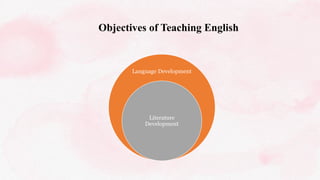
Objectives of Teaching English
Language Development
Literature
Development
1. To understand Spoken Language (Listening)
2. To speak the Language (Speaking)
3. To read the language (Reading)
4. To write the language (Writing)
Objectives of Learning English at Junior & Senior Level
Literary Objective
1. Developing a taste for English Literature
through Poems, Prose, Drama, Story etc.
2. Drawing Aesthetic pleasure.
3. Understanding critical views.
4. Development of translating abilities.
Challenges in Teaching English
Generic challenges
• Mother tongue interference.
• Inadequate training in English language teaching methodologies.
• Large class sizes.
• Limited resources: Insufficient teaching materials and technology.
• Limited parental involvement.
• Language reduced to subject.
Specific challenges
• Shyness and fear of making mistakes.
• Low Self-esteem.
• Complex grammar rules.
• Diverse vocabulary.
• Pronunciation difficulties.
Who are the three types of Learners?
VAK
 VISUAL
 AUDITORY
 KINESTHETIC
1. Visual Learners
•Learn best by seeing information.
•Prefer images, diagrams, charts, graphs, and demonstrations.
•May enjoy activities like drawing, coloring, or using mind maps.
2. Auditory Learners
•Learn best by hearing information.
•Prefer lectures, discussions, music, and spoken words.
•May enjoy activities like listening to audiobooks, participating in group
discussions, or reciting information aloud.
3. Kinesthetic Learners
•Learn best by doing and experiencing.
•Prefer hands-on activities and experiments.
•May enjoy activities like building, playing games, or
moving around while learning.
Weave a story by looking at the picture.
Let’s listen to an Audio
Create Quiz in a
minute
Add slides with a
classic layout
Import questions
from a spreadsheet
KAHOOT PLAY
What are some of the methods of teaching English?
Here are some tips of teaching English
Creating an Engaging Learning Environment
 Make it fun:
Incorporate games
role-plays and
songs to make learning enjoyable.
 Foster a supportive atmosphere:
Encourage students to make mistakes without fear of judgment.
 Use real-life context:
Connect language learning to real-world situations.
Effective Teaching Strategies
 Focus on communication: Prioritize speaking and listening skills.
 Balance the four skills: Give equal attention to reading, writing,
speaking, and listening.
 Use authentic materials: Employ newspapers, magazines, and online
resources.
 Differentiate instruction: Cater to different learning styles and abilities.
 Provide ample practice opportunities: Encourage students to use
English regularly.
 Give constructive feedback: Offer specific and actionable feedback on
students’ work.
A glimpse of the book
 Lesson
 Comprehension Skills
 Vocabulary Skills
 Listening & Speaking Skills
 Writing Skills
 Grammar
• Warm-up sets the tone of the lesson and get students to begin
thinking and focusing on English.
• It may have been a few days, a week, or even longer since they last
used English.
• A little time spent by doing a warm-up activity will improve interest
later.
• They also provide a transition into the topic.
• Incorporating fun and interactive activities, can help students
develop their English language skills while enjoying the learning
process.
Purpose of Warm-ups
•Keep them short and engaging.
•Vary the activities to maintain interest.
•Involve all students in participation.
•Relate warm-ups to the day's lesson whenever possible.
•Use props or visual aids to enhance learning.
Tips for Effective Warm-ups:
Refer to ‘the big winner’
from 5th
Course book Term 2. Page 40
Teaching of Prose
Find out…
•Who is the speaker?
•What is the situation?
•What types of sentences are used?
•Do the types of sentences reveal anything about the characters’ emotions?
•Is there any shift in the tone of the characters or situation in the story?
•How does the syntax help you to infer the gist?
Teaching of Prose
 Pre-reading activities to spark interest and activate prior knowledge.
(Motivation)
 Read the prose aloud with expression to bring the story to life and help students
understand the context and emotions.
 Use visual aids, role-playing, and storytelling games to make understanding
prose engaging and fun.
 Encourage students to talk about the story, ask questions, and share their
thoughts to deepen comprehension.
 Use pictures, story maps, and diagrams to help students visualize the story’s
elements and structure.
How can we teach?
Refer to ‘Rules’ poem pg.47 in Class 5 Term 1 Course Book
Governments rule most countries,
Bankers rule most banks,
Captains rule their football teams
And piranhas rule fish tanks.
There are rules for gnobling gnomes
And rules for frying frogs,
There are rules for biting bullies
And for vexing vicious dogs.
There are rules for driving motor cars
And crashing into chums,
There are rules for taking off your pants
And showing spotty bums.
There are rules for nasty children
Who tie bangers to old cats,
There are rules for running riots
And rules for burning bats.
There are rules in the classroom.
There are rules in the street.
Some rules are wild and woolly
And some are tame and neat.
And some are pretty sensible
And some are pretty daft;
Some I take quite seriously,
At others I have laughed,
But there is one special rule
You should not be without:
If you do not like the rules
OPEN YOUR MOUTH AND SHOUT!
Rules
Teaching of Poetry
Read the poem aloud.
Identify and define the difficult words.
Read the poem aloud again.
Visualize and illustrate
Memorization and recitation
Perform and celebrate poetry
How to remember the parts of Speech quite easily?
NOUN
VERB
ADJECTIVE
PRONOUN
ADVERB
PREPOSITION
CONJUCTION
INTERJECTION
N
V
A
P
A
P
C
I
What are the Eight Parts of Speech?
Group Activity (Noun)
Pronoun! Pronoun! Is instead of a NOUN.
In Singular
I, You, He, She, It are called Subjective Pronoun!
Me, You, Him, Her, It are Objective Pronoun!
Mine, Yours, His, Hers, Its are Possessive
Pronouns!
Pronoun! Pronoun! Is instead of a NOUN.
In Plural,
We, You, They are called Subjective Pronoun!
Us, You, Them are Objective Pronoun!
Our, Yours, Theirs are Possessive Pronouns!
Pronoun! Pronoun! Is instead of a NOUN.
A Song to remember the Pronouns
What are the people in the picture doing?
• Dedicated
• Curious
• Persistent
• Resilient
• Disciplined
• Practical
• Ambitious
• Tenacious
• Resourceful
• Organized
• Bold
• Open-minded
• Respectful
• Cooperative
• Self-motivated
• Adaptable
• Reliable
• Loyal
• Inspiring
• Hard-working
• Proactive
• Attentive
• Thorough
• Responsible
• Insightful
• Engaging
• Committed
• Focused
• Punctual
• Reflective
DESCRIBE YOURSELF
Grammar Family
There is a family in London whose surname is Grammar. Mr.Noun and
Mrs.Verb are young couples. The couple have three children: a son – Pronoun
and two daughter – Adjective and Adverb. The son has to do all the work of his
father in his absence. The two daughters seem to be alike but there is a slight
difference between them. Adjective likes her father and her brother and keeps on
praising them. Whereas Adverb loves her mother and always praises her.
Preposition and Conjunction are their servants. Preposition is the official
servant of his master. Conjunction is the home servant and he helps people to
stay connected. Interjection is the family friend who joins during times of
happiness and sorrow.
• Grammar can be taught in a fun way.
• From simple to complex.
• From examples to rules.
• Using visual aids.
• Involving them in fun games and activities.
• Motivating them to solve more exercise.
• Positive reinforcement.
Break the myth in learning and teaching grammar by
using some of the techniques given here
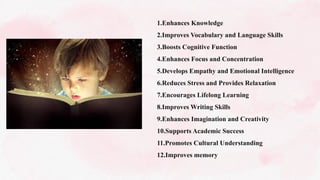
1.Enhances Knowledge
2.Improves Vocabulary and Language Skills
3.Boosts Cognitive Function
4.Enhances Focus and Concentration
5.Develops Empathy and Emotional Intelligence
6.Reduces Stress and Provides Relaxation
7.Encourages Lifelong Learning
8.Improves Writing Skills
9.Enhances Imagination and Creativity
10.Supports Academic Success
11.Promotes Cultural Understanding
12.Improves memory
கற்க கசடறக் கற்பவை கற்றபின்
நிற்க அதற்குத் தக.
Thank You

27.07.2024.faculty development program.pptx

  • 1.
  • 4.
    Answer these questions •Whatis the best part in being an English Teacher? •Name the English Movie/series you watched recently. •How many new vocabularies have you learnt in the last two months? •How do you want yourself to be remembered by your students? •What do you hope to receive from this session?
  • 5.
    Objectives of TeachingEnglish Language Development Literature Development
  • 6.
    1. To understandSpoken Language (Listening) 2. To speak the Language (Speaking) 3. To read the language (Reading) 4. To write the language (Writing) Objectives of Learning English at Junior & Senior Level
  • 7.
    Literary Objective 1. Developinga taste for English Literature through Poems, Prose, Drama, Story etc. 2. Drawing Aesthetic pleasure. 3. Understanding critical views. 4. Development of translating abilities.
  • 8.
    Challenges in TeachingEnglish Generic challenges • Mother tongue interference. • Inadequate training in English language teaching methodologies. • Large class sizes. • Limited resources: Insufficient teaching materials and technology. • Limited parental involvement. • Language reduced to subject.
  • 9.
    Specific challenges • Shynessand fear of making mistakes. • Low Self-esteem. • Complex grammar rules. • Diverse vocabulary. • Pronunciation difficulties.
  • 10.
    Who are thethree types of Learners?
  • 11.
  • 12.
    1. Visual Learners •Learnbest by seeing information. •Prefer images, diagrams, charts, graphs, and demonstrations. •May enjoy activities like drawing, coloring, or using mind maps.
  • 13.
    2. Auditory Learners •Learnbest by hearing information. •Prefer lectures, discussions, music, and spoken words. •May enjoy activities like listening to audiobooks, participating in group discussions, or reciting information aloud.
  • 14.
    3. Kinesthetic Learners •Learnbest by doing and experiencing. •Prefer hands-on activities and experiments. •May enjoy activities like building, playing games, or moving around while learning.
  • 15.
    Weave a storyby looking at the picture.
  • 16.
  • 17.
    Create Quiz ina minute Add slides with a classic layout Import questions from a spreadsheet KAHOOT PLAY
  • 18.
    What are someof the methods of teaching English?
  • 19.
    Here are sometips of teaching English Creating an Engaging Learning Environment  Make it fun: Incorporate games role-plays and songs to make learning enjoyable.  Foster a supportive atmosphere: Encourage students to make mistakes without fear of judgment.  Use real-life context: Connect language learning to real-world situations.
  • 20.
    Effective Teaching Strategies Focus on communication: Prioritize speaking and listening skills.  Balance the four skills: Give equal attention to reading, writing, speaking, and listening.  Use authentic materials: Employ newspapers, magazines, and online resources.  Differentiate instruction: Cater to different learning styles and abilities.  Provide ample practice opportunities: Encourage students to use English regularly.  Give constructive feedback: Offer specific and actionable feedback on students’ work.
  • 21.
    A glimpse ofthe book  Lesson  Comprehension Skills  Vocabulary Skills  Listening & Speaking Skills  Writing Skills  Grammar
  • 22.
    • Warm-up setsthe tone of the lesson and get students to begin thinking and focusing on English. • It may have been a few days, a week, or even longer since they last used English. • A little time spent by doing a warm-up activity will improve interest later. • They also provide a transition into the topic. • Incorporating fun and interactive activities, can help students develop their English language skills while enjoying the learning process. Purpose of Warm-ups
  • 23.
    •Keep them shortand engaging. •Vary the activities to maintain interest. •Involve all students in participation. •Relate warm-ups to the day's lesson whenever possible. •Use props or visual aids to enhance learning. Tips for Effective Warm-ups:
  • 24.
    Refer to ‘thebig winner’ from 5th Course book Term 2. Page 40 Teaching of Prose
  • 25.
    Find out… •Who isthe speaker? •What is the situation? •What types of sentences are used? •Do the types of sentences reveal anything about the characters’ emotions? •Is there any shift in the tone of the characters or situation in the story? •How does the syntax help you to infer the gist? Teaching of Prose
  • 26.
     Pre-reading activitiesto spark interest and activate prior knowledge. (Motivation)  Read the prose aloud with expression to bring the story to life and help students understand the context and emotions.  Use visual aids, role-playing, and storytelling games to make understanding prose engaging and fun.  Encourage students to talk about the story, ask questions, and share their thoughts to deepen comprehension.  Use pictures, story maps, and diagrams to help students visualize the story’s elements and structure. How can we teach?
  • 27.
    Refer to ‘Rules’poem pg.47 in Class 5 Term 1 Course Book
  • 28.
    Governments rule mostcountries, Bankers rule most banks, Captains rule their football teams And piranhas rule fish tanks. There are rules for gnobling gnomes And rules for frying frogs, There are rules for biting bullies And for vexing vicious dogs. There are rules for driving motor cars And crashing into chums, There are rules for taking off your pants And showing spotty bums. There are rules for nasty children Who tie bangers to old cats, There are rules for running riots And rules for burning bats. There are rules in the classroom. There are rules in the street. Some rules are wild and woolly And some are tame and neat. And some are pretty sensible And some are pretty daft; Some I take quite seriously, At others I have laughed, But there is one special rule You should not be without: If you do not like the rules OPEN YOUR MOUTH AND SHOUT! OPEN YOUR MOUTH AND SHOUT! Rules
  • 29.
    Teaching of Poetry Readthe poem aloud. Identify and define the difficult words. Read the poem aloud again. Visualize and illustrate Memorization and recitation Perform and celebrate poetry
  • 30.
    How to rememberthe parts of Speech quite easily?
  • 31.
  • 32.
  • 33.
    Pronoun! Pronoun! Isinstead of a NOUN. In Singular I, You, He, She, It are called Subjective Pronoun! Me, You, Him, Her, It are Objective Pronoun! Mine, Yours, His, Hers, Its are Possessive Pronouns! Pronoun! Pronoun! Is instead of a NOUN. In Plural, We, You, They are called Subjective Pronoun! Us, You, Them are Objective Pronoun! Our, Yours, Theirs are Possessive Pronouns! Pronoun! Pronoun! Is instead of a NOUN. A Song to remember the Pronouns
  • 34.
    What are thepeople in the picture doing?
  • 35.
    • Dedicated • Curious •Persistent • Resilient • Disciplined • Practical • Ambitious • Tenacious • Resourceful • Organized • Bold • Open-minded • Respectful • Cooperative • Self-motivated • Adaptable • Reliable • Loyal • Inspiring • Hard-working • Proactive • Attentive • Thorough • Responsible • Insightful • Engaging • Committed • Focused • Punctual • Reflective DESCRIBE YOURSELF
  • 36.
    Grammar Family There isa family in London whose surname is Grammar. Mr.Noun and Mrs.Verb are young couples. The couple have three children: a son – Pronoun and two daughter – Adjective and Adverb. The son has to do all the work of his father in his absence. The two daughters seem to be alike but there is a slight difference between them. Adjective likes her father and her brother and keeps on praising them. Whereas Adverb loves her mother and always praises her. Preposition and Conjunction are their servants. Preposition is the official servant of his master. Conjunction is the home servant and he helps people to stay connected. Interjection is the family friend who joins during times of happiness and sorrow.
  • 38.
    • Grammar canbe taught in a fun way. • From simple to complex. • From examples to rules. • Using visual aids. • Involving them in fun games and activities. • Motivating them to solve more exercise. • Positive reinforcement. Break the myth in learning and teaching grammar by using some of the techniques given here
  • 40.
    1.Enhances Knowledge 2.Improves Vocabularyand Language Skills 3.Boosts Cognitive Function 4.Enhances Focus and Concentration 5.Develops Empathy and Emotional Intelligence 6.Reduces Stress and Provides Relaxation 7.Encourages Lifelong Learning 8.Improves Writing Skills 9.Enhances Imagination and Creativity 10.Supports Academic Success 11.Promotes Cultural Understanding 12.Improves memory
  • 42.
    கற்க கசடறக் கற்பவைகற்றபின் நிற்க அதற்குத் தக.
  • 43.