Payo, Whenan Faith O. BSED English I-A
Lesson 3: Language of Mathematics
What symbol can you associate with the following words?
PLUS
+
DECREASE
-
DOUBLE
{[(۰)]}
DISTRIBUTE
{[(۰)]}
IS
=
MINUS
-
DIFFERENCE
-
PRODUCT
{[(۰)]}
INCREASE
+
DIVIDE
÷, /
TAKE AWAY
-
TOTAL
=
QUOTIENT
÷, /
MORE
+
SPLIT INTO
÷, /
Guide questions:
1. What symbols are used in the above activity?
The symbols used in the given activity were basic mathematical (symbols) operations. This
includes Addition (+), Subtraction (-), Multiplication (x) and Division (÷).
2. How important are these symbols in the study of mathematics?
Mathematical operations are very essential since it help us acquire better problem-solving skills.
This would also be the first basic thing we need to help solve as we go on through in learning
more about mathematics. Also, this would assist us understand the language of mathematics
and describe its relationship to the elements, structure etc.
Translate the following phrases to mathematical symbols.
1.) the sum of m and 7
m + 7
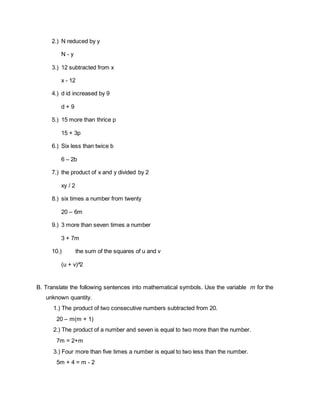
2.) N reduced by y
N - y
3.) 12 subtracted from x
x - 12
4.) d id increased by 9
d + 9
5.) 15 more than thrice p
15 + 3p
6.) Six less than twice b
6 – 2b
7.) the product of x and y divided by 2
xy / 2
8.) six times a number from twenty
20 – 6m
9.) 3 more than seven times a number
3 + 7m
10.) the sum of the squares of u and v
(u + v)^2
B. Translate the following sentences into mathematical symbols. Use the variable m for the
unknown quantity.
1.) The product of two consecutive numbers subtracted from 20.
20 – m(m + 1)
2.) The product of a number and seven is equal to two more than the number.
7m = 2+m
3.) Four more than five times a number is equal to two less than the number.
5m + 4 = m - 2
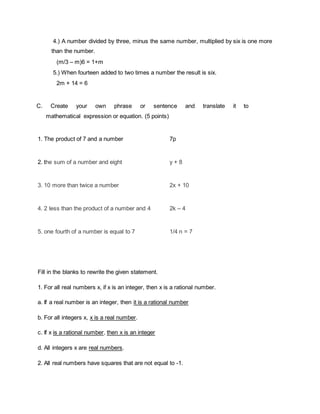
4.) A number divided by three, minus the same number, multiplied by six is one more
than the number.
(m/3 – m)6 = 1+m
5.) When fourteen added to two times a number the result is six.
2m + 14 = 6
C. Create your own phrase or sentence and translate it to
mathematical expression or equation. (5 points)
1. The product of 7 and a number 7p
2. the sum of a number and eight y + 8
3. 10 more than twice a number 2x + 10
4. 2 less than the product of a number and 4 2k – 4
5. one fourth of a number is equal to 7 1/4 n = 7
Fill in the blanks to rewrite the given statement.
1. For all real numbers x, if x is an integer, then x is a rational number.
a. If a real number is an integer, then it is a rational number
b. For all integers x, x is a real number.
c. If x is a rational number, then x is an integer
d. All integers x are real numbers.
2. All real numbers have squares that are not equal to -1.
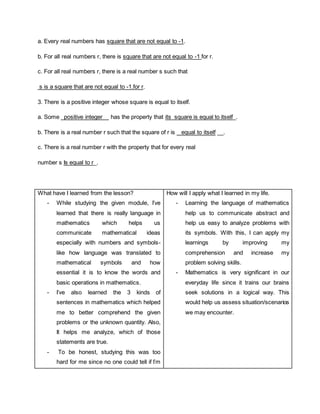
a. Every real numbers has square that are not equal to -1.
b. For all real numbers r, there is square that are not equal to -1 for r.
c. For all real numbers r, there is a real number s such that
s is a square that are not equal to -1.for r.
3. There is a positive integer whose square is equal to itself.
a. Some _positive integer__ has the property that its square is equal to itself_.
b. There is a real number r such that the square of r is _ equal to itself __.
c. There is a real number r with the property that for every real
number s Is equal to r_.
What have I learned from the lesson?
- While studying the given module, I’ve
learned that there is really language in
mathematics which helps us
communicate mathematical ideas
especially with numbers and symbols-
like how language was translated to
mathematical symbols and how
essential it is to know the words and
basic operations in mathematics.
- I’ve also learned the 3 kinds of
sentences in mathematics which helped
me to better comprehend the given
problems or the unknown quantity. Also,
It helps me analyze, which of those
statements are true.
- To be honest, studying this was too
hard for me since no one could tell if I’m
How will I apply what I learned in my life.
- Learning the language of mathematics
help us to communicate abstract and
help us easy to analyze problems with
its symbols. With this, I can apply my
learnings by improving my
comprehension and increase my
problem solving skills.
- Mathematics is very significant in our
everyday life since it trains our brains
seek solutions in a logical way. This
would help us assess situation/scenarios
we may encounter.
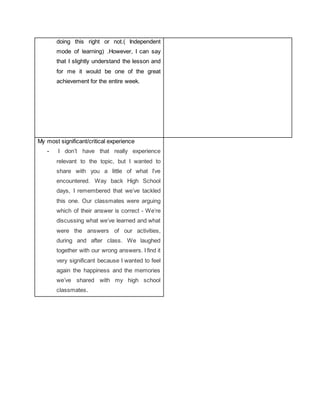
doing this right or not.( Independent
mode of learning) .However, I can say
that I slightly understand the lesson and
for me it would be one of the great
achievement for the entire week.
My most significant/critical experience
- I don’t have that really experience
relevant to the topic, but I wanted to
share with you a little of what I’ve
encountered. Way back High School
days, I remembered that we’ve tackled
this one. Our classmates were arguing
which of their answer is correct - We‘re
discussing what we’ve learned and what
were the answers of our activities,
during and after class. We laughed
together with our wrong answers. I find it
very significant because I wanted to feel
again the happiness and the memories
we’ve shared with my high school
classmates.

Activity 1.docx

  • 1.
    Payo, Whenan FaithO. BSED English I-A Lesson 3: Language of Mathematics What symbol can you associate with the following words? PLUS + DECREASE - DOUBLE {[(۰)]} DISTRIBUTE {[(۰)]} IS = MINUS - DIFFERENCE - PRODUCT {[(۰)]} INCREASE + DIVIDE ÷, / TAKE AWAY - TOTAL = QUOTIENT ÷, / MORE + SPLIT INTO ÷, / Guide questions: 1. What symbols are used in the above activity? The symbols used in the given activity were basic mathematical (symbols) operations. This includes Addition (+), Subtraction (-), Multiplication (x) and Division (÷). 2. How important are these symbols in the study of mathematics? Mathematical operations are very essential since it help us acquire better problem-solving skills. This would also be the first basic thing we need to help solve as we go on through in learning more about mathematics. Also, this would assist us understand the language of mathematics and describe its relationship to the elements, structure etc. Translate the following phrases to mathematical symbols. 1.) the sum of m and 7 m + 7
  • 2.
    2.) N reducedby y N - y 3.) 12 subtracted from x x - 12 4.) d id increased by 9 d + 9 5.) 15 more than thrice p 15 + 3p 6.) Six less than twice b 6 – 2b 7.) the product of x and y divided by 2 xy / 2 8.) six times a number from twenty 20 – 6m 9.) 3 more than seven times a number 3 + 7m 10.) the sum of the squares of u and v (u + v)^2 B. Translate the following sentences into mathematical symbols. Use the variable m for the unknown quantity. 1.) The product of two consecutive numbers subtracted from 20. 20 – m(m + 1) 2.) The product of a number and seven is equal to two more than the number. 7m = 2+m 3.) Four more than five times a number is equal to two less than the number. 5m + 4 = m - 2
  • 3.
    4.) A numberdivided by three, minus the same number, multiplied by six is one more than the number. (m/3 – m)6 = 1+m 5.) When fourteen added to two times a number the result is six. 2m + 14 = 6 C. Create your own phrase or sentence and translate it to mathematical expression or equation. (5 points) 1. The product of 7 and a number 7p 2. the sum of a number and eight y + 8 3. 10 more than twice a number 2x + 10 4. 2 less than the product of a number and 4 2k – 4 5. one fourth of a number is equal to 7 1/4 n = 7 Fill in the blanks to rewrite the given statement. 1. For all real numbers x, if x is an integer, then x is a rational number. a. If a real number is an integer, then it is a rational number b. For all integers x, x is a real number. c. If x is a rational number, then x is an integer d. All integers x are real numbers. 2. All real numbers have squares that are not equal to -1.
  • 4.
    a. Every realnumbers has square that are not equal to -1. b. For all real numbers r, there is square that are not equal to -1 for r. c. For all real numbers r, there is a real number s such that s is a square that are not equal to -1.for r. 3. There is a positive integer whose square is equal to itself. a. Some _positive integer__ has the property that its square is equal to itself_. b. There is a real number r such that the square of r is _ equal to itself __. c. There is a real number r with the property that for every real number s Is equal to r_. What have I learned from the lesson? - While studying the given module, I’ve learned that there is really language in mathematics which helps us communicate mathematical ideas especially with numbers and symbols- like how language was translated to mathematical symbols and how essential it is to know the words and basic operations in mathematics. - I’ve also learned the 3 kinds of sentences in mathematics which helped me to better comprehend the given problems or the unknown quantity. Also, It helps me analyze, which of those statements are true. - To be honest, studying this was too hard for me since no one could tell if I’m How will I apply what I learned in my life. - Learning the language of mathematics help us to communicate abstract and help us easy to analyze problems with its symbols. With this, I can apply my learnings by improving my comprehension and increase my problem solving skills. - Mathematics is very significant in our everyday life since it trains our brains seek solutions in a logical way. This would help us assess situation/scenarios we may encounter.
  • 5.
    doing this rightor not.( Independent mode of learning) .However, I can say that I slightly understand the lesson and for me it would be one of the great achievement for the entire week. My most significant/critical experience - I don’t have that really experience relevant to the topic, but I wanted to share with you a little of what I’ve encountered. Way back High School days, I remembered that we’ve tackled this one. Our classmates were arguing which of their answer is correct - We‘re discussing what we’ve learned and what were the answers of our activities, during and after class. We laughed together with our wrong answers. I find it very significant because I wanted to feel again the happiness and the memories we’ve shared with my high school classmates.