Equipo #1
González Arredondo Beatriz Adriana
Ochoa Pineda Bianca Viviana
Ortiz Íñiguez Valeria
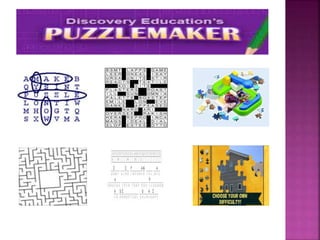
What is a Puzzle Maker?
How to use it?
 Is an exercise-creating program which can be used by
webmasters, teachers and even students to make a variety of
interactive exercises.
 All that is required of the program user is to write questions
and answers, or to import data such as texts or images.
 The program also has the ability to change the provided data
into interactive exercises and export them as web pages.
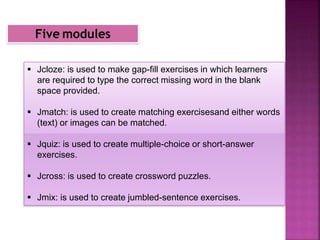
Five modules
 Jcloze: is used to make gap-fill exercises in which learners
are required to type the correct missing word in the blank
space provided.
 Jmatch: is used to create matching exercisesand either words
(text) or images can be matched.
 Jquiz: is used to create multiple-choice or short-answer
exercises.
 Jcross: is used to create crossword puzzles.
 Jmix: is used to create jumbled-sentence exercises.
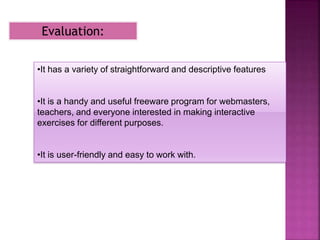
Evaluation:
•It has a variety of straightforward and descriptive features
•It is a handy and useful freeware program for webmasters,
teachers, and everyone interested in making interactive
exercises for different purposes.
•It is user-friendly and easy to work with.
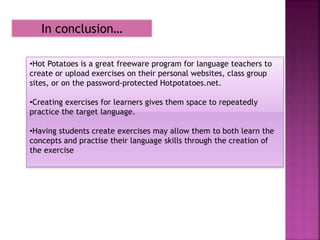
In conclusion…
•Hot Potatoes is a great freeware program for language teachers to
create or upload exercises on their personal websites, class group
sites, or on the password-protected Hotpotatoes.net.
•Creating exercises for learners gives them space to repeatedly
practice the target language.
•Having students create exercises may allow them to both learn the
concepts and practise their language skills through the creation of
the exercise
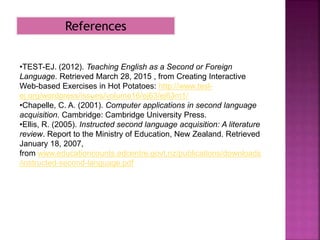
•TEST-EJ. (2012). Teaching English as a Second or Foreign
Language. Retrieved March 28, 2015 , from Creating Interactive
Web-based Exercises in Hot Potatoes: http://www.tesl-
ej.org/wordpress/issues/volume16/ej63/ej63m1/
•Chapelle, C. A. (2001). Computer applications in second language
acquisition. Cambridge: Cambridge University Press.
•Ellis, R. (2005). Instructed second language acquisition: A literature
review. Report to the Ministry of Education, New Zealand. Retrieved
January 18, 2007,
from www.educationcounts.edcentre.govt.nz/publications/downloads
/instructed-second-language.pdf
References

Hot Potatoes

  • 1.
    Equipo #1 González ArredondoBeatriz Adriana Ochoa Pineda Bianca Viviana Ortiz Íñiguez Valeria
  • 2.
    What is aPuzzle Maker?
  • 4.
    How to useit?  Is an exercise-creating program which can be used by webmasters, teachers and even students to make a variety of interactive exercises.  All that is required of the program user is to write questions and answers, or to import data such as texts or images.  The program also has the ability to change the provided data into interactive exercises and export them as web pages.
  • 5.
    Five modules  Jcloze:is used to make gap-fill exercises in which learners are required to type the correct missing word in the blank space provided.  Jmatch: is used to create matching exercisesand either words (text) or images can be matched.  Jquiz: is used to create multiple-choice or short-answer exercises.  Jcross: is used to create crossword puzzles.  Jmix: is used to create jumbled-sentence exercises.
  • 6.
    Evaluation: •It has avariety of straightforward and descriptive features •It is a handy and useful freeware program for webmasters, teachers, and everyone interested in making interactive exercises for different purposes. •It is user-friendly and easy to work with.
  • 7.
    In conclusion… •Hot Potatoesis a great freeware program for language teachers to create or upload exercises on their personal websites, class group sites, or on the password-protected Hotpotatoes.net. •Creating exercises for learners gives them space to repeatedly practice the target language. •Having students create exercises may allow them to both learn the concepts and practise their language skills through the creation of the exercise
  • 8.
    •TEST-EJ. (2012). TeachingEnglish as a Second or Foreign Language. Retrieved March 28, 2015 , from Creating Interactive Web-based Exercises in Hot Potatoes: http://www.tesl- ej.org/wordpress/issues/volume16/ej63/ej63m1/ •Chapelle, C. A. (2001). Computer applications in second language acquisition. Cambridge: Cambridge University Press. •Ellis, R. (2005). Instructed second language acquisition: A literature review. Report to the Ministry of Education, New Zealand. Retrieved January 18, 2007, from www.educationcounts.edcentre.govt.nz/publications/downloads /instructed-second-language.pdf References