1
Active Learning Modules for Multi-Professional Emergency
Management Training in Virtual Reality
Ekaterina Prasolova-Førland, Judith Molka-Danielsen,
Mikhail Fominykh and Katherine Lamb
2
Overview
1. Introduction & Theoretical Models
– Pedagogic: Activity Theory & Active Learning Model
– Decision Making: Recognition-Primed Decision Making
2. Description of the VR-ALM
3. Trials: Methodology and Feedback
4. Discussion: Activity Theory Analysis
5. Concluding Remarks
3
Project Objectives
o Design and apply an active learning module (ALM) using
virtual reality technologies (VR) that improves learning in
education for Emergency Management and Health
professional students in training communications in
management during a crisis situation
o The existing pedagogical approaches in EM training focus on
behaviorist and cognitive aspects to such training and often
neglect the social aspects and multi-professional aspects
o Naturalistic Decision Making model and Recognition- Primed
Decision making model (RPD) + Activity Theory (AT) + Virtual
Reality (VR)
Introduction
4
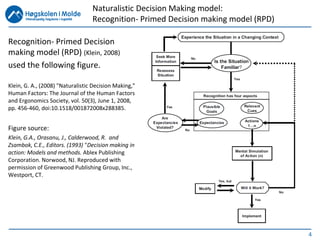
Recognition- Primed Decision
making model (RPD) (Klein, 2008)
used the following figure.
Klein, G. A., (2008) "Naturalistic Decision Making,"
Human Factors: The Journal of the Human Factors
and Ergonomics Society, vol. 50(3), June 1, 2008,
pp. 456-460, doi:10.1518/001872008x288385.
Figure source:
Klein, G.A., Orasanu, J., Calderwood, R. and
Zsambok, C.E., Editors. (1993) "Decision making in
action: Models and methods. Ablex Publishing
Corporation. Norwood, NJ. Reproduced with
permission of Greenwood Publishing Group, Inc.,
Westport, CT.
Naturalistic Decision Making model:
Recognition- Primed Decision making model (RPD)
5
Engeström, Y. (2007).
Activity Theory and
individual and social
transformation. In Y.
Engeström, R Miettinen,
& R. L. Punamäki (Eds),
Perspectices on Activity
Theory 8, pp.19-38).
Cambridge: Cambridge
University Press.
J. L. Mishra, D. K. Allen,
and A. D. Pearman,
(2011) "Activity theory as
a methodological and
analytical framework for
information practices in
emergency
management," in 8th
International Conference
on Information Systems
for Crisis Response and
Management (ISCRAM),
Lisbon, Portugal, pp 1–9.
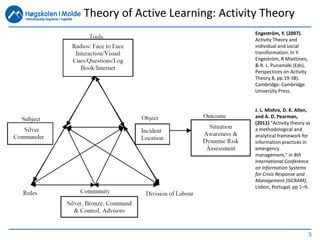
Theory of Active Learning: Activity Theory
6
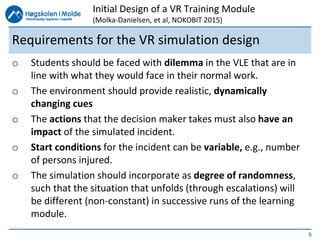
Requirements for the VR simulation design
o Students should be faced with dilemma in the VLE that are in
line with what they would face in their normal work.
o The environment should provide realistic, dynamically
changing cues
o The actions that the decision maker takes must also have an
impact of the simulated incident.
o Start conditions for the incident can be variable, e.g., number
of persons injured.
o The simulation should incorporate as degree of randomness,
such that the situation that unfolds (through escalations) will
be different (non-constant) in successive runs of the learning
module.
Initial Design of a VR Training Module
(Molka-Danielsen, et al, NOKOBIT 2015)
7
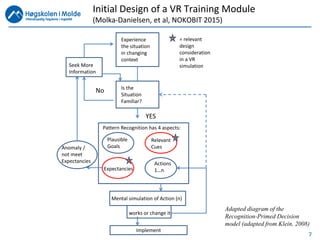
Initial Design of a VR Training Module
(Molka-Danielsen, et al, NOKOBIT 2015)
Experience
the situation
in changing
context
Is the
Situation
Familiar?
Pattern Recognition has 4 aspects:
Plausible
Goals
Relevant
Cues
Expectancies
Actions
1…n
YES
Seek More
Information
Anomaly /
not meet
Expectancies
Mental simulation of Action (n)
Implement
works or change it
No
= relevant
design
consideration
in a VR
simulation
Adapted diagram of the
Recognition-Primed Decision
model (adapted from Klein, 2008)
8
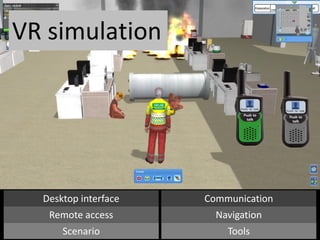
VR simulation
Desktop interface
Remote access
Scenario
Communication
Navigation
Tools
9
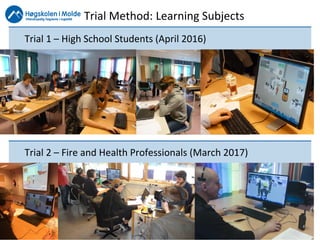
Trial 1 – High School Students (April 2016)
Trial Method: Learning Subjects
Trial 2 – Fire and Health Professionals (March 2017)
10
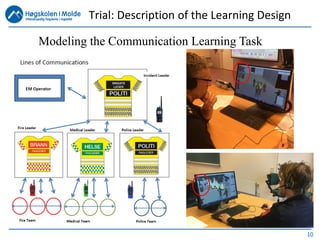
Trial: Description of the Learning Design
Modeling the Communication Learning Task
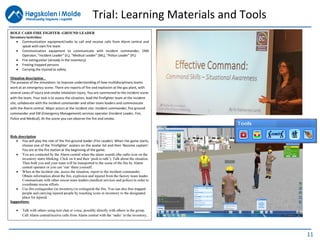
11
Trial: Learning Materials and Tools
12
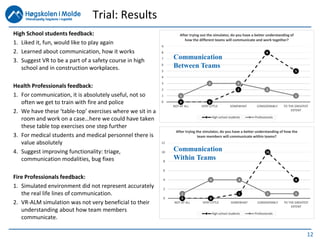
High School students feedback:
1. Liked it, fun, would like to play again
2. Learned about communication, how it works
3. Suggest VR to be a part of a safety course in high
school and in construction workplaces.
Health Professionals feedback:
1. For communication, it is absolutely useful, not so
often we get to train with fire and police
2. We have these ‘table-top’ exercises where we sit in a
room and work on a case…here we could have taken
these table top exercises one step further
3. For medical students and medical personnel there is
value absolutely
4. Suggest improving functionality: triage,
communication modalities, bug fixes
Fire Professionals feedback:
1. Simulated environment did not represent accurately
the real life lines of communication.
2. VR-ALM simulation was not very beneficial to their
understanding about how team members
communicate.
Trial: Results
Communication
Between Teams
Communication
Within Teams
13
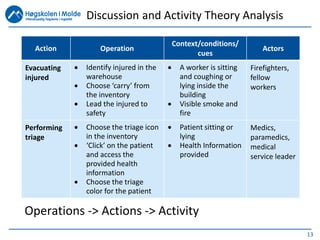
Operations -> Actions -> Activity
Discussion and Activity Theory Analysis
Action Operation
Context/conditions/
cues
Actors
Evacuating
injured
• Identify injured in the
warehouse
• Choose ‘carry’ from
the inventory
• Lead the injured to
safety
• A worker is sitting
and coughing or
lying inside the
building
• Visible smoke and
fire
Firefighters,
fellow
workers
Performing
triage
• Choose the triage icon
in the inventory
• ‘Click’ on the patient
and access the
provided health
information
• Choose the triage
color for the patient
• Patient sitting or
lying
• Health Information
provided
Medics,
paramedics,
medical
service leader
14
Engeström, Y. (2007).
Activity Theory and
individual and social
transformation. In Y.
Engeström, R Miettinen,
& R. L. Punamäki (Eds),
Perspectices on Activity
Theory 8, pp.19-38).
Cambridge: Cambridge
University Press.
J. L. Mishra, D. K. Allen,
and A. D. Pearman,
(2011) "Activity theory as
a methodological and
analytical framework for
information practices in
emergency
management," in 8th
International Conference
on Information Systems
for Crisis Response and
Management (ISCRAM),
Lisbon, Portugal, pp 1–9.
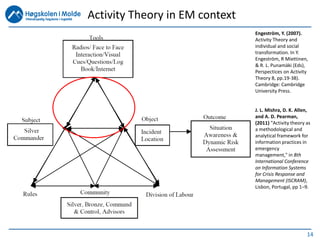
Activity Theory in EM context
15
Subject: Player: commander, team member (medic, firefighter)
o Elements in the simulation and requirements
– The avatars should wear profession-specific clothing, indicating their place in the chain of
command
– The scenario and role cards should include a correct and comprehensive description of the roles
and tasks
o Examples of related user feedbacks
– “Should be able to choose avatars to walk to and communicate with”
– “Need proper avatar vests indicating different roles”
Object: incident site/warehouse/factory
o Elements in the simulation and requirements
– The actions by the decision maker to have an impact on the simulated incident
– Start conditions for the incident can be variable, for example, the number of persons injured or the
starting location of the incident (fire outbreak)
– Description of the incident cite and context in the role cards and scenario
o Examples of related user feedbacks
– “To be realistic, after triage, people go to ambulances and get evacuated, some workers and
medics will be gone, will be less people left [at the incident site]”
AT analysis: subject and object
16
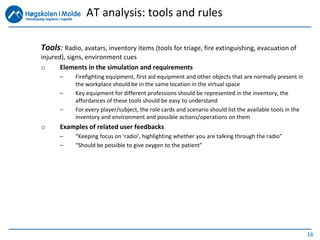
Tools: Radio, avatars, inventory items (tools for triage, fire extinguishing, evacuation of
injured), signs, environment cues
o Elements in the simulation and requirements
– Firefighting equipment, first aid equipment and other objects that are normally present in
the workplace should be in the same location in the virtual space
– Key equipment for different professions should be represented in the inventory, the
affordances of these tools should be easy to understand
– For every player/subject, the role cards and scenario should list the available tools in the
inventory and environment and possible actions/operations on them
o Examples of related user feedbacks
– “Keeping focus on ‘radio’, highlighting whether you are talking through the radio”
– “Should be possible to give oxygen to the patient”
AT analysis: tools and rules
17
Community: Other commanders, teams members, EM center operator
o Elements in the simulation and requirements
– The possibility to choose roles/team, appropriate avatar clothing for different groups
– Modes for inter- and cross-team communication (e.g. ‘radio’ and on-site ‘voice)
– The role cards and scenario should contain the description of one’s place in the community
structure and associated communication modes
o Examples of related user feedbacks
– “The information that the operative medical leader got from us [ambulance personnel] on
the incident site should be brought further to the EM center”
– “We [medics] can hear the firefighters and the workers on the ground talking… should be
able to ‘zone out’”
Division of labor: Areas of responsibility, chain of command
o Elements in the simulation and requirements
– Teams arriving to different designated spots in the beginning of the simulation
– Signs that are normally seen in the workplace and indicating commando points
– Different inventory sets for different teams
– Task description for different teams in the role cards, explicit description of responsibility
areas in the exercise (e.g., medics do not go inside the fire)
o Examples of related user feedbacks
– “Operative medical leader sits together with incident commander, medical service leader
is in the filed performing triage”
AT: community and division of labour
18
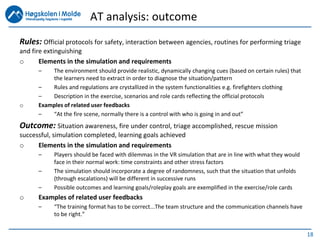
Rules: Official protocols for safety, interaction between agencies, routines for performing triage
and fire extinguishing
o Elements in the simulation and requirements
– The environment should provide realistic, dynamically changing cues (based on certain rules) that
the learners need to extract in order to diagnose the situation/pattern
– Rules and regulations are crystallized in the system functionalities e.g. firefighters clothing
– Description in the exercise, scenarios and role cards reflecting the official protocols
o Examples of related user feedbacks
– “At the fire scene, normally there is a control with who is going in and out”
Outcome: Situation awareness, fire under control, triage accomplished, rescue mission
successful, simulation completed, learning goals achieved
o Elements in the simulation and requirements
– Players should be faced with dilemmas in the VR simulation that are in line with what they would
face in their normal work: time constraints and other stress factors
– The simulation should incorporate a degree of randomness, such that the situation that unfolds
(through escalations) will be different in successive runs
– Possible outcomes and learning goals/roleplay goals are exemplified in the exercise/role cards
o Examples of related user feedbacks
– “The training format has to be correct...The team structure and the communication channels have
to be right.”
AT analysis: outcome
19
Feedback from the professional participants helped to realise complexities
of the real life environment that were not anticipated (5 radio systems in
use IRL, > 15 simultaneous users)
o In comparison to workplace training, VR simulations offer no training of
physical skills and are therefore less realistic by definition
o The necessary degree of realism and complexity is relative and depends on the
target user group (less realism is adequate for non-professionals)
o Different user groups have different learning goals – it should be possible to
adjust the simulation and exercises to accommodate these differences.
o Social and communication skills, as well as social and community aspects
should be a part of the EM simulation model
o There is a need for a consistent methodological approach to develop
simulations and exercises adapted to different learning goals.
Future AR tools and AR training components could help the learner to
form a “repertoire of patterns” at a much faster rate than traditional
experience building in the field.
Lessons Learned
20
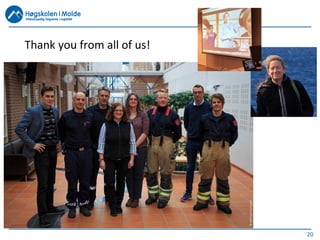
Thank you from all of us!

Active learning modules for multi professional emergency management training in virtual reality tale-2017-slides

  • 1.
    1 Active Learning Modulesfor Multi-Professional Emergency Management Training in Virtual Reality Ekaterina Prasolova-Førland, Judith Molka-Danielsen, Mikhail Fominykh and Katherine Lamb
  • 2.
    2 Overview 1. Introduction &Theoretical Models – Pedagogic: Activity Theory & Active Learning Model – Decision Making: Recognition-Primed Decision Making 2. Description of the VR-ALM 3. Trials: Methodology and Feedback 4. Discussion: Activity Theory Analysis 5. Concluding Remarks
  • 3.
    3 Project Objectives o Designand apply an active learning module (ALM) using virtual reality technologies (VR) that improves learning in education for Emergency Management and Health professional students in training communications in management during a crisis situation o The existing pedagogical approaches in EM training focus on behaviorist and cognitive aspects to such training and often neglect the social aspects and multi-professional aspects o Naturalistic Decision Making model and Recognition- Primed Decision making model (RPD) + Activity Theory (AT) + Virtual Reality (VR) Introduction
  • 4.
    4 Recognition- Primed Decision makingmodel (RPD) (Klein, 2008) used the following figure. Klein, G. A., (2008) "Naturalistic Decision Making," Human Factors: The Journal of the Human Factors and Ergonomics Society, vol. 50(3), June 1, 2008, pp. 456-460, doi:10.1518/001872008x288385. Figure source: Klein, G.A., Orasanu, J., Calderwood, R. and Zsambok, C.E., Editors. (1993) "Decision making in action: Models and methods. Ablex Publishing Corporation. Norwood, NJ. Reproduced with permission of Greenwood Publishing Group, Inc., Westport, CT. Naturalistic Decision Making model: Recognition- Primed Decision making model (RPD)
  • 5.
    5 Engeström, Y. (2007). ActivityTheory and individual and social transformation. In Y. Engeström, R Miettinen, & R. L. Punamäki (Eds), Perspectices on Activity Theory 8, pp.19-38). Cambridge: Cambridge University Press. J. L. Mishra, D. K. Allen, and A. D. Pearman, (2011) "Activity theory as a methodological and analytical framework for information practices in emergency management," in 8th International Conference on Information Systems for Crisis Response and Management (ISCRAM), Lisbon, Portugal, pp 1–9. Theory of Active Learning: Activity Theory
  • 6.
    6 Requirements for theVR simulation design o Students should be faced with dilemma in the VLE that are in line with what they would face in their normal work. o The environment should provide realistic, dynamically changing cues o The actions that the decision maker takes must also have an impact of the simulated incident. o Start conditions for the incident can be variable, e.g., number of persons injured. o The simulation should incorporate as degree of randomness, such that the situation that unfolds (through escalations) will be different (non-constant) in successive runs of the learning module. Initial Design of a VR Training Module (Molka-Danielsen, et al, NOKOBIT 2015)
  • 7.
    7 Initial Design ofa VR Training Module (Molka-Danielsen, et al, NOKOBIT 2015) Experience the situation in changing context Is the Situation Familiar? Pattern Recognition has 4 aspects: Plausible Goals Relevant Cues Expectancies Actions 1…n YES Seek More Information Anomaly / not meet Expectancies Mental simulation of Action (n) Implement works or change it No = relevant design consideration in a VR simulation Adapted diagram of the Recognition-Primed Decision model (adapted from Klein, 2008)
  • 8.
    8 VR simulation Desktop interface Remoteaccess Scenario Communication Navigation Tools
  • 9.
    9 Trial 1 –High School Students (April 2016) Trial Method: Learning Subjects Trial 2 – Fire and Health Professionals (March 2017)
  • 10.
    10 Trial: Description ofthe Learning Design Modeling the Communication Learning Task
  • 11.
  • 12.
    12 High School studentsfeedback: 1. Liked it, fun, would like to play again 2. Learned about communication, how it works 3. Suggest VR to be a part of a safety course in high school and in construction workplaces. Health Professionals feedback: 1. For communication, it is absolutely useful, not so often we get to train with fire and police 2. We have these ‘table-top’ exercises where we sit in a room and work on a case…here we could have taken these table top exercises one step further 3. For medical students and medical personnel there is value absolutely 4. Suggest improving functionality: triage, communication modalities, bug fixes Fire Professionals feedback: 1. Simulated environment did not represent accurately the real life lines of communication. 2. VR-ALM simulation was not very beneficial to their understanding about how team members communicate. Trial: Results Communication Between Teams Communication Within Teams
  • 13.
    13 Operations -> Actions-> Activity Discussion and Activity Theory Analysis Action Operation Context/conditions/ cues Actors Evacuating injured • Identify injured in the warehouse • Choose ‘carry’ from the inventory • Lead the injured to safety • A worker is sitting and coughing or lying inside the building • Visible smoke and fire Firefighters, fellow workers Performing triage • Choose the triage icon in the inventory • ‘Click’ on the patient and access the provided health information • Choose the triage color for the patient • Patient sitting or lying • Health Information provided Medics, paramedics, medical service leader
  • 14.
    14 Engeström, Y. (2007). ActivityTheory and individual and social transformation. In Y. Engeström, R Miettinen, & R. L. Punamäki (Eds), Perspectices on Activity Theory 8, pp.19-38). Cambridge: Cambridge University Press. J. L. Mishra, D. K. Allen, and A. D. Pearman, (2011) "Activity theory as a methodological and analytical framework for information practices in emergency management," in 8th International Conference on Information Systems for Crisis Response and Management (ISCRAM), Lisbon, Portugal, pp 1–9. Activity Theory in EM context
  • 15.
    15 Subject: Player: commander,team member (medic, firefighter) o Elements in the simulation and requirements – The avatars should wear profession-specific clothing, indicating their place in the chain of command – The scenario and role cards should include a correct and comprehensive description of the roles and tasks o Examples of related user feedbacks – “Should be able to choose avatars to walk to and communicate with” – “Need proper avatar vests indicating different roles” Object: incident site/warehouse/factory o Elements in the simulation and requirements – The actions by the decision maker to have an impact on the simulated incident – Start conditions for the incident can be variable, for example, the number of persons injured or the starting location of the incident (fire outbreak) – Description of the incident cite and context in the role cards and scenario o Examples of related user feedbacks – “To be realistic, after triage, people go to ambulances and get evacuated, some workers and medics will be gone, will be less people left [at the incident site]” AT analysis: subject and object
  • 16.
    16 Tools: Radio, avatars,inventory items (tools for triage, fire extinguishing, evacuation of injured), signs, environment cues o Elements in the simulation and requirements – Firefighting equipment, first aid equipment and other objects that are normally present in the workplace should be in the same location in the virtual space – Key equipment for different professions should be represented in the inventory, the affordances of these tools should be easy to understand – For every player/subject, the role cards and scenario should list the available tools in the inventory and environment and possible actions/operations on them o Examples of related user feedbacks – “Keeping focus on ‘radio’, highlighting whether you are talking through the radio” – “Should be possible to give oxygen to the patient” AT analysis: tools and rules
  • 17.
    17 Community: Other commanders,teams members, EM center operator o Elements in the simulation and requirements – The possibility to choose roles/team, appropriate avatar clothing for different groups – Modes for inter- and cross-team communication (e.g. ‘radio’ and on-site ‘voice) – The role cards and scenario should contain the description of one’s place in the community structure and associated communication modes o Examples of related user feedbacks – “The information that the operative medical leader got from us [ambulance personnel] on the incident site should be brought further to the EM center” – “We [medics] can hear the firefighters and the workers on the ground talking… should be able to ‘zone out’” Division of labor: Areas of responsibility, chain of command o Elements in the simulation and requirements – Teams arriving to different designated spots in the beginning of the simulation – Signs that are normally seen in the workplace and indicating commando points – Different inventory sets for different teams – Task description for different teams in the role cards, explicit description of responsibility areas in the exercise (e.g., medics do not go inside the fire) o Examples of related user feedbacks – “Operative medical leader sits together with incident commander, medical service leader is in the filed performing triage” AT: community and division of labour
  • 18.
    18 Rules: Official protocolsfor safety, interaction between agencies, routines for performing triage and fire extinguishing o Elements in the simulation and requirements – The environment should provide realistic, dynamically changing cues (based on certain rules) that the learners need to extract in order to diagnose the situation/pattern – Rules and regulations are crystallized in the system functionalities e.g. firefighters clothing – Description in the exercise, scenarios and role cards reflecting the official protocols o Examples of related user feedbacks – “At the fire scene, normally there is a control with who is going in and out” Outcome: Situation awareness, fire under control, triage accomplished, rescue mission successful, simulation completed, learning goals achieved o Elements in the simulation and requirements – Players should be faced with dilemmas in the VR simulation that are in line with what they would face in their normal work: time constraints and other stress factors – The simulation should incorporate a degree of randomness, such that the situation that unfolds (through escalations) will be different in successive runs – Possible outcomes and learning goals/roleplay goals are exemplified in the exercise/role cards o Examples of related user feedbacks – “The training format has to be correct...The team structure and the communication channels have to be right.” AT analysis: outcome
  • 19.
    19 Feedback from theprofessional participants helped to realise complexities of the real life environment that were not anticipated (5 radio systems in use IRL, > 15 simultaneous users) o In comparison to workplace training, VR simulations offer no training of physical skills and are therefore less realistic by definition o The necessary degree of realism and complexity is relative and depends on the target user group (less realism is adequate for non-professionals) o Different user groups have different learning goals – it should be possible to adjust the simulation and exercises to accommodate these differences. o Social and communication skills, as well as social and community aspects should be a part of the EM simulation model o There is a need for a consistent methodological approach to develop simulations and exercises adapted to different learning goals. Future AR tools and AR training components could help the learner to form a “repertoire of patterns” at a much faster rate than traditional experience building in the field. Lessons Learned
  • 20.