Vol 17 • Issue 3
c h a n g e y o u r l i f e . c h a n g e y o u r w o r l d .
Discovering
Faith
Seek and find
Butterfly Encounters
On the wings of hope
Easter Wonders
The third day
Vol 17, Issue 3
EDITOR’S INTRODUCTION
a christian’s hope
Most people understand hope as wishful think-
ing, as in I hope something will happen. But this is
not what the Bible means by hope. In the Bible,
hope is used in the sense of “joyful and confident
expectation.”1
Maybe you hope for good things to happen, or
like me sometimes, you tend to rather hope that bad things won’t happen. In
my case, when those less-than-ideal things do occur, as they do for everyone,
I’ve found the following affirmation comforting: “You’ve got to believe that
God is in control of your life. It may be a tough time, but you’ve got to believe
that God has a reason for it and He’s going to make everything good.”2
This philosophy works for the mundane difficulties of life, but might not
be enough for life’s deeper troubles, such as the diagnosis of a terminal illness,
or the loss of home and livelihood. In types of serious trouble we need serious
hope, and that’s what we can receive through Jesus. His resurrection, which
Christians commemorate this month, includes the promise of our own eternal
life with Him. As King David of old said, “Because of this, my heart will be
glad, my words will be joyful, and I will live in hope.”3
And in the meantime, Jesus left indications of how He wants us to lead our
lives:
As His Father sent Him, so He sends us.4
He calls us to be His hands, His
feet, His eyes, His lips; to bind up the brokenhearted, comfort those that
mourn, feed the hungry, raise those whose spirits have died from despair and
loneliness, give new sight to the blind by giving them Jesus the light, share
the gospel with the poor, undo the heavy burdens, and set the spiritually
oppressed free.5
“Freely you have received, freely give.”6
Let’s place Jesus at the heart of our Easter celebrations and share with every-
one we can the wonderful news of His birth, death, and resurrection, which
provide “confident expectation” of a new life for all who reach out to Him.
Samuel Keating
Executive Editor
For information on Activated and other
inspirational products, visit our website or
contact one of the distributors below.
www.activated.org
Activated Ministries
P.O. Box 462805
Escondido, CA 92046–2805, USA
Toll-free: 1–877–862–3228
Email: info@actmin.org
www.activatedministries.org
Activated Africa
P.O. Box 2509, Faerie Glen
Pretoria 0043, South Africa
Tel: 0861 888 918
Email: activatedAfrica@activated.org
Activated Nigeria
P.O. Box 9009, Aggrey Road P.O.
Port Harcourt, Nigeria
Cell: +234 (0) 7036963333
Email: activatednigeria@activated.org
Activated Philippines
P.O. Box 8225, Paranaque Central P.O.
1700 Paranaque City, Philippines
Cell: (0922) 8125326
Email: activatedph@gmail.com
Editor	 Samuel Keating
Design	 Gentian Suçi
© 2015 Activated. All Rights Reserved.
Printed in Taiwan by Ji Yi Co., Ltd.
All scripture quotations, unless otherwise
indicated, are taken from the New King James
Version®. Copyright © 1982 by Thomas Nelson.
Used by permission. Other Bible quotations
are from the following sources: Contemporary
English Version (CEV). Copyright © 1995 by
American Bible Society. Used by permission.
New International Version (NIV). Copyright
© 1978, 1984 by International Bible Society.
Used by permission. New Life Version
(NLV). Copyright © 1969–2003 by Christian
Literature International. Used by permission.
English Standard Version (ESV). Copyright
© 2001 by Good News Publishers. Used by
permission.
1.	 E.g., 2 Corinthians 1:7 AMP
2.	 Joel Osteen, b. 1963
3.	 Acts 2:26 CEV
4.	 See John 20:21.
5.	 See Isaiah 61:1–3.
6.	 Matthew 10:8
2
1.	 http://butterflywebsite.com/discover/stories.cfm
2.	 See Matthew 7:7.
3.	 http://elixirmime.com
Butterfly
Encounters
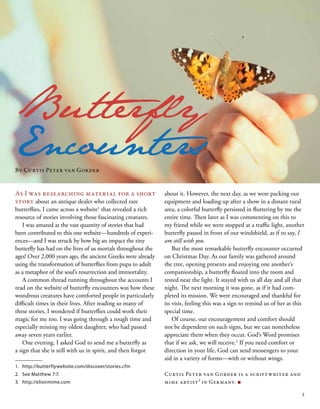
As I was researching material for a short
story about an antique dealer who collected rare
butterflies, I came across a website1
that revealed a rich
resource of stories involving those fascinating creatures.
I was amazed at the vast quantity of stories that had
been contributed to this one website—hundreds of experi-
ences—and I was struck by how big an impact the tiny
butterfly has had on the lives of us mortals throughout the
ages! Over 2,000 years ago, the ancient Greeks were already
using the transformation of butterflies from pupa to adult
as a metaphor of the soul’s resurrection and immortality.
A common thread running throughout the accounts I
read on the website of butterfly encounters was how these
wondrous creatures have comforted people in particularly
difficult times in their lives. After reading so many of
these stories, I wondered if butterflies could work their
magic for me too. I was going through a rough time and
especially missing my oldest daughter, who had passed
away seven years earlier.
One evening, I asked God to send me a butterfly as
a sign that she is still with us in spirit, and then forgot
about it. However, the next day, as we were packing our
equipment and loading up after a show in a distant rural
area, a colorful butterfly persisted in fluttering by me the
entire time. Then later as I was commenting on this to
my friend while we were stopped at a traffic light, another
butterfly passed in front of our windshield, as if to say, I
am still with you.
But the most remarkable butterfly encounter occurred
on Christmas Day. As our family was gathered around
the tree, opening presents and enjoying one another’s
companionship, a butterfly floated into the room and
rested near the light. It stayed with us all day and all that
night. The next morning it was gone, as if it had com-
pleted its mission. We were encouraged and thankful for
its visit, feeling this was a sign to remind us of her at this
special time.
Of course, our encouragement and comfort should
not be dependent on such signs, but we can nonetheless
appreciate them when they occur. God’s Word promises
that if we ask, we will receive.2
If you need comfort or
direction in your life, God can send messengers to your
aid in a variety of forms—with or without wings.
Curtis Peter van Gorder is a scriptwriter and
mime artist3
in Germany. ■
By Curtis Peter van Gorder
3
my hat off to them. They give life and
meaning to the word faith and show
me that no matter how bad things
get, God will be there to help me
through; all I have to do is hold on to
Him and to the faith I have received
through His Word, which will keep
doubts and discouragement away.
God promises, “All things work
together for good to them that love
God.”1
It took me a while to realize
that the verse doesn’t say, “All things
are always good” but that, “All things
work together for good.” To me, that
means that even though bad things
do happen to all of us, God works
them into the story of our lives to
bring about good on our behalf,
It might surprise you, though,
to discover that people with such
exemplary personalities didn’t neces-
sarily become faith-filled and positive
because their lives floated along like
a song. Many people have taken
on this nature as a result of facing
difficult, trying, sometimes heart-
breaking and painful circumstances,
and choosing to wait to see how God
would come through for them—even
though it sometimes took a while.
They may have fought battles with
their health or watched their children
battle an enduring sickness or lost
a loved one. Whatever it was, these
faith-filled people came out strong,
courageous, and compassionate. I take
It’s second nature for
some people to have faith
and show trust in God. They
somehow see the good in difficult
people or trying situations. To them,
the glass is always half full. You’ll
often hear them say things like, “God
will supply,” and, “Don’t worry,
things will work out.” Upon meeting
a person like this for the first time,
you’d probably think their life has
been pretty peachy—with very few
problems and everything going their
way.
HAVING FAITH
IN FAITH
By Tina Kapp
1.	 Romans 8:28
2.	 Psalm 86:10–13 NIV
3.	 www.just1thing.com
4
whether now or in eternity. When I
take this approach, I also realize that
we can’t thank Him for all the good
in our lives and then blame Him for
the bad things. It means we can trust
Him through the bad and be abso-
lutely confident that He’ll make our
difficulties become something good,
or through them bring something
good into our lives.
The Bible is so full of examples of
this principle, and I think it’s because
God wanted to get this point across.
King David is one of my favorites.
Imagine for a second that your big
career plan was to be a shepherd,
which from my vast knowledge of
shepherding (and my vivid imagina-
tion) amounted to watching sheep eat
for hours, fighting off the odd life-
threatening beast, and fiddling on your
harp. Then suddenly, you’re hitting the
big time: you get anointed king; you
kill a giant in front of two armies, the
king, and your big brothers; and you
become best buddies with the heir to
the throne. At that point, if David was
all like, Yeah, God’s really great, you’d
know it was easy for him to say that.
However, reality hit later on when
he nearly lost the kingdom (a few
times), had his own son betray him,
and had to face God’s punishments
for some seriously bad choices. You
know that when he praised God after
that, he was doing it from a place
where he knew exactly what it meant
to trust God through ups and downs.
I was reading where King David
says to God, “You are great and do
marvelous deeds; you alone are God.
I will praise you, Lord my God, with
all my heart; I will glorify your name
forever. For great is your love toward
me; you have delivered me from the
depths, from the realm of the dead.”2
In that psalm he’s desperately praying
yet again for God to deliver him
from his enemies, but he also knows
and is confident in God’s protection
and care, so that his faith is not
shaken but is stronger than ever.
Faith is compared to gold in the
Bible. And like gold, faith has high
value. Faith that weakens when it is
tested would be like having a cur-
rency with little or no value, which
would be pretty useless. But like
gold, faith is precious, rare, costly,
and lasts a lifetime.
In my own life, I can look back
at situations and events that weren’t
easy to experience, or that I definitely
wouldn’t want to relive, but I realize
that if I hadn’t gone through the tough
times, I would have missed some of
the wonderful things that I gained
along the way. Having this knowledge
and experience has strengthened my
faith and given me the assurance that
no matter what emotional storms I go
through, I know Jesus is behind them,
waiting to shine through and give me
exactly what I need to move forward
with grace and strength, ready to face
whatever else life throws at me.
Tina Kapp is a dancer, presenter,
and freelance writer in
South Africa. She runs an
entertainment company that
helps raise funds for charity
and missionary projects. This
article was adapted from
a podcast on Just1Thing,3
a
Christian character-building
website for young people. ■
5
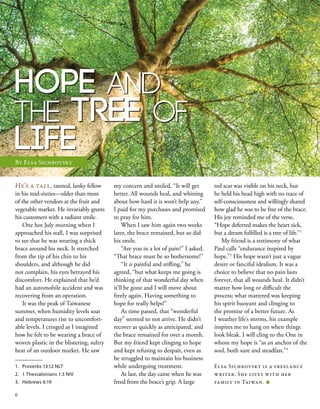
Hope and
the Tree of
Life
He’s a tall, tanned, lanky fellow
in his mid-sixties—older than most
of the other vendors at the fruit and
vegetable market. He invariably greets
his customers with a radiant smile.
One hot July morning when I
approached his stall, I was surprised
to see that he was wearing a thick
brace around his neck. It stretched
from the tip of his chin to his
shoulders, and although he did
not complain, his eyes betrayed his
discomfort. He explained that he’d
had an automobile accident and was
recovering from an operation.
It was the peak of Taiwanese
summer, when humidity levels soar
and temperatures rise to uncomfort-
able levels. I cringed as I imagined
how he felt to be wearing a brace of
woven plastic in the blistering, sultry
heat of an outdoor market. He saw
my concern and smiled. “It will get
better. All wounds heal, and whining
about how hard it is won’t help any.”
I paid for my purchases and promised
to pray for him.
When I saw him again two weeks
later, the brace remained, but so did
his smile.
“Are you in a lot of pain?” I asked.
“That brace must be so bothersome!”
“It is painful and stifling,” he
agreed, “but what keeps me going is
thinking of that wonderful day when
it’ll be gone and I will move about
freely again. Having something to
hope for really helps!”
As time passed, that “wonderful
day” seemed to not arrive. He didn’t
recover as quickly as anticipated, and
the brace remained for over a month.
But my friend kept clinging to hope
and kept refusing to despair, even as
he struggled to maintain his business
while undergoing treatment.
At last, the day came when he was
freed from the brace’s grip. A large
red scar was visible on his neck, but
he held his head high with no trace of
self-consciousness and willingly shared
how glad he was to be free of the brace.
His joy reminded me of the verse,
“Hope deferred makes the heart sick,
but a dream fulfilled is a tree of life.”1
My friend is a testimony of what
Paul calls “endurance inspired by
hope.”2
His hope wasn’t just a vague
desire or fanciful idealism. It was a
choice to believe that no pain lasts
forever, that all wounds heal. It didn’t
matter how long or difficult the
process; what mattered was keeping
his spirit buoyant and clinging to
the promise of a better future. As
I weather life’s storms, his example
inspires me to hang on when things
look bleak. I will cling to the One in
whom my hope is “as an anchor of the
soul, both sure and steadfast.”3
Elsa Sichrovsky is a freelance
writer. She lives with her
family in Taiwan. ■
1.	 Proverbs 13:12 NLT
2.	 1 Thessalonians 1:3 NIV
3.	 Hebrews 6:19
By Elsa Sichrovsky
6
1.	 See Job 22:27.
2.	 See Hebrews 4:12.
3.	 See Psalm 147:3
4.	 See Hebrews 11:6.
Dear Bill
By Iris Richard
Bill and I are old friends. When we met up for coffee recently, he told me about his
difficulties. His wife has developed a chronic condition which has left her bedridden, and Bill is
struggling with her care. Meanwhile, he is overwhelmed by the demands at his workplace and
the fear of losing his job. This has led to a crisis of faith. I had found myself battling with similar
emotions not long ago. We prayed together, but later I felt I had more to share, and this is the
letter I wrote.
Dear Bill,
It was nice meeting with you, even though it saddens me to hear of your setbacks and hardships.
Recently I went through a rough spot in my life. Perhaps what brought me through could help you
as well.
When I lost sight of God, I came to realize that I had to become quiet—like early in the morning,
when only the birds are up and chirping, or in the quiet of night when all external commotion has
ceased—calming my mental processes, to be able to hear from God clearly again.
Talking with a trusted friend about my heartaches helped me process the difficult situations. I
learned not to be afraid of tears.
Reading a variety of spiritually feeding materials did wonders, as I found passages that turned
my key. As I kept searching for hope, it did eventually spring forth.
Finding even small reasons for gratitude kept the nagging voices of negativity and misery at bay
and helped me to keep open the door to regaining my faith.
Since then, I have made some commitments:
•	 Whenever I find myself too worn out to pray, I pray anyway—trusting that God will hear my plea.1
•	 When feeling too weary to read the Bible, I read it anyway—God’s Word is living and powerful.2
•	 When too impatient to find my inner stillness, I seek for it anyway—reminding myself that God
mends broken hearts.3
•	 When my thoughts are downcast and sad, I look up anyway—trusting that the fog will lift, for
God rewards those who seek Him.4
To end this letter, dear Bill, I wish you all the best and promise to keep your situation in my daily
prayers.
Your friend,
Iris
Iris Richard is a counselor in Kenya, where she has been
active in community and volunteer work since 1995. ■
7
THE WORLD’S
BEST PICTURE
By Marie Boisjoly
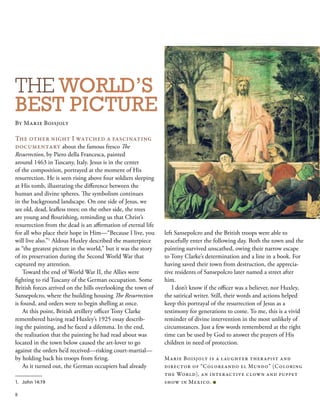
The other night I watched a fascinating
documentary about the famous fresco The
Resurrection, by Piero della Francesca, painted
around 1463 in Tuscany, Italy. Jesus is in the center
of the composition, portrayed at the moment of His
resurrection. He is seen rising above four soldiers sleeping
at His tomb, illustrating the difference between the
human and divine spheres. The symbolism continues
in the background landscape. On one side of Jesus, we
see old, dead, leafless trees; on the other side, the trees
are young and flourishing, reminding us that Christ’s
resurrection from the dead is an affirmation of eternal life
for all who place their hope in Him—“Because I live, you
will live also.”1
Aldous Huxley described the masterpiece
as “the greatest picture in the world,” but it was the story
of its preservation during the Second World War that
captured my attention.
Toward the end of World War II, the Allies were
fighting to rid Tuscany of the German occupation. Some
British forces arrived on the hills overlooking the town of
Sansepolcro, where the building housing The Resurrection
is found, and orders were to begin shelling at once.
At this point, British artillery officer Tony Clarke
remembered having read Huxley’s 1925 essay describ-
ing the painting, and he faced a dilemma. In the end,
the realization that the painting he had read about was
located in the town below caused the art-lover to go
against the orders he’d received—risking court-martial—
by holding back his troops from firing.
As it turned out, the German occupiers had already
left Sansepolcro and the British troops were able to
peacefully enter the following day. Both the town and the
painting survived unscathed, owing their narrow escape
to Tony Clarke’s determination and a line in a book. For
having saved their town from destruction, the apprecia-
tive residents of Sansepolcro later named a street after
him.
I don’t know if the officer was a believer, nor Huxley,
the satirical writer. Still, their words and actions helped
keep this portrayal of the resurrection of Jesus as a
testimony for generations to come. To me, this is a vivid
reminder of divine intervention in the most unlikely of
circumstances. Just a few words remembered at the right
time can be used by God to answer the prayers of His
children in need of protection.
Marie Boisjoly is a laughter therapist and
director of “Coloreando el Mundo” (Coloring
the World), an interactive clown and puppet
show in Mexico. ■
1.	 John 14:19
8
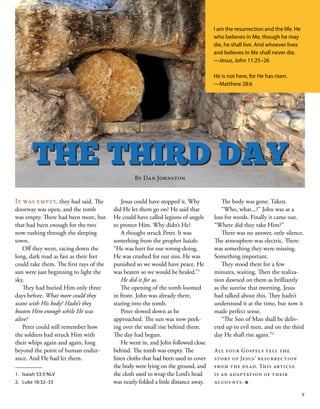
It was empty, they had said. The
doorway was open, and the tomb
was empty. There had been more, but
that had been enough for the two
now rushing through the sleeping
town.
Off they went, racing down the
long, dark road as fast as their feet
could take them. The first rays of the
sun were just beginning to light the
sky.
They had buried Him only three
days before. What more could they
want with His body? Hadn’t they
beaten Him enough while He was
alive?
Peter could still remember how
the soldiers had struck Him with
their whips again and again, long
beyond the point of human endur-
ance. And He had let them.
Jesus could have stopped it. Why
did He let them go on? He said that
He could have called legions of angels
to protect Him. Why didn’t He?
A thought struck Peter. It was
something from the prophet Isaiah:
“He was hurt for our wrong-doing.
He was crushed for our sins. He was
punished so we would have peace. He
was beaten so we would be healed.”1
He did it for us.
The opening of the tomb loomed
in front. John was already there,
staring into the tomb.
Peter slowed down as he
approached. The sun was now peek-
ing over the small rise behind them.
The day had begun.
He went in, and John followed close
behind. The tomb was empty. The
linen cloths that had been used to cover
the body were lying on the ground, and
the cloth used to wrap the Lord’s head
was neatly folded a little distance away.
The body was gone. Taken.
“Who, what...?” John was at a
loss for words. Finally it came out.
“Where did they take Him?”
There was no answer, only silence.
The atmosphere was electric. There
was something they were missing.
Something important.
They stood there for a few
minutes, waiting. Then the realiza-
tion dawned on them as brilliantly
as the sunrise that morning. Jesus
had talked about this. They hadn’t
understood it at the time, but now it
made perfect sense.
“The Son of Man shall be deliv-
ered up to evil men, and on the third
day He shall rise again.”2
All four Gospels tell the
story of Jesus’ resurrection
from the dead. This article
is an adaptation of their
accounts. ■
THE THIRD DAY
I am the resurrection and the life. He
who believes in Me, though he may
die, he shall live. And whoever lives
and believes in Me shall never die.
—Jesus, John 11:25–26
He is not here, for He has risen.
—Matthew 28:6
1.	 Isaiah 53:5 NLV
2.	 Luke 18:32–33
By Dan Johnston
9
EASTER
WONDERS
By Peter Amsterdam, adapted
At this time of year, we
celebrate the very heart of our Christian
faith—the resurrection of Jesus. It is
the central theme of the gospel, the
key component which proves the
validity of everything Jesus taught. The
resurrection tells us that Jesus is the
Son of God; that as believers we have
salvation and forgiveness, we are God’s
children, and we’ll be with Him for
eternity in heaven.
The apostle Paul said that if Jesus
hadn’t risen from the dead, then the
message of Christianity would be
without foundation, and the faith of
those who believe would be worthless.1
But as the angel told the women who
came to Jesus’ tomb, He has risen from
the dead, just as He said He would.
This fact validates our belief system
and our faith. Jesus is alive! He lives!
And because He does, so do we.
A sense of renewed awe and
wonder
Jesus rose from the grave,
conquering death, and in doing so,
freed us from being bound only to
this life. Though we presently live in
a broken world, we have the promise
of a perfect world to come. While we
experience heartbreak and disap-
pointment today, our tears and fears
will be forever wiped away in our life
after this one.2
While we sometimes
struggle with confusion, sadness, fear,
and uncertainty, when we join Him
and are in His presence in heaven, we
will experience joy unspeakable.
This is possible because God, who
so deeply loves us and wants us to
be in relationship with Him, made
a plan by which we could become
His children. This plan required
God entering this world through a
miraculous birth, and after living
among us, giving His life for us on
the cross—and then rising from
the dead. Through the completion
of His plan, we can enter into the
relationship with Him that we were
created for—both now and forever.
It is awesome that God has made
it possible for us to have His pres-
ence in our lives now and to dwell in
His presence eternally. The appropri-
ate response on our part is one of
eternal gratitude, praise, worship,
and adoration, for we have been
given the greatest gift possible.
Increased faith for life
If we think about, meditate
on, and appreciate what Jesus’
1.	 See 1 Corinthians 15:12–20.
2.	 See Revelation 21:4.
3.	 Mark 16:15 CEV
4.	 John 3:16 ESV
10
resurrection meant, what it achieved,
and how it has changed our lives
forever, we can gain increased faith
for every area of our lives. Jesus not
only rose from the dead, but He’s
in the business of helping us rise
above the dead ends, deadwood, and
deadweights in our lives.
Sometimes we resign ourselves to
situations and circumstances because
we feel there’s no hope for change,
that things are what they are and
that we simply have to endure them.
However, God is in the business
of changing things, of breathing
new life into hearts, relationships,
or situations that seem or may be
“dead.” Perhaps you’re in a situation
that seems out of your control or as
if all hope is gone, but no situation is
beyond Jesus’ control; His power is
unlimited. When Jesus was on earth,
He regularly did the impossible. He
multiplied the loaves and fishes,
walked on water, healed the para-
lyzed, and gave sight to the blind.
Dead people were even raised to life.
Renewed commitment to
spread the Good News
Jesus coming to earth, dying on
the cross for us, and His subsequent
resurrection forever changed the
course of history. These actions
allowed each of us the opportunity
to accept Jesus and become part of
God’s family.
When Jesus told His disciples to
“preach the good news to everyone
in the world,”3
He showed that He
wants each man, woman, and child
to have the opportunity to become a
part of His family, to be saved from
their sins, and to experience His
forgiveness and reconciliation. Each
person who has already received His
marvelous gift, who knows what it
is to live within God’s family, to be
forgiven for our sins, to have God’s
Spirit within us, will naturally want
to share this with others.
We who believe in the resurrec-
tion, have been saved because of the
resurrection, and will experience res-
urrection, should remind ourselves
as we celebrate the resurrection of
God the Son that we are proclaimers
of the risen Christ to those who
have not yet heard that “God so
loved the world, that he gave his
only Son, that whoever believes
in him should not perish but have
eternal life.”4
Peter Amsterdam and his
wife, Maria Fontaine, are
directors of the Family
International, a Christian
community of faith. ■
A marvelous and mighty paradox has thus occurred, for the
death which they thought to inflict on Him as dishonor and
disgrace has become the glorious monument to death’s defeat.
—Athanasius of Alexandria (296–373)
11
Do not abandon your-
selves to despair. We are the
Easter people and hallelujah is our
song.—Pope John Paul II (1920–2005)
2
A man who was completely innocent
offered himself as a sacrifice for
the good of others, including his
enemies, and became the ransom
of the world. It was a perfect act.—
Mahatma Gandhi (1869–1948)
2
Christian hope is faith looking ahead to
the fulfillment of the promises of God.
Christian hope is a certainty, guaran-
teed by God himself. Christian hope
expresses knowledge that every day of
his life, and every moment beyond it,
the believer can say with truth, on the
basis of God’s own commitment, that
the best is yet to come.—Adapted from
Jim Packer (b. 1926)
What happens when a Christian dies
is not a matter of speculation, but of
certainty based on truth. Something
tremendous happened in history
that has taken the issue of life after
death out of the realm of conjecture
and moved it into verified fact. Paul
openly and clearly states the reason
for his confidence. “We know that
the one who raised the Lord Jesus
from the dead will also raise us with
Jesus and present us with you in his
presence.”1
 The resurrection of Jesus
Christ is a precedent for the resurrec-
tion of all those who are in Christ. In
other words, our future resurrection
is based on the historicity of Christ’s
resurrection. The resurrection of
Jesus Christ is not a peripheral issue,
but is central and crucial to the
Christian faith. … The fact that Jesus
is alive and makes His home in us
doesn’t only change our perspective
on the next life, but in this life as
well, because until we are ready to
face death, we will never really know
how to live freely. The Christian faith
is not about escapism, but about
life here and now, lived in the love,
strength and wisdom of the presence
of Christ within us. In this, we have
the assurance of the One who was
raised from the dead raising us up
to our eternal home with Him.—
Charles Price
2
No tabloid will ever print the star-
tling news that the mummified body
of Jesus of Nazareth has been dis-
covered in old Jerusalem. Christians
have no carefully embalmed body
enclosed in a glass case to worship.
Thank God, we have an empty tomb.
The glorious fact that the empty
tomb proclaims to us is that life for
us does not stop when death comes.
Death is not a wall, but a door.—
Peter Marshall (1902–1949) ■
1.	 2 Corinthians 4:14 NIV
the
EASTER
PEOPLE
12
B E Y O N D
W I S H F U L
T H I N K I N G
By Sukanya Kumar-Sinha
I was eight years old when I lost my
grandfather at the age of 65. My family is
very close knit and this was a big blow to all of us.
I remember kissing Nanu’s cold cheek and bidding him
farewell. But something inside told me this was not a per-
manent goodbye. I always had a fervent hope of reuniting
with him one day. Every time we visited the graveyard, I
cried at not being able to see him, touch him, talk to him;
but deep down, there was always a confident knowledge
that I was going to see him again. In expectation of this
eventual reunion, I’d think thoughts like When I see Nanu
again, I’ll ask him about the time he was chased by a gang
of armed robbers, or When I see Nanu again, I’ll reprimand
him for not getting his kidney operation done in time. As I
grew older, however, I adjusted to his absence.
After Nanu’s death, my grandmother, Nanna, was the
heart of our big family, and now she too is gone. When
she died recently and we gathered to clear out her house,
I ran my hand over the quilt on her bed and couldn’t stop
weeping. At church, I would find myself looking at her
regular seat and asking Jesus, Why?
As the weeks passed, the pain became less raw, less
constant, but it was nevertheless always there. Until one
day I caught myself thinking, When I see Nanna again, I’m
going to tell her how much we’ve all missed her. I’ll give her
that hug I couldn’t at the hospital …
And that’s when I realized that the promise of eternal
life isn’t just fit for the childish wishful thinking of an
eight-year-old, but that it can comfort throughout life. As
Christians, we have an undying hope and faith that death
is not the end. God sent His Son, Jesus, to earth so we
could have eternal life with Him. All we need is childlike
faith to believe God’s promise.
I don’t know exactly how the relationships we enjoy so
much on earth will continue in heaven, but I know that
eternal life with God awaits us. Death is the door we pass
through to reach it.
Sukanya Kumar-Sinha is an Activated reader
from India. She lives in Gurgaon, and works as
Deputy Director in a diplomatic mission in New
Delhi. ■
13
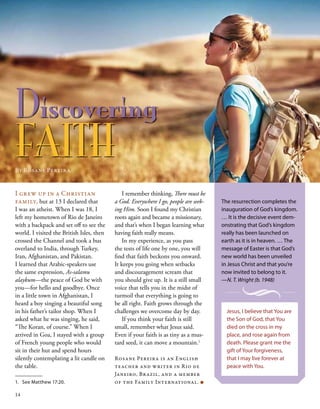
Discovering
Faith
I grew up in a Christian
family, but at 13 I declared that
I was an atheist. When I was 18, I
left my hometown of Rio de Janeiro
with a backpack and set off to see the
world. I visited the British Isles, then
crossed the Channel and took a bus
overland to India, through Turkey,
Iran, Afghanistan, and Pakistan.
I learned that Arabic-speakers use
the same expression, As-salamu
alaykum—the peace of God be with
you—for hello and goodbye. Once
in a little town in Afghanistan, I
heard a boy singing a beautiful song
in his father’s tailor shop. When I
asked what he was singing, he said,
“The Koran, of course.” When I
arrived in Goa, I stayed with a group
of French young people who would
sit in their hut and spend hours
silently contemplating a lit candle on
the table.
I remember thinking, There must be
a God. Everywhere I go, people are seek-
ing Him. Soon I found my Christian
roots again and became a missionary,
and that’s when I began learning what
having faith really means.
In my experience, as you pass
the tests of life one by one, you will
find that faith beckons you onward.
It keeps you going when setbacks
and discouragement scream that
you should give up. It is a still small
voice that tells you in the midst of
turmoil that everything is going to
be all right. Faith grows through the
challenges we overcome day by day.
If you think your faith is still
small, remember what Jesus said.
Even if your faith is as tiny as a mus-
tard seed, it can move a mountain.1
Rosane Pereira is an English
teacher and writer in Rio de
Janeiro, Brazil, and a member
of the Family International. ■
The resurrection completes the
inauguration of God’s kingdom.
… It is the decisive event dem-
onstrating that God’s kingdom
really has been launched on
earth as it is in heaven. … The
message of Easter is that God’s
new world has been unveiled
in Jesus Christ and that you’re
now invited to belong to it.
—N. T. Wright (b. 1948)
Jesus, I believe that You are
the Son of God, that You
died on the cross in my
place, and rose again from
death. Please grant me the
gift of Your forgiveness,
that I may live forever at
peace with You.
1.	 See Matthew 17:20.
By Rosane Pereira
14
Being with
God
If there is anything that
Easter reminds us, it is that
“salvation”—God’s wonderful gift
of peace with Him in this life and in
the life to come—is not something
we achieve by what we do. It’s some-
thing that has already been done for
us. Jesus died on the cross for our
sins; He rose again on the third day.
He did it, not us.
“This day you will be with Me in
paradise,” He told the dying thief,
hanging on the adjacent cross.1
There
was nothing that thief could do
about his situation, his past, and cer-
tainly not his future, as he was being
executed for his crimes. There was,
however, something he could think
and say. “Remember me, Lord, when
you come into your kingdom.”2
An
expression of faith was all it took.
That’s a lesson for us. How easy it
is to be busy for God for good causes,
for other people. We can fill our days
with good deeds, kind words, acts of
generosity. But that is not enough to
reconcile us with God, because just as
we have our good moments, we have
our bad ones too—the times when
our deeds aren’t wise or measured,
when our words aren’t as kind as they
should be, when we selfishly think of
our own wants just a bit more than
someone else’s. We get angry, we don’t
forgive, we grumble.
None of us quite make the grade.
If reconciliation with God were
dependent on the things we do, we
wouldn’t get it. That’s why none of
our good deeds or best efforts will
earn us a place at His side.3
The wonderful thing is we don’t
have to make the grade. The Son of
God took on the life of a human
being, lived amongst us, listening,
watching, touching, healing. His
love for us was so great that even
though He knew what He was about
to suffer, He allowed Himself to be
taken, to be beaten and whipped,
and finally to be nailed to the cross.
And even there His love reigned; He
forgave those that crucified Him, He
made arrangements for the care of
His weeping mother, and He gave
the thief courage with His promise:
“This day you will be with Me in
paradise.” He did it; not us.
No matter our fears and worries,
no matter our regrets and guilt, no
matter our feelings of inadequacy,
when we pray, “Remember me,
Lord,” He does. Let’s set our
concerns and cares aside and be with
Him today.
Abi May is a freelance writer,
educator, and healthcare
advocate in Great Britain.
Visit her website at www.abi
.mayihelp.co.uk. ■
Quiet Moments
By Abi May
1.	 Luke 23:43
2.	 Luke 23:42
3.	 See Titus 3:5.
15
The trying
of hearts
I understand the trying of men’s hearts, the depths of
despair, discouragement, and desperation. I understand
forsaking, for I had to forsake My Father to go to earth,
and then I had to forsake those that I loved so dearly on
earth to return to My Father.
I understand the depth of pain and affliction, for I
screamed out in pain as the nails pierced My hands and
My feet. I understand the feeling of being forsaken by those
who loved Me, even My own Father, for I cried out, “My
God, My God, why have You forsaken Me?”1
I understand the depth of fear—fear of facing what
is ahead for the pain and the sorrow that it will bring. I
understand the depth of the feeling of abandonment, for
those who loved Me most forsook Me as I was carried away
into custody. I know the depth of hurt to see one that you
love betray you, as one of My own friends betrayed Me
with a kiss.
Though My Father did not let this cup pass from Me,
and though My loved ones fled from My side in My time
of need, and though the nails pierced My hands and feet,
and though I was beaten, and though I felt as if My Father
had forsaken Me—it all brought about such great victory,
renewal, and salvation!
It looked like a defeat when I was whipped, crowned
with thorns, and nailed to the cross, but it changed the
course of history and all eternity!
When life looks dark and you cannot see, I have My
arms around you, as My Father had His arms around Me.
I ask you to trust Me in the depths, trust Me in your heart-
ache, trust Me in your hour of need, for you too shall have
a glorious resurrection as a result of My sacrifice for you.
From Jesus with Love
1.	 Matthew 27:46

Activated: Discovering Faith

  • 1.
    Vol 17 •Issue 3 c h a n g e y o u r l i f e . c h a n g e y o u r w o r l d . Discovering Faith Seek and find Butterfly Encounters On the wings of hope Easter Wonders The third day
  • 2.
    Vol 17, Issue3 EDITOR’S INTRODUCTION a christian’s hope Most people understand hope as wishful think- ing, as in I hope something will happen. But this is not what the Bible means by hope. In the Bible, hope is used in the sense of “joyful and confident expectation.”1 Maybe you hope for good things to happen, or like me sometimes, you tend to rather hope that bad things won’t happen. In my case, when those less-than-ideal things do occur, as they do for everyone, I’ve found the following affirmation comforting: “You’ve got to believe that God is in control of your life. It may be a tough time, but you’ve got to believe that God has a reason for it and He’s going to make everything good.”2 This philosophy works for the mundane difficulties of life, but might not be enough for life’s deeper troubles, such as the diagnosis of a terminal illness, or the loss of home and livelihood. In types of serious trouble we need serious hope, and that’s what we can receive through Jesus. His resurrection, which Christians commemorate this month, includes the promise of our own eternal life with Him. As King David of old said, “Because of this, my heart will be glad, my words will be joyful, and I will live in hope.”3 And in the meantime, Jesus left indications of how He wants us to lead our lives: As His Father sent Him, so He sends us.4 He calls us to be His hands, His feet, His eyes, His lips; to bind up the brokenhearted, comfort those that mourn, feed the hungry, raise those whose spirits have died from despair and loneliness, give new sight to the blind by giving them Jesus the light, share the gospel with the poor, undo the heavy burdens, and set the spiritually oppressed free.5 “Freely you have received, freely give.”6 Let’s place Jesus at the heart of our Easter celebrations and share with every- one we can the wonderful news of His birth, death, and resurrection, which provide “confident expectation” of a new life for all who reach out to Him. Samuel Keating Executive Editor For information on Activated and other inspirational products, visit our website or contact one of the distributors below. www.activated.org Activated Ministries P.O. Box 462805 Escondido, CA 92046–2805, USA Toll-free: 1–877–862–3228 Email: info@actmin.org www.activatedministries.org Activated Africa P.O. Box 2509, Faerie Glen Pretoria 0043, South Africa Tel: 0861 888 918 Email: activatedAfrica@activated.org Activated Nigeria P.O. Box 9009, Aggrey Road P.O. Port Harcourt, Nigeria Cell: +234 (0) 7036963333 Email: activatednigeria@activated.org Activated Philippines P.O. Box 8225, Paranaque Central P.O. 1700 Paranaque City, Philippines Cell: (0922) 8125326 Email: activatedph@gmail.com Editor Samuel Keating Design Gentian Suçi © 2015 Activated. All Rights Reserved. Printed in Taiwan by Ji Yi Co., Ltd. All scripture quotations, unless otherwise indicated, are taken from the New King James Version®. Copyright © 1982 by Thomas Nelson. Used by permission. Other Bible quotations are from the following sources: Contemporary English Version (CEV). Copyright © 1995 by American Bible Society. Used by permission. New International Version (NIV). Copyright © 1978, 1984 by International Bible Society. Used by permission. New Life Version (NLV). Copyright © 1969–2003 by Christian Literature International. Used by permission. English Standard Version (ESV). Copyright © 2001 by Good News Publishers. Used by permission. 1. E.g., 2 Corinthians 1:7 AMP 2. Joel Osteen, b. 1963 3. Acts 2:26 CEV 4. See John 20:21. 5. See Isaiah 61:1–3. 6. Matthew 10:8 2
  • 3.
    1. http://butterflywebsite.com/discover/stories.cfm 2. SeeMatthew 7:7. 3. http://elixirmime.com Butterfly Encounters As I was researching material for a short story about an antique dealer who collected rare butterflies, I came across a website1 that revealed a rich resource of stories involving those fascinating creatures. I was amazed at the vast quantity of stories that had been contributed to this one website—hundreds of experi- ences—and I was struck by how big an impact the tiny butterfly has had on the lives of us mortals throughout the ages! Over 2,000 years ago, the ancient Greeks were already using the transformation of butterflies from pupa to adult as a metaphor of the soul’s resurrection and immortality. A common thread running throughout the accounts I read on the website of butterfly encounters was how these wondrous creatures have comforted people in particularly difficult times in their lives. After reading so many of these stories, I wondered if butterflies could work their magic for me too. I was going through a rough time and especially missing my oldest daughter, who had passed away seven years earlier. One evening, I asked God to send me a butterfly as a sign that she is still with us in spirit, and then forgot about it. However, the next day, as we were packing our equipment and loading up after a show in a distant rural area, a colorful butterfly persisted in fluttering by me the entire time. Then later as I was commenting on this to my friend while we were stopped at a traffic light, another butterfly passed in front of our windshield, as if to say, I am still with you. But the most remarkable butterfly encounter occurred on Christmas Day. As our family was gathered around the tree, opening presents and enjoying one another’s companionship, a butterfly floated into the room and rested near the light. It stayed with us all day and all that night. The next morning it was gone, as if it had com- pleted its mission. We were encouraged and thankful for its visit, feeling this was a sign to remind us of her at this special time. Of course, our encouragement and comfort should not be dependent on such signs, but we can nonetheless appreciate them when they occur. God’s Word promises that if we ask, we will receive.2 If you need comfort or direction in your life, God can send messengers to your aid in a variety of forms—with or without wings. Curtis Peter van Gorder is a scriptwriter and mime artist3 in Germany. ■ By Curtis Peter van Gorder 3
  • 4.
    my hat offto them. They give life and meaning to the word faith and show me that no matter how bad things get, God will be there to help me through; all I have to do is hold on to Him and to the faith I have received through His Word, which will keep doubts and discouragement away. God promises, “All things work together for good to them that love God.”1 It took me a while to realize that the verse doesn’t say, “All things are always good” but that, “All things work together for good.” To me, that means that even though bad things do happen to all of us, God works them into the story of our lives to bring about good on our behalf, It might surprise you, though, to discover that people with such exemplary personalities didn’t neces- sarily become faith-filled and positive because their lives floated along like a song. Many people have taken on this nature as a result of facing difficult, trying, sometimes heart- breaking and painful circumstances, and choosing to wait to see how God would come through for them—even though it sometimes took a while. They may have fought battles with their health or watched their children battle an enduring sickness or lost a loved one. Whatever it was, these faith-filled people came out strong, courageous, and compassionate. I take It’s second nature for some people to have faith and show trust in God. They somehow see the good in difficult people or trying situations. To them, the glass is always half full. You’ll often hear them say things like, “God will supply,” and, “Don’t worry, things will work out.” Upon meeting a person like this for the first time, you’d probably think their life has been pretty peachy—with very few problems and everything going their way. HAVING FAITH IN FAITH By Tina Kapp 1. Romans 8:28 2. Psalm 86:10–13 NIV 3. www.just1thing.com 4
  • 5.
    whether now orin eternity. When I take this approach, I also realize that we can’t thank Him for all the good in our lives and then blame Him for the bad things. It means we can trust Him through the bad and be abso- lutely confident that He’ll make our difficulties become something good, or through them bring something good into our lives. The Bible is so full of examples of this principle, and I think it’s because God wanted to get this point across. King David is one of my favorites. Imagine for a second that your big career plan was to be a shepherd, which from my vast knowledge of shepherding (and my vivid imagina- tion) amounted to watching sheep eat for hours, fighting off the odd life- threatening beast, and fiddling on your harp. Then suddenly, you’re hitting the big time: you get anointed king; you kill a giant in front of two armies, the king, and your big brothers; and you become best buddies with the heir to the throne. At that point, if David was all like, Yeah, God’s really great, you’d know it was easy for him to say that. However, reality hit later on when he nearly lost the kingdom (a few times), had his own son betray him, and had to face God’s punishments for some seriously bad choices. You know that when he praised God after that, he was doing it from a place where he knew exactly what it meant to trust God through ups and downs. I was reading where King David says to God, “You are great and do marvelous deeds; you alone are God. I will praise you, Lord my God, with all my heart; I will glorify your name forever. For great is your love toward me; you have delivered me from the depths, from the realm of the dead.”2 In that psalm he’s desperately praying yet again for God to deliver him from his enemies, but he also knows and is confident in God’s protection and care, so that his faith is not shaken but is stronger than ever. Faith is compared to gold in the Bible. And like gold, faith has high value. Faith that weakens when it is tested would be like having a cur- rency with little or no value, which would be pretty useless. But like gold, faith is precious, rare, costly, and lasts a lifetime. In my own life, I can look back at situations and events that weren’t easy to experience, or that I definitely wouldn’t want to relive, but I realize that if I hadn’t gone through the tough times, I would have missed some of the wonderful things that I gained along the way. Having this knowledge and experience has strengthened my faith and given me the assurance that no matter what emotional storms I go through, I know Jesus is behind them, waiting to shine through and give me exactly what I need to move forward with grace and strength, ready to face whatever else life throws at me. Tina Kapp is a dancer, presenter, and freelance writer in South Africa. She runs an entertainment company that helps raise funds for charity and missionary projects. This article was adapted from a podcast on Just1Thing,3 a Christian character-building website for young people. ■ 5
  • 6.
    Hope and the Treeof Life He’s a tall, tanned, lanky fellow in his mid-sixties—older than most of the other vendors at the fruit and vegetable market. He invariably greets his customers with a radiant smile. One hot July morning when I approached his stall, I was surprised to see that he was wearing a thick brace around his neck. It stretched from the tip of his chin to his shoulders, and although he did not complain, his eyes betrayed his discomfort. He explained that he’d had an automobile accident and was recovering from an operation. It was the peak of Taiwanese summer, when humidity levels soar and temperatures rise to uncomfort- able levels. I cringed as I imagined how he felt to be wearing a brace of woven plastic in the blistering, sultry heat of an outdoor market. He saw my concern and smiled. “It will get better. All wounds heal, and whining about how hard it is won’t help any.” I paid for my purchases and promised to pray for him. When I saw him again two weeks later, the brace remained, but so did his smile. “Are you in a lot of pain?” I asked. “That brace must be so bothersome!” “It is painful and stifling,” he agreed, “but what keeps me going is thinking of that wonderful day when it’ll be gone and I will move about freely again. Having something to hope for really helps!” As time passed, that “wonderful day” seemed to not arrive. He didn’t recover as quickly as anticipated, and the brace remained for over a month. But my friend kept clinging to hope and kept refusing to despair, even as he struggled to maintain his business while undergoing treatment. At last, the day came when he was freed from the brace’s grip. A large red scar was visible on his neck, but he held his head high with no trace of self-consciousness and willingly shared how glad he was to be free of the brace. His joy reminded me of the verse, “Hope deferred makes the heart sick, but a dream fulfilled is a tree of life.”1 My friend is a testimony of what Paul calls “endurance inspired by hope.”2 His hope wasn’t just a vague desire or fanciful idealism. It was a choice to believe that no pain lasts forever, that all wounds heal. It didn’t matter how long or difficult the process; what mattered was keeping his spirit buoyant and clinging to the promise of a better future. As I weather life’s storms, his example inspires me to hang on when things look bleak. I will cling to the One in whom my hope is “as an anchor of the soul, both sure and steadfast.”3 Elsa Sichrovsky is a freelance writer. She lives with her family in Taiwan. ■ 1. Proverbs 13:12 NLT 2. 1 Thessalonians 1:3 NIV 3. Hebrews 6:19 By Elsa Sichrovsky 6
  • 7.
    1. See Job22:27. 2. See Hebrews 4:12. 3. See Psalm 147:3 4. See Hebrews 11:6. Dear Bill By Iris Richard Bill and I are old friends. When we met up for coffee recently, he told me about his difficulties. His wife has developed a chronic condition which has left her bedridden, and Bill is struggling with her care. Meanwhile, he is overwhelmed by the demands at his workplace and the fear of losing his job. This has led to a crisis of faith. I had found myself battling with similar emotions not long ago. We prayed together, but later I felt I had more to share, and this is the letter I wrote. Dear Bill, It was nice meeting with you, even though it saddens me to hear of your setbacks and hardships. Recently I went through a rough spot in my life. Perhaps what brought me through could help you as well. When I lost sight of God, I came to realize that I had to become quiet—like early in the morning, when only the birds are up and chirping, or in the quiet of night when all external commotion has ceased—calming my mental processes, to be able to hear from God clearly again. Talking with a trusted friend about my heartaches helped me process the difficult situations. I learned not to be afraid of tears. Reading a variety of spiritually feeding materials did wonders, as I found passages that turned my key. As I kept searching for hope, it did eventually spring forth. Finding even small reasons for gratitude kept the nagging voices of negativity and misery at bay and helped me to keep open the door to regaining my faith. Since then, I have made some commitments: • Whenever I find myself too worn out to pray, I pray anyway—trusting that God will hear my plea.1 • When feeling too weary to read the Bible, I read it anyway—God’s Word is living and powerful.2 • When too impatient to find my inner stillness, I seek for it anyway—reminding myself that God mends broken hearts.3 • When my thoughts are downcast and sad, I look up anyway—trusting that the fog will lift, for God rewards those who seek Him.4 To end this letter, dear Bill, I wish you all the best and promise to keep your situation in my daily prayers. Your friend, Iris Iris Richard is a counselor in Kenya, where she has been active in community and volunteer work since 1995. ■ 7
  • 8.
    THE WORLD’S BEST PICTURE ByMarie Boisjoly The other night I watched a fascinating documentary about the famous fresco The Resurrection, by Piero della Francesca, painted around 1463 in Tuscany, Italy. Jesus is in the center of the composition, portrayed at the moment of His resurrection. He is seen rising above four soldiers sleeping at His tomb, illustrating the difference between the human and divine spheres. The symbolism continues in the background landscape. On one side of Jesus, we see old, dead, leafless trees; on the other side, the trees are young and flourishing, reminding us that Christ’s resurrection from the dead is an affirmation of eternal life for all who place their hope in Him—“Because I live, you will live also.”1 Aldous Huxley described the masterpiece as “the greatest picture in the world,” but it was the story of its preservation during the Second World War that captured my attention. Toward the end of World War II, the Allies were fighting to rid Tuscany of the German occupation. Some British forces arrived on the hills overlooking the town of Sansepolcro, where the building housing The Resurrection is found, and orders were to begin shelling at once. At this point, British artillery officer Tony Clarke remembered having read Huxley’s 1925 essay describ- ing the painting, and he faced a dilemma. In the end, the realization that the painting he had read about was located in the town below caused the art-lover to go against the orders he’d received—risking court-martial— by holding back his troops from firing. As it turned out, the German occupiers had already left Sansepolcro and the British troops were able to peacefully enter the following day. Both the town and the painting survived unscathed, owing their narrow escape to Tony Clarke’s determination and a line in a book. For having saved their town from destruction, the apprecia- tive residents of Sansepolcro later named a street after him. I don’t know if the officer was a believer, nor Huxley, the satirical writer. Still, their words and actions helped keep this portrayal of the resurrection of Jesus as a testimony for generations to come. To me, this is a vivid reminder of divine intervention in the most unlikely of circumstances. Just a few words remembered at the right time can be used by God to answer the prayers of His children in need of protection. Marie Boisjoly is a laughter therapist and director of “Coloreando el Mundo” (Coloring the World), an interactive clown and puppet show in Mexico. ■ 1. John 14:19 8
  • 9.
    It was empty,they had said. The doorway was open, and the tomb was empty. There had been more, but that had been enough for the two now rushing through the sleeping town. Off they went, racing down the long, dark road as fast as their feet could take them. The first rays of the sun were just beginning to light the sky. They had buried Him only three days before. What more could they want with His body? Hadn’t they beaten Him enough while He was alive? Peter could still remember how the soldiers had struck Him with their whips again and again, long beyond the point of human endur- ance. And He had let them. Jesus could have stopped it. Why did He let them go on? He said that He could have called legions of angels to protect Him. Why didn’t He? A thought struck Peter. It was something from the prophet Isaiah: “He was hurt for our wrong-doing. He was crushed for our sins. He was punished so we would have peace. He was beaten so we would be healed.”1 He did it for us. The opening of the tomb loomed in front. John was already there, staring into the tomb. Peter slowed down as he approached. The sun was now peek- ing over the small rise behind them. The day had begun. He went in, and John followed close behind. The tomb was empty. The linen cloths that had been used to cover the body were lying on the ground, and the cloth used to wrap the Lord’s head was neatly folded a little distance away. The body was gone. Taken. “Who, what...?” John was at a loss for words. Finally it came out. “Where did they take Him?” There was no answer, only silence. The atmosphere was electric. There was something they were missing. Something important. They stood there for a few minutes, waiting. Then the realiza- tion dawned on them as brilliantly as the sunrise that morning. Jesus had talked about this. They hadn’t understood it at the time, but now it made perfect sense. “The Son of Man shall be deliv- ered up to evil men, and on the third day He shall rise again.”2 All four Gospels tell the story of Jesus’ resurrection from the dead. This article is an adaptation of their accounts. ■ THE THIRD DAY I am the resurrection and the life. He who believes in Me, though he may die, he shall live. And whoever lives and believes in Me shall never die. —Jesus, John 11:25–26 He is not here, for He has risen. —Matthew 28:6 1. Isaiah 53:5 NLV 2. Luke 18:32–33 By Dan Johnston 9
  • 10.
    EASTER WONDERS By Peter Amsterdam,adapted At this time of year, we celebrate the very heart of our Christian faith—the resurrection of Jesus. It is the central theme of the gospel, the key component which proves the validity of everything Jesus taught. The resurrection tells us that Jesus is the Son of God; that as believers we have salvation and forgiveness, we are God’s children, and we’ll be with Him for eternity in heaven. The apostle Paul said that if Jesus hadn’t risen from the dead, then the message of Christianity would be without foundation, and the faith of those who believe would be worthless.1 But as the angel told the women who came to Jesus’ tomb, He has risen from the dead, just as He said He would. This fact validates our belief system and our faith. Jesus is alive! He lives! And because He does, so do we. A sense of renewed awe and wonder Jesus rose from the grave, conquering death, and in doing so, freed us from being bound only to this life. Though we presently live in a broken world, we have the promise of a perfect world to come. While we experience heartbreak and disap- pointment today, our tears and fears will be forever wiped away in our life after this one.2 While we sometimes struggle with confusion, sadness, fear, and uncertainty, when we join Him and are in His presence in heaven, we will experience joy unspeakable. This is possible because God, who so deeply loves us and wants us to be in relationship with Him, made a plan by which we could become His children. This plan required God entering this world through a miraculous birth, and after living among us, giving His life for us on the cross—and then rising from the dead. Through the completion of His plan, we can enter into the relationship with Him that we were created for—both now and forever. It is awesome that God has made it possible for us to have His pres- ence in our lives now and to dwell in His presence eternally. The appropri- ate response on our part is one of eternal gratitude, praise, worship, and adoration, for we have been given the greatest gift possible. Increased faith for life If we think about, meditate on, and appreciate what Jesus’ 1. See 1 Corinthians 15:12–20. 2. See Revelation 21:4. 3. Mark 16:15 CEV 4. John 3:16 ESV 10
  • 11.
    resurrection meant, whatit achieved, and how it has changed our lives forever, we can gain increased faith for every area of our lives. Jesus not only rose from the dead, but He’s in the business of helping us rise above the dead ends, deadwood, and deadweights in our lives. Sometimes we resign ourselves to situations and circumstances because we feel there’s no hope for change, that things are what they are and that we simply have to endure them. However, God is in the business of changing things, of breathing new life into hearts, relationships, or situations that seem or may be “dead.” Perhaps you’re in a situation that seems out of your control or as if all hope is gone, but no situation is beyond Jesus’ control; His power is unlimited. When Jesus was on earth, He regularly did the impossible. He multiplied the loaves and fishes, walked on water, healed the para- lyzed, and gave sight to the blind. Dead people were even raised to life. Renewed commitment to spread the Good News Jesus coming to earth, dying on the cross for us, and His subsequent resurrection forever changed the course of history. These actions allowed each of us the opportunity to accept Jesus and become part of God’s family. When Jesus told His disciples to “preach the good news to everyone in the world,”3 He showed that He wants each man, woman, and child to have the opportunity to become a part of His family, to be saved from their sins, and to experience His forgiveness and reconciliation. Each person who has already received His marvelous gift, who knows what it is to live within God’s family, to be forgiven for our sins, to have God’s Spirit within us, will naturally want to share this with others. We who believe in the resurrec- tion, have been saved because of the resurrection, and will experience res- urrection, should remind ourselves as we celebrate the resurrection of God the Son that we are proclaimers of the risen Christ to those who have not yet heard that “God so loved the world, that he gave his only Son, that whoever believes in him should not perish but have eternal life.”4 Peter Amsterdam and his wife, Maria Fontaine, are directors of the Family International, a Christian community of faith. ■ A marvelous and mighty paradox has thus occurred, for the death which they thought to inflict on Him as dishonor and disgrace has become the glorious monument to death’s defeat. —Athanasius of Alexandria (296–373) 11
  • 12.
    Do not abandonyour- selves to despair. We are the Easter people and hallelujah is our song.—Pope John Paul II (1920–2005) 2 A man who was completely innocent offered himself as a sacrifice for the good of others, including his enemies, and became the ransom of the world. It was a perfect act.— Mahatma Gandhi (1869–1948) 2 Christian hope is faith looking ahead to the fulfillment of the promises of God. Christian hope is a certainty, guaran- teed by God himself. Christian hope expresses knowledge that every day of his life, and every moment beyond it, the believer can say with truth, on the basis of God’s own commitment, that the best is yet to come.—Adapted from Jim Packer (b. 1926) What happens when a Christian dies is not a matter of speculation, but of certainty based on truth. Something tremendous happened in history that has taken the issue of life after death out of the realm of conjecture and moved it into verified fact. Paul openly and clearly states the reason for his confidence. “We know that the one who raised the Lord Jesus from the dead will also raise us with Jesus and present us with you in his presence.”1  The resurrection of Jesus Christ is a precedent for the resurrec- tion of all those who are in Christ. In other words, our future resurrection is based on the historicity of Christ’s resurrection. The resurrection of Jesus Christ is not a peripheral issue, but is central and crucial to the Christian faith. … The fact that Jesus is alive and makes His home in us doesn’t only change our perspective on the next life, but in this life as well, because until we are ready to face death, we will never really know how to live freely. The Christian faith is not about escapism, but about life here and now, lived in the love, strength and wisdom of the presence of Christ within us. In this, we have the assurance of the One who was raised from the dead raising us up to our eternal home with Him.— Charles Price 2 No tabloid will ever print the star- tling news that the mummified body of Jesus of Nazareth has been dis- covered in old Jerusalem. Christians have no carefully embalmed body enclosed in a glass case to worship. Thank God, we have an empty tomb. The glorious fact that the empty tomb proclaims to us is that life for us does not stop when death comes. Death is not a wall, but a door.— Peter Marshall (1902–1949) ■ 1. 2 Corinthians 4:14 NIV the EASTER PEOPLE 12
  • 13.
    B E YO N D W I S H F U L T H I N K I N G By Sukanya Kumar-Sinha I was eight years old when I lost my grandfather at the age of 65. My family is very close knit and this was a big blow to all of us. I remember kissing Nanu’s cold cheek and bidding him farewell. But something inside told me this was not a per- manent goodbye. I always had a fervent hope of reuniting with him one day. Every time we visited the graveyard, I cried at not being able to see him, touch him, talk to him; but deep down, there was always a confident knowledge that I was going to see him again. In expectation of this eventual reunion, I’d think thoughts like When I see Nanu again, I’ll ask him about the time he was chased by a gang of armed robbers, or When I see Nanu again, I’ll reprimand him for not getting his kidney operation done in time. As I grew older, however, I adjusted to his absence. After Nanu’s death, my grandmother, Nanna, was the heart of our big family, and now she too is gone. When she died recently and we gathered to clear out her house, I ran my hand over the quilt on her bed and couldn’t stop weeping. At church, I would find myself looking at her regular seat and asking Jesus, Why? As the weeks passed, the pain became less raw, less constant, but it was nevertheless always there. Until one day I caught myself thinking, When I see Nanna again, I’m going to tell her how much we’ve all missed her. I’ll give her that hug I couldn’t at the hospital … And that’s when I realized that the promise of eternal life isn’t just fit for the childish wishful thinking of an eight-year-old, but that it can comfort throughout life. As Christians, we have an undying hope and faith that death is not the end. God sent His Son, Jesus, to earth so we could have eternal life with Him. All we need is childlike faith to believe God’s promise. I don’t know exactly how the relationships we enjoy so much on earth will continue in heaven, but I know that eternal life with God awaits us. Death is the door we pass through to reach it. Sukanya Kumar-Sinha is an Activated reader from India. She lives in Gurgaon, and works as Deputy Director in a diplomatic mission in New Delhi. ■ 13
  • 14.
    Discovering Faith I grew upin a Christian family, but at 13 I declared that I was an atheist. When I was 18, I left my hometown of Rio de Janeiro with a backpack and set off to see the world. I visited the British Isles, then crossed the Channel and took a bus overland to India, through Turkey, Iran, Afghanistan, and Pakistan. I learned that Arabic-speakers use the same expression, As-salamu alaykum—the peace of God be with you—for hello and goodbye. Once in a little town in Afghanistan, I heard a boy singing a beautiful song in his father’s tailor shop. When I asked what he was singing, he said, “The Koran, of course.” When I arrived in Goa, I stayed with a group of French young people who would sit in their hut and spend hours silently contemplating a lit candle on the table. I remember thinking, There must be a God. Everywhere I go, people are seek- ing Him. Soon I found my Christian roots again and became a missionary, and that’s when I began learning what having faith really means. In my experience, as you pass the tests of life one by one, you will find that faith beckons you onward. It keeps you going when setbacks and discouragement scream that you should give up. It is a still small voice that tells you in the midst of turmoil that everything is going to be all right. Faith grows through the challenges we overcome day by day. If you think your faith is still small, remember what Jesus said. Even if your faith is as tiny as a mus- tard seed, it can move a mountain.1 Rosane Pereira is an English teacher and writer in Rio de Janeiro, Brazil, and a member of the Family International. ■ The resurrection completes the inauguration of God’s kingdom. … It is the decisive event dem- onstrating that God’s kingdom really has been launched on earth as it is in heaven. … The message of Easter is that God’s new world has been unveiled in Jesus Christ and that you’re now invited to belong to it. —N. T. Wright (b. 1948) Jesus, I believe that You are the Son of God, that You died on the cross in my place, and rose again from death. Please grant me the gift of Your forgiveness, that I may live forever at peace with You. 1. See Matthew 17:20. By Rosane Pereira 14
  • 15.
    Being with God If thereis anything that Easter reminds us, it is that “salvation”—God’s wonderful gift of peace with Him in this life and in the life to come—is not something we achieve by what we do. It’s some- thing that has already been done for us. Jesus died on the cross for our sins; He rose again on the third day. He did it, not us. “This day you will be with Me in paradise,” He told the dying thief, hanging on the adjacent cross.1 There was nothing that thief could do about his situation, his past, and cer- tainly not his future, as he was being executed for his crimes. There was, however, something he could think and say. “Remember me, Lord, when you come into your kingdom.”2 An expression of faith was all it took. That’s a lesson for us. How easy it is to be busy for God for good causes, for other people. We can fill our days with good deeds, kind words, acts of generosity. But that is not enough to reconcile us with God, because just as we have our good moments, we have our bad ones too—the times when our deeds aren’t wise or measured, when our words aren’t as kind as they should be, when we selfishly think of our own wants just a bit more than someone else’s. We get angry, we don’t forgive, we grumble. None of us quite make the grade. If reconciliation with God were dependent on the things we do, we wouldn’t get it. That’s why none of our good deeds or best efforts will earn us a place at His side.3 The wonderful thing is we don’t have to make the grade. The Son of God took on the life of a human being, lived amongst us, listening, watching, touching, healing. His love for us was so great that even though He knew what He was about to suffer, He allowed Himself to be taken, to be beaten and whipped, and finally to be nailed to the cross. And even there His love reigned; He forgave those that crucified Him, He made arrangements for the care of His weeping mother, and He gave the thief courage with His promise: “This day you will be with Me in paradise.” He did it; not us. No matter our fears and worries, no matter our regrets and guilt, no matter our feelings of inadequacy, when we pray, “Remember me, Lord,” He does. Let’s set our concerns and cares aside and be with Him today. Abi May is a freelance writer, educator, and healthcare advocate in Great Britain. Visit her website at www.abi .mayihelp.co.uk. ■ Quiet Moments By Abi May 1. Luke 23:43 2. Luke 23:42 3. See Titus 3:5. 15
  • 16.
    The trying of hearts Iunderstand the trying of men’s hearts, the depths of despair, discouragement, and desperation. I understand forsaking, for I had to forsake My Father to go to earth, and then I had to forsake those that I loved so dearly on earth to return to My Father. I understand the depth of pain and affliction, for I screamed out in pain as the nails pierced My hands and My feet. I understand the feeling of being forsaken by those who loved Me, even My own Father, for I cried out, “My God, My God, why have You forsaken Me?”1 I understand the depth of fear—fear of facing what is ahead for the pain and the sorrow that it will bring. I understand the depth of the feeling of abandonment, for those who loved Me most forsook Me as I was carried away into custody. I know the depth of hurt to see one that you love betray you, as one of My own friends betrayed Me with a kiss. Though My Father did not let this cup pass from Me, and though My loved ones fled from My side in My time of need, and though the nails pierced My hands and feet, and though I was beaten, and though I felt as if My Father had forsaken Me—it all brought about such great victory, renewal, and salvation! It looked like a defeat when I was whipped, crowned with thorns, and nailed to the cross, but it changed the course of history and all eternity! When life looks dark and you cannot see, I have My arms around you, as My Father had His arms around Me. I ask you to trust Me in the depths, trust Me in your heart- ache, trust Me in your hour of need, for you too shall have a glorious resurrection as a result of My sacrifice for you. From Jesus with Love 1. Matthew 27:46