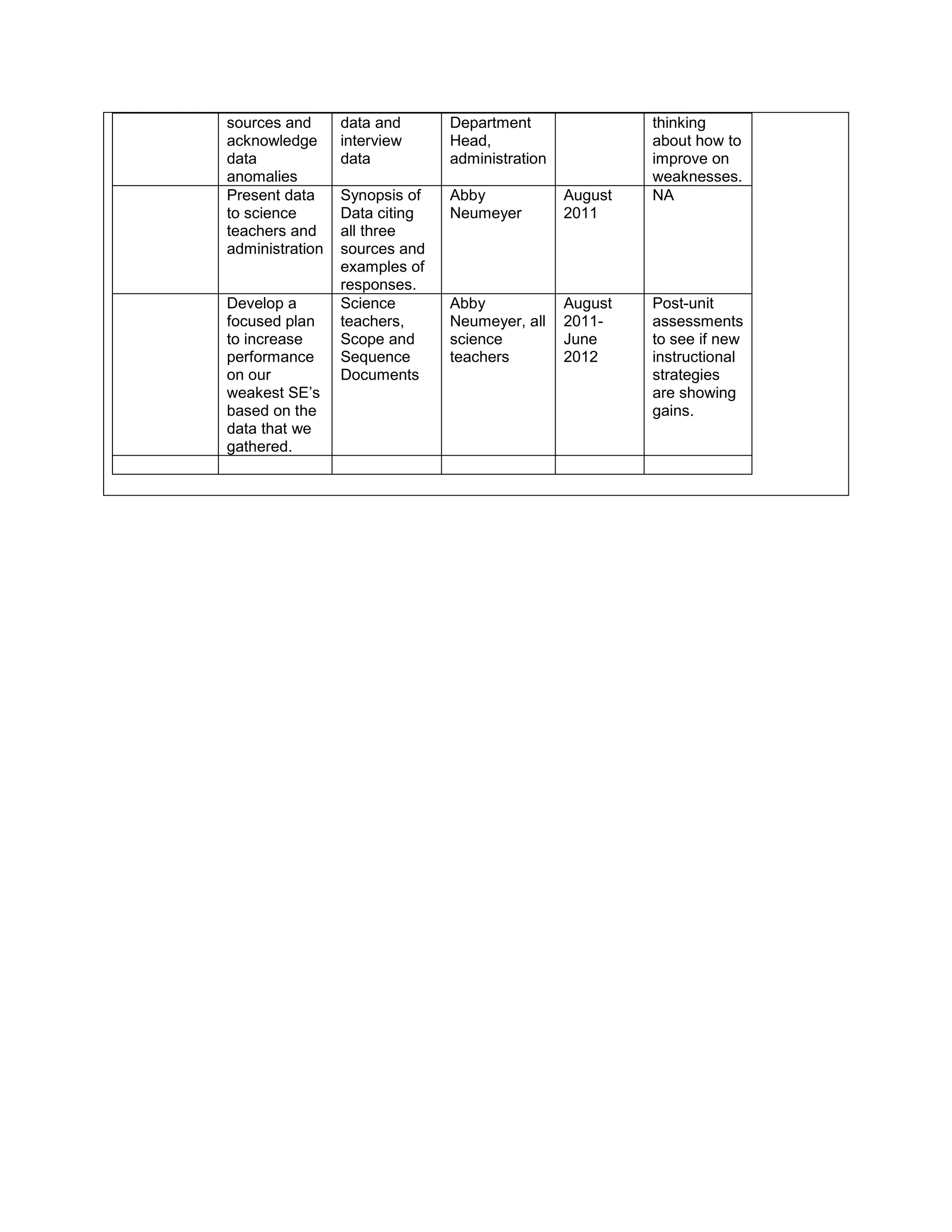
The document outlines a plan to use student data to inform science instruction and help students improve their performance on the lowest scoring areas of the state's Science TAKS test. The plan involves analyzing past TAKS data, observing classrooms, interviewing students and teachers, identifying trends, and developing a new instructional plan focused on the weakest areas. Progress will be evaluated by assessing student performance after implementing the new strategies.
![Goal: Use data to inform science instruction in a way that will help student be successful on all objectives of the Science TAKS test.OutcomesAction StepsNeeded ResourcesPerson(s) ResponsibleTime LineEvaluationIncreased student achievement in weakest Student Expectations on Science TAKS TestConduct analysis of 10th and 11th grade TAKS Student Expectation data for the previous 5 years.Eduphoria [our student database]Abby Neumeyer, department headAugust 2010NAConduct walk-throughs of teachers while they are instructing on the weakest and strongest SE’s. Make observational notes.Composition Notebook, Flip Video Camera, Examples of student workAbby NeumeyerApril 2011Monthly reflection on information gathered so far. Interview students and teachers about the lowest and highest performing SE’s using a different questioning sequence for teachers and students.Interview questions, voice recorder, Every science teacher, 100 randomly selected studentsAbby Neumeyer,Various Science TeachersJune 2011As I interview people, I will need to reflect on my questions to make sure that interviewees are responding in ways that align with the goals of the research. i.e. Am I really getting them to open up about their experiences. Am I appropriately asking questions so that I am producing good data for my research?Find trends in all three data sources and acknowledge data anomaliesTAKS data, observational data and interview dataAbby Neumeyer, Department Head, administrationJuly 2011Reflect on data to start thinking about how to improve on weaknesses.Present data to science teachers and administrationSynopsis of Data citing all three sources and examples of responses.Abby NeumeyerAugust 2011NADevelop a focused plan to increase performance on our weakest SE’s based on the data that we gathered.Science teachers, Scope and Sequence Documents Abby Neumeyer, all science teachersAugust 2011-June 2012Post-unit assessments to see if new instructional strategies are showing gains. <br />](https://image.slidesharecdn.com/actionresearchplan-100727140222-phpapp01/75/Action-research-plan-1-2048.jpg)