Dr. Rashid Mahmood
Action Potential & its Propagation
By Prof. Dr. Rashid Mahmood
Dr. Rashid Mahmood
Objectives
• Goal /Aim:
• By the end of this session students should be able to understand the mechanism of
production & propagation of electrical changes occurring in excitable tissues.
• Student should be able to:
• To know the types of Disturbances across the Cell Membrane include action
potential & local response
• Define Action Potential
• Describe the Typical Action Potential in Large Myelinated Nerve fiber
• Explain & draw the Stages of Action Potential
• Describe the Types of Channels involved in Various Excitable Tissues
• Tell the difference between Voltage Gated Na+ and K+ Channels
• Describe the Propagation (Transmission) of Action Potential
• Explain Saltatory Conduction
• Differentiate between different Types of Action Potential
Dr. Rashid Mahmood
2
Dr. Rashid Mahmood
Lesson contents
• Types of Disturbances across the Cell Membrane
• Definition of Action Potential
• Typical Action Potential in Large Myelinated Nerve fiber
• Stages of Action Potential
• Types of Channels involved in Various Excitable Tissues
• Voltage Gated Na+ and K+ Channels
• Na+
and K+
Conductance
• Propagation (Transmission) of Action Potential
• Saltatory Conduction
• Direction of Propagation
• Types of Action Potential
Dr. Rashid Mahmood
3
Dr. Rashid Mahmood Dr. Rashid Mahmood
4
Types of Disturbances across the Cell
Membrane
• TWO Types:
• Non-Propagated Potentials:
– Synaptic
– Generator
• Propagated
• Action Potential
Action Potential
Dr. Rashid Mahmood 5
ACTION POTENTIAL
Dr. Rashid Mahmood 6
Action Potential
• Definition:
– Rapid changes in the membrane potential that spread
rapidly along cell membrane of excitable tissues
– Abrupt / sudden Change (reversal) in resting membrane
potential in response to a threshold stimulus.
– Sequence of events along the membrane of an Excitable
tissue in response to threshold stimuli
• Transmission of signals
• Sudden change, sudden end
• Transmission continues until fiber ends
• Transport of ions
Dr. Rashid Mahmood
Assessment Q.1
• Define Action Potential
Dr. Rashid Mahmood
7
Dr. Rashid Mahmood 8
Typical Action Potential in Large
Myelinated Nerve fiber
Exact
Dr. Rashid Mahmood 9
Dr. Rashid Mahmood 10
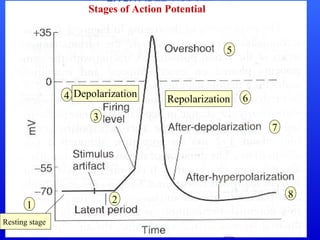
Resting stage
Depolarization
Repolarization
1
2
3
4
5
6
7
8
Stages of Action Potential
Dr. Rashid Mahmood 11
Types of Channels involved in Various
Excitable Tissues
• Na+ Leak Channels
– From -90 (or-70) mv to -50 mv
Na+
• Voltage gated channels (fast)
– from -70 mv onwards K+
• Slow Ca++
- Na+
Channels
• Ligand Gated Channels
• Na+
- K+
Pump
Dr. Rashid Mahmood Dr. Rashid Mahmood
12
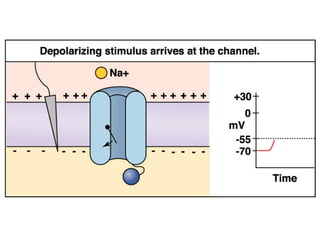
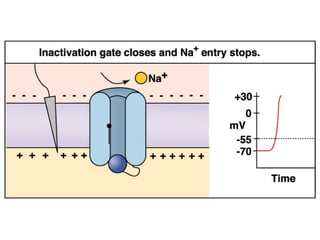
Voltage Gated Na+ Channels
Dr. Rashid Mahmood 13
Voltage Gated Na+
Channels
Dr. Rashid Mahmood 14
Voltage Gated K+
Channels
Dr. Rashid Mahmood 15
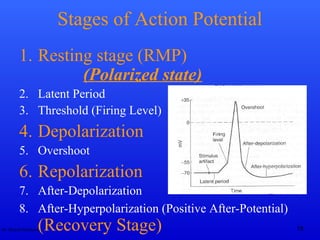
Stages of Action Potential
1. Resting stage (RMP)
(Polarized state)
2. Latent Period
3. Threshold (Firing Level)
4. Depolarization
5. Overshoot
6. Repolarization
7. After-Depolarization
8. After-Hyperpolarization (Positive After-Potential)
(Recovery Stage)
Dr. Rashid Mahmood
Assessment Q.2
• List the Stages of Action Potential
Dr. Rashid Mahmood
16
Dr. Rashid Mahmood 17
Dr. Rashid Mahmood 18
Dr. Rashid Mahmood 19
Dr. Rashid Mahmood 20
Dr. Rashid Mahmood 21
Dr. Rashid Mahmood 22
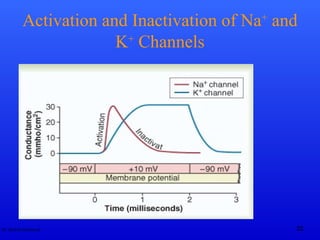
Activation and Inactivation of Na+
and
K+
Channels
Dr. Rashid Mahmood 23
Summary of mechanism of development of
different stages of Action Potential
1. Resting stage (RMP)
(Polarized state)
-90 mV
1. Depolarization
Stimulus → sudden ↑in
Na+ Permeability
Na+ Leak Channels
From -90 (or-70) mv to
-50 mv
Voltage gated channels
(fast)
from -70 mv onwards
3. Overshoot Potential
4. Repolarization
Closure of Na+ Channels
Inactivation of Na+
Channels (Same
stimulus but Delayed)
Opening of K+ Channels
(Activation by same
stimulus but Delayed)
4. Hyperpolarization:
K+ Channels remain open
Na+ Out
4. Recovery Stage
Na+ K+ ATPase Pump
Dr. Rashid Mahmood 24
Na+
and K+
Conductance
Dr. Rashid Mahmood 25
Stages of
Action
Potential vs
Na+ & K+
Conductance
Dr. Rashid Mahmood 26
Video of Action Potential:
Roll of Sodium channels
Dr. Rashid Mahmood
Assessment Q.3
Draw the figure of a Typical Action potential
Dr. Rashid Mahmood
27
Dr. Rashid Mahmood 28
Summary
of events
in Action
Potential
Dr. Rashid Mahmood 29
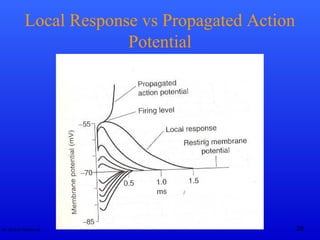
Local Response vs Propagated Action
Potential
Dr. Rashid Mahmood 30
Propagation
(Transmission)
of Action
Potential
• Electrotonic
Conduction.
• Local circuit of
Current along both
sides of membrane
Dr. Rashid Mahmood 31
Propagation of Action Potential-II
(Saltatory Conduction)
Dr. Rashid Mahmood 32
Dr. Rashid Mahmood 33
Dr. Rashid Mahmood 34
Propagation of Action Potential-II
(Saltatory Conduction)
• Jumping
• Advantages:
1. ↑ velocity
Myelinated fibers: 100 m/s
Unmyelinated fibers: 0.25
m/s
1. Energy Conservation
Dr. Rashid Mahmood 35
Direction of Propagation
• All directions
• Till end
• Orthodromic
• Antidromic
Dr. Rashid Mahmood
Action Potential Video
• ..Videosaction-potential video. studentconsult.htm
36
Dr. Rashid Mahmood 37
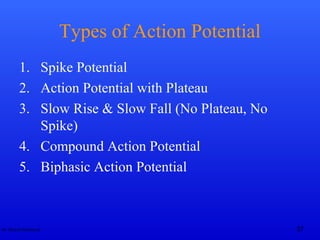
Types of Action Potential
1. Spike Potential
2. Action Potential with Plateau
3. Slow Rise & Slow Fall (No Plateau, No
Spike)
4. Compound Action Potential
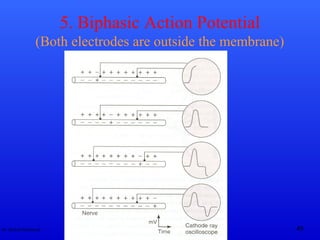
5. Biphasic Action Potential
Dr. Rashid Mahmood 38
1. Spike Potential
Action Potential in Self Excitatory Tissues (S-A Node)
Dr. Rashid Mahmood 39
2. Action Potential with Plateau
Dr. Rashid Mahmood 40
Action Potential with Plateau
(Cardiac Muscle)
Red curve shows rise and fall in tension of ventricular myocyte
Dr. Rashid Mahmood 41
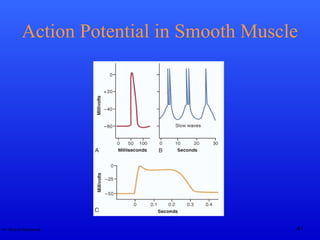
Action Potential in Smooth Muscle
Dr. Rashid Mahmood 42
3. Slow Rise & Slow Fall
• No Plateau
• Only Slow Channels
Dr. Rashid Mahmood 43
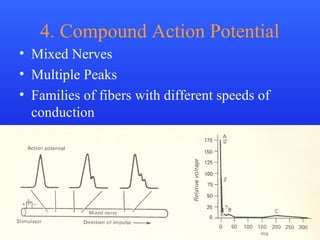
4. Compound Action Potential
• Mixed Nerves
• Multiple Peaks
• Families of fibers with different speeds of
conduction
Dr. Rashid Mahmood 44
Compound Action Potential
Dr. Rashid Mahmood 45
5. Biphasic Action Potential
(Both electrodes are outside the membrane)
Dr. Rashid Mahmood 46
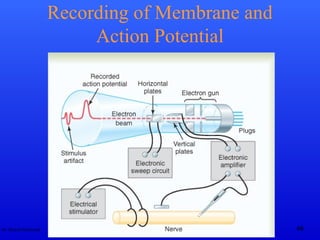
Recording of Membrane and
Action Potential
Dr. Rashid Mahmood 47
Recording of Membrane and Action
Potential
Dr. Rashid Mahmood 48
Action Potential is energy consuming
process
Dr. Rashid Mahmood 49
Self-Study Topics
• All-or-nothing Principle
– “Safety factor” for propagation
• Rhythmicity
I don’t t each my st udent s, I j ust
provide guidance and environment
conduct ive t o learning.
Albert Einstein (1877-1955)
Dr. Rashid Mahmood
Summary
• Types of Disturbances across the Cell Membrane include action potential &
local response
• Action Potential is defined as Rapid changes in the membrane potential that
spread rapidly along cell membrane of excitable tissues
• Main stages of Action Potential include Resting stage (Polarized state),
Depolarization, Overshoot, Repolarization & Recovery Stage
• Types of Channels involved in Various Excitable Tissues include Voltage Gated
Na+ and K+ Channels, Na+
-K+
leak channels, & in some cases Ca++
channels
• Propagation (Transmission) of Action Potential occurs in All directions till the
end of the fiber
• Saltatory Conduction is the Jumping of Action Potential from one Node of
Ranvier to next in Myelinated fibers
• The advantages of Saltatory Conduction include increase velocity of conduction
& Energy Conservation
• Main Types of Action Potential include Spike Potential, Action Potential with
Plateau, Compound Action Potential & Biphasic Action Potential
Dr. Rashid Mahmood
50
Dr. Rashid Mahmood
Assessment Q.4
• What is meant by Saltatory conduction?
Dr. Rashid Mahmood
51
Dr. Rashid Mahmood
Learning Resources
• Guyton and Hall (Text book of physiology), 13th Edition
• Ganong (Text book of physiology), 24th Edition
• Berne & Levy Principles of Physiology (Koeppen BM), 6th
Edition
• Human Physiology Stuart Ira Fox, 13th Edition
• Human Physiology : from cells to system Lauralee
Sherwood,9th
Edition
• Internet
© Prof. Dr. Rashid Mahmood 52

action potential 2.pdf

  • 1.
    Dr. Rashid Mahmood ActionPotential & its Propagation By Prof. Dr. Rashid Mahmood
  • 2.
    Dr. Rashid Mahmood Objectives •Goal /Aim: • By the end of this session students should be able to understand the mechanism of production & propagation of electrical changes occurring in excitable tissues. • Student should be able to: • To know the types of Disturbances across the Cell Membrane include action potential & local response • Define Action Potential • Describe the Typical Action Potential in Large Myelinated Nerve fiber • Explain & draw the Stages of Action Potential • Describe the Types of Channels involved in Various Excitable Tissues • Tell the difference between Voltage Gated Na+ and K+ Channels • Describe the Propagation (Transmission) of Action Potential • Explain Saltatory Conduction • Differentiate between different Types of Action Potential Dr. Rashid Mahmood 2
  • 3.
    Dr. Rashid Mahmood Lessoncontents • Types of Disturbances across the Cell Membrane • Definition of Action Potential • Typical Action Potential in Large Myelinated Nerve fiber • Stages of Action Potential • Types of Channels involved in Various Excitable Tissues • Voltage Gated Na+ and K+ Channels • Na+ and K+ Conductance • Propagation (Transmission) of Action Potential • Saltatory Conduction • Direction of Propagation • Types of Action Potential Dr. Rashid Mahmood 3
  • 4.
    Dr. Rashid MahmoodDr. Rashid Mahmood 4 Types of Disturbances across the Cell Membrane • TWO Types: • Non-Propagated Potentials: – Synaptic – Generator • Propagated • Action Potential Action Potential
  • 5.
    Dr. Rashid Mahmood5 ACTION POTENTIAL
  • 6.
    Dr. Rashid Mahmood6 Action Potential • Definition: – Rapid changes in the membrane potential that spread rapidly along cell membrane of excitable tissues – Abrupt / sudden Change (reversal) in resting membrane potential in response to a threshold stimulus. – Sequence of events along the membrane of an Excitable tissue in response to threshold stimuli • Transmission of signals • Sudden change, sudden end • Transmission continues until fiber ends • Transport of ions
  • 7.
    Dr. Rashid Mahmood AssessmentQ.1 • Define Action Potential Dr. Rashid Mahmood 7
  • 8.
    Dr. Rashid Mahmood8 Typical Action Potential in Large Myelinated Nerve fiber Exact
  • 9.
  • 10.
    Dr. Rashid Mahmood10 Resting stage Depolarization Repolarization 1 2 3 4 5 6 7 8 Stages of Action Potential
  • 11.
    Dr. Rashid Mahmood11 Types of Channels involved in Various Excitable Tissues • Na+ Leak Channels – From -90 (or-70) mv to -50 mv Na+ • Voltage gated channels (fast) – from -70 mv onwards K+ • Slow Ca++ - Na+ Channels • Ligand Gated Channels • Na+ - K+ Pump
  • 12.
    Dr. Rashid MahmoodDr. Rashid Mahmood 12 Voltage Gated Na+ Channels
  • 13.
    Dr. Rashid Mahmood13 Voltage Gated Na+ Channels
  • 14.
    Dr. Rashid Mahmood14 Voltage Gated K+ Channels
  • 15.
    Dr. Rashid Mahmood15 Stages of Action Potential 1. Resting stage (RMP) (Polarized state) 2. Latent Period 3. Threshold (Firing Level) 4. Depolarization 5. Overshoot 6. Repolarization 7. After-Depolarization 8. After-Hyperpolarization (Positive After-Potential) (Recovery Stage)
  • 16.
    Dr. Rashid Mahmood AssessmentQ.2 • List the Stages of Action Potential Dr. Rashid Mahmood 16
  • 17.
  • 18.
  • 19.
  • 20.
  • 21.
  • 22.
    Dr. Rashid Mahmood22 Activation and Inactivation of Na+ and K+ Channels
  • 23.
    Dr. Rashid Mahmood23 Summary of mechanism of development of different stages of Action Potential 1. Resting stage (RMP) (Polarized state) -90 mV 1. Depolarization Stimulus → sudden ↑in Na+ Permeability Na+ Leak Channels From -90 (or-70) mv to -50 mv Voltage gated channels (fast) from -70 mv onwards 3. Overshoot Potential 4. Repolarization Closure of Na+ Channels Inactivation of Na+ Channels (Same stimulus but Delayed) Opening of K+ Channels (Activation by same stimulus but Delayed) 4. Hyperpolarization: K+ Channels remain open Na+ Out 4. Recovery Stage Na+ K+ ATPase Pump
  • 24.
    Dr. Rashid Mahmood24 Na+ and K+ Conductance
  • 25.
    Dr. Rashid Mahmood25 Stages of Action Potential vs Na+ & K+ Conductance
  • 26.
    Dr. Rashid Mahmood26 Video of Action Potential: Roll of Sodium channels
  • 27.
    Dr. Rashid Mahmood AssessmentQ.3 Draw the figure of a Typical Action potential Dr. Rashid Mahmood 27
  • 28.
    Dr. Rashid Mahmood28 Summary of events in Action Potential
  • 29.
    Dr. Rashid Mahmood29 Local Response vs Propagated Action Potential
  • 30.
    Dr. Rashid Mahmood30 Propagation (Transmission) of Action Potential • Electrotonic Conduction. • Local circuit of Current along both sides of membrane
  • 31.
    Dr. Rashid Mahmood31 Propagation of Action Potential-II (Saltatory Conduction)
  • 32.
  • 33.
  • 34.
    Dr. Rashid Mahmood34 Propagation of Action Potential-II (Saltatory Conduction) • Jumping • Advantages: 1. ↑ velocity Myelinated fibers: 100 m/s Unmyelinated fibers: 0.25 m/s 1. Energy Conservation
  • 35.
    Dr. Rashid Mahmood35 Direction of Propagation • All directions • Till end • Orthodromic • Antidromic
  • 36.
    Dr. Rashid Mahmood ActionPotential Video • ..Videosaction-potential video. studentconsult.htm 36
  • 37.
    Dr. Rashid Mahmood37 Types of Action Potential 1. Spike Potential 2. Action Potential with Plateau 3. Slow Rise & Slow Fall (No Plateau, No Spike) 4. Compound Action Potential 5. Biphasic Action Potential
  • 38.
    Dr. Rashid Mahmood38 1. Spike Potential Action Potential in Self Excitatory Tissues (S-A Node)
  • 39.
    Dr. Rashid Mahmood39 2. Action Potential with Plateau
  • 40.
    Dr. Rashid Mahmood40 Action Potential with Plateau (Cardiac Muscle) Red curve shows rise and fall in tension of ventricular myocyte
  • 41.
    Dr. Rashid Mahmood41 Action Potential in Smooth Muscle
  • 42.
    Dr. Rashid Mahmood42 3. Slow Rise & Slow Fall • No Plateau • Only Slow Channels
  • 43.
    Dr. Rashid Mahmood43 4. Compound Action Potential • Mixed Nerves • Multiple Peaks • Families of fibers with different speeds of conduction
  • 44.
    Dr. Rashid Mahmood44 Compound Action Potential
  • 45.
    Dr. Rashid Mahmood45 5. Biphasic Action Potential (Both electrodes are outside the membrane)
  • 46.
    Dr. Rashid Mahmood46 Recording of Membrane and Action Potential
  • 47.
    Dr. Rashid Mahmood47 Recording of Membrane and Action Potential
  • 48.
    Dr. Rashid Mahmood48 Action Potential is energy consuming process
  • 49.
    Dr. Rashid Mahmood49 Self-Study Topics • All-or-nothing Principle – “Safety factor” for propagation • Rhythmicity I don’t t each my st udent s, I j ust provide guidance and environment conduct ive t o learning. Albert Einstein (1877-1955)
  • 50.
    Dr. Rashid Mahmood Summary •Types of Disturbances across the Cell Membrane include action potential & local response • Action Potential is defined as Rapid changes in the membrane potential that spread rapidly along cell membrane of excitable tissues • Main stages of Action Potential include Resting stage (Polarized state), Depolarization, Overshoot, Repolarization & Recovery Stage • Types of Channels involved in Various Excitable Tissues include Voltage Gated Na+ and K+ Channels, Na+ -K+ leak channels, & in some cases Ca++ channels • Propagation (Transmission) of Action Potential occurs in All directions till the end of the fiber • Saltatory Conduction is the Jumping of Action Potential from one Node of Ranvier to next in Myelinated fibers • The advantages of Saltatory Conduction include increase velocity of conduction & Energy Conservation • Main Types of Action Potential include Spike Potential, Action Potential with Plateau, Compound Action Potential & Biphasic Action Potential Dr. Rashid Mahmood 50
  • 51.
    Dr. Rashid Mahmood AssessmentQ.4 • What is meant by Saltatory conduction? Dr. Rashid Mahmood 51
  • 52.
    Dr. Rashid Mahmood LearningResources • Guyton and Hall (Text book of physiology), 13th Edition • Ganong (Text book of physiology), 24th Edition • Berne & Levy Principles of Physiology (Koeppen BM), 6th Edition • Human Physiology Stuart Ira Fox, 13th Edition • Human Physiology : from cells to system Lauralee Sherwood,9th Edition • Internet © Prof. Dr. Rashid Mahmood 52