Action leads to
  success!
challenged attitude
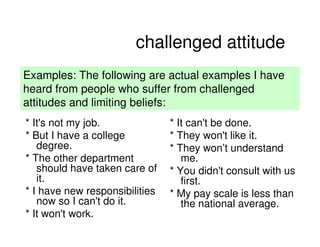
Examples: The following are actual examples I have
heard from people who suffer from challenged
attitudes and limiting beliefs:
* It's not my job.              * It can't be done.
* But I have a college          * They won't like it.
   degree.                      * They won’t understand
* The other department             me.
   should have taken care of    * You didn't consult with us
   it.                             first.
* I have new responsibilities   * My pay scale is less than
   now so I can't do it.           the national average.
* It won't work.
                                                 2008 PEW RESEARCH CENTER
challenged attitude
                                  (cont)


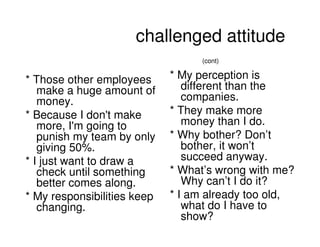
* Those other employees      * My perception is
   make a huge amount of        different than the
   money.                       companies.
* Because I don't make       * They make more
   more, I'm going to           money than I do.
   punish my team by only    * Why bother? Don’t
   giving 50%.                  bother, it won’t
* I just want to draw a         succeed anyway.
   check until something     * What’s wrong with me?
   better comes along.          Why can’t I do it?
* My responsibilities keep   * I am already too old,
   changing.                    what do I have to
                                show?
                                           2008 PEW RESEARCH CENTER
challenged attitude
                                         (cont)


* How can I compete with         * If I fail, I’m going to look
   these guys?                      stupid.
* I am considered a bottom       * I have no incentives.
   feeder.                       * I have no growth
* I am just going to look like      possibilities.
   a fool.                       * I want higher pay.
* I did the research I should    * I can't advance because of
   make more money.                 a political environment.
* There is too much change.      * I don't get any respect.
* Nothing stays the same.        * I hope to get fired so I can
* I am just going to                collect unemployment.
   embarrass myself if I try.

                                                    2008 PEW RESEARCH CENTER
the limiting beliefs
When we are born, nature installs 2 basic survival
instincts in us; the fear of heights and the fear of loud
noises. Fear can be a good thing in small moderation
as it protects us from harm when we seek safety. In
our daily experience, our biological senses also helps
us in deciding what we should eat. Our sense of smell
may prevent us from eating something that had gone
bad, and when we are drowsy, our body tells us to
sleep and recharge ourselves. Most fears and instincts
we have are limits we place on ourselves, whether we
have learned it directly or indirectly from others, or our
painful learning experience in our earlier years.
                                                2008 PEW RESEARCH CENTER
why are   limiting beliefs
                                     bad?


I would not say that all limiting beliefs are bad,
however, I can say that some of the beliefs we have
prevents us from taking actions, realizing our full
potential or try out other interesting things.

If you want to be an entrepreneur, having limiting
beliefs and self doubts will most definitely not inspire
confidence in stakeholders and customers. Being
negative and may also mean setting mental barriers to
success.
                                              2008 PEW RESEARCH CENTER
the   motivating mindset

We have instincts that motivates us to do
things. When we are hungry, the biological
motivating mindset signals us eat, when
thirsty, it signals us to drink. People may
have different motivating mindset due to
culture, education and experience.


                                     2008 PEW RESEARCH CENTER
case 1:
4 minute mile. For hundreds of years, many have
attempted this feat and all have fallen short. But on
May 6, 1954, Roger Bannister ran 1 mile in 3 minutes
and 54 seconds. This was amazing but within a year,
37 other runners had broken his record. Within the
next 3 years, 300 runners had repeated the same feat.
What held these runners back were their limiting
beliefs and it was not until someone had proven that it
could be done, people do not perform to their fullest
potential.

                                             2008 PEW RESEARCH CENTER
case 2:
In the American army, the new recruits were often
called “Heroes” and “Champions” during the initial
training. They were given a lot of positive feedback to
make them believe that they can achieve more.

And many did. People who could never do pull ups
could do 6, and people who had never exercised could
run 5 miles. Thing they would have never done without
peer pressure and the reinforcements and
encouragements given, changed their beliefs and
unleashed their potential, making them do feats they
have never thought possible.                  2008 PEW RESEARCH CENTER
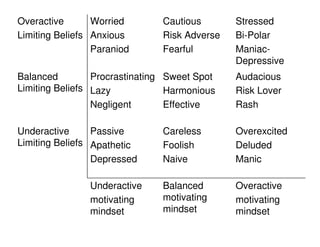
Overactive       Worried       Cautious       Stressed
Limiting Beliefs Anxious       Risk Adverse   Bi-Polar
                 Paraniod      Fearful        Maniac-
                                              Depressive
Balanced         Procrastinating Sweet Spot   Audacious
Limiting Beliefs Lazy            Harmonious   Risk Lover
                 Negligent       Effective    Rash

Underactive      Passive       Careless       Overexcited
Limiting Beliefs Apathetic     Foolish        Deluded
                 Depressed     Naive          Manic

                Underactive    Balanced       Overactive
                motivating     motivating     motivating
                mindset        mindset        mindset
When our limiting beliefs and motivating
mindsets are out of balance, all kinds of
afflictions arise. It is important for us to
identify our limiting beliefs and
compulsions if we want to achieve our full
potential.

                                    2008 PEW RESEARCH CENTER
beliefs & outcomes(PAW
                         process)


You need to believe three things
about your outcomes:
1) It is possible to achieve
2) You are able to achieve them
3) You deserve to achieve them
P - Possibility

Very often, we mistake possibility for competence.
We think something if not possible when really we
do not know how to do it. As humans, we all do
have physical limits, but we don’t usually know that
these limits are.

You cannot prove a negative, therefore you can
never prove that you are incapable of anything, you
can only say that you have not achieved it yet.
A - Ability

Have you the put a limit on what you can achieve?
We often sell ourselves short by not believing we
can do something. But beliefs are not facts – they
are just our best guess about things at a certain
point of time.

Keep an open mind. Have one basic true belief:
You have not reached the limit of what you are
capable yet.
A - Ability


Do not ever announce to other people that you
can’t do something, even if you think you can’t.
People often own up much more readily about
things that they are bad at than what they are good
at. This is not modesty. Modesty mean not bragging
about what you can do.
DON’T BOAST ABOUT YOUR SUPPOSED
            LIMITATIONS

Negative talk just places a self-imposed glass
   ceiling on what you are going to do. If you
  think like this, add the little word “yet” to the
end. Though there may be good reasons why
you may not get the goal, don’t make excuses
in advance, then you have just set yourself up
                     for failure.
W - Worthiness
Many people may have a positive attitude, but the
key towards achievement is a PAW Process.

Do you deserve to achieve your goals?

Only you can answer this question, but why not?
If people are unwilling to try, but if you volunteered
and accomplished, who deserves the success? It is
not about ethics or morals when it comes to self-
worthiness. Do not apologize for succeeding or
winning. Notice any uncomfortable feelings, and
they will point to obstacles and self-doubts.
Just repeat the following for
         each goal:

    ‘This goal is possible’
‘I have the ability to achieve
           this goal’
  “I deserve to achieve this
             goal’
7 Steps to Overcoming
        Challenged Attitudes
1. WORK on your personal foundation,
  namely in the Five Pillars of Attraction.
  Remember what F.R.E.S.H. stands for:
F: Finances
R: Relationships
E: Environment
S: Spirituality
H: Health
7 Steps to Overcoming
        Challenged Attitudes
  Right now, write down one task for each of the
  Five Pillars (F.R.E.S.H.) that you can make an
  immediate improvement in.
2. STOP listening to that little negative voice.
  Counter-punch the negative self talk with a
  substantial dose of positiveness.
3. LOOK for alternative explanations. In many
  cases there could be hundreds of them,
  unfortunately when you are frustrated you are
  unable to see the forest for the trees -
  sometimes referred to as Frustration Tunnel
  Vision.
7 Steps to Overcoming
          Challenged Attitudes
4. MOODS are contagious, both positive and negative. Do
   something that will place you in a positive mood, such as
   a daily delicious habit or speaking with anyone that is
   known for having a positive attitude or mood.
5. CONTROL your frustration. Speak slowly, breath deeply
   into your heart, choose to remain calm or excuse
   yourself from the discussion take a time out. Stop
   drinking caffeine.
6. STOP looking out the rear view mirror when that big
   broad windshield is staring you in the face. Your vision of
   each event or situation is totally up to you. You can
   either choose to be negative or positive your choice. Or,
   you can either focus on your negative past or look
   forward into a positive future. Remember this quote:
   "Past failures don't equal current successes."
7 Steps to Overcoming
         Challenged Attitudes
7. WATCH with great care who you hang out with. My most
   favorite quote by Jim Rohn says "YOU become the
   average sum of the five people with whom you associate
   with." In regards to this powerful philosophy, ask
   yourselves these questions:
o Who am I around?
o What are they doing to me?
o What have they got me saying?
o Where do they have me going?
o What do they have me thinking?
o What do they have me becoming?
o Then ask yourself the big question: Is that okay?
UNLEASH YOUR BRAND
         There is nothing hide

                  Twitter: robin_low
   Blog: http://blog.unleashyourbranding.com/
   Facebook: http://www.facebook.com/socialhub
   LinkedIn: http://www.linkedin.com/in/robinlow88

Action leads to success

  • 1.
  • 2.
    challenged attitude Examples: Thefollowing are actual examples I have heard from people who suffer from challenged attitudes and limiting beliefs: * It's not my job. * It can't be done. * But I have a college * They won't like it. degree. * They won’t understand * The other department me. should have taken care of * You didn't consult with us it. first. * I have new responsibilities * My pay scale is less than now so I can't do it. the national average. * It won't work. 2008 PEW RESEARCH CENTER
  • 3.
    challenged attitude (cont) * Those other employees * My perception is make a huge amount of different than the money. companies. * Because I don't make * They make more more, I'm going to money than I do. punish my team by only * Why bother? Don’t giving 50%. bother, it won’t * I just want to draw a succeed anyway. check until something * What’s wrong with me? better comes along. Why can’t I do it? * My responsibilities keep * I am already too old, changing. what do I have to show? 2008 PEW RESEARCH CENTER
  • 4.
    challenged attitude (cont) * How can I compete with * If I fail, I’m going to look these guys? stupid. * I am considered a bottom * I have no incentives. feeder. * I have no growth * I am just going to look like possibilities. a fool. * I want higher pay. * I did the research I should * I can't advance because of make more money. a political environment. * There is too much change. * I don't get any respect. * Nothing stays the same. * I hope to get fired so I can * I am just going to collect unemployment. embarrass myself if I try. 2008 PEW RESEARCH CENTER
  • 5.
    the limiting beliefs Whenwe are born, nature installs 2 basic survival instincts in us; the fear of heights and the fear of loud noises. Fear can be a good thing in small moderation as it protects us from harm when we seek safety. In our daily experience, our biological senses also helps us in deciding what we should eat. Our sense of smell may prevent us from eating something that had gone bad, and when we are drowsy, our body tells us to sleep and recharge ourselves. Most fears and instincts we have are limits we place on ourselves, whether we have learned it directly or indirectly from others, or our painful learning experience in our earlier years. 2008 PEW RESEARCH CENTER
  • 6.
    why are limiting beliefs bad? I would not say that all limiting beliefs are bad, however, I can say that some of the beliefs we have prevents us from taking actions, realizing our full potential or try out other interesting things. If you want to be an entrepreneur, having limiting beliefs and self doubts will most definitely not inspire confidence in stakeholders and customers. Being negative and may also mean setting mental barriers to success. 2008 PEW RESEARCH CENTER
  • 7.
    the motivating mindset We have instincts that motivates us to do things. When we are hungry, the biological motivating mindset signals us eat, when thirsty, it signals us to drink. People may have different motivating mindset due to culture, education and experience. 2008 PEW RESEARCH CENTER
  • 8.
    case 1: 4 minutemile. For hundreds of years, many have attempted this feat and all have fallen short. But on May 6, 1954, Roger Bannister ran 1 mile in 3 minutes and 54 seconds. This was amazing but within a year, 37 other runners had broken his record. Within the next 3 years, 300 runners had repeated the same feat. What held these runners back were their limiting beliefs and it was not until someone had proven that it could be done, people do not perform to their fullest potential. 2008 PEW RESEARCH CENTER
  • 9.
    case 2: In theAmerican army, the new recruits were often called “Heroes” and “Champions” during the initial training. They were given a lot of positive feedback to make them believe that they can achieve more. And many did. People who could never do pull ups could do 6, and people who had never exercised could run 5 miles. Thing they would have never done without peer pressure and the reinforcements and encouragements given, changed their beliefs and unleashed their potential, making them do feats they have never thought possible. 2008 PEW RESEARCH CENTER
  • 10.
    Overactive Worried Cautious Stressed Limiting Beliefs Anxious Risk Adverse Bi-Polar Paraniod Fearful Maniac- Depressive Balanced Procrastinating Sweet Spot Audacious Limiting Beliefs Lazy Harmonious Risk Lover Negligent Effective Rash Underactive Passive Careless Overexcited Limiting Beliefs Apathetic Foolish Deluded Depressed Naive Manic Underactive Balanced Overactive motivating motivating motivating mindset mindset mindset
  • 11.
    When our limitingbeliefs and motivating mindsets are out of balance, all kinds of afflictions arise. It is important for us to identify our limiting beliefs and compulsions if we want to achieve our full potential. 2008 PEW RESEARCH CENTER
  • 12.
    beliefs & outcomes(PAW process) You need to believe three things about your outcomes: 1) It is possible to achieve 2) You are able to achieve them 3) You deserve to achieve them
  • 13.
    P - Possibility Veryoften, we mistake possibility for competence. We think something if not possible when really we do not know how to do it. As humans, we all do have physical limits, but we don’t usually know that these limits are. You cannot prove a negative, therefore you can never prove that you are incapable of anything, you can only say that you have not achieved it yet.
  • 14.
    A - Ability Haveyou the put a limit on what you can achieve? We often sell ourselves short by not believing we can do something. But beliefs are not facts – they are just our best guess about things at a certain point of time. Keep an open mind. Have one basic true belief: You have not reached the limit of what you are capable yet.
  • 15.
    A - Ability Donot ever announce to other people that you can’t do something, even if you think you can’t. People often own up much more readily about things that they are bad at than what they are good at. This is not modesty. Modesty mean not bragging about what you can do.
  • 16.
    DON’T BOAST ABOUTYOUR SUPPOSED LIMITATIONS Negative talk just places a self-imposed glass ceiling on what you are going to do. If you think like this, add the little word “yet” to the end. Though there may be good reasons why you may not get the goal, don’t make excuses in advance, then you have just set yourself up for failure.
  • 17.
    W - Worthiness Manypeople may have a positive attitude, but the key towards achievement is a PAW Process. Do you deserve to achieve your goals? Only you can answer this question, but why not? If people are unwilling to try, but if you volunteered and accomplished, who deserves the success? It is not about ethics or morals when it comes to self- worthiness. Do not apologize for succeeding or winning. Notice any uncomfortable feelings, and they will point to obstacles and self-doubts.
  • 18.
    Just repeat thefollowing for each goal: ‘This goal is possible’ ‘I have the ability to achieve this goal’ “I deserve to achieve this goal’
  • 19.
    7 Steps toOvercoming Challenged Attitudes 1. WORK on your personal foundation, namely in the Five Pillars of Attraction. Remember what F.R.E.S.H. stands for: F: Finances R: Relationships E: Environment S: Spirituality H: Health
  • 20.
    7 Steps toOvercoming Challenged Attitudes Right now, write down one task for each of the Five Pillars (F.R.E.S.H.) that you can make an immediate improvement in. 2. STOP listening to that little negative voice. Counter-punch the negative self talk with a substantial dose of positiveness. 3. LOOK for alternative explanations. In many cases there could be hundreds of them, unfortunately when you are frustrated you are unable to see the forest for the trees - sometimes referred to as Frustration Tunnel Vision.
  • 21.
    7 Steps toOvercoming Challenged Attitudes 4. MOODS are contagious, both positive and negative. Do something that will place you in a positive mood, such as a daily delicious habit or speaking with anyone that is known for having a positive attitude or mood. 5. CONTROL your frustration. Speak slowly, breath deeply into your heart, choose to remain calm or excuse yourself from the discussion take a time out. Stop drinking caffeine. 6. STOP looking out the rear view mirror when that big broad windshield is staring you in the face. Your vision of each event or situation is totally up to you. You can either choose to be negative or positive your choice. Or, you can either focus on your negative past or look forward into a positive future. Remember this quote: "Past failures don't equal current successes."
  • 22.
    7 Steps toOvercoming Challenged Attitudes 7. WATCH with great care who you hang out with. My most favorite quote by Jim Rohn says "YOU become the average sum of the five people with whom you associate with." In regards to this powerful philosophy, ask yourselves these questions: o Who am I around? o What are they doing to me? o What have they got me saying? o Where do they have me going? o What do they have me thinking? o What do they have me becoming? o Then ask yourself the big question: Is that okay?
  • 23.
    UNLEASH YOUR BRAND There is nothing hide Twitter: robin_low Blog: http://blog.unleashyourbranding.com/ Facebook: http://www.facebook.com/socialhub LinkedIn: http://www.linkedin.com/in/robinlow88