Genre Research (Horror)
Lee Turner
Characters
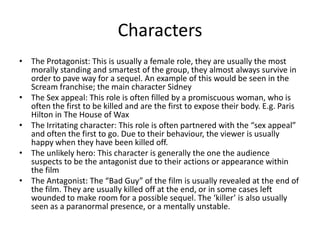
• The Protagonist: This is usually a female role, they are usually the most
morally standing and smartest of the group, they almost always survive in
order to pave way for a sequel. An example of this would be seen in the
Scream franchise; the main character Sidney
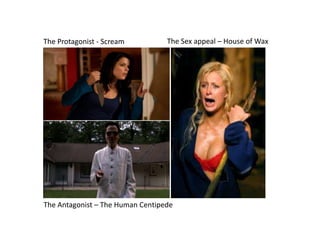
• The Sex appeal: This role is often filled by a promiscuous woman, who is
often the first to be killed and are the first to expose their body. E.g. Paris
Hilton in The House of Wax
• The Irritating character: This role is often partnered with the “sex appeal”
and often the first to go. Due to their behaviour, the viewer is usually
happy when they have been killed off.
• The unlikely hero: This character is generally the one the audience
suspects to be the antagonist due to their actions or appearance within
the film
• The Antagonist: The “Bad Guy” of the film is usually revealed at the end of
the film. They are usually killed off at the end, or in some cases left
wounded to make room for a possible sequel. The ‘killer’ is also usually
seen as a paranormal presence, or a mentally unstable.
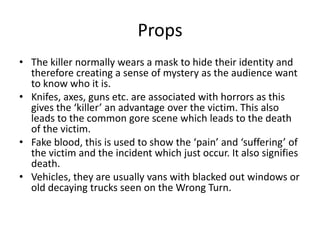
The Protagonist - Scream The Sex appeal – House of Wax
The Antagonist – The Human Centipede
Props
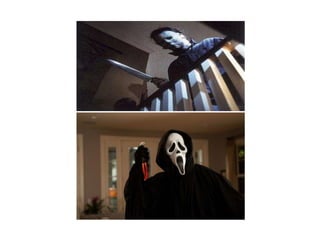
• The killer normally wears a mask to hide their identity and
therefore creating a sense of mystery as the audience want
to know who it is.
• Knifes, axes, guns etc. are associated with horrors as this
gives the ‘killer’ an advantage over the victim. This also
leads to the common gore scene which leads to the death
of the victim.
• Fake blood, this is used to show the ‘pain’ and ‘suffering’ of
the victim and the incident which just occur. It also signifies
death.
• Vehicles, they are usually vans with blacked out windows or
old decaying trucks seen on the Wrong Turn.
Location/ Setting
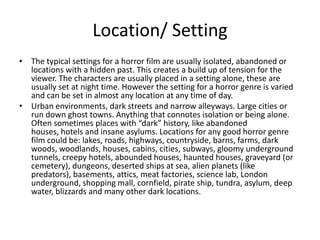
• The typical settings for a horror film are usually isolated, abandoned or
locations with a hidden past. This creates a build up of tension for the
viewer. The characters are usually placed in a setting alone, these are
usually set at night time. However the setting for a horror genre is varied
and can be set in almost any location at any time of day.
• Urban environments, dark streets and narrow alleyways. Large cities or
run down ghost towns. Anything that connotes isolation or being alone.
Often sometimes places with “dark” history, like abandoned
houses, hotels and insane asylums. Locations for any good horror genre
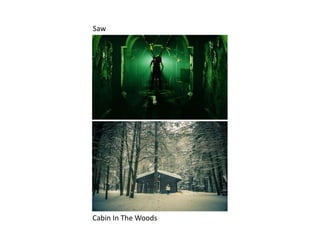
film could be: lakes, roads, highways, countryside, barns, farms, dark
woods, woodlands, houses, cabins, cities, subways, gloomy underground
tunnels, creepy hotels, abounded houses, haunted houses, graveyard (or
cemetery), dungeons, deserted ships at sea, alien planets (like
predators), basements, attics, meat factories, science lab, London
underground, shopping mall, cornfield, pirate ship, tundra, asylum, deep
water, blizzards and many other dark locations.
Saw
Cabin In The Woods
Situations
• Power is cut at the scariest moment possible, the lights suddenly go out! An ancient staple, probably leading back to a time before there was
electricity. Serial killers: cut the power before they begin their killing spree.
• Phone lines are cut, the killers always take out the phones so that no one will attract the attention of any policemen. Almost all horror films where a
phone can be seen will have the phone lines cut. In the recent age of cellular phones, things have changed - a phone's battery runs out, the mobile
phone is damaged, or goes somewhere where there is no service.
• Someone investigates a strange noise, this is one of the most unbelievable, yet most overused horror movie conventions. All of your friends have
been brutally butchered and eaten by an unseen maniac. You hear something odd coming from the woods. Is that the sound of someone dragging a
dead teenaged body across a bridge with exposed nails in it? Now would you, even on a dare, walk into the woods alone to investigate? I wouldn't
either, but it seems every movie character would.
• Someone runs upstairs instead of outside e.g. Scream. You will frequently see potential victims running past open doors to the outside world (and
safety) in a desperate attempt to get upstairs where they can lock themselves in a ‘safe’ place.
• Victim cowers in front of a window or door an old, easy scare in ‘slashers’ is to have someone hiding from the killer against a door/wall/window only
to have the killer's hand break through the door/wall/window and grab them. Or the victim looks out the window (car windows too), sees
nothing, and when they turn away, the killer jumps through. There are hundreds of possibilities, and this particular scare can certainly be done
effectively.
• Victim inexplicably falls over.
• Vehicle won’t start, this can happen with any vehicle, from snowmobiles to motorcycles to spaceships to the chain falling off a bicycle .
• The fake scare this is one of the oldest and most over-used conventions in horror films. They can take on any shape and size, but in general, any
scare in a film that is not connected to the threat (a friend jumps out, a door slams, someone looks into a mirror, someone new enters the room
unnoticed, the phone rings, someone bumps into a department store mannequin, something falls, someone is tapped on the shoulder or grabbed, a
policeman knocks on the car window, a balloon pops, a bird flies out of the trees, etc.) is a fake one. They are easy to do, and can be very effective.
• Warning goes unheeded, it is human nature to go where one is told not to go, and do what one is advised against. This can be achieved in many
ways: someone has a dream that something nasty will befall all who go on that ski-trip (yet they go anyway), there is a rumoured curse regarding a
discovered object (and they take it anyway).
• Someone is killed in the first 5 minutes, most of these are all ‘slashers’. When well done (ie.. Jaws , House , Halloween , or Scream ), it's used to set
the mood of the rest of the film and can be very effective.
• X years before / later, this indicates either a prologue, setting up the events that happened before our story (such as the first couple minutes of
Halloween or The Descent ), or a film where we see the latter effects of an incident (e.g. What You Did Last Summer ), or an extensive flashback used
to explain things .
• The stormy night since the days of Victorian Horror, and even before, this has been one of the genre's most overused clichés. It may stem from the
fact that we have a childhood fear of thunder, or that lightning and rain create atmosphere.
• The short cut, if you are driving somewhere, why not go off the beaten track and take a short-cut? Better still, go somewhere completely out of the
way where there is absolutely no chance of being able to find anyone to help you. Even better still, take the advice of a creepy local and head down
that deserted road.
Sound
• Exaggerated diegetic sounds allow tension to build within the film world
for example rustling winds, doors banging by themselves, someone
screaming, dripping water etc., generally these sounds are heard by
viewers on a day to day to basis. But if these sounds were to be used in a
scary movie following up to a surprise attack, the viewers will feel more
thrilled and alert, therefore keeping them entertained. For example
‘Paranormal Activity’ had no non-diegetic sounds, this was so it had a
more authentic feel which is what viewers are interested to see. There’s
no intense music in the background (non-diegetic) thus creating a sense of
authenticity to what we are watching, it’s more chilling because the
viewer is made to feel, that what they are witnessing are actual events. If
you had disturbing but faint music in the background; the viewer would
know it is leading towards a scary scene, this makes it too predictable.
• Fast and loud non diegetic sound are used to make the audience jump or
feel scared i.e. the music in the shower scene in Psycho.

Genre Research - Horror Forms and Conventions

  • 1.
  • 2.
    Characters • The Protagonist:This is usually a female role, they are usually the most morally standing and smartest of the group, they almost always survive in order to pave way for a sequel. An example of this would be seen in the Scream franchise; the main character Sidney • The Sex appeal: This role is often filled by a promiscuous woman, who is often the first to be killed and are the first to expose their body. E.g. Paris Hilton in The House of Wax • The Irritating character: This role is often partnered with the “sex appeal” and often the first to go. Due to their behaviour, the viewer is usually happy when they have been killed off. • The unlikely hero: This character is generally the one the audience suspects to be the antagonist due to their actions or appearance within the film • The Antagonist: The “Bad Guy” of the film is usually revealed at the end of the film. They are usually killed off at the end, or in some cases left wounded to make room for a possible sequel. The ‘killer’ is also usually seen as a paranormal presence, or a mentally unstable.
  • 3.
    The Protagonist -Scream The Sex appeal – House of Wax The Antagonist – The Human Centipede
  • 4.
    Props • The killernormally wears a mask to hide their identity and therefore creating a sense of mystery as the audience want to know who it is. • Knifes, axes, guns etc. are associated with horrors as this gives the ‘killer’ an advantage over the victim. This also leads to the common gore scene which leads to the death of the victim. • Fake blood, this is used to show the ‘pain’ and ‘suffering’ of the victim and the incident which just occur. It also signifies death. • Vehicles, they are usually vans with blacked out windows or old decaying trucks seen on the Wrong Turn.
  • 6.
    Location/ Setting • Thetypical settings for a horror film are usually isolated, abandoned or locations with a hidden past. This creates a build up of tension for the viewer. The characters are usually placed in a setting alone, these are usually set at night time. However the setting for a horror genre is varied and can be set in almost any location at any time of day. • Urban environments, dark streets and narrow alleyways. Large cities or run down ghost towns. Anything that connotes isolation or being alone. Often sometimes places with “dark” history, like abandoned houses, hotels and insane asylums. Locations for any good horror genre film could be: lakes, roads, highways, countryside, barns, farms, dark woods, woodlands, houses, cabins, cities, subways, gloomy underground tunnels, creepy hotels, abounded houses, haunted houses, graveyard (or cemetery), dungeons, deserted ships at sea, alien planets (like predators), basements, attics, meat factories, science lab, London underground, shopping mall, cornfield, pirate ship, tundra, asylum, deep water, blizzards and many other dark locations.
  • 7.
  • 8.
    Situations • Power iscut at the scariest moment possible, the lights suddenly go out! An ancient staple, probably leading back to a time before there was electricity. Serial killers: cut the power before they begin their killing spree. • Phone lines are cut, the killers always take out the phones so that no one will attract the attention of any policemen. Almost all horror films where a phone can be seen will have the phone lines cut. In the recent age of cellular phones, things have changed - a phone's battery runs out, the mobile phone is damaged, or goes somewhere where there is no service. • Someone investigates a strange noise, this is one of the most unbelievable, yet most overused horror movie conventions. All of your friends have been brutally butchered and eaten by an unseen maniac. You hear something odd coming from the woods. Is that the sound of someone dragging a dead teenaged body across a bridge with exposed nails in it? Now would you, even on a dare, walk into the woods alone to investigate? I wouldn't either, but it seems every movie character would. • Someone runs upstairs instead of outside e.g. Scream. You will frequently see potential victims running past open doors to the outside world (and safety) in a desperate attempt to get upstairs where they can lock themselves in a ‘safe’ place. • Victim cowers in front of a window or door an old, easy scare in ‘slashers’ is to have someone hiding from the killer against a door/wall/window only to have the killer's hand break through the door/wall/window and grab them. Or the victim looks out the window (car windows too), sees nothing, and when they turn away, the killer jumps through. There are hundreds of possibilities, and this particular scare can certainly be done effectively. • Victim inexplicably falls over. • Vehicle won’t start, this can happen with any vehicle, from snowmobiles to motorcycles to spaceships to the chain falling off a bicycle . • The fake scare this is one of the oldest and most over-used conventions in horror films. They can take on any shape and size, but in general, any scare in a film that is not connected to the threat (a friend jumps out, a door slams, someone looks into a mirror, someone new enters the room unnoticed, the phone rings, someone bumps into a department store mannequin, something falls, someone is tapped on the shoulder or grabbed, a policeman knocks on the car window, a balloon pops, a bird flies out of the trees, etc.) is a fake one. They are easy to do, and can be very effective. • Warning goes unheeded, it is human nature to go where one is told not to go, and do what one is advised against. This can be achieved in many ways: someone has a dream that something nasty will befall all who go on that ski-trip (yet they go anyway), there is a rumoured curse regarding a discovered object (and they take it anyway). • Someone is killed in the first 5 minutes, most of these are all ‘slashers’. When well done (ie.. Jaws , House , Halloween , or Scream ), it's used to set the mood of the rest of the film and can be very effective. • X years before / later, this indicates either a prologue, setting up the events that happened before our story (such as the first couple minutes of Halloween or The Descent ), or a film where we see the latter effects of an incident (e.g. What You Did Last Summer ), or an extensive flashback used to explain things . • The stormy night since the days of Victorian Horror, and even before, this has been one of the genre's most overused clichés. It may stem from the fact that we have a childhood fear of thunder, or that lightning and rain create atmosphere. • The short cut, if you are driving somewhere, why not go off the beaten track and take a short-cut? Better still, go somewhere completely out of the way where there is absolutely no chance of being able to find anyone to help you. Even better still, take the advice of a creepy local and head down that deserted road.
  • 9.
    Sound • Exaggerated diegeticsounds allow tension to build within the film world for example rustling winds, doors banging by themselves, someone screaming, dripping water etc., generally these sounds are heard by viewers on a day to day to basis. But if these sounds were to be used in a scary movie following up to a surprise attack, the viewers will feel more thrilled and alert, therefore keeping them entertained. For example ‘Paranormal Activity’ had no non-diegetic sounds, this was so it had a more authentic feel which is what viewers are interested to see. There’s no intense music in the background (non-diegetic) thus creating a sense of authenticity to what we are watching, it’s more chilling because the viewer is made to feel, that what they are witnessing are actual events. If you had disturbing but faint music in the background; the viewer would know it is leading towards a scary scene, this makes it too predictable. • Fast and loud non diegetic sound are used to make the audience jump or feel scared i.e. the music in the shower scene in Psycho.