MEDIASTUDIES REVISION:
SECTIONA
ACTIONADVENTURE FILMS.
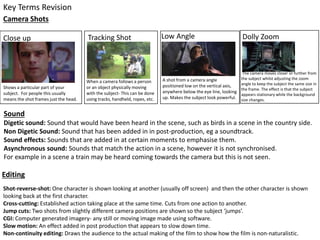
Key Terms Revision
Editing
Shows a particular part of your
subject. For people this usually
means the shot frames just the head.
Tracking Shot
When a camera follows a person
or an object physically moving
with the subject- This can be done
using tracks, handheld, ropes, etc.
Low Angle
A shot from a camera angle
positioned low on the vertical axis,
anywhere below the eye line, looking
up. Makes the subject look powerful.
Dolly Zoom
The camera moves closer or further from
the subject whilst adjusting the zoom
angle to keep the subject the same size in
the frame. The effect is that the subject
appears stationary while the background
size changes.
Sound
Digetic sound: Sound that would have been heard in the scene, such as birds in a scene in the country side.
Non Digetic Sound: Sound that has been added in in post-production, eg a soundtrack.
Sound effects: Sounds that are added in at certain moments to emphasise them.
Asynchronous sound: Sounds that match the action in a scene, however it is not synchronised.
For example in a scene a train may be heard coming towards the camera but this is not seen.
Camera Shots
Close up
Shot-reverse-shot: One character is shown looking at another (usually off screen) and then the other character is shown
looking back at the first character.
Cross-cutting: Established action taking place at the same time. Cuts from one action to another.
Jump cuts: Two shots from slightly different camera positions are shown so the subject ‘jumps’.
CGI: Computer generated imagery- any still or moving image made using software.
Slow motion: An effect added in post production that appears to slow down time.
Non-continuity editing: Draws the audience to the actual making of the film to show how the film is non-naturalistic.
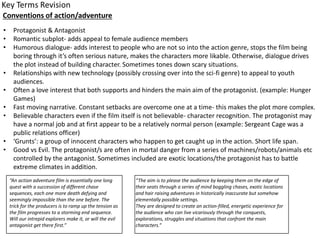
Conventions of action/adventure
• Protagonist & Antagonist
• Romantic subplot- adds appeal to female audience members
• Humorous dialogue- adds interest to people who are not so into the action genre, stops the film being
boring through it’s often serious nature, makes the characters more likable. Otherwise, dialogue drives
the plot instead of building character. Sometimes tones down scary situations.
• Relationships with new technology (possibly crossing over into the sci-fi genre) to appeal to youth
audiences.
• Often a love interest that both supports and hinders the main aim of the protagonist. (example: Hunger
Games)
• Fast moving narrative. Constant setbacks are overcome one at a time- this makes the plot more complex.
• Believable characters even if the film itself is not believable- character recognition. The protagonist may
have a normal job and at first appear to be a relatively normal person (example: Sergeant Cage was a
public relations officer)
• ‘Grunts’: a group of innocent characters who happen to get caught up in the action. Short life span.
• Good vs Evil. The protagonist/s are often in mortal danger from a series of machines/robots/animals etc
controlled by the antagonist. Sometimes included are exotic locations/the protagonist has to battle
extreme climates in addition.
“An action adventure film is essentially one long
quest with a succession of different chase
sequences, each one more death defying and
seemingly impossible than the one before. The
trick for the producers is to ramp up the tension as
the film progresses to a storming end sequence.
Will our intrepid explorers make it, or will the evil
antagonist get there first.”
“The aim is to please the audience by keeping them on the edge of
their seats through a series of mind boggling chases, exotic locations
and hair raising adventures in historically inaccurate but somehow
elementally possible settings.
They are designed to create an action-filled, energetic experience for
the audience who can live vicariously through the conquests,
explorations, struggles and situations that confront the main
characters.”
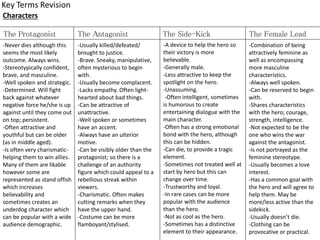
Characters
The Protagonist The Antagonist The Side-Kick The Female Lead
-Never dies although this
seems the most likely
outcome. Always wins.
-Stereotypically confident,
brave, and masculine.
-Well spoken and strategic.
-Determined. Will fight
back against whatever
negative force he/she is up
against until they come out
on top; persistent.
-Often attractive and
youthful but can be older
(as in middle aged).
-Is often very charismatic-
helping them to win allies.
Many of them are likable
however some are
represented as stand offish
which increases
believability and
sometimes creates an
underdog character which
can be popular with a wide
audience demographic.
-Usually killed/defeated/
brought to justice.
-Brave. Sneaky, manipulative,
often mysterious to begin
with.
-Usually become complacent.
-Lacks empathy. Often light-
hearted about bad things.
-Can be attractive of
unattractive.
-Well spoken or sometimes
have an accent.
-Always have an ulterior
motive.
-Can be visibly older than the
protagonist; so there is a
challenge of an authority
figure which could appeal to a
rebellious streak within
viewers.
-Charismatic. Often makes
cutting remarks when they
have the upper hand.
-Costume can be more
flamboyant/stylised.
-A device to help the hero so
their victory is more
believable.
-Generally male.
-Less attractive to keep the
spotlight on the hero.
-Unassuming.
-Often intelligent, sometimes
is humorous to create
entertaining dialogue with the
main character.
-Often has a strong emotional
bond with the hero, although
this can be hidden.
-Can die, to provide a tragic
element.
-Sometimes not treated well at
start by hero but this can
change over time.
-Trustworthy and loyal.
-In rare cases can be more
popular with the audience
than the hero.
-Not as cool as the hero.
-Sometimes has a distinctive
element to their appearance.
-Combination of being
attractively feminine as
well as encompassing
more masculine
characteristics.
-Always well spoken.
-Can be reserved to begin
with.
-Shares characteristics
with the hero; courage,
strength, intelligence.
-Not expected to be the
one who wins the war
against the antagonist.
-Is not portrayed as the
feminine stereotype.
-Usually becomes a love
interest.
-Has a common goal with
the hero and will agree to
help them. May be
more/less active than the
sidekick.
-Usually doesn’t die.
-Clothing can be
provocative or practical.

Media Studies- Exam Revision for Action/Adventure films

  • 1.
  • 2.
    Key Terms Revision Editing Showsa particular part of your subject. For people this usually means the shot frames just the head. Tracking Shot When a camera follows a person or an object physically moving with the subject- This can be done using tracks, handheld, ropes, etc. Low Angle A shot from a camera angle positioned low on the vertical axis, anywhere below the eye line, looking up. Makes the subject look powerful. Dolly Zoom The camera moves closer or further from the subject whilst adjusting the zoom angle to keep the subject the same size in the frame. The effect is that the subject appears stationary while the background size changes. Sound Digetic sound: Sound that would have been heard in the scene, such as birds in a scene in the country side. Non Digetic Sound: Sound that has been added in in post-production, eg a soundtrack. Sound effects: Sounds that are added in at certain moments to emphasise them. Asynchronous sound: Sounds that match the action in a scene, however it is not synchronised. For example in a scene a train may be heard coming towards the camera but this is not seen. Camera Shots Close up Shot-reverse-shot: One character is shown looking at another (usually off screen) and then the other character is shown looking back at the first character. Cross-cutting: Established action taking place at the same time. Cuts from one action to another. Jump cuts: Two shots from slightly different camera positions are shown so the subject ‘jumps’. CGI: Computer generated imagery- any still or moving image made using software. Slow motion: An effect added in post production that appears to slow down time. Non-continuity editing: Draws the audience to the actual making of the film to show how the film is non-naturalistic.
  • 3.
    Conventions of action/adventure •Protagonist & Antagonist • Romantic subplot- adds appeal to female audience members • Humorous dialogue- adds interest to people who are not so into the action genre, stops the film being boring through it’s often serious nature, makes the characters more likable. Otherwise, dialogue drives the plot instead of building character. Sometimes tones down scary situations. • Relationships with new technology (possibly crossing over into the sci-fi genre) to appeal to youth audiences. • Often a love interest that both supports and hinders the main aim of the protagonist. (example: Hunger Games) • Fast moving narrative. Constant setbacks are overcome one at a time- this makes the plot more complex. • Believable characters even if the film itself is not believable- character recognition. The protagonist may have a normal job and at first appear to be a relatively normal person (example: Sergeant Cage was a public relations officer) • ‘Grunts’: a group of innocent characters who happen to get caught up in the action. Short life span. • Good vs Evil. The protagonist/s are often in mortal danger from a series of machines/robots/animals etc controlled by the antagonist. Sometimes included are exotic locations/the protagonist has to battle extreme climates in addition. “An action adventure film is essentially one long quest with a succession of different chase sequences, each one more death defying and seemingly impossible than the one before. The trick for the producers is to ramp up the tension as the film progresses to a storming end sequence. Will our intrepid explorers make it, or will the evil antagonist get there first.” “The aim is to please the audience by keeping them on the edge of their seats through a series of mind boggling chases, exotic locations and hair raising adventures in historically inaccurate but somehow elementally possible settings. They are designed to create an action-filled, energetic experience for the audience who can live vicariously through the conquests, explorations, struggles and situations that confront the main characters.”
  • 4.
    Characters The Protagonist TheAntagonist The Side-Kick The Female Lead -Never dies although this seems the most likely outcome. Always wins. -Stereotypically confident, brave, and masculine. -Well spoken and strategic. -Determined. Will fight back against whatever negative force he/she is up against until they come out on top; persistent. -Often attractive and youthful but can be older (as in middle aged). -Is often very charismatic- helping them to win allies. Many of them are likable however some are represented as stand offish which increases believability and sometimes creates an underdog character which can be popular with a wide audience demographic. -Usually killed/defeated/ brought to justice. -Brave. Sneaky, manipulative, often mysterious to begin with. -Usually become complacent. -Lacks empathy. Often light- hearted about bad things. -Can be attractive of unattractive. -Well spoken or sometimes have an accent. -Always have an ulterior motive. -Can be visibly older than the protagonist; so there is a challenge of an authority figure which could appeal to a rebellious streak within viewers. -Charismatic. Often makes cutting remarks when they have the upper hand. -Costume can be more flamboyant/stylised. -A device to help the hero so their victory is more believable. -Generally male. -Less attractive to keep the spotlight on the hero. -Unassuming. -Often intelligent, sometimes is humorous to create entertaining dialogue with the main character. -Often has a strong emotional bond with the hero, although this can be hidden. -Can die, to provide a tragic element. -Sometimes not treated well at start by hero but this can change over time. -Trustworthy and loyal. -In rare cases can be more popular with the audience than the hero. -Not as cool as the hero. -Sometimes has a distinctive element to their appearance. -Combination of being attractively feminine as well as encompassing more masculine characteristics. -Always well spoken. -Can be reserved to begin with. -Shares characteristics with the hero; courage, strength, intelligence. -Not expected to be the one who wins the war against the antagonist. -Is not portrayed as the feminine stereotype. -Usually becomes a love interest. -Has a common goal with the hero and will agree to help them. May be more/less active than the sidekick. -Usually doesn’t die. -Clothing can be provocative or practical.