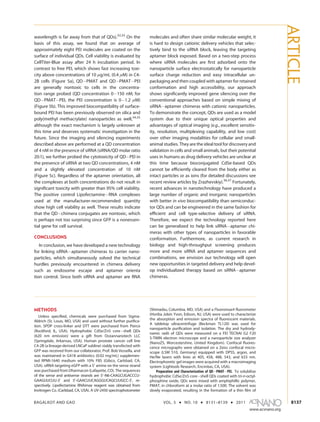
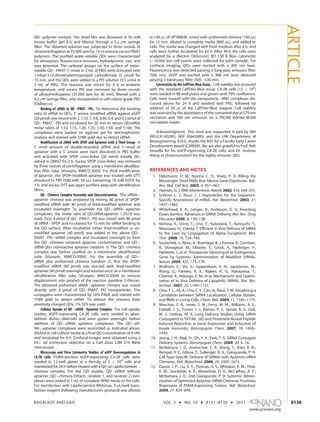
BAGALKOT AND GAO VOL. 5 ’ NO. 10 ’ 8131–8139 ’ 2011
www.acsnano.org
8131
September 21, 2011
C 2011 American Chemical Society
siRNA-Aptamer Chimeras on
Nanoparticles: Preserving Targeting
Functionality for Effective Gene
Silencing
Vaishali Bagalkot and Xiaohu Gao*
Department of Bioengineering, University of Washington, Seattle, Washington 98195, United States
s
iRNA is of considerable current interest
in biology and medicine because it can
elicit potent, target-specific knock-
down of virtually any mRNA, creating new
opportunities for functional genomics stud-
iesandmedicaltreatmentoftoughdiseases.1À3
Similar to other antisense approaches, ap-
plying siRNA technology in vivo, however,
still faces major challenges, particularly the
technical hurdles in selective delivery.4
To
guide siRNA to diseased cells, targeting
ligands such as small molecules, lipids, pep-
tides, and proteins have been linked directly
tosiRNAoronthesurfaceofsiRNAcarriers.5À10
Most recently, a siRNAÀaptamer chimera, em-
ploying only RNA molecules, has emerged as a
promising approach for efficient delivery of
siRNA to specific cell types, owing to its low
immunogenicity, ease of chemical synthesis
and modification, and the outstanding target-
ing specificity of the aptamer. For example,
chimeras composed of aptamer targeting
prostate-specific membrane antigen (PSMA)
and siRNA targeting antiapoptotic genes have
been identified and optimized.11,12
The apta-
mer block recognizes PSMA on the prostate
tumor cell surface and leads to chimera cell
internalization, whereas the siRNA block enzy-
matically cleaved from the chimera causes cell
death. Significantly reduced tumor mass was
observed in mouse xenograft models of pros-
tate tumor after administration of the chimera,
though the exact mechanism of how chimeras
escape endosomes after cell entry remains
unclear.13
This limitation may help explain
the fact that high concentrations of chimeras
were used in these pioneer studies to treat
prostate tumors.11,12
A solution to this problem and potential
improvement of the chimera technology is
to combine chimeras with nanocarriers
with endosome-rupturing capabilities. Recent
advances in bionanotechnology and molec-
ular engineering have produced a number
of siRNA delivery strategies based on lipo-
some, cationic polymers, and most recently
inorganic nanoparticles such as gold, silica,
magnetic, and semiconductor nanoparti-
cles.14À18
In addition to the endosome-rup-
ture capability, inorganic nanoparticles of-
ten provide imaging functionalities as well,
due to their unique electronic, optical, and
magnetic properties, which enable real-
time imaging of siRNA delivery, distribution,
and intracellular behavior.19
For example, we
have previously reported the combination of
* Address correspondence to
xgao@u.washington.edu.
Received for review July 21, 2011
and accepted September 17, 2011.
Published online
10.1021/nn202772p
ABSTRACT SiRNAÀaptamer chimeras are emerging as a highly promising approach for cell-type
specific delivery of siRNA due to the outstanding targeting capability of aptamers and the
compatibility of chimeras with native ribonuclease (Dicer) processing. For efficient RNA interference
(RNAi), however, additional challenges must be addressed, in particular how to get siRNA out of the
endosome after cell entry and how to preserve aptamer targeting specificity when chimeras are
combined with delivery carriers. Here, we report a rationally designed nanoparticle vector that
simultaneously displays large surface area for high siRNA payload, exposed aptamer for specific
targeting, proton sponge effect for endosome escape, and fluorescence for imaging and
quantification. A key concept of this work is to graft chimeras onto nanoparticle surface via a
two-step process: first immobilizing siRNA onto nanoparticle via noncovalent interactions to
facilitate intracellular unpackaging and reduce nanoparticle surface charge (avoiding nonspecific
electrostatic interactions between aptamers and nanoparticles) and then coupling siRNA and
aptamer with retained conformation and high accessibility. Compared with conventional one-step
adsorption of siRNAÀaptamer chimeras onto nanoparticles with random orientations and con-
formations, which does not elicit much improved RNAi effect than nontargeted nanoparticleÀsiRNA
complexes (∼6À8% improvement of the total cell population), under the same RNA concentration
our approach shows selective gene silencing and enables 34% more silenced cells of the total cell
population over nontargeted nanoparticleÀsiRNA complexes. This remarkable difference in RNAi
efficiency using nanoparticleÀchimera complexes is directly related to cell uptake discrepancy
resulting from aptamer conformation on the nanoparticle surface (intact vs random).
KEYWORDS: quantum dot . nanoparticle . siRNA . aptamer . chimera . gene silencing .
targeting ARTICLE
BAGALKOT AND GAO VOL. 5 ’ NO. 10 ’ 8131–8139 ’ 2011
www.acsnano.org
8132
quantum dots (QDs) with zwitterionic amphiphilic
polymers for efficient in vitro siRNA delivery.20,21
The
intrinsic fluorescence of QDs and exquisitely designed
energy transfer assays allow real-time observation of
siRNA cell entry, endosome escape, and separation
with the nanoparticle carrier.20
A common feature
shared by these existing nanocarriers is that they are
positively charged, which is essential for siRNA immo-
bilization, condensation, and escape from endosome
and lysosome. On the other hand, this high positive
charge also creates a problem for targeted delivery of
siRNAÀaptamer chimeras. Since both the siRNA and
aptamer blocks are negatively charged RNA molecules,
they will nonspecifically “collapse” onto cationic ma-
terials and thus affect aptamer conformation and
selective binding (Figure 1a). Indeed, using planar
microarray chips, Walter et al. have shown that
aptamers interact with a positively charged surface
electrostatically, resulting in unfolding of aptamers and
loss of binding activity.22
Thus, we hypothesize that the control of aptamer
orientation and 3D conformation on the surface of
nanoparticles is critical in preserving its targeting
functionality (at least for some aptamer sequences).
Ideally, the siRNA block should become the anchor
point for interaction with cationic nanoparticles for
reduced enzymatic degradation and nonspecific inter-
action with cells and tissues, whereas the aptamer
block should stay on the outside with minimized
interaction with the nanoparticle surface. Toward this
goal, here we present a two-step approach to link
siRNAÀaptamer chimeras onto nanoparticles with en-
dosome-rupturing capability. In contrast to single-step
adsorption of preformed chimeras onto nanoparticles
(Figure 1a), siRNA molecules (targeting eGFP) with a
thiol-reactive terminal group are first adsorbed onto
Figure 1. Schematic representation of cationic nanoparticles for targeted delivery of siRNAÀaptamer chimeras.
(a) Immobilization of preformed siRNAÀaptamer chimeras onto positively charged QDÀPMATÀPEI nanoparticles. The
aptamer block collapsed on the carrier results in reduced binding activity. (b) Two-step immobilization of chimeras
on a cationic nanoparticle surface. siRNA molecules with a thiol-reactive terminal group are first adsorbed on the
QDÀPMATÀPEI surface to reduce the positive charge; subsequently aptamers with a single thiol group are brought in to
form siRNAÀaptamer chimeras on the nanoparticle surface. (c) TEM image of QDÀPMATÀPEI nanoparticles (scale bar 10 nm).
(d) Hydrodynamic diameter of QD-PMAT (12.1 ( 0.7 nm) and QDÀPMATÀPEI (32.2 ( 4.5 nm) nanoparticles.
ARTICLE
BAGALKOT AND GAO VOL. 5 ’ NO. 10 ’ 8131–8139 ’ 2011
www.acsnano.org
8133
polyethylene imine (PEI)-coated nanoparticles electro-
statically (Figure 1b). This noncovalent interaction not
only facilitates siRNA detaching from the nanocarrier
inside cells but also helps neutralize some of the
positive charges on the nanoparticle surface. In the
second step, aptamers (targeting PSMA) with a single
thiol group away from the binding site are brought in
to form siRNAÀaptamer chimeras. Due to the reduced
positive charge on nanoparticles, their interaction with
aptamers is weakened, thus helping to retain aptamer
flexibility, accessibility, and original binding activity.
Note that a QD is selected as a model system because
of its excellent photoluminiscent properties for real-
time imaging. We expect the design principles learned
from these studies can be generalized because other
types of nanoparticles can be readily made with similar
surface chemistry.
RESULTS AND DISCUSSION
Water-soluble QDs are prepared by molecular self-
assembly of hydrophobic QDs with amphiphilic copo-
lymers (poly(maleic anhydride-alt-1-tetradecene), or
PMAT).23
The resulting QDs are highly stable in aqueous
solution (due to the high-density carboxylic acid groups
of PMAT) with well-preserved optical properties. To
capture siRNA and facilitate its escape from endosome,
PEI is conjugated to water-soluble QDs due to PEI's pH
buffering capability, also known as the proton sponge
effect.24
In contrast to prior reports on the formation of a
QDÀPEI cluster of approximately 200 nm by mixing PEI
with carbodiimide compounds first,25
our approach by
adding carbodiimide-activated QDs to PEI yields single
nonaggregated QDs (TEM images in Figure 1c). Dy-
namic light-scattering measurements of purified QDÀ
PEI particles show an average hydrodynamic diameter
of 32.2 ( 4.5 nm (Figure 1d), which is ∼10 nm greater
than QDÀPMAT (12.1 ( 0.7 nm) on both sides, indicat-
ing successful conjugation of PEI to QDs. To further
confirm this result, we characterized the surface charge
before and after PEI conjugation. The zeta potential of
QDs reverses from negative 43.9 ( 5.3 mV to positive
27.0 ( 4.5 mV, confirming a positively charged PEI layer
on the QD surface.
To investigate the number of siRNA molecules that
can be loaded on QDs, siRNA at a fixed amount is mixed
Figure 2. Characterization of the two-step QDÀchimera formation process. (a) Determination of siRNA loading capacity on
the QDÀPMATÀPEI surface. Twenty pmole of siRNA is mixed with QDs at various molar ratios (10, 15, 20, 25, 30, 50, and 100).
Free siRNA is undetectable up to 1:50 QD:siRNA molar ratio; however at 1:100 ratio the green flourescence of SYBR
gold-stained siRNA can be seen, indicating that at least 50 siRNA molecules can bind onto each QD. (b and inset)
Hydrodynamic size and zeta potential measured by DLS of QDÀPMATÀPEI nanoparticles before and after siRNA loading.
The particle size of the complexes increases with increasing siRNA/QD molar ratio 5, 10, 15, 20, 25, 30, 40, 50, 60, and
100 as follows: 66.3 ( 23.8, 46.0 ( 18.9, 42.4 ( 4.29, 41.6 ( 5.0, 31.4 ( 3.9, 193.1 ( 141.3, 625.7 ( 106.4, 1067.8 ( 443.0,
243 ( 177.5, and 76.5 ( 47.8 nm, respectively. The zeta potential values for QDÀPMAT and QDÀPMATÀPEI are À43.9 ( 5.3
and 27.0 ( 4.5 mV. After siRNA binding at siRNA/QD molar ratios 5, 10, and 20, the values become 27.4 ( 6.1, 19.6 ( 4.5, and
7.7 ( 6.3 mV, respectively. The average values and error bars are calculated on the basis of three runs. (c) Polyacrylamide gel
(10%) characterization of thiolÀaptamer conjugation with siRNAÀSPDP after complexation on the QD surface. Lanes 1À5 are
siRNA, aptamer, siRNAÀaptamer chimera formed in solution, QDÀsiRNA with SDS, and chimera formed on QD surface with
SDS, respectively. The DNA ladder on the left is a 10bp ladder (Track it Orange, Invitrogen). The yield of the siRNAÀaptamer
conjugation reaction does not change with or without QDs.
ARTICLE
BAGALKOT AND GAO VOL. 5 ’ NO. 10 ’ 8131–8139 ’ 2011
www.acsnano.org
8134
with QDs at various molar ratios and probed with gel
electrophoresis. As shown in Figure 2a, when the molar
ratio of siRNA/QD is below 50, no free siRNA band is
detected after SYBR gold staining. Further increase of
the molar ratio to 100 results in a smeared stain of
siRNA on the gel. These results indicate that at least 50
copies of siRNA can be stably condensed with QDÀPEI
complexes, a loading capacity that is ∼5 times higher
than that of the QDÀzwitterionic amphiphilic polymer
complexes we reported previously.20
This improve-
ment is likely due to PEI's higher density of positive
charges and thicker coating on QD surfaces compared
to the monolayer of amphiphilic polymers on QD
surfaces.20
In general, high siRNA payload is desirable.
For rational design of efficient siRNA delivery vehicles,
however, additional parameters beyond the siRNA
loading capacity must also be taken into account, such
as the overall size of the final assembly that affects
nanoparticle behaviors both in vitro and in vivo. For
example, it is well documented that in plasma circula-
tion nanoparticle extravasation into tumors, clearance
by kidney and the reticuloendothelial systems, and
transfer to the lymphatic systems are all directly corre-
lated with particle sizes.26
Most recently, Jiang et al.
reported the size effect on receptor-mediated endocy-
tosis and suggested that 40À60 nm is the optimal size
range for enhanced uptake.27
As shown in Figure 2b,
quantitative DLS measurements reveal that QDÀsiRNA
complexes with a siRNA/QD ratio below 25 are close to
this optimal size range for receptor-mediated endocy-
tosis. In contrast, above a siRNA/QD ratio of 30, the
particle size increases rapidly to hundreds of nanome-
ters, indicating formation of large aggregates. When
siRNA is in large excess, the particle size drops back
down, a typical technique used in charge-mediated
layer-by-layer self-assembly to avoid aggregation.16
Following size characterization, we evaluated QDÀsiR-
NA complexes in the optimal size range against the
next design criterion, nanoparticle surface charge. As
aforementioned, we hypothesize that the initial high
positive charge of QDÀPEI should be significantly
reduced before addition of aptamers. Indeed, the
positive charge of QDÀPEI gradually decreases as the
siRNA/QD ratio increases. The zeta potential drops to
19.6 ( 4.5 mV at ratio 10 and to 7.7 ( 6.3 mV at ratio 20,
which is significantly lower than the original 27.0 mV of
QDÀPEI (Figure 2b inset). We thus proceeded with the
siRNA/QD ratio of 20 for the following experiments
since this reduced positive charge should minimize
interaction between QDÀPEI and aptamer and help
retain the aptamer's activity.
For targeted cell-specific delivery, a 41-base RNA
aptamer targeting PSMA is coupled to siRNA on the
nanoparticle surface, via the well-established thiolÀ
disulfide exchange reaction.28
Previous research has
identified PSMA as one of the most attractive cell
surface markers for both prostate epithelial cells and
neovascular endothelial cells.29
Accumulation and re-
tention of PSMA targeting probes at the site of tumor
growth is the basis of radioimmunoscintigraphic scan-
ning (e.g., ProstaScint scan) and targeted therapy for
human prostate cancer metastasis. By combining
QDÀantibody bioconjugate targeting PSMA and hy-
perspectral imaging, we have previously achieved
molecular imaging of prostate tumors in mouse
models.30
In order to overcome the shortcomings of
antibody-based targeting such as immunogenicity,
Coffey et al. have identified two highly specific aptamer
sequences for PSMA targeting,31
both of which have
been proven to be effective in a variety of applications
including formation of siRNAÀaptamer chimeras for
targeted prostate tumor treatment.11,12
To conjugate
PSMA aptamers onto siRNA molecules, RNA aptamer
molecules with a terminal thiol group are added to
N-succinimidyl 3-(2-pyridyldithio)propionate (SPDP)-
modified siRNA on the surface of QDs. The starting
molar ratio of QD/siRNA/aptamer in the reaction is kept
at 1/20/10. The resulting siRNAÀaptamer chimera is
analyzed with polyacrylamide gel electrophoresis
(PAGE) after detaching from the QD surface by treat-
ment with sodium dodecyl sulfate (SDS). The 21bp
double-stranded siRNA and the 41-base RNA aptamer
Figure 3. Intracellular uptake of QDÀsiRNAÀaptamer
in PSMA-positive eGFP-expressing C4-2B cells after 6 h
incubation. (a) Untreated C4-2B cells, (bÀd) cell uptake of
QDÀsiRNA without aptamer, QDÀsiRNA with nonreactive
aptamer (random 1), and QD with preformed chimera
(random 2), and (e) QDÀchimera formed via the two-step
process. The uptake of QDÀchimeras with intact aptamer
conformation is remarkably higher than that in bÀd. The
red dot outside the cells in panel d is likely a QD aggregate.
ARTICLE
BAGALKOT AND GAO VOL. 5 ’ NO. 10 ’ 8131–8139 ’ 2011
www.acsnano.org
8135
share similar mobility (Figure 2c, lanes 1 and 2). Com-
pared with the control experiment, where free siRNA
and aptamer are conjugated (Figure 2c, lane 3), the
reaction on the surface of QDÀPEI shows virtually the
same yield (∼71%, 7 out of 10 copies of aptamer
reacted with siRNA) based on the approximate percen-
tage of the chimera to free siRNA and aptamer
(Figure 2c, lane 5). Note that in lanes 3 and 5, the band
with lower mobility is the siRNAÀaptamer chimera,
and the band with higher mobility is composed of a
mixture of unreacted siRNA and aptamer. Therefore,
the final assembly of QDÀchimera on average should
have a single QD and ∼20 copies of siRNA molecules
with ∼7 of them forming chimeras with aptamer, as
schematically plotted in Figure 1b. Further character-
ization of the fully assembled QDÀchimera reveals a
DLS size of 66.3 ( 2.2 nm and approximately neutral
surface charge (À1.8 ( 0.6 mV).
To address the central hypothesis of this work, the
functionality and targeting capability of the aptamer
decorated on the QD surface, we evaluated the
cell uptake efficiency of QDs directed by the PSMA
aptamer. For direct comparison of our two-step bio-
conjugation approach with the conventional methods
where aptamers are linked to highly positively charged
nanoparticles with random conformation and orienta-
tion, two key control groups are included in this study:
(1) siRNAÀSPDP complexed with QDs followed by addi-
tion of aptamers without thiol modification (random 1);
and (2) preformed siRNAÀaptamer chimeras mixed
with QDs in a single step (random 2). After 6 h incuba-
tion with PSMA-positive C4-2B cells, fluorescence mi-
croscopy reveals that compared to QDÀsiRNA without
aptamer, random 1, and random 2 (Figure 3bÀd), the
QDÀchimera complexes prepared in the two-step
process (Figure 3e) have significantly improved cell
uptake as a result of aptamer binding to PSMA antigen
on the plasma membrane. This improved cell uptake
indeed demonstrates that the internalization of the
nanoparticleÀchimera is affected by the molecular
orientation and conformation of the PSMA aptamer.
Next, using eGFP-expressing C4-2B cells as a model,
we evaluated the gene-silencing effect of this new
class of nanoparticleÀchimera complex with confocal
Figure 4. Evaluation of eGFP gene silencing in C4-2B cells with confocal microscopy and flow cytometry. (a) Untreated C4-2B
cells only, (b) cells treated with QDÀsiRNA without aptamer, (c) cells treated with QDÀsiRNA and aptamer without terminal
thiol group (random 1), (d) cells treated with QD and preformed chimera (random 2), (e) cells treated with QDÀchimera with
retained aptamer conformation, and (f) cells treated with LipofectamineÀchimera. Fluorescence imaging shows significant
GFP reduction (green) and QD fluorescence (red) in (e). (gÀk) Quantitative flow cytometry of eGFP silencing corresponding to
the above fluorescence imaging studies. At the current gate value, the eGFP-positive cells are 82.7%, 63.3%, 55.9%, 54.7%,
and 29.7%, respectively, revealing enhanced silencing is only observed when the aptamer is in its native conformation. The
flow cytometry study also confirms the microscopy result on enhanced uptake of QDÀchimera with intact conformation.
Compared to cells treated with QDÀsiRNA without targeting aptamer (h), cells in random 1 (i), random 2 (j), and QDÀchimera
(k) experiments on average uptake approximately 1.4, 1.4, and 2 times more particles, revealed by the QD fluorescence
channel. (l) Positive control using Lipofectamine confirms the activity of the chimera.
ARTICLE
BAGALKOT AND GAO VOL. 5 ’ NO. 10 ’ 8131–8139 ’ 2011
www.acsnano.org
8136
microscopy and quantitative flow cytometry. Figure 4aÀe
shows confocal images of the C4-2B cells treated with
QDÀsiRNA without aptamer, random 1, random 2, and
the QDÀchimera. Qualitatively, it appears that the high
uptake efficiency of QDÀchimera complexes is directly
correlated with efficient gene silencing (Figure 4e),
whereas QDÀsiRNA without aptamer (Figure 4b) or
with aptamer in unfavorable conformation (Figure 4c
and d) do not lead to significant suppression of GFP
expression. The gene-silencing efficiency and nano-
particle cell uptake are further quantitatively assessed
by fluorescence-activated cell sorting (FACS), where
cells are evaluated with respect to the untreated eGFP-
expressing cells (Figure 4g). At the current gate value
set with the GFP fluorescence intensity, the original
untreated cells showed an eGFP-positive population of
82.7%. QDÀsiRNA without aptamer vs QDÀsiRNAÀ
aptamer complexes with random aptamer conforma-
tion show insignificant differences (6À8%) in gene
silencing (GFP-positive cells 63.3% vs 55.9% and
54.7%, respectively, Figure 4hÀj). Remarkably, the
GFP-positive cell group is reduced to 29.7% by the
QDÀchimera complexes prepared with the two-step
procedure, which represents a ∼34% drop compared
to the nontargetedcase(Figure4k).Takentogether,these
results clearly showthe importance of aptamer conforma-
tionforefficientdeliveryofsiRNAÀaptamerchimeras.The
positive control using a cationic liposome (Lipofectamine)
to deliver preformed siRNAÀaptamer chimeras also
shows excellent gene-silencing efficiency (16% eGFP-
positive cells) (Figure 4l), confirming that the chemi-
cally conjugated siRNAÀaptamer chimera is func-
tional, similar to the chimera structures obtained with
in vitro transcription.11,12
It is also noteworthy that
using our rationally designed nanoparticle vectors or
Lipofectamine for chimera delivery, efficient gene ex-
pression suppression can be achieved at much lower
chimera concentration than using chimeras alone.11,12
A remaining important issue is the cytotoxicity of the
QDÀPEI carrier, since the cationic polymer PEI is known
for its high transfection efficiency but at the same time
high toxicity. In our study, branched PEI (25 kD) is
chemically conjugated to QDÀPMAT. To ensure a fair
toxicity comparison of free PEI and PEI on nanoparticle
surface (since toxicity is concentration dependent),
we first quantified the amount of PEI on the nanopar-
ticle surface using O-phthalaldehyde (OPA), a sensitive
assay for analysis of primary amines (OPA fluorescence
Figure 5. Dose-dependent cytoxicity of free PEI and QDÀPMATÀPEI nanoparticles in C4-2B cells after 24 h treatment. (a) Free
PEI shows a sharp decline in cell viability above 0.4 μM. (b) QDÀPMAT and QDÀPMATÀPEI nanoparticles are not toxic to cells
up to 150 nM based on QDs (for QDÀPMATÀPEI the PEI concentration is 1.2 μM). (c) Comparison of cytotoxicity of
QDÀPMATÀPEI (4 and 10 nM) in the presence of siRNA. Cell viabilities after treatment with QDÀsiRNA, random 1, random 2,
QDÀchimera with preserved conformation, Lipofectamine with siRNA, and Lipofectamine with preformed chimera compared
with untreated cells. The assembled complexes at the above concentrations are nontoxic to cells.
ARTICLE
BAGALKOT AND GAO VOL. 5 ’ NO. 10 ’ 8131–8139 ’ 2011
www.acsnano.org
8137
wavelength is far away from that of QDs).32,33
On the
basis of this assay, we found that on average of
approximately eight PEI molecules are coated on the
surface of individual QDs. Cell viability is evaluated by
CellTiter-Blue assay after 24 h incubation period. In
contrast to free PEI, which shows fast increasing toxi-
city above concentrations of 10 μg/mL (0.4 μM) in C4-
2B cells (Figure 5a), QDÀPMAT and QDÀPMATÀPEI
are generally nontoxic to cells in the concentra-
tion range probed (QD concentration 0À150 nM; for
QDÀPMATÀPEI, the PEI concentration is 0À1.2 μM)
(Figure 5b). This improved biocompatibility of surface-
bound PEI has been previously observed on silica and
poly(methyl methacrylate) nanoparticles as well,34,35
although the exact mechanism is largely unknown at
this time and deserves systematic investigation in the
future. Since the imaging and silencing experiments
described above are performed at a QD concentration
of 4 nM in the presence of siRNA (siRNA/QD molar ratio
20:1), we further probed the cytotoxicity of QDÀPEI in
the presence of siRNA at two QD concentrations, 4 nM
and a slightly elevated concentration of 10 nM
(Figure 5c). Regardless of the aptamer orientation, all
the complexes at both concentrations do not result in
significant toxicity with greater than 95% cell viability.
The positive control LipofectamineÀRNA complexes
used at the manufacturer-recommended quantity
show high cell viability as well. These results indicate
that the QDÀchimera conjugates are nontoxic, which
is perhaps not too surprising since GFP is a nonessen-
tial gene for cell survival.
CONCLUSIONS
In conclusion, we have developed a new technology
for linking siRNAÀaptamer chimeras to carrier nano-
particles, which simultaneously solved the technical
hurdles previously encountered in chimera delivery
such as endosome escape and aptamer orienta
tion control. Since both siRNA and aptamer are RNA
molecules and often share similar molecular weight, it
is hard to design cationic delivery vehicles that selec-
tively bind to the siRNA block, leaving the targeting
aptamer block exposed. Based on a two-step process
where siRNA molecules are first adsorbed onto the
nanoparticle surface electrostatically for nanoparticle
surface charge reduction and easy intracellular un-
packaging and then coupled with aptamer for retained
conformation and high accessibility, our approach
shows significantly improved gene silencing over the
conventional approaches based on simple mixing of
siRNAÀaptamer chimeras with cationic nanoparticles.
To demonstrate the concept, QDs are used as a model
system due to their unique optical properties and
advantages of optical imaging (e.g., excellent sensitiv-
ity, resolution, multiplexing capability, and low cost)
over other imaging modalities for cellular and small-
animal studies. They are the ideal tool for discovery and
validation in cells and small animals, but their potential
uses in humans as drug delivery vehicles are unclear at
this time because bioconjugated CdSe-based QDs
cannot be efficiently cleared from the body either as
intact particles or as ions (for detailed discussions see
recent review articles by Zrazhevskiy).36,37
Fortunately,
recent advances in nanotechnology have produced a
large number of organic and inorganic nanoparticles
with better in vivo biocompatibility than semiconduc-
tor QDs and can be engineered in the same fashion for
efficient and cell type-selective delivery of siRNA.
Therefore, we expect the technology reported here
can be generalized to help link siRNAÀaptamer chi-
meras with other types of nanoparticles in favorable
conformation. Furthermore, as current research in
biology and high-throughput screening produces
more and more siRNA and aptamer sequences and
combinations, we envision our technology will open
new opportunities in targeted delivery and help devel-
op individualized therapy based on siRNAÀaptamer
chimeras.
METHODS
Unless specified, chemicals were purchased from Sigma-
Aldrich (St. Louis, MO, USA) and used without further purifica-
tion. SPDP cross-linker and DTT were purchased from Pierce
(Rockford, IL, USA). Hydrophobic CdSe/ZnS coreÀshell QDs
(620 nm emission) were a gift from Oceannanotech LLC
(Springdale, Arkansas, USA). Human prostate cancer cell line
C4-2B (a lineage-derived LNCaP subline) stably transfected with
GFP was received from our collaborator, Prof. Bob Vessella, and
was maintained in G418 antibiotics (0.02 mg/mL) supplemen-
ted RPMI-1640 medium with 10% FBS (Gibco, Carlsbad, CA,
USA). siRNA targeting eGFP with a 50
amine on the sense strand
was purchased from Dharmacon (Lafayette, CO). The sequences
of the sense and antisense strands are 50
-N6-CAAGCUGACCCU-
GAAGUUCUU-30
and 50
-GAACUUCAGGGUCAGCUUGCC-30
, re-
spectively. Lipofectamine RNAimax reagent was obtained from
Invitrogen Co. (Carlsbad, CA, USA). A UV-2450 spectrophotometer
(Shimadzu, Columbia, MD, USA) and a Fluoromax4 fluorometer
(Horiba Jobin Yvon, Edison, NJ, USA) were used to characterize
the absorption and emission spectra of fluorescent materials.
A tabletop ultracentrifuge (Beckman TL120) was used for
nanoparticle purification and isolation. The dry and hydrody-
namic radii of QDs were measured on a FEI TECNAI G2 F20
S-TWIN electron microscope and a nanoparticle size analyzer
(NanoZS, Worcestershire, United Kingdom). Confocal fluores-
cence micrographs were obtained on a Zeiss confocal micro-
scope (LSM 510, Germany) equipped with DPSS, argon, and
He/Ne lasers with lines at 405, 458, 488, 543, and 633 nm.
Electrophoretic gel images were acquired with a macroimaging
system (Lightools Research, Encinitas, CA, USA).
Preparation and Characterization of QDÀPMATÀPEI. To solubilize
hydrophobic CdSe/ZnS coreÀshell QDs coated with tri-n-octyl-
phosphine oxide, QDs were mixed with amphiphillic polymer,
PMAT, in chloroform at a molar ratio of 1:500. The solvent was
slowly evaporated, resulting in the formation of a thin film of
ARTICLE
BAGALKOT AND GAO VOL. 5 ’ NO. 10 ’ 8131–8139 ’ 2011
www.acsnano.org
8138
QDÀpolymer mixture. The dried film was dissolved in 50 mM
borate buffer (pH 8.5) and filtered through a 0.2 μm syringe
filter. The obtained solution was subjected to three rounds of
ultracentrifugation at 55 000 rpm for 1 h to remove excess PMAT
polymers. The purified water-soluble QDs were characterized
for absorption, fluorescence emission, hydrodynamic size, and
zeta potential. The carboxyl groups on the surface of water-
soluble QDÀPMAT (1 nmol, in 2 mL of PBS) were activated with
1-ethyl-3-(3-dimethylaminopropyl) carbodiimide (5 μmol) for
15 min, and the QDs were added to a PEI solution (0.5 μmol in
3 mL of PBS). The reaction was stirred for 4 h at ambient
temperature, and excess PEI was removed by three rounds
of ultracentrifugation (35 000 rpm for 30 min), filtered with a
0.2 μm syringe filter, and resuspended in cell culture grade PBS
(Dulbecco).
Binding of siRNA to QDÀPMATÀPEI. To determine the binding
ratio of siRNA to QDs, 50
amine modified siRNA against eGFP
(20 pmol) was mixed with 2, 1.33, 1, 0.8, 0.66, 0.4, and 0.2 pmol of
QDÀPMATÀPEI and incubated for 20 min to obtain QD:siRNA
molar ratios of 1:10, 1:15, 1:20, 1:25, 1:30, 1:50, and 1:100. The
complexes were loaded on agarose gel for electrophoretic
analysis and stained with SYBR gold dye to detect siRNA.
Modification of siRNA with SPDP and Aptamer with a Thiol Group. A
2 nmol amount of double-stranded siRNA and 1 nmol of
aptamer with a 50
amine were each dissolved in PBS buffer
and activated with SPDP cross-linker (20 nmol) initially dis-
solved in DMSO for 2 h. Excess SPDP cross-linker was removed
by three rounds of centrifugation using a membrane ultrafiltra-
tion filter tube (Vivaspin, MWCO:3000). For thiol modification
of aptamer, the SPDP-modified aptamer was treated with DTT
dissolved in PBS (500 mM, 50 μL) containing 10 mM EDTA for
1 h, and excess DTT was again purified away with ultrafiltration
filters.
QDÀChimera Complex Assembly and Characterization. The siRNAÀ
aptamer chimera was prepared by mixing 80 pmol of SPDP-
modified siRNA with 40 pmol of thiol-modified aptamer and
incubated overnight. To assemble the QDÀsiRNAÀaptamer
complexes, the molar ratio of QD:siRNA:aptamer 1:20:10 was
used. First, 4 pmol of QDÀPMATÀPEI was mixed with 80 pmol
of siRNAÀSPDP and incubated for 15 min for siRNA binding to
the QD surface. After incubation either thiol-modified or un-
modified aptamer (40 pmol) was added to the above QDÀ
PMATÀPEIÀsiRNA complex and incubated overnight to form
the QDÀchimera (retained aptamer conformation) and QDÀ
siRNA plus nonreactive aptamer (random 1). The QDÀchimera
complex was further purified on a membrane ultrafiltration
tube (Vivaspin, MWCO:5000). For the assembly of QDÀ
siRNA plus preformed chimera (random 2), first the SPDP-
modified siRNA (80 pmol) was reacted with thiol-modified
aptamer (40 pmol) overnight and washed once on a membrane
ultrafiltration filter tube (Vivaspin, MWCO:5000) to remove
displacement side product of the reaction (pyridine 2-thione).
The obtained preformed siRNAÀaptamer chimera was mixed
directly with 4 pmol of QDÀPMATÀPEI nanoparticles. The
conjugates were characterized by 10% PAGE and stained with
SYBR gold to detect siRNA. To release the chimera from
positively charged QDs, 1% SDS was used.
Cellular Uptake of QDÀsiRNAÀAptamer Complex. For cell uptake
studies, eGFP-expressing C4-2B cells were seeded in glass-
bottom dishes (Mat-tek) and were grown overnight before
addition of QDÀsiRNAÀaptamer complexes. The QDÀsiR-
NAÀaptamer complexes were assembled as indicated above,
diluted in cell culture media at a final QD concentration of 4 nM,
and incubated for 6 h. Confocal images were obtained using a
63Â oil immersion objective on a Carl Zeiss LSM 510 Meta
microscope.
Microscopy and Flow Cytometry Studies of eGFP Downregulation in
C4-2B Cells. PSMA-positive eGFP-expressing C4-2B cells were
seeded in 12-well plates at a density of 5 Â 104
cells and
maintained for 24 h before treated with a QD (or Lipofectamine)À
chimera complex. For the QD studies, QDÀsiRNA without
aptamer, QDÀchimera (intact), random 1, and random 2 com-
plexes were added in 1 mL of complete RPMI media to the cells.
For transfection with Lipofectamine RNAimax, 3 μL/well trans-
fection reagent (following manufacturers protocol) was diluted
in 100 μL of OPTIMEM, mixed with preformed chimera (100 μL)
for 15 min, diluted in complete media (800 μL), and added to
cells. The media was changed with fresh medium after 6 h, and
cells were further incubated for 42 h. After 48 h the cells were
analyzed by a (Becton Dickinson) BD LSR II flow cytometer
(∼10 000 live cell events were collected for each sample). For
confocal imaging, QDs were excited with a 405 nm laser.
Fluorescence was detected passing a long-pass emission filter
(560 nm). eGFP was excited with a 488 nm laser detected
passing a band-pass filter (505À530 nm).
Cytotoxicity by the CellTiter-Blue Assay. Cell viability was assessed
with the standard CellTiter-Blue assay. C4-2B cells (15 Â 103
)
were seeded in 96-well plates and grown until 70% confluence.
Cells were treated with the nanoparticleÀRNA complexes dis-
cussed above for 24 h and washed with PBS, followed by
addition of 20 μL of the CellTiter-Blue reagent. Cell viability
was assessed by the absorbance of the converted dye at 570 nm
excitation and 590 nm emission on a TECAN Infinite M200
microplate reader.
Acknowledgment. This work was supported in part by NIH
(R01CA140295), NSF (0645080), and the UW Department of
Bioengineering. X.H.G. thanks the NSF for a Faculty Early Career
Development award (CAREER). We are also grateful to Prof. Bob
Vessella for his eGFP-expressing C4-2B cells, and Dr. Andrew
Wang at Oceannanotech for the highly emissive QDs.
REFERENCES AND NOTES
1. Dykxhoorn, D. M.; Novina, C. D.; Sharp, P. A. Killing the
Messenger: Short RNAs that Silence Gene Expression. Nat.
Rev. Mol. Cell Biol. 2003, 4, 457–467.
2. Hannon, G. J. RNA Interference. Nature 2002, 418, 244–251.
3. Scherer, L. J.; Rossi, J. J. Approaches for the Sequence-
Specific Knockdown of mRNA. Nat. Biotechnol. 2003, 21,
1457–1465.
4. Whitehead, K. A.; Langer, R.; Anderson, D. G. Knocking
Down Barriers: Advances in SiRNA Delivery. Nat. Rev. Drug
Discovery 2009, 8, 129–138.
5. Nishina, K.; Unno, T.; Uno, Y.; Kubodera, T.; Kanouchi, T.;
Mizusawa, H.; Yokota, T. Efficient in Vivo Delivery of SiRNA
to the Liver by Conjugation of Alpha-Tocopherol. Mol.
Ther. 2008, 16, 734–740.
6. Soutschek, J.; Akinc, A.; Bramlage, B.; Charisse, K.; Constien,
R.; Donoghue, M.; Elbashir, S.; Geick, A.; Hadwiger, P.;
Harborth, J.; et al. Therapeutic Silencing of an Endogenous
Gene by Systemic Administration of Modified SiRNAs.
Nature 2004, 432, 173–178.
7. Wolfrum, C.; Shi, S.; Jayaprakash, K. N.; Jayaraman, M.;
Wang, G.; Pandey, R. K.; Rajeev, K. G.; Nakayama, T.;
Charrise, K.; Ndungo, E. M.; et al. Mechanisms and Optimi-
zation of in Vivo Delivery of Lipophilic SiRNAs. Nat. Bio-
technol. 2007, 25, 1149–1157.
8. Chiu, Y. L.; Ali, A.; Chu, C. Y.; Cao, H.; Rana, T. M. Visualizing a
Correlation between SiRNA Localization, Cellular Uptake,
and RNAi in Living Cells. Chem. Biol. 2004, 11, 1165–1175.
9. Moschos, S. A.; Jones, S. W.; Perry, M. M.; Williams, A. E.;
Erjefalt, J. S.; Turner, J. J.; Barnes, P. J.; Sproat, B. S.; Gait,
M. J.; Lindsay, M. A. Lung Delivery Studies Using SiRNA
Conjugated to TAT(48À60) and Penetratin Reveal Peptide
Induced Reduction in Gene Expression and Induction of
Innate Immunity. Bioconjugate Chem. 2007, 18, 1450–
1459.
10. Jeong, J. H.; Mok, H.; Oh, Y. K.; Park, T. G. SiRNA Conjugate
Delivery Systems. Bioconjugate Chem. 2009, 20, 5–14.
11. McNamara, J. O.; Andrechek, E. R.; Wang, Y.; Viles, K. D.;
Rempel, R. E.; Gilboa, E.; Sullenger, B. A.; Giangrande, P. H.
Cell Type-Specific Delivery of SiRNAs with Aptamer-siRNA
Chimeras. Nat. Biotechnol. 2006, 24, 1005–1015.
12. Dassie, J. P.; Liu, X. Y.; Thomas, G. S.; Whitaker, R. M.; Thiel,
K. W.; Stockdale, K. R.; Meyerholz, D. K.; McCaffrey, A. P.;
McNamara, J. O., 2nd; Giangrande, P. H. Systemic Admin-
istration of Optimized Aptamer-SiRNA Chimeras Promotes
Regression of PSMA-Expressing Tumors. Nat. Biotechnol.
2009, 27, 839–849.
ARTICLE
BAGALKOT AND GAO VOL. 5 ’ NO. 10 ’ 8131–8139 ’ 2011
www.acsnano.org
8139
13. Levy-Nissenbaum, E.; Radovic-Moreno, A. F.; Wang, A. Z.;
Langer, R.; Farokhzad, O. C. Nanotechnology and Apta-
mers: Applications in Drug Delivery. Trends Biotechnol.
2008, 26, 442–449.
14. Medarova, Z.; Pham, W.; Farrar, C.; Petkova, V.; Moore, A.
In Vivo Imaging of SiRNA Delivery and Silencing in Tumors.
Nat. Med. 2007, 13, 372–377.
15. Derfus, A. M.; Chen, A. A.; Min, D. H.; Ruoslahti, E.; Bhatia,
S. N. Targeted Quantum Dot Conjugates for SiRNA Deliv-
ery. Bioconjugate Chem. 2007, 18, 1391–1396.
16. Elbakry, A.; Zaky, A.; Liebl, R.; Rachel, R.; Goepferich, A.;
Breunig, M. Layer-by-Layer Assembled Gold Nanoparticles
for SiRNA Delivery. Nano Lett. 2009, 9, 2059–2064.
17. Meng, H.; Liong, M.; Xia, T.; Li, Z.; Ji, Z.; Zink, J. I.; Nel, A. E.
Engineered Design of Mesoporous Silica Nanoparticles to
Deliver Doxorubicin and P-glycoprotein SiRNA to Over-
come Drug Resistance in a Cancer Cell Line. ACS Nano
2010, 4, 4539–4550.
18. Xia, T.; Kovochich, M.; Liong, M.; Meng, H.; Kabehie, S.;
George, S.; Zink, J. I.; Nel, A. E. Polyethyleneimine Coating
Enhances the Cellular Uptake of Mesoporous Silica Nano-
particles and Allows Safe Delivery of SiRNA and DNA
Constructs. ACS Nano 2009, 3, 3273–3286.
19. Qi, L.; Gao, X. Emerging Application of Quantum Dots for
Drug Delivery and Therapy. Exp. Opin. Drug Delivery 2008,
5, 263–267.
20. Qi, L.; Gao, X. Quantum Dot-Amphipol Nanocomplex for
Intracellular Delivery and Real-Time Imaging of SiRNA. ACS
Nano 2008, 2, 1403–1410.
21. Yezhelyev, M. V.; Qi, L.; O'Regan, R. M.; Nie, S.; Gao, X.
Proton-Sponge Coated Quantum Dots for SiRNA Delivery
and Intracellular Imaging. J. Am. Chem. Soc. 2008, 130,
9006–9012.
22. Walter, J. G.; Kolkpinar, O. Z.; Friehs, K.; Stahl, F.; Scheper, T.
Systematic Investigation of Optimal Aptamer Immobiliza-
tion for Protein Microarray Applications. Anal. Chem. 2008,
80, 7372–7378.
23. Pellegrino, T.; Manna, L.; Kudera, S.; Liedl, T.; Koktysh, D.;
Rogach, A. L.; Keller, S.; Raddler, J.; Natile, G.; Parak, W. J.
Hydrophobic Nanocrystals Coated with an Amphiphilic
Polymer Shell a General Route to Water Soluble Nano-
crystals. Nano Lett. 2004, 4, 703–707.
24. Boussif, O.; Lezoualc'h, F.; Zanta, M. A.; Mergny, M. D.;
Scherman, D.; Demeneix, B.; Behr, J. P. A Versatile Vector
for Gene and Oligonucleotide Transfer into Cells in Culture
and in Vivo: Polyethylenimine. Proc. Natl. Acad. Sci. U. S. A.
1995, 92, 7297–7301.
25. Lee, H.; Kim, I. K.; Park, T. G. Intracellular Trafficking and
Unpacking of SiRNA/Quantum Dot-PEI Complexes Mod-
ified with and without Cell Penetrating Peptide: Confocal
and Flow Cytometric FRET Analysis. Bioconjugate Chem.
2010, 21, 289–295.
26. Moghimi, S. M.; Hunter, A. C.; Murray, J. C. Long-Circulating
and Target-Specific Nanoparticles: Theory to Practice.
Pharmacol. Rev. 2001, 53, 283–318.
27. Jiang, W.; KimBetty, Y. S.; Rutka, J. T.; Chan, W. C. W.
Nanoparticle-Mediated Cellular Response is Size-Depen-
dent. Nat. Nanotechnol. 2008, 3, 145–150.
28. Kam, N. W.; Liu, Z.; Dai, H. Functionalization of Carbon
Nanotubes via Cleavable Disulfide Bonds for Efficient
Intracellular Delivery of SiRNA and Potent Gene Silencing.
J. Am. Chem. Soc. 2005, 127, 12492–12493.
29. Chang, S. S.; Reuter, V. E.; Heston, W. D. W.; Gaudin, P. B.
Metastatic Renal Cell Carcinoma Neovasculature Expres-
ses Prostate-Specific Membrane Antigen. Urology 2001,
57, 801–805.
30. Gao, X.; Cui, Y.; Levenson, R. M.; Chung, L. W. K.; Nie, S.
In Vivo Cancer Targeting and Imaging with Semiconduc-
tor Quantum Dots. Nat. Biotechnol. 2004, 22, 969–976.
31. Lupold, S. E.; Hicke, B. J.; Lin, Y.; Coffey, D. S. Identification and
Characterization of Nuclease-Stabilized RNA Molecules that
Bind Human Prostate Cancer Cells via the Prostate-Specific
Membrane Antigen. Cancer Res. 2002, 62, 4029–4033.
32. Benson, J. R.; Hare, P. E. O-phthalaldehyde: Fluorogenic
Detection of Primary Amines in the Picomole Range.
Comparison with Fluorescamine and Ninhydrin. Proc. Natl.
Acad. Sci. U. S. A. 1975, 72, 619–622.
33. Roth, M. Fluorescence Reaction for Amino Acids. Anal.
Chem. 1971, 43, 880–882.
34. He, W. T.; Xue, Y. N.; Peng, N.; Liu, W. M.; Zhuo, R. X.; Huang,
S. W. One-Pot Preparation of Polyethylenimine-Silica Nano-
particles as Serum-Resistant Gene Delivery Vectors: Intra-
cellular Trafficking and Transfection. J. Mater. Chem. 2011,
21, 10496–10503.
35. Zhu, J.; Tang, A.; Law, L. P.; Feng, M.; Ho, K. M.; Lee, D. K. L.;
Harris, F. W.; Li, P. Amphiphilic Core Shell Nanoparticles
with Poly(ethylenimine) Shells as Potential Gene Delivery
Carriers. Bioconjugate Chem. 2004, 16, 139–146.
36. Zrazhevskiy, P.; Sena, M; Gao, X. H. Designing Multifunc-
tional Quantum Dots for Bioimaging, Detection, and Drug
Delivery. Chem. Soc. Rev. 2010, 39, 4326–4354.
37. Zrazhevskiy, P.; Gao, X. H. Multifunctional Quantum Dots
for Personalized Medicine. Nano Today 2009, 4, 414–428.
ARTICLE

ACS-NANO-2011

  • 1.
    BAGALKOT AND GAOVOL. 5 ’ NO. 10 ’ 8131–8139 ’ 2011 www.acsnano.org 8131 September 21, 2011 C 2011 American Chemical Society siRNA-Aptamer Chimeras on Nanoparticles: Preserving Targeting Functionality for Effective Gene Silencing Vaishali Bagalkot and Xiaohu Gao* Department of Bioengineering, University of Washington, Seattle, Washington 98195, United States s iRNA is of considerable current interest in biology and medicine because it can elicit potent, target-specific knock- down of virtually any mRNA, creating new opportunities for functional genomics stud- iesandmedicaltreatmentoftoughdiseases.1À3 Similar to other antisense approaches, ap- plying siRNA technology in vivo, however, still faces major challenges, particularly the technical hurdles in selective delivery.4 To guide siRNA to diseased cells, targeting ligands such as small molecules, lipids, pep- tides, and proteins have been linked directly tosiRNAoronthesurfaceofsiRNAcarriers.5À10 Most recently, a siRNAÀaptamer chimera, em- ploying only RNA molecules, has emerged as a promising approach for efficient delivery of siRNA to specific cell types, owing to its low immunogenicity, ease of chemical synthesis and modification, and the outstanding target- ing specificity of the aptamer. For example, chimeras composed of aptamer targeting prostate-specific membrane antigen (PSMA) and siRNA targeting antiapoptotic genes have been identified and optimized.11,12 The apta- mer block recognizes PSMA on the prostate tumor cell surface and leads to chimera cell internalization, whereas the siRNA block enzy- matically cleaved from the chimera causes cell death. Significantly reduced tumor mass was observed in mouse xenograft models of pros- tate tumor after administration of the chimera, though the exact mechanism of how chimeras escape endosomes after cell entry remains unclear.13 This limitation may help explain the fact that high concentrations of chimeras were used in these pioneer studies to treat prostate tumors.11,12 A solution to this problem and potential improvement of the chimera technology is to combine chimeras with nanocarriers with endosome-rupturing capabilities. Recent advances in bionanotechnology and molec- ular engineering have produced a number of siRNA delivery strategies based on lipo- some, cationic polymers, and most recently inorganic nanoparticles such as gold, silica, magnetic, and semiconductor nanoparti- cles.14À18 In addition to the endosome-rup- ture capability, inorganic nanoparticles of- ten provide imaging functionalities as well, due to their unique electronic, optical, and magnetic properties, which enable real- time imaging of siRNA delivery, distribution, and intracellular behavior.19 For example, we have previously reported the combination of * Address correspondence to xgao@u.washington.edu. Received for review July 21, 2011 and accepted September 17, 2011. Published online 10.1021/nn202772p ABSTRACT SiRNAÀaptamer chimeras are emerging as a highly promising approach for cell-type specific delivery of siRNA due to the outstanding targeting capability of aptamers and the compatibility of chimeras with native ribonuclease (Dicer) processing. For efficient RNA interference (RNAi), however, additional challenges must be addressed, in particular how to get siRNA out of the endosome after cell entry and how to preserve aptamer targeting specificity when chimeras are combined with delivery carriers. Here, we report a rationally designed nanoparticle vector that simultaneously displays large surface area for high siRNA payload, exposed aptamer for specific targeting, proton sponge effect for endosome escape, and fluorescence for imaging and quantification. A key concept of this work is to graft chimeras onto nanoparticle surface via a two-step process: first immobilizing siRNA onto nanoparticle via noncovalent interactions to facilitate intracellular unpackaging and reduce nanoparticle surface charge (avoiding nonspecific electrostatic interactions between aptamers and nanoparticles) and then coupling siRNA and aptamer with retained conformation and high accessibility. Compared with conventional one-step adsorption of siRNAÀaptamer chimeras onto nanoparticles with random orientations and con- formations, which does not elicit much improved RNAi effect than nontargeted nanoparticleÀsiRNA complexes (∼6À8% improvement of the total cell population), under the same RNA concentration our approach shows selective gene silencing and enables 34% more silenced cells of the total cell population over nontargeted nanoparticleÀsiRNA complexes. This remarkable difference in RNAi efficiency using nanoparticleÀchimera complexes is directly related to cell uptake discrepancy resulting from aptamer conformation on the nanoparticle surface (intact vs random). KEYWORDS: quantum dot . nanoparticle . siRNA . aptamer . chimera . gene silencing . targeting ARTICLE
  • 2.
    BAGALKOT AND GAOVOL. 5 ’ NO. 10 ’ 8131–8139 ’ 2011 www.acsnano.org 8132 quantum dots (QDs) with zwitterionic amphiphilic polymers for efficient in vitro siRNA delivery.20,21 The intrinsic fluorescence of QDs and exquisitely designed energy transfer assays allow real-time observation of siRNA cell entry, endosome escape, and separation with the nanoparticle carrier.20 A common feature shared by these existing nanocarriers is that they are positively charged, which is essential for siRNA immo- bilization, condensation, and escape from endosome and lysosome. On the other hand, this high positive charge also creates a problem for targeted delivery of siRNAÀaptamer chimeras. Since both the siRNA and aptamer blocks are negatively charged RNA molecules, they will nonspecifically “collapse” onto cationic ma- terials and thus affect aptamer conformation and selective binding (Figure 1a). Indeed, using planar microarray chips, Walter et al. have shown that aptamers interact with a positively charged surface electrostatically, resulting in unfolding of aptamers and loss of binding activity.22 Thus, we hypothesize that the control of aptamer orientation and 3D conformation on the surface of nanoparticles is critical in preserving its targeting functionality (at least for some aptamer sequences). Ideally, the siRNA block should become the anchor point for interaction with cationic nanoparticles for reduced enzymatic degradation and nonspecific inter- action with cells and tissues, whereas the aptamer block should stay on the outside with minimized interaction with the nanoparticle surface. Toward this goal, here we present a two-step approach to link siRNAÀaptamer chimeras onto nanoparticles with en- dosome-rupturing capability. In contrast to single-step adsorption of preformed chimeras onto nanoparticles (Figure 1a), siRNA molecules (targeting eGFP) with a thiol-reactive terminal group are first adsorbed onto Figure 1. Schematic representation of cationic nanoparticles for targeted delivery of siRNAÀaptamer chimeras. (a) Immobilization of preformed siRNAÀaptamer chimeras onto positively charged QDÀPMATÀPEI nanoparticles. The aptamer block collapsed on the carrier results in reduced binding activity. (b) Two-step immobilization of chimeras on a cationic nanoparticle surface. siRNA molecules with a thiol-reactive terminal group are first adsorbed on the QDÀPMATÀPEI surface to reduce the positive charge; subsequently aptamers with a single thiol group are brought in to form siRNAÀaptamer chimeras on the nanoparticle surface. (c) TEM image of QDÀPMATÀPEI nanoparticles (scale bar 10 nm). (d) Hydrodynamic diameter of QD-PMAT (12.1 ( 0.7 nm) and QDÀPMATÀPEI (32.2 ( 4.5 nm) nanoparticles. ARTICLE
  • 3.
    BAGALKOT AND GAOVOL. 5 ’ NO. 10 ’ 8131–8139 ’ 2011 www.acsnano.org 8133 polyethylene imine (PEI)-coated nanoparticles electro- statically (Figure 1b). This noncovalent interaction not only facilitates siRNA detaching from the nanocarrier inside cells but also helps neutralize some of the positive charges on the nanoparticle surface. In the second step, aptamers (targeting PSMA) with a single thiol group away from the binding site are brought in to form siRNAÀaptamer chimeras. Due to the reduced positive charge on nanoparticles, their interaction with aptamers is weakened, thus helping to retain aptamer flexibility, accessibility, and original binding activity. Note that a QD is selected as a model system because of its excellent photoluminiscent properties for real- time imaging. We expect the design principles learned from these studies can be generalized because other types of nanoparticles can be readily made with similar surface chemistry. RESULTS AND DISCUSSION Water-soluble QDs are prepared by molecular self- assembly of hydrophobic QDs with amphiphilic copo- lymers (poly(maleic anhydride-alt-1-tetradecene), or PMAT).23 The resulting QDs are highly stable in aqueous solution (due to the high-density carboxylic acid groups of PMAT) with well-preserved optical properties. To capture siRNA and facilitate its escape from endosome, PEI is conjugated to water-soluble QDs due to PEI's pH buffering capability, also known as the proton sponge effect.24 In contrast to prior reports on the formation of a QDÀPEI cluster of approximately 200 nm by mixing PEI with carbodiimide compounds first,25 our approach by adding carbodiimide-activated QDs to PEI yields single nonaggregated QDs (TEM images in Figure 1c). Dy- namic light-scattering measurements of purified QDÀ PEI particles show an average hydrodynamic diameter of 32.2 ( 4.5 nm (Figure 1d), which is ∼10 nm greater than QDÀPMAT (12.1 ( 0.7 nm) on both sides, indicat- ing successful conjugation of PEI to QDs. To further confirm this result, we characterized the surface charge before and after PEI conjugation. The zeta potential of QDs reverses from negative 43.9 ( 5.3 mV to positive 27.0 ( 4.5 mV, confirming a positively charged PEI layer on the QD surface. To investigate the number of siRNA molecules that can be loaded on QDs, siRNA at a fixed amount is mixed Figure 2. Characterization of the two-step QDÀchimera formation process. (a) Determination of siRNA loading capacity on the QDÀPMATÀPEI surface. Twenty pmole of siRNA is mixed with QDs at various molar ratios (10, 15, 20, 25, 30, 50, and 100). Free siRNA is undetectable up to 1:50 QD:siRNA molar ratio; however at 1:100 ratio the green flourescence of SYBR gold-stained siRNA can be seen, indicating that at least 50 siRNA molecules can bind onto each QD. (b and inset) Hydrodynamic size and zeta potential measured by DLS of QDÀPMATÀPEI nanoparticles before and after siRNA loading. The particle size of the complexes increases with increasing siRNA/QD molar ratio 5, 10, 15, 20, 25, 30, 40, 50, 60, and 100 as follows: 66.3 ( 23.8, 46.0 ( 18.9, 42.4 ( 4.29, 41.6 ( 5.0, 31.4 ( 3.9, 193.1 ( 141.3, 625.7 ( 106.4, 1067.8 ( 443.0, 243 ( 177.5, and 76.5 ( 47.8 nm, respectively. The zeta potential values for QDÀPMAT and QDÀPMATÀPEI are À43.9 ( 5.3 and 27.0 ( 4.5 mV. After siRNA binding at siRNA/QD molar ratios 5, 10, and 20, the values become 27.4 ( 6.1, 19.6 ( 4.5, and 7.7 ( 6.3 mV, respectively. The average values and error bars are calculated on the basis of three runs. (c) Polyacrylamide gel (10%) characterization of thiolÀaptamer conjugation with siRNAÀSPDP after complexation on the QD surface. Lanes 1À5 are siRNA, aptamer, siRNAÀaptamer chimera formed in solution, QDÀsiRNA with SDS, and chimera formed on QD surface with SDS, respectively. The DNA ladder on the left is a 10bp ladder (Track it Orange, Invitrogen). The yield of the siRNAÀaptamer conjugation reaction does not change with or without QDs. ARTICLE
  • 4.
    BAGALKOT AND GAOVOL. 5 ’ NO. 10 ’ 8131–8139 ’ 2011 www.acsnano.org 8134 with QDs at various molar ratios and probed with gel electrophoresis. As shown in Figure 2a, when the molar ratio of siRNA/QD is below 50, no free siRNA band is detected after SYBR gold staining. Further increase of the molar ratio to 100 results in a smeared stain of siRNA on the gel. These results indicate that at least 50 copies of siRNA can be stably condensed with QDÀPEI complexes, a loading capacity that is ∼5 times higher than that of the QDÀzwitterionic amphiphilic polymer complexes we reported previously.20 This improve- ment is likely due to PEI's higher density of positive charges and thicker coating on QD surfaces compared to the monolayer of amphiphilic polymers on QD surfaces.20 In general, high siRNA payload is desirable. For rational design of efficient siRNA delivery vehicles, however, additional parameters beyond the siRNA loading capacity must also be taken into account, such as the overall size of the final assembly that affects nanoparticle behaviors both in vitro and in vivo. For example, it is well documented that in plasma circula- tion nanoparticle extravasation into tumors, clearance by kidney and the reticuloendothelial systems, and transfer to the lymphatic systems are all directly corre- lated with particle sizes.26 Most recently, Jiang et al. reported the size effect on receptor-mediated endocy- tosis and suggested that 40À60 nm is the optimal size range for enhanced uptake.27 As shown in Figure 2b, quantitative DLS measurements reveal that QDÀsiRNA complexes with a siRNA/QD ratio below 25 are close to this optimal size range for receptor-mediated endocy- tosis. In contrast, above a siRNA/QD ratio of 30, the particle size increases rapidly to hundreds of nanome- ters, indicating formation of large aggregates. When siRNA is in large excess, the particle size drops back down, a typical technique used in charge-mediated layer-by-layer self-assembly to avoid aggregation.16 Following size characterization, we evaluated QDÀsiR- NA complexes in the optimal size range against the next design criterion, nanoparticle surface charge. As aforementioned, we hypothesize that the initial high positive charge of QDÀPEI should be significantly reduced before addition of aptamers. Indeed, the positive charge of QDÀPEI gradually decreases as the siRNA/QD ratio increases. The zeta potential drops to 19.6 ( 4.5 mV at ratio 10 and to 7.7 ( 6.3 mV at ratio 20, which is significantly lower than the original 27.0 mV of QDÀPEI (Figure 2b inset). We thus proceeded with the siRNA/QD ratio of 20 for the following experiments since this reduced positive charge should minimize interaction between QDÀPEI and aptamer and help retain the aptamer's activity. For targeted cell-specific delivery, a 41-base RNA aptamer targeting PSMA is coupled to siRNA on the nanoparticle surface, via the well-established thiolÀ disulfide exchange reaction.28 Previous research has identified PSMA as one of the most attractive cell surface markers for both prostate epithelial cells and neovascular endothelial cells.29 Accumulation and re- tention of PSMA targeting probes at the site of tumor growth is the basis of radioimmunoscintigraphic scan- ning (e.g., ProstaScint scan) and targeted therapy for human prostate cancer metastasis. By combining QDÀantibody bioconjugate targeting PSMA and hy- perspectral imaging, we have previously achieved molecular imaging of prostate tumors in mouse models.30 In order to overcome the shortcomings of antibody-based targeting such as immunogenicity, Coffey et al. have identified two highly specific aptamer sequences for PSMA targeting,31 both of which have been proven to be effective in a variety of applications including formation of siRNAÀaptamer chimeras for targeted prostate tumor treatment.11,12 To conjugate PSMA aptamers onto siRNA molecules, RNA aptamer molecules with a terminal thiol group are added to N-succinimidyl 3-(2-pyridyldithio)propionate (SPDP)- modified siRNA on the surface of QDs. The starting molar ratio of QD/siRNA/aptamer in the reaction is kept at 1/20/10. The resulting siRNAÀaptamer chimera is analyzed with polyacrylamide gel electrophoresis (PAGE) after detaching from the QD surface by treat- ment with sodium dodecyl sulfate (SDS). The 21bp double-stranded siRNA and the 41-base RNA aptamer Figure 3. Intracellular uptake of QDÀsiRNAÀaptamer in PSMA-positive eGFP-expressing C4-2B cells after 6 h incubation. (a) Untreated C4-2B cells, (bÀd) cell uptake of QDÀsiRNA without aptamer, QDÀsiRNA with nonreactive aptamer (random 1), and QD with preformed chimera (random 2), and (e) QDÀchimera formed via the two-step process. The uptake of QDÀchimeras with intact aptamer conformation is remarkably higher than that in bÀd. The red dot outside the cells in panel d is likely a QD aggregate. ARTICLE
  • 5.
    BAGALKOT AND GAOVOL. 5 ’ NO. 10 ’ 8131–8139 ’ 2011 www.acsnano.org 8135 share similar mobility (Figure 2c, lanes 1 and 2). Com- pared with the control experiment, where free siRNA and aptamer are conjugated (Figure 2c, lane 3), the reaction on the surface of QDÀPEI shows virtually the same yield (∼71%, 7 out of 10 copies of aptamer reacted with siRNA) based on the approximate percen- tage of the chimera to free siRNA and aptamer (Figure 2c, lane 5). Note that in lanes 3 and 5, the band with lower mobility is the siRNAÀaptamer chimera, and the band with higher mobility is composed of a mixture of unreacted siRNA and aptamer. Therefore, the final assembly of QDÀchimera on average should have a single QD and ∼20 copies of siRNA molecules with ∼7 of them forming chimeras with aptamer, as schematically plotted in Figure 1b. Further character- ization of the fully assembled QDÀchimera reveals a DLS size of 66.3 ( 2.2 nm and approximately neutral surface charge (À1.8 ( 0.6 mV). To address the central hypothesis of this work, the functionality and targeting capability of the aptamer decorated on the QD surface, we evaluated the cell uptake efficiency of QDs directed by the PSMA aptamer. For direct comparison of our two-step bio- conjugation approach with the conventional methods where aptamers are linked to highly positively charged nanoparticles with random conformation and orienta- tion, two key control groups are included in this study: (1) siRNAÀSPDP complexed with QDs followed by addi- tion of aptamers without thiol modification (random 1); and (2) preformed siRNAÀaptamer chimeras mixed with QDs in a single step (random 2). After 6 h incuba- tion with PSMA-positive C4-2B cells, fluorescence mi- croscopy reveals that compared to QDÀsiRNA without aptamer, random 1, and random 2 (Figure 3bÀd), the QDÀchimera complexes prepared in the two-step process (Figure 3e) have significantly improved cell uptake as a result of aptamer binding to PSMA antigen on the plasma membrane. This improved cell uptake indeed demonstrates that the internalization of the nanoparticleÀchimera is affected by the molecular orientation and conformation of the PSMA aptamer. Next, using eGFP-expressing C4-2B cells as a model, we evaluated the gene-silencing effect of this new class of nanoparticleÀchimera complex with confocal Figure 4. Evaluation of eGFP gene silencing in C4-2B cells with confocal microscopy and flow cytometry. (a) Untreated C4-2B cells only, (b) cells treated with QDÀsiRNA without aptamer, (c) cells treated with QDÀsiRNA and aptamer without terminal thiol group (random 1), (d) cells treated with QD and preformed chimera (random 2), (e) cells treated with QDÀchimera with retained aptamer conformation, and (f) cells treated with LipofectamineÀchimera. Fluorescence imaging shows significant GFP reduction (green) and QD fluorescence (red) in (e). (gÀk) Quantitative flow cytometry of eGFP silencing corresponding to the above fluorescence imaging studies. At the current gate value, the eGFP-positive cells are 82.7%, 63.3%, 55.9%, 54.7%, and 29.7%, respectively, revealing enhanced silencing is only observed when the aptamer is in its native conformation. The flow cytometry study also confirms the microscopy result on enhanced uptake of QDÀchimera with intact conformation. Compared to cells treated with QDÀsiRNA without targeting aptamer (h), cells in random 1 (i), random 2 (j), and QDÀchimera (k) experiments on average uptake approximately 1.4, 1.4, and 2 times more particles, revealed by the QD fluorescence channel. (l) Positive control using Lipofectamine confirms the activity of the chimera. ARTICLE
  • 6.
    BAGALKOT AND GAOVOL. 5 ’ NO. 10 ’ 8131–8139 ’ 2011 www.acsnano.org 8136 microscopy and quantitative flow cytometry. Figure 4aÀe shows confocal images of the C4-2B cells treated with QDÀsiRNA without aptamer, random 1, random 2, and the QDÀchimera. Qualitatively, it appears that the high uptake efficiency of QDÀchimera complexes is directly correlated with efficient gene silencing (Figure 4e), whereas QDÀsiRNA without aptamer (Figure 4b) or with aptamer in unfavorable conformation (Figure 4c and d) do not lead to significant suppression of GFP expression. The gene-silencing efficiency and nano- particle cell uptake are further quantitatively assessed by fluorescence-activated cell sorting (FACS), where cells are evaluated with respect to the untreated eGFP- expressing cells (Figure 4g). At the current gate value set with the GFP fluorescence intensity, the original untreated cells showed an eGFP-positive population of 82.7%. QDÀsiRNA without aptamer vs QDÀsiRNAÀ aptamer complexes with random aptamer conforma- tion show insignificant differences (6À8%) in gene silencing (GFP-positive cells 63.3% vs 55.9% and 54.7%, respectively, Figure 4hÀj). Remarkably, the GFP-positive cell group is reduced to 29.7% by the QDÀchimera complexes prepared with the two-step procedure, which represents a ∼34% drop compared to the nontargetedcase(Figure4k).Takentogether,these results clearly showthe importance of aptamer conforma- tionforefficientdeliveryofsiRNAÀaptamerchimeras.The positive control using a cationic liposome (Lipofectamine) to deliver preformed siRNAÀaptamer chimeras also shows excellent gene-silencing efficiency (16% eGFP- positive cells) (Figure 4l), confirming that the chemi- cally conjugated siRNAÀaptamer chimera is func- tional, similar to the chimera structures obtained with in vitro transcription.11,12 It is also noteworthy that using our rationally designed nanoparticle vectors or Lipofectamine for chimera delivery, efficient gene ex- pression suppression can be achieved at much lower chimera concentration than using chimeras alone.11,12 A remaining important issue is the cytotoxicity of the QDÀPEI carrier, since the cationic polymer PEI is known for its high transfection efficiency but at the same time high toxicity. In our study, branched PEI (25 kD) is chemically conjugated to QDÀPMAT. To ensure a fair toxicity comparison of free PEI and PEI on nanoparticle surface (since toxicity is concentration dependent), we first quantified the amount of PEI on the nanopar- ticle surface using O-phthalaldehyde (OPA), a sensitive assay for analysis of primary amines (OPA fluorescence Figure 5. Dose-dependent cytoxicity of free PEI and QDÀPMATÀPEI nanoparticles in C4-2B cells after 24 h treatment. (a) Free PEI shows a sharp decline in cell viability above 0.4 μM. (b) QDÀPMAT and QDÀPMATÀPEI nanoparticles are not toxic to cells up to 150 nM based on QDs (for QDÀPMATÀPEI the PEI concentration is 1.2 μM). (c) Comparison of cytotoxicity of QDÀPMATÀPEI (4 and 10 nM) in the presence of siRNA. Cell viabilities after treatment with QDÀsiRNA, random 1, random 2, QDÀchimera with preserved conformation, Lipofectamine with siRNA, and Lipofectamine with preformed chimera compared with untreated cells. The assembled complexes at the above concentrations are nontoxic to cells. ARTICLE
  • 7.
    BAGALKOT AND GAOVOL. 5 ’ NO. 10 ’ 8131–8139 ’ 2011 www.acsnano.org 8137 wavelength is far away from that of QDs).32,33 On the basis of this assay, we found that on average of approximately eight PEI molecules are coated on the surface of individual QDs. Cell viability is evaluated by CellTiter-Blue assay after 24 h incubation period. In contrast to free PEI, which shows fast increasing toxi- city above concentrations of 10 μg/mL (0.4 μM) in C4- 2B cells (Figure 5a), QDÀPMAT and QDÀPMATÀPEI are generally nontoxic to cells in the concentra- tion range probed (QD concentration 0À150 nM; for QDÀPMATÀPEI, the PEI concentration is 0À1.2 μM) (Figure 5b). This improved biocompatibility of surface- bound PEI has been previously observed on silica and poly(methyl methacrylate) nanoparticles as well,34,35 although the exact mechanism is largely unknown at this time and deserves systematic investigation in the future. Since the imaging and silencing experiments described above are performed at a QD concentration of 4 nM in the presence of siRNA (siRNA/QD molar ratio 20:1), we further probed the cytotoxicity of QDÀPEI in the presence of siRNA at two QD concentrations, 4 nM and a slightly elevated concentration of 10 nM (Figure 5c). Regardless of the aptamer orientation, all the complexes at both concentrations do not result in significant toxicity with greater than 95% cell viability. The positive control LipofectamineÀRNA complexes used at the manufacturer-recommended quantity show high cell viability as well. These results indicate that the QDÀchimera conjugates are nontoxic, which is perhaps not too surprising since GFP is a nonessen- tial gene for cell survival. CONCLUSIONS In conclusion, we have developed a new technology for linking siRNAÀaptamer chimeras to carrier nano- particles, which simultaneously solved the technical hurdles previously encountered in chimera delivery such as endosome escape and aptamer orienta tion control. Since both siRNA and aptamer are RNA molecules and often share similar molecular weight, it is hard to design cationic delivery vehicles that selec- tively bind to the siRNA block, leaving the targeting aptamer block exposed. Based on a two-step process where siRNA molecules are first adsorbed onto the nanoparticle surface electrostatically for nanoparticle surface charge reduction and easy intracellular un- packaging and then coupled with aptamer for retained conformation and high accessibility, our approach shows significantly improved gene silencing over the conventional approaches based on simple mixing of siRNAÀaptamer chimeras with cationic nanoparticles. To demonstrate the concept, QDs are used as a model system due to their unique optical properties and advantages of optical imaging (e.g., excellent sensitiv- ity, resolution, multiplexing capability, and low cost) over other imaging modalities for cellular and small- animal studies. They are the ideal tool for discovery and validation in cells and small animals, but their potential uses in humans as drug delivery vehicles are unclear at this time because bioconjugated CdSe-based QDs cannot be efficiently cleared from the body either as intact particles or as ions (for detailed discussions see recent review articles by Zrazhevskiy).36,37 Fortunately, recent advances in nanotechnology have produced a large number of organic and inorganic nanoparticles with better in vivo biocompatibility than semiconduc- tor QDs and can be engineered in the same fashion for efficient and cell type-selective delivery of siRNA. Therefore, we expect the technology reported here can be generalized to help link siRNAÀaptamer chi- meras with other types of nanoparticles in favorable conformation. Furthermore, as current research in biology and high-throughput screening produces more and more siRNA and aptamer sequences and combinations, we envision our technology will open new opportunities in targeted delivery and help devel- op individualized therapy based on siRNAÀaptamer chimeras. METHODS Unless specified, chemicals were purchased from Sigma- Aldrich (St. Louis, MO, USA) and used without further purifica- tion. SPDP cross-linker and DTT were purchased from Pierce (Rockford, IL, USA). Hydrophobic CdSe/ZnS coreÀshell QDs (620 nm emission) were a gift from Oceannanotech LLC (Springdale, Arkansas, USA). Human prostate cancer cell line C4-2B (a lineage-derived LNCaP subline) stably transfected with GFP was received from our collaborator, Prof. Bob Vessella, and was maintained in G418 antibiotics (0.02 mg/mL) supplemen- ted RPMI-1640 medium with 10% FBS (Gibco, Carlsbad, CA, USA). siRNA targeting eGFP with a 50 amine on the sense strand was purchased from Dharmacon (Lafayette, CO). The sequences of the sense and antisense strands are 50 -N6-CAAGCUGACCCU- GAAGUUCUU-30 and 50 -GAACUUCAGGGUCAGCUUGCC-30 , re- spectively. Lipofectamine RNAimax reagent was obtained from Invitrogen Co. (Carlsbad, CA, USA). A UV-2450 spectrophotometer (Shimadzu, Columbia, MD, USA) and a Fluoromax4 fluorometer (Horiba Jobin Yvon, Edison, NJ, USA) were used to characterize the absorption and emission spectra of fluorescent materials. A tabletop ultracentrifuge (Beckman TL120) was used for nanoparticle purification and isolation. The dry and hydrody- namic radii of QDs were measured on a FEI TECNAI G2 F20 S-TWIN electron microscope and a nanoparticle size analyzer (NanoZS, Worcestershire, United Kingdom). Confocal fluores- cence micrographs were obtained on a Zeiss confocal micro- scope (LSM 510, Germany) equipped with DPSS, argon, and He/Ne lasers with lines at 405, 458, 488, 543, and 633 nm. Electrophoretic gel images were acquired with a macroimaging system (Lightools Research, Encinitas, CA, USA). Preparation and Characterization of QDÀPMATÀPEI. To solubilize hydrophobic CdSe/ZnS coreÀshell QDs coated with tri-n-octyl- phosphine oxide, QDs were mixed with amphiphillic polymer, PMAT, in chloroform at a molar ratio of 1:500. The solvent was slowly evaporated, resulting in the formation of a thin film of ARTICLE
  • 8.
    BAGALKOT AND GAOVOL. 5 ’ NO. 10 ’ 8131–8139 ’ 2011 www.acsnano.org 8138 QDÀpolymer mixture. The dried film was dissolved in 50 mM borate buffer (pH 8.5) and filtered through a 0.2 μm syringe filter. The obtained solution was subjected to three rounds of ultracentrifugation at 55 000 rpm for 1 h to remove excess PMAT polymers. The purified water-soluble QDs were characterized for absorption, fluorescence emission, hydrodynamic size, and zeta potential. The carboxyl groups on the surface of water- soluble QDÀPMAT (1 nmol, in 2 mL of PBS) were activated with 1-ethyl-3-(3-dimethylaminopropyl) carbodiimide (5 μmol) for 15 min, and the QDs were added to a PEI solution (0.5 μmol in 3 mL of PBS). The reaction was stirred for 4 h at ambient temperature, and excess PEI was removed by three rounds of ultracentrifugation (35 000 rpm for 30 min), filtered with a 0.2 μm syringe filter, and resuspended in cell culture grade PBS (Dulbecco). Binding of siRNA to QDÀPMATÀPEI. To determine the binding ratio of siRNA to QDs, 50 amine modified siRNA against eGFP (20 pmol) was mixed with 2, 1.33, 1, 0.8, 0.66, 0.4, and 0.2 pmol of QDÀPMATÀPEI and incubated for 20 min to obtain QD:siRNA molar ratios of 1:10, 1:15, 1:20, 1:25, 1:30, 1:50, and 1:100. The complexes were loaded on agarose gel for electrophoretic analysis and stained with SYBR gold dye to detect siRNA. Modification of siRNA with SPDP and Aptamer with a Thiol Group. A 2 nmol amount of double-stranded siRNA and 1 nmol of aptamer with a 50 amine were each dissolved in PBS buffer and activated with SPDP cross-linker (20 nmol) initially dis- solved in DMSO for 2 h. Excess SPDP cross-linker was removed by three rounds of centrifugation using a membrane ultrafiltra- tion filter tube (Vivaspin, MWCO:3000). For thiol modification of aptamer, the SPDP-modified aptamer was treated with DTT dissolved in PBS (500 mM, 50 μL) containing 10 mM EDTA for 1 h, and excess DTT was again purified away with ultrafiltration filters. QDÀChimera Complex Assembly and Characterization. The siRNAÀ aptamer chimera was prepared by mixing 80 pmol of SPDP- modified siRNA with 40 pmol of thiol-modified aptamer and incubated overnight. To assemble the QDÀsiRNAÀaptamer complexes, the molar ratio of QD:siRNA:aptamer 1:20:10 was used. First, 4 pmol of QDÀPMATÀPEI was mixed with 80 pmol of siRNAÀSPDP and incubated for 15 min for siRNA binding to the QD surface. After incubation either thiol-modified or un- modified aptamer (40 pmol) was added to the above QDÀ PMATÀPEIÀsiRNA complex and incubated overnight to form the QDÀchimera (retained aptamer conformation) and QDÀ siRNA plus nonreactive aptamer (random 1). The QDÀchimera complex was further purified on a membrane ultrafiltration tube (Vivaspin, MWCO:5000). For the assembly of QDÀ siRNA plus preformed chimera (random 2), first the SPDP- modified siRNA (80 pmol) was reacted with thiol-modified aptamer (40 pmol) overnight and washed once on a membrane ultrafiltration filter tube (Vivaspin, MWCO:5000) to remove displacement side product of the reaction (pyridine 2-thione). The obtained preformed siRNAÀaptamer chimera was mixed directly with 4 pmol of QDÀPMATÀPEI nanoparticles. The conjugates were characterized by 10% PAGE and stained with SYBR gold to detect siRNA. To release the chimera from positively charged QDs, 1% SDS was used. Cellular Uptake of QDÀsiRNAÀAptamer Complex. For cell uptake studies, eGFP-expressing C4-2B cells were seeded in glass- bottom dishes (Mat-tek) and were grown overnight before addition of QDÀsiRNAÀaptamer complexes. The QDÀsiR- NAÀaptamer complexes were assembled as indicated above, diluted in cell culture media at a final QD concentration of 4 nM, and incubated for 6 h. Confocal images were obtained using a 63Â oil immersion objective on a Carl Zeiss LSM 510 Meta microscope. Microscopy and Flow Cytometry Studies of eGFP Downregulation in C4-2B Cells. PSMA-positive eGFP-expressing C4-2B cells were seeded in 12-well plates at a density of 5 Â 104 cells and maintained for 24 h before treated with a QD (or Lipofectamine)À chimera complex. For the QD studies, QDÀsiRNA without aptamer, QDÀchimera (intact), random 1, and random 2 com- plexes were added in 1 mL of complete RPMI media to the cells. For transfection with Lipofectamine RNAimax, 3 μL/well trans- fection reagent (following manufacturers protocol) was diluted in 100 μL of OPTIMEM, mixed with preformed chimera (100 μL) for 15 min, diluted in complete media (800 μL), and added to cells. The media was changed with fresh medium after 6 h, and cells were further incubated for 42 h. After 48 h the cells were analyzed by a (Becton Dickinson) BD LSR II flow cytometer (∼10 000 live cell events were collected for each sample). For confocal imaging, QDs were excited with a 405 nm laser. Fluorescence was detected passing a long-pass emission filter (560 nm). eGFP was excited with a 488 nm laser detected passing a band-pass filter (505À530 nm). Cytotoxicity by the CellTiter-Blue Assay. Cell viability was assessed with the standard CellTiter-Blue assay. C4-2B cells (15 Â 103 ) were seeded in 96-well plates and grown until 70% confluence. Cells were treated with the nanoparticleÀRNA complexes dis- cussed above for 24 h and washed with PBS, followed by addition of 20 μL of the CellTiter-Blue reagent. Cell viability was assessed by the absorbance of the converted dye at 570 nm excitation and 590 nm emission on a TECAN Infinite M200 microplate reader. Acknowledgment. This work was supported in part by NIH (R01CA140295), NSF (0645080), and the UW Department of Bioengineering. X.H.G. thanks the NSF for a Faculty Early Career Development award (CAREER). We are also grateful to Prof. Bob Vessella for his eGFP-expressing C4-2B cells, and Dr. Andrew Wang at Oceannanotech for the highly emissive QDs. REFERENCES AND NOTES 1. Dykxhoorn, D. M.; Novina, C. D.; Sharp, P. A. Killing the Messenger: Short RNAs that Silence Gene Expression. Nat. Rev. Mol. Cell Biol. 2003, 4, 457–467. 2. Hannon, G. J. RNA Interference. Nature 2002, 418, 244–251. 3. Scherer, L. J.; Rossi, J. J. Approaches for the Sequence- Specific Knockdown of mRNA. Nat. Biotechnol. 2003, 21, 1457–1465. 4. Whitehead, K. A.; Langer, R.; Anderson, D. G. Knocking Down Barriers: Advances in SiRNA Delivery. Nat. Rev. Drug Discovery 2009, 8, 129–138. 5. Nishina, K.; Unno, T.; Uno, Y.; Kubodera, T.; Kanouchi, T.; Mizusawa, H.; Yokota, T. Efficient in Vivo Delivery of SiRNA to the Liver by Conjugation of Alpha-Tocopherol. Mol. Ther. 2008, 16, 734–740. 6. Soutschek, J.; Akinc, A.; Bramlage, B.; Charisse, K.; Constien, R.; Donoghue, M.; Elbashir, S.; Geick, A.; Hadwiger, P.; Harborth, J.; et al. Therapeutic Silencing of an Endogenous Gene by Systemic Administration of Modified SiRNAs. Nature 2004, 432, 173–178. 7. Wolfrum, C.; Shi, S.; Jayaprakash, K. N.; Jayaraman, M.; Wang, G.; Pandey, R. K.; Rajeev, K. G.; Nakayama, T.; Charrise, K.; Ndungo, E. M.; et al. Mechanisms and Optimi- zation of in Vivo Delivery of Lipophilic SiRNAs. Nat. Bio- technol. 2007, 25, 1149–1157. 8. Chiu, Y. L.; Ali, A.; Chu, C. Y.; Cao, H.; Rana, T. M. Visualizing a Correlation between SiRNA Localization, Cellular Uptake, and RNAi in Living Cells. Chem. Biol. 2004, 11, 1165–1175. 9. Moschos, S. A.; Jones, S. W.; Perry, M. M.; Williams, A. E.; Erjefalt, J. S.; Turner, J. J.; Barnes, P. J.; Sproat, B. S.; Gait, M. J.; Lindsay, M. A. Lung Delivery Studies Using SiRNA Conjugated to TAT(48À60) and Penetratin Reveal Peptide Induced Reduction in Gene Expression and Induction of Innate Immunity. Bioconjugate Chem. 2007, 18, 1450– 1459. 10. Jeong, J. H.; Mok, H.; Oh, Y. K.; Park, T. G. SiRNA Conjugate Delivery Systems. Bioconjugate Chem. 2009, 20, 5–14. 11. McNamara, J. O.; Andrechek, E. R.; Wang, Y.; Viles, K. D.; Rempel, R. E.; Gilboa, E.; Sullenger, B. A.; Giangrande, P. H. Cell Type-Specific Delivery of SiRNAs with Aptamer-siRNA Chimeras. Nat. Biotechnol. 2006, 24, 1005–1015. 12. Dassie, J. P.; Liu, X. Y.; Thomas, G. S.; Whitaker, R. M.; Thiel, K. W.; Stockdale, K. R.; Meyerholz, D. K.; McCaffrey, A. P.; McNamara, J. O., 2nd; Giangrande, P. H. Systemic Admin- istration of Optimized Aptamer-SiRNA Chimeras Promotes Regression of PSMA-Expressing Tumors. Nat. Biotechnol. 2009, 27, 839–849. ARTICLE
  • 9.
    BAGALKOT AND GAOVOL. 5 ’ NO. 10 ’ 8131–8139 ’ 2011 www.acsnano.org 8139 13. Levy-Nissenbaum, E.; Radovic-Moreno, A. F.; Wang, A. Z.; Langer, R.; Farokhzad, O. C. Nanotechnology and Apta- mers: Applications in Drug Delivery. Trends Biotechnol. 2008, 26, 442–449. 14. Medarova, Z.; Pham, W.; Farrar, C.; Petkova, V.; Moore, A. In Vivo Imaging of SiRNA Delivery and Silencing in Tumors. Nat. Med. 2007, 13, 372–377. 15. Derfus, A. M.; Chen, A. A.; Min, D. H.; Ruoslahti, E.; Bhatia, S. N. Targeted Quantum Dot Conjugates for SiRNA Deliv- ery. Bioconjugate Chem. 2007, 18, 1391–1396. 16. Elbakry, A.; Zaky, A.; Liebl, R.; Rachel, R.; Goepferich, A.; Breunig, M. Layer-by-Layer Assembled Gold Nanoparticles for SiRNA Delivery. Nano Lett. 2009, 9, 2059–2064. 17. Meng, H.; Liong, M.; Xia, T.; Li, Z.; Ji, Z.; Zink, J. I.; Nel, A. E. Engineered Design of Mesoporous Silica Nanoparticles to Deliver Doxorubicin and P-glycoprotein SiRNA to Over- come Drug Resistance in a Cancer Cell Line. ACS Nano 2010, 4, 4539–4550. 18. Xia, T.; Kovochich, M.; Liong, M.; Meng, H.; Kabehie, S.; George, S.; Zink, J. I.; Nel, A. E. Polyethyleneimine Coating Enhances the Cellular Uptake of Mesoporous Silica Nano- particles and Allows Safe Delivery of SiRNA and DNA Constructs. ACS Nano 2009, 3, 3273–3286. 19. Qi, L.; Gao, X. Emerging Application of Quantum Dots for Drug Delivery and Therapy. Exp. Opin. Drug Delivery 2008, 5, 263–267. 20. Qi, L.; Gao, X. Quantum Dot-Amphipol Nanocomplex for Intracellular Delivery and Real-Time Imaging of SiRNA. ACS Nano 2008, 2, 1403–1410. 21. Yezhelyev, M. V.; Qi, L.; O'Regan, R. M.; Nie, S.; Gao, X. Proton-Sponge Coated Quantum Dots for SiRNA Delivery and Intracellular Imaging. J. Am. Chem. Soc. 2008, 130, 9006–9012. 22. Walter, J. G.; Kolkpinar, O. Z.; Friehs, K.; Stahl, F.; Scheper, T. Systematic Investigation of Optimal Aptamer Immobiliza- tion for Protein Microarray Applications. Anal. Chem. 2008, 80, 7372–7378. 23. Pellegrino, T.; Manna, L.; Kudera, S.; Liedl, T.; Koktysh, D.; Rogach, A. L.; Keller, S.; Raddler, J.; Natile, G.; Parak, W. J. Hydrophobic Nanocrystals Coated with an Amphiphilic Polymer Shell a General Route to Water Soluble Nano- crystals. Nano Lett. 2004, 4, 703–707. 24. Boussif, O.; Lezoualc'h, F.; Zanta, M. A.; Mergny, M. D.; Scherman, D.; Demeneix, B.; Behr, J. P. A Versatile Vector for Gene and Oligonucleotide Transfer into Cells in Culture and in Vivo: Polyethylenimine. Proc. Natl. Acad. Sci. U. S. A. 1995, 92, 7297–7301. 25. Lee, H.; Kim, I. K.; Park, T. G. Intracellular Trafficking and Unpacking of SiRNA/Quantum Dot-PEI Complexes Mod- ified with and without Cell Penetrating Peptide: Confocal and Flow Cytometric FRET Analysis. Bioconjugate Chem. 2010, 21, 289–295. 26. Moghimi, S. M.; Hunter, A. C.; Murray, J. C. Long-Circulating and Target-Specific Nanoparticles: Theory to Practice. Pharmacol. Rev. 2001, 53, 283–318. 27. Jiang, W.; KimBetty, Y. S.; Rutka, J. T.; Chan, W. C. W. Nanoparticle-Mediated Cellular Response is Size-Depen- dent. Nat. Nanotechnol. 2008, 3, 145–150. 28. Kam, N. W.; Liu, Z.; Dai, H. Functionalization of Carbon Nanotubes via Cleavable Disulfide Bonds for Efficient Intracellular Delivery of SiRNA and Potent Gene Silencing. J. Am. Chem. Soc. 2005, 127, 12492–12493. 29. Chang, S. S.; Reuter, V. E.; Heston, W. D. W.; Gaudin, P. B. Metastatic Renal Cell Carcinoma Neovasculature Expres- ses Prostate-Specific Membrane Antigen. Urology 2001, 57, 801–805. 30. Gao, X.; Cui, Y.; Levenson, R. M.; Chung, L. W. K.; Nie, S. In Vivo Cancer Targeting and Imaging with Semiconduc- tor Quantum Dots. Nat. Biotechnol. 2004, 22, 969–976. 31. Lupold, S. E.; Hicke, B. J.; Lin, Y.; Coffey, D. S. Identification and Characterization of Nuclease-Stabilized RNA Molecules that Bind Human Prostate Cancer Cells via the Prostate-Specific Membrane Antigen. Cancer Res. 2002, 62, 4029–4033. 32. Benson, J. R.; Hare, P. E. O-phthalaldehyde: Fluorogenic Detection of Primary Amines in the Picomole Range. Comparison with Fluorescamine and Ninhydrin. Proc. Natl. Acad. Sci. U. S. A. 1975, 72, 619–622. 33. Roth, M. Fluorescence Reaction for Amino Acids. Anal. Chem. 1971, 43, 880–882. 34. He, W. T.; Xue, Y. N.; Peng, N.; Liu, W. M.; Zhuo, R. X.; Huang, S. W. One-Pot Preparation of Polyethylenimine-Silica Nano- particles as Serum-Resistant Gene Delivery Vectors: Intra- cellular Trafficking and Transfection. J. Mater. Chem. 2011, 21, 10496–10503. 35. Zhu, J.; Tang, A.; Law, L. P.; Feng, M.; Ho, K. M.; Lee, D. K. L.; Harris, F. W.; Li, P. Amphiphilic Core Shell Nanoparticles with Poly(ethylenimine) Shells as Potential Gene Delivery Carriers. Bioconjugate Chem. 2004, 16, 139–146. 36. Zrazhevskiy, P.; Sena, M; Gao, X. H. Designing Multifunc- tional Quantum Dots for Bioimaging, Detection, and Drug Delivery. Chem. Soc. Rev. 2010, 39, 4326–4354. 37. Zrazhevskiy, P.; Gao, X. H. Multifunctional Quantum Dots for Personalized Medicine. Nano Today 2009, 4, 414–428. ARTICLE