ACUTE CORONARY
SYNDROME
Acute Coronary Syndrome
 Patients with coronary atherosclerosis
may dev a spectrum of clinical syndromes
representing varying degrees of coronary
artery occlusion
 The syndrome includes:
 STEMI
 NSTEMI
 UNSTABLE ANGINA- Low Intermediate risk ACS
 Diagnosis by 12 lead ECG to classify the patients
into the above categories each with different
strategies of care and management.
 Should be done within 10 min of patients arrival
into the ED.
 NOTE:
 12 lead ECG is at the centre of the
decision pathway in the mgt of
ischaemic chest discomfort and is
the only means of identifying
STEMI
STEMI: ST elevation, elevated cardiac
enzymes suggesting ongoing acute
injury
NSTEMI: ST depression, T-wave
inversion, elevated cardiac enzymes
suggesting ischemia
Unstable Angina: Non specific or no
EKG changes, normal cardiac enzymes
ACS – Etiology - Atherothrombosis
ACCSAP V
Presentation (Why suspect
ACS?)
1. Chest pain
2. Pain radiation to the lower jaw
and left shoulder
3. Presyncope or syncope
4. Diaphoresis
5. Shortness of breath
6. Anxiety
7. Nausea
Symptoms
 Most common symptom for myocardial
infarction and ischemia is retrosternal
chest discomfort
 Symptoms suggestive of ACS may include:
 Uncomfortable pressure, fullness,
squeezing
 Pain in the centre of the chest lasting
several minutes
 Chest discomfort spreading to the back or
between the shoulder blades
 Chest discomfort spreading to the
shoulder, neck, one or both arms, or jaw.
 Chest discomfort with light-headedness,
dizziness, fainting, sweating, nausea or
vomiting
 Unexplained sudden shortness of breath,
which may occur with or without chest
discomfort.
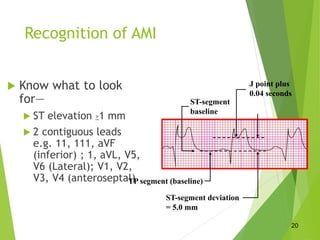
Recognition of AMI
 Know what to look
for—
 ST elevation >1 mm
 2 contiguous leads
e.g. 11, 111, aVF
(inferior) ; 1, aVL, V5,
V6 (Lateral); V1, V2,
V3, V4 (anteroseptal)
TP segment (baseline)
ST-segment deviation
= 5.0 mm
J point plus
0.04 seconds
ST-segment
baseline
20
Treatment Goals Of ACS
Patients
1. The primary goal is identification of pts
with ST seg elevation MI & triage for
early reperfusion therapy.
2. Relief of ischemic chest discomfort
3. Prevention of death and other major
adverse cardiac events
4. Treatment of acute life threatening
complications of ACS: Vfib, Vtach,
symptomatic brady & unstable
tachycardias
 ECG is central to the initial risk and
treatment stratification
 Reports of elevated cardiac markers
are not necessary for a decision to
administer fibrinolytic therapy
STEMI Chain of Survival
 This links actions to be taken by patients, family
members and healthcare providers to maximize
STEMI recovery.
 Rapid recognition and reaction to STEMI warning
signs
 Rapid EMS despatch and rapid EMS system transport
and prearrival notification to the receiving hospital
 Rapid assessment and diagnosis in the ED (or cath
lab)
 Rapid treatment
 Drug therapy and treatment is geared
towards:
 Rapid reperfusion
 Relieve of ischemic pain
 Treatment of early life threatening
complications
 Reperfusion may involve use of
fibrinolytic therapy or coronary
angiography
 Treatment involves the use of the
following drugs:
 Oxygen
 Aspirin
 Nitroglycerin
 Morphine
 Fibrinolytic therapy
MONA
 Oxygen-
 If the patient is dyspnoeic, hypoxemic, obvious signs of
heart failure, saturations of less than 90%
 High inspired oxygen tension will maximize arterial
oxygen saturation and arterial oxygen content.
 Aspirin- 160-325mg non enteric coated
 Inhibits thromboxane A production
 Absorbed better when chewed
 Rectal suppositories 300mg for pts with nausea
,vomiting, active peptic ulcer disease, other disorders
of upper GI tract
 Nitroglycerin
 Reduce ischaemic discomfort
 1 sublingual or spray dose every 3-5 min
 Repeat the dose to a max of 3 doses
 Only if the pt is hemodynamically stable
 SBP greater than 90 mmHg or no less than
30mmHg below the baseline
 HR 50-100 b/min
 Contraindicated with pts with inadequate
ventricular pre-load
 Morphine
 For chest discomfort unresponsive to sublingual
or spray nitroglycerin
 Is a venodilator
 If hypotension develops, administer fluids as a
first line therapy
 Use of NSAIDs is contraindicated- Increase risk
of mortality, reinfarction, hypertension, heart
failure
EMS Assessment and care
 Monitor and support airway, breathing and
circulation(ABCs)
 Administer aspirin and consider oxygen if
saturations less than 90%
 Give Nitroglycerine and morphine if
discomfort is unresponsive to nitrates
 Obtain a 12 lead ECG, interpret or
transmit for interpretation
 Use Of Morphine in ACS because it:
 Produces CNS analgesia which reduces the
adverse effects of neurohumoral
activation, catecholamine release and
heightened myocardial oxygen demand.
 Produces venodilation which reduces LV
preload and oxygen requirement
 Decreases systemic vascular resistance,
thereby reducing LV afterload
 Helps redistribute blood volume in
patients with acute pulmonary edema.
 Complete a fibrinolytic checklist if
indicated
 Provide a pre arrival notification to
the receiving facility if ST elevation
Immediate assessment and
actions by Out-of-hospital
responder
 Oxygen at 4 L/min if SPO2 <94%,
 Aspirin 160 to 325 mg (chewed)-rule out GIT bleeding
 Nitroglycerin SL (1 tab-0.03 to 0.04mg) or spray (1 metered
dose-0.04mg) ; repeat 2 times at 5 min intervals
 Morphine IV if chest pain is non relieved by nitroglycerine
(2-4mg IV repeated every 5 min)
 12 lead ECG, interpret or send for interpretation
 Completing the fibrinolytic therapy checklist
 Notifying the receiving hospital of the potential AMI-STEMI
Immediate Assessment (<10 min)
Reperfusion therapy
 The results of cardiac markers, chest x
ray and lab studies should not delay
reperfusion therapy.
 The mainstay of treatment for STEMI is
early reperfusion therapy achieved with
PCI or fibrinolytics
 The goal of reperfusion is to give
fibrinolytics within 30 minutes of
arrival or perform PCI within 90
minutes.
Contraindications of
fibrinolytic therapy
 Significant head trauma or prior stroke in
previous 3 months
 Symptoms suggest subarachnoid
haemorrhage
 Arterial puncture at non compressible site
in previous 7 days
 Hx of previous intracranial haemorrhage
 Elevated BP Systolic more than 185mmH,
diastolic more than 110 mmHg
 Active internal bleeding
 Active bleeding diathesis-
 platelet count less than 100000/mm3
 Heparin received within 48 hrs
 Current use of anticoagulant with INR of more
than 1.7 or prothrombin time (PT) of more than
15 Sec.
 Blood glucose of less than 2.7 mmol/l
 CT demonstrates multilobar infarction
Relative exclusion criteria
 Minor or rapidly improving stroke symptoms
 Pregnancy
 Seizure at onset with postictal residual neurologic
impairments
 Major surgery or serious trauma within previous 14
days
 Recent GI or urinary tract haemorrhage within
previous 21 days
 Recent acute MI within previous 3 months
Recommendations For Fibrinolytics
1. In the absence of CI , fibrinolytic therapy is the
one option for reperfusion in pts with STEMI and
symptoms within 12hrs
2. Not recommended for pts presenting more than
12 h after onset of symptoms
3. Do not give to those who present after 24 hrs
of symptom onset
PCI
 Percutaneous Coronary Intervention
 ED door –to-balloon inflation time is 90 min.
 Patients presenting to non PCI capable hospitals-
time from first medical contact to device should be
less than 120 min
 Pts who are ineligible for fibrinolytic therapy should
be considered for transfer to a PCI facility
regardless of delay
 The system should prepare for a door-to-departure
time of 30 min when a transfer decision is made
 The most commonly used form of
PCI is coronary intervention with
stent placement
 Optimally performed primary PCI is
the preferred reperfusion strategy
over fibrinolytic administration.
IMPORTANT TIMELINES
 Door to needle of 30 minutes (fibrinolytics)
 Door to Balloon inflation of 90 minutes (Percutaneous
Coronary Intervention)
 Time saving should be done from door to data, data to
decision and decision to drug or PCI. Pre-hospital delay
only constitutes 5% of delay while Emergency Dept
evaluation constitutes between 25-30%.
 Patients who are ineligible for
fibrinolytic therapy should be
transferred to a PCI facility
regardless of the delay.
 Door-to-departure time is 30 min
when a transfer decision is made.
END
Q & A

ACS ALGORITHYME STEMI.pptx

  • 1.
  • 2.
    Acute Coronary Syndrome Patients with coronary atherosclerosis may dev a spectrum of clinical syndromes representing varying degrees of coronary artery occlusion
  • 3.
     The syndromeincludes:  STEMI  NSTEMI  UNSTABLE ANGINA- Low Intermediate risk ACS  Diagnosis by 12 lead ECG to classify the patients into the above categories each with different strategies of care and management.  Should be done within 10 min of patients arrival into the ED.
  • 4.
     NOTE:  12lead ECG is at the centre of the decision pathway in the mgt of ischaemic chest discomfort and is the only means of identifying STEMI
  • 5.
    STEMI: ST elevation,elevated cardiac enzymes suggesting ongoing acute injury NSTEMI: ST depression, T-wave inversion, elevated cardiac enzymes suggesting ischemia Unstable Angina: Non specific or no EKG changes, normal cardiac enzymes
  • 6.
    ACS – Etiology- Atherothrombosis ACCSAP V
  • 7.
    Presentation (Why suspect ACS?) 1.Chest pain 2. Pain radiation to the lower jaw and left shoulder 3. Presyncope or syncope 4. Diaphoresis 5. Shortness of breath 6. Anxiety 7. Nausea
  • 8.
    Symptoms  Most commonsymptom for myocardial infarction and ischemia is retrosternal chest discomfort  Symptoms suggestive of ACS may include:  Uncomfortable pressure, fullness, squeezing  Pain in the centre of the chest lasting several minutes  Chest discomfort spreading to the back or between the shoulder blades
  • 9.
     Chest discomfortspreading to the shoulder, neck, one or both arms, or jaw.  Chest discomfort with light-headedness, dizziness, fainting, sweating, nausea or vomiting  Unexplained sudden shortness of breath, which may occur with or without chest discomfort.
  • 11.
    Recognition of AMI Know what to look for—  ST elevation >1 mm  2 contiguous leads e.g. 11, 111, aVF (inferior) ; 1, aVL, V5, V6 (Lateral); V1, V2, V3, V4 (anteroseptal) TP segment (baseline) ST-segment deviation = 5.0 mm J point plus 0.04 seconds ST-segment baseline 20
  • 12.
    Treatment Goals OfACS Patients 1. The primary goal is identification of pts with ST seg elevation MI & triage for early reperfusion therapy. 2. Relief of ischemic chest discomfort 3. Prevention of death and other major adverse cardiac events 4. Treatment of acute life threatening complications of ACS: Vfib, Vtach, symptomatic brady & unstable tachycardias
  • 13.
     ECG iscentral to the initial risk and treatment stratification  Reports of elevated cardiac markers are not necessary for a decision to administer fibrinolytic therapy
  • 14.
    STEMI Chain ofSurvival  This links actions to be taken by patients, family members and healthcare providers to maximize STEMI recovery.  Rapid recognition and reaction to STEMI warning signs  Rapid EMS despatch and rapid EMS system transport and prearrival notification to the receiving hospital  Rapid assessment and diagnosis in the ED (or cath lab)  Rapid treatment
  • 15.
     Drug therapyand treatment is geared towards:  Rapid reperfusion  Relieve of ischemic pain  Treatment of early life threatening complications  Reperfusion may involve use of fibrinolytic therapy or coronary angiography
  • 16.
     Treatment involvesthe use of the following drugs:  Oxygen  Aspirin  Nitroglycerin  Morphine  Fibrinolytic therapy MONA
  • 17.
     Oxygen-  Ifthe patient is dyspnoeic, hypoxemic, obvious signs of heart failure, saturations of less than 90%  High inspired oxygen tension will maximize arterial oxygen saturation and arterial oxygen content.  Aspirin- 160-325mg non enteric coated  Inhibits thromboxane A production  Absorbed better when chewed  Rectal suppositories 300mg for pts with nausea ,vomiting, active peptic ulcer disease, other disorders of upper GI tract
  • 18.
     Nitroglycerin  Reduceischaemic discomfort  1 sublingual or spray dose every 3-5 min  Repeat the dose to a max of 3 doses  Only if the pt is hemodynamically stable  SBP greater than 90 mmHg or no less than 30mmHg below the baseline  HR 50-100 b/min  Contraindicated with pts with inadequate ventricular pre-load
  • 19.
     Morphine  Forchest discomfort unresponsive to sublingual or spray nitroglycerin  Is a venodilator  If hypotension develops, administer fluids as a first line therapy  Use of NSAIDs is contraindicated- Increase risk of mortality, reinfarction, hypertension, heart failure
  • 20.
    EMS Assessment andcare  Monitor and support airway, breathing and circulation(ABCs)  Administer aspirin and consider oxygen if saturations less than 90%  Give Nitroglycerine and morphine if discomfort is unresponsive to nitrates  Obtain a 12 lead ECG, interpret or transmit for interpretation
  • 21.
     Use OfMorphine in ACS because it:  Produces CNS analgesia which reduces the adverse effects of neurohumoral activation, catecholamine release and heightened myocardial oxygen demand.  Produces venodilation which reduces LV preload and oxygen requirement  Decreases systemic vascular resistance, thereby reducing LV afterload  Helps redistribute blood volume in patients with acute pulmonary edema.
  • 22.
     Complete afibrinolytic checklist if indicated  Provide a pre arrival notification to the receiving facility if ST elevation
  • 23.
    Immediate assessment and actionsby Out-of-hospital responder  Oxygen at 4 L/min if SPO2 <94%,  Aspirin 160 to 325 mg (chewed)-rule out GIT bleeding  Nitroglycerin SL (1 tab-0.03 to 0.04mg) or spray (1 metered dose-0.04mg) ; repeat 2 times at 5 min intervals  Morphine IV if chest pain is non relieved by nitroglycerine (2-4mg IV repeated every 5 min)  12 lead ECG, interpret or send for interpretation  Completing the fibrinolytic therapy checklist  Notifying the receiving hospital of the potential AMI-STEMI
  • 24.
  • 25.
    Reperfusion therapy  Theresults of cardiac markers, chest x ray and lab studies should not delay reperfusion therapy.  The mainstay of treatment for STEMI is early reperfusion therapy achieved with PCI or fibrinolytics
  • 26.
     The goalof reperfusion is to give fibrinolytics within 30 minutes of arrival or perform PCI within 90 minutes.
  • 27.
    Contraindications of fibrinolytic therapy Significant head trauma or prior stroke in previous 3 months  Symptoms suggest subarachnoid haemorrhage  Arterial puncture at non compressible site in previous 7 days  Hx of previous intracranial haemorrhage  Elevated BP Systolic more than 185mmH, diastolic more than 110 mmHg
  • 28.
     Active internalbleeding  Active bleeding diathesis-  platelet count less than 100000/mm3  Heparin received within 48 hrs  Current use of anticoagulant with INR of more than 1.7 or prothrombin time (PT) of more than 15 Sec.  Blood glucose of less than 2.7 mmol/l  CT demonstrates multilobar infarction
  • 29.
    Relative exclusion criteria Minor or rapidly improving stroke symptoms  Pregnancy  Seizure at onset with postictal residual neurologic impairments  Major surgery or serious trauma within previous 14 days  Recent GI or urinary tract haemorrhage within previous 21 days  Recent acute MI within previous 3 months
  • 31.
    Recommendations For Fibrinolytics 1.In the absence of CI , fibrinolytic therapy is the one option for reperfusion in pts with STEMI and symptoms within 12hrs 2. Not recommended for pts presenting more than 12 h after onset of symptoms 3. Do not give to those who present after 24 hrs of symptom onset
  • 32.
    PCI  Percutaneous CoronaryIntervention  ED door –to-balloon inflation time is 90 min.  Patients presenting to non PCI capable hospitals- time from first medical contact to device should be less than 120 min  Pts who are ineligible for fibrinolytic therapy should be considered for transfer to a PCI facility regardless of delay  The system should prepare for a door-to-departure time of 30 min when a transfer decision is made
  • 33.
     The mostcommonly used form of PCI is coronary intervention with stent placement  Optimally performed primary PCI is the preferred reperfusion strategy over fibrinolytic administration.
  • 35.
    IMPORTANT TIMELINES  Doorto needle of 30 minutes (fibrinolytics)  Door to Balloon inflation of 90 minutes (Percutaneous Coronary Intervention)  Time saving should be done from door to data, data to decision and decision to drug or PCI. Pre-hospital delay only constitutes 5% of delay while Emergency Dept evaluation constitutes between 25-30%.
  • 36.
     Patients whoare ineligible for fibrinolytic therapy should be transferred to a PCI facility regardless of the delay.  Door-to-departure time is 30 min when a transfer decision is made.
  • 37.