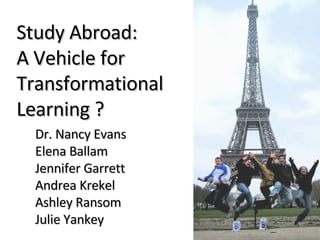
Study Abroad:  A Vehicle for  Transformational  Learning ?   Dr. Nancy Evans Elena Ballam Jennifer Garrett Andrea Krekel Ashley Ransom Julie Yankey
Introductions Literature review Theoretical framework Design of study  Participants Perspective transformation Internal External Reactions Discussion Overview
Introductions
Literature Review 190,000 students 2% of enrollment Europe dominates Study tour focus
Mezirow’s Theory of Transformational Learning Transformative learning specific belief or attitude entire perspective Perspective transformation grounded in life experience influenced by affective, emotional,  social, and cultural factors  Phases of transformative learning:  1.  disorienting dilemma  2.  critical reflection  3. reflective discourse 4. plan of action 5.  reintegration
Design of the study Preparation: Organizing study & finding participants Actual Study:  Interview participants & review data
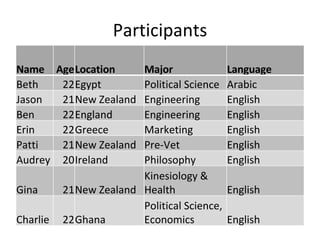
Participants Name Age Location Major Language Beth 22 Egypt Political Science Arabic Jason 21 New Zealand Engineering English Ben 22 England Engineering English Erin 22 Greece Marketing English Patti 21 New Zealand Pre-Vet English Audrey 20 Ireland Philosophy English Gina 21 New Zealand Kinesiology & Health English Charlie 22 Ghana Political Science, Economics English
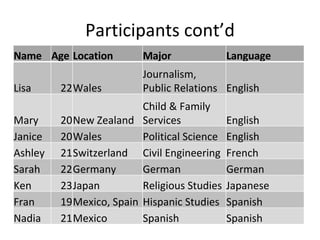
Participants cont’d Name Age Location Major Language Lisa 22 Wales Journalism, Public Relations English Mary 20 New Zealand Child & Family Services English Janice 20 Wales Political Science English Ashley 21 Switzerland Civil Engineering French Sarah 22 Germany German German Ken 23 Japan Religious Studies Japanese Fran 19 Mexico, Spain Hispanic Studies Spanish Nadia 21 Mexico  Spanish Spanish
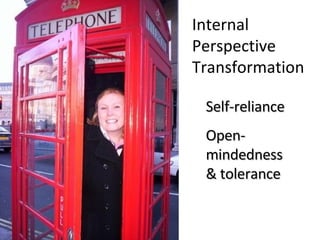
Internal Perspective  Transformation Self-reliance Open-mindedness  & tolerance
Self-reliance Being on one’s own Surviving in a different culture Independent decision making Adapting to situations, planning & trying new things Traveling Resourcefulness & money management
Being on one’s own I learned a little bit more about who I am because I finally got away from everybody that I knew…just seeing who I am with new people confirmed for me a sense of self that I’m the same person no matter who I’m with.  (Mary, New Zealand)
Surviving in a different culture I was very determined to make it through the year and learned that I do have the determination needed to survive in a sometimes unforgiving culture. I also believe I am stronger than I thought I was both physically and mentally. (Beth, Eygpt)
Independent decision making It’s kind of cool to be able to call your own shots. “I want to go here. I want to go there.” You can do it.  (Jason, New Zealand)
  Adapting to Situations, Planning & Trying New Things I [developed a] better understanding of myself and ways that I respond to a situation that is totally new and different from what I have ever done before. (Gina, New Zealand) 
Traveling I surprised myself a lot of times in traveling by myself. I missed one of my flights and it wasn’t my fault because the airline got delayed but I was like, “you are gonna get me there.”  I surprised myself in a lot of situations. (Erin, Greece)
Resourcefulness &  Money-management [I learned] a lot just about how resourceful you can be on your own, how little you can get by on.  (Ben, England)
Open-mindedness & tolerance Broader view of the world Acceptance of different viewpoints Understanding of others Avoiding stereotypes Desire to learn more
Broader View of the World Your view of the world changes. You can tell when you present it to others. A lot more broad sense of things, you see the big picture a little better. (Ben, England)
Acceptance of Different Viewpoints I’ve grown in my ability to accept the varying viewpoints…. Regardless of all of the differences within Buddhism and Christianity , if you can experience them…,you can understand them and with that understanding…you’ve gained a good foothold in breaking down any kind of barrier that stops you from understanding the people who practice that tradition.  (Ken, Japan)
Understanding of Others I learned to have more compassion for people than I did before. Because I got to see different sides of people that I wasn’t able to see here. A lot of people here cover up who they are with their stuff, how much stuff they have. The wealthier people there could do that with all their things but the poor people didn’t have as much stuff. They had pain and things that were going on in their lives. If they were poor, like dirt poor, the only things they had was what was going on in their lives... They couldn’t cover it up with junk. So it taught me to have compassion for people, the rich people and the poor people. (Nadia, Mexico)
Avoiding Stereotypes When people talk about whatever race and say a comment that generalizes an entire country or culture …I’m a lot more skeptical and don’t really necessarily take that for what it is because I met people who are exceptions to that stereotype so I don’t really believe them anymore. I try to look for the common link that we share rather than the differences being negative. I think the differences are the interesting part rather than something that needs to be called out and may make someone else feel worse for it because they’re not the same as you.  (Ashley, Switzerland)
Desire to learn more [With regard to people who are from different cultural backgrounds than myself,] I think I would be more interested in finding out things about their culture now than before.  (Erin, Greece)
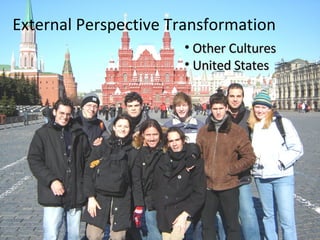
External Perspective Transformation Other Cultures United States
Perspectives of other cultures Adjustment to a different country Experiencing culture firsthand Understanding social issues Increased cultural knowledge Resulting changes
Adjustment to a different country In Japanese culture, the group is held responsible for any actions of its members…  If you have that one individual who does something disruptive, it really reflects poorly on the entire group  (Ken, Japan)
Experiencing culture firsthand  I learned that despite…major differences in culture , upbringing, [and] opportunity, it’s still easy to find a lot in common with people regardless of how different they are from your background…I learned…it’s really easy to find things that you have in common with people, it’s easy to find common ground with things, things to talk about. People have interesting insights to contribute.  (Charlie, Ghana)
Understanding social issues  [In Mexico,] there is definitely discrimination. I am white and I’m blond and they see me as rich so they treat me with more respect. But there is horrible discrimination against the indigenous people...  (Fran, Mexico/Spain)  
Increased cultural knowledge  I learned something new every day.  I always am looking for something new every day…  It was like you’re learning something new about different cultures whereas being here you’re learning something new about your own culture…  I loved learning.  (Lisa, Wales)
Resulting changes I’m more understanding of people who immigrated here or [are] visiting here, they are struggling a lot of times to get by, especially the language barrier.  (Janice, Wales) 
Perspectives on the  United States Feelings about U.S. politics Impressions of the U.S. U.S. lifestyle Heightened awareness of issues Impact of U.S in other countries Seeing Americans differently
Feelings about US politics I am not proud at all to be an American. I have rights in this country [that] I have nowhere else in the world and yet I have [them] and I do take [them] for granted. I am still ashamed to say that I am from the U.S.  (Fran, Mexico/Spain)
Impressions of the US After I got back…I noticed that people here…we don’t talk to each other face to face anymore, we don’t get a chance to just catch up with people…those interactions that were so key to life in Ghana, everyone really took the time…people were late because they were taking time to talk to people, see how they are doing, how are they feeling, how’s their family been, what are they planning on doing next week…  Here I go home and I sit in front of my computer and I have thirty new email messages that I need to respond to but they’re all really impersonal. Sure it’s a lot more efficient but I miss the personal interaction that I got without all this technology.  (Charlie, Ghana)  
U.S. lifestyle I became aware of how much of a culture of convenience we are. The first thing that struck me coming home was that we have a lot of parking lots.  [In Germany,] everybody walks or takes the bus.  There is a McDonald’s in town and it is the only place that’s open past eight o’clock. (Sarah, Germany)  
Heightened awareness of issues  The government [of New Zealand] has …tried to make steps to amend [the conflicts with the indigenous people], so I knew there was going to be more emphasis on the indigenous,…more so than America is [focused on Native Americans].  (Patti, New Zealand)  
Impact of U.S. in other countries [I] definitely noticed the dominance of the U.S.  The culture, their celebrities…  You would find people who were…more interested in U.S. politics than you were.  (Jason, England)  
Seeing Americans differently I live in a sorority… [and] I don’t really want to be worrying about sorority problems. I lived in the Balkan countries [with]… people from Bosnia and the whole thing going on in Kosovo… I know how big the world is now so I don’t get so concerned about the little things going on here.  (Erin, Greece)  
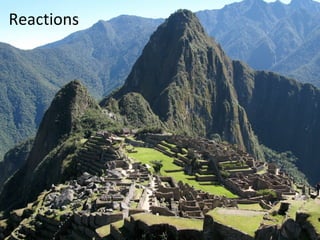
Reactions
Implications for Student Affairs Professionals
Implications  for our campuses
Dr. Nancy Evans Educational Leadership & Policy Studies [email_address] Contact information
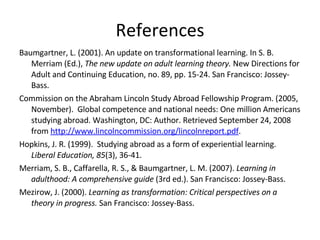
References Baumgartner, L. (2001). An update on transformational learning. In S. B. Merriam (Ed.),  The new update on adult learning theory.  New Directions for Adult and Continuing Education, no. 89, pp. 15-24. San Francisco: Jossey-Bass. Commission on the Abraham Lincoln Study Abroad Fellowship Program. (2005, November).  Global competence and national needs: One million Americans studying abroad. Washington, DC: Author. Retrieved September 24, 2008 from  http://www.lincolncommission.org/lincolnreport.pdf .  Hopkins, J. R. (1999).  Studying abroad as a form of experiential learning.  Liberal Education, 85 (3), 36-41. Merriam, S. B., Caffarella, R. S., & Baumgartner, L. M. (2007).  Learning in adulthood: A comprehensive guide  (3rd ed.). San Francisco: Jossey-Bass.  Mezirow, J. (2000).  Learning as transformation: Critical perspectives on a theory in progress.  San Francisco: Jossey-Bass.
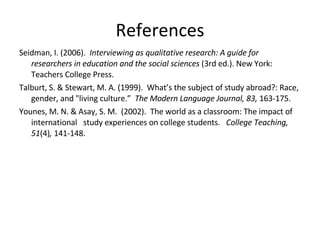
References Seidman, I. (2006).  Interviewing as qualitative research: A guide for researchers in education and the social sciences  (3rd ed.). New York:  Teachers College Press. Talburt, S. & Stewart, M. A. (1999).  What’s the subject of study abroad?: Race, gender, and "living culture.”  The Modern Language Journal, 83,  163-175. Younes, M. N. & Asay, S. M.  (2002).  The world as a classroom: The impact of international study experiences on college students.  College Teaching, 51 (4) ,  141-148.

Study Abroad: A Vehicle for Transformational Learning?

  • 1.
    Study Abroad: A Vehicle for Transformational Learning ? Dr. Nancy Evans Elena Ballam Jennifer Garrett Andrea Krekel Ashley Ransom Julie Yankey
  • 2.
    Introductions Literature reviewTheoretical framework Design of study Participants Perspective transformation Internal External Reactions Discussion Overview
  • 3.
  • 4.
    Literature Review 190,000students 2% of enrollment Europe dominates Study tour focus
  • 5.
    Mezirow’s Theory ofTransformational Learning Transformative learning specific belief or attitude entire perspective Perspective transformation grounded in life experience influenced by affective, emotional, social, and cultural factors Phases of transformative learning: 1. disorienting dilemma 2. critical reflection 3. reflective discourse 4. plan of action 5. reintegration
  • 6.
    Design of thestudy Preparation: Organizing study & finding participants Actual Study: Interview participants & review data
  • 7.
    Participants Name AgeLocation Major Language Beth 22 Egypt Political Science Arabic Jason 21 New Zealand Engineering English Ben 22 England Engineering English Erin 22 Greece Marketing English Patti 21 New Zealand Pre-Vet English Audrey 20 Ireland Philosophy English Gina 21 New Zealand Kinesiology & Health English Charlie 22 Ghana Political Science, Economics English
  • 8.
    Participants cont’d NameAge Location Major Language Lisa 22 Wales Journalism, Public Relations English Mary 20 New Zealand Child & Family Services English Janice 20 Wales Political Science English Ashley 21 Switzerland Civil Engineering French Sarah 22 Germany German German Ken 23 Japan Religious Studies Japanese Fran 19 Mexico, Spain Hispanic Studies Spanish Nadia 21 Mexico Spanish Spanish
  • 9.
    Internal Perspective Transformation Self-reliance Open-mindedness & tolerance
  • 10.
    Self-reliance Being onone’s own Surviving in a different culture Independent decision making Adapting to situations, planning & trying new things Traveling Resourcefulness & money management
  • 11.
    Being on one’sown I learned a little bit more about who I am because I finally got away from everybody that I knew…just seeing who I am with new people confirmed for me a sense of self that I’m the same person no matter who I’m with. (Mary, New Zealand)
  • 12.
    Surviving in adifferent culture I was very determined to make it through the year and learned that I do have the determination needed to survive in a sometimes unforgiving culture. I also believe I am stronger than I thought I was both physically and mentally. (Beth, Eygpt)
  • 13.
    Independent decision makingIt’s kind of cool to be able to call your own shots. “I want to go here. I want to go there.” You can do it. (Jason, New Zealand)
  • 14.
    Adaptingto Situations, Planning & Trying New Things I [developed a] better understanding of myself and ways that I respond to a situation that is totally new and different from what I have ever done before. (Gina, New Zealand) 
  • 15.
    Traveling I surprisedmyself a lot of times in traveling by myself. I missed one of my flights and it wasn’t my fault because the airline got delayed but I was like, “you are gonna get me there.” I surprised myself in a lot of situations. (Erin, Greece)
  • 16.
    Resourcefulness & Money-management [I learned] a lot just about how resourceful you can be on your own, how little you can get by on. (Ben, England)
  • 17.
    Open-mindedness & toleranceBroader view of the world Acceptance of different viewpoints Understanding of others Avoiding stereotypes Desire to learn more
  • 18.
    Broader View ofthe World Your view of the world changes. You can tell when you present it to others. A lot more broad sense of things, you see the big picture a little better. (Ben, England)
  • 19.
    Acceptance of DifferentViewpoints I’ve grown in my ability to accept the varying viewpoints…. Regardless of all of the differences within Buddhism and Christianity , if you can experience them…,you can understand them and with that understanding…you’ve gained a good foothold in breaking down any kind of barrier that stops you from understanding the people who practice that tradition. (Ken, Japan)
  • 20.
    Understanding of OthersI learned to have more compassion for people than I did before. Because I got to see different sides of people that I wasn’t able to see here. A lot of people here cover up who they are with their stuff, how much stuff they have. The wealthier people there could do that with all their things but the poor people didn’t have as much stuff. They had pain and things that were going on in their lives. If they were poor, like dirt poor, the only things they had was what was going on in their lives... They couldn’t cover it up with junk. So it taught me to have compassion for people, the rich people and the poor people. (Nadia, Mexico)
  • 21.
    Avoiding Stereotypes Whenpeople talk about whatever race and say a comment that generalizes an entire country or culture …I’m a lot more skeptical and don’t really necessarily take that for what it is because I met people who are exceptions to that stereotype so I don’t really believe them anymore. I try to look for the common link that we share rather than the differences being negative. I think the differences are the interesting part rather than something that needs to be called out and may make someone else feel worse for it because they’re not the same as you. (Ashley, Switzerland)
  • 22.
    Desire to learnmore [With regard to people who are from different cultural backgrounds than myself,] I think I would be more interested in finding out things about their culture now than before. (Erin, Greece)
  • 23.
    External Perspective TransformationOther Cultures United States
  • 24.
    Perspectives of othercultures Adjustment to a different country Experiencing culture firsthand Understanding social issues Increased cultural knowledge Resulting changes
  • 25.
    Adjustment to adifferent country In Japanese culture, the group is held responsible for any actions of its members… If you have that one individual who does something disruptive, it really reflects poorly on the entire group (Ken, Japan)
  • 26.
    Experiencing culture firsthand I learned that despite…major differences in culture , upbringing, [and] opportunity, it’s still easy to find a lot in common with people regardless of how different they are from your background…I learned…it’s really easy to find things that you have in common with people, it’s easy to find common ground with things, things to talk about. People have interesting insights to contribute. (Charlie, Ghana)
  • 27.
    Understanding social issues [In Mexico,] there is definitely discrimination. I am white and I’m blond and they see me as rich so they treat me with more respect. But there is horrible discrimination against the indigenous people... (Fran, Mexico/Spain)  
  • 28.
    Increased cultural knowledge I learned something new every day. I always am looking for something new every day… It was like you’re learning something new about different cultures whereas being here you’re learning something new about your own culture… I loved learning. (Lisa, Wales)
  • 29.
    Resulting changes I’mmore understanding of people who immigrated here or [are] visiting here, they are struggling a lot of times to get by, especially the language barrier. (Janice, Wales) 
  • 30.
    Perspectives on the United States Feelings about U.S. politics Impressions of the U.S. U.S. lifestyle Heightened awareness of issues Impact of U.S in other countries Seeing Americans differently
  • 31.
    Feelings about USpolitics I am not proud at all to be an American. I have rights in this country [that] I have nowhere else in the world and yet I have [them] and I do take [them] for granted. I am still ashamed to say that I am from the U.S. (Fran, Mexico/Spain)
  • 32.
    Impressions of theUS After I got back…I noticed that people here…we don’t talk to each other face to face anymore, we don’t get a chance to just catch up with people…those interactions that were so key to life in Ghana, everyone really took the time…people were late because they were taking time to talk to people, see how they are doing, how are they feeling, how’s their family been, what are they planning on doing next week… Here I go home and I sit in front of my computer and I have thirty new email messages that I need to respond to but they’re all really impersonal. Sure it’s a lot more efficient but I miss the personal interaction that I got without all this technology. (Charlie, Ghana)  
  • 33.
    U.S. lifestyle Ibecame aware of how much of a culture of convenience we are. The first thing that struck me coming home was that we have a lot of parking lots. [In Germany,] everybody walks or takes the bus. There is a McDonald’s in town and it is the only place that’s open past eight o’clock. (Sarah, Germany)  
  • 34.
    Heightened awareness ofissues The government [of New Zealand] has …tried to make steps to amend [the conflicts with the indigenous people], so I knew there was going to be more emphasis on the indigenous,…more so than America is [focused on Native Americans]. (Patti, New Zealand)  
  • 35.
    Impact of U.S.in other countries [I] definitely noticed the dominance of the U.S. The culture, their celebrities… You would find people who were…more interested in U.S. politics than you were. (Jason, England)  
  • 36.
    Seeing Americans differentlyI live in a sorority… [and] I don’t really want to be worrying about sorority problems. I lived in the Balkan countries [with]… people from Bosnia and the whole thing going on in Kosovo… I know how big the world is now so I don’t get so concerned about the little things going on here. (Erin, Greece)  
  • 37.
  • 38.
    Implications for StudentAffairs Professionals
  • 39.
    Implications forour campuses
  • 40.
    Dr. Nancy EvansEducational Leadership & Policy Studies [email_address] Contact information
  • 41.
    References Baumgartner, L.(2001). An update on transformational learning. In S. B. Merriam (Ed.), The new update on adult learning theory. New Directions for Adult and Continuing Education, no. 89, pp. 15-24. San Francisco: Jossey-Bass. Commission on the Abraham Lincoln Study Abroad Fellowship Program. (2005, November). Global competence and national needs: One million Americans studying abroad. Washington, DC: Author. Retrieved September 24, 2008 from http://www.lincolncommission.org/lincolnreport.pdf . Hopkins, J. R. (1999). Studying abroad as a form of experiential learning. Liberal Education, 85 (3), 36-41. Merriam, S. B., Caffarella, R. S., & Baumgartner, L. M. (2007). Learning in adulthood: A comprehensive guide (3rd ed.). San Francisco: Jossey-Bass. Mezirow, J. (2000). Learning as transformation: Critical perspectives on a theory in progress. San Francisco: Jossey-Bass.
  • 42.
    References Seidman, I.(2006). Interviewing as qualitative research: A guide for researchers in education and the social sciences (3rd ed.). New York: Teachers College Press. Talburt, S. & Stewart, M. A. (1999). What’s the subject of study abroad?: Race, gender, and "living culture.” The Modern Language Journal, 83, 163-175. Younes, M. N. & Asay, S. M. (2002). The world as a classroom: The impact of international study experiences on college students. College Teaching, 51 (4) , 141-148.