“Harnessing our Global Energy”
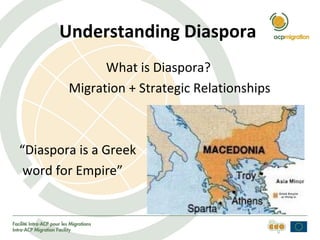
Understanding Diaspora
              What is Diaspora?
        Migration + Strategic Relationships


“Diaspora is a Greek
 word for Empire”
Definition of Diaspora
• Definition of Diaspora?
• Further to a lacuna identified in the inaugural
  inter-regional workshop (Observatory, April
  2011), discussions at both national and
  regional levels should include the
  adoption/advancement of a clear definition of
  diaspora in ACP Caribbean (perhaps in
  cooperation with India, China and AU).
Where are we?
 Trinidad and Tobago in South-North context

•A difficult and historical relationship with the
advance of the major industrial countries (G8) –
Canada, United States, United Kingdom
•The Trinidad and Tobago Diaspora has come to
be positioned in some of the preeminent global
cities of the first world.
Where are we from?
 Trinidad and Tobago in South-South context

•The colonial history of the West Indies has
brought populations from several of the major
world centres of wealth.
•Over the course of the 20th/21st century, these
centres have begun to reassert their historical
preeminence in world affairs: China, Nigeria,
Ghana, old Ottoman Empire, India.
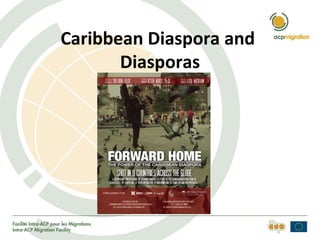
Caribbean Diaspora and
       Diasporas
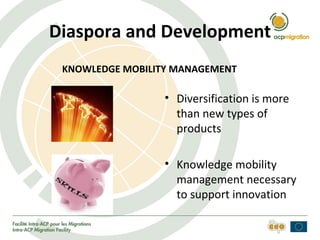
Diaspora and Development
 KNOWLEDGE MOBILITY MANAGEMENT

                  • Diversification is more
                    than new types of
                    products

                  • Knowledge mobility
                    management necessary
                    to support innovation
Seven Pillars:
 Innovation for Lasting Prosperity
• Knowledge-based, diversified economy
  – brain gain
  – dual brain drain
  – nostalgic markets
  – Cross-diasporic/co-diasporic linkages
Seven Pillars:
  Innovation for Lasting Prosperity
• Good governance
  – migration and diaspora affects social and
    economic health of Trinidad and Tobago


• Foreign Policy
  – a new aspect of soft power
Diaspora Stakeholders
The Diaspora-Development nexus comprises a                   number   of
interconnected relationships among seven (7) sectors:

1) Community Members: Migrants’ households in origin and destination
countries

2) Civil Society Organisations in Countries of Origin

3) Civil Society Organisations in Countries of Destination

4) Relevant Government Institutions in Countries of Origin

5) Relevant Governments Institutions in Countries of Destination

6) Private Sector/Commercial Sector in Countries of Origin

7) Private Sector/Commercial Sector in Countries of Destination
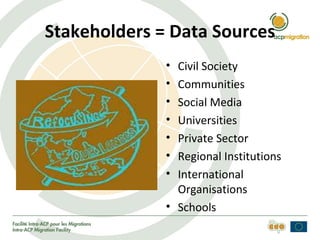
Stakeholders = Data Sources
              • Civil Society
              • Communities
              • Social Media
              • Universities
              • Private Sector
              • Regional Institutions
              • International
                Organisations
              • Schools
Diaspora Data Needs
1.The (relative) status of the country of origin and the country of destination

2. Relationship between diaspora and home country (remittances, imports,
tourism, financial services)

3. The demographic composition of the diaspora/transnational families

4. The nature and level of commercial and NGO activity

5. Local and International Infrastructure (cost of diasporic relations)

Inter-national or Inter-state Relations: existing international legal agreements
on migrant rights/decent work; data sharing among states at regional and
international level
ACP and Diaspora
• ACP Observatory             • Establishment of
  Interregional Workshop        Diaspora Policy and
  on Diaspora                   Diaspora Unit at
                                Ministry of Foreign
• ACP itself as a space of      Affairs and
  African and Asian             Communications,
                                including the
  diasporas worldwide
                                establishment of a
  (African continent, Fiji,
                                diaspora database
  Seychelles in Pacific,
  Caribbean)
Professional Training + P3
             • Development of
               professional training
               curriculum on M&D
               mainstreaming

             • Government, civil
               society and private
               sector institutions (P3
               secondments)
Feel free to add your input

Harnessing Our Global Energy- Workshop on Diaspora and Diaspora PolicyMMU Concept

  • 1.
  • 2.
    Understanding Diaspora What is Diaspora? Migration + Strategic Relationships “Diaspora is a Greek word for Empire”
  • 3.
    Definition of Diaspora •Definition of Diaspora? • Further to a lacuna identified in the inaugural inter-regional workshop (Observatory, April 2011), discussions at both national and regional levels should include the adoption/advancement of a clear definition of diaspora in ACP Caribbean (perhaps in cooperation with India, China and AU).
  • 4.
    Where are we? Trinidad and Tobago in South-North context •A difficult and historical relationship with the advance of the major industrial countries (G8) – Canada, United States, United Kingdom •The Trinidad and Tobago Diaspora has come to be positioned in some of the preeminent global cities of the first world.
  • 5.
    Where are wefrom? Trinidad and Tobago in South-South context •The colonial history of the West Indies has brought populations from several of the major world centres of wealth. •Over the course of the 20th/21st century, these centres have begun to reassert their historical preeminence in world affairs: China, Nigeria, Ghana, old Ottoman Empire, India.
  • 6.
  • 7.
    Diaspora and Development KNOWLEDGE MOBILITY MANAGEMENT • Diversification is more than new types of products • Knowledge mobility management necessary to support innovation
  • 8.
    Seven Pillars: Innovationfor Lasting Prosperity • Knowledge-based, diversified economy – brain gain – dual brain drain – nostalgic markets – Cross-diasporic/co-diasporic linkages
  • 9.
    Seven Pillars: Innovation for Lasting Prosperity • Good governance – migration and diaspora affects social and economic health of Trinidad and Tobago • Foreign Policy – a new aspect of soft power
  • 10.
    Diaspora Stakeholders The Diaspora-Developmentnexus comprises a number of interconnected relationships among seven (7) sectors: 1) Community Members: Migrants’ households in origin and destination countries 2) Civil Society Organisations in Countries of Origin 3) Civil Society Organisations in Countries of Destination 4) Relevant Government Institutions in Countries of Origin 5) Relevant Governments Institutions in Countries of Destination 6) Private Sector/Commercial Sector in Countries of Origin 7) Private Sector/Commercial Sector in Countries of Destination
  • 11.
    Stakeholders = DataSources • Civil Society • Communities • Social Media • Universities • Private Sector • Regional Institutions • International Organisations • Schools
  • 12.
    Diaspora Data Needs 1.The(relative) status of the country of origin and the country of destination 2. Relationship between diaspora and home country (remittances, imports, tourism, financial services) 3. The demographic composition of the diaspora/transnational families 4. The nature and level of commercial and NGO activity 5. Local and International Infrastructure (cost of diasporic relations) Inter-national or Inter-state Relations: existing international legal agreements on migrant rights/decent work; data sharing among states at regional and international level
  • 13.
    ACP and Diaspora •ACP Observatory • Establishment of Interregional Workshop Diaspora Policy and on Diaspora Diaspora Unit at Ministry of Foreign • ACP itself as a space of Affairs and African and Asian Communications, including the diasporas worldwide establishment of a (African continent, Fiji, diaspora database Seychelles in Pacific, Caribbean)
  • 14.
    Professional Training +P3 • Development of professional training curriculum on M&D mainstreaming • Government, civil society and private sector institutions (P3 secondments)
  • 15.
    Feel free toadd your input

Editor's Notes

  • #2 Trinidad and Tobago- 50 Years of Independence, but 500 years of Diaspora
  • #5 Where are we? Trinidad and Tobago Diaspora in South-North context The composition of the Caribbean’s people is not the result of chance, but the product of over 400 years of high politics and strategic economic decision-making. By dint of the Caribbean’s difficult and historic relationship with the advance of the major industrial countries (G8) – Canada, United States, United Kingdom, France… the Trinidad and Tobago Diaspora has come to be positioned in some of the preeminent global cities of the first world.
  • #6   Where are we from? Trinidad and Tobago Diaspora in South-South context The colonial history of the Caribbean has brought populations from several of the major centres of wealth and over the course of the 20 th and early 21 st century, these centres of power have begun to see a reassertion of their historical preeminence in world affairs: China, Nigeria, Ghana, old Ottoman Empire, India.
  • #14 Establishment of Diaspora Unit at Ministry of Foreign Affairs, including the establishment of a diaspora database; Establishment of Migration Management Unit to coordinate the mainstreaming of migration into planning and the coordination of migration management among key ministries; Development of professional training programme on mainstreaming of migration for both staff of proposed units, relevant government institutions and relevant civil society and private sectors institutions; Support to civil society actions relating to information on human trafficking and social services to mobile populations, including returnees, asylum seekers (esp. from African continent), and irregular migrants