Achieving Leadership
Effectiveness
Supervisory Development Program
1
Getting Acquainted
• Print your nickname on top of a bond paper
• Tape the bond paper at your back
• Go around the room. As you do so, write on the
bond papers of your co-participants your
impression of them.
• Make sure that you are able to write for all your
co-participants.
Getting Acquainted
• Read what your co-participants wrote on your
own bond paper.
• Introduce yourself by stating the following:
 Your name, position, agency
 Which impressions written on your bond paper are
true. Expound on this.
 Which impressions are not true.
Getting Acquainted
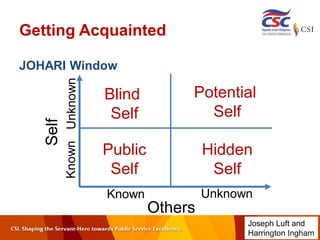
JOHARI Window
Self
Unknown
Known
Known Unknown
Others
Blind
Self
Potential
Self
Public
Self
Hidden
Self
Joseph Luft and
Harrington Ingham
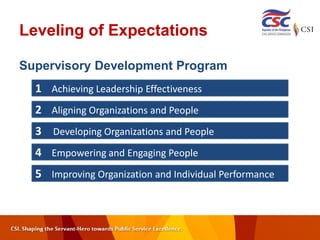
Leveling of Expectations
Supervisory Development Program
1 Achieving Leadership Effectiveness
2 Aligning Organizations and People
3 Developing Organizations and People
4 Empowering and Engaging People
5 Improving Organization and Individual Performance
Leveling of Expectations
1 Achieving Leadership Effectiveness
Performance Objective:
By the end of this course, you shall be able to
formulate and commit to a implement a personal
development plan that will hone your competencies
in leadership and supervision guided by the
established requirements for supervisors and the
assessment of your own areas for improvements.
Leveling of Expectations
2 Aligning Organizations and People
Performance Objective:
By the end of this course, you shall be able to
develop a Division Performance Commitment
and Review (DPCR) that is aligned to your Office
Performance Commitment and Review (OPCR) and
your team members’ Individual Performance
Commitment and Review (IPCR).
You shall also be able to develop a Monitoring Plan
to ensure achievement of your DPCR.
Leveling of Expectations
3 Developing Organizations and People
Performance Objective:
By the end of this course, you shall be able to
facilitate your team members to prepare Personal
Development Plans and consolidate them into a
Team Development Plan that will enable your team
and its individual members to pursue established
objectives as indicated in your DPCR and your team
members’ IPCR.
Leveling of Expectations
4 Empowering and Engaging People
Performance Objective:
By the end of this course, you shall be able to
develop a plan for creating and maintaining a
work environment that will empower and enable
your team and its members to successfully achieve
your DPCR and your team members’ IPCR.
Leveling of Expectations
5 Improving Organization and Individual Performance
Performance Objective:
By the end of this course, you shall be able to
evaluate team and individual performance results
and apply problem solving techniques towards
achieving continual improvements.
Leveling of Expectations
• Given the performance objectives of the
different components of the Supervisory
Development Program, what would you like to
personally learn from the program in general
and this Achieving Leadership Effectiveness
course in particular?
• What will help you learn from this program?
• What may make it difficult for you to learn from
this program?
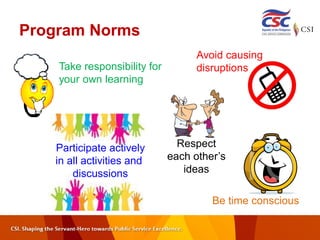
Program Norms
Take responsibility for
your own learning
Participate actively
in all activities and
discussions
Avoid causing
disruptions
Be time conscious
Respect
each other’s
ideas
Achieving Leadership
Effectiveness
Learning Objectives
By the end of this course, you shall be able to:
1. Appreciate the need to shift from contributing
directly to producing work through others.
2. Enumerate and discuss the challenges inherent
in supervision.
3. Enumerate and discuss the supervisory
functions, role and responsibilities.
Achieving Leadership
Effectiveness
Learning Objectives
By the end of this course, you shall be able to:
4. Appreciate the value of setting team objectives,
establishing plans and monitoring results
5. Appreciate the value of organizing the team,
allocating resources and assigning work.
6. Appreciate the value of applying the
appropriate leadership style
Achieving Leadership
Effectiveness
Learning Objectives
By the end of this course, you shall be able to:
7. Appreciate the value of using structured
problem-solving and decision making
processes to achieve continual improvements
8. Prepare and commit to action plans that will
further hone your supervisory competencies.
Achieving Leadership
Effectiveness
Course Content
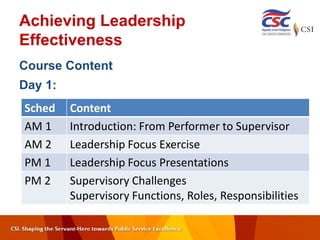
Day 1:
Sched Content
AM 1 Introduction: From Performer to Supervisor
AM 2 Leadership Focus Exercise
PM 1 Leadership Focus Presentations
PM 2 Supervisory Challenges
Supervisory Functions, Roles, Responsibilities
Achieving Leadership
Effectiveness
Course Content
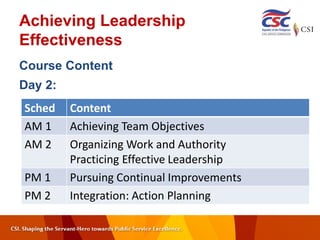
Day 2:
Sched Content
AM 1 Achieving Team Objectives
AM 2 Organizing Work and Authority
Practicing Effective Leadership
PM 1 Pursuing Continual Improvements
PM 2 Integration: Action Planning
Basketball Exercise
Instructions- Round 1:
 Form yourselves into four teams of seven persons.
Each team shall be provided with a set of basket
and balls
 Take turns. Within 30 seconds, each person should
shoot into the basket as many balls as possible.
Record the scores of each person and compute the
team average.
 Post the scores on the wall.
Basketball Exercise
Instructions- Round 2:
 The highest scorer in each team is promoted as a
supervisor. The highest scorer will not shoot but
instruct the other team members how to shoot. The
objective is to beat the previous team score.
 As the highest scorer supervises, the rest of the
team takes turn shooting. Scores are recorded and
the team average is computed.
 Post the Scores on the wall.
Basketball Exercise
Processing
 What can you say about the individual and team
scores?
 What contributed to the increase or decrease in the
team scores between Rounds 1 & 2?
 How did the supervisors feel about their roles? What
insights can be taken from this?
 How did the other members feel about the new
arrangement in Round 2? Any insights from this?
 How does this apply in the workplace?
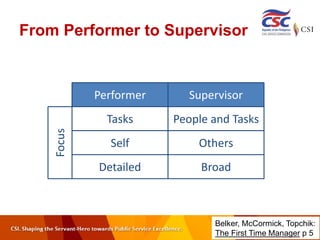
From Performer to Supervisor
Performer Supervisor
Tasks People and Tasks
Self Others
Detailed Broad
Belker, McCormick, Topchik:
The First Time Manager p 5
Focus
From Performer to Supervisor
A manager at the first level of management
• Requires the use of independent judgement
when exercising authority
• Ensures unit contributes its share to
accomplishing the organization’s goals
• Focus on day-to-day problems and goals to be
achieved in one year or less
Samuel C. Certo,
Supervision p. 4

Leadership Focus Exercise
Instructions:
 Your team objective is to prepare a 10 minute
presentation from a set of reading materials. Within
this 10 minutes all members of the team must be
seen to actively contribute
 You have until 12 noon to prepare your presentation
as a team. The presentations will be made after
lunch.
Leadership Focus Exercise
Readings:
 Blanchard, Ken (2007) Leading at a Higher Level
 Goleman, Daniel (2002) Primal Leadership
 Maxwell, John C. (2008) Leadership Gold
 Maxwell, John C. (2011) Five Levels of Leadership
 Shaw, Robert Bruce (2014) Leadership Blindspots
 Zenger, John H. (2009) The Inspiring Leaders
Leadership Focus
Presentations
Presentations:
 Each team will present the highlights of what they
learned about leadership from their readings for 10
minutes. A five minute open forum will follow.
 As each team make their presentations, the other
teams will rate the presentations.
Leadership Focus
Presentations
Processing:
 How did you feel at the start of the exercise and
after you made the presentation?
 Did a leader emerge from within the team? How did
this happen?
 What was done well by the team? How did this
happen?
 What can be improved? How?
 What is the exercise telling us about supervision?
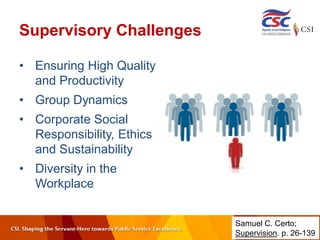
Supervisory Challenges
• Ensuring High Quality
and Productivity
• Group Dynamics
• Corporate Social
Responsibility, Ethics
and Sustainability
• Diversity in the
Workplace
Samuel C. Certo;
Supervision. p. 26-139
Supervisory Challenges
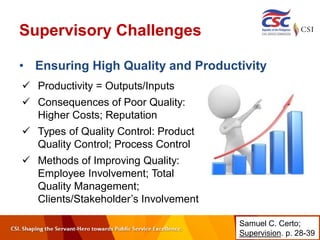
• Ensuring High Quality and Productivity
 Productivity = Outputs/Inputs
 Consequences of Poor Quality:
Higher Costs; Reputation
 Types of Quality Control: Product
Quality Control; Process Control
 Methods of Improving Quality:
Employee Involvement; Total
Quality Management;
Clients/Stakeholder’s Involvement
Samuel C. Certo;
Supervision. p. 28-39
Supervisory Challenges
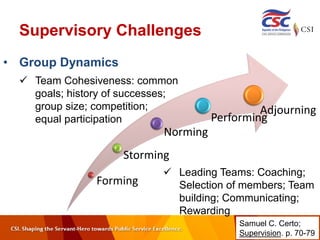
Forming
Storming
Norming
Performing
Adjourning
• Group Dynamics
 Team Cohesiveness: common
goals; history of successes;
group size; competition;
equal participation
 Leading Teams: Coaching;
Selection of members; Team
building; Communicating;
Rewarding
Samuel C. Certo;
Supervision. p. 70-79
Supervisory Challenges
• Social
Responsibility,
Ethics and
Sustainability
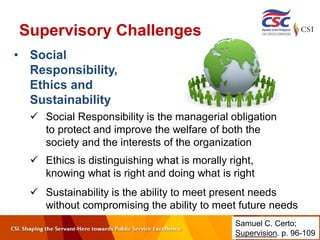
 Social Responsibility is the managerial obligation
to protect and improve the welfare of both the
society and the interests of the organization
 Ethics is distinguishing what is morally right,
knowing what is right and doing what is right
 Sustainability is the ability to meet present needs
without compromising the ability to meet future needs
Samuel C. Certo;
Supervision. p. 96-109
Defining Ethics
Ethics is derived from the Greek word “ethos”
meaning “way of life”. It is that branch of
philosophy that studies and recommends
fundamental principles and basic concepts of
what is considered morally good and bad, right
and wrong in human conduct.
Supervisory Challenges
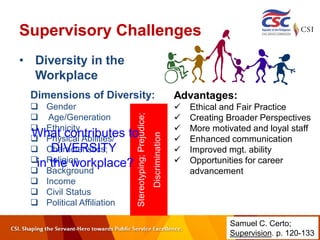
• Diversity in the
Workplace
Dimensions of Diversity:
 Gender
 Age/Generation
 Ethnicity
 Physical Abilities/
 Characteristics;
 Religion
 Background
 Income
 Civil Status
 Political Affiliation
Samuel C. Certo;
Supervision. p. 120-133
Advantages:
 Ethical and Fair Practice
 Creating Broader Perspectives
 More motivated and loyal staff
 Enhanced communication
 Improved mgt. ability
 Opportunities for career
advancement
Stereotyping;
Prejudice;
Discrimination
What contributes to
DIVERSITY
in the workplace?
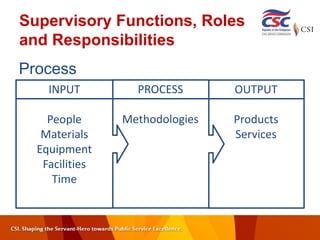
OUTPUT
Products
Services
PROCESS
Methodologies
Supervisory Functions, Roles
and Responsibilities
INPUT
People
Materials
Equipment
Facilities
Time
Process
Supervisory Functions, Roles
and Responsibilities
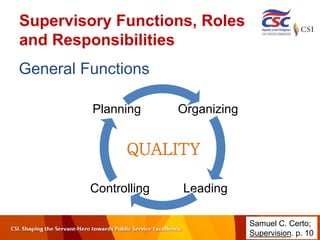
General Functions
Organizing
Leading
Controlling
Planning
QUALITY
Samuel C. Certo;
Supervision. p. 10
Supervisory Functions, Roles
and Responsibilities
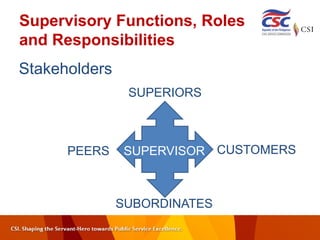
Stakeholders
SUPERVISOR
SUPERIORS
SUBORDINATES
CUSTOMERS
PEERS
Supervisory Functions, Roles
and Responsibilities
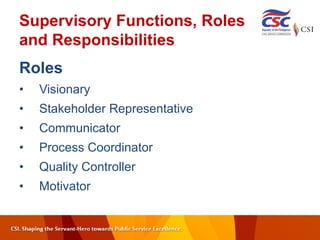
Roles
• Visionary
• Stakeholder Representative
• Communicator
• Process Coordinator
• Quality Controller
• Motivator
Supervisory Functions, Roles
and Responsibilities
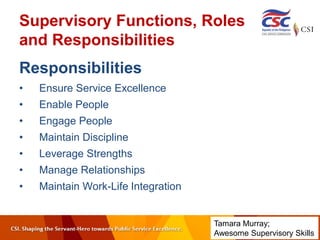
Responsibilities
• Ensure Service Excellence
• Enable People
• Engage People
• Maintain Discipline
• Leverage Strengths
• Manage Relationships
• Maintain Work-Life Integration
Tamara Murray;
Awesome Supervisory Skills
Achieving Leadership Effectiveness - Course 1a.pdf

Achieving Leadership Effectiveness - Course 1a.pdf

  • 1.
  • 2.
    Getting Acquainted • Printyour nickname on top of a bond paper • Tape the bond paper at your back • Go around the room. As you do so, write on the bond papers of your co-participants your impression of them. • Make sure that you are able to write for all your co-participants.
  • 3.
    Getting Acquainted • Readwhat your co-participants wrote on your own bond paper. • Introduce yourself by stating the following:  Your name, position, agency  Which impressions written on your bond paper are true. Expound on this.  Which impressions are not true.
  • 4.
    Getting Acquainted JOHARI Window Self Unknown Known KnownUnknown Others Blind Self Potential Self Public Self Hidden Self Joseph Luft and Harrington Ingham
  • 5.
    Leveling of Expectations SupervisoryDevelopment Program 1 Achieving Leadership Effectiveness 2 Aligning Organizations and People 3 Developing Organizations and People 4 Empowering and Engaging People 5 Improving Organization and Individual Performance
  • 6.
    Leveling of Expectations 1Achieving Leadership Effectiveness Performance Objective: By the end of this course, you shall be able to formulate and commit to a implement a personal development plan that will hone your competencies in leadership and supervision guided by the established requirements for supervisors and the assessment of your own areas for improvements.
  • 7.
    Leveling of Expectations 2Aligning Organizations and People Performance Objective: By the end of this course, you shall be able to develop a Division Performance Commitment and Review (DPCR) that is aligned to your Office Performance Commitment and Review (OPCR) and your team members’ Individual Performance Commitment and Review (IPCR). You shall also be able to develop a Monitoring Plan to ensure achievement of your DPCR.
  • 8.
    Leveling of Expectations 3Developing Organizations and People Performance Objective: By the end of this course, you shall be able to facilitate your team members to prepare Personal Development Plans and consolidate them into a Team Development Plan that will enable your team and its individual members to pursue established objectives as indicated in your DPCR and your team members’ IPCR.
  • 9.
    Leveling of Expectations 4Empowering and Engaging People Performance Objective: By the end of this course, you shall be able to develop a plan for creating and maintaining a work environment that will empower and enable your team and its members to successfully achieve your DPCR and your team members’ IPCR.
  • 10.
    Leveling of Expectations 5Improving Organization and Individual Performance Performance Objective: By the end of this course, you shall be able to evaluate team and individual performance results and apply problem solving techniques towards achieving continual improvements.
  • 11.
    Leveling of Expectations •Given the performance objectives of the different components of the Supervisory Development Program, what would you like to personally learn from the program in general and this Achieving Leadership Effectiveness course in particular? • What will help you learn from this program? • What may make it difficult for you to learn from this program?
  • 12.
    Program Norms Take responsibilityfor your own learning Participate actively in all activities and discussions Avoid causing disruptions Be time conscious Respect each other’s ideas
  • 13.
    Achieving Leadership Effectiveness Learning Objectives Bythe end of this course, you shall be able to: 1. Appreciate the need to shift from contributing directly to producing work through others. 2. Enumerate and discuss the challenges inherent in supervision. 3. Enumerate and discuss the supervisory functions, role and responsibilities.
  • 14.
    Achieving Leadership Effectiveness Learning Objectives Bythe end of this course, you shall be able to: 4. Appreciate the value of setting team objectives, establishing plans and monitoring results 5. Appreciate the value of organizing the team, allocating resources and assigning work. 6. Appreciate the value of applying the appropriate leadership style
  • 15.
    Achieving Leadership Effectiveness Learning Objectives Bythe end of this course, you shall be able to: 7. Appreciate the value of using structured problem-solving and decision making processes to achieve continual improvements 8. Prepare and commit to action plans that will further hone your supervisory competencies.
  • 16.
    Achieving Leadership Effectiveness Course Content Day1: Sched Content AM 1 Introduction: From Performer to Supervisor AM 2 Leadership Focus Exercise PM 1 Leadership Focus Presentations PM 2 Supervisory Challenges Supervisory Functions, Roles, Responsibilities
  • 17.
    Achieving Leadership Effectiveness Course Content Day2: Sched Content AM 1 Achieving Team Objectives AM 2 Organizing Work and Authority Practicing Effective Leadership PM 1 Pursuing Continual Improvements PM 2 Integration: Action Planning
  • 18.
    Basketball Exercise Instructions- Round1:  Form yourselves into four teams of seven persons. Each team shall be provided with a set of basket and balls  Take turns. Within 30 seconds, each person should shoot into the basket as many balls as possible. Record the scores of each person and compute the team average.  Post the scores on the wall.
  • 19.
    Basketball Exercise Instructions- Round2:  The highest scorer in each team is promoted as a supervisor. The highest scorer will not shoot but instruct the other team members how to shoot. The objective is to beat the previous team score.  As the highest scorer supervises, the rest of the team takes turn shooting. Scores are recorded and the team average is computed.  Post the Scores on the wall.
  • 20.
    Basketball Exercise Processing  Whatcan you say about the individual and team scores?  What contributed to the increase or decrease in the team scores between Rounds 1 & 2?  How did the supervisors feel about their roles? What insights can be taken from this?  How did the other members feel about the new arrangement in Round 2? Any insights from this?  How does this apply in the workplace?
  • 21.
    From Performer toSupervisor Performer Supervisor Tasks People and Tasks Self Others Detailed Broad Belker, McCormick, Topchik: The First Time Manager p 5 Focus
  • 22.
    From Performer toSupervisor A manager at the first level of management • Requires the use of independent judgement when exercising authority • Ensures unit contributes its share to accomplishing the organization’s goals • Focus on day-to-day problems and goals to be achieved in one year or less Samuel C. Certo, Supervision p. 4
  • 23.
    Leadership Focus Exercise Instructions: Your team objective is to prepare a 10 minute presentation from a set of reading materials. Within this 10 minutes all members of the team must be seen to actively contribute  You have until 12 noon to prepare your presentation as a team. The presentations will be made after lunch.
  • 24.
    Leadership Focus Exercise Readings: Blanchard, Ken (2007) Leading at a Higher Level  Goleman, Daniel (2002) Primal Leadership  Maxwell, John C. (2008) Leadership Gold  Maxwell, John C. (2011) Five Levels of Leadership  Shaw, Robert Bruce (2014) Leadership Blindspots  Zenger, John H. (2009) The Inspiring Leaders
  • 25.
    Leadership Focus Presentations Presentations:  Eachteam will present the highlights of what they learned about leadership from their readings for 10 minutes. A five minute open forum will follow.  As each team make their presentations, the other teams will rate the presentations.
  • 26.
    Leadership Focus Presentations Processing:  Howdid you feel at the start of the exercise and after you made the presentation?  Did a leader emerge from within the team? How did this happen?  What was done well by the team? How did this happen?  What can be improved? How?  What is the exercise telling us about supervision?
  • 27.
    Supervisory Challenges • EnsuringHigh Quality and Productivity • Group Dynamics • Corporate Social Responsibility, Ethics and Sustainability • Diversity in the Workplace Samuel C. Certo; Supervision. p. 26-139
  • 28.
    Supervisory Challenges • EnsuringHigh Quality and Productivity  Productivity = Outputs/Inputs  Consequences of Poor Quality: Higher Costs; Reputation  Types of Quality Control: Product Quality Control; Process Control  Methods of Improving Quality: Employee Involvement; Total Quality Management; Clients/Stakeholder’s Involvement Samuel C. Certo; Supervision. p. 28-39
  • 29.
    Supervisory Challenges Forming Storming Norming Performing Adjourning • GroupDynamics  Team Cohesiveness: common goals; history of successes; group size; competition; equal participation  Leading Teams: Coaching; Selection of members; Team building; Communicating; Rewarding Samuel C. Certo; Supervision. p. 70-79
  • 30.
    Supervisory Challenges • Social Responsibility, Ethicsand Sustainability  Social Responsibility is the managerial obligation to protect and improve the welfare of both the society and the interests of the organization  Ethics is distinguishing what is morally right, knowing what is right and doing what is right  Sustainability is the ability to meet present needs without compromising the ability to meet future needs Samuel C. Certo; Supervision. p. 96-109
  • 31.
    Defining Ethics Ethics isderived from the Greek word “ethos” meaning “way of life”. It is that branch of philosophy that studies and recommends fundamental principles and basic concepts of what is considered morally good and bad, right and wrong in human conduct.
  • 32.
    Supervisory Challenges • Diversityin the Workplace Dimensions of Diversity:  Gender  Age/Generation  Ethnicity  Physical Abilities/  Characteristics;  Religion  Background  Income  Civil Status  Political Affiliation Samuel C. Certo; Supervision. p. 120-133 Advantages:  Ethical and Fair Practice  Creating Broader Perspectives  More motivated and loyal staff  Enhanced communication  Improved mgt. ability  Opportunities for career advancement Stereotyping; Prejudice; Discrimination What contributes to DIVERSITY in the workplace?
  • 33.
    OUTPUT Products Services PROCESS Methodologies Supervisory Functions, Roles andResponsibilities INPUT People Materials Equipment Facilities Time Process
  • 34.
    Supervisory Functions, Roles andResponsibilities General Functions Organizing Leading Controlling Planning QUALITY Samuel C. Certo; Supervision. p. 10
  • 35.
    Supervisory Functions, Roles andResponsibilities Stakeholders SUPERVISOR SUPERIORS SUBORDINATES CUSTOMERS PEERS
  • 36.
    Supervisory Functions, Roles andResponsibilities Roles • Visionary • Stakeholder Representative • Communicator • Process Coordinator • Quality Controller • Motivator
  • 37.
    Supervisory Functions, Roles andResponsibilities Responsibilities • Ensure Service Excellence • Enable People • Engage People • Maintain Discipline • Leverage Strengths • Manage Relationships • Maintain Work-Life Integration Tamara Murray; Awesome Supervisory Skills