ACHIEVING HEALTH EQUITY
through
Law Policy
Marice Ashe, JD, MPH
Founder & CEO
Healthy communities
for all through better
laws & policies
Disclaimer
The information provided in this discussion is for informational
purposes only, and does not constitute legal advice. ChangeLab
Solutions does not enter into attorney-client relationships.
ChangeLab Solutions is a non-partisan, nonprofit organization that
educates and informs the public through objective, non-partisan
analysis, study, and/or research. The primary purpose of this
discussion is to address legal and/or policy options to improve
public health. There is no intent to reflect a view on specific
legislation.
© 2016 ChangeLab Solutions
Legal HISTORY reveals both
the POWER & LIMITATIONS
of government authority
to protect the public’s
health
Let’s go back in time
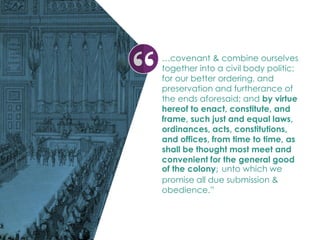
The Mayflower Compact
…covenant & combine ourselves
together into a civil body politic;
for our better ordering, and
preservation and furtherance of
the ends aforesaid; and by virtue
hereof to enact, constitute, and
frame, such just and equal laws,
ordinances, acts, constitutions,
and offices, from time to time, as
shall be thought most meet and
convenient for the general good
of the colony; unto which we
promise all due submission &
obedience.”
The Broad Street Pump
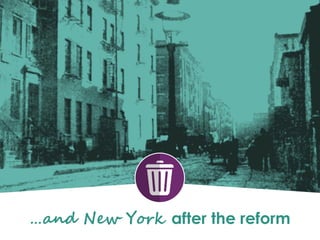
New York before sanitation reform
…and New York after the reform
The story of a
1902 smallpox
outbreak in
Massachusetts
But the liberty secured by the
Constitution of the United States
to every person within its
jurisdiction does not import an
absolute right in each person to
be, at all times and in all
circumstances, wholly freed from
restraint. There are manifold
restraints to which every person is
necessarily subject for the
common good. On any other
basis, organized society could not
exist with safety to its members.”
The government
can regulate
individual
behavior to
protect health.
TRUE
or
FALSE
The government can regulate
individual behavior to protect
health.
TRUE
As long as it is a
reasonable
regulation aimed
at protecting the
public’s health
and safety.
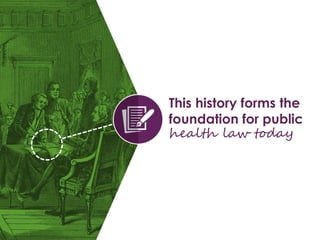
This history forms the
foundation for public
health law today
Consider the history of
tobacco control
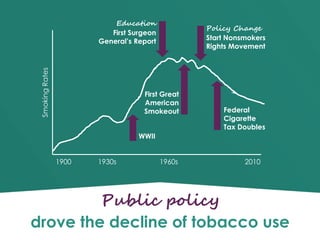
Public policy
drove the decline of tobacco use
1900 20101930s 1960s
SmokingRates
WWII
Education
First Surgeon
General’s Report
Federal
Cigarette
Tax Doubles
Policy Change
Start Nonsmokers
Rights Movement
First Great
American
Smokeout
25% fewer tobacco-related
diseases (compared to the
rest of the nation)
California 1989-2008
$134 billion saved
6.79 billion fewer packs
Education
Clinical
Interventions
Long-lasting
Protective Interventions
Changing the Context to
Make Individuals’ Default
Decisions Easier
Socioeconomic Factors
Source: Friedman T.R. (2010). A Framework for Public Health Action: The Health Impact
Pyramid. American Journal of Public Health, 100(4), 590-595.
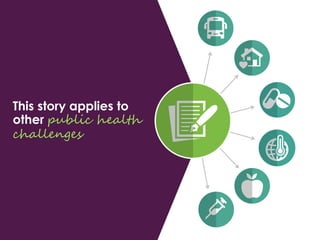
This story applies to
other public health
challenges
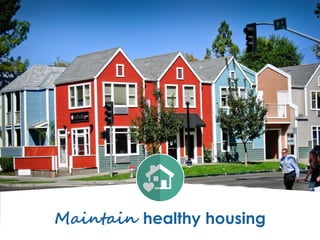
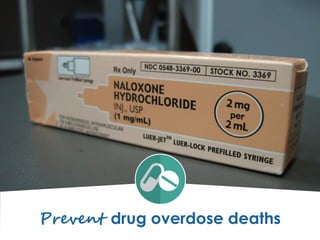
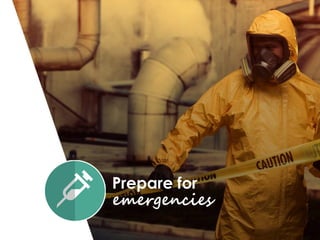
Create transportation infrastructure
Maintain healthy housing
Prevent drug overdose deaths
Ensure food safety
Provide access
to healthy foods
Prepare for
emergencies
Who has the power
to shape public
policy to improve
public health?
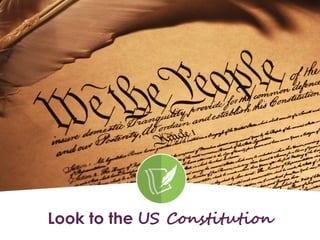
Look to the US Constitution
What are the public
health powers of the
federal government?
MULTIPLE
CHOICE
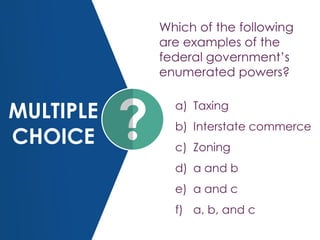
Which of the following
are examples of the
federal government’s
enumerated powers?
a) Taxing
b) Interstate commerce
c) Zoning
d) a and b
e) a and c
f) a, b, and c
MULTIPLE
CHOICE
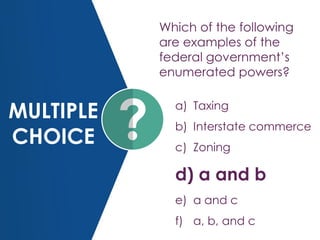
Which of the following
are examples of the
federal government’s
enumerated powers?
a) Taxing
b) Interstate commerce
c) Zoning
d) a and b
e) a and c
f) a, b, and c
Federal regulations
can incentivize
local action
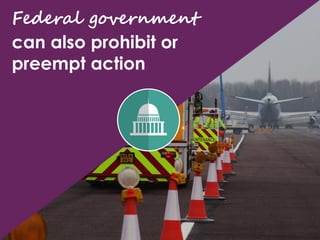
Federal government
can also prohibit or
preempt action
The states have the primary responsibility
for public health
“A county or city may make & enforce within its limits all
local, police, sanitary, & other ordinances and regulations not in
conflict with general laws.”
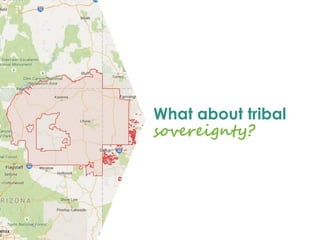
What about tribal
sovereignty?
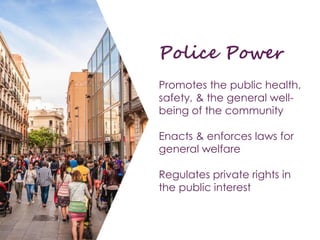
Police Power
Promotes the public health,
safety, & the general well-
being of the community
Enacts & enforces laws for
general welfare
Regulates private rights in
the public interest
Can’t violate state & federal
laws or constitutions
Some
REQUIREMENTS:
Can’t be arbitrary
or oppressive
Must be rationally related to
public health, safety, or general
welfare
Must be reasonably designed to
correct a condition adversely
affecting the public good
TRUE
or
FALSE
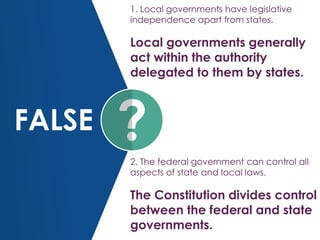
1. Local governments have
legislative independence
apart from states.
2. The federal government
can control all aspects of
state and local laws.
FALSE
1. Local governments have legislative
independence apart from states.
Local governments generally
act within the authority
delegated to them by states.
2. The federal government can control all
aspects of state and local laws.
The Constitution divides control
between the federal and state
governments.
State & local
government
can…
Investigate disease outbreaks
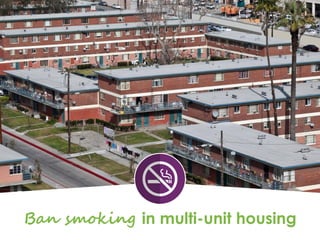
Ban smoking in multi-unit housing
Create zoning for farmers markets
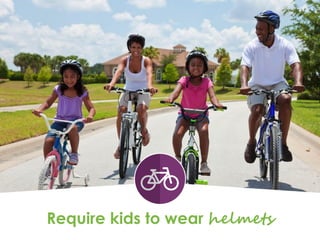
Require kids to wear helmets
Limit portion sizes
What are the
limitations on this
power?
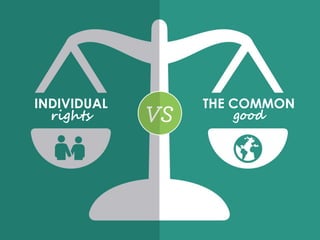
THE COMMON
good
INDIVIDUAL
rights
The
Bill of Rights
CONSTITUTIONAL
rights
Due process
Freedom of speech & religion
Right to bear arms
Search & seizure
Equal protection
According to the 5th & 14th
amendments, the government
cannot deprive individuals of
life, liberty, or property without
due process of law
Procedural
Due Process
Did the government allow the
right to fair and impartial legal
proceedings before depriving
someone of life, liberty, or
property?
Substantive
Due Process
Does the government have
an appropriate justification
for depriving someone of
life, liberty, or property?
Some things are
more difficult
for the
government to
regulate than
others
What are fundamental liberties?
The Strict Scrutiny Test
Is the government action narrowly
tailored, or is it the least restrictive
alternative to achieve a
compelling goal?
Can the government
require parents to
vaccinate their
children?
What about in order to
attend public school?
What about in order to
attend private school?
MULTIPLE
CHOICE
Which of the following is
required for the government
to prohibit unvaccinated
children from attending
public school?
a) A compelling
government interest
b) A public health
emergency
c) Exceptions for religious
or personal /
philosophical beliefs
d) a and b
e) b and c
f) a, b, and c
MULTIPLE
CHOICE
Which of the following is
required for the government
to prohibit unvaccinated
children from attending
public school?
a) A compelling
government
interest
b) A public health
emergency
c) Exceptions for religious
or personal /
philosophical beliefs
d) a and b
e) b and c
f) a, b, and c
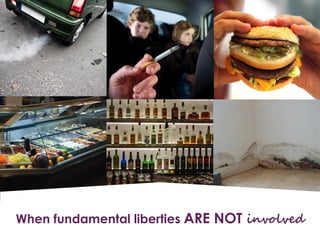
When fundamental liberties ARE NOT involved
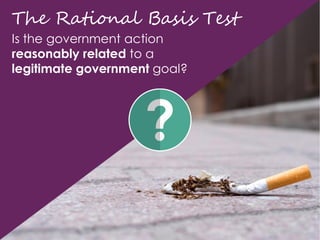
The Rational Basis Test
Is the government action
reasonably related to a
legitimate government goal?
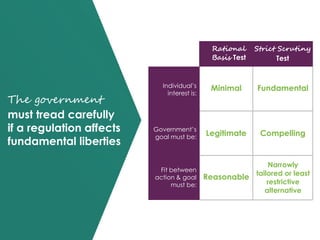
The government
must tread carefully
if a regulation affects
fundamental liberties
Rational
Basis Test
Strict Scrutiny
Test
Individual’s
interest is:
Government’s
goal must be:
Fit between
action & goal
must be:
Minimal Fundamental
Legitimate Compelling
Reasonable
Narrowly
tailored or least
restrictive
alternative
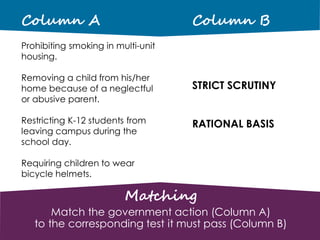
Matching
Match the government action (Column A)
to the corresponding test it must pass (Column B)
Column A
Prohibiting smoking in multi-unit
housing.
Removing a child from his/her
home because of a neglectful
or abusive parent.
Restricting K-12 students from
leaving campus during the
school day.
Requiring children to wear
bicycle helmets.
Column B
STRICT SCRUTINY
RATIONAL BASIS
According to
the 5th & 14th
amendments,
the government
shall not “deny to
any person within
its jurisdiction the
equal protection
of the laws”
Protected Classes
The Strict Scrutiny Test
Is the government action
narrowly tailored to achieve
a compelling goal?
Non-protected classifications
The Rational Basis Test
Is the government acting
reasonably related to a legitimate
government goal?
Can the government
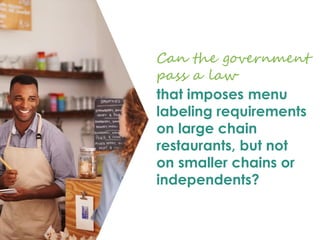
pass a law
that imposes menu
labeling requirements
on large chain
restaurants, but not
on smaller chains or
independents?
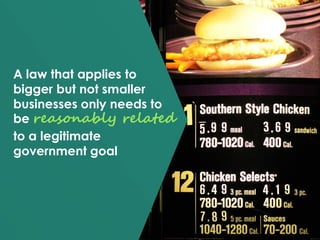
A law that applies to
bigger but not smaller
businesses only needs to
be reasonably related
to a legitimate
government goal
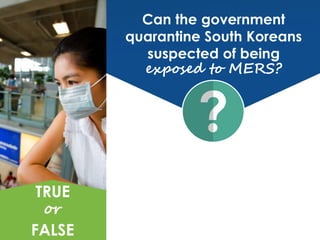
Can the government
quarantine South Koreans
suspected of being
exposed to MERS?
What about limiting the
number of fast food
restaurants in certain
parts of the city?
What about putting an
age restriction on
buying harmful
products?
Questions to consider
Can the government
quarantine South Koreans
suspected of being
exposed to MERS?
TRUE
or
FALSE
Can the government quarantine
South Koreans suspected of being
exposed to MERS?
FALSE
The government must have a
valid justification for
distinguishing between
members of certain protected
categories, such as race or
national origin.
TRUE
or
FALSE
What about limiting the
number of fast food
restaurants in certain
parts of the city?
What about limiting the number of
fast food restaurants in certain
parts of the city?
TRUE
Zoning codes can restrict the
number of fast food chains in
certain parts of the city as long
as those distinctions are not
based on the race, national
origin, or ethnicity of a
community.
TRUE
or
FALSE
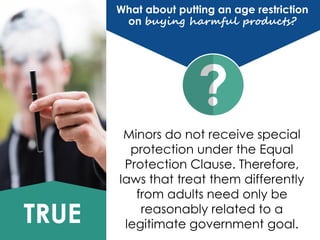
What about putting an age
restriction on
buying harmful
products?
TRUE
Minors do not receive special
protection under the Equal
Protection Clause. Therefore,
laws that treat them differently
from adults need only be
reasonably related to a
legitimate government goal.
What about putting an age restriction
on buying harmful products?
Recap
Can the government
quarantine South Koreans
suspected of being
exposed to MERS?
What about limiting the
number of fast food
restaurants in certain
parts of the city?
What about putting an
age restriction on
buying harmful
products?
Legal HISTORY reveals both
the POWER & LIMITATIONS
of government authority
to protect the
public’s health
ACHIEVING HEALTH EQUITY
through
Law Policy
Marice Ashe, JD, MPH
Founder & CEO

Achieving Health Equity through Law & Policy

  • 1.
    ACHIEVING HEALTH EQUITY through LawPolicy Marice Ashe, JD, MPH Founder & CEO
  • 2.
    Healthy communities for allthrough better laws & policies
  • 3.
    Disclaimer The information providedin this discussion is for informational purposes only, and does not constitute legal advice. ChangeLab Solutions does not enter into attorney-client relationships. ChangeLab Solutions is a non-partisan, nonprofit organization that educates and informs the public through objective, non-partisan analysis, study, and/or research. The primary purpose of this discussion is to address legal and/or policy options to improve public health. There is no intent to reflect a view on specific legislation. © 2016 ChangeLab Solutions
  • 4.
    Legal HISTORY revealsboth the POWER & LIMITATIONS of government authority to protect the public’s health
  • 5.
  • 6.
  • 7.
    …covenant & combineourselves together into a civil body politic; for our better ordering, and preservation and furtherance of the ends aforesaid; and by virtue hereof to enact, constitute, and frame, such just and equal laws, ordinances, acts, constitutions, and offices, from time to time, as shall be thought most meet and convenient for the general good of the colony; unto which we promise all due submission & obedience.”
  • 8.
  • 9.
    New York beforesanitation reform
  • 10.
    …and New Yorkafter the reform
  • 11.
    The story ofa 1902 smallpox outbreak in Massachusetts
  • 12.
    But the libertysecured by the Constitution of the United States to every person within its jurisdiction does not import an absolute right in each person to be, at all times and in all circumstances, wholly freed from restraint. There are manifold restraints to which every person is necessarily subject for the common good. On any other basis, organized society could not exist with safety to its members.”
  • 13.
    The government can regulate individual behaviorto protect health. TRUE or FALSE
  • 14.
    The government canregulate individual behavior to protect health. TRUE As long as it is a reasonable regulation aimed at protecting the public’s health and safety.
  • 15.
    This history formsthe foundation for public health law today
  • 16.
    Consider the historyof tobacco control
  • 17.
    Public policy drove thedecline of tobacco use 1900 20101930s 1960s SmokingRates WWII Education First Surgeon General’s Report Federal Cigarette Tax Doubles Policy Change Start Nonsmokers Rights Movement First Great American Smokeout
  • 18.
    25% fewer tobacco-related diseases(compared to the rest of the nation) California 1989-2008 $134 billion saved 6.79 billion fewer packs
  • 19.
    Education Clinical Interventions Long-lasting Protective Interventions Changing theContext to Make Individuals’ Default Decisions Easier Socioeconomic Factors Source: Friedman T.R. (2010). A Framework for Public Health Action: The Health Impact Pyramid. American Journal of Public Health, 100(4), 590-595.
  • 20.
    This story appliesto other public health challenges
  • 21.
  • 22.
  • 23.
  • 24.
  • 25.
  • 26.
  • 27.
    Who has thepower to shape public policy to improve public health?
  • 28.
    Look to theUS Constitution
  • 29.
    What are thepublic health powers of the federal government?
  • 30.
    MULTIPLE CHOICE Which of thefollowing are examples of the federal government’s enumerated powers? a) Taxing b) Interstate commerce c) Zoning d) a and b e) a and c f) a, b, and c
  • 31.
    MULTIPLE CHOICE Which of thefollowing are examples of the federal government’s enumerated powers? a) Taxing b) Interstate commerce c) Zoning d) a and b e) a and c f) a, b, and c
  • 32.
  • 33.
    Federal government can alsoprohibit or preempt action
  • 34.
    The states havethe primary responsibility for public health
  • 35.
    “A county orcity may make & enforce within its limits all local, police, sanitary, & other ordinances and regulations not in conflict with general laws.”
  • 36.
  • 37.
    Police Power Promotes thepublic health, safety, & the general well- being of the community Enacts & enforces laws for general welfare Regulates private rights in the public interest
  • 38.
    Can’t violate state& federal laws or constitutions Some REQUIREMENTS: Can’t be arbitrary or oppressive Must be rationally related to public health, safety, or general welfare Must be reasonably designed to correct a condition adversely affecting the public good
  • 39.
    TRUE or FALSE 1. Local governmentshave legislative independence apart from states. 2. The federal government can control all aspects of state and local laws.
  • 40.
    FALSE 1. Local governmentshave legislative independence apart from states. Local governments generally act within the authority delegated to them by states. 2. The federal government can control all aspects of state and local laws. The Constitution divides control between the federal and state governments.
  • 41.
  • 42.
  • 43.
    Ban smoking inmulti-unit housing
  • 44.
    Create zoning forfarmers markets
  • 45.
    Require kids towear helmets
  • 46.
  • 47.
  • 48.
  • 49.
  • 50.
    CONSTITUTIONAL rights Due process Freedom ofspeech & religion Right to bear arms Search & seizure Equal protection
  • 51.
    According to the5th & 14th amendments, the government cannot deprive individuals of life, liberty, or property without due process of law
  • 52.
    Procedural Due Process Did thegovernment allow the right to fair and impartial legal proceedings before depriving someone of life, liberty, or property?
  • 53.
    Substantive Due Process Does thegovernment have an appropriate justification for depriving someone of life, liberty, or property?
  • 54.
    Some things are moredifficult for the government to regulate than others
  • 55.
  • 56.
    The Strict ScrutinyTest Is the government action narrowly tailored, or is it the least restrictive alternative to achieve a compelling goal?
  • 57.
    Can the government requireparents to vaccinate their children? What about in order to attend public school? What about in order to attend private school?
  • 58.
    MULTIPLE CHOICE Which of thefollowing is required for the government to prohibit unvaccinated children from attending public school? a) A compelling government interest b) A public health emergency c) Exceptions for religious or personal / philosophical beliefs d) a and b e) b and c f) a, b, and c
  • 59.
    MULTIPLE CHOICE Which of thefollowing is required for the government to prohibit unvaccinated children from attending public school? a) A compelling government interest b) A public health emergency c) Exceptions for religious or personal / philosophical beliefs d) a and b e) b and c f) a, b, and c
  • 60.
  • 61.
    The Rational BasisTest Is the government action reasonably related to a legitimate government goal?
  • 62.
    The government must treadcarefully if a regulation affects fundamental liberties Rational Basis Test Strict Scrutiny Test Individual’s interest is: Government’s goal must be: Fit between action & goal must be: Minimal Fundamental Legitimate Compelling Reasonable Narrowly tailored or least restrictive alternative
  • 63.
    Matching Match the governmentaction (Column A) to the corresponding test it must pass (Column B) Column A Prohibiting smoking in multi-unit housing. Removing a child from his/her home because of a neglectful or abusive parent. Restricting K-12 students from leaving campus during the school day. Requiring children to wear bicycle helmets. Column B STRICT SCRUTINY RATIONAL BASIS
  • 64.
    According to the 5th& 14th amendments, the government shall not “deny to any person within its jurisdiction the equal protection of the laws”
  • 65.
  • 66.
    The Strict ScrutinyTest Is the government action narrowly tailored to achieve a compelling goal?
  • 67.
  • 68.
    The Rational BasisTest Is the government acting reasonably related to a legitimate government goal?
  • 69.
    Can the government passa law that imposes menu labeling requirements on large chain restaurants, but not on smaller chains or independents?
  • 70.
    A law thatapplies to bigger but not smaller businesses only needs to be reasonably related to a legitimate government goal
  • 71.
    Can the government quarantineSouth Koreans suspected of being exposed to MERS? What about limiting the number of fast food restaurants in certain parts of the city? What about putting an age restriction on buying harmful products? Questions to consider
  • 72.
    Can the government quarantineSouth Koreans suspected of being exposed to MERS? TRUE or FALSE
  • 73.
    Can the governmentquarantine South Koreans suspected of being exposed to MERS? FALSE The government must have a valid justification for distinguishing between members of certain protected categories, such as race or national origin.
  • 74.
    TRUE or FALSE What about limitingthe number of fast food restaurants in certain parts of the city?
  • 75.
    What about limitingthe number of fast food restaurants in certain parts of the city? TRUE Zoning codes can restrict the number of fast food chains in certain parts of the city as long as those distinctions are not based on the race, national origin, or ethnicity of a community.
  • 76.
    TRUE or FALSE What about puttingan age restriction on buying harmful products?
  • 77.
    TRUE Minors do notreceive special protection under the Equal Protection Clause. Therefore, laws that treat them differently from adults need only be reasonably related to a legitimate government goal. What about putting an age restriction on buying harmful products?
  • 78.
    Recap Can the government quarantineSouth Koreans suspected of being exposed to MERS? What about limiting the number of fast food restaurants in certain parts of the city? What about putting an age restriction on buying harmful products?
  • 79.
    Legal HISTORY revealsboth the POWER & LIMITATIONS of government authority to protect the public’s health
  • 80.
    ACHIEVING HEALTH EQUITY through LawPolicy Marice Ashe, JD, MPH Founder & CEO