ARKADIN WEBINAR SERIES – HUMAN RESOURCES
      Needs Based Coaching
  Andrew J. Calvert, Solution Architect
AchieveGlobal, Greater China & Singapore
            September 12 2011
About AchieveGlobal


   • Specialize in communication skills in the areas of
          >    Leadership,
          >    Sales force effectiveness and
          >    Customer Service / Experience management
          >    Innovation and Change management
   • In 45 countries and territories
   • Deliver in 30+ languages in dialects
   • Local presence with Global best practices


Speaker LOGO
  140 x 60                                                2
How much do we really know about what
motivates employees?

   • There are many theories about human motivation – a scientific field for over 100
       years.
   •   Scientific management
   •   Behaviorism
   •   Intrinsic Motivation


Speaker LOGO
  140 x 60                                                                              3
The research is clear


Speaker LOGO
  140 x 60              4
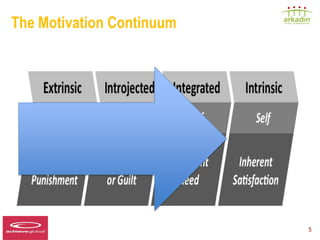
The Motivation Continuum


Speaker LOGO
  140 x 60                 5
Is there a better way to motivate
employees?

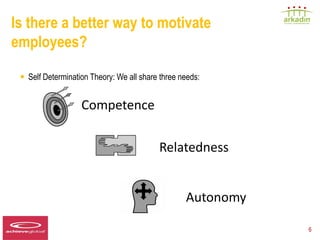
   • Self Determination Theory: We all share three needs:

                     Competence

                                            Relatedness


                                                    Autonomy
Speaker LOGO
  140 x 60                                                     6
Think of a time


   • When you felt least motivated in your job
          > Write in the chat box at the side about why you were de-motivated


     • When you felt most motivated in your job
               > Write in the chat box at the side about why you were so motivated


Speaker LOGO
  140 x 60                                                                           7
So how do you conduct needs based
coaching?

   • It needs to be a genuine two way dialogue
          • Refrain from judgments and criticism.
          • Avoid controlling expressions like “should,” “ought,” or “have to.”
   • Be clear about the reasons for required structures and actions
         •     Share the “why” behind decisions, parameters, and requests.


   • Collaboration on solutions and next steps

   • Consider the explicit links between any solution and the employees basic
       psychological needs


Speaker LOGO
  140 x 60                                                                        8
Questions?


Speaker LOGO
  140 x 60                  9
Take our survey!


   • We are gathering data on Asian attitudes to motivation – take our survey and stand
       a chance to win a 16GB Apple iPad2

   • http://www.zoomerang.com/Survey/WEB22CJ49AWZQR/


Speaker LOGO
  140 x 60                                                                                10
Stay in touch!
                      Sign up for one of AchieveGlobal’s free e-newsletters
http://learning.achieveglobal.com/forms/enewsletterSignup

                                                            Follow me on Twitter @Calverta


  Follow AchieveGlobal on Twitter @AchieveGlobal.sg


                                  Connect with me on LinkedIn http://sg.linkedin.com/in/andrewcalvert


               Ask me a question? Andrew.calvert@achieveglobal.com.sg


Speaker LOGO
  140 x 60                                                                                          11
References
   • “Drive” by Daniel H. Pink
   • RS Animate: The surprising truth about motivation:
          > http://youtu.be/u6XAPnuFjJc
   • www.sciencedirect.com: Personality and Individual Differences 43
     (2007) 1037–1049 (Singapore based)
   • http://jcc.sagepub.com/cgi/content/abstract/35/2/209 (Cross cultural
     study)


Speaker LOGO
  140 x 60                                                                  12
Bibliography
   •   Amabile, T. M. (1983). The social psychology of creativity. New York: Springer-Verlag.
   •   Assor, A., Roth, G., & Deci, E. L. (2004). The emotional costs of parents' conditional regard: A self-determination theory analysis. Journal of Personality, 72, 47-88.
   •   Baard, P. P., Deci, E. L., & Ryan, R. M. (2004). Intrinsic need satisfaction: A motivational basis of performance and well-being in two work settings. Journal of Applied
       Social Psychology, 34, 2045-2068.
   •   Calder, B. J., & Staw, B. M. (1975). The interaction of intrinsic and extrinsic motivation: Some methodological notes. Journal of Personality and Social Psychology, 31, 76-
       80.
   •   Chirkov, V., Ryan, R. M., Kim, Y., & Kaplan, U. (2003). Differentiating autonomy from individualism and independence: A self-determination theory perspective on
       internalization of cultural orientations and well-being. Journal of Personality and Social Psychology, 84, 97-110.
   •   de Charms, R. (1968). Personal causation. New York: Academic Press.
   •   Deci, E. L., Connell, J. P., & Ryan, R. M. (1989). Self-determination in a work organization. Journal of Applied Psychology, 74, 580-590.
   •   Deci, E. L., Eghrari, H., Patrick, B. C., & Leone, D. (1994). Facilitating internalization: The self-determination theory perspective. Journal of Personality, 62, 119-142.
   •   Deci, E. L., Koestner, R., & Ryan, R. M. (1999). A meta-analytic review of experiments examining the effects of extrinsic rewards on intrinsic motivation. Psychological
       Bulletin, 125, 627-668.
   •   Deci, E. L., & Ryan, R. M. (1980). The empirical exploration of intrinsic motivational processes. In L. Berkowitz (Ed.), Advances in experimental social psychology (Vol.
       13, pp. 39-80). New York: Academic Press.
   •   Deci, E. L., & Ryan, R. M. (1985). Intrinsic motivation and self-determination in human behavior. New York: Plenum.
   •   Deci, E. L., & Ryan, R. M. (2000). The "what" and "why" of goal pursuits: Human needs and the self-determination of behavior. Psychological Inquiry, 11, 227-268.
   •   Deci, E. L., Ryan, R. M., Gagné, M., Leone, D. R., Usunov, J., & Kornazheva, B. P. (2001). Need satisfaction, motivation, and well-being in the work organizations of a
       former Eastern Bloc country. Personality and Social Psychology Bulletin, 27, 930-942.
   •   Eisenberger, R., & Cameron, J. (1996). Detrimental effects of reward: Reality or myth? American Psychologist, 51, 1153-1166.
   •   Harlow, H. F. (1950). Learning and satiation of response in intrinsically motivated complex puzzle performance by monkeys. Journal of Comparative and Physiological
       Psychology, 43, 289-294.
   •   Herzberg, F. (1968). One more time: How do you motivate employees? Harvard Business Review, 46, 53-62.
   •   La Guardia, J. G., Ryan, R. M., Couchman, C. E., & Deci, E. L. (2000). Within-person variation in security of attachment: A self-determination theory perspective on
       attachment, need fulfillment, and well-being. Journal of Personality and Social Psychology, 79, 367-384.
   •   Lam, C. F., & Gurland, S. T. (2008). Self-determined work motivation predicts job outcomes, but what predicts self-determined work motivation? Journal of Research in
       Personality, 42, 1109-1115.


Speaker LOGO
  140 x 60                                                                                                                                                                            13
Bibliography (continued)

   •   Locke, E. A., & Latham, G. P. (1990). A theory of goal setting and task performance. Englewood Cliffs, NJ: Prentice-Hall.
   •   Maslow, A. H. (1965). Eupsychian management. Homewood, IL: Irwin (Dorsey Press).
   •   Maslow, A. H. (1970). Motivation and personality (2nd ed.). New York: Harper and Row.
   •   McGregor, D. (1960). The human side of enterprise. New York: McGraw-Hill.
   •   Niemiec, C. P., & Ryan, R. M. (in press). What makes for a life well lived? Autonomy and its relation to full functioning and organismic wellness. In I. Boniwell & S. David
       (Eds.), Oxford handbook of happiness. Oxford: Oxford University Press.
   •   Niemiec, C. P., Ryan, R. M., & Deci, E. L. (2010). Self-determination theory and the relation of autonomy to self-regulatory processes and personality development. In R.
       H. Hoyle (Ed.), Handbook of personality and self-regulation (pp. 169-191). Malden, MA: Blackwell Publishing.
   •   Richer, S. F., Blanchard, C., & Vallerand, R. J. (2002). A motivational model of work turnover. Journal of Applied Social Psychology, 32, 2089–2113.
   •   Ryan, R. M. (1993). Agency and organization: Intrinsic motivation, autonomy and the self in psychological development. In J. Jacobs (Ed.), Nebraska symposium on
       motivation: Developmental perspectives on motivation (Vol. 40, pp. 1-56). Lincoln, NE: University of Nebraska Press.
   •   Ryan, R. M. (1995). Psychological needs and the facilitation of integrative processes. Journal of Personality, 63, 397-427.
   •   Ryan, R. M., & Deci, E. L. (2000). Self-determination theory and the facilitation of intrinsic motivation, social development, and well-being. American Psychologist, 55, 68-
       78.
   •   Scott, W. E., Jr. (1975). The effects of extrinsic rewards on "intrinsic motivation": A critique. Organizational Behavior and Human Performance, 15, 117-129.
   •   Shapira, Z. (1976). Expectancy determinants of intrinsically motivated behavior. Journal of Personality and Social Psychology, 34, 1235- 1244.
   •   Skinner, B. F. (1953). Science and human behavior. New York: Macmillan.
   •   Skinner, B. F. (1971). Beyond freedom and dignity. New York: Knopf.
   •   Vansteenkiste, M., & Deci, E. L. (2003). Competitively contingent rewards and intrinsic motivation: Can losers remain motivated? Motivation and Emotion, 27, 273-299.
   •   Vansteenkiste, M., Lens, W., Dewitte, S., De Witte, H., & Deci, E. L. (2004). The 'why' and 'why not' of job search behaviour: Their relation to searching, unemployment
       experience, and well-being. European Journal of Social Psychology, 34, 345-363.
   •   Vroom, V. H. (1964). Work and motivation. New York: Wiley.
   •   White, R. W. (1959). Motivation reconsidered: The concept of competence. Psychological Review, 66, 297-333


Speaker LOGO
  140 x 60                                                                                                                                                                             14
Thank you for attending the Webinar !


                        This webinar is jointly brought to you by :


                                                          Speaker Logo
                                                            180 x 120


Speaker LOGO
  140 x 60                                                               15

Achieve global needs_based_coaching

  • 1.
    ARKADIN WEBINAR SERIES– HUMAN RESOURCES Needs Based Coaching Andrew J. Calvert, Solution Architect AchieveGlobal, Greater China & Singapore September 12 2011
  • 2.
    About AchieveGlobal • Specialize in communication skills in the areas of > Leadership, > Sales force effectiveness and > Customer Service / Experience management > Innovation and Change management • In 45 countries and territories • Deliver in 30+ languages in dialects • Local presence with Global best practices Speaker LOGO 140 x 60 2
  • 3.
    How much dowe really know about what motivates employees? • There are many theories about human motivation – a scientific field for over 100 years. • Scientific management • Behaviorism • Intrinsic Motivation Speaker LOGO 140 x 60 3
  • 4.
    The research isclear Speaker LOGO 140 x 60 4
  • 5.
  • 6.
    Is there abetter way to motivate employees? • Self Determination Theory: We all share three needs: Competence Relatedness Autonomy Speaker LOGO 140 x 60 6
  • 7.
    Think of atime • When you felt least motivated in your job > Write in the chat box at the side about why you were de-motivated • When you felt most motivated in your job > Write in the chat box at the side about why you were so motivated Speaker LOGO 140 x 60 7
  • 8.
    So how doyou conduct needs based coaching? • It needs to be a genuine two way dialogue • Refrain from judgments and criticism. • Avoid controlling expressions like “should,” “ought,” or “have to.” • Be clear about the reasons for required structures and actions • Share the “why” behind decisions, parameters, and requests. • Collaboration on solutions and next steps • Consider the explicit links between any solution and the employees basic psychological needs Speaker LOGO 140 x 60 8
  • 9.
  • 10.
    Take our survey! • We are gathering data on Asian attitudes to motivation – take our survey and stand a chance to win a 16GB Apple iPad2 • http://www.zoomerang.com/Survey/WEB22CJ49AWZQR/ Speaker LOGO 140 x 60 10
  • 11.
    Stay in touch! Sign up for one of AchieveGlobal’s free e-newsletters http://learning.achieveglobal.com/forms/enewsletterSignup Follow me on Twitter @Calverta Follow AchieveGlobal on Twitter @AchieveGlobal.sg Connect with me on LinkedIn http://sg.linkedin.com/in/andrewcalvert Ask me a question? Andrew.calvert@achieveglobal.com.sg Speaker LOGO 140 x 60 11
  • 12.
    References • “Drive” by Daniel H. Pink • RS Animate: The surprising truth about motivation: > http://youtu.be/u6XAPnuFjJc • www.sciencedirect.com: Personality and Individual Differences 43 (2007) 1037–1049 (Singapore based) • http://jcc.sagepub.com/cgi/content/abstract/35/2/209 (Cross cultural study) Speaker LOGO 140 x 60 12
  • 13.
    Bibliography • Amabile, T. M. (1983). The social psychology of creativity. New York: Springer-Verlag. • Assor, A., Roth, G., & Deci, E. L. (2004). The emotional costs of parents' conditional regard: A self-determination theory analysis. Journal of Personality, 72, 47-88. • Baard, P. P., Deci, E. L., & Ryan, R. M. (2004). Intrinsic need satisfaction: A motivational basis of performance and well-being in two work settings. Journal of Applied Social Psychology, 34, 2045-2068. • Calder, B. J., & Staw, B. M. (1975). The interaction of intrinsic and extrinsic motivation: Some methodological notes. Journal of Personality and Social Psychology, 31, 76- 80. • Chirkov, V., Ryan, R. M., Kim, Y., & Kaplan, U. (2003). Differentiating autonomy from individualism and independence: A self-determination theory perspective on internalization of cultural orientations and well-being. Journal of Personality and Social Psychology, 84, 97-110. • de Charms, R. (1968). Personal causation. New York: Academic Press. • Deci, E. L., Connell, J. P., & Ryan, R. M. (1989). Self-determination in a work organization. Journal of Applied Psychology, 74, 580-590. • Deci, E. L., Eghrari, H., Patrick, B. C., & Leone, D. (1994). Facilitating internalization: The self-determination theory perspective. Journal of Personality, 62, 119-142. • Deci, E. L., Koestner, R., & Ryan, R. M. (1999). A meta-analytic review of experiments examining the effects of extrinsic rewards on intrinsic motivation. Psychological Bulletin, 125, 627-668. • Deci, E. L., & Ryan, R. M. (1980). The empirical exploration of intrinsic motivational processes. In L. Berkowitz (Ed.), Advances in experimental social psychology (Vol. 13, pp. 39-80). New York: Academic Press. • Deci, E. L., & Ryan, R. M. (1985). Intrinsic motivation and self-determination in human behavior. New York: Plenum. • Deci, E. L., & Ryan, R. M. (2000). The "what" and "why" of goal pursuits: Human needs and the self-determination of behavior. Psychological Inquiry, 11, 227-268. • Deci, E. L., Ryan, R. M., Gagné, M., Leone, D. R., Usunov, J., & Kornazheva, B. P. (2001). Need satisfaction, motivation, and well-being in the work organizations of a former Eastern Bloc country. Personality and Social Psychology Bulletin, 27, 930-942. • Eisenberger, R., & Cameron, J. (1996). Detrimental effects of reward: Reality or myth? American Psychologist, 51, 1153-1166. • Harlow, H. F. (1950). Learning and satiation of response in intrinsically motivated complex puzzle performance by monkeys. Journal of Comparative and Physiological Psychology, 43, 289-294. • Herzberg, F. (1968). One more time: How do you motivate employees? Harvard Business Review, 46, 53-62. • La Guardia, J. G., Ryan, R. M., Couchman, C. E., & Deci, E. L. (2000). Within-person variation in security of attachment: A self-determination theory perspective on attachment, need fulfillment, and well-being. Journal of Personality and Social Psychology, 79, 367-384. • Lam, C. F., & Gurland, S. T. (2008). Self-determined work motivation predicts job outcomes, but what predicts self-determined work motivation? Journal of Research in Personality, 42, 1109-1115. Speaker LOGO 140 x 60 13
  • 14.
    Bibliography (continued) • Locke, E. A., & Latham, G. P. (1990). A theory of goal setting and task performance. Englewood Cliffs, NJ: Prentice-Hall. • Maslow, A. H. (1965). Eupsychian management. Homewood, IL: Irwin (Dorsey Press). • Maslow, A. H. (1970). Motivation and personality (2nd ed.). New York: Harper and Row. • McGregor, D. (1960). The human side of enterprise. New York: McGraw-Hill. • Niemiec, C. P., & Ryan, R. M. (in press). What makes for a life well lived? Autonomy and its relation to full functioning and organismic wellness. In I. Boniwell & S. David (Eds.), Oxford handbook of happiness. Oxford: Oxford University Press. • Niemiec, C. P., Ryan, R. M., & Deci, E. L. (2010). Self-determination theory and the relation of autonomy to self-regulatory processes and personality development. In R. H. Hoyle (Ed.), Handbook of personality and self-regulation (pp. 169-191). Malden, MA: Blackwell Publishing. • Richer, S. F., Blanchard, C., & Vallerand, R. J. (2002). A motivational model of work turnover. Journal of Applied Social Psychology, 32, 2089–2113. • Ryan, R. M. (1993). Agency and organization: Intrinsic motivation, autonomy and the self in psychological development. In J. Jacobs (Ed.), Nebraska symposium on motivation: Developmental perspectives on motivation (Vol. 40, pp. 1-56). Lincoln, NE: University of Nebraska Press. • Ryan, R. M. (1995). Psychological needs and the facilitation of integrative processes. Journal of Personality, 63, 397-427. • Ryan, R. M., & Deci, E. L. (2000). Self-determination theory and the facilitation of intrinsic motivation, social development, and well-being. American Psychologist, 55, 68- 78. • Scott, W. E., Jr. (1975). The effects of extrinsic rewards on "intrinsic motivation": A critique. Organizational Behavior and Human Performance, 15, 117-129. • Shapira, Z. (1976). Expectancy determinants of intrinsically motivated behavior. Journal of Personality and Social Psychology, 34, 1235- 1244. • Skinner, B. F. (1953). Science and human behavior. New York: Macmillan. • Skinner, B. F. (1971). Beyond freedom and dignity. New York: Knopf. • Vansteenkiste, M., & Deci, E. L. (2003). Competitively contingent rewards and intrinsic motivation: Can losers remain motivated? Motivation and Emotion, 27, 273-299. • Vansteenkiste, M., Lens, W., Dewitte, S., De Witte, H., & Deci, E. L. (2004). The 'why' and 'why not' of job search behaviour: Their relation to searching, unemployment experience, and well-being. European Journal of Social Psychology, 34, 345-363. • Vroom, V. H. (1964). Work and motivation. New York: Wiley. • White, R. W. (1959). Motivation reconsidered: The concept of competence. Psychological Review, 66, 297-333 Speaker LOGO 140 x 60 14
  • 15.
    Thank you forattending the Webinar ! This webinar is jointly brought to you by : Speaker Logo 180 x 120 Speaker LOGO 140 x 60 15